
Reports
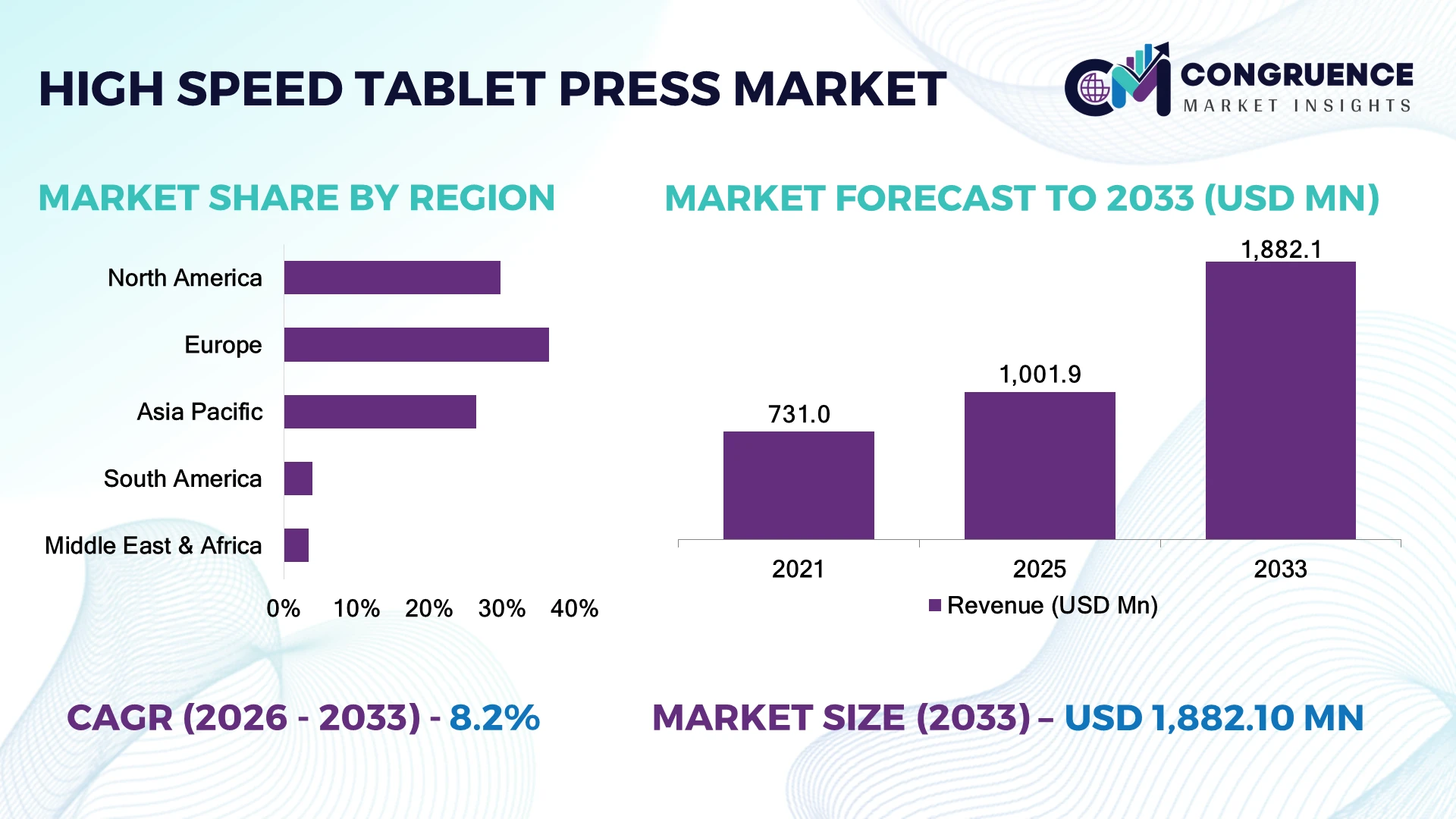
The Global High-speed Tablet Press Market was valued at USD 1,001.9 Million in 2025 and is anticipated to reach a value of USD 1,882.1 Million by 2033 expanding at a CAGR of 8.2% between 2026 and 2033. Growth is driven by expanding pharmaceutical manufacturing capacity, continuous manufacturing adoption, and rising investment in high-throughput solid dosage production with advanced process automation.
Germany accounts for approximately 24% of global high-speed tablet press manufacturing capacity, supported by sustained investment in pharmaceutical engineering, precision machinery, and digital production technologies. More than 61% of large pharmaceutical plants in the country utilise automated tablet compression lines, compared with approximately 46% in India, where rapid expansion of generic drug manufacturing continues. Ongoing pharmaceutical supply-chain diversification following geopolitical disruptions has accelerated equipment modernisation across regulated production facilities.
Manufacturers investing in intelligent compression systems, predictive maintenance, and flexible production platforms are strengthening long-term competitiveness in pharmaceutical manufacturing.
Market Size & Growth: USD 1,001.9 Million in 2025, reaching USD 1,882.1 Million by 2033 at 8.2% CAGR, supported by pharmaceutical automation and continuous manufacturing.
Top Growth Drivers: Continuous manufacturing 31%, generic drug expansion 27%, automation adoption 24%.
Short-Term Forecast: By 2028, production efficiency increases 22% while changeover time declines 18%.
Emerging Technologies: AI process control, digital twins, servo-driven compression, and real-time quality monitoring reshape production.
Regional Leaders: Europe exceeds USD 560 Million, Asia-Pacific approaches USD 590 Million, North America surpasses USD 420 Million with advanced pharmaceutical investments.
Consumer/End-User Trends: Around 64% of pharmaceutical manufacturers prioritise high-output tablet production with automated quality assurance.
Pilot/Case Example: A 2026 continuous manufacturing upgrade improved tablet throughput by 29% while reducing waste by 17%.
Competitive Landscape: Leading suppliers hold approximately 48% market share, led by Fette Compacting, Korsch, GEA, Romaco, and IMA.
Regulatory & ESG Impact: Digital process validation reduces batch deviations by approximately 23%.
Investment & Funding: More than USD 1.8 Billion supports pharmaceutical production expansion and equipment modernisation globally.
Innovation & Future Outlook: Smart manufacturing platforms and predictive analytics are redefining pharmaceutical tablet production.
High-speed Tablet Press systems are increasingly deployed across generic pharmaceuticals, nutraceuticals, and contract manufacturing facilities where production speed and quality consistency directly influence operational performance. AI-enabled compression monitoring improves process stability by approximately 26%, while modular machine architectures simplify product changeovers. Pharmaceutical supply-chain localisation and stricter quality compliance continue accelerating investments in digitally connected production equipment, creating a natural transition into the market's strategic evolution.
The High-speed Tablet Press Market has become strategically important as pharmaceutical manufacturers prioritise production flexibility, regulatory compliance, and manufacturing resilience. Continuous manufacturing, digital quality assurance, and pharmaceutical supply-chain restructuring are transforming tablet compression equipment into a critical investment area. Companies are modernising production facilities to reduce batch variability, increase equipment utilisation, and support growing demand for regulated solid dosage manufacturing.
Modern servo-driven tablet presses deliver approximately 27% higher throughput while reducing energy consumption by nearly 16% compared with conventional mechanical compression systems. Europe maintains leadership in precision equipment engineering and advanced automation, while India and China continue expanding production capacity to support generic medicines and contract manufacturing. Over the next two to three years, digital monitoring and predictive maintenance are expected to be incorporated into more than 60% of newly installed high-speed tablet press systems.
Leading pharmaceutical manufacturers are deploying integrated compression lines combining tablet presses, automated feeders, and in-line quality inspection to minimise production interruptions and strengthen regulatory compliance. Equipment suppliers are expanding engineering partnerships, investing in smart manufacturing technologies, and enhancing remote diagnostics capabilities. Competitive advantage will increasingly depend on production flexibility, intelligent automation, rapid product changeovers, and seamless integration with digital pharmaceutical manufacturing environments.
The transition toward continuous pharmaceutical manufacturing is driving replacement of conventional tablet compression equipment with high-speed, digitally integrated tablet presses. Approximately 66% of newly commissioned solid dosage production lines now incorporate automated compression and in-line quality monitoring, while advanced servo-driven systems improve overall equipment effectiveness by nearly 24%. The United States and Germany continue strengthening pharmaceutical manufacturing through facility modernization and regulatory emphasis on real-time process verification. This structural shift is increasing demand for intelligent tablet presses capable of supporting high-volume, validated production with minimal operator intervention. Equipment manufacturers are expanding automation portfolios, investing in AI-enabled process control, and partnering with pharmaceutical engineering firms to deliver integrated production solutions. A key competitive advantage increasingly lies in reducing batch release time while maintaining compression consistency across multiple formulations.
High-speed tablet presses require precision tooling, servo motors, force monitoring systems, and advanced control electronics, creating elevated capital and maintenance costs for pharmaceutical manufacturers. Approximately 42% of equipment costs are associated with high-precision mechanical assemblies and automation components, while maintenance expenditure increases lifecycle operating costs by nearly 17%. Dependence on specialised European engineering components exposes manufacturers to procurement delays during global logistics disruptions and industrial supply-chain adjustments. These structural constraints slow equipment replacement among medium-sized pharmaceutical producers and contract manufacturers. Companies are mitigating risks by localising component sourcing, expanding regional service centres, securing long-term supplier agreements, and standardising modular machine designs that simplify maintenance while improving spare parts availability and operational continuity.
Digital pharmaceutical manufacturing presents a significant opportunity for high-speed tablet press suppliers as manufacturers seek integrated production intelligence rather than standalone machinery. AI-assisted compression optimisation improves tablet weight consistency by approximately 28%, while predictive maintenance reduces unplanned equipment stoppages by nearly 21%. India's pharmaceutical manufacturing expansion and Saudi Arabia's investment in domestic medicine production are accelerating demand for digitally connected compression systems. Equipment suppliers are strengthening R&D in digital twins, cloud-based production analytics, and vision-assisted inspection while expanding partnerships with manufacturing execution system providers. An emerging strategic opportunity lies in subscription-based performance monitoring that combines machine diagnostics, production optimisation, and lifecycle maintenance into long-term service agreements, creating recurring value beyond equipment sales.
Integrating high-speed tablet presses with feeders, granulation systems, coating equipment, manufacturing execution systems, and electronic batch records remains a complex implementation challenge. Approximately 46% of brownfield pharmaceutical facilities require customised engineering before digital production lines achieve full interoperability, while software validation extends commissioning schedules by nearly 20%. Increasing cybersecurity requirements for connected manufacturing equipment add further complexity as pharmaceutical facilities expand industrial connectivity. These operational barriers reduce deployment speed and complicate multinational production standardisation. Equipment suppliers must invest in open communication architectures, digital validation tools, workforce training, and engineering partnerships to deliver scalable pharmaceutical manufacturing platforms capable of supporting evolving regulatory expectations and fully connected production environments.
AI Compression Control Expands: AI-enabled compression systems improve tablet weight uniformity by approximately 27% while reducing process deviations by nearly 19%. Pharmaceutical manufacturers are embedding machine learning into production workflows to support real-time adjustments, prompting equipment suppliers to strengthen software capabilities and digital automation partnerships.
Modular Equipment Adoption Increases: Modular tablet press platforms now represent approximately 34% of new pharmaceutical equipment installations, reducing product changeover time by nearly 23%. Increasing contract manufacturing activity and diversified product portfolios are encouraging manufacturers to deploy flexible production systems capable of supporting smaller batch sizes without sacrificing productivity.
Vision Inspection Integration Grows: Advanced vision inspection integrated directly into tablet presses improves defect detection rates by approximately 31% while reducing manual inspection requirements by nearly 22%. Tightened pharmaceutical quality expectations are driving suppliers to combine compression, inspection, and data acquisition within unified production platforms that simplify regulatory documentation.
Remote Equipment Monitoring Advances: Cloud-connected monitoring solutions are deployed across approximately 41% of newly installed high-speed tablet presses, reducing maintenance response time by nearly 18%. Pharmaceutical equipment manufacturers are expanding predictive service programmes, remote diagnostics, and digital lifecycle management to improve equipment availability while supporting globally distributed production networks.
Rotary High-speed Tablet Presses account for approximately 72% of the High-speed Tablet Press market owing to their superior production throughput, multi-station compression capability, and compatibility with continuous pharmaceutical manufacturing. Their ability to produce several hundred thousand tablets per hour while maintaining weight uniformity and compression consistency makes them the preferred choice for large-scale pharmaceutical and nutraceutical manufacturers. Single-sided high-speed tablet presses continue serving medium-volume production and product development, while double-sided rotary systems are increasingly adopted for high-capacity commercial manufacturing requiring uninterrupted production and advanced automation.
Double-sided rotary tablet presses represent the fastest-growing segment as pharmaceutical manufacturers expand high-volume production for generic medicines and contract manufacturing. Adoption has increased by approximately 29%, while integrated force monitoring improves production efficiency by nearly 23%. Around 57% of newly commissioned pharmaceutical facilities now specify digitally controlled rotary tablet presses with automated quality monitoring. Equipment manufacturers are strengthening product portfolios through servo-driven platforms, AI-enabled compression optimisation, and partnerships with pharmaceutical automation specialists, reflecting a strategic shift toward intelligent, flexible manufacturing systems.
A 2026 pharmaceutical manufacturing assessment published by a recognised international process engineering organisation found that rotary tablet presses remain the preferred production technology for large-scale solid dosage manufacturing due to their scalability and process consistency.
Pharmaceutical manufacturing accounts for approximately 68% of High-speed Tablet Press demand because commercial drug production requires high-volume compression, strict process validation, and consistent product quality. Generic medicines, prescription drugs, and over-the-counter formulations continue driving equipment investments across regulated production facilities. Nutraceutical manufacturing has emerged as another significant application, while herbal medicines and confectionery products increasingly utilise high-speed tablet presses to improve productivity, formulation consistency, and automated production control.
Contract manufacturing organisations represent the fastest-growing application segment as pharmaceutical companies increasingly outsource solid dosage production to optimise capacity and reduce capital expenditure. Deployment within this segment has increased by approximately 31%, while automated compression lines improve production utilisation by nearly 24%. Around 53% of newly installed tablet presses purchased by contract manufacturers include integrated in-line quality inspection and digital production controls. Equipment suppliers are expanding modular platforms, automation capabilities, and lifecycle service offerings to address evolving production requirements and strengthen long-term customer relationships.
According to a 2025 enterprise survey conducted by a leading pharmaceutical manufacturing authority, continuous tablet production and integrated process monitoring are becoming standard investment priorities for newly expanded oral solid dosage facilities.
Pharmaceutical manufacturers account for approximately 61% of High-speed Tablet Press procurement because of their extensive production infrastructure, regulatory compliance requirements, and continuous investment in commercial-scale oral solid dosage manufacturing. Large multinational pharmaceutical companies continue modernising production assets with automated tablet compression systems to improve manufacturing flexibility and batch consistency. Contract manufacturing organisations maintain strong purchasing activity, while nutraceutical producers and research organisations increasingly invest in scalable equipment supporting diversified product portfolios and shorter development cycles.
Contract manufacturing organisations represent the fastest-growing end-user group as outsourcing strategies continue reshaping pharmaceutical production. Adoption has increased by approximately 28%, while integrated digital production systems improve equipment utilisation by nearly 22%. Nearly 49% of new high-speed tablet press installations supplied to contract manufacturers feature predictive maintenance and remote performance monitoring capabilities. Equipment suppliers are responding through customised machine configurations, flexible financing models, engineering partnerships, and digital service ecosystems that strengthen customer retention while supporting expanding outsourced pharmaceutical manufacturing.
A 2026 institutional study released by an international pharmaceutical engineering association reported that contract manufacturing organisations are accelerating investment in automated tablet compression platforms to improve production flexibility, regulatory readiness, and operational efficiency.
Europe accounted for the largest market share at 36.4% in 2025 however, Asia-Pacific is expected to register the fastest growth, expanding at a CAGR of 9.1% between 2026 and 2033.
Advanced Pharmaceutical Automation Strengthens Production Efficiency
North America represents a significant share of the High-speed Tablet Press market, supported by mature pharmaceutical manufacturing, contract development and manufacturing organizations, and continuous investment in digital production technologies. Automated tablet compression systems are increasingly deployed to improve throughput, process validation, and operational flexibility across prescription and over-the-counter drug production. Approximately 59% of newly installed oral solid dosage production lines incorporate integrated tablet presses with real-time monitoring and automated rejection systems. Pharmaceutical manufacturers continue expanding smart factory initiatives, while equipment suppliers strengthen engineering partnerships and digital service capabilities to improve equipment reliability and regulatory compliance.
United States Market Outlook: The United States remains the region's largest market due to its extensive pharmaceutical manufacturing infrastructure, biologics expansion, and leadership in advanced manufacturing technologies. Continuous investment in oral solid dosage facilities and modernization of legacy production plants support sustained equipment demand. Approximately 62% of large pharmaceutical manufacturers have integrated digital production monitoring with high-speed tablet compression systems, reinforcing operational efficiency, batch consistency, and regulatory readiness.
Precision Engineering Drives Equipment Leadership
Europe leads the High-speed Tablet Press market through its globally recognised pharmaceutical machinery industry, advanced engineering expertise, and strong regulatory focus on manufacturing quality. The region accounts for approximately 36.4% of global demand, supported by continuous investment in automated production technologies and high-value pharmaceutical exports. Nearly 55% of newly supplied tablet presses feature integrated process analytical technologies and digital control systems. Equipment manufacturers continue investing in precision engineering, sustainable manufacturing practices, and modular machine platforms that improve operational flexibility for pharmaceutical producers.
Germany Market Outlook: Germany serves as Europe's manufacturing and technology hub for high-speed tablet press equipment, supported by established machinery manufacturers, pharmaceutical engineering expertise, and advanced automation capabilities. The country's pharmaceutical equipment industry continues expanding exports while integrating AI-assisted process optimisation and predictive maintenance into production systems. Approximately 60% of domestically manufactured premium tablet presses include intelligent compression control technologies, strengthening Germany's leadership in pharmaceutical production equipment.
Manufacturing Scale Accelerates Capacity Expansion
Asia-Pacific is the fastest-growing High-speed Tablet Press market as pharmaceutical production, generic drug manufacturing, and contract manufacturing continue expanding across China, India, Japan, and South Korea. Approximately 63% of newly established pharmaceutical production facilities in the region incorporate automated tablet compression systems to improve production efficiency and quality consistency. Regional manufacturers are increasing investments in high-output equipment, local engineering capabilities, and digital manufacturing platforms to support rising domestic demand and export-oriented pharmaceutical production.
India Market Outlook: India has emerged as the region's most dynamic market through its leadership in generic medicines, contract manufacturing, and pharmaceutical exports. Rapid expansion of oral solid dosage manufacturing facilities continues driving investment in high-speed compression technologies capable of supporting global regulatory standards. Nearly 58% of recently commissioned large pharmaceutical plants have adopted automated tablet press lines integrated with in-line quality monitoring, strengthening India's competitive manufacturing position.
Local Pharmaceutical Production Expands Equipment Demand
South America is experiencing steady demand for High-speed Tablet Press systems as pharmaceutical manufacturers modernise production infrastructure and strengthen regional medicine manufacturing capabilities. Investments in generic medicines, public healthcare supply, and contract manufacturing continue supporting equipment replacement across established production facilities. Approximately 36% of pharmaceutical capacity expansion projects now include automated tablet compression systems. Although imported machinery and technical service availability remain operational constraints, suppliers are strengthening regional distribution, engineering support, and maintenance capabilities to improve equipment deployment and long-term customer service.
Brazil Market Outlook: Brazil represents the largest pharmaceutical manufacturing base in South America, supported by strong domestic medicine production, expanding healthcare demand, and continued investment in industrial modernisation. Pharmaceutical manufacturers are upgrading compression equipment to improve production efficiency and comply with evolving quality standards. Approximately 52% of new tablet press installations across the region are concentrated in Brazil, reinforcing its position as the principal market for advanced pharmaceutical manufacturing equipment.
Pharmaceutical Self-Sufficiency Supports Industrial Investment
The Middle East & Africa market is expanding as governments prioritise domestic pharmaceutical manufacturing, healthcare security, and industrial diversification. New pharmaceutical production facilities increasingly incorporate automated tablet compression equipment to improve manufacturing efficiency and reduce dependence on imported medicines. Approximately 33% of recently announced pharmaceutical infrastructure projects include investments in advanced oral solid dosage manufacturing technologies. Equipment suppliers are expanding technical partnerships, training programmes, and regional service networks to support long-term operational reliability and technology transfer.
Saudi Arabia Market Outlook: Saudi Arabia is the region's leading market due to sustained investment in pharmaceutical manufacturing under industrial diversification initiatives and expanding domestic medicine production capacity. Local manufacturers continue adopting digitally controlled high-speed tablet presses to improve production quality and operational productivity. Approximately 45% of new pharmaceutical production investments within the Gulf region are concentrated in Saudi Arabia, positioning the country as a strategic hub for advanced pharmaceutical equipment deployment.
Global technology leaders Fette Compacting, KORSCH, Romaco Kilian, GEA, and IMA compete through automation, containment capability, and production throughput, while Asian manufacturers challenge primarily on acquisition cost and delivery speed. The top five suppliers collectively account for approximately 49% of the market. Competition increasingly centres on digital process control, rapid product changeovers, and lifecycle service, with AI-enabled compression improving process consistency by nearly 26%, modular turret systems reducing changeover time by approximately 30%, and predictive maintenance increasing equipment availability by around 18%. Leading suppliers expand application centres, strengthen pharmaceutical engineering partnerships, and integrate software with manufacturing execution systems to secure long-term customer relationships. Competitive momentum is shifting toward smart, connected tablet presses supporting continuous manufacturing and high-containment production. The primary entry barrier remains precision engineering, regulatory validation, and pharmaceutical process expertise. Winning requires combining high-speed performance, digital intelligence, validation support, and global service capability.
Fette Compacting GmbH
KORSCH AG
Romaco Group
GEA Group AG
IMA Group
ACG Engineering
Syntegon Technology GmbH
Cadmach Machinery Co. Pvt. Ltd.
PTK GB Ltd.
SaintyCo
Riva Europe S.r.l.
Sejong Pharmatech Co., Ltd.
CHS Technology (Jiangsu) Inc.
High-speed tablet press technology is rapidly advancing through servo-driven compression, intelligent force control, process analytical technology (PAT), and integrated vision inspection. Modern compression systems improve tablet weight consistency by approximately 27% while reducing energy consumption by nearly 16%. Around 64% of newly installed pharmaceutical tablet presses now feature digital human-machine interfaces, automated rejection systems, and real-time process monitoring. These technologies enhance production stability, minimise batch variability, and strengthen compliance with increasingly demanding pharmaceutical manufacturing requirements.
Emerging innovations include AI-assisted compression optimisation, digital twins, predictive maintenance, and cloud-connected production analytics. Compared with conventional mechanical tablet presses, intelligent servo-controlled platforms deliver approximately 29% higher production efficiency while reducing unplanned downtime by nearly 22%. Large pharmaceutical manufacturers and contract manufacturing organisations gain the greatest competitive advantage because connected equipment enables faster validation, greater production flexibility, and lower lifecycle operating costs across multiple product formats.
Between 2026 and 2028, autonomous machine optimisation, robotics-assisted material handling, and integrated manufacturing execution systems will redefine pharmaceutical tablet production. Adoption of AI-enabled compression analytics is expected to exceed 60% across new commercial production facilities. Equipment manufacturers investing in interoperability, cybersecurity, advanced containment, and predictive service platforms will strengthen competitive differentiation while supporting continuous manufacturing, personalised medicine, and increasingly flexible pharmaceutical production strategies.
May 2025 Fette Compacting broke ground on a new Customer Development Center to expand application testing and pharmaceutical process support, strengthening customer collaboration and accelerating equipment validation for commercial production. Source: Fette Compacting. (Fette Compacting)
November 2024 Romaco introduced the Kilian KTP 720X with a segment turret delivering up to 30% higher performance and outputs reaching 1.38 million tablets per hour, improving productivity and reducing cleaning time for pharmaceutical manufacturers. Source: Romaco. (romaco.com)
May 2026 KORSCH unveiled the XT 300 high-speed rotary tablet press featuring 324,000 tablets per hour capacity and Industry 4.0-ready controls, enabling efficient medium- to high-volume pharmaceutical manufacturing with predictive maintenance capabilities. Source: KORSCH
April 2026 Romaco launched the KTS 840 triple-layer tablet press with up to 300,000 tablets per hour output and 91 press stations, expanding production flexibility for nutraceutical and pharmaceutical manufacturers. Source: Romaco Group press release
The High-speed Tablet Press Market Report provides comprehensive assessment across rotary high-speed tablet presses, single-sided systems, double-sided platforms, and advanced automated compression equipment serving pharmaceutical manufacturing, contract manufacturing organisations, nutraceutical production, research laboratories, and specialty dosage applications. The analysis covers Europe, North America, Asia-Pacific, South America, and the Middle East & Africa while evaluating deployment trends across commercial manufacturing, product development, and high-containment production. More than 60% of newly installed systems now incorporate intelligent digital process monitoring and automated quality control capabilities.
The report further examines servo-driven compression, process analytical technology, AI-enabled optimisation, predictive maintenance, digital twins, and manufacturing execution system integration shaping equipment evolution between 2026 and 2033. Strategic insights include competitive positioning, regional manufacturing expansion, technology adoption, customer purchasing priorities, and partnership strategies. The assessment supports investment planning, production modernisation, product portfolio development, market expansion, and long-term competitive positioning across the global pharmaceutical equipment industry.
| Report Attribute/Metric | Report Details |
|---|---|
|
Market Revenue in 2025 |
USD 1,001.9 Million |
|
Market Revenue in 2033 |
USD 1,882.1 Million |
|
CAGR (2026 - 2033) |
8.2% |
|
Base Year |
2025 |
|
Forecast Period |
2026 - 2033 |
|
Historic Period |
2021 - 2025 |
|
Segments Covered |
By Type
By Application
By End-User
|
|
Key Report Deliverable |
Revenue Forecast, Growth Trends, Market Dynamics, Segmental Overview, Regional and Country-wise Analysis, Competition Landscape |
|
Region Covered |
North America, Europe, Asia-Pacific, South America, Middle East, Africa |
|
Key Players Analyzed |
Fette Compacting GmbH, KORSCH AG, Romaco Group, GEA Group AG, IMA Group, ACG Engineering, Syntegon Technology GmbH, Cadmach Machinery Co. Pvt. Ltd., PTK GB Ltd., SaintyCo, Riva Europe S.r.l., Sejong Pharmatech Co., Ltd., CHS Technology (Jiangsu) Inc. |
|
Customization & Pricing |
Available on Request (10% Customization is Free) |




