
Reports
The Global High Speed Streaming Camera Market was valued at USD 1,142.0 Million in 2025 and is anticipated to reach a value of USD 2,145.3 Million by 2033 expanding at a CAGR of 8.2% between 2026 and 2033. Growth is driven by AI-enabled motion analytics, ultra-high-frame-rate imaging adoption in automotive testing, semiconductor inspection, and defense simulation applications.
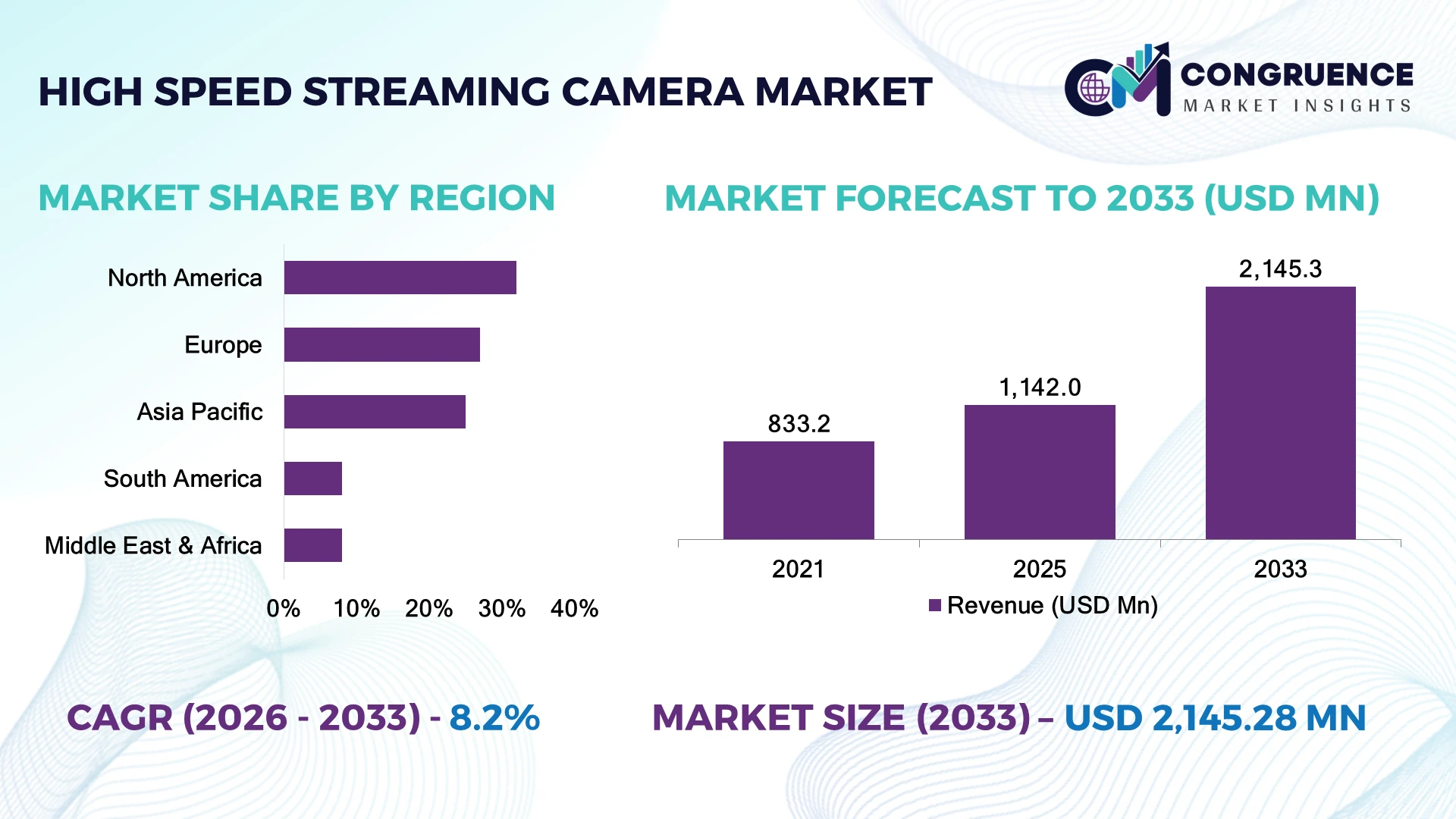
The United States dominates the market with nearly 32% share, supported by aerospace testing, autonomous vehicle validation, and defense modernization programs under initiatives such as the U.S. CHIPS Act. Japan and Germany follow with strong industrial imaging ecosystems, where over 45% of advanced manufacturing facilities integrate automated inspection systems. The U.S. records higher defense deployment, while Germany emphasizes precision engineering applications.
Strategic focus is shifting toward AI-integrated cameras, localized component supply chains, and industrial automation partnerships.
Market Size & Growth: USD 1,142.0 Million (2025) to USD 2,145.3 Million (2033) at 8.2% CAGR, driven by AI-based imaging and industrial automation adoption.
Top Growth Drivers: Automotive testing +18%, semiconductor inspection +15%, defense simulation +12% adoption growth.
Short-Term Forecast: By 2028, AI-powered camera deployments increase processing efficiency by 35% while reducing manual analysis costs by 25%.
Emerging Technologies: AI vision algorithms, edge computing, CMOS sensor advancements, and automated defect recognition are reshaping high-speed imaging.
Regional Leaders: North America reaches approximately USD 690 Million with defense adoption; Europe approaches USD 520 Million with smart manufacturing; Asia-Pacific exceeds USD 600 Million through electronics expansion.
Consumer/End-User Trends: Over 40% of industrial users prioritize real-time streaming and automated analytics capabilities for production monitoring.
Pilot/Case Example: In 2024, automotive crash-testing programs using high-speed streaming cameras achieved nearly 30% faster failure analysis cycles.
Competitive Landscape: Key players including Photron, Vision Research, Optronis, nac Image Technology, and Olympus compete, with leading manufacturers holding approximately 20% combined market influence.
Regulatory & ESG Impact: Advanced inspection cameras support manufacturing waste reduction by up to 20% through early defect detection and resource optimization.
Investment & Funding: More than USD 500 Million in industrial imaging investments target AI vision, semiconductor supply chains, and automation partnerships.
Innovation & Future Outlook: Next-generation systems will combine AI inference, cloud connectivity, and compact sensor designs to strengthen industrial decision-making.
High Speed Streaming Cameras are becoming essential across automotive validation, aerospace research, electronics manufacturing, and scientific visualization due to increasing demand for precise motion capture and real-time analytics. Recent innovations in global CMOS sensor technology have improved image processing speeds by over 25%, while manufacturers are expanding localized production strategies amid semiconductor supply-chain restructuring. The market is transitioning toward intelligent imaging platforms that combine hardware performance with software-driven insights, creating new opportunities for industrial competitiveness.
The High Speed Streaming Camera Market is becoming strategically important as industries shift toward predictive manufacturing, autonomous systems validation, and precision-based quality control. Companies are investing in advanced imaging infrastructure to reduce production failures, accelerate research cycles, and improve operational intelligence. Global supply-chain restructuring after semiconductor shortages has encouraged camera manufacturers to strengthen regional component sourcing and develop more resilient sensor ecosystems.
Modern high-speed streaming cameras deliver significantly higher processing efficiency compared with traditional recording systems, with AI-enabled platforms reducing analysis time by nearly 40% through automated event detection. North America maintains leadership through aerospace and defense applications, while China, Japan, and South Korea are expanding deployment through semiconductor and electronics manufacturing investments.
Automotive companies are using high-speed imaging for crash testing, battery safety evaluation, and autonomous driving validation, while research institutions integrate these systems into fluid dynamics and material analysis projects. Manufacturers are responding through strategic partnerships, AI software integration, and compact camera development. Over the next 2–3 years, competitive advantage will depend on intelligent imaging capabilities, supply-chain resilience, and the ability to deliver faster operational insights across industrial environments.
AI-powered imaging adoption is accelerating demand for high-speed streaming cameras across automotive, semiconductor, and aerospace sectors. Automated inspection systems improve defect detection accuracy by nearly 30% and reduce analysis workloads by approximately 35%. The expansion of electric vehicle testing facilities in countries such as the United States, Germany, and South Korea is increasing demand for high-frame-rate visualization. Semiconductor manufacturers are deploying advanced cameras to monitor micron-level production defects as chip fabrication complexity rises. Companies including Photron and Vision Research are investing in AI-compatible platforms and faster sensor architectures. The strategic impact is clear: intelligent imaging is transforming cameras from recording devices into real-time industrial decision systems.
High-speed streaming cameras face scalability limitations due to expensive sensors, specialized processors, and dependency on advanced semiconductor components. Premium systems can cost 40–60% more than conventional industrial cameras, limiting adoption among small manufacturers. Global semiconductor supply fluctuations continue affecting sensor availability, particularly for specialized CMOS components. European and Asian manufacturers are addressing these challenges through supplier diversification and regional production agreements. Companies are also developing modular camera architectures to reduce replacement costs and improve maintenance efficiency. The key operational challenge remains balancing advanced imaging performance with affordability across emerging industrial applications.
The integration of edge AI and connected industrial platforms creates significant opportunities for high-speed streaming cameras. Smart factories adopting automated inspection are increasing rapidly, with more than 50% of large manufacturers prioritizing real-time analytics solutions. Emerging markets such as India and Southeast Asia are expanding electronics and automotive production capacity, creating new deployment opportunities. Companies are developing compact cameras with embedded processing capabilities that reduce data-transfer requirements by approximately 30%. Partnerships between imaging companies and automation providers are accelerating ecosystem development. The strongest opportunity lies in combining high-speed capture with predictive analytics to improve manufacturing efficiency and reduce operational waste.
Integration complexity remains a major challenge as industries require compatibility with robotics, automation software, and cybersecurity frameworks. Approximately 35% of industrial organizations identify system interoperability as a barrier to advanced imaging adoption. High-bandwidth data management requirements increase infrastructure pressure, particularly in large manufacturing environments. Companies operating in Japan, Germany, and the United States are investing in standardized communication protocols and secure edge-processing solutions to overcome deployment issues. Workforce expertise gaps also affect implementation consistency, requiring specialized training programs and technical partnerships. Long-term competitiveness will depend on developing scalable platforms that integrate seamlessly with evolving industrial digital ecosystems.
AI Vision Integration Surge Industrial users are rapidly integrating AI-powered analytics into high-speed streaming cameras, with adoption increasing by nearly 35% across automated inspection workflows. Automotive manufacturers in Germany and Japan are deploying intelligent motion analysis systems to reduce manual review time by approximately 40%. Companies are responding through software partnerships, embedded AI processors, and cloud-connected imaging platforms that improve decision speed and operational accuracy.
Edge Processing Expansion Edge-based camera architectures are gaining momentum as enterprises seek faster data processing with reduced network dependency. Around 30% of advanced manufacturing facilities are shifting toward localized analytics to lower data-transfer loads and improve response times by nearly 25%. Semiconductor supply-chain disruptions have accelerated demand for compact processing modules, prompting manufacturers to redesign systems with integrated computing and optimized sensor components.
Ultra-Speed Sensor Innovation Next-generation CMOS sensor development is improving frame rates, image clarity, and energy efficiency, with advanced systems delivering approximately 20–30% better processing performance than earlier platforms. Aerospace and defense organizations are increasing adoption for flight testing and simulation environments. Camera suppliers are expanding R&D investments toward high-resolution sensors, thermal management solutions, and modular designs to meet demanding operational requirements.
Automation-Driven Deployment Shift Factories are moving from standalone imaging equipment toward fully connected automation ecosystems, with nearly 45% of large manufacturers prioritizing integrated machine vision solutions. Labor shortages in industrial hubs such as South Korea and the United States are accelerating automated inspection deployment. Companies are strengthening robotics partnerships and developing interoperable platforms to support scalable production monitoring and predictive maintenance.
CMOS-based high-speed streaming cameras represent the leading type segment, accounting for approximately 58% market share due to superior processing speed, lower power consumption, and easier integration with industrial automation systems. Their scalability across automotive testing, semiconductor inspection, and scientific research applications strengthens adoption compared with traditional sensor technologies. CCD-based cameras maintain relevance in specialized imaging environments requiring exceptional image stability, but their higher operational costs limit broader deployment. Emerging ultra-high-speed camera systems are gaining traction, with adoption increasing by nearly 25% as industries demand real-time visualization and AI-based analysis capabilities. Manufacturers are prioritizing CMOS innovation, compact architectures, and embedded analytics to capture growing industrial demand. Advanced sensor suppliers are also improving thermal efficiency and data-transfer capabilities, enabling deployment in high-frequency testing environments. The shift toward intelligent imaging platforms is redirecting investment from standalone recording devices toward integrated camera solutions with software-driven performance advantages.
Industrial testing applications dominate the High Speed Streaming Camera Market, representing nearly 42% market share due to extensive use in automotive crash analysis, aerospace validation, and manufacturing quality inspection. These systems enable detailed motion capture during high-speed events, reducing testing cycles by approximately 30% compared with conventional analysis methods. Scientific research and defense applications continue expanding, while entertainment and sports analysis represent smaller but technologically advanced segments. Automotive testing is emerging as the fastest-growing application area, supported by electric vehicle development and autonomous driving validation programs. Deployment in battery safety testing and vehicle simulation environments has increased by around 35% as manufacturers demand faster failure identification. Companies are responding through specialized software integration, automated workflows, and partnerships with testing laboratories. Demand is shifting toward cameras that combine high-speed recording with predictive analytics and real-time decision support.
Automotive manufacturers represent the leading end-user segment, contributing approximately 38% market share due to extensive requirements for crash testing, component validation, and autonomous vehicle development. Large automotive enterprises in Germany, the United States, and Japan rely on high-speed streaming cameras to analyze complex mechanical events and improve safety engineering. Aerospace and defense organizations remain significant users, driven by missile testing, aircraft development, and simulation requirements. Electronics and semiconductor manufacturers are emerging as the fastest-growing end-user group, with adoption expanding by nearly 30% as chip fabrication and precision inspection requirements become more complex. Research institutions and industrial laboratories continue using these systems for advanced material analysis and scientific visualization. Companies are adjusting strategies through customized solutions, integration partnerships, and industry-specific software packages. Future demand is increasingly shifting toward semiconductor, robotics, and automated manufacturing users requiring continuous process monitoring.
North America accounted for the largest market share at 32% in 2025 however, Asia-Pacific is expected to register the fastest growth, expanding at a CAGR of 9.1% between 2026 and 2033.
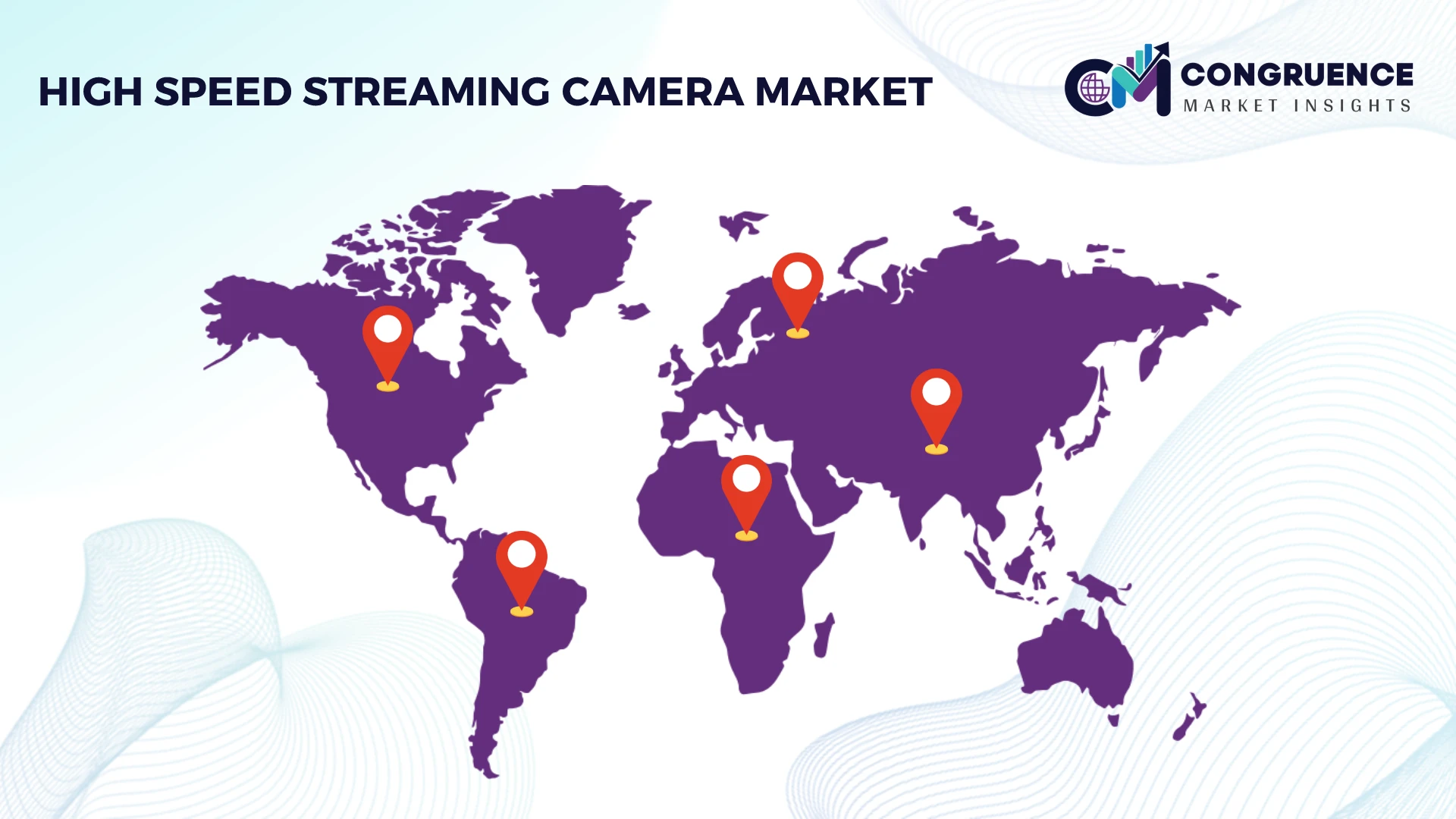
North America holds the leading position in the High Speed Streaming Camera Market due to strong aerospace, automotive, defense, and semiconductor testing ecosystems. The region contributes nearly 32% of global demand, supported by advanced research facilities and high investment in automated inspection technologies. The United States represents the largest deployment base, with increasing integration of AI-enabled imaging platforms across manufacturing and defense applications. More than 45% of large industrial enterprises are adopting machine vision solutions to improve quality monitoring and production efficiency. Companies are expanding through software partnerships, localized manufacturing strategies, and advanced sensor development to strengthen industrial imaging capabilities.
United States Market Outlook: The United States remains the key country market due to its strong aerospace, defense, and automotive testing infrastructure. Over 50% of advanced vehicle testing facilities incorporate high-speed imaging technologies for safety validation and performance analysis. Government-supported semiconductor investments and automation initiatives are further accelerating demand for advanced imaging systems across industrial facilities.
Europe maintains a strong market position through advanced automotive engineering, aerospace research, and industrial automation adoption. Germany, France, and the United Kingdom represent major deployment centers, with demand concentrated in precision manufacturing and quality inspection applications. The region accounts for approximately 27% of market adoption, supported by Industry 4.0 initiatives and increased automation investments. More than 40% of European manufacturers are integrating machine vision technologies to improve production monitoring and reduce operational errors. Companies are focusing on energy-efficient camera designs, industrial partnerships, and AI-based inspection solutions to align with sustainability and manufacturing modernization goals.
Germany Market Outlook: Germany leads European adoption due to its automotive manufacturing strength and highly automated industrial ecosystem. Nearly 45% of large automotive suppliers use advanced inspection technologies for component validation and production analysis. Investments in smart factories and precision engineering continue to support demand for high-speed streaming camera solutions.
Asia-Pacific is the fastest-growing market due to expanding electronics manufacturing, semiconductor production, and industrial automation deployment. China, Japan, South Korea, and India are driving demand through large-scale production facilities and technology modernization programs. The region contributes nearly 25% of current market adoption, with electronics and automotive industries representing major application areas. Semiconductor manufacturing investments in countries such as Taiwan and South Korea are increasing requirements for advanced inspection systems, while automation adoption among manufacturers has grown by more than 35%. Companies are expanding production capacity, forming technology partnerships, and developing cost-efficient imaging solutions for high-volume industrial applications.
China Market Outlook: China represents the largest Asia-Pacific country market due to extensive electronics manufacturing and industrial automation infrastructure. More than 50% of major manufacturing facilities are adopting automated inspection technologies to improve production efficiency. Strong semiconductor investments and smart manufacturing initiatives continue driving high-speed camera deployment.
South America is experiencing gradual adoption of high-speed streaming cameras, supported by automotive manufacturing, mining technology, research activities, and industrial modernization. Brazil and Argentina represent key demand centers where companies are upgrading testing and monitoring systems. The region contributes nearly 8% of global adoption, with deployment concentrated in industrial facilities and research institutions. Increasing automation investments have improved adoption of machine vision solutions by approximately 20% in manufacturing environments. Companies are addressing infrastructure limitations through targeted partnerships, regional service networks, and customized imaging solutions designed for industrial requirements.
Brazil Market Outlook: Brazil leads regional demand due to its automotive, mining, and industrial manufacturing base. More than 30% of large industrial operators are increasing investments in automation and digital monitoring technologies. Expansion of research facilities and manufacturing modernization programs is strengthening opportunities for advanced imaging systems.
The Middle East & Africa market is developing through infrastructure modernization, defense investments, energy-sector testing, and industrial automation programs. Countries including the United Arab Emirates, Saudi Arabia, and South Africa are increasing adoption of advanced imaging technologies for engineering and operational applications. The region represents nearly 8% of global demand, with defense and energy industries accounting for significant deployment activity. Smart infrastructure projects and industrial digitalization initiatives are increasing demand for real-time monitoring solutions, with automation adoption improving by nearly 25% across selected industrial sectors. Companies are expanding through regional partnerships and customized solutions for specialized applications.
United Arab Emirates Market Outlook: The United Arab Emirates is emerging as a strategic market due to investments in aerospace, defense, and smart infrastructure projects. More than 35% of advanced industrial facilities are integrating digital monitoring technologies to improve operational efficiency. Government-led technology modernization programs continue supporting adoption of high-speed imaging solutions.
The High Speed Streaming Camera Market features competition between global imaging specialists such as Photron, Vision Research, Optronis, and nac Image Technology, alongside regional industrial camera providers and automation-focused technology firms. The top five players collectively account for approximately 35% of market presence, creating a moderately consolidated structure. Competition is driven by sensor performance, frame rate capability, software integration, customization, and supply reliability. Premium manufacturers achieve differentiation through ultra-high-speed CMOS innovation, offering 25–40% faster processing than traditional systems, while cost-focused suppliers compete through scalable manufacturing and localized support. Companies are expanding through automation partnerships, AI integration, and application-specific solutions for automotive, aerospace, and semiconductor sectors. The market is shifting toward intelligent imaging platforms, increasing pressure on standalone camera vendors. High entry barriers include advanced sensor development expertise, industrial certifications, and customer-specific engineering requirements. Winning players will combine superior imaging performance, software intelligence, and reliable global service networks.
Vision Research (AMETEK)
Optronis
nac Image Technology
iX Cameras
Olympus
Mikrotron
Motion Capture Technologies
PCO AG
DEL Imaging
Fastec Imaging
Integrated Design Tools (IDT)
AOS Technologies
Kron Technologies
High-speed streaming camera technology is shifting from traditional high-frame-rate recording toward AI-enabled imaging platforms. Advanced CMOS sensors, embedded processors, and real-time analytics are improving processing efficiency by nearly 35% while reducing manual analysis requirements by approximately 30%. Automotive and semiconductor manufacturers are increasingly deploying intelligent cameras for automated inspection and predictive testing workflows.
Edge computing integration represents a major technology transition, enabling faster decision-making compared with older centralized processing systems. Modern edge-enabled cameras improve response times by nearly 25% and reduce data-transfer requirements by around 30%. More than 40% of advanced industrial facilities are adopting connected vision systems that combine cameras with automation software and robotics.
Between 2026 and 2028, competitive advantage will increasingly depend on AI inference, compact sensor architecture, and cloud-compatible imaging ecosystems. Companies investing in machine learning algorithms and modular camera designs will benefit most as industries demand faster validation cycles, improved quality control, and lower operational complexity. The transition from recording-focused equipment to intelligent industrial platforms is reshaping purchasing priorities across manufacturing, defense, and research sectors.
February 2025 Vision Research launched the Phantom KT-series high-speed cameras featuring BSI sensor technology, with models delivering up to 16 Gpx/s image throughput and frame rates reaching 916,660 fps at reduced resolution. The launch improves portability and precision imaging for industrial testing, aerospace, and research applications. Source: www.ametek.com
November 2025 Optronis participated in the International Vision Standards Meeting in China, validating its CyclonePlus-14 and CycloneFiber-2 cameras through CoaXPress interoperability testing. The systems achieved a 100% compatibility success rate with participating frame grabber platforms, strengthening industrial machine vision integration capabilities. Source: www.optronis.com
December 2025 Photron acquired AOS Technologies AG to expand its high-speed imaging portfolio and strengthen global industrial imaging capabilities. The strategic acquisition combines Photron’s camera expertise with AOS’s customized high-speed systems, supporting aerospace, automotive, and scientific applications. Source: www.aostechnologies.com
May 2025 AOS Technologies introduced the PROMON 2000 HSR high-speed camera system with up to 8 TB of non-volatile recording memory, enabling extended recording without traditional DRAM limitations. The development supports uninterrupted industrial testing workflows and complex engineering applications requiring long-duration high-speed capture.
The High Speed Streaming Camera Market Report covers comprehensive analysis across camera types, including CMOS-based systems, advanced sensor platforms, and specialized high-speed imaging solutions. The report evaluates applications such as automotive testing, aerospace analysis, semiconductor inspection, scientific research, defense simulation, and industrial monitoring. It also examines end-users including automotive manufacturers, research organizations, electronics companies, and industrial enterprises across North America, Europe, Asia-Pacific, South America, and Middle East & Africa.
The study provides strategic insights into technology adoption, competitive positioning, deployment patterns, and emerging opportunities from 2026 to 2033. It analyzes AI integration, edge processing, automation compatibility, and next-generation imaging innovations shaping market direction. The report supports investment decisions, expansion planning, partnership strategies, and competitive benchmarking by evaluating leading companies, market shifts, and evolving industrial requirements.
| Report Attribute / Metric | Details |
|---|---|
| Market Revenue (2025) | USD 1,142.0 Million |
| Market Revenue (2033) | USD 2,145.3 Million |
| CAGR (2026–2033) | 8.2% |
| Base Year | 2025 |
| Forecast Period | 2026–2033 |
| Historic Period | 2021–2025 |
| Segments Covered |
By Type
By Application
By End-User
|
| Key Deliverables | Revenue Forecast; Market Trends; Growth Drivers & Restraints; Technology Insights; Segmentation Analysis; Regional Insights; Competitive Landscape; Regulatory & ESG Overview; Recent Developments |
| Regions Covered | North America; Europe; Asia-Pacific; South America; Middle East & Africa |
| Companies Profiled | Photron; Vision Research (AMETEK); Optronis; nac Image Technology; iX Cameras; Olympus; Mikrotron; Motion Capture Technologies; PCO AG; DEL Imaging; Fastec Imaging; Integrated Design Tools (IDT); AOS Technologies; Kron Technologies |
| Customization & Pricing | Available on Request (10% Customization Free) |




