
Reports
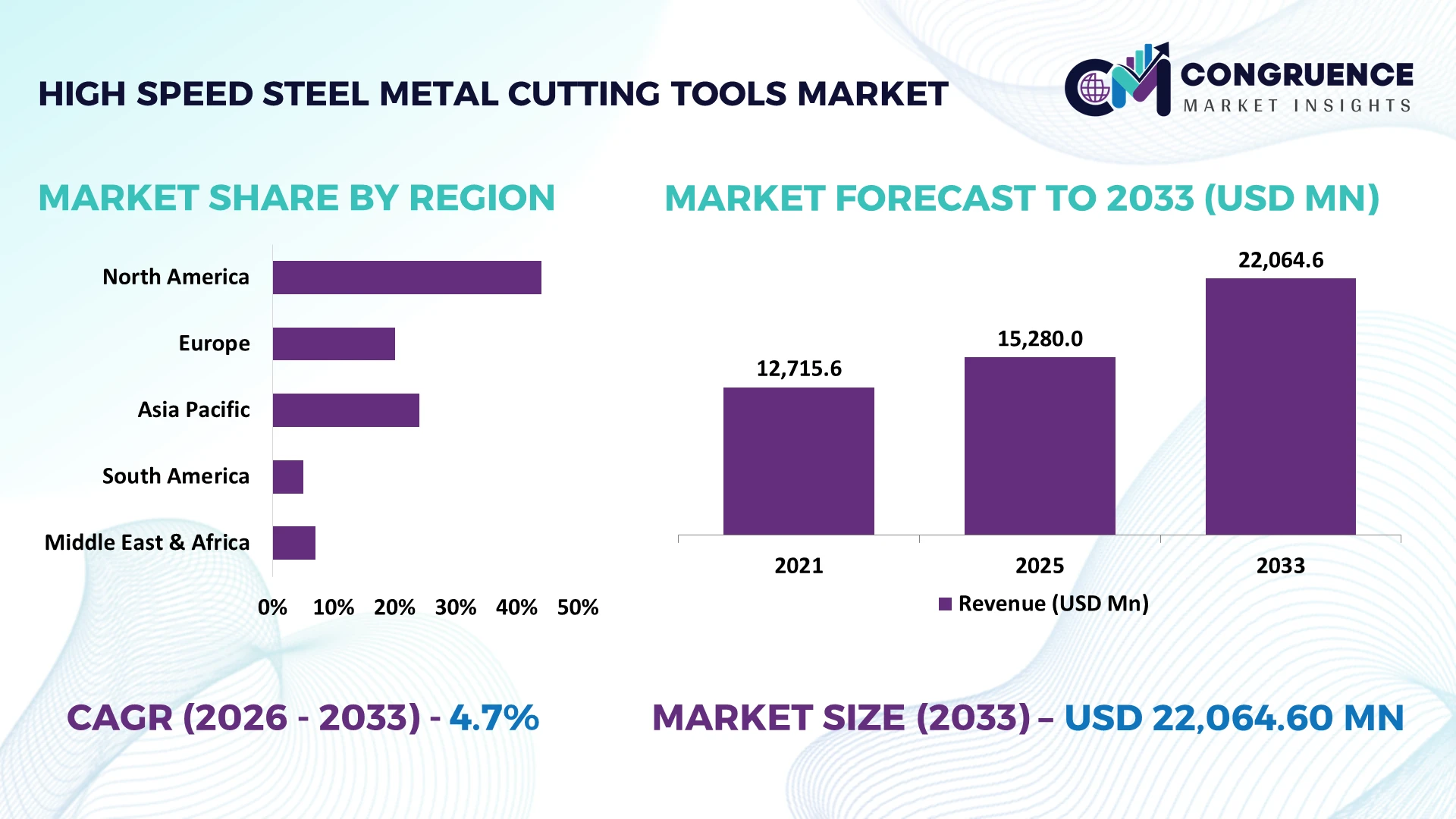
The Global High-Speed Steel Metal Cutting Tools Market was valued at USD 15280 Million in 2025 and is anticipated to reach a value of USD 22064.6 Million by 2033 expanding at a CAGR of 4.7% between 2026 and 2033. Growth is driven by automated machining, rising demand for wear-resistant HSS grades, and replacement of conventional carbon-steel tooling across automotive, aerospace, and industrial equipment production.
China remains the dominant country, supported by its large machine-tool base and metalworking ecosystem; it accounts for roughly 30% of global HSS tooling consumption and maintains more than 30% of global machine-tool production capacity. India follows with faster industrial expansion, while China’s automotive output is over 4 times India’s, reinforcing its tooling advantage amid supply-chain diversification and U.S.-China trade tensions.
Strategic decisions should prioritize Asia-Pacific capacity, advanced HSS grades, and automation-linked tooling portfolios.
Market Size & Growth: USD 15.28 billion in 2025 to USD 22.06 billion by 2033, at 4.7% CAGR, driven by automated precision machining.
Top Growth Drivers: Automation 18%; automotive machining 15%; advanced HSS adoption 12%.
Short-Term Forecast: By 2028, automated tooling can cut setup costs 8% and raise machining efficiency 10%.
Emerging Technologies: AI tool monitoring, automated tool presetting, and cobalt-enriched HSS grades strengthen precision and tool life.
Regional Leaders: Asia-Pacific approaches USD 12 billion; Europe USD 5 billion; North America USD 4 billion, with automation adoption accelerating.
Consumer/End-User Trends: Around 65% of industrial users increasingly prioritize longer-life cutting tools to reduce downtime.
Pilot/Case Example: 2025 smart-machining deployments achieved approximately 10% lower tool-change frequency through predictive monitoring.
Competitive Landscape: China leads near 30% consumption share; Sandvik, Kennametal, OSG, Guhring, and Walter anchor competition.
Regulatory & ESG Impact: Recycling-focused tooling programs can reduce material waste by 8%, supporting tighter industrial sustainability targets.
Investment & Funding: More than USD 1 billion in recent capacity, automation, and precision-machining investments is shifting toward Asia-Pacific.
Innovation & Future Outlook: Next-generation HSS coatings, digital monitoring, and hybrid tooling will shift competition toward productivity, lifecycle cost, and supply-chain resilience.
High-Speed Steel Metal Cutting Tools increasingly serve automotive components, aerospace parts, heavy machinery, and general engineering, where durability and repeatable cutting performance remain critical. Approximately 65% of industrial users prioritize longer tool life to reduce downtime, while automated tool monitoring and advanced coatings accelerate adoption. Supply-chain diversification and regional manufacturing expansion are strengthening demand for locally available precision tooling, creating new strategic opportunities across high-growth machining clusters.
High-Speed Steel Metal Cutting Tools are becoming strategically important as manufacturers balance machining precision, equipment utilization, and supply-chain resilience. Automotive, aerospace, and industrial-equipment producers are shifting toward localized machining capacity, while automated production lines increase requirements for repeatable cutting performance. HSS tools remain relevant because they combine thermal resistance with lower replacement costs than several premium carbide alternatives.
Technology adoption is reshaping productivity. Digitally monitored HSS tooling can improve tool-life utilization by approximately 8–12% versus manual inspection, while automated presetting can reduce setup time by nearly 10%. China maintains greater manufacturing scale, whereas Germany emphasizes high-precision engineering and process automation. India is expanding deployment through automotive and engineering clusters, creating a more diversified manufacturing base.
Over the next 2–3 years, manufacturers are expected to prioritize coated HSS grades, tool-condition monitoring, and automated inventory systems, targeting 5–10% reductions in unplanned tool changes. A practical deployment model combines HSS cutters with CNC machining centers and digital tool tracking, enabling tighter consumption control. Companies are responding through localized production, supplier partnerships, and application-specific R&D. Competitive advantage will increasingly depend on integrating durable tooling with measurable shop-floor productivity.
Automated machining is strengthening HSS tool demand as automotive and engineering plants increase CNC utilization and repeatability requirements. Tool-condition monitoring can improve usable tool life by 8–12%, while automated presetting cuts setup time by about 10%. China’s extensive automotive and machinery base is accelerating deployment, while India’s expanding engineering clusters are increasing demand for locally available precision tooling. The shift toward smart factories also favors HSS grades engineered for consistent cutting under automated cycles. Manufacturers are responding through coated-tool development, CNC-compatible product portfolios, and partnerships with machine-tool integrators. The non-obvious advantage is reduced intervention frequency: better tool-life predictability improves machine availability without requiring complete migration to higher-cost tooling systems.
Raw-material volatility remains a structural constraint because cobalt, tungsten, molybdenum, and chromium influence HSS formulation costs. Material-price movements can increase tooling input costs by 5–10%, while imported alloy dependencies expose Indian and European manufacturers to logistics disruptions and procurement delays. Smaller machining firms face greater margin pressure because they purchase in lower volumes and have weaker contract leverage. China benefits from deeper metalworking supply chains, but geopolitical trade restrictions continue to complicate sourcing strategies. Companies are responding through multi-source procurement, longer-duration contracts, recycled alloy inputs, and optimized material formulations. A critical operational insight is that formulation efficiency can protect margins without sacrificing cutting performance, making metallurgy optimization as important as production expansion.
Digital tool lifecycle management creates an underexploited opportunity by connecting HSS tools with CNC monitoring, inventory software, and predictive maintenance platforms. Automated tracking can reduce tool-related downtime by roughly 8%, while predictive replacement strategies can improve tool utilization by 10–12%. India and Southeast Asian manufacturing hubs offer attractive deployment opportunities as factories modernize without fully replacing established HSS tooling fleets. AI-assisted wear detection and digitally recorded cutting histories are emerging as practical extensions of existing machining infrastructure. Companies are positioning through sensor-enabled tools, software partnerships, and application-specific R&D. The strongest opportunity lies in converting HSS from a consumable purchase into a measurable productivity asset, improving lifecycle economics and customer retention.
Advanced HSS tooling increasingly depends on skilled CNC programming, digital monitoring, and application engineering, creating execution gaps across expanding manufacturing clusters. Workforce shortages can reduce automation effectiveness by 5–8%, while inconsistent machine parameters can shorten expected tool life by approximately 10%. Indian tier-two machining centers face particular pressure when integrating monitoring systems with heterogeneous CNC equipment. Germany has stronger process-engineering capabilities, but higher labor costs intensify pressure for automation. Companies must invest in operator training, standardized cutting databases, interoperable monitoring platforms, and technical partnerships with machine-tool suppliers. The strategic challenge is not simply adopting smarter tooling; it is maintaining consistent process data across multiple machines, shifts, and production sites.
AI-Assisted Tool Production Accelerates AI-supported edge preparation and tool-design workflows are reducing parameter-calculation effort by roughly 10–15%, while digital process monitoring improves repeatability by 8–12%. Siemens and other industrial technology suppliers are integrating AI into CNC environments, shifting tooling decisions from operator experience toward data-led optimization. Companies are expanding software-tool partnerships and automated grinding capabilities to capture these productivity gains.
Local-for-Local Supply Chains Expand Supply-chain restructuring is pushing manufacturers toward geographically distributed production, with 12 major German machine-tool producers already operating overseas facilities representing more than 20% of their domestic production. China accounted for 37% of global machine-tool production in 2025, strengthening localized tooling ecosystems. Companies are responding through regional sourcing, inventory buffers, and overseas manufacturing partnerships.
China Strengthens Export Position China increased machine-tool exports by 13% in 2025, while German exports declined 10%, intensifying competitive pressure across cutting-tool supply chains. China also represented about 32% of global machine-tool consumption, creating a dense domestic customer base for HSS tooling. Suppliers are scaling local distribution and application engineering to protect share as procurement becomes increasingly China-centered.
Engineering Demand Becomes More Diversified Automotive dependence is being diluted as electronics, semiconductor, aviation, and medical manufacturing gain importance. Germany’s engineering sector accounted for 30.1% of machine-tool production demand in a recent VDW customer survey, versus 27.2% for automotive. HSS suppliers are therefore broadening product portfolios toward specialized drilling, milling, and finishing applications.
Twist Drills represent the leading type at approximately 38% share, supported by broad penetration across automotive, machinery, fabrication, and general engineering. Their standardized geometries, repeatable performance, and compatibility with CNC drilling cycles give them stronger replacement frequency than specialized tooling. Milling Cutters follow at about 24%, while Taps & Dies account for nearly 16%, serving standardized threading requirements. Reamers and Saw Blades remain smaller but strategically important in precision finishing and high-volume cutting applications. Companies are prioritizing coated HSS grades and geometry optimization, with advanced drill designs improving tool-life consistency by roughly 8–10%.
Milling Cutters are the fastest-growing type, expanding adoption as manufacturers increase multi-axis machining and complex component production. Their ability to consolidate operations can reduce secondary machining steps by around 6–8%. Investment is shifting toward application-specific geometries, coolant-compatible designs, and integrated toolholding systems, while Twist Drills retain the strongest volume economics.
Turning accounts for approximately 31% of application demand, reflecting its extensive use in shafts, automotive components, fittings, and cylindrical engineering parts. Milling follows near 27%, supported by increasingly complex component geometries and multi-axis machining. Drilling remains essential at about 22%, while Threading and Cutting collectively represent the balance across specialized production workflows. Companies are improving cutting parameters and adopting coated HSS tooling to raise usable tool life by 8–10%, reducing tool-change interruptions.
Milling is the fastest-growing application at roughly 8% deployment expansion across advanced machining environments, driven by multi-axis CNC adoption and component complexity. Compared with mature turning operations, modern milling cells increasingly consolidate several machining stages, improving throughput by approximately 7%. Threading retains strong relevance in precision assemblies, while Cutting serves high-volume material separation. Suppliers are responding with application-specific geometries, machine-tool partnerships, and bundled tooling solutions that improve process consistency.
Automotive represents the leading end-user segment at approximately 32% share, reflecting high-volume machining of shafts, gears, engine components, transmission parts, and structural elements. General Engineering follows at around 25%, supported by diversified component production and lower-volume precision work. Machinery Manufacturing contributes nearly 20%, while Aerospace and Metal Fabrication maintain specialized demand. Automotive buyers increasingly prioritize predictable tool life and cycle consistency, with optimized HSS tooling reducing tool-change frequency by about 8%.
Aerospace is the fastest-growing end-user at approximately 9% adoption expansion, driven by precision requirements, lightweight-component manufacturing, and increasing investment in advanced production systems. Compared with automotive’s volume-driven purchasing, aerospace buyers place greater emphasis on process qualification, surface integrity, and dimensional consistency. Metal Fabrication remains cost-sensitive, while Machinery Manufacturing increasingly favors customized tooling packages. Suppliers are responding through application engineering, direct OEM partnerships, and tailored HSS grades.
Asia-Pacific accounted for the largest market share at 45% in 2025 however, Asia-Pacific is expected to register the fastest growth, expanding at a CAGR of 5.2% between 2026 and 2033.
Reshoring and aerospace machining strengthen tooling intensity
North America remains a high-value HSS tooling market, supported by aerospace, automotive, defense, and precision engineering clusters across the United States and Mexico. The United States represented approximately 14% of global machine-tool consumption in 2025, reinforcing its importance as a machining-equipment and tooling demand center. Demand is shifting toward automated CNC cells, tool-life optimization, and localized supply following supply-chain disruptions and tariff uncertainty. Aerospace and defense investment is particularly important because these applications emphasize dimensional consistency and qualified cutting processes. Tool suppliers are increasing application-engineering support, regional inventory, and OEM relationships rather than competing solely on unit price. The operational priority is shortening replacement lead times while improving cutting consistency across increasingly automated production environments.
United States Market Outlook: The United States combines the region's deepest aerospace, defense, automotive, and industrial-equipment manufacturing base with advanced CNC infrastructure. Its machine-tool consumption reached roughly 14% of global demand in 2025, creating a strong installed base for HSS drilling, milling, threading, and finishing applications. Manufacturers are increasingly prioritizing domestic sourcing and digitally monitored tooling to improve production resilience.
Industrial modernization shifts demand toward precision and diversification
Europe's HSS tooling demand is being reshaped by automation, aerospace, defense, medical technology, and energy-transition manufacturing. Germany remains the principal industrial hub, while Italy, Spain, Poland, and the Czech Republic contribute substantial machining capacity. German metal-cutting and eroding machine tools represented 49.6% of machine-tool production during the first three quarters of 2025, underscoring the region's precision-machining base. Skilled-labor shortages and tighter sustainability requirements are accelerating automated tool management and longer-life HSS grades. Companies are also adopting local-for-local manufacturing: twelve major German machine-tool producers now operate foreign production facilities, with overseas output exceeding one-fifth of their German production. This is strengthening regional supply resilience while reducing exposure to cross-border logistics volatility.
Germany Market Outlook: Germany retains a strategic advantage through sophisticated engineering, precision manufacturing, and research-intensive production. German machine-tool companies invested around 3% of turnover in research and development, supporting advanced cutting processes, automation integration, and application-specific tooling. Aerospace, defense, medical technology, and industrial machinery are increasingly offsetting weaker automotive machining demand.
Manufacturing scale reinforces Asia-Pacific's tooling advantage
Asia-Pacific dominates HSS metal-cutting-tool consumption through China's enormous manufacturing base, Japan's precision-engineering ecosystem, India's expanding automotive production, and South Korea's electronics and industrial-equipment industries. China accounted for approximately 32% of global machine-tool consumption in 2025 and produced 37% of global machine tools, creating a dense installed base for drilling, milling, threading, and cutting applications. Chinese machine-tool exports also increased 13% in 2025, strengthening domestic tooling ecosystems and export-oriented supply chains. India is becoming strategically important as manufacturers diversify production and expand engineering capacity. Suppliers are responding with localized inventory, application centers, coated HSS products, and partnerships with CNC-machine producers. Scale remains the region's decisive advantage, but precision and digital integration are increasingly separating premium suppliers from low-cost competitors.
China Market Outlook: China is the most strategically significant country because of its manufacturing scale and extensive machine-tool ecosystem. Machine-tool production reached approximately EUR 30 billion in 2025, while domestic consumption represented about 32% of global demand. This installed industrial base supports high-volume HSS tooling requirements and enables suppliers to develop localized products rapidly.
Brazilian industrial diversification supports replacement demand
South America remains a smaller but strategically relevant HSS tooling market, with Brazil accounting for the largest share of regional industrial activity. Automotive assembly, agricultural machinery, mining equipment, oil and gas, and metal fabrication generate recurring requirements for drills, milling cutters, taps, dies, reamers, and saw blades. Brazil's industrial structure favors durable tooling because machining operations frequently balance equipment utilization against maintenance budgets. Imported premium tooling remains important, while local distributors compete through availability and application support. Currency volatility and longer import cycles can raise procurement costs and encourage manufacturers to hold additional inventory. Companies are responding with distributor partnerships, localized stock, and product ranges spanning standard and coated HSS grades. The strategic opportunity lies in serving maintenance-heavy industrial applications where rapid replacement availability can outweigh marginal differences in tool price.
Brazil Market Outlook: Brazil offers the strongest manufacturing platform in South America through automotive, machinery, mining, and agricultural-equipment production. Its large installed industrial base supports recurring cutting-tool replacement, while domestic distributors provide an important bridge between international manufacturers and smaller machining enterprises seeking shorter procurement cycles.
Industrial localization creates new machining demand
Middle East & Africa demand is increasingly connected to industrial diversification, infrastructure modernization, oilfield equipment, construction machinery, and metal fabrication. Saudi Arabia and the United Arab Emirates are strengthening manufacturing ecosystems through localization programs and industrial investment, creating requirements for precision drilling, milling, threading, and cutting. Saudi Arabia's industrial strategy is particularly important because localization reduces dependence on imported finished components and increases demand for domestic machining capabilities. Defense, energy, and heavy-equipment projects favor durable HSS tooling where repair and component-production requirements remain significant. Suppliers are building distributor networks, technical partnerships, and application-support capabilities rather than relying exclusively on imports. The key constraint remains uneven machining infrastructure across African markets, making equipment availability and technical service critical differentiators. Companies that combine local stock with training and application engineering are best positioned to convert industrial investment into sustained tooling demand.
Saudi Arabia Market Outlook: Saudi Arabia provides the region's strongest strategic opportunity through manufacturing localization, energy-equipment production, infrastructure development, and defense industrialization. Industrial diversification is increasing the need for domestic machining capabilities, while local technical partnerships can improve tooling availability and support specialized applications across heavy engineering and fabrication.
The High-Speed Steel Metal Cutting Tools market pits global precision-tool leaders such as Sandvik, Kennametal, OSG, Guhring, and Walter against regional manufacturers competing on price and local availability. The top five players collectively command an estimated 25–30% share, leaving substantial fragmented demand. Competition centers on tool life, geometry, coating performance, delivery speed, and application engineering. Premium suppliers can achieve 8–12% longer usable tool life through advanced grades and coatings, while localized suppliers compete with 5–10% lower procurement costs. Players are expanding regional inventory, partnering with CNC-machine manufacturers, and developing application-specific tooling. China's growing machine-tool ecosystem is intensifying cost pressure, while aerospace and medical applications favor qualified premium tooling. Entry barriers include metallurgy expertise, grinding precision, application databases, and established distributor networks. Winning requires combining reliable supply with measurable productivity gains rather than competing on price alone.
Sandvik
Kennametal
OSG Corporation
Guhring
Walter AG
Dormer Pramet
Mitsubishi Materials
Tungaloy Corporation
YG-1
ISCAR
Nachi-Fujikoshi
Sumitomo Electric Industries
Advanced HSS grades are moving beyond conventional metallurgy through cobalt-alloyed, powder-metallurgy, and PVD-coated compositions. PM-HSS can improve wear resistance and cutting-edge stability by 8–12% versus conventional HSS, while coated grades reduce friction-related tool wear by about 10%. Adoption is strongest in CNC drilling, tapping, and precision milling.
Digital integration is becoming more important as tool-condition monitoring, automated presetting, and CNC data capture enter production workflows. These systems can improve tool-life utilization by 8–10% and reduce setup-related downtime by 5–8%. Approximately 25–30% of advanced machining environments now deploy some form of digital tooling management, benefiting high-volume automotive and aerospace producers through tighter process control.
From 2026–2028, AI-assisted wear prediction, additive manufacturing of HSS components, and hybrid material architectures will reshape premium tooling. Additive HSS research is targeting dense, application-specific tool structures, while smart monitoring can deliver another 5–8% productivity improvement. Compared with manual inspection and standard HSS, integrated tooling systems provide roughly 15% better operational efficiency. Premium manufacturers with metallurgy, coatings, and digital integration capabilities will gain the strongest competitive advantage as machining plants prioritize measurable lifecycle performance.
May 2025 Gleason acquired 100% of Fubri, a specialist in high-speed steel hobs, strengthening its gear-tool portfolio and Total Gear Solutions platform. The transaction expands access to Fubri’s 85+ years of HSS expertise and improves global customer coverage. Source: gleason.com
November 2024 OSG released its 2025–2026 general catalog with two volumes covering drilling/threading and milling tools, adding new products and digital product-search functions. The catalog supports faster tool selection and cutting-condition matching across global manufacturing customers. Source: osg.co.jp
July 2024 Kennametal expanded its DUO-λOCK modular platform with HARVI I TE geometry, enabling 1xD full-slot milling and 1.5xD side milling at up to 50% radial engagement. The launch targets shorter cycles, fewer tool changes, and lower setup downtime. Source: kennametal.com
March 2024 Dormer Pramet introduced new tooling emphasizing simplified selection, plug-and-play setup, and digital product data, including HSS drills and HSS-E tool bits. Its expanded portfolio supports more than 100 markets and strengthens standardized tooling access. Source: dormerpramet.com
The report covers High-Speed Steel Metal Cutting Tools across Twist Drills, Milling Cutters, Taps & Dies, Reamers, and Saw Blades, with application analysis spanning Turning, Milling, Drilling, Threading, and Cutting. End-user coverage includes Automotive, Aerospace, General Engineering, Machinery Manufacturing, and Metal Fabrication, enabling comparison of volume-driven and precision-intensive demand patterns.
Geographic assessment spans North America, Europe, Asia-Pacific, South America, and Middle East & Africa, with country-level analysis emphasizing China, the United States, Germany, India, Brazil, and Saudi Arabia. Technology coverage evaluates coated HSS, powder-metallurgy grades, cobalt-alloyed materials, automated tooling, digital monitoring, and emerging additive approaches. The report supports 2026–2033 investment planning through segment prioritization, deployment analysis, competitive positioning, technology assessment, and expansion strategy.
| Report Attribute/Metric | Report Details |
|---|---|
Market Revenue in 2025 | USD 15280 Million |
Market Revenue in 2033 | USD 22064.6 Million |
CAGR (2026 - 2033) | 4.7% |
Base Year | 2025 |
Forecast Period | 2026 - 2033 |
Historic Period | 2021 - 2025 |
Segments Covered | By Type
By Application
By End-User
|
Key Report Deliverable | Revenue Forecast, Growth Trends, Market Dynamics, Segmental Overview, Regional and Country-wise Analysis, Competition Landscape |
Region Covered | North America, Europe, Asia-Pacific, South America, Middle East, Africa |
Key Players Analyzed | Sandvik, Kennametal, OSG Corporation, Guhring, Walter AG, Dormer Pramet, Mitsubishi Materials, Tungaloy Corporation, YG-1, ISCAR, Nachi-Fujikoshi, Sumitomo Electric Industries |
Customization & Pricing | Available on Request (10% Customization is Free) |




