
Reports
The Global High Speed Oven Market was valued at USD 249.0 Million in 2025 and is anticipated to reach a value of USD 354.1 Million by 2033 expanding at a CAGR of 4.5% between 2026 and 2033. Growth is driven by rapid-cooking technologies, commercial kitchen automation, and rising adoption of combination cooking systems in restaurants and foodservice operations.
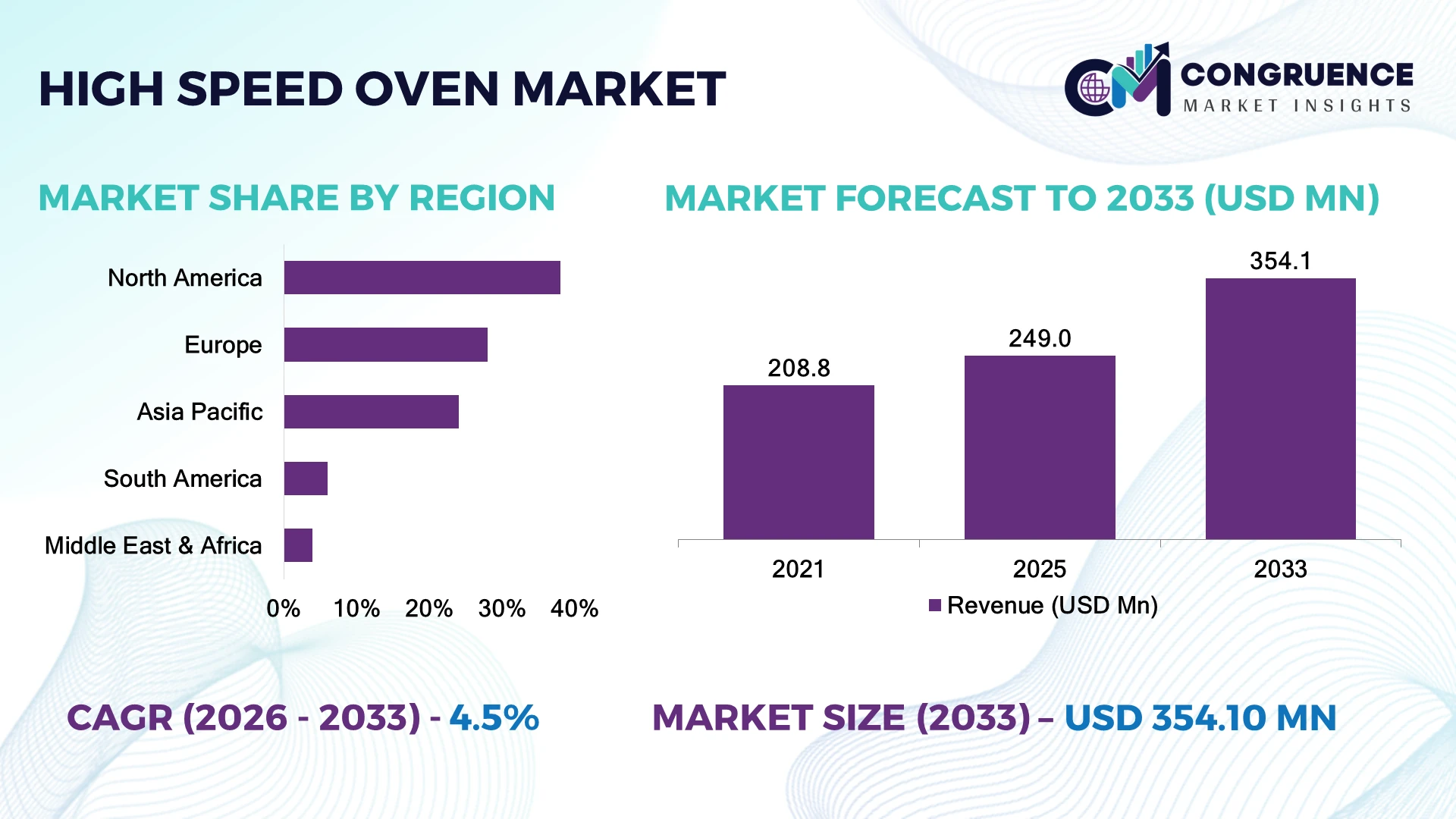
The United States dominates the market with approximately 35% share, supported by over 70% penetration of advanced commercial kitchen equipment in major foodservice chains and investments in automated cooking infrastructure. Europe follows with strong adoption across Germany and the UK, while Japan integrates compact high-speed ovens in urban food outlets. In 2024, U.S. restaurant technology investments exceeded USD 10 billion, compared with growing smart kitchen deployment across Asia-Pacific markets.
Strategic decisions are increasingly focused on automation-led efficiency and scalable food preparation systems.
Market Size & Growth: USD 249.0 Million market value in 2025 reaching USD 354.1 Million by 2033 at 4.5% CAGR, driven by automation in commercial kitchens.
Top Growth Drivers: Automation adoption 45%, quick-service restaurant expansion 38%, smart appliance integration 32%.
Short-Term Forecast: By 2028, advanced oven adoption improves kitchen throughput by 25% and reduces preparation time by 30%.
Emerging Technologies: AI-based cooking controls, IoT-enabled monitoring, and hybrid microwave-convection heating systems are transforming operations.
Regional Leaders: North America reaches USD 124 Million with smart kitchen adoption; Europe reaches USD 98 Million with energy-efficient upgrades; Asia-Pacific reaches USD 82 Million through urban foodservice expansion.
Consumer/End-User Trends: Over 40% of restaurants prioritize compact rapid-cooking equipment to improve service speed and menu flexibility.
Pilot/Case Example: In 2024, automated cooking deployments in restaurant chains reduced cooking cycle times by 35% and improved operational consistency.
Competitive Landscape: Leading manufacturers hold approximately 50% combined share, including Merrychef, TurboChef, Panasonic, Miele, and Electrolux.
Regulatory & ESG Impact: Energy-efficient kitchen equipment adoption reduces electricity consumption by up to 20% in commercial operations.
Investment & Funding: More than USD 5 billion invested globally in foodservice automation, digital kitchens, and smart appliance partnerships.
Innovation & Future Outlook: Next-generation ovens focus on AI recipes, predictive maintenance, and connected kitchen ecosystems for competitive advantage.
High Speed Oven Market demand is expanding across quick-service restaurants, hospitality, and institutional kitchens due to the shift toward faster preparation cycles and consistent food quality. Manufacturers are introducing compact hybrid ovens with improved heating precision, while supply-chain optimization after global logistics disruptions has increased focus on locally supported equipment networks. Adoption of energy-saving cooking systems is rising, with approximately 25% of commercial operators prioritizing efficiency upgrades.
The High Speed Oven Market is becoming strategically important as foodservice operators prioritize faster service, labor optimization, and digital kitchen transformation. The shift toward automated cooking environments is accelerating as restaurants restructure operations after global supply-chain disruptions and rising labor costs.
Advanced high speed ovens combine microwave, convection, and impingement technologies to deliver cooking cycles up to 70% faster than traditional systems while improving consistency. Compared with conventional ovens, connected models reduce manual monitoring requirements and enable remote performance tracking. North America leads in commercial deployment, while Asia-Pacific shows stronger adoption momentum through compact urban foodservice formats and expanding quick-service restaurant networks.
Over the next few years, companies are prioritizing partnerships with restaurant chains, technology providers, and appliance manufacturers to strengthen connected kitchen capabilities. For example, large foodservice operators are deploying programmable oven systems to standardize menus across multiple locations while reducing training requirements. Manufacturers are increasing investments in AI-enabled controls, energy-efficient components, and modular designs to address operational challenges.
The future competitive advantage in the High Speed Oven Market will depend on combining automation, energy efficiency, and digital intelligence to deliver scalable solutions for evolving foodservice ecosystems.
Rising labor shortages and demand for faster meal preparation are accelerating high speed oven adoption across commercial kitchens, with automated cooking systems improving operational efficiency by 30–40%. In the United States, quick-service restaurant chains are expanding smart kitchen deployments to reduce preparation bottlenecks and maintain consistent output. Hybrid heating technologies combining convection, microwave, and impingement systems are gaining traction, reducing cooking cycles by nearly 50% compared with conventional equipment. Companies are responding through product innovation, cloud-connected appliance development, and partnerships with restaurant operators to strengthen automated food preparation ecosystems.
High initial investment and installation requirements remain key barriers for small and medium foodservice operators, with advanced high speed ovens often costing 20–40% more than traditional commercial ovens. Limited electrical infrastructure in older facilities, particularly across developing markets, restricts large-scale deployment. Supply-chain volatility for electronic components and heating modules has increased equipment lead times by approximately 15–25%, affecting expansion planning. Manufacturers are reducing exposure through localized production, diversified supplier networks, and long-term component contracts. Strategic equipment financing models are also emerging to improve accessibility for smaller restaurant operators.
The integration of AI controls, IoT monitoring, and predictive maintenance creates new opportunities for high speed oven manufacturers, with connected kitchen adoption increasing by more than 35% among large foodservice operators. Japan and South Korea are advancing compact automated cooking formats for urban restaurants with limited kitchen space. Digital recipe management systems improve consistency across multi-location restaurant networks while reducing operator training requirements by nearly 30%. Companies are investing in software-enabled appliances, strategic technology partnerships, and ecosystem platforms to capture demand from automated restaurants, hospitality chains, and institutional kitchens seeking operational efficiency.
Scaling intelligent high speed oven networks requires overcoming integration challenges related to software compatibility, cybersecurity, and workforce adaptation. Approximately 25–30% of commercial kitchens still operate with limited digital infrastructure, creating barriers for connected appliance deployment. Data security requirements are becoming more critical as manufacturers introduce cloud-based monitoring and remote diagnostics. In countries such as Germany and the United States, stricter digital compliance expectations are influencing equipment design strategies. Companies must strengthen cybersecurity frameworks, improve interoperability standards, and develop simplified user interfaces to ensure reliable adoption across diverse foodservice environments.
AI Cooking Optimization Shift: AI-enabled cooking controls are gaining adoption as commercial kitchens target 20–30% workflow efficiency improvements and 15% lower operator intervention. Restaurant chains in the United States are integrating programmable cooking platforms to standardize menus across locations. Manufacturers are responding by expanding connected oven portfolios with predictive analytics, cloud monitoring, and automated recipe adjustment capabilities.
Compact Kitchen Deployment Growth: Urban foodservice operators are increasing demand for space-efficient high speed ovens, with compact equipment adoption rising nearly 35% in densely populated markets such as Japan and South Korea. Limited kitchen footprints and rising labor costs are driving modular equipment deployment. Companies are redesigning products with smaller footprints, multi-function heating systems, and flexible installation options.
Energy Efficiency Transition: Commercial kitchens are prioritizing energy-efficient cooking technologies, with advanced high speed ovens reducing energy usage by approximately 20–25% compared with traditional cooking setups. European sustainability requirements and rising electricity costs are accelerating equipment upgrades. Manufacturers are investing in optimized heating chambers, improved insulation materials, and low-power operating modes.
Digital Service Expansion: Remote diagnostics and connected maintenance solutions are expanding across enterprise foodservice networks, improving equipment uptime by nearly 25%. Supply-chain pressure on replacement parts has encouraged manufacturers to adopt predictive maintenance models. Companies are developing service partnerships, digital platforms, and automated support systems to improve lifecycle management and reduce operational disruptions.
Combination high speed ovens represent the leading segment, accounting for approximately 45% of market adoption due to their ability to integrate convection, microwave, and impingement technologies within a single platform. Their scalability, faster cooking cycles, and menu flexibility make them highly preferred by quick-service restaurants and hospitality operators. Traditional high speed microwave ovens maintain relevance with around 30% share due to lower acquisition costs and simple operating requirements, particularly among small foodservice businesses. Rapid growth is emerging in hybrid smart ovens, supported by increasing demand for automation, programmable cooking, and digital connectivity. Adoption of intelligent models is rising by nearly 35% as enterprises seek consistent food quality across multiple locations. Manufacturers are shifting investments toward AI-enabled controls, cloud-based monitoring, and modular designs to capture premium commercial demand. Remaining types, including convection-focused systems, continue serving specialized applications where reliability and operational simplicity remain priorities.
Commercial restaurants and quick-service food outlets dominate high speed oven applications with an estimated 55% market share, supported by high-volume cooking requirements, faster service expectations, and standardized menu operations. These systems help operators reduce preparation time by 40–50% while improving consistency across locations. Institutional kitchens, including hotels and catering operations, represent a stable application base with increasing adoption of programmable cooking systems. The fastest-growing application segment is convenience food preparation, where retailers and grab-and-go operators are deploying high speed ovens to expand fresh food offerings without increasing kitchen complexity. Adoption in this segment is increasing by approximately 30% as consumer preference shifts toward rapid meal availability. Manufacturers are responding through partnerships with food retailers, development of compact systems, and integration of automated cooking programs. Emerging applications in workplace cafeterias and healthcare facilities are also strengthening demand through operational efficiency requirements.
Restaurant chains and quick-service operators represent the largest end-user group, contributing nearly 60% of high speed oven deployments due to multi-location expansion, standardized food preparation, and high transaction volumes. Large enterprises prioritize equipment reliability, remote monitoring, and faster cooking cycles to improve operational efficiency. Independent restaurants hold approximately 25% adoption share, mainly driven by affordable compact models and flexible menu requirements. The fastest-growing end-user category is institutional and corporate foodservice, where automation adoption is increasing by nearly 30% as operators modernize kitchens and address labor shortages. Universities, hospitals, and workplace dining facilities are investing in programmable cooking equipment to improve workflow efficiency. Companies are targeting these segments through customized solutions, service agreements, and financing models. Future demand is shifting toward enterprise buyers seeking integrated kitchen ecosystems rather than standalone appliances.
North America accounted for the largest market share at 38% in 2025 however, Asia-Pacific is expected to register the fastest growth, expanding at a CAGR of 5.6% between 2026 and 2033.

North America holds approximately 38% of the global High Speed Oven Market, driven by strong adoption among quick-service restaurants, hotels, and institutional kitchens. The United States represents the largest contributor due to high penetration of automated food preparation systems and technology-focused restaurant operations. More than 45% of large foodservice chains in the country are integrating advanced cooking equipment to improve throughput and labor efficiency. Partnerships between oven manufacturers and restaurant technology providers are increasing as operators prioritize connected kitchen ecosystems. Canada is also expanding adoption through hospitality modernization projects and energy-efficient equipment upgrades.
United States Market Outlook: The United States remains the strategic hub with approximately 35% global market contribution, supported by extensive restaurant infrastructure and high automation adoption. Over 70% of major foodservice operators are investing in digital kitchen solutions, including programmable ovens, remote monitoring systems, and workflow automation platforms. Leading manufacturers are strengthening local distribution networks and enterprise partnerships to support large-scale deployments.
Europe accounts for nearly 28% of the High Speed Oven Market, supported by demand from Germany, the United Kingdom, France, and Italy. Commercial kitchens are upgrading equipment to comply with energy efficiency targets and reduce operating costs. Germany leads regional adoption with strong industrial manufacturing capabilities and advanced hospitality infrastructure. Approximately 30% of European foodservice operators are prioritizing energy-efficient cooking equipment as electricity costs and sustainability requirements influence purchasing decisions. Manufacturers are focusing on low-energy heating systems, recyclable components, and connected service models to align with evolving environmental standards.
Germany Market Outlook: Germany represents the leading European market with nearly 12% global share, supported by advanced foodservice infrastructure, engineering expertise, and sustainability-driven equipment upgrades. More than 40% of large commercial kitchens are adopting automated technologies to improve operational efficiency. Local manufacturers and international brands are expanding partnerships with hospitality groups to accelerate smart kitchen deployment.
Asia-Pacific contributes approximately 24% of the global High Speed Oven Market and is the fastest-expanding adoption hub due to rapid urbanization, restaurant expansion, and manufacturing advantages. Japan, China, and South Korea are leading deployment through compact kitchen formats and automated food preparation systems. China accounts for nearly 10% market share, supported by large-scale appliance manufacturing capabilities and expanding foodservice networks. Around 35% of urban restaurants in major Asian cities are adopting space-efficient cooking solutions to improve service speed. Companies are increasing production capacity, forming technology partnerships, and introducing customized models for high-density markets.
China Market Outlook: China holds the strongest position in Asia-Pacific with approximately 10% global market share, supported by manufacturing capacity, domestic appliance expertise, and rapidly expanding commercial foodservice infrastructure. The country’s smart kitchen equipment adoption has increased by nearly 30% as restaurant operators integrate automated cooking technologies. Manufacturers are strengthening local supply chains and developing cost-efficient models for domestic and export markets.
South America represents around 6% of the global High Speed Oven Market, with Brazil and Argentina accounting for the majority of regional demand. Adoption is concentrated among quick-service restaurants, hotels, and premium foodservice operators upgrading kitchen productivity. Brazil contributes approximately 4% global market share due to its large restaurant sector and expanding hospitality industry. Around 20% of foodservice operators are shifting toward compact automated equipment to address labor availability challenges. Companies are improving regional distribution networks, offering service agreements, and introducing affordable models to overcome infrastructure limitations.
Brazil Market Outlook: Brazil is the dominant South American market with nearly 4% global share, supported by its extensive restaurant network and growing demand for operational efficiency. More than 25% of major foodservice operators are evaluating automated kitchen equipment to improve preparation consistency. Manufacturers are focusing on localized partnerships, service coverage expansion, and flexible equipment solutions to strengthen market penetration.
Middle East & Africa account for approximately 4% of the global High Speed Oven Market, supported by hospitality expansion, premium restaurants, and infrastructure modernization projects. The United Arab Emirates and Saudi Arabia are leading adoption due to investments in hotels, airports, and commercial dining facilities. The UAE contributes nearly 2% global market share, driven by advanced hospitality infrastructure and technology-oriented foodservice operations. More than 30% of new hospitality projects in major Gulf cities incorporate automated kitchen technologies. Companies are expanding regional partnerships, strengthening after-sales networks, and introducing energy-efficient systems for large-scale hospitality applications.
United Arab Emirates Market Outlook: The UAE represents the key Middle East market with approximately 2% global share, supported by luxury hospitality development, international restaurant chains, and smart infrastructure investments. Over 40% of premium hotels are adopting advanced kitchen automation solutions to improve service efficiency. Manufacturers are targeting the country through partnerships with hospitality groups and technology-integrated foodservice providers.
The High Speed Oven Market features competition between global technology leaders such as Merrychef, TurboChef, and Panasonic against regional equipment manufacturers and specialized commercial kitchen suppliers. The top five players collectively account for approximately 45% of market presence, creating a moderately consolidated structure. Competition is driven by rapid cooking performance, energy efficiency, customization, service networks, and connected kitchen capabilities. Leading brands invest 15–25% of product development efforts into smart controls, automation, and hybrid heating systems. Companies compete through restaurant chain partnerships, regional expansion, digital service platforms, and vertically integrated manufacturing. Technology innovators are challenging traditional OEMs by introducing AI-enabled monitoring and predictive maintenance solutions. Cost-focused manufacturers compete through localized production and supply chain optimization. High entry barriers include engineering expertise, certification requirements, and established distribution networks. Winning players must combine advanced technology, reliable service infrastructure, and scalable commercial solutions.
TurboChef Technologies
Panasonic Corporation
Miele & Cie. KG
Electrolux Professional
Welbilt Inc.
Middleby Corporation
Sharp Corporation
Siemens AG
Samsung Electronics
LG Electronics
Ali Group S.r.l.
Unox S.p.A.
High speed oven technology is shifting from standalone heating equipment toward connected cooking platforms integrating AI controls, IoT monitoring, and automated recipe management. Smart ovens improve operational consistency by 20–30% through automated temperature adjustment and digital workflow control. Large restaurant chains are increasingly deploying connected systems to standardize food preparation across multiple locations.
Hybrid heating technology combining microwave, convection, and impingement systems remains a key advancement, reducing cooking cycles by up to 50% compared with conventional ovens. AI-enabled diagnostics and predictive maintenance features lower equipment downtime by approximately 25%, giving enterprise operators stronger operational visibility. These technologies benefit global brands with large restaurant networks seeking scalability and efficiency.
Between 2026 and 2028, cloud-connected kitchen ecosystems, energy optimization software, and automated cooking intelligence will shape competitive differentiation. Companies investing in digital integration, cybersecurity, and modular equipment design will gain advantages over traditional equipment suppliers. The transition from manual monitoring to intelligent automation represents the primary technology shift influencing future deployment strategies.
May 2025 Merrychef expanded its UK manufacturing facility to support rising demand for the conneX® high speed oven range. The Sheffield extension added 42,700 sq. ft. of space, increased production capacity, and doubled warehousing capability, strengthening international supply availability. Source: www.merrychef.com
February 2025 TurboChef Technologies launched the TurboChef CIBO+ rapid cook oven at the NAFEM Show, expanding its compact high speed cooking portfolio. The model introduced Tri-Heat technology combining microwave, convection air, and controlled base heating for improved speed, consistency, and energy efficiency in smaller foodservice operations. Source: www.turbochef.com
June 2025 Merrychef introduced Merrychef Ready Recipes, a digital menu support platform featuring more than 300 high speed oven-ready dishes. The initiative helps operators simplify menu expansion, improve staff onboarding, and maximize utilization of existing high speed cooking equipment across busy kitchens. Source: www.merrychef.com
October 2025 Merrychef enhanced the conneX16 high speed oven with a new panini press accessory, enabling operators to prepare multiple sandwich-based products with greater flexibility. The accessory supports up to four paninis or toasted sandwiches in less than 75 seconds, improving service speed during peak demand periods.
The High Speed Oven Market Report covers comprehensive analysis across major product types, including combination ovens, microwave-based systems, convection technologies, and emerging hybrid solutions. The study evaluates applications across restaurants, quick-service outlets, hospitality facilities, institutional kitchens, and convenience food operations. It also examines end-user adoption patterns, deployment models, technology integration, and competitive positioning across North America, Europe, Asia-Pacific, South America, and Middle East & Africa.
The report provides strategic insights into automation adoption, connected kitchen development, energy-efficient cooking systems, and evolving enterprise requirements. With analysis of leading companies, regional demand patterns, and innovation trends, the report supports investment decisions, market expansion planning, competitive benchmarking, and technology prioritization throughout the 2026–2033 market landscape.
| Report Attribute / Metric | Details |
|---|---|
| Market Revenue (2025) | USD 249.0 Million |
| Market Revenue (2033) | USD 354.1 Million |
| CAGR (2026–2033) | 4.5% |
| Base Year | 2025 |
| Forecast Period | 2026–2033 |
| Historic Period | 2021–2025 |
| Segments Covered |
By Type
By Application
By End-User
|
| Key Deliverables | Revenue Forecast; Market Trends; Growth Drivers & Restraints; Technology Insights; Segmentation Analysis; Regional Insights; Competitive Landscape; Regulatory & ESG Overview; Recent Developments |
| Regions Covered | North America; Europe; Asia-Pacific; South America; Middle East & Africa |
| Companies Profiled | Merrychef; TurboChef Technologies; Panasonic Corporation; Miele & Cie. KG; Electrolux Professional; Welbilt Inc.; Middleby Corporation; Sharp Corporation; Siemens AG; Samsung Electronics; LG Electronics; Ali Group S.r.l.; Unox S.p.A. |
| Customization & Pricing | Available on Request (10% Customization Free) |




