
Reports
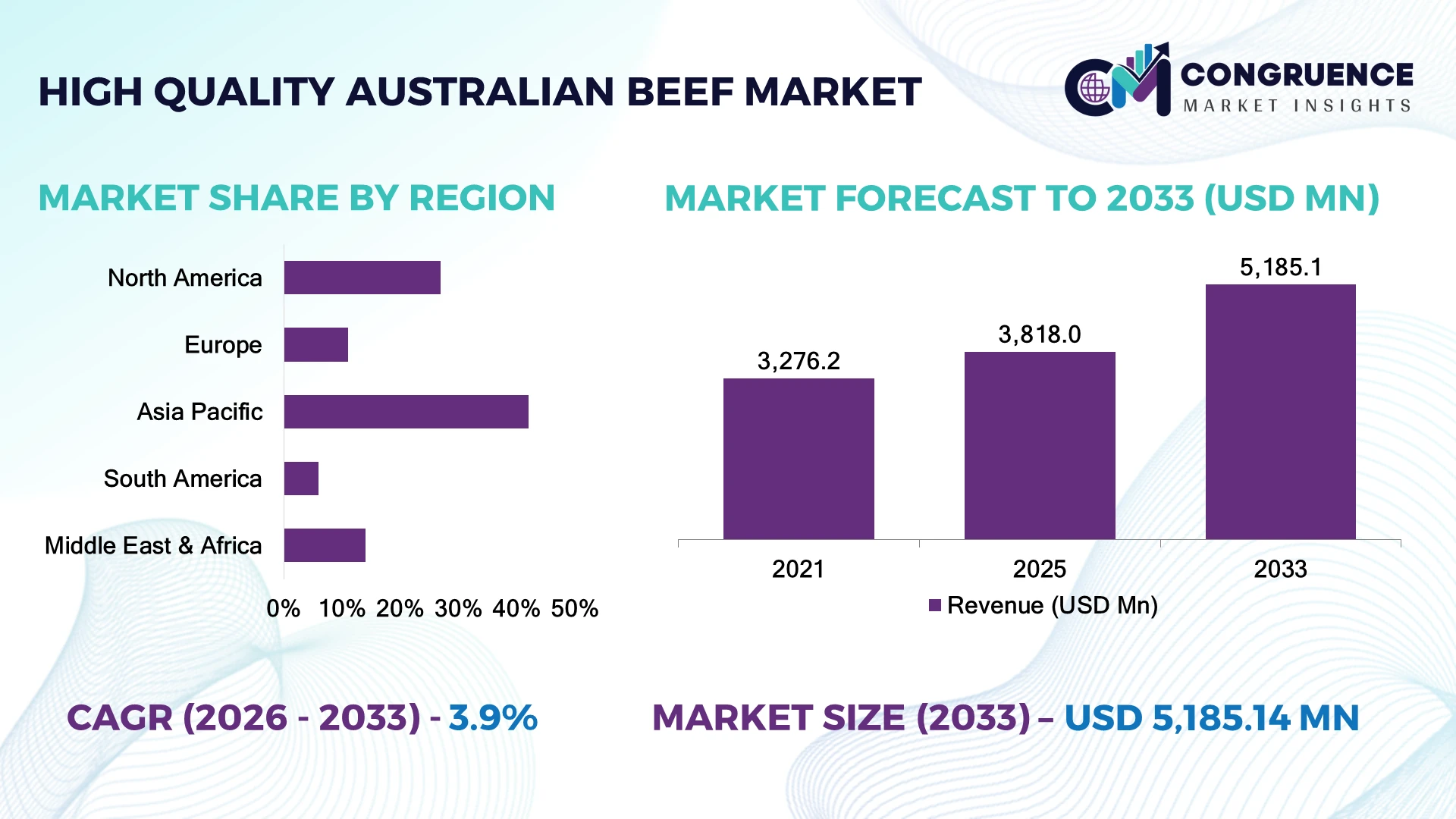
The Global High Quality Australian Beef Market was valued at USD 3,818.0 Million in 2025 and is anticipated to reach a value of USD 5,185.1 Million by 2033 expanding at a CAGR of 3.9% between 2026 and 2033. Growth is driven by premiumization of beef consumption, rising demand for traceable grainfed and grassfed products, and Australia’s advanced livestock traceability and quality-grading infrastructure.
Australia remains the dominant production and export base, supported by more than 24 million cattle and over 90 export-accredited processing facilities, while Japan and the United States remain major premium destinations; Japan accounts for roughly 30% of Australian beef export value. Technology-led traceability, automated grading, and cold-chain modernization are strengthening product consistency and export readiness.
Strategically, producers and processors should prioritize traceability, premium cuts, and high-value Asian and North American channels to protect margins and expand market positioning.
Market Size & Growth: Market value reaches USD 3,818.0 million in 2025 and USD 5,185.1 million by 2033, supported by premium product positioning, traceability, and supply-chain modernization.
Top Growth Drivers: Premiumization 45%; traceable-product preference 35%; sustainable-production adoption 30%.
Short-Term Forecast: By 2028, automated grading and digital traceability can reduce quality-assessment costs by 8% and improve processing efficiency by 12%.
Emerging Technologies: AI-assisted carcass grading, RFID-enabled livestock tracking, automated sorting, and digital cold-chain monitoring are accelerating quality consistency.
Regional Leaders: Asia-Pacific approaches USD 2.2 billion, North America USD 1.1 billion, and Europe USD 0.8 billion by 2033, with digital traceability and premium foodservice adoption strengthening across all three markets.
Consumer/End-User Trends: Around 40% of premium-meat consumers increasingly prioritize provenance, animal welfare, and production transparency when purchasing high-value beef.
Pilot/Case Example: In 2024, digital livestock identification and automated processing initiatives delivered operational improvements of approximately 10–15% in tracking and quality-control workflows.
Competitive Landscape: JBS Foods Australia, NH Foods, Thomas Foods International, Australian Agricultural Company, and Greenham Australia remain prominent competitors, with leading processors controlling roughly 30% of organized premium supply.
Regulatory & ESG Impact: Sustainability and traceability programs cover more than 30% of premium production pathways, strengthening compliance with increasingly stringent international sourcing requirements.
Investment & Funding: More than USD 500 million in recent processing, livestock, cold-chain, and export-capacity investment is supporting automation, facility modernization, and international expansion.
Innovation & Future Outlook: Next-generation Wagyu, precision livestock management, AI grading, low-emission production, and digitally verified provenance will shift competition toward measurable quality and supply-chain transparency.
The High Quality Australian Beef Market is increasingly centered on premium grainfed, grassfed, Wagyu, and traceable products across upscale retail, foodservice, and export channels. Approximately 40% of premium consumers prioritize provenance and sustainability, encouraging processors to combine digital traceability with advanced grading and cold-chain systems. Asia-Pacific remains the critical demand corridor as supply chains adapt to stricter quality, food-safety, and sustainability requirements.
The market is becoming strategically important because premium beef increasingly competes on verified quality, provenance, consistency, and supply-chain control rather than volume alone. Australia’s integrated cattle-to-processing ecosystem gives producers an advantage in export traceability, while Japan, South Korea, China, and the United States continue to absorb differentiated premium cuts. Supply-chain restructuring is also pushing processors toward closer producer relationships and digitally documented sourcing.
Technology is changing operational economics. AI-assisted carcass grading can reduce manual inspection requirements by around 10–15% while improving consistency compared with conventional visual assessment. Australia operates at substantially greater export scale than emerging premium suppliers, whereas North American markets are moving faster in retail digitization and direct-to-consumer traceability. Over the next 2–3 years, automated grading, RFID tracking, and digital provenance systems are positioned to achieve 10%+ efficiency improvements across selected processing workflows.
Companies are responding through processing upgrades, producer partnerships, premium Wagyu and grassfed portfolios, and stronger cold-chain infrastructure. Exporters serving Japan prioritize consistency and marbling, while North American operators emphasize provenance and differentiated sustainability credentials. The strategic advantage will increasingly belong to companies that connect livestock data, processing precision, certification, and premium-market distribution into one controlled value chain.
Premiumization is strengthening demand for Australian grainfed, grassfed, and Wagyu beef, with roughly 40% of premium consumers placing greater emphasis on provenance and production standards. Digital traceability adoption across modern livestock operations is improving shipment visibility by around 15%, while automated carcass assessment can raise processing consistency by 10–15%. Japan’s established premium-beef channel and expanding North American foodservice demand reinforce this shift. Companies are responding by investing in RFID identification, AI-supported grading, branded beef programs, and vertically coordinated producer networks. The non-obvious advantage is data continuity: processors that connect farm-level records with grading and export documentation can reduce quality disputes and strengthen premium pricing discipline.
Feed, energy, labor, and refrigerated logistics remain significant constraints on premium-beef margins, with operating-cost movements of 10–20% capable of materially affecting processor economics. Australia’s exposure to drought conditions and variable feed availability adds further pressure on cattle finishing costs, while long-distance exports increase cold-chain dependency. Processing facilities also face labor and automation-capital requirements that can delay capacity expansion. Companies are reducing exposure through longer-term cattle contracts, feed procurement agreements, energy-efficiency upgrades, and diversified destination markets. The key operational pressure is margin compression between farm-gate procurement and premium export pricing, making supply-chain coordination more important than simply expanding slaughter capacity.
Digital provenance creates a high-value opportunity beyond conventional beef processing. RFID livestock identification, blockchain-enabled certification, AI grading, and smart cold-chain monitoring can collectively improve operational efficiency by 10–15% while strengthening product verification. Premium Wagyu and grassfed products offer additional differentiation in Japan, South Korea, Singapore, and North America, where provenance increasingly influences purchasing decisions. Companies are expanding branded-product portfolios and partnering with technology providers, retailers, and foodservice distributors to build digitally verifiable supply chains. A particularly attractive opportunity lies in linking farm-level sustainability data with premium product labeling, allowing exporters to convert environmental and quality credentials into measurable commercial differentiation rather than treating ESG reporting as a compliance-only activity.
Scaling digital systems across Australia’s fragmented cattle-production network remains a major execution challenge. Data interoperability between farms, feedlots, processors, certification bodies, and distributors can create 15–20% workflow inefficiencies where systems remain disconnected. Skilled labor shortages and uneven technology capabilities across smaller producers further complicate standardized deployment, while evolving sustainability and animal-welfare requirements increase documentation intensity. Companies must invest in interoperable platforms, workforce training, automated quality systems, and producer partnerships to maintain consistent data integrity. The strategic challenge is not simply installing technology; it is achieving reliable adoption across the entire cattle-to-export chain. Operators that standardize data architecture and quality protocols will secure stronger scalability and more dependable premium-market compliance.
Premium Marbling Gains Momentum: Demand for Wagyu and highly marbled beef is strengthening across Japan, Southeast Asia, and the Middle East, with one in five UK consumers having purchased highly marbled beef. Australian processors are expanding differentiated grainfed portfolios and adjusting cut specifications toward premium foodservice requirements.
Digital Traceability Expands Operations: Farm-to-export traceability is moving toward integrated digital identification, with around 70% of Australian cattle raised and finished on pasture while premium supply chains increasingly connect identification, grading, and shipment records. Processors are investing in automated data capture to reduce documentation friction and improve provenance verification amid tighter buyer requirements.
Foodservice Specifications Become Precise: Commercial buyers are increasingly requesting portion-controlled, trimmed, chilled, and consistently graded products, with Australian grassfed beef representing about 70% of domestic production. This shift reduces kitchen preparation time and product waste, prompting exporters to expand tailored cutting, packaging, and specification-based supply partnerships.
Younger Buyers Reshape Premium Demand: Millennials and Gen Z are increasing interest in variety, novelty, provenance, and premium dining experiences, pushing demand toward Wagyu, grainfed, and differentiated grassfed products. Companies are responding with branded offerings, digital product information, and flexible pack formats, while supply-chain pressure encourages closer coordination between producers, processors, and foodservice distributors.
Grainfed Beef represents the leading type, accounting for approximately 55% of the market, supported by consistent marbling, tenderness, portion uniformity, and strong acceptance among premium foodservice buyers. Australia finished more than 3 million cattle through feedlot systems in 2024, reinforcing the segment’s processing scale and supply consistency. Grassfed Beef remains strategically important, representing roughly 45% of the market and benefiting from Australia’s extensive pasture systems and natural-production positioning. Companies are balancing both systems rather than replacing one with another, using grainfed products for premium consistency and grassfed products for provenance and sustainability-oriented demand.
Grassfed Beef is the faster-expanding type in several export channels, with adoption strengthened by natural-production preferences and demand for differentiated products. Its approximately 70% share of Australia’s broader cattle production base provides substantial supply flexibility, while grainfed operators continue investing in feedlot capacity and premium marbling programs. The strategic shift is toward portfolio segmentation, allowing processors to serve price-sensitive premium buyers and ultra-premium customers without compromising supply continuity.
Commercial Use is the leading application, representing approximately 80% of market demand, as restaurants, hotels, catering operators, premium butcheries, and foodservice distributors purchase larger volumes and require consistent specifications. Personal Use accounts for about 20%, supported by premium retail, specialty butcher shops, supermarkets, and online purchasing. Commercial buyers place greater emphasis on cut consistency, yield, marbling, shelf life, and delivery reliability, making operational specifications more important than simple product availability. Companies are therefore expanding portion-controlled formats, chilled distribution, and customized primal-cut programs to secure recurring contracts.
Personal Use is the faster-changing application, particularly as premium home dining and online meat purchasing become more established. Digital retail adoption is increasing product discovery and allowing consumers to compare provenance, feeding systems, and quality grades. Commercial demand remains more operationally critical because foodservice contracts generate predictable purchasing schedules, while personal-use channels provide higher opportunities for branded differentiation. Processors are responding with dual-channel portfolios, using standardized commercial packs alongside premium consumer-facing products to improve utilization and reduce inventory mismatches.
Restaurants and foodservice operators form the leading end-user group, accounting for approximately 50% of demand, supported by premium dining, hotels, catering, and chef-driven menu development. Retail Consumers represent roughly 30%, while Export Markets account for approximately 20% as international distributors and importers channel Australian beef into overseas foodservice and retail systems. Foodservice buyers demand precise specifications, reliable availability, and consistent grading, creating higher operational requirements than household purchasing. Companies are responding through dedicated foodservice portfolios, customized cuts, portion control, and supply agreements designed around menu and yield requirements.
Export Markets represent the fastest-expanding strategic end-user group, particularly where Australian provenance and quality differentiation command premium positioning. Export-oriented processors are strengthening relationships with Japanese, Chinese, South Korean, North American, and Middle Eastern buyers, while retail-focused companies emphasize traceability and consumer education. The competitive shift is toward end-user specialization: foodservice contracts prioritize consistency and yield, whereas retail and export channels increasingly reward provenance, packaging flexibility, and differentiated product credentials.
Asia-Pacific accounted for the largest market share at 42% in 2025 however, Middle East & Africa is expected to register the fastest growth, expanding at a CAGR of 4.6% between 2026 and 2033.
North America accounted for approximately 27% of the global market in 2025, with the United States representing the principal demand center. Australian beef shipments to the United States exceeded 453,000 tonnes in 2025, representing about 29% of Australia’s total beef exports. Tight domestic cattle supplies are increasing reliance on imported lean and premium beef, while Australian grainfed products strengthen high-end foodservice positioning. Automated grading, cold-chain monitoring, and specification-based cutting are improving consistency across distributor networks. The U.S. market also demonstrated resilience during the 2025 tariff disruption, reinforcing the value of diversified sourcing. Processors are expanding U.S. distributor partnerships and prioritizing chilled premium cuts, while Australian exporters are allocating greater capacity toward high-margin foodservice and manufacturing channels.
United States Market Outlook: The United States is the most strategically significant North American market because of its enormous beef-processing infrastructure and persistent supply imbalance. Australian suppliers benefit from established importer relationships, sophisticated cold-chain logistics, and strong demand from foodservice and manufacturing buyers. The country's advanced retail and restaurant infrastructure also supports differentiated Wagyu, grassfed, and grainfed product positioning.
Europe accounted for approximately 11% of the global market in 2025, with demand concentrated in premium foodservice, specialty retail, and sustainability-oriented procurement. Australia's high-quality beef access remains constrained by tariff-rate quotas, with the EU high-quality beef quota reaching 97% utilization during the 2025–26 quota year. This tight access favors established exporters capable of meeting certification, traceability, and product-specification requirements. The Australia–EU trade agreement introduces substantially greater long-term preferential access, including dedicated volumes for grassfed and grain-finished beef. European buyers are increasingly prioritizing environmental credentials, animal-welfare compliance, and provenance documentation. Australian processors are therefore strengthening certification systems, premium branding, and producer traceability while preparing supply chains for expanded quota access.
United Kingdom Market Outlook: The United Kingdom represents an important premium destination because of its established restaurant, hospitality, and specialty-meat infrastructure. The market has a dedicated Australian high-quality beef quota of 3,761 tonnes, creating a controlled channel for premium products. Australian suppliers are emphasizing grassfed credentials, provenance, and high-end foodservice relationships to differentiate from European and South American competitors.
Asia-Pacific accounted for approximately 42% of the global market in 2025, making it the largest demand center for high-quality Australian beef. China received 272,940 tonnes of Australian beef in 2025, while Japan and South Korea received 257,379 tonnes and 221,350 tonnes, respectively. These three markets collectively represented nearly half of Australia's 2025 beef exports, demonstrating the region's strategic concentration. Japanese buyers continue prioritizing marbling and consistency, Chinese foodservice operators are broadening Australian beef usage, and South Korea is strengthening premium chilled and grainfed demand. Exporters are responding with market-specific cuts, branded Wagyu programs, cold-chain partnerships, and tailored foodservice contracts. The region's sophisticated distribution infrastructure enables faster movement from processing facilities to premium restaurants and retail outlets.
Japan Market Outlook: Japan remains the most strategically established premium market, supported by sophisticated foodservice distribution, strong consumer recognition of marbled beef, and long-standing Australian supplier relationships. Australian exporters are focusing on consistent marbling, chilled logistics, and specification-driven cuts. The market's mature cold-chain infrastructure supports premium product positioning and rewards processors that maintain tight quality control from feedlot through final distribution.
South America represented approximately 6% of the global market in 2025, with premium demand concentrated in upscale hospitality, specialty retail, and urban foodservice channels. The region's large domestic cattle industries, particularly in Brazil and Argentina, limit broad-based dependence on imported Australian beef, but premium Australian products retain differentiation through grainfed consistency, Wagyu genetics, and specialized cuts. Importers face infrastructure and price-sensitivity constraints that favor targeted rather than mass-market deployment. Australian exporters are therefore concentrating on high-value accounts instead of competing directly with lower-cost regional production. Partnerships with premium distributors and restaurant groups are strengthening market access, while chilled logistics and smaller shipment configurations help reduce inventory exposure. The strategic opportunity lies in premium niches where provenance and eating quality outweigh local commodity pricing.
Brazil Market Outlook: Brazil is the region's most strategically significant market because of its massive cattle-processing ecosystem, extensive distribution infrastructure, and influential foodservice sector. Domestic production dominates mainstream beef consumption, so Australian products compete primarily through premium differentiation. Wagyu and highly marbled cuts provide a clear positioning route, while established logistics networks support selective imports into major metropolitan foodservice markets.
Middle East & Africa accounted for approximately 14% of the global market in 2025, with demand increasingly concentrated in Gulf hospitality, premium retail, catering, and institutional foodservice. The United Arab Emirates received approximately 16,783 tonnes of Australian beef, while Saudi Arabia received 15,643 tonnes, highlighting the concentration of demand in two major Gulf markets. Chilled grainfed beef represented 38% of UAE shipments, demonstrating strong premium-channel penetration. Saudi Arabia remained more heavily oriented toward frozen products, with frozen beef accounting for 71% of export value. Australian exporters are responding by expanding halal-compliant supply, chilled distribution, cold-storage partnerships, and hotel and catering contracts. Investment is increasingly directed toward temperature-controlled logistics and market-specific product formats rather than broad geographic expansion.
United Arab Emirates Market Outlook: The United Arab Emirates is the region's strongest premium-market hub because of its sophisticated hospitality industry, high concentration of international hotels, and advanced cold-chain infrastructure. Australian beef shipments to the UAE include a strong chilled component, supporting premium foodservice applications. Exporters are strengthening distributor relationships and tailoring chilled grainfed and grassfed products to high-end hospitality and catering requirements.
The competitive landscape is led by vertically integrated processors and premium beef specialists, including JBS Australia, NH Foods Australia, Teys Australia, Australian Agricultural Company, Thomas Foods International, and Greenham, competing across branded Wagyu, grainfed, grassfed, foodservice, and export channels. The top five players are estimated to control about 35% of organized premium supply, leaving room for regional processors and specialist producers. Competition centers on consistency, supply security, traceability, customization, and cold-chain execution: traceability investment can improve shipment visibility by 10–15%, while automated grading can improve processing consistency by roughly 10–15%. Players are expanding feedlot and processing capacity, building distributor partnerships, strengthening branded portfolios, and integrating producer relationships. The competitive shift is moving from volume-led processing toward data-enabled quality control and premium specification management. High capital requirements, export accreditation, livestock access, and established buyer networks remain major entry barriers. Winning requires controlled supply, measurable quality, premium branding, and reliable multi-market distribution.
JBS Australia
NH Foods Australia
Australian Agricultural Company
Thomas Foods International
Teys Australia
Greenham
Kilcoy Global Foods
Mort & Co
Stanbroke
Australian Country Choice
Bindaree Food Group
AI-assisted carcass grading is moving from pilot deployment into commercial processing. JBS Australia became the first Australian beef processor to receive AUS-MEAT objective carcase measurement approval for MEQ camera grading, with three sites approved in 2025. Compared with manual assessment, camera-based measurement improves repeatability and supports roughly 10–15% greater grading consistency. This favors processors with scale, data infrastructure, and premium specifications.
Digital traceability is becoming embedded across livestock procurement, feedlots, processing, and export documentation. RFID, NLIS-linked records, cloud platforms, and automated cold-chain monitoring can reduce documentation and reconciliation workloads by around 10%, while improving shipment visibility by approximately 15%. Vertically integrated operators gain the strongest advantage because farm, feedlot, and processing data can be connected without fragmented ownership.
From 2026–2028, smart sensors, machine vision, predictive analytics, and automated portioning will shift technology spending toward measurable yield and labor productivity. Automated workflow controls can deliver 8–12% efficiency gains in targeted processing tasks, helping offset workforce shortages and rising operating costs. Premium exporters will benefit most as verified quality data increasingly supports differentiated pricing, customized cuts, tighter international buyer specifications, faster claims resolution, and stronger compliance across complex export corridors while improving inventory planning, buyer confidence, and end-to-end supply-chain coordination globally today.
September 2025 JBS Australia partnered with MEQ and received AUS-MEAT approval for objective carcase measurement at three sites. The deployment advances camera grading and strengthens data-driven quality control across premium beef processing operations and export specifications today globally. Source: jbsfoodsgroup.com
August 2025 NH Foods’ Oakey Premium Wagyu won Gold at the Sydney Royal Fine Food Show, reinforcing its guaranteed marble-score 3–9 positioning and international premium strategy across more than 13 export markets, strengthening brand differentiation and consumer confidence. Source: nh-foods.com.au
June 2025 Australian Agricultural Company expanded its grass-fed Wagyu distribution after a successful trial and scaled value-added Westholme and 1824 products, including burgers and ground beef. The move improves carcase utilization and broadens premium demand channels internationally further. Source: aaco.com.au
September 2025 Thomas Foods International planned a A$22 million expansion of its Southern Cross Feedlot in South Australia, adding 66 shade-covered pens and lifting capacity from 27,000 to 38,000 Standard Cattle Units, strengthening domestic beef supply and employment. Source: business.sa.gov.au
The report evaluates the global High Quality Australian Beef Market across Type, Application, and End-User segments, covering Grainfed Beef, Grassfed Beef, Commercial Use, Personal Use, Restaurants and Foodservice Operators, Retail Consumers, and Export Markets. It assesses premium Wagyu, marbled beef, traceable products, branded grassfed offerings, and specialized foodservice channels.
Geographic coverage spans North America, Europe, Asia-Pacific, South America, and Middle East & Africa, with country-level analysis of major demand and export hubs. The study examines digital traceability, AI-assisted grading, cold-chain monitoring, precision livestock management, automated processing, and sustainability systems. With Asia-Pacific representing about 42% of market demand and foodservice accounting for roughly 50%, the report supports investment planning, capacity allocation, market-entry decisions, partnership development, competitive positioning, and portfolio expansion through 2026–2033.
| Report Attribute / Metric | Details |
|---|---|
| Market Revenue (2025) | USD 3,818.0 Million |
| Market Revenue (2033) | USD 5,185.1 Million |
| CAGR (2026–2033) | 3.9% |
| Base Year | 2025 |
| Forecast Period | 2026–2033 |
| Historic Period | 2021–2025 |
| Segments Covered |
By Type
By Application
By End-User
|
| Key Deliverables | Revenue Forecast; Market Trends; Growth Drivers & Restraints; Technology Insights; Segmentation Analysis; Regional Insights; Competitive Landscape; Regulatory & ESG Overview; Recent Developments |
| Regions Covered | North America; Europe; Asia-Pacific; South America; Middle East & Africa |
| Companies Profiled | JBS Australia; NH Foods Australia; Australian Agricultural Company; Thomas Foods International; Teys Australia; Greenham; Kilcoy Global Foods; Mort & Co; Stanbroke; Australian Country Choice; Bindaree Food Group; Stockyard Beef |
| Customization & Pricing | Available on Request (10% Customization Free) |




