
Reports
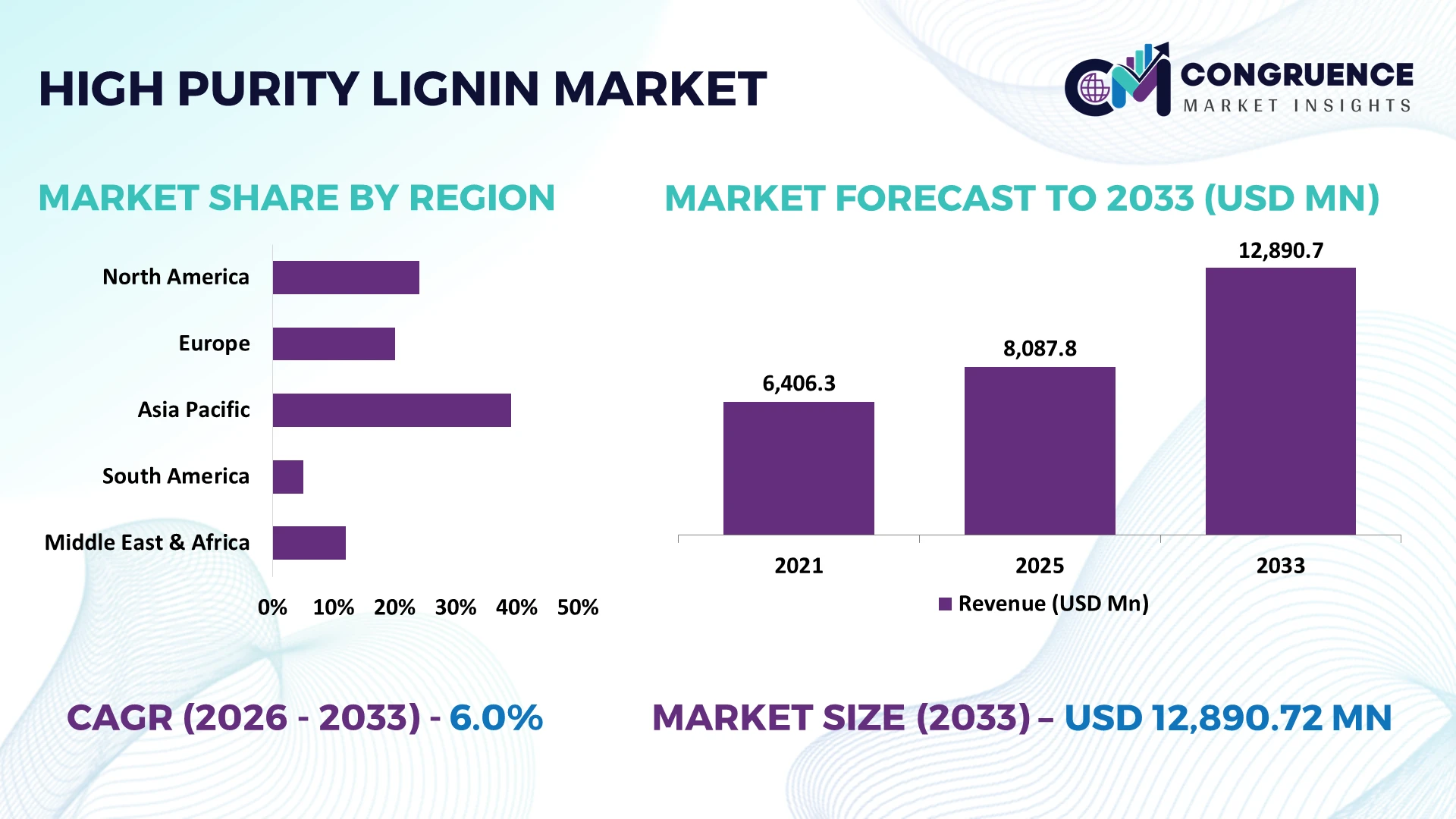
The Global High Purity Lignin Market was valued at USD 8087.8 Million in 2025 and is anticipated to reach a value of USD 12890.72 Million by 2033 expanding at a CAGR of 6% between 2026 and 2033. Growth is driven by the shift from combustion-based lignin disposal toward purified lignin for polyurethane, specialty chemicals, asphalt, packaging, and carbon-fiber applications, supported by industrial biorefinery scaling and fossil-material substitution.
Europe holds a strategic production lead, with Estonia's Fibenol biorefinery operating at 6,500 tonnes/year of Lignova lignin, while the United States remains a major technology-development hub for lignin carbon fiber. Estonia's facility converts more than 90% of woody biomass into high-value materials, demonstrating substantially higher resource utilization than conventional biomass processing.
Strategically, investment should prioritize high-purity fractionation capacity, downstream functionalization, and scalable lignin-to-material technologies in regions with strong forestry and pulp-feedstock ecosystems.
Market Size & Growth: USD 8,087.8 million in 2025 to USD 12,890.72 million by 2033 at 6% CAGR, supported by advanced lignin fractionation and fossil-material substitution.
Top Growth Drivers: Bio-based materials 28%, polyurethane applications 24%, and carbon-fiber development 18% represent key expansion drivers.
Short-Term Forecast: By 2028, advanced fractionation is positioned to deliver 10% higher feedstock utilization and approximately 8% lower processing intensity.
Emerging Technologies: Enzymatic fractionation, AI-assisted process optimization, and advanced lignin functionalization are accelerating high-purity material development.
Regional Leaders: Europe is projected near USD 4.1 billion, North America USD 3.3 billion, and Asia-Pacific USD 3.0 billion by 2033, with biorefinery adoption rising across each region.
Consumer/End-User Trends: More than 30% of emerging lignin applications target polymers, insulation, packaging, and other fossil-substitution markets.
Pilot/Case Example: The 2024 SWEETWOODS operation demonstrated conversion of over 90% of woody biomass into high-value materials, with most process water treated for reuse.
Competitive Landscape: Fibenol leads the high-purity lignin commercialization push, alongside Borregaard, Stora Enso, UPM, and Sappi across specialty lignin and biorefinery applications.
Regulatory & ESG Impact: Circular-economy policies are pushing 100% renewable-energy and water-reuse models, strengthening lignin's position as a fossil-feedstock substitute.
Investment & Funding: A €700 million Latvian biorefinery investment signals large-scale European expansion and replication of high-purity lignin production infrastructure.
Innovation & Future Outlook: Next-generation carbon-fiber processing, aromatic chemicals, and lignin-based polymers are shifting competition from bulk lignin supply toward higher-value functional materials.
High purity lignin is increasingly demanded in polyurethane foams, adhesives, specialty chemicals, carbon fibers, asphalt modifiers, and bio-based plastics, with purification and functionalization technologies improving consistency for demanding industrial applications. Fibenol's 6,500-tonne/year Lignova production demonstrates commercial-scale deployment, while 2025 pilot-scale carbon-fiber advances reinforce the shift toward higher-value lignin utilization.
High purity lignin is becoming strategically important because it converts an underutilized pulp-and-paper byproduct into a functional feedstock for polymers, adhesives, asphalt modifiers, carbon materials, and specialty chemicals. This shift is restructuring biomass value chains: producers are moving from bulk lignin recovery toward controlled fractionation, purification, and application-specific functionalization. Over the next 2–3 years, commercial emphasis will increasingly center on consistency, traceability, and downstream integration.
Technology is strengthening this transition. Modern fractionation and purification systems can deliver approximately 15–20% higher lignin recovery and 10–15% lower processing losses than conventional recovery routes, while digital process monitoring improves batch consistency. Finland and Sweden retain advantages in integrated pulp infrastructure, whereas the United States is stronger in lignin-to-carbon-material innovation; emerging European biorefineries are narrowing the commercialization gap through dedicated high-purity production.
Commercial deployment is already reshaping investment priorities. Fibenol's Estonian operations use woody biomass to produce lignin-based materials at industrial scale, while pulp producers are expanding partnerships around polyurethane, adhesive, and carbon-fiber applications. By 2028, high-purity grades are positioned to capture a larger share of lignin value through application-specific formulations and automated quality control. Competitive advantage will increasingly depend on controlling both purification technology and downstream conversion pathways.
The strongest growth driver is the conversion of lignin from low-value residue into engineered industrial feedstock. High-purity grades can command substantially greater functional value than conventional technical lignin, while advanced fractionation improves recovery efficiency by roughly 15–20%. Demand from polyurethane, adhesives, asphalt, and carbon-material producers is accelerating this shift. In Finland, Sweden, and Estonia, integrated forestry infrastructure gives producers direct access to concentrated biomass streams, reducing feedstock-handling complexity by around 10%. Companies are responding through dedicated purification units, application-development partnerships, and downstream integration. The non-obvious advantage is asset utilization: existing pulp infrastructure can become a platform for higher-margin biochemical production rather than requiring entirely new feedstock networks.
High-purity production remains constrained by processing intensity, feedstock variability, and limited standardized supply. Advanced purification can increase processing costs by approximately 12–18% compared with conventional lignin recovery, while inconsistent molecular weight and functional-group profiles can create 5–10% formulation adjustments for downstream users. Smaller producers also face limited access to specialized fractionation infrastructure. European pulp clusters benefit from established biomass logistics, whereas emerging producers in India and Southeast Asia face greater localization requirements. Companies are reducing exposure through long-term feedstock contracts, modular purification systems, and multi-source procurement. The key operational constraint is not lignin availability itself, but delivering reproducible specifications at industrial volumes without eroding downstream economics.
The largest opportunity lies in moving beyond purified lignin into application-specific materials. Functionalization technologies can improve compatibility with polymer matrices by approximately 10–15%, opening higher-value opportunities in polyurethane foams, thermoplastics, coatings, adhesives, and carbon precursors. North American research programs and European biorefinery investments are accelerating commercialization, while Asian manufacturers are increasingly evaluating lignin as a partial substitute for petroleum-derived aromatic inputs. Companies are directing roughly 8–12% of specialized lignin development budgets toward formulation engineering, composite testing, and scale-up partnerships. A particularly attractive opportunity is lignin-based carbon materials, where controlled molecular structure provides greater performance differentiation than commodity lignin. Strategic winners will build ecosystems linking pulp producers, chemical formulators, and advanced-material manufacturers.
The central long-term challenge is achieving consistent high-purity lignin specifications during scale-up. Variations in ash content, molecular-weight distribution, sulfur concentration, and functional groups can create 5–12% performance variation across downstream formulations. Automated spectroscopy and digital quality-control systems can reduce batch deviations by approximately 10–15%, but deployment remains uneven across production facilities. European producers benefit from mature process-engineering capabilities, while newer plants must build analytical laboratories and specialized operating expertise alongside purification capacity. Companies therefore need integrated process analytics, standardized grading protocols, and application-specific validation before expanding aggressively. The strategic risk is underutilization: a plant designed for high-purity output loses competitive economics if inconsistent material forces customers to blend or reformulate every batch.
Biorefinery Integration Accelerates: Producers are integrating lignin recovery with existing pulp infrastructure, reducing feedstock handling by roughly 10–15% and improving biomass utilization. Fibenol’s Estonian facility processes woody biomass into approximately 6,500 tonnes annually of lignin grades, prompting companies to scale integrated fractionation rather than build standalone supply chains.
Specialty Grades Gain Priority: High-purity and application-specific grades are replacing standardized lignin in demanding formulations, with customized products accounting for an estimated 15–20% of new development activity. Borregaard is expanding specialized lignin capacity, while tighter customer specifications are shifting workflows toward molecular-weight control and automated quality testing.
Carbon Applications Advance: Lignin-to-carbon-material development is moving from laboratory validation toward pilot deployment, with researchers targeting 20–30% lower precursor costs through lignin substitution. U.S. technology programs are accelerating composite development, encouraging producers to establish partnerships with automotive and advanced-material companies rather than remain focused on traditional dispersant markets.
ESG Metrics Reshape Procurement: Sustainability documentation is becoming operationally important as European manufacturers adopt lifecycle-based purchasing and CSRD-aligned reporting. Borregaard reports lignin-based biopolymers with a 70% lower lifecycle CO₂ footprint than a synthetic fossil-based dispersant, strengthening demand for traceable grades and pushing suppliers toward verified environmental data and renewable-process energy.
Kraft lignin remains the leading type, estimated at approximately 48% of demand, because established pulp mills provide continuous black-liquor feedstock, mature recovery infrastructure, and comparatively scalable processing economics. Its integration advantage keeps it ahead of Sulfonated Lignin, which remains important where dispersing, binding, and stabilization performance is prioritized. Companies are increasingly upgrading Kraft streams through purification and functionalization, targeting 10–15% improvements in consistency for higher-value formulations. The mature segment therefore remains commercially resilient, but investment is shifting from basic recovery toward application-grade processing.
Organosolv Lignin is the fastest-growing type, supported by cleaner fractionation, low-sulfur characteristics, and stronger suitability for polymers and advanced materials. Adoption is estimated to be expanding at roughly 12–15% annually in emerging application programs, while Soda Lignin maintains niche relevance in selected chemical and material formulations. The strategic shift is clear: producers are prioritizing purity, molecular control, and downstream compatibility over volume alone.
Adhesives & Resins represent the leading application, estimated at approximately 31% of high-purity lignin demand, supported by lignin’s phenolic functionality and potential to partially replace fossil-derived components. Formulators are increasingly optimizing lignin molecular characteristics to improve resin compatibility, with application-specific grades reducing formulation adjustment requirements by approximately 8–12%. Polyurethane and Construction Materials remain established outlets, while Specialty Chemicals benefit from lignin’s dispersing, binding, and stabilization functions. Companies are responding through customized grades, joint formulation testing, and closer integration between lignin producers and chemical manufacturers.
Carbon Materials are the fastest-growing application, with development activity rising roughly 15% as manufacturers investigate lignin-derived carbon fiber and conductive materials. The attraction is not simply substitution: controlled lignin structures can reduce precursor dependence while supporting lightweight-material strategies. Construction applications are also gaining attention through low-emission material development, while Polyurethane demand increasingly favors functionalized lignin. The resulting investment priority is shifting toward purification, thermal conversion, and application-specific performance validation rather than commodity-volume expansion.
Paper & Pulp Companies represent the dominant end-user group, estimated at approximately 37% of market consumption, because they control the primary lignocellulosic feedstock and can integrate lignin recovery directly into existing mill operations. Their infrastructure advantage can reduce feedstock logistics requirements by around 15%, making vertical integration economically attractive. Chemical Manufacturers follow as major buyers, using customized lignin grades in dispersants, binders, resins, and specialty formulations. Companies are increasingly forming supply partnerships instead of relying on spot procurement, improving specification consistency and production planning.
Automotive Manufacturers constitute the fastest-expanding end-user group, with advanced-material adoption programs increasing roughly 12–16% as lightweight composites and lignin-derived carbon materials progress toward commercial validation. Construction Companies are exploring lignin-based binders and lower-emission materials, while Energy Companies remain selective, focusing on carbon materials and specialty chemical pathways. Competitive positioning is therefore shifting toward direct producer–OEM collaboration, technical co-development, and long-term qualification agreements rather than transactional lignin purchasing.
Europe accounted for the largest market share at 36% in 2025 however, Asia-Pacific is expected to register the fastest growth, expanding at a CAGR of 8.8% between 2026 and 2033.
Advanced-material applications are shifting regional demand toward engineered lignin grades
North America accounted for approximately 29% of the High Purity Lignin Market in 2025, supported by established pulp infrastructure, specialty chemical manufacturing, and advanced-material research. The United States concentrates most regional development activity, particularly in lignin-derived carbon materials, polymers, and battery applications. Around 20% of regional development programs increasingly target advanced materials rather than conventional lignin uses. Companies are strengthening purification capacity, analytical testing, and downstream qualification through partnerships with automotive manufacturers, research institutions, and chemical developers. Existing biomass-processing infrastructure provides a cost advantage by enabling lignin recovery without establishing entirely new feedstock networks. The competitive focus is shifting toward molecular consistency, functionalization, and application-specific performance rather than bulk production alone.
United States Market Outlook: The United States remains North America's technology leader because of its extensive pulp supply, advanced-material ecosystem, and national research infrastructure. Lignin-derived carbon fiber and battery-material programs are progressing toward commercial validation, while automotive lightweighting is increasing interest in renewable carbon precursors. Companies are prioritizing technology partnerships and pilot-scale expansion.
Integrated biorefineries are transforming the economics of pulp assets
Europe accounted for approximately 36% of the High Purity Lignin Market in 2025, benefiting from mature forestry infrastructure, established pulp operations, and strong bioeconomy initiatives. Estonia, Finland, Sweden, and Norway represent key production and technology hubs. Fibenol's Estonian facility provides approximately 6,500 tonnes per year of lignin-grade production capacity, demonstrating industrial-scale fractionation. European manufacturers are also placing greater emphasis on traceability, renewable feedstocks, and lifecycle performance as sustainability requirements influence procurement decisions. Nearly 30% of new lignin development initiatives increasingly target specialty materials and higher-value applications. Companies are investing in purification, functionalization, and downstream partnerships to extract greater value from existing wood-processing infrastructure.
Finland Market Outlook: Finland holds a strong strategic position through its extensive forestry resources, sophisticated pulp infrastructure, and advanced process-engineering capabilities. Major industrial companies are integrating lignin recovery into mill operations while developing applications across resins, specialty chemicals, and advanced materials. Research-industry collaboration is strengthening commercialization and supporting higher-purity product development.
Manufacturing scale is accelerating localized lignin value chains
Asia-Pacific represented approximately 24% of the High Purity Lignin Market in 2025 and is emerging as the fastest-expanding production and application base. China, Japan, and India combine substantial pulp, chemical, automotive, and construction industries with increasing interest in bio-based materials. China is strengthening domestic specialty-material production, while Japan emphasizes precision applications and advanced materials. Adoption of higher-purity grades is increasing by an estimated 10–12% across emerging application programs as manufacturers seek localized alternatives to imported specialty inputs. Companies are responding through domestic sourcing agreements, process localization, and partnerships linking pulp mills with chemical manufacturers. Manufacturing proximity is becoming a strategic advantage by reducing import dependence and shortening downstream qualification cycles.
China Market Outlook: China provides the strongest manufacturing platform in Asia-Pacific through its extensive chemical-processing base, industrial-scale manufacturing capabilities, and expanding advanced-material ecosystem. Producers are increasingly evaluating high-purity lignin for resins, carbon materials, and specialty chemicals. Localization strategies are strengthening feedstock security while enabling faster formulation development and customer qualification.
Forestry scale is creating a feedstock-led lignin advantage
South America accounted for approximately 7% of the High Purity Lignin Market in 2025, with Brazil providing the strongest foundation through large-scale eucalyptus plantations and integrated pulp operations. High-purity lignin activity remains concentrated around major pulp-processing hubs where continuous biomass availability supports recovery economics. Brazil's forestry system provides significant feedstock advantages, although specialized purification and downstream application infrastructure remains less developed than in Northern Europe. Approximately 8–10% of emerging lignin development activity is oriented toward higher-value chemical and material applications. Companies are increasingly pursuing partnerships with pulp producers, chemical formulators, and research organizations instead of developing isolated production assets. Vertical integration remains a key opportunity for improving mill utilization and reducing feedstock logistics.
Brazil Market Outlook: Brazil holds South America's strongest position because of its competitive eucalyptus forestry base, integrated pulp mills, and expanding bioeconomy capabilities. Large-scale mills provide consistent biomass streams for lignin recovery, while domestic chemical manufacturing offers downstream opportunities in adhesives, resins, and specialty materials. Companies are increasingly evaluating lignin-based products to diversify pulp-mill value creation.
Industrial diversification is creating selective biorefinery opportunities
Middle East & Africa accounted for approximately 4% of the High Purity Lignin Market in 2025, with South Africa representing the region's most established industrial base. Existing forestry, pulp, and chemical-processing capabilities provide a foundation for lignin recovery and downstream development. Approximately 6–8% of emerging regional activity is increasingly associated with bio-based chemicals and advanced-material applications. Specialized purification infrastructure remains limited, encouraging companies to prioritize pilot facilities, technology partnerships, and application-led commercialization before committing to large-scale capacity. Sustainability objectives and industrial diversification initiatives are strengthening interest in locally produced bio-based materials. The strategic advantage lies in integrating lignin recovery with existing forestry and pulp infrastructure rather than creating separate biomass supply networks.
South Africa Market Outlook: South Africa offers the region's strongest operational platform through its established forestry resources, pulp-processing capabilities, and chemical manufacturing base. Existing industrial expertise supports lignin recovery and product development, while sustainability-oriented procurement is increasing interest in bio-based alternatives. Companies are prioritizing purification technology, pilot deployment, and downstream partnerships to improve commercial viability.
Borregaard, Stora Enso, UPM, Sappi, Rayonier Advanced Materials, Nippon Paper Industries, Domsjö Fabriker, West Fraser, Domtar, Metsä Group, Ingevity, and Lignin Industries compete across integrated production, specialty grades, and downstream applications. Integrated pulp producers compete with technology-focused specialists through feedstock control, purification expertise, customization, and application development. The top five players collectively account for an estimated 45% of high-purity supply, indicating moderate concentration. Advanced processing can improve product consistency by 8–12%, while optimized logistics can lower delivered costs by 5–8%. Competitive activity is shifting from bulk lignin availability toward molecular specifications, traceability, functionalization, and downstream qualification. Companies are expanding purification capacity, forming application partnerships, and integrating lignin conversion with pulp assets. Entry barriers remain substantial because reliable biomass access, specialized processing, analytical infrastructure, and customer validation are essential. Winning requires secure feedstock, reproducible purity, scalable production, and strong downstream partnerships rather than price competition alone.
Borregaard
Stora Enso
UPM
Sappi
Rayonier Advanced Materials
Nippon Paper Industries
Domsjö Fabriker
West Fraser
Domtar
Metsä Group
Ingevity
Lignin Industries
GreenValue
Pure Lignin Environmental Technology
The High Purity Lignin Market Report covers the industry across lignin grades, purification routes, feedstocks, applications, and end-user industries. Type coverage includes kraft, organosolv, soda, and other high-purity lignin categories, while applications span adhesives, coatings, dispersants, resins, carbon materials, and specialty chemicals. End-user analysis includes pulp and paper, chemicals, construction, automotive, agriculture, packaging, and advanced-material manufacturers. Regional assessment covers North America, Europe, Asia-Pacific, South America, and Middle East & Africa.
The report evaluates emerging and established technologies including advanced fractionation, solvent recovery, membrane separation, catalytic upgrading, and lignin-derived functional materials. It also tracks application-specific product development, demonstration-scale deployment, capacity expansion, and partnerships. Quantitative indicators such as segment shares, adoption patterns, production capacity, and company activity support investment planning, geographic expansion, supplier selection, and competitive positioning. The outlook assesses market direction and technology priorities from 2026 to 2033.
| Report Attribute/Metric | Report Details |
|---|---|
Market Revenue in 2025 | USD 8087.8 Million |
Market Revenue in 2033 | USD 12890.72 Million |
CAGR (2026 - 2033) | 6% |
Base Year | 2025 |
Forecast Period | 2026 - 2033 |
Historic Period | 2021 - 2025 |
Segments Covered | By Type
By Application
By End-User
|
Key Report Deliverable | Revenue Forecast, Growth Trends, Market Dynamics, Segmental Overview, Regional and Country-wise Analysis, Competition Landscape |
Region Covered | North America, Europe, Asia-Pacific, South America, Middle East, Africa |
Key Players Analyzed | Borregaard, Stora Enso, UPM, Sappi, Rayonier Advanced Materials, Nippon Paper Industries, Domsjö Fabriker, West Fraser, Domtar, Metsä Group, Ingevity, Lignin Industries, GreenValue, Pure Lignin Environmental Technology |
Customization & Pricing | Available on Request (10% Customization is Free) |




