
Reports
The Global High Protein Yoghurt Market was valued at USD 1,757.6 Million in 2025 and is anticipated to reach a value of USD 2,887.0 Million by 2033 expanding at a CAGR of 6.4% between 2026 and 2033. Growth is being driven by high-protein nutrition positioning, Greek-style formulations, convenient meal-replacement formats, and reformulation toward higher protein density with lower sugar.
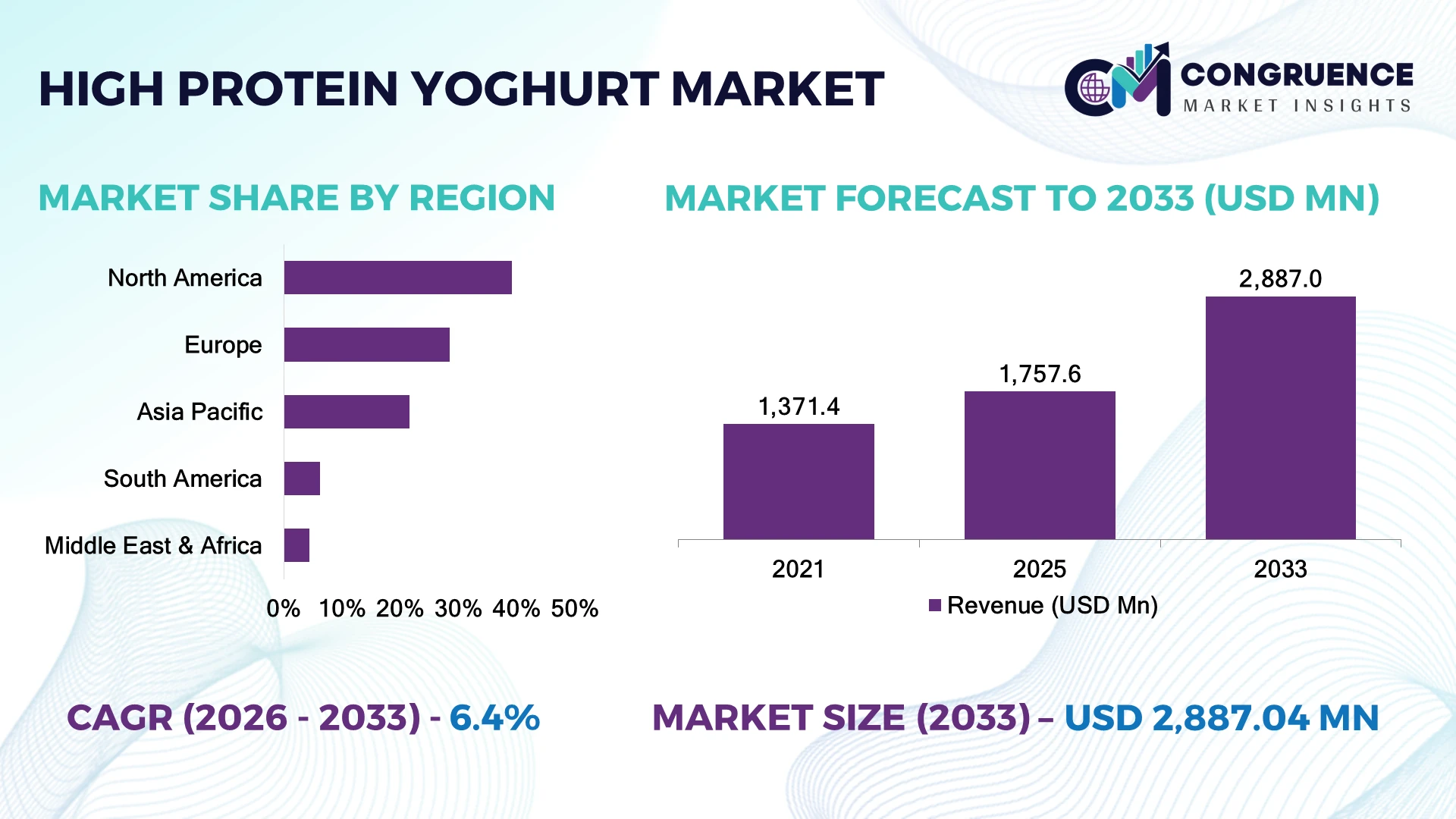
The United States represents the dominant consumption base at approximately 38% share, supported by mature Greek-yoghurt penetration, refrigerated retail infrastructure, and strong sports-nutrition crossover. Germany accounts for roughly 8%, while China is expanding through premium chilled dairy and fitness-oriented products. In 2026, manufacturers are prioritizing formulations delivering 15–25g protein per serving, while geopolitical pressure on dairy inputs is encouraging localized milk procurement and shorter cold-chain networks.
Strategic implication: manufacturers with high-protein formulation expertise, efficient chilled distribution, and differentiated functional positioning are best positioned to capture premium shelf space.
Market Size & Growth: USD 1,757.6 Million in 2025 to USD 2,887.0 Million by 2033 at 6.4% CAGR, supported by Greek-style products and protein-focused reformulation.
Top Growth Drivers: Sports nutrition adoption 8–12%; meal-replacement usage 7–10%; high-protein breakfast consumption 6–9%.
Short-Term Forecast: By 2028, automated filling and dosing can improve production efficiency 8–12% while reducing formulation waste 3–6%.
Emerging Technologies: AI-assisted formulation, automated protein dosing, precision fermentation, and advanced cold-chain monitoring are reshaping premium yoghurt production.
Regional Leaders: North America approaches USD 1.0 billion; Europe exceeds USD 700 million; Asia-Pacific approaches USD 600 million, supported by expanding chilled-dairy penetration.
Consumer/End-User Trends: Products delivering 15–25g protein per serving increasingly target fitness, weight-management, and convenient nutrition occasions.
Pilot/Case Example: 2026 high-protein formulation programs are targeting 20–30% higher protein density while maintaining spoonability and acceptable sensory performance.
Competitive Landscape: Chobani leads premium Greek-style positioning at roughly 10–12% share, competing with Danone, FAGE, Nestlé, and Lactalis.
Regulatory & ESG Impact: Reformulation toward lower sugar and cleaner labels is reducing sugar content by approximately 10–20% across selected premium launches.
Investment & Funding: More than USD 500 million in combined dairy-capacity, processing, and product-development investment is supporting protein-focused expansion and cold-chain modernization.
Innovation & Future Outlook: Next-generation products emphasize 20g+ protein, reduced sugar, functional cultures, recyclable packaging, and localized dairy supply chains.
High protein yoghurt demand is concentrated across Greek yoghurt, skyr, drinkable yoghurt, functional snacks, breakfast products, and sports-nutrition formats, with premium products increasingly delivering 15–25g protein per serving. Automated protein dosing and texture optimization are improving formulation consistency, while reduced-sugar variants represent roughly 10–20% of new premium positioning. In 2026, dairy processors are also strengthening localized milk procurement and cold-chain resilience as input and logistics volatility reshape product economics. These shifts create a clear transition toward functional, convenient, and nutritionally dense chilled dairy.
High protein yoghurt is becoming strategically important because it sits at the intersection of dairy processing, sports nutrition, functional food, and convenient meal replacement. Protein density has shifted from a niche nutritional attribute to a central product-positioning tool, enabling manufacturers to command premium shelf space while competing against protein bars, shakes, and ready-to-drink beverages. Products containing 15–25g protein per serving increasingly bridge breakfast, snacking, and post-exercise consumption.
Manufacturing is also becoming more formulation-intensive. Automated ingredient dosing and inline quality controls can improve batch consistency by approximately 5–10% compared with manually controlled processes, while precision fermentation and improved milk-protein concentration expand formulation flexibility. North America remains the most developed premium market, whereas Asia-Pacific is moving faster through urban fitness adoption, modern retail penetration, and expanding refrigerated distribution.
Over the next 2–3 years, companies are expected to prioritize higher-protein, lower-sugar formulations, localized dairy sourcing, and recyclable packaging. Major processors are combining product launches with cold-chain investments and retailer partnerships rather than relying solely on advertising-led growth. The strategic winners will be companies that integrate protein science, sensory performance, supply-chain efficiency, and scalable chilled distribution into one defensible product platform.
Protein-focused nutrition is shifting yoghurt from a conventional dairy snack toward a functional meal and sports-nutrition format. Products delivering 15–25g protein per serving are gaining shelf visibility, while Greek-style and strained formulations typically command 10–20% premium pricing over conventional yoghurt. In the United States, fitness-oriented consumption and weight-management occasions are accelerating premiumization, while European manufacturers are expanding skyr and high-protein cultured products. Automated protein dosing and standardized milk-protein concentrates are improving batch consistency by approximately 5–10%. Companies are responding through dedicated high-protein production lines, reformulation programs, and retailer partnerships. The strategic shift is significant: protein content is increasingly becoming the primary product architecture, allowing manufacturers to differentiate through nutrition credentials rather than flavor extensions alone.
High-protein yoghurt requires greater milk-solids concentration, protein ingredients, processing intensity, and refrigerated handling than conventional yoghurt, increasing formulation and manufacturing costs by approximately 10–20%. Milk and whey-protein input volatility can create additional 5–15% procurement variation, particularly when processors depend on imported concentrates. In India, fragmented cold-chain infrastructure also increases distribution losses and inventory requirements compared with mature U.S. refrigerated networks. Texture correction further complicates economics because excessive protein concentration can produce chalkiness or excessive viscosity, increasing reformulation cycles by 10–15%. Manufacturers are mitigating exposure through domestic milk procurement, long-term ingredient contracts, optimized protein blends, and localized production. A non-obvious constraint is that higher protein does not automatically justify higher pricing; sensory quality and spoonability increasingly determine repeat purchase.
The next opportunity lies in tailoring high-protein yoghurt to specific nutritional occasions rather than selling a single premium formulation. Products combining 20g+ protein with probiotics, reduced sugar, fiber, or micronutrients can address sports recovery, satiety, healthy ageing, and meal replacement. Precision formulation can reduce protein over-dosing by approximately 5–10%, improving ingredient economics while maintaining declared nutritional targets. Digital formulation tools and automated dosing can also shorten product-development iterations by 10–20%. China and India offer significant whitespace as modern chilled retail and fitness participation expand beyond major metropolitan centers. Companies are investing in application laboratories, contract manufacturing partnerships, and localized SKU development. The strategic opportunity is to use one production platform for multiple nutritional propositions, increasing line utilization while reducing the cost of launching differentiated products.
Increasing protein concentration creates technical challenges involving viscosity, syneresis, acidity, mouthfeel, and refrigerated stability. At high inclusion levels, protein-fortified yoghurt can require 10–20% more formulation adjustment than conventional products, while inadequate stabilization can increase whey separation and consumer rejection. Manufacturers must also maintain live-culture performance through processing and shelf life, particularly when combining protein concentrates with sweeteners, fibers, or functional ingredients. In the United States and Europe, clean-label positioning further limits reliance on certain texture-modifying systems. Companies are addressing these constraints through advanced homogenization, milk-protein fractionation, culture selection, and pilot-scale sensory testing. The critical long-term issue is scalability: a formulation that performs well in laboratory batches must retain texture and nutritional consistency across high-volume filling lines, seasonal milk variation, and extended refrigerated distribution.
Protein Claims Become More Precise: Premium yoghurt launches increasingly target 15–25g protein per serving, compared with roughly 5–10g in conventional products. Manufacturers are tightening nutritional formulation and front-of-pack communication, while reducing sugar by approximately 10–20% to strengthen the health proposition. The non-obvious shift is toward measurable protein density rather than simply using “high-protein” positioning.
Drinkable Formats Gain Functional Reach: High-protein drinkable yoghurt is expanding beyond breakfast into post-workout and on-the-go occasions, with selected products delivering 20g+ protein in portable formats. Liquid products can require 5–10% greater viscosity-control precision than spoonable yoghurt. Producers are investing in aseptic-compatible processing, improved stabilizer systems, and single-serve packaging to broaden consumption occasions.
Protein Blends Improve Texture Control: Manufacturers are increasingly combining milk-protein concentrate, whey proteins, and casein fractions rather than relying on one protein source. Optimized blends can reduce chalkiness and improve perceived smoothness by approximately 5–10%, while lowering formulation adjustment requirements. U.S. and European processors are prioritizing proprietary protein systems as a differentiation tool rather than competing solely on protein quantity.
Cold-Chain Efficiency Gains Priority: Refrigerated distribution is becoming a larger operational focus as high-protein products expand into India, China, and secondary U.S. markets. Route optimization and temperature monitoring can reduce avoidable cold-chain losses by approximately 5–10%. Dairy companies are responding with regional manufacturing, shorter delivery routes, digital temperature tracking, and retailer-level inventory coordination to protect shelf life and minimize write-offs.
Greek-style high protein yoghurt accounts for approximately 48–52% of global high protein yoghurt demand, supported by established consumer recognition, naturally higher protein concentration through straining, and broad compatibility with low-fat and reduced-sugar formulations. Skyr represents roughly 18–22%, benefiting from its dense texture and strong protein credentials, while conventional protein-fortified yoghurt contributes around 15–18%. Plant-based high-protein yoghurt remains smaller at approximately 8–12% but is the fastest-growing type, supported by soy, pea, and blended-protein formulations targeting flexitarian consumers. Companies are expanding protein fortification while improving texture and reducing ingredient complexity.
Skyr and plant-based formats are gaining shelf space as manufacturers diversify beyond conventional Greek yoghurt. Plant-based products typically command 10–20% premium pricing, while improved protein systems are reducing texture penalties and widening mainstream acceptance. In the United States, companies are scaling single-serve Greek formats, whereas European producers are emphasizing skyr and functional cultured products. Investment is shifting toward protein systems, fermentation control, and differentiated formats rather than basic yoghurt capacity.
Mintel's 2025 yoghurt innovation review identifies protein claims as a major innovation driver, with European launches increasingly using high-protein positioning while Asian manufacturers combine protein-rich recipes with cleaner-label formulations.
Breakfast and everyday nutrition represent approximately 38–42% of high protein yoghurt demand, making the category's largest application through convenient morning meals, cereal combinations, and fruit-based consumption. Sports nutrition follows at approximately 25–29%, supported by consumers seeking 15–25g protein servings without preparing shakes. Snack consumption contributes roughly 18–22%, while meal replacement and other functional applications account for 10–14%. Breakfast remains structurally mature, but its protein-density upgrade is expanding yoghurt's role from traditional dairy into functional nutrition. Companies are increasing single-serve packaging, larger family formats, and reduced-sugar formulations to capture different consumption occasions.
Sports nutrition is the fastest-growing application, expanding around 9–12% as mainstream consumers adopt protein-focused eating beyond dedicated athletes. In the United States, brands are increasingly positioning yoghurt alongside protein bars and shakes, while European producers are using skyr and strained formats to capture active-lifestyle demand. Companies are adapting through higher-protein recipes, portable packaging, and retailer partnerships. The strategic implication is that application growth increasingly depends on occasion-specific formulation rather than additional flavour proliferation.
IFIC's 2025 U.S. research found that 80% of Americans prioritize protein during at least one eating occasion each day, while one-third reported increasing their protein intake over the preceding year, reinforcing the shift toward protein-led everyday nutrition.
Households account for approximately 72–76% of high protein yoghurt consumption, reflecting widespread retail purchasing across breakfast, snacking, and family nutrition occasions. Fitness-oriented consumers represent approximately 14–18%, while foodservice and institutional buyers contribute around 7–10%. Household demand benefits from supermarket availability, multipack economics, and increasing familiarity with Greek and skyr formats. However, fitness-oriented purchasing is expanding faster, at approximately 10–13%, as protein becomes mainstream among consumers pursuing weight management, healthy ageing, and active lifestyles. Manufacturers are responding with single-serve packs, 20g-plus protein propositions, and differentiated nutritional claims.
Foodservice remains smaller but strategically relevant because cafés, gyms, hotels, and prepared-food operators can introduce high-protein yoghurt through breakfast bowls, smoothies, and grab-and-go formats. Institutional demand is also emerging around nutrition-focused meal programs. Companies are developing foodservice tubs and portion-controlled formats while strengthening partnerships with retailers and fitness channels. The key shift is that high protein yoghurt is moving from a specialist fitness purchase toward mainstream household consumption, while specialist channels increasingly influence product specifications, serving sizes, and functional claims.
IFIC's April 2026 protein-labeling research found that two-thirds of U.S. consumers look for nutrition information on the front of food packaging, making clearly communicated protein quantity and quality increasingly important at the retail decision point.
North America accounted for the largest market share at 39.2% in 2025 however, Asia-Pacific is expected to register the fastest growth, expanding at a CAGR of 8.1% between 2026 and 2033.

Protein-led premiumization strengthens refrigerated dairy economics
North America represents approximately 39.2% of global high protein yoghurt demand, supported by established Greek yoghurt consumption, extensive refrigerated retail infrastructure, and strong overlap with sports nutrition. The United States accounts for the majority of regional consumption, with premium products commonly delivering 15–25g protein per serving. Retailers are expanding dedicated functional-dairy shelf space, while manufacturers are introducing lower-sugar, high-protein, lactose-free, and drinkable formats. Automated filling and ingredient dosing can improve production efficiency by approximately 8–12%, helping processors manage increasingly complex formulations. Canada contributes through premium dairy and fitness-oriented consumption. Companies are strengthening domestic milk sourcing, expanding refrigerated distribution, and partnering with retailers and fitness channels. The strategic shift is toward everyday protein consumption, reducing dependence on the narrower traditional athlete segment.
United States Market Outlook: The United States is the region's principal high protein yoghurt market because of mature Greek yoghurt penetration, broad supermarket distribution, and strong sports-nutrition crossover. Leading products increasingly target 15–25g protein per serving while combining reduced sugar, probiotics, and convenient single-serve packaging. Large processors benefit from national cold-chain networks and retailer scale, allowing rapid rollout of differentiated protein formulations across multiple consumption occasions.
Skyr and clean-label formulations reshape premium dairy
Europe represents approximately 28.5% of global high protein yoghurt demand, with Germany, the United Kingdom, France, and the Nordic countries providing important consumption centers. Skyr and Greek-style products are particularly relevant because consumers associate dense texture with protein concentration and satiety. European manufacturers are also emphasizing reduced sugar, short ingredient lists, and functional cultures. Automated fermentation and filling systems can improve batch consistency by roughly 5–10%, supporting increasingly complex formulations. Sustainability requirements are encouraging lighter packaging and more efficient refrigerated logistics, while local dairy sourcing reduces exposure to long-distance ingredient transport. Companies are expanding high-protein portfolios through reformulation, premium private-label partnerships, and targeted launches across supermarket and convenience channels.
Germany Market Outlook: Germany provides a strong combination of dairy-processing capacity, modern grocery distribution, and established consumer interest in protein-rich foods. High-protein yoghurt is increasingly positioned alongside quark, skyr, and other functional dairy products, creating intense competition for refrigerated shelf space. Manufacturers are emphasizing reduced-sugar recipes, recyclable packaging, and efficient domestic sourcing while using established supermarket networks to scale new protein formulations quickly.
Urban fitness adoption accelerates chilled-dairy premiumization
Asia-Pacific accounts for approximately 21.6% of global high protein yoghurt demand but represents the fastest-changing consumption base. China, Japan, Australia, South Korea, and India are driving premiumization through urban fitness participation, modern grocery formats, and expanding refrigerated distribution. China provides the largest regional opportunity, while India is developing from a smaller base through Greek yoghurt, probiotic products, and fitness-oriented dairy. Protein-forward products increasingly deliver 15–20g per serving, while premium formats command approximately 10–20% higher pricing than conventional yoghurt. Manufacturers are investing in local processing, smaller pack sizes, and e-commerce-compatible cold-chain infrastructure. The strategic advantage lies in adapting protein formats to local taste preferences rather than simply replicating Western Greek yoghurt products.
China Market Outlook: China represents the region's largest high protein yoghurt opportunity because of its extensive chilled-dairy manufacturing base, modern retail penetration, and rapidly expanding functional-food culture. Urban consumers increasingly favor convenient nutrition formats, creating opportunities for drinkable and single-serve products. Manufacturers are investing in localized formulations, cold-chain distribution, and premium dairy innovation, with protein content increasingly integrated into broader wellness positioning.
Brazil anchors functional dairy expansion
South America contributes approximately 6.3% of global high protein yoghurt demand, with Brazil accounting for the majority of regional consumption. Expanding fitness culture, supermarket penetration, and interest in convenient nutrition are supporting higher-value yoghurt formats, particularly Greek-style and drinkable products. Brazil's established dairy-processing industry provides domestic milk access, while modern retailers increasingly allocate space to functional and premium chilled products. High protein formulations generally command approximately 10–18% pricing premiums over conventional yoghurt when combined with reduced sugar or probiotic positioning. Distribution remains more challenging outside major metropolitan centers, increasing the importance of regional manufacturing and cold-chain efficiency. Companies are responding through local dairy partnerships, retailer-exclusive products, and smaller pack formats. Growth is therefore becoming increasingly linked to distribution reach and affordability rather than premium positioning alone.
Brazil Market Outlook: Brazil is the strategic center of South American high protein yoghurt demand because of its large consumer base, established dairy industry, and extensive supermarket network. Domestic milk availability supports localized manufacturing, reducing dependence on imported dairy inputs. Manufacturers are increasingly targeting urban consumers with Greek-style, high-protein, reduced-sugar, and convenient single-serve products while expanding distribution beyond premium metropolitan retail.
Premium nutrition investment expands refrigerated dairy
Middle East & Africa represents approximately 4.4% of global high protein yoghurt demand, with Saudi Arabia, the United Arab Emirates, and South Africa forming the principal commercial centers. Gulf markets show strong potential for premium functional dairy because of modern retail infrastructure, fitness-oriented consumption, and high demand for convenient nutrition. Products delivering 15–20g protein per serving are increasingly positioned for breakfast, sports recovery, and weight-management occasions. Imported dairy inputs remain important in several markets, making local processing and supply-chain resilience commercially significant. Producers are investing in modern filling equipment, localized product development, and controlled-temperature logistics. The strategic opportunity is concentrated in premium urban channels where modern supermarkets, gyms, hotels, and foodservice operators can support higher-value functional dairy formats.
Saudi Arabia Market Outlook: Saudi Arabia provides the region's strongest premium opportunity through modern grocery infrastructure, domestic dairy processing, and expanding health-and-fitness consumption. Large-scale dairy producers can leverage integrated milk production, processing, and refrigerated distribution to control product quality and availability. High-protein yoghurt is increasingly suited to single-serve breakfast and fitness occasions, while localized production reduces exposure to imported finished-product logistics and strengthens response speed.
Chobani, Danone, FAGE, Lactalis, and Nestlé compete across premium Greek, skyr, functional, and high-protein yoghurt, while regional dairy processors challenge global brands through localized pricing and distribution. The top five are estimated to hold about 38% combined share. Competition centers on protein density, taste, price, innovation, and refrigerated supply chains; premium products command 10–20% pricing premiums, while automated processing can improve efficiency 5–10%. Chobani emphasizes extra-strained 15–30g protein formats, Danone expands Oikos, YoPRO, and plant-based protein platforms, while Lactalis strengthened U.S. yoghurt manufacturing through its 2025 acquisition of General Mills’ yoghurt business. The competitive shift is toward functional nutrition ecosystems, formulation control, and portfolio expansion rather than conventional yoghurt scale alone. Entry barriers include cold-chain infrastructure, dairy-processing capacity, retailer access, sensory validation, and brand trust. Winning requires differentiated protein formulations, scalable chilled distribution, rapid innovation, and disciplined ingredient sourcing.
Chobani LLC
Danone S.A.
FAGE International S.A.
Lactalis Group
Nestlé S.A.
General Mills, Inc.
Arla Foods amba
Müller Group
FrieslandCampina
Meiji Holdings Co., Ltd.
Yili Group
China Mengniu Dairy Company Limited
Sodiaal International
Fonterra Co-operative Group Limited
High-protein yoghurt manufacturing is adopting precision protein dosing, automated fermentation control, and inline viscosity monitoring. Automated dosing can improve ingredient accuracy by 1–2%, while advanced filling systems reduce product losses by 2–4%. Adoption is strongest among large processors producing multi-SKU portfolios, where tighter process control supports consistent protein declarations, texture, and portion weights.
Membrane filtration and ultrafiltration are becoming important for concentrating milk proteins before fermentation. Compared with conventional batch concentration, integrated membrane systems can reduce processing energy requirements by approximately 5–10% and improve protein recovery by 3–6%. Chobani benefits from extra-straining technology for products delivering 15g, 20g, and 30g protein, while Danone uses broader protein science across dairy and plant-based platforms. The competitive advantage shifts toward processors controlling formulation and separation capabilities.
From 2026–2028, precision fermentation, AI-assisted formulation, digital twins, and sensor-based cold-chain monitoring will strengthen product development and distribution. AI formulation can reduce trial iterations by 10–20%, while predictive refrigeration analytics can cut temperature-related losses by 5–10%. Plant-protein integration will also expand, as demonstrated by Danone’s 2026 Silk Protein Yogurt. Companies investing now in flexible processing, protein fractionation, and digital quality systems will gain faster commercialization, lower waste, and stronger differentiation across premium yoghurt formats across major markets.
July 2026 Danone launched Silk Protein Yogurt with at least 12g complete plant protein per serving, twice the segment average. The nationwide rollout broadens high-protein yoghurt into plant-based nutrition, strengthening dairy-alternative competition and expanding functional chilled offerings. Source: danone.com
June 2025 Lactalis completed its acquisition of General Mills’ U.S. yogurt business, adding two manufacturing facilities and approximately 1,000 employees. The transaction materially expands manufacturing scale and strengthens access to high-protein yogurt brands, supporting faster innovation and distribution. Source: lactalis.com
July 2025 Nestlé launched Milo Pro in Indonesia with three times more protein than traditional Milo. The ready-to-drink and powder formats target active consumers and establish a protein platform for Southeast Asian expansion, widening pressure around convenient nutrition. Source: nestle.com
August 2025 Fonterra reported Europe as its largest market for functional Whey Protein Concentrate, an ingredient used in high-protein yoghurts. Sourcing from New Zealand and the Netherlands strengthens ingredient diversification as buyers seek dairy supply amid shifting procurement. Source: fonterra.com
The High Protein Yoghurt Market Report evaluates Greek-style, skyr, conventional protein-fortified, and plant-based high-protein formats across breakfast, sports nutrition, snacking, meal replacement, and functional nutrition applications. End-user coverage includes households, fitness-oriented consumers, foodservice operators, and institutional buyers, with emphasis on 15–25g protein serving formats and premium nutritional positioning.
Regional analysis covers North America, Europe, Asia-Pacific, South America, and Middle East & Africa, with detailed assessment of the United States, Germany, China, India, Brazil, and Saudi Arabia. Technology coverage includes ultrafiltration, precision protein dosing, automated fermentation, AI-assisted formulation, advanced stabilization, and cold-chain monitoring. The report supports investment planning, capacity expansion, formulation prioritization, channel strategy, competitive positioning, and supply-chain decisions through 2033, including emerging plant-based and functional yoghurt opportunities.
| Report Attribute/Metric | Report Details |
|---|---|
|
Market Revenue in 2025 |
USD 1,757.6 Million |
|
Market Revenue in 2033 |
USD 2,887.0 Million |
|
CAGR (2026 - 2033) |
6.4% |
|
Base Year |
2025 |
|
Forecast Period |
2026 - 2033 |
|
Historic Period |
2021 - 2025 |
|
Segments Covered |
By Type
By Application
By End-User
|
|
Key Report Deliverable |
Revenue Forecast, Growth Trends, Market Dynamics, Segmental Overview, Regional and Country-wise Analysis, Competition Landscape |
|
Region Covered |
North America, Europe, Asia-Pacific, South America, Middle East, Africa |
|
Key Players Analyzed |
Chobani LLC, Danone S.A., FAGE International S.A., Lactalis Group, Nestlé S.A., General Mills, Inc., Arla Foods amba, Müller Group, FrieslandCampina, Meiji Holdings Co., Ltd., Yili Group, China Mengniu Dairy Company Limited, Sodiaal International, Fonterra Co-operative Group Limited |
|
Customization & Pricing |
Available on Request (10% Customization is Free) |




