Global High Precision Mechanical Machine Components Market Report Overview
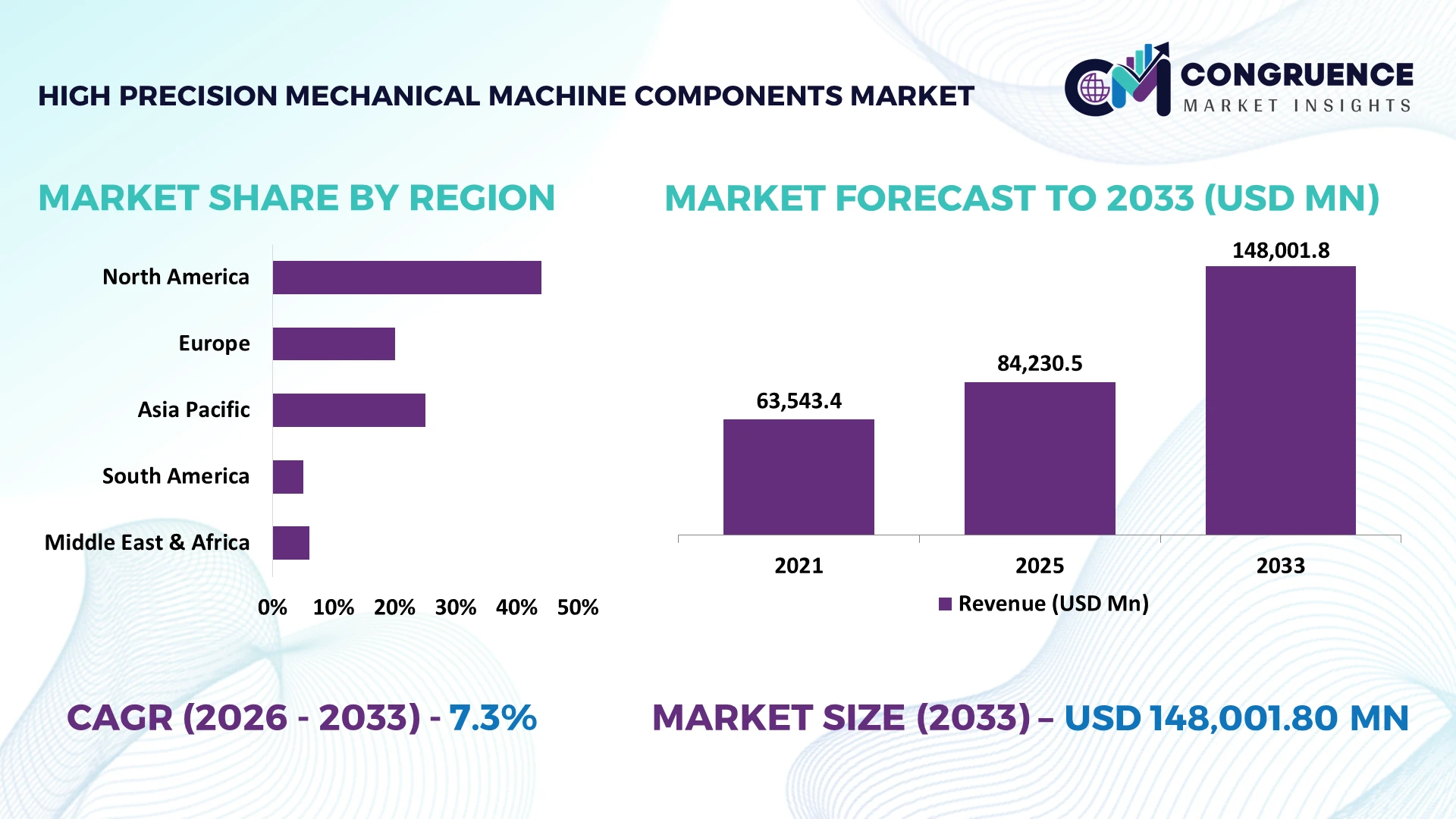
The Global High Precision Mechanical Machine Components Market was valued at USD 84230.5 Million in 2025 and is anticipated to reach a value of USD 148001.8 Million by 2033 expanding at a CAGR of 7.3% between 2026 and 2033. Growth is driven by semiconductor equipment localization, aerospace component manufacturing, advanced CNC machining, industrial robotics, and increasing requirements for micron-level dimensional accuracy.
China maintains a leading manufacturing position, accounting for approximately 30% of global manufacturing value added, compared with roughly 15% for the United States. China's industrial ecosystem supports precision bearings, linear motion systems, machine tool components, and semiconductor equipment parts. The country installed approximately 295,000 industrial robots in 2024, representing 54% of global installations, compared with approximately 44,500 installations in Japan. China's manufacturing modernization initiatives and semiconductor localization investments are strengthening domestic precision component production and automated machining capabilities.
Strategically, manufacturers should prioritize submicron machining capabilities, automated quality inspection, and localized component sourcing to secure high-value contracts across semiconductor, aerospace, and industrial automation supply chains.
Key Highlights of the Global High Precision Mechanical Machine Components Market
-
Market Size & Growth: USD 84,230.5 million in 2025, reaching USD 148,001.8 million by 2033 at 7.3% CAGR, driven by CNC automation and semiconductor equipment localization.
-
Top Growth Drivers: China's robot installations increased 20%, India's increased 15%, and global installations rose 11% in 2025, strengthening precision component demand.
-
Short-Term Forecast: By 2028, manufacturers targeting 10–15% lower machining cycle times through automated toolpath optimization will strengthen production competitiveness.
-
Emerging Technologies: Five-axis CNC machining, AI-driven metrology, and additive-subtractive manufacturing support micron-level tolerances and automated dimensional inspection.
-
Regional Leaders: Asia-Pacific leads manufacturing, with China producing 37% of global machine tools; Europe follows, with Germany contributing 12%; North America benefits from U.S. semiconductor localization.
-
Consumer/End-User Trends: Asia accounted for 74% of global industrial robot installations in 2024, concentrating demand for precision gears, bearings, and motion-control components.
-
Pilot/Case Example: China's 2025 robotics expansion reached approximately 354,000 installations, increasing 20% and supporting greater demand for precision mechanical assemblies.
-
Competitive Landscape: SKF, Schaeffler, NSK, THK, and HIWIN compete across precision bearings and linear motion systems; combined component-market shares require verification.
-
Regulatory & ESG Impact: ISO 14001 environmental management and ISO 9001 quality systems support supplier qualification, traceability, and manufacturing waste reduction.
-
Investment & Funding: TSMC announced USD 100 billion in additional U.S. semiconductor manufacturing investment in 2025, strengthening opportunities for precision equipment suppliers.
-
Innovation & Future Outlook: China's 57% domestic industrial robot supplier share in 2024 highlights increasing localization of high-precision components and manufacturing technologies.
The High Precision Mechanical Machine Components Market is increasingly shaped by semiconductor fabrication equipment, aerospace manufacturing, industrial robotics, and advanced medical devices. Five-axis machining, automated optical inspection, and digital twin technologies are strengthening production accuracy and dimensional consistency. China's 37% share of global machine tool production in 2025 illustrates its manufacturing scale, while Germany and Japan maintain specialized engineering capabilities. Semiconductor supply-chain localization and growing demand for high-tolerance mechanical assemblies are encouraging suppliers to invest in advanced metrology and automated machining. These developments establish precision engineering capabilities and supplier qualification as central strategic considerations.
What Is the Strategic Relevance and Future Pathways of the High Precision Mechanical Machine Components Market?
High precision mechanical machine components are becoming strategically essential as semiconductor fabrication, aerospace manufacturing, and industrial automation require tighter dimensional tolerances and dependable component traceability. Supply chain restructuring is shifting procurement toward qualified domestic and regional manufacturers, particularly in the United States, Japan, and China. China accounted for approximately 54% of global industrial robot installations in 2024, reinforcing demand for precision bearings, ball screws, linear guides, and mechanical transmission assemblies. Manufacturers are prioritizing localized machining capacity and advanced inspection systems to secure contracts with equipment producers.
Technology differentiation increasingly centers on five axis CNC machining, automated metrology, and digitally controlled production. Modern five axis systems consolidate operations previously requiring multiple machine setups, reducing repositioning requirements and associated alignment errors. A targeted 15% reduction in machining cycle time would increase theoretical throughput by approximately 17.6% at unchanged availability. Germany and Japan emphasize ultra precision engineering and specialized machine tools, while China benefits from manufacturing scale and extensive automation infrastructure.
TSMC's Arizona semiconductor manufacturing expansion illustrates how advanced fabrication investments create opportunities for precision component suppliers. Between 2026 and 2028, manufacturers will prioritize automated inspection, process traceability, and localized supplier qualification. Competitive advantage will depend on verified dimensional accuracy, dependable delivery performance, and consistent production quality.
High Precision Mechanical Machine Components Market Dynamics
DRIVER:
Semiconductor Localization and Industrial Automation Expansion
Semiconductor manufacturing localization and industrial robotics deployment are strengthening demand for high precision mechanical machine components. China accounted for approximately 54% of global industrial robot installations in 2024, reflecting extensive automation adoption across manufacturing facilities. Industrial robots require precision reducers, linear bearings, ball screws, and high accuracy transmission assemblies. Meanwhile, China's domestic robot manufacturers captured approximately 57% of their home market, strengthening localized component procurement. Semiconductor fabrication expansion in the United States is increasing requirements for vacuum compatible mechanical assemblies and precision motion systems. Manufacturers including THK, NSK, and Schaeffler are advancing specialized motion technologies and production capabilities. Suppliers capable of maintaining micron level tolerances and documented process stability gain stronger access to qualified equipment manufacturing contracts.
RESTRAINT:
Critical Material Dependence and Precision Manufacturing Costs
High precision mechanical component production remains constrained by specialized material requirements, advanced machine tool costs, and concentrated critical mineral processing. China accounts for approximately 91% of global rare earth refining and around 94% of permanent magnet manufacturing, creating significant supply exposure for precision motion assemblies incorporating magnetic technologies. Additionally, the United States imposed a 25% tariff on selected Chinese steel and aluminum products under Section 301 measures, increasing procurement complexity for affected industrial supply chains. High accuracy machining also requires temperature controlled environments, specialized cutting tools, and calibrated measurement equipment. Manufacturers are responding through supplier diversification, alternative material qualification, and localized machining investments. Long term procurement contracts and standardized component designs improve cost predictability while reducing dependence on individual suppliers.
OPPORTUNITY:
Intelligent Metrology and Advanced Motion Control Systems
Integration of intelligent metrology, predictive maintenance, and digital manufacturing creates opportunities for precision component manufacturers to expand beyond conventional machining services. China's domestic industrial robot suppliers held approximately 57% of their national market in 2024, creating opportunities for localized precision reducers and motion control components. Asia accounted for approximately 74% of global robot installations, concentrating demand for automated positioning technologies. A 10% reduction in inspection cycle time through automated coordinate measurement would increase theoretical inspection throughput by approximately 11.1%, assuming unchanged equipment availability. Manufacturers are investing in in-process measurement, digital twins, and sensor integrated mechanical assemblies. Between 2026 and 2028, suppliers combining precision hardware with condition monitoring capabilities will strengthen differentiation through improved maintenance planning and component lifecycle visibility.
CHALLENGE:
Submicron Quality Control and Skilled Workforce Integration
Scaling high precision component manufacturing requires consistent dimensional accuracy across production batches, increasingly complex geometries, and interconnected manufacturing systems. China's approximately 54% share of global industrial robot installations demonstrates the scale of automation integration, while its domestic suppliers' 57% market penetration intensifies competition for specialized manufacturing capabilities. Maintaining a 99.9% production acceptance rate still produces 1,000 nonconforming components per million units, highlighting the commercial importance of process capability and automated inspection. Semiconductor equipment manufacturers impose demanding cleanliness, surface finish, and traceability requirements that complicate supplier qualification. Companies must invest in closed loop machining, skilled metrology personnel, and cybersecurity protected manufacturing data systems. Sustained competitiveness depends on achieving repeatable precision without sacrificing production throughput or qualification consistency.
High Precision Mechanical Machine Components Market Latest Trends
-
Precision Manufacturing Shifts Toward Five-Axis Machining: Advanced CNC manufacturers are consolidating multiple machining operations into single setups, reducing repositioning errors and fixture requirements. Five-axis systems provide 2 additional rotational axes compared with conventional three-axis machines. Manufacturers targeting 10–15% shorter machining cycles are investing in integrated tool changers, automated workholding, and high-speed spindle technologies to improve production throughput.
-
Precision Bearing Designs Prioritize Energy Efficiency: Bearing manufacturers are introducing low-friction seals, optimized raceway geometries, and advanced lubrication systems. SKF's energy-efficient bearing designs demonstrate friction reductions of at least 30% compared with comparable standard bearings under specified conditions. Manufacturers are integrating improved surface finishing and lubricant distribution technologies, reducing mechanical losses and supporting longer maintenance intervals in high-speed industrial machinery.
-
Machine Tool Production Networks Become Regionalized: Trade restrictions and equipment localization policies are reshaping precision component procurement. China accounted for approximately 37% of global machine tool production in 2025, while Germany contributed approximately 12%. Suppliers are establishing regional machining partnerships, expanding qualified vendor networks, and maintaining alternative production locations to reduce cross-border delivery exposure and protect customer production schedules.
-
Advanced Surface Engineering Improves Component Durability: Precision component manufacturers are adopting diamond-like carbon coatings, ceramic hybrid bearings, and laser surface texturing. Certain diamond-like carbon coatings achieve friction coefficients below 0.1 under specified testing conditions, compared with approximately 0.2 for conventional untreated contact surfaces. Suppliers are expanding coating capabilities and application-specific material testing to reduce wear in demanding aerospace and industrial machinery environments.
Segmentation Analysis
By Type
Bearings Lead Established Precision Component Applications
Bearings represent a leading product category within high-precision mechanical machine components, supported by extensive use in industrial machinery, automotive production equipment, aerospace systems, and automated manufacturing. Precision bearing assemblies provide controlled rotational motion, minimize mechanical friction, and maintain dimensional stability under demanding operating conditions. SKF's energy-efficient bearing technologies demonstrate friction reductions of at least 30% under specified operating conditions, strengthening their relevance for energy-intensive machinery. Gears and Precision Shafts remain essential for torque transmission and accurate rotational alignment, particularly in machine tools and industrial equipment. Manufacturers are investing in improved steel processing, precision grinding, and advanced lubrication technologies to strengthen component performance.
Linear Motion Components represent a rapidly developing segment as robotics and automated production systems increasingly require accurate positioning and repeatable movement. Ball Screws and Lead Screws support high-accuracy feed mechanisms, while Precision Couplings compensate for shaft misalignment and protect transmission stability. China's industrial robot installations increased approximately 20% in 2025, reinforcing demand for specialized motion components. Suppliers including THK, HIWIN, and NSK are prioritizing compact designs, higher load capacity, and integrated motion solutions.
- The International Federation of Robotics reported approximately 542,000 industrial robot installations worldwide in 2024, with Asia accounting for 74%. This deployment concentration reinforces demand for precision bearings, transmission components, and linear motion assemblies across automated manufacturing systems.
By Application
Industrial Automation Leads Precision Component Integration
Industrial Automation represents a leading application for high-precision mechanical machine components, supported by extensive deployment across manufacturing equipment, automated assembly systems, and industrial production lines. Bearings, precision shafts, gears, and linear motion assemblies maintain positioning accuracy and mechanical reliability in automated operations. Global industrial robot installations reached approximately 542,000 units in 2024, demonstrating substantial equipment deployment requiring precision motion systems. Machine Tools represent another established application, where ball screws, precision couplings, and spindle bearings determine machining accuracy and production consistency. Automotive Manufacturing maintains significant demand through automated machining, component assembly, and dimensional inspection operations.
Robotics represents a rapidly expanding application as manufacturers adopt advanced articulated robots, collaborative systems, and automated material handling technologies. China's approximately 295,000 industrial robot installations in 2024 demonstrate concentrated demand for high-accuracy mechanical assemblies. Aerospace Systems require specialized components capable of maintaining dimensional stability under demanding operating conditions, while Medical Equipment emphasizes compact motion mechanisms and precision positioning. Manufacturers are developing application-specific assemblies, advanced bearing materials, and customized linear motion technologies to strengthen equipment performance and supplier differentiation.
- The International Federation of Robotics reported that China accounted for 54% of global industrial robot installations in 2024. This manufacturing concentration highlights the importance of precision mechanical components in expanding robotic production capacity and automated equipment integration.
By End-User
Industrial Machinery Manufacturers Anchor Component Procurement
Industrial Machinery Manufacturers represent a major end-user category for high-precision mechanical machine components because machine tools, industrial equipment, and automated production systems require extensive integration of bearings, gears, shafts, and motion control assemblies. China's approximately 37% contribution to global machine tool production in 2025 illustrates the scale of manufacturing activity supporting precision component procurement. Automotive Manufacturers remain established buyers through powertrain manufacturing, robotic assembly lines, and precision machining operations. Aerospace and Defense Companies prioritize specialized components requiring strict dimensional tolerances, documented material properties, and extensive supplier qualification.
Electronics and Semiconductor Manufacturers represent a rapidly developing end-user category as fabrication equipment becomes increasingly dependent on precision positioning and contamination-controlled mechanical assemblies. China's domestic industrial robot suppliers captured approximately 57% of their national market in 2024, illustrating broader equipment localization trends. Medical Equipment Manufacturers require compact precision bearings, miniature shafts, and accurate linear motion components for diagnostic and surgical systems. Suppliers are responding through customized component engineering, localized production, and application-specific qualification processes, strengthening customer relationships in technologically demanding manufacturing sectors.
- The International Federation of Robotics reported approximately 542,000 industrial robot installations globally in 2024. China's 54% installation share demonstrates substantial automation concentration, reinforcing procurement opportunities for precision component manufacturers serving industrial machinery and electronics equipment producers.
Region-Wise Market Insights
Asia-Pacific accounted for the largest market share at an estimated 46% in 2025 however, Asia-Pacific is expected to register the fastest growth, expanding at an estimated CAGR of 8.5% between 2026 and 2033.
North America High Precision Mechanical Machine Components Market
Semiconductor Reshoring and Advanced Precision Manufacturing
North America accounted for an estimated 24% of the global high-precision mechanical machine components market in 2025, supported by aerospace engineering, semiconductor equipment manufacturing, industrial automation, and advanced medical technologies. The United States dominates regional demand through precision machining clusters in California, Texas, Arizona, and Michigan. TSMC's planned expansion of its U.S. semiconductor investment to USD 165 billion strengthens opportunities for precision motion systems, vacuum-compatible assemblies, and specialized machine components. Mexico contributes through automotive manufacturing and industrial equipment supply chains, particularly in Nuevo León and Guanajuato. Canada's aerospace and industrial machinery industries support demand for high-accuracy bearings, gears, and mechanical transmission components. Manufacturers are prioritizing automated dimensional inspection, localized component sourcing, and advanced CNC machining to satisfy stringent equipment qualification requirements and reduce cross-border supply dependencies.
United States Market Outlook: The United States benefits from semiconductor manufacturing localization, aerospace engineering expertise, and extensive precision machining infrastructure. The CHIPS and Science Act provides USD 52.7 billion for semiconductor manufacturing, research, and workforce development. Equipment suppliers are expanding domestic production capabilities for precision shafts, high-accuracy bearings, and specialized motion assemblies, strengthening procurement opportunities across semiconductor fabrication and advanced industrial equipment manufacturing.
Europe High Precision Mechanical Machine Components Market
Precision Engineering Leadership and Industrial Equipment Modernization
Europe represented an estimated 22% of the global high-precision mechanical machine components market in 2025, supported by advanced machine tool production, automotive engineering, aerospace manufacturing, and industrial equipment modernization. Germany anchors regional precision engineering through established manufacturers including Schaeffler, Bosch Rexroth, and specialized machine tool suppliers. Italy contributes through industrial machinery manufacturing and precision mechanical assemblies, while Switzerland maintains expertise in ultra-precision machining and high-accuracy positioning systems. European manufacturers are strengthening production capabilities through automated grinding, advanced surface treatment, and integrated quality inspection technologies. Germany installed approximately 27,000 industrial robots in 2024, reflecting sustained automation requirements across industrial facilities. European Union machinery safety regulations and industrial sustainability requirements are encouraging manufacturers to improve component traceability, energy efficiency, and lifecycle performance. Suppliers are prioritizing specialized engineering capabilities and application-specific product differentiation.
Germany Market Outlook: Germany remains a leading European precision engineering center, supported by established automotive manufacturers, machine tool producers, and industrial automation suppliers. Schaeffler and Bosch Rexroth contribute advanced bearing and motion control technologies. Germany's industrial manufacturing ecosystem emphasizes high-accuracy machining, digital production monitoring, and standardized quality management, supporting precision component applications in robotics, automotive equipment, and aerospace manufacturing.
Asia-Pacific High Precision Mechanical Machine Components Market
Manufacturing Scale and Advanced Motion Technology Localization
Asia-Pacific accounted for an estimated 46% of the global high-precision mechanical machine components market in 2025, supported by concentrated machine tool production, electronics manufacturing, and industrial automation deployment. China dominates regional manufacturing capacity, contributing approximately 37% of global machine tool production. Japan maintains technological leadership in precision bearings, high-accuracy machining, and advanced motion systems through manufacturers including NSK, THK, and NTN. Taiwan specializes in linear guides, ball screws, and precision machining technologies, while South Korea supports demand through semiconductor equipment and industrial robotics. China installed approximately 295,000 industrial robots in 2024, accounting for 54% of global installations. Manufacturers are expanding domestic component production, automated grinding capacity, and precision measurement capabilities. Regional supply-chain integration supports efficient production of bearings, transmission components, and high-accuracy mechanical assemblies for export-oriented equipment manufacturers.
China Market Outlook: China benefits from extensive industrial manufacturing infrastructure, domestic machine tool production, and advanced robotics deployment. Domestic industrial robot manufacturers captured approximately 57% of China's market in 2024, strengthening local demand for precision reducers, bearings, and motion components. Manufacturing centers including Shenzhen, Suzhou, and Dongguan support precision machining, electronics equipment production, and automated assembly, reinforcing China's position in high-volume mechanical component manufacturing.
South America High Precision Mechanical Machine Components Market
Automotive Manufacturing and Industrial Equipment Localization
South America accounted for an estimated 5% of the global high-precision mechanical machine components market in 2025, supported by automotive production, mining equipment, agricultural machinery, and industrial maintenance requirements. Brazil represents the largest manufacturing center, particularly across São Paulo, Minas Gerais, and Paraná. Its automotive industry produced approximately 2.55 million vehicles in 2024, sustaining demand for precision bearings, transmission components, machined shafts, and industrial tooling. Argentina contributes through automotive assembly and agricultural equipment manufacturing, while Chile supports specialized mechanical component requirements across mining operations. Regional manufacturers face constraints involving imported machine tools, specialized materials, and limited domestic high-precision production capacity. Companies are strengthening local machining partnerships, expanding replacement component inventories, and investing in automated inspection equipment to reduce equipment downtime and improve delivery reliability.
Brazil Market Outlook: Brazil maintains South America's strongest industrial manufacturing base through established automotive, agricultural machinery, and industrial equipment industries. São Paulo concentrates precision machining suppliers and automotive component manufacturers, while Minas Gerais supports mining equipment and heavy machinery applications. Domestic suppliers are investing in CNC machining, precision grinding, and localized component production to reduce dependence on imported mechanical assemblies and improve industrial maintenance responsiveness.
Middle East & Africa High Precision Mechanical Machine Components Market
Industrial Diversification and Precision Engineering Capacity Development
The Middle East & Africa accounted for an estimated 3% of the global high-precision mechanical machine components market in 2025, supported by industrial diversification, energy equipment manufacturing, aerospace maintenance, and infrastructure modernization. Saudi Arabia and the United Arab Emirates are strengthening domestic manufacturing capabilities through industrial investment programs and advanced production facilities. Saudi Arabia's National Industrial Strategy targets approximately 36,000 factories by 2035, expanding potential demand for precision bearings, gears, shafts, and machine tool components. The UAE supports aerospace engineering, advanced manufacturing, and specialized mechanical assembly production. South Africa contributes through mining machinery, automotive manufacturing, and industrial equipment maintenance. Regional challenges include limited high-accuracy machining infrastructure and dependence on imported precision equipment. Manufacturers are responding through technology partnerships, workforce training, and localized machining investments to improve component availability and industrial production resilience.
Saudi Arabia Market Outlook: Saudi Arabia is strengthening its precision manufacturing ecosystem through Vision 2030 industrial diversification initiatives and the National Industrial Development and Logistics Program. Industrial centers including Jubail, Dammam, and Riyadh support machinery manufacturing, energy equipment, and specialized engineering activities. Investment in advanced machining, industrial automation, and domestic supplier qualification is expanding opportunities for precision component manufacturers serving energy, aerospace, and industrial equipment applications.
Market Competition Landscape
Competition centers on SKF, Schaeffler, NSK, THK, and NTN, which challenge specialized suppliers including HIWIN and Timken across precision bearings, motion systems, and mechanical transmission components. The combined global market share of the five leading suppliers remains unverified because component categories span fragmented industrial supply chains. SKF's energy-efficient bearings achieve at least 30% friction reduction under specified conditions, strengthening performance differentiation. China's domestic industrial robot suppliers captured approximately 57% of their national market, intensifying localization pressure. Asia's 74% share of global robot installations concentrates procurement opportunities for precision component manufacturers. Companies compete through advanced materials, automated grinding, customized assemblies, and regional manufacturing partnerships. Japanese and German suppliers emphasize precision engineering, while Chinese and Taiwanese manufacturers leverage production scale and localized supply networks. Capital-intensive machining equipment, demanding qualification procedures, and proprietary manufacturing expertise restrict entry. Winning requires repeatable dimensional accuracy, dependable delivery, and competitive lifecycle performance across demanding industrial applications.
Companies Profiled in the High Precision Mechanical Machine Components Market Report
-
SKF AB
-
Schaeffler AG
-
NSK Ltd.
-
NTN Corporation
-
THK Co., Ltd.
-
HIWIN Technologies Corp.
-
The Timken Company
-
Bosch Rexroth AG
-
JTEKT Corporation
-
Nippon Thompson Co., Ltd. (IKO)
-
MinebeaMitsumi Inc.
-
Tsubaki Nakashima Co., Ltd.
-
Nidec Corporation
-
MISUMI Group Inc.
Technology Insights for the High Precision Mechanical Machine Components Market
Current manufacturing technologies combine five-axis CNC machining, precision grinding, coordinate measuring machines, and automated optical inspection to achieve micron-level dimensional accuracy. SKF reports friction reductions exceeding 30% for selected energy-efficient bearings compared with conventional designs under specified conditions. Five-axis machining provides two additional rotational axes compared with three-axis equipment, reducing repositioning requirements and improving geometric consistency. China's 54% share of global industrial robot installations in 2024 demonstrates substantial adoption of precision motion technologies across automated manufacturing facilities.
Emerging technologies include AI-assisted toolpath optimization, in-process laser measurement, and sensor-integrated bearings. Automated inspection systems connect machining equipment with digital quality records, enabling earlier detection of dimensional deviations. A 15% reduction in inspection cycle time translates into approximately 17.6% higher theoretical inspection throughput at unchanged equipment availability. Manufacturers are developing hybrid ceramic bearings, advanced surface coatings, and predictive maintenance capabilities to improve component reliability.
Disruptive technologies increasingly integrate digital twins, closed-loop machining, and adaptive process control. Between 2026 and 2028, manufacturers will prioritize real-time metrology feedback, automated process correction, and connected production systems. Suppliers combining proprietary materials engineering with integrated inspection gain competitive advantages through consistent tolerances, reduced rework, and stronger qualification performance in semiconductor and aerospace applications.
Recent Developments in the Global High Precision Mechanical Machine Components Market
-
September 2025: Schaeffler introduced PTB precision angular contact ball bearings for driven machine tools, covering shaft diameters from 10 to 50 millimeters. Their P4 accuracy classification supports stable machining, improved spindle rigidity, and precision equipment reconditioning. Source: schaeffler.com
-
March 2026: THK expanded its miniature RSX linear guide portfolio with six additional models, introducing RSX20 and RSX25 configurations. Their compact two-row raceway design supports semiconductor manufacturing equipment and medical devices, enabling more flexible precision machinery designs. Source: thk.com
-
September 2025: SKF inaugurated its automated super-precision bearing center in Airasca, Italy, consolidating manufacturing and engineering operations. The facility increased production capacity by 30% while reducing throughput time by 30%, strengthening manufacturing efficiency and customer responsiveness. Source: cdn.skfmediahub.skf.com
-
April 2025: Timken expanded its bearing manufacturing facility in Bharuch, India, establishing 55,465 square meters of advanced production infrastructure. Automated grinding and superfinishing systems strengthen local manufacturing of cylindrical and spherical roller bearings, improving supply responsiveness. Source: themachinist.in
Scope of the High Precision Mechanical Machine Components Market Report
The High Precision Mechanical Machine Components Market Report evaluates manufacturing technologies, product demand, supplier competitiveness, and industrial procurement patterns between 2026 and 2033. Segmentation covers six component types: Gears, Precision Shafts, Bearings, Ball Screws and Lead Screws, Linear Motion Components, and Precision Couplings. Application coverage includes Industrial Automation, Machine Tools, Robotics, Aerospace Systems, Automotive Manufacturing, and Medical Equipment. End-user analysis examines Automotive Manufacturers, Aerospace and Defense Companies, Industrial Machinery Manufacturers, Electronics and Semiconductor Manufacturers, and Medical Equipment Manufacturers.
Regional coverage encompasses North America, Europe, Asia-Pacific, South America, and the Middle East & Africa. Technology assessment examines five-axis machining, automated metrology, advanced coatings, digital twins, and precision grinding. Competitive benchmarking evaluates manufacturing capacity, dimensional accuracy, supplier localization, and component performance, supporting investment planning, procurement diversification, geographic expansion, and long-term competitive positioning.
High Precision Mechanical Machine Components Market Report Summary
| Report Attribute/Metric | Report Details |
|---|
Market Revenue in 2025 | USD 84230.5 Million |
Market Revenue in 2033 | USD 148001.8 Million |
CAGR (2026 - 2033) | 7.3% |
Base Year | 2025 |
Forecast Period | 2026 - 2033 |
Historic Period | 2021 - 2025 |
Segments Covered | By TypeBall Screws and Lead Screws
By ApplicationBy End-UserAerospace and Defense Companies Industrial Machinery Manufacturers Electronics and Semiconductor Manufacturers Medical Equipment Manufacturers
|
Key Report Deliverable | Revenue Forecast, Growth Trends, Market Dynamics, Segmental Overview, Regional and Country-wise Analysis, Competition Landscape |
Region Covered | North America, Europe, Asia-Pacific, South America, Middle East, Africa |
Key Players Analyzed | SKF AB, Schaeffler AG, NSK Ltd., NTN Corporation, THK Co., Ltd., HIWIN Technologies Corp., The Timken Company, Bosch Rexroth AG, JTEKT Corporation, Nippon Thompson Co., Ltd. (IKO), MinebeaMitsumi Inc., Tsubaki Nakashima Co., Ltd., Nidec Corporation, MISUMI Group Inc. |
Customization & Pricing | Available on Request (10% Customization is Free) |





