
Reports
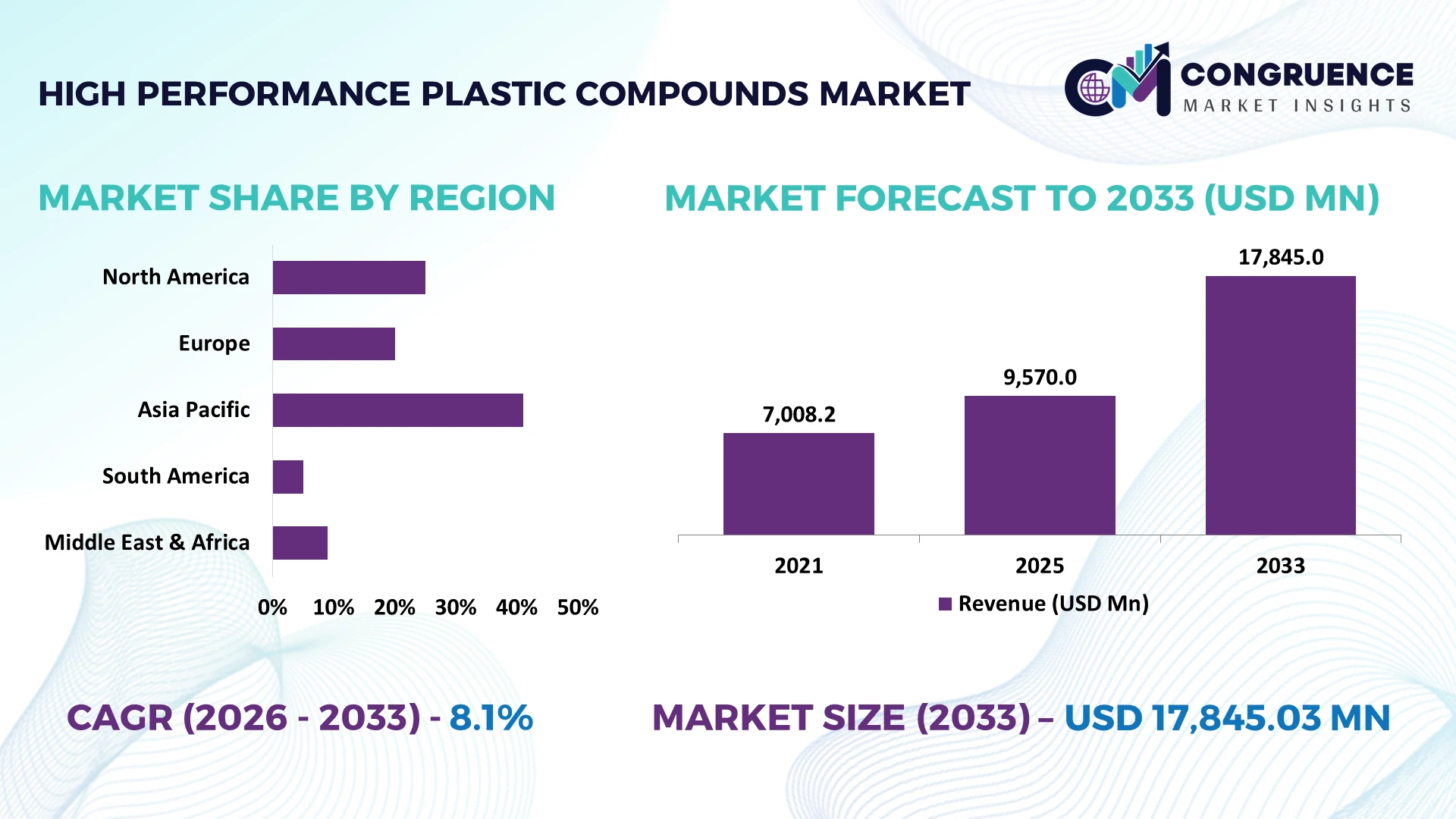
The Global High-Performance Plastic Compounds Market was valued at USD 9570 Million in 2025 and is anticipated to reach a value of USD 17845.03 Million by 2033 expanding at a CAGR of 8.1% between 2026 and 2033. Real growth drivers: Electrification of automotive powertrains, semiconductor fabrication equipment, and aerospace lightweighting are increasing the use of thermally stable, chemically resistant, and dimensionally precise polymer compounds that replace metal components in demanding operating environments.
China represents the principal manufacturing base for the global high-performance plastic compounds market, with its 2025 market estimated at approximately USD 2.47 billion, equivalent to roughly 25.8% of the global valuation. Automotive applications accounted for approximately USD 1.19 billion, compared with USD 527.1 million for electrical and electronics, highlighting the importance of vehicle production and precision electronic components. China's established compounding ecosystem and semiconductor supply-chain expansion reinforce its position, while US aerospace and European automotive engineering sustain competing high-value demand. Geopolitical technology restrictions and supply-chain localization are increasing the strategic value of qualified regional suppliers.
Strategic implication: Prioritize capacity and application-development partnerships in China while diversifying qualified supply across North America and Europe to reduce concentration and cross-border sourcing risks.
Market Size & Growth: The market rises from USD 9.57 billion in 2025 to USD 17.85 billion by 2033 at an 8.1% CAGR, driven by EV electrification and semiconductor-grade material requirements.
Top Growth Drivers: EV component lightweighting, semiconductor equipment demand, and aerospace material substitution are the three structural growth drivers; their individual percentage contributions require validated segment data.
Short-Term Forecast: By 2030, China's automotive high-performance compound market reaches approximately USD 1.79 billion, up from USD 1.19 billion in 2025, strengthening demand for reinforced grades.
Emerging Technologies: PEEK, PPS, and PEI compounds, AI-assisted formulation, and automated compounding improve thermal performance, process consistency, and application-specific material design.
Regional Leaders: Asia-Pacific leads manufacturing scale; North America benefits from aerospace and semiconductor investment; Europe emphasizes automotive engineering and sustainability. Regional dollar forecasts require consistent geographic market data.
Consumer/End-User Trends: Automotive applications account for approximately USD 1.19 billion of China's 2025 market, underscoring the importance of lightweight, heat-resistant components.
Pilot/Case Example: China's automotive compound segment is projected to increase from USD 1.19 billion in 2025 to USD 1.79 billion in 2030, a roughly 50% expansion that supports targeted grade development.
Competitive Landscape: BASF, Syensqo, SABIC, Victrex, and Celanese are leading competitors; market-wide company share percentages require a consistent, independently validated competitive dataset.
Regulatory & ESG Impact: EU sustainability and end-of-life vehicle requirements increase the importance of recyclability, material traceability, and lifecycle-performance validation in compound selection.
Investment & Funding: Semiconductor capacity expansion and regional compounding investments are directing capital toward specialty formulations, local technical support, and more resilient supply chains; a verified global investment total is not established here.
Innovation & Future Outlook: Next-generation reinforced compounds, application-specific formulations, and lower-impact material systems position suppliers to compete on validated performance, processing reliability, and lifecycle cost rather than resin price alone.
The high-performance plastic compounds market is gaining traction across electric mobility, aerospace systems, semiconductor manufacturing, medical devices, and industrial equipment, where conventional polymers often fail under extreme temperatures, chemical exposure, or mechanical stress. Glass-fiber and carbon-fiber reinforcement, flame-retardant formulations, and precision-engineered PEEK and PPS grades are expanding application potential. China's automotive segment is projected to grow approximately 50% between 2025 and 2030, reinforcing the importance of localized technical support and application-specific compounding. Amid export controls and supply-chain regionalization, suppliers that combine reliable material qualification with processing expertise are better positioned to secure long-term OEM programs.
High-performance plastic compounds are becoming strategic materials because they determine component reliability, thermal management, weight reduction, and manufacturing precision in electric vehicles, semiconductor equipment, aerospace systems, and industrial machinery. For manufacturers, material selection increasingly influences qualification timelines, component lifetime, and total operating cost. Compounds based on PEEK, PPS, PEI, and reinforced engineering polymers provide alternatives to metals in applications where corrosion resistance, electrical insulation, and dimensional stability directly affect equipment performance.
Supply-chain restructuring is accelerating investment in qualified domestic materials. US semiconductor manufacturing incentives, China's advanced manufacturing localization, and Europe's automotive decarbonization requirements are encouraging OEMs to diversify suppliers and validate application-specific formulations. This shift increases the importance of regional compounding capacity, technical service laboratories, and traceable material specifications rather than resin availability alone.
Over the next two to three years, competitive advantage will depend on repeatable processing, material qualification, and measurable component-level savings. Replacing machined metal with engineered polymer can reduce component weight by approximately 30–60% in suitable designs, although the result varies with geometry, reinforcement, and load requirements. US semiconductor projects prioritize purity and dimensional control, while Chinese manufacturers emphasize production scale and localized sourcing. Companies deploying automated compounding, simulation-led formulation, and joint OEM testing can shorten development cycles and reduce scrap. Strategic investment should therefore favor validated application platforms and qualified supply partnerships over undifferentiated capacity expansion.
Electrification and advanced electronics are accelerating adoption of glass-fiber-reinforced PPS, PEEK, and PEI compounds in battery systems, connectors, semiconductor equipment, and precision components. The US Department of Energy reports that a 10% reduction in vehicle weight can improve fuel economy by 6–8%, strengthening the business case for lightweight engineered materials. This advantage drives redesigns of metal housings, brackets, and electrical insulation components, although substitution requires application-specific mechanical and thermal validation. China's automotive manufacturing base benefits from production scale, while US suppliers gain opportunities in semiconductor and aerospace applications. Companies are responding through localized compounding, OEM co-development, and investment in reinforced formulations. The strategic priority is to qualify compounds against complete component performance, not weight reduction alone.
Specialty resin pricing restricts adoption where commodity polymers or metals already satisfy performance requirements. PEEK illustrates the constraint: commercial market estimates place its price at roughly 10–20 times that of nylon, reflecting complex synthesis, limited supply, and demanding processing requirements. Such premiums increase working-capital requirements and make material substitution difficult in price-sensitive automotive and industrial applications. High-temperature processing, tooling requirements, and scrap from out-of-specification components can further erode conversion economics. Manufacturers in India and China can improve cost control through regional compounding, optimized filler loading, and multi-year resin procurement agreements. The operational priority is to reserve premium grades for applications where service life, chemical resistance, or component consolidation offsets the material-cost differential.
Recyclable thermoplastic compounds, recycled-content formulations, and lightweight structural components create opportunities beyond conventional resin substitution. The European Union's end-of-life vehicle framework establishes a 25% recycled-plastic-content requirement for new vehicle types covered from September 2036, creating a measurable incentive to develop traceable, compliant material systems. Manufacturers can differentiate through validated recycled feedstocks, fiber-reinforced grades, and formulations that retain mechanical performance across repeated processing cycles. In India, automotive electronics, industrial machinery, and domestic electric-vehicle supply chains offer opportunities for localized formulation and technical support. Companies should prioritize partnerships between compounders, recyclers, and OEMs, with investment tied to material qualification and batch-level traceability. The strongest opportunity lies in solving recyclability and performance requirements simultaneously rather than selling recycled content as a standalone feature.
Scaling advanced compounds requires repeatable dispersion, moisture control, thermal stability, and dimensional accuracy across production batches. These requirements become particularly demanding in semiconductor equipment, aerospace components, and electrical systems, where a minor material deviation can trigger component rejection or extended qualification. The EU's 25% recycled-plastic requirement for covered new vehicle types from September 2036 adds pressure to establish traceable feedstocks without compromising specifications. Recycled polymers and fiber-reinforced blends also require validation for contamination, fiber-length retention, and long-term fatigue performance. Manufacturers must invest in automated process monitoring, laboratory testing, supplier audits, and digital batch records. The strategic challenge is to scale output without increasing variability: production capacity creates competitive value only when customers can rely on consistent, documented material performance.
Precision Compounding and Process Automation: Manufacturers are integrating automated dosing, inline monitoring, and closed-loop extrusion controls to improve batch consistency. A 10–15% scrap reduction represents a potential operational target for optimized production lines, rather than a verified industry-wide average. Companies are investing in predictive maintenance and digital quality records to reduce rejected batches, stabilize throughput, and improve production reliability.
Semiconductor-Grade Material Qualification: Advanced chip fabrication is increasing requirements for chemical resistance, dimensional stability, and contamination control. According to SEMI, global semiconductor materials sales reached USD 73.2 billion in 2025, increasing 6.8% year over year. Taiwan accounted for USD 21.7 billion and China USD 15.6 billion. Compounders are strengthening purity testing and customer qualification to serve specialized semiconductor equipment applications.
Lightweighting Through Component Consolidation: Automotive manufacturers are redesigning brackets, housings, connectors, and thermal-management components to reduce assembly mass and part counts. A 10% vehicle-weight reduction can improve fuel economy by approximately 6–8%, although actual gains depend on vehicle architecture. Suppliers are expanding reinforced PPS and PEEK portfolios and collaborating with OEM engineering teams to validate mechanical performance, processing consistency, and component durability.
Traceability and Recycled-Content Readiness: Automotive procurement is shifting toward documented material composition, batch traceability, and verified recycled-content claims. European Commission research published in November 2025 found that plastics represent approximately 14–18% of vehicle mass, while recycled plastics account for only around 3% of plastics in new vehicles. Compounders are investing in feedstock qualification and controlled blending to address the gap.
Polyphenylene Sulfide (PPS) represents the leading type, accounting for approximately 32.46% of the high-performance plastic compounds market in 2026. Its chemical resistance, dimensional stability, flame resistance, and injection-molding suitability support automotive electrical systems, connectors, pump housings, and industrial components. Compared with PEEK, PPS provides a more economical option for applications requiring thermal durability without the highest specialty-polymer cost. Manufacturers are expanding reinforced PPS formulations to serve high-volume production while maintaining processing consistency.
Polyether Ether Ketone (PEEK) is gaining traction in aerospace components, medical devices, and semiconductor equipment because of its wear resistance, mechanical strength, and thermal stability. Its projected growth reflects increasing adoption in applications where component failure carries high operational costs. Polyetherimide (PEI) supports electrical insulation and medical equipment; Polyamide-Imide (PAI) serves high-load and wear-critical applications; Polytetrafluoroethylene (PTFE) provides chemical resistance and low friction; Liquid Crystal Polymers (LCP) support miniaturized electronics; and high-performance polyamides balance mechanical performance and processability. Companies are prioritizing PEEK innovation while retaining PPS production scale and expanding application-specific formulations.
Automotive Components represent the leading application, accounting for an estimated 35.91% of the market in 2026. High-volume vehicle manufacturing, electrified powertrains, thermal-management assemblies, connectors, and sensor housings support demand for PPS, PEEK, and high-performance polyamides. Automakers value these materials for component consolidation, electrical insulation, and resistance to heat and automotive fluids. Compounders are expanding reinforced grades and collaborating with vehicle manufacturers to qualify compounds for specific platforms, where consistent processing and reliable supply influence supplier selection.
Semiconductor Equipment is a strategically important application as advanced fabrication increases requirements for high-purity materials, chemical resistance, and dimensional stability. Electrical Insulation remains an established use, while Aerospace Components benefit from lightweighting and thermal performance. Medical Devices require sterilization compatibility, and Industrial Machinery and Chemical Processing Equipment depend on wear resistance and chemical durability. These applications have different qualification requirements: automotive rewards scalable production, while semiconductor and aerospace customers prioritize stringent specifications and traceability. Suppliers are directing technical investment toward specialized applications where qualification creates stronger customer retention and reduces price-based competition.
Automotive Manufacturers constitute the leading end-user group, representing approximately 35.91% of the market in 2026. Their purchasing scale reflects established production platforms, extensive component requirements, and the transition toward electrified vehicle architectures. PPS compounds support connectors, pump housings, and thermal-management systems, while PEEK serves more demanding performance applications. Automotive buyers emphasize consistent supply, production compatibility, and component-level cost justification. Compounders are responding with customer-specific formulations, technical validation, and localized supply agreements that protect manufacturing continuity.
Semiconductor Manufacturers represent a strategically important customer group as fabrication complexity increases demand for high-purity, chemically resistant materials. Electrical and Electronics buyers prioritize insulation and miniaturization; Aerospace and Defense buyers emphasize thermal stability and weight reduction; and Healthcare and Medical Devices customers require sterilization compatibility and material validation. Industrial Equipment Manufacturers and Oil and Gas operators prioritize durability in demanding mechanical and chemical environments. Suppliers are strengthening technical support and developing application-specific portfolios to meet distinct qualification and pricing requirements. Investment is shifting toward semiconductor-grade materials and aerospace certification alongside established automotive programs.
Asia-Pacific accounted for the largest market share at approximately 46% in 2025; however, Asia-Pacific is expected to register the fastest growth, supported by automotive electrification, semiconductor manufacturing, and localized specialty-polymer production between 2026 and 2033.
Advanced aerospace engineering and semiconductor investment strengthen specialty-material demand
North America’s high-performance plastic compounds market benefits from aerospace manufacturing, semiconductor equipment investment, medical technology, and advanced automotive engineering. The United States anchors demand through its concentration of aerospace contractors, chip manufacturers, and specialty-material developers, while Canada contributes automotive, industrial, and energy-related applications. The region’s strategic advantage lies in technical qualification, material-science expertise, and established relationships between compounders and original equipment manufacturers (OEMs). US semiconductor incentives and domestic manufacturing initiatives are reinforcing interest in reliable, locally qualified materials. Suppliers are prioritizing high-purity PEEK, PEI, PPS, and reinforced compounds for demanding applications where component failure creates substantial operating costs. Competitive positioning increasingly depends on certification capability, application engineering, and dependable delivery rather than resin price alone.
United States Market Outlook: The United States leads regional demand through semiconductor fabrication, aerospace production, defense systems, and electric-vehicle component engineering. The CHIPS and Science Act established approximately USD 52.7 billion in semiconductor-related funding, supporting domestic manufacturing and research capacity. This investment strengthens the commercial case for chemically resistant polymer components, precision insulation, and contamination-controlled materials. Compounders that establish application-testing partnerships near fabrication and aerospace manufacturing hubs can improve qualification responsiveness and customer retention.
Engineering specialization and circular-material requirements reshape procurement
Europe’s high-performance plastic compounds market is supported by automotive engineering, aerospace manufacturing, industrial automation, medical technology, and chemical processing. Germany anchors advanced automotive and industrial applications, while France contributes aerospace demand and specialized materials development. European suppliers compete through precision formulations, flame-retardant performance, and documented material quality. The EU’s End-of-Life Vehicles Regulation, which entered into force in August 2026, introduces recycled-plastic targets of 15% from 2032 and 25% from 2036 for covered new vehicle types. This creates a commercial incentive to develop recyclable formulations without compromising thermal or mechanical specifications. Compounders are investing in traceability, recycled-feedstock qualification, and OEM partnerships. Suppliers that establish validated circular-material systems early can strengthen procurement relationships and reduce future compliance-related reformulation costs.
Germany Market Outlook: Germany’s automotive, machinery, electrical engineering, and chemical industries create a strong customer base for high-performance compounds. Its concentration of OEM engineering centers and specialized component manufacturers supports joint material testing, prototype development, and industrial-scale qualification. Suppliers should prioritize PPS for electrical and thermal-management components, alongside PEEK and PEI for demanding applications. Collaboration with automotive engineering teams offers a practical route to securing long-term material specifications across multiple vehicle platforms.
Manufacturing scale and electronics localization reinforce regional leadership
Asia-Pacific leads the high-performance plastic compounds market, accounting for an estimated 46% of the broader high-performance plastics market in 2025. China, Japan, South Korea, and Taiwan combine automotive manufacturing, electronics production, semiconductor fabrication, and established polymer-processing ecosystems. SEMI reported that semiconductor materials sales reached USD 21.7 billion in Taiwan and USD 15.6 billion in China in 2025, highlighting concentrated industrial activity relevant to precision polymer components. Chinese manufacturers benefit from production scale and localized sourcing, while Japanese and South Korean suppliers compete through specialized formulations and process reliability. Expanding electronics complexity and electric-vehicle production support demand for LCP, PPS, PEEK, and reinforced high-performance polyamides. Companies are strengthening regional compounding, technical laboratories, and customer partnerships to shorten qualification cycles and protect supply continuity.
China Market Outlook: China benefits from its extensive automotive supply chain, electronics manufacturing capacity, and domestic industrial-materials ecosystem. Localization initiatives encourage manufacturers to qualify domestic compounds for electrical systems, precision machinery, and selected semiconductor applications. Suppliers should focus on reliable batch performance, application-specific formulations, and partnerships with component manufacturers. Competing effectively requires combining competitive processing economics with technical evidence that meets increasingly demanding OEM specifications.
Automotive production and industrial modernization create selective demand
South America’s market is concentrated in Brazil, where automotive assembly, agricultural machinery, electrical equipment, oil and gas, and chemical processing support specialized polymer consumption. Regional adoption remains smaller than in Asia-Pacific and Europe because advanced compounding capacity and application-specific qualification infrastructure are less extensive. Brazil’s automotive manufacturing ecosystem creates opportunities for PPS electrical components, reinforced polyamides, and chemically resistant compounds used in industrial equipment. Demand also benefits from maintenance-intensive operations where corrosion resistance and longer component life can offset higher material costs. However, currency volatility, imported specialty-resin exposure, and uneven access to advanced processing technology constrain broader adoption. Suppliers are responding through distributor partnerships, technical service agreements, and selective local processing investments. The most attractive opportunities involve applications with measurable durability benefits rather than wholesale replacement of lower-cost polymers.
Brazil Market Outlook: Brazil offers the strongest regional platform through its automotive manufacturing base, industrial equipment market, and energy-sector operations. The country produced approximately 2.6 million motor vehicles in 2025, reinforcing the importance of component suppliers serving established OEM production networks. Compounders can build demand by working with local molders and automotive suppliers to qualify reinforced grades for electrical insulation, under-hood components, and chemical exposure. Local technical support and dependable inventory can help reduce procurement delays associated with imported specialty materials.
Industrial diversification expands demand beyond hydrocarbon processing
The Middle East and Africa market is shaped by petrochemical infrastructure, energy projects, industrial modernization, water treatment, and selective aerospace and electronics investment. Saudi Arabia and the United Arab Emirates are developing industrial ecosystems that create demand for chemically resistant, thermally stable, and electrically insulating compounds. Oil and gas operators require materials capable of handling aggressive fluids and demanding service conditions, while infrastructure and manufacturing diversification support applications in pumps, electrical systems, and industrial machinery. The region remains dependent on imported specialty polymers and technical expertise, limiting rapid expansion of advanced compounding capabilities. Companies are strengthening distribution agreements, local technical support, and downstream processing partnerships to improve supply responsiveness. Suppliers that connect specialty materials with measurable maintenance savings and operating reliability are best positioned to secure industrial procurement contracts.
Saudi Arabia Market Outlook: Saudi Arabia’s industrial diversification agenda and established petrochemical infrastructure provide a platform for expanding specialty-polymer applications. The National Industrial Strategy targets approximately 12,000 additional industrial facilities by 2030, supporting a broader manufacturing ecosystem. High-performance compounds can serve chemical-processing equipment, electrical systems, industrial machinery, and selected automotive applications. Suppliers should prioritize partnerships with local processors and industrial operators, emphasizing chemical compatibility, service life, and technical support to establish a stronger position in specialty-material supply chains.
The high-performance plastic compounds market combines global specialty-polymer producers, engineering-resin suppliers, and independent compounders competing for qualified industrial applications. BASF, SABIC, Celanese, Syensqo, and Victrex compete through polymer performance, formulation expertise, and OEM relationships, while RTP Company and Ensinger emphasize customized compounds and application-specific processing. The top five players are estimated to account for approximately 25–30% of the market, although this indicative concentration requires validation against consistent market-share data. Competition centers on thermal stability, chemical resistance, processing consistency, customization, and supply reliability. In suitable automotive applications, lightweight polymer substitution can reduce component weight by 30–60%, creating opportunities for material suppliers to demonstrate measurable engineering value. European producers are strengthening circular-material capabilities, while Chinese suppliers compete through manufacturing scale and localized supply. Partnerships with automotive, semiconductor, and aerospace manufacturers accelerate qualification and product integration. Entry barriers include specialized processing equipment, stringent customer testing, and lengthy application approvals. Winning requires validated material performance, competitive lifecycle economics, reliable regional supply, and sustained technical collaboration.
BASF SE
SABIC
Celanese Corporation
Syensqo
Victrex plc
DuPont
Mitsubishi Chemical Group
Daikin Industries, Ltd.
Arkema
Evonik Industries
Polyplastics Co., Ltd.
RTP Company
Ensinger
Solvay Specialty Polymers
Advanced compounding, precision extrusion, and fiber-reinforcement technologies are improving material consistency for automotive, semiconductor, aerospace, and industrial applications. Modern closed-loop extrusion controls can target 10–15% lower scrap than poorly optimized legacy processes, although results depend on equipment and formulation. Automated dosing, inline monitoring, and digital batch records help manufacturers stabilize quality, reduce rejected components, and improve production repeatability.
Metal-to-polymer substitution and advanced material design are reshaping component engineering. In electric motors, Syensqo and Politubes developed PEEK-based slot-liner tubes designed to improve motor efficiency by up to 2% through better copper fill and heat dissipation. This illustrates how specialized geometry and material integration can outperform conventional insulation designs. Global polymer suppliers with application-engineering capabilities benefit most because they can validate performance alongside OEMs rather than compete solely on resin pricing.
From 2026 to 2028, AI-assisted formulation, simulation-led material selection, and automated quality monitoring will strengthen development workflows. Adoption remains application-specific, with no reliable universal deployment percentage across compounders. Companies should prioritize digital process control, specialty-grade qualification, and collaborative product development to reduce trial cycles and strengthen customer retention. Competitive advantage will favor suppliers that combine measurable component performance with repeatable industrial-scale production.
May 2025 — Syensqo expanded Ryton PPS compounding capabilities at its Augusta, Georgia, facility, adding local PPS supply alongside existing PPA and PEEK capabilities. The investment strengthens North American supply-chain control and automotive-grade sourcing. Source: Syensqo
August 2025 — Victrex advanced its LMPAEK polymer, which melts at 300–310°C versus 343°C for PEEK. The wider processing window supports manufacturing flexibility and expanded design options for aerospace, marine, and additive-manufacturing applications. Source: Victrex
October 2025 — Celanese introduced enhanced Chemille digital material-selection capabilities alongside advanced engineered polymers. Its AI-powered assistant supports tailored recommendations using material properties and application requirements, helping engineering teams streamline early-stage selection and improve development decisions. Source: Celanese
May 2026 — SEMI reported global semiconductor materials sales of USD 73.2 billion for 2025, up 6.8% year over year. Advanced-process and packaging requirements strengthen demand signals for precision materials used in semiconductor manufacturing equipment. Source: SEMI
This report evaluates the global high-performance plastic compounds market across seven material categories: Polyether Ether Ketone (PEEK), Polyphenylene Sulfide (PPS), Polyamide-Imide (PAI), Polytetrafluoroethylene (PTFE), Polyetherimide (PEI), Liquid Crystal Polymers (LCP), and high-performance polyamides. Application coverage includes automotive components, electrical insulation, semiconductor equipment, aerospace components, medical devices, industrial machinery, and chemical processing equipment. End-user analysis examines automotive manufacturers, aerospace and defense, electrical and electronics, healthcare, semiconductor manufacturers, industrial equipment manufacturers, and oil and gas operators.
Geographic coverage spans North America, Europe, Asia-Pacific, South America, and the Middle East and Africa, with country-level assessments of manufacturing capacity, technology adoption, supply-chain localization, and regulatory pressures. The report examines advanced compounding, fiber reinforcement, AI-assisted material selection, component lightweighting, and circular-material development. Competitive analysis evaluates leading suppliers, application specialization, production expansion, and technical partnerships. These insights support investment prioritization, market-entry decisions, capacity planning, customer targeting, and competitive positioning through 2033.
| Report Attribute/Metric | Report Details |
|---|---|
Market Revenue in 2025 | USD 9570 Million |
Market Revenue in 2033 | USD 17845.03 Million |
CAGR (2026 - 2033) | 8.1% |
Base Year | 2025 |
Forecast Period | 2026 - 2033 |
Historic Period | 2021 - 2025 |
Segments Covered | By Type
By Application
By End-User
|
Key Report Deliverable | Revenue Forecast, Growth Trends, Market Dynamics, Segmental Overview, Regional and Country-wise Analysis, Competition Landscape |
Region Covered | North America, Europe, Asia-Pacific, South America, Middle East, Africa |
Key Players Analyzed | BASF SE, SABIC, Celanese Corporation, Syensqo, Victrex plc, DuPont, Mitsubishi Chemical Group, Daikin Industries, Ltd., Arkema, Evonik Industries, Polyplastics Co., Ltd., RTP Company, Ensinger, Solvay Specialty Polymers |
Customization & Pricing | Available on Request (10% Customization is Free) |




