
Reports
The Global High Intensity Sweeteners Market was valued at USD 2247.15 Million in 2025 and is anticipated to reach a value of USD 3719 Million by 2033 expanding at a CAGR of 6.5% between 2026 and 2033. Growth is being accelerated by reformulation programs in packaged foods and beverages, expanding sugar-reduction regulations, and increasing adoption of next-generation sweetener blends across functional nutrition and pharmaceutical formulations.
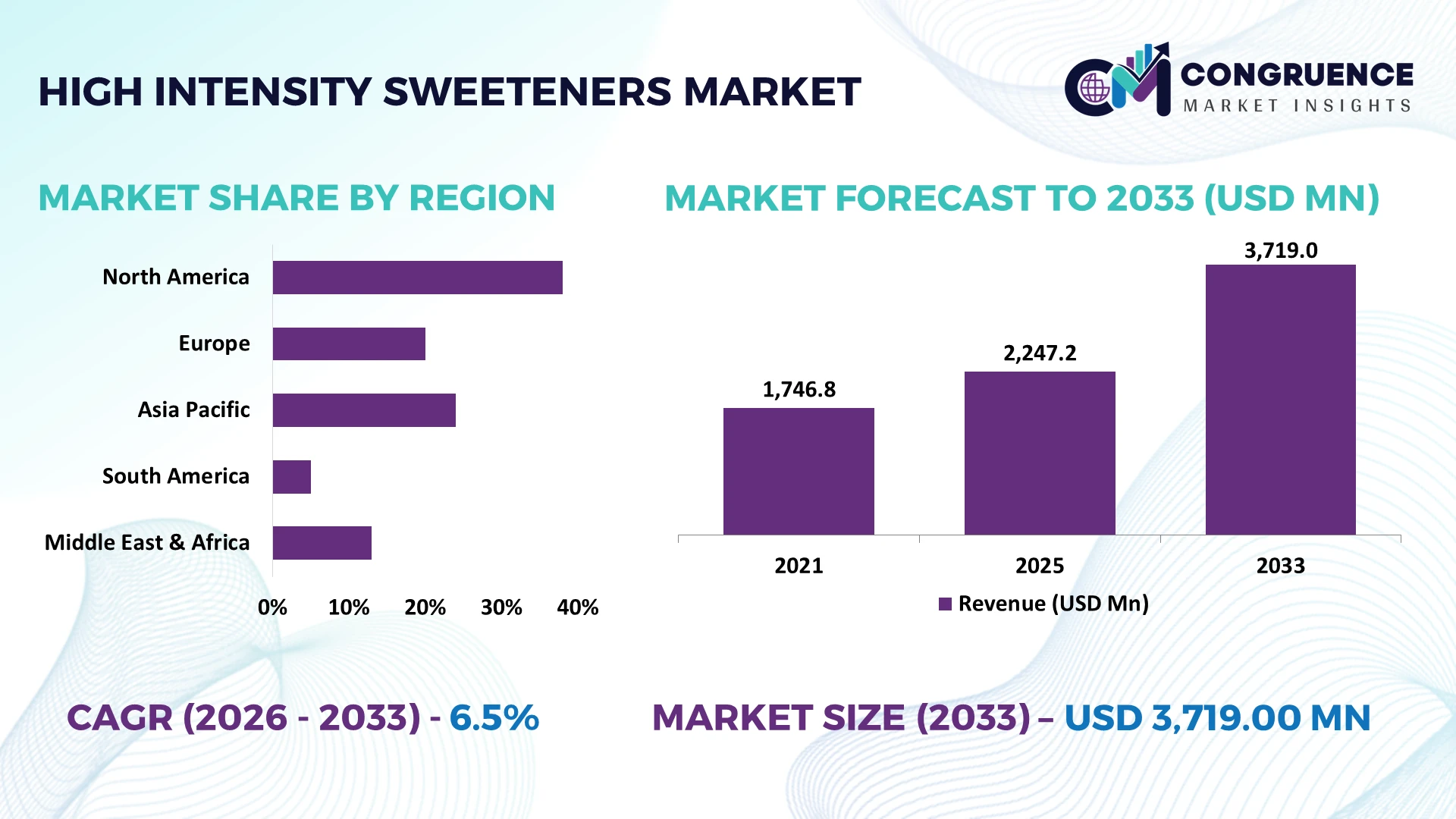
China remains the dominant production and export hub, accounting for approximately 38% of global high-intensity sweetener manufacturing capacity, supported by large-scale ingredient processing and continuous investments in food technology. The United States contributes around 22% of premium formulation demand, driven by beverage innovation and advanced R&D, while China maintains nearly 1.7× higher production capacity. Ongoing trade diversification following post-pandemic supply-chain restructuring has encouraged regional sourcing strategies and automation adoption exceeding 55% across major facilities by 2026.
Businesses should prioritize diversified sourcing, advanced formulation capabilities, and regional manufacturing partnerships to strengthen long-term competitiveness.
Market Size & Growth: USD 2247.15 Million in 2025, reaching USD 3719 Million by 2033 at a 6.5% CAGR, supported by rapid sugar-reduction product reformulation and advanced ingredient innovation.
Top Growth Drivers: Sugar reduction initiatives increase adoption by 34%, clean-label product launches expand 28%, and functional beverage innovation contributes 24% of new ingredient demand.
Short-Term Forecast: By 2028, formulation efficiency improves 18% while ingredient waste declines approximately 12% through automated blending and digital quality control.
Emerging Technologies: AI-assisted formulation, precision fermentation, and advanced encapsulation technologies reduce development cycles by nearly 25% while improving sweetness consistency.
Regional Leaders: Asia-Pacific exceeds USD 1500 Million through manufacturing expansion, North America surpasses USD 980 Million with beverage innovation, and Europe approaches USD 760 Million through regulatory-driven reformulation.
Consumer/End-User Trends: More than 48% of new low-sugar beverage launches integrate high-intensity sweeteners with natural flavor systems to improve consumer acceptance.
Pilot/Case Example: During 2026, an automated beverage reformulation program lowered production losses by 15% while shortening product validation timelines by 20%.
Competitive Landscape: Leading manufacturers collectively control approximately 42% of global supply, with major participants including Cargill, Ingredion, Tate & Lyle, Ajinomoto, and PureCircle.
Regulatory & ESG Impact: Sugar-reduction policies and manufacturing optimization lower processing emissions by approximately 10% while accelerating clean-label product approvals across multiple regions.
Investment & Funding: More than USD 900 Million supports production expansion, strategic partnerships, and advanced ingredient manufacturing amid ongoing regional supply-chain diversification.
Innovation & Future Outlook: Next-generation sweetener combinations, precision formulation, and digital manufacturing strengthen premium product differentiation and reinforce long-term global market competitiveness.
Rising demand from beverage manufacturers, dairy alternatives, nutraceuticals, and pharmaceutical formulations continues to reshape the High Intensity Sweeteners Market through cleaner taste profiles and improved ingredient stability. Advanced encapsulation and precision blending technologies enhance formulation performance, while over 40% of new product developments emphasize reduced sugar content. Regional manufacturing expansion and evolving food-label regulations further strengthen resilient supply chains, setting the stage for broader strategic market analysis.
The High Intensity Sweeteners Market has become strategically important as food, beverage, and pharmaceutical companies accelerate sugar-reduction initiatives while maintaining product consistency and cost efficiency. Regulatory tightening on added sugar content and ongoing supply-chain restructuring are reshaping procurement strategies, encouraging manufacturers to secure diversified ingredient sources and expand formulation capabilities. This transition is intensifying competition around product performance, compliance, and scalable manufacturing rather than volume alone.
Advanced AI-assisted formulation platforms and precision blending systems now reduce product development cycles by nearly 22% compared with conventional laboratory-driven formulation while lowering formulation errors by approximately 15%. China continues to lead large-scale manufacturing and ingredient processing, whereas the United States remains focused on premium innovation, functional beverages, and proprietary sweetener systems with higher R&D intensity. Over the next two to three years, automated quality monitoring is expected to exceed 60% deployment among major producers, improving production consistency and inventory planning.
A leading beverage manufacturer deploying digital formulation software alongside encapsulated sweetener technology shortened commercial launch timelines by nearly 18% while improving ingredient utilization. In response, companies are expanding strategic partnerships with ingredient developers, strengthening localized production networks, and investing in advanced application laboratories to improve competitive positioning, operational resilience, and long-term differentiation.
Government sugar-reduction initiatives, evolving consumer nutrition preferences, and rapid product reformulation are strengthening demand for high intensity sweeteners across beverages, dairy, and nutraceutical applications. More than 46% of new reduced-sugar beverage launches now incorporate high-intensity sweetener blends, while automated formulation platforms improve development efficiency by approximately 20%. China continues expanding production capacity through integrated food ingredient manufacturing, while the United States increases investment in premium sweetener innovation for functional products. This structural shift enables manufacturers to optimize ingredient usage, shorten commercialization timelines, and improve regulatory compliance. Companies are responding through formulation partnerships, production expansion, and application-specific research to strengthen product portfolios and secure long-term supply competitiveness.
Supply dependence on specialized raw materials and varying regulatory approval frameworks continue to constrain operational flexibility. Ingredient procurement costs fluctuate by nearly 12% during periods of agricultural and logistics disruption, while regulatory documentation requirements increase product approval timelines by approximately 18% in several developed markets. Manufacturers operating across China, Europe, and North America must adapt formulations to satisfy differing food standards, increasing development costs and inventory complexity. To reduce exposure, companies are localizing selected production activities, expanding supplier networks, and negotiating long-term procurement agreements. This diversified sourcing strategy strengthens operational continuity while protecting manufacturing efficiency against external supply disruptions.
Precision formulation technologies, functional nutrition products, and next-generation sweetener combinations are creating new commercial opportunities beyond conventional beverage applications. AI-supported ingredient optimization improves formulation accuracy by nearly 23%, while advanced encapsulation extends sweetness stability by approximately 17% in demanding processing environments. India is emerging as a high-potential manufacturing and application development hub as food processing investments expand and health-focused product portfolios diversify. Companies are increasing R&D collaboration with ingredient specialists, establishing innovation centers, and developing customized sweetener systems for pharmaceuticals, sports nutrition, and plant-based foods. These targeted investments strengthen product differentiation while improving manufacturing efficiency and premium market positioning.
Maintaining consistent sweetness profiles, regulatory compliance, and manufacturing quality across multiple production sites remains a critical long-term challenge. Quality deviations during large-scale formulation can increase batch adjustment requirements by nearly 14%, while workforce shortages in specialized food science functions extend process optimization timelines by approximately 16%. Japan and several European manufacturing hubs continue emphasizing advanced quality assurance and digital process monitoring to address increasing compliance expectations. Companies must expand automation, invest in skilled technical personnel, and strengthen digital quality management platforms to ensure consistent global production standards. Organizations that successfully integrate intelligent manufacturing with standardized formulation processes will secure stronger operational resilience and sustainable competitive advantage.
AI-Driven Formulation Optimization Food manufacturers are integrating AI-assisted formulation platforms to shorten ingredient validation cycles by nearly 22% while reducing laboratory trial batches by approximately 18%. Regulatory pressure for sugar reduction is accelerating digital recipe optimization, allowing faster reformulation without compromising taste profiles. Companies in the United States and Japan are expanding partnerships with software developers and ingredient specialists, enabling quicker product launches, lower development costs, and improved production consistency across multiple manufacturing sites.
Localized Supply Chain Expansion Supply-chain diversification remains a defining operational trend as manufacturers reduce dependence on single-country sourcing. Around 35% of leading producers have expanded dual-sourcing strategies, while localized ingredient processing has lowered logistics lead times by nearly 16%. Ongoing geopolitical trade adjustments and transportation uncertainties are encouraging production investments in India and Southeast Asia. Companies are restructuring procurement networks, increasing regional inventories, and strengthening long-term supplier agreements to improve resilience and manufacturing continuity.
Advanced Sweetener Blending Systems Precision blending technologies are improving sweetness stability by approximately 20% and reducing ingredient usage by nearly 12% across beverage and dairy production. Hybrid formulations combining natural and synthetic high-intensity sweeteners are becoming standard for cleaner taste profiles. Major manufacturers are investing in automated dosing equipment and encapsulation technologies to improve formulation repeatability while supporting large-scale commercial production with greater operational efficiency.
Functional Product Portfolio Diversification More than 42% of newly developed reduced-sugar products now target functional nutrition, sports beverages, and specialized pharmaceutical applications instead of conventional soft drinks alone. A less obvious shift is the growing integration of customized sweetener systems for personalized nutrition products requiring precise sweetness control. Companies are expanding application laboratories, collaborating with nutraceutical brands, and increasing formulation flexibility to address specialized customer requirements while improving premium product differentiation.
Sucralose remains the leading product category with an estimated 33% market share due to its high sweetness intensity, strong heat stability, broad food compatibility, and efficient large-scale manufacturing. Beverage, bakery, and processed food manufacturers continue relying on sucralose because it integrates easily into existing production lines with minimal formulation adjustments. Aspartame maintains significant demand in beverages despite evolving consumer preferences, while Acesulfame-K is increasingly used in blended formulations to improve taste performance. Saccharin continues serving cost-sensitive industrial applications where long shelf life remains a competitive advantage.
Stevia represents the fastest-growing segment as food manufacturers respond to increasing clean-label preferences and natural ingredient positioning. Adoption of advanced steviol glycoside purification technologies has improved taste acceptance by nearly 24%, while blended sweetener systems have expanded commercial deployment by approximately 19%. Companies are investing in extraction technologies, expanding production partnerships, and developing customized formulations to balance cost and sensory performance. Investment priorities are gradually shifting from single-ingredient portfolios toward multifunctional sweetener systems supporting premium food and beverage innovation.
Beverages account for approximately 44% of total application demand, supported by continuous reformulation of carbonated drinks, flavored water, energy beverages, and functional nutrition products. Large-scale beverage production benefits from standardized dosing systems and rapid formulation scalability, making high-intensity sweeteners operationally efficient. Dairy products continue expanding through protein beverages and yogurt innovations, while bakery and confectionery manufacturers increasingly adopt blended sweetener systems to maintain texture and shelf stability with reduced sugar content.
Pharmaceutical applications are emerging as the fastest-growing segment as oral formulations, syrups, and chewable tablets require improved taste masking and patient compliance. Adoption within pharmaceutical formulations has increased by nearly 21%, while automated ingredient dispensing improves production consistency by approximately 17%. Tabletop sweeteners continue evolving through premium packaging and personalized nutrition trends. Companies are expanding production capacity, integrating automated formulation systems, and strengthening application-specific product development to address shifting industrial demand and specialized customer requirements.
Food & Beverage companies represent the dominant end-user group with an estimated 68% market share, reflecting extensive deployment across beverages, dairy, confectionery, and processed foods. High production volumes, established manufacturing infrastructure, and continuous product reformulation sustain demand concentration. Food service operators continue increasing adoption through reduced-sugar menu offerings, while pharmaceutical manufacturers maintain stable procurement for medicinal formulations requiring improved palatability and consistent ingredient performance.
Nutraceutical companies are the fastest-growing end-user category as demand rises for functional supplements, protein products, and wellness-focused formulations. Product launches within nutraceutical applications have increased by approximately 23%, while customized sweetener systems improve formulation efficiency by nearly 18%. Companies are strengthening partnerships with ingredient suppliers, offering application-specific product customization, and implementing flexible pricing strategies to capture premium health-focused markets. Competitive positioning increasingly depends on formulation expertise, technical collaboration, and rapid product development capabilities across specialized customer segments.
Asia-Pacific accounted for the largest market share at 41.8% in 2025 however, Middle East & Africa is expected to register the fastest growth, expanding at a 7.4% between 2026 and 2033.
Advanced Reformulation and Premium Ingredient Innovation
North America remains a highly mature market, contributing approximately 27% of global demand through advanced food processing infrastructure and strong deployment across beverages, dairy, pharmaceuticals, and functional nutrition products. Manufacturers continue integrating AI-assisted formulation platforms and automated ingredient dosing systems, reducing product development cycles by nearly 20%. Regulatory emphasis on sugar reduction continues accelerating reformulation activity across major consumer brands. Strategic partnerships between ingredient suppliers and food manufacturers have increased by approximately 16% since 2025, supporting faster commercialization of reduced-sugar products. Investment continues shifting toward application-specific sweetener blends, digital quality monitoring, and localized production capabilities that strengthen supply resilience while improving formulation consistency across industrial-scale manufacturing operations.
United States Market Outlook: The United States leads regional deployment through its extensive food and beverage manufacturing ecosystem, advanced R&D infrastructure, and rapid commercialization capabilities. More than 65% of large packaged-food manufacturers have expanded reduced-sugar product portfolios using high-intensity sweeteners. Continued investment in precision formulation software, automated production facilities, and functional nutrition products strengthens operational efficiency while supporting innovation across premium beverage, pharmaceutical, and health-focused food applications.
Regulatory Compliance Driving Product Modernization
Europe accounts for approximately 23% of global market activity, supported by stringent food standards, strong clean-label positioning, and extensive product reformulation across processed food industries. Manufacturers increasingly deploy advanced blending technologies and digital quality assurance systems to maintain regulatory compliance while improving sensory performance. Nearly 52% of premium food launches now incorporate reduced-sugar formulations using high-intensity sweeteners. Investment in sustainable ingredient sourcing and process optimization continues expanding, while collaborative product development between ingredient suppliers and food manufacturers accelerates commercialization of compliant formulations. The region's focus remains on combining operational efficiency with product transparency and consistent manufacturing quality.
Germany Market Outlook: Germany serves as the region's industrial leader through its advanced food processing sector, strong engineering capabilities, and extensive manufacturing infrastructure. Automated ingredient handling systems are now deployed across more than 58% of major processing facilities, improving production consistency and reducing formulation variability. Domestic companies continue investing in application laboratories, sustainable processing technologies, and collaborative research supporting premium reduced-sugar food innovation.
Manufacturing Scale Strengthens Global Supply Leadership
Asia-Pacific represents the largest manufacturing and consumption hub, supported by integrated ingredient production, expanding food processing industries, and competitive manufacturing economics. The region contributes nearly 42% of global market demand while accounting for over 45% of high-intensity sweetener production capacity. Manufacturing automation has improved production efficiency by approximately 21%, enabling higher export competitiveness and stable supply. Investment continues expanding across food ingredient processing facilities, logistics infrastructure, and application development centers. Large-scale production capabilities and diversified export networks position the region as the primary global supply base for food, beverage, and pharmaceutical manufacturers.
China Market Outlook: China remains the most influential country through large-scale production capacity, integrated chemical processing infrastructure, and export-oriented manufacturing. Approximately 38% of global production capacity is concentrated within the country, supported by continuous automation investments and modern manufacturing facilities. Companies are expanding specialty sweetener production, improving energy-efficient processing, and strengthening supply agreements with international food manufacturers seeking stable long-term sourcing.
Food Processing Expansion Supports Industrial Demand
South America is strengthening its market position through expanding processed food production, growing beverage manufacturing, and increasing adoption of healthier consumer products. The region contributes approximately 5.8% of global market demand while food processing investments continue improving industrial capacity. Modern production upgrades have enhanced manufacturing productivity by nearly 14%, although logistics infrastructure and cross-border distribution remain operational constraints. Companies are increasing regional partnerships, expanding localized warehousing, and improving procurement networks to reduce supply disruptions. Operational strategies increasingly focus on balancing manufacturing efficiency with distribution resilience across geographically dispersed consumer markets.
Brazil Market Outlook: Brazil leads regional demand through its diversified food manufacturing industry and expanding beverage sector. More than 47% of regional industrial sweetener consumption is concentrated within the country, supported by investments in processing modernization and packaged food production. Manufacturers continue expanding production capacity and strengthening supplier relationships to improve domestic availability while supporting export-oriented food manufacturing operations.
Food Industry Modernization Accelerates Investment
The Middle East & Africa market is benefiting from food manufacturing modernization, increasing packaged food consumption, and expanding industrial investments across processing infrastructure. The region contributes approximately 2.4% of global demand, while automated food manufacturing deployment has increased by nearly 18% since 2025. Governments continue encouraging domestic food production and value-added manufacturing, creating opportunities for advanced ingredient suppliers. Companies are investing in localized distribution centers, regional formulation support, and strategic partnerships that improve supply reliability while reducing dependence on imported finished food products.
Saudi Arabia Market Outlook: Saudi Arabia leads regional investment through expanding food manufacturing infrastructure, industrial diversification programs, and advanced processing facilities. Modern production projects have increased local manufacturing capability by approximately 20%, encouraging wider deployment of high-intensity sweeteners across beverages and processed foods. Companies continue strengthening regional partnerships, upgrading manufacturing technology, and expanding localized ingredient distribution networks to support long-term food security objectives.
Competition is led by Ingredion, Cargill, Tate & Lyle, Ajinomoto, and PureCircle, while regional ingredient manufacturers compete aggressively on manufacturing scale and pricing. The top five companies collectively control approximately 44% of global market activity, with global innovators competing against cost-focused Asian producers and specialized formulation suppliers. Competition centers on formulation technology, supply-chain reliability, application customization, and production efficiency rather than price alone. Automated production systems improve manufacturing efficiency by nearly 18%, while AI-supported formulation reduces product development time by approximately 20%, creating meaningful differentiation. Companies continue expanding regional production, forming application-development partnerships, investing in precision sweetener blends, and strengthening vertical integration to secure raw material availability. Consolidation increasingly favors companies offering integrated formulation support alongside dependable supply networks. New entrants face significant barriers from regulatory approval requirements, formulation expertise, and established customer relationships. Winning requires scalable manufacturing, technical collaboration, rapid innovation, resilient sourcing, and application-specific product performance that consistently outperforms conventional ingredient solutions.
Cargill
Ingredion Incorporated
Tate & Lyle PLC
Ajinomoto Co., Inc.
PureCircle Ltd.
GLG Life Tech Corporation
JK Sucralose Inc.
HYET Sweet S.A.S.
Celanese Corporation
Roquette Frères
Foodchem International Corporation
Archer Daniels Midland Company
NutraSweet Company
Zhucheng Haotian Pharm Co., Ltd.
Current manufacturing technologies are centered on automated precision dosing, continuous blending systems, and digital process control that improve formulation consistency while reducing ingredient losses. Automated production lines increase batching efficiency by approximately 18%, and nearly 58% of large-scale manufacturers have integrated real-time quality monitoring into commercial operations. These technologies enable faster product validation, lower process variability, and improved compliance with evolving sugar-reduction requirements, giving established producers stronger operational control and more predictable manufacturing performance.
Emerging technologies are shifting toward AI-assisted formulation, precision fermentation, and advanced encapsulation for improved taste performance and ingredient stability. AI-supported formulation platforms shorten product development cycles by around 22%, while encapsulation technologies enhance sweetness stability by approximately 17% in demanding beverage and pharmaceutical applications. Compared with conventional laboratory-led formulation, AI-driven development reduces optimization time by nearly 25%. More than 40% of premium product developers have adopted digital formulation workflows, enabling quicker commercialization and stronger customization for health-focused food portfolios.
Disruptive innovation between 2026 and 2028 will increasingly combine digital manufacturing, predictive quality analytics, and hybrid natural-synthetic sweetener systems. Companies investing early in intelligent production networks are expected to improve manufacturing responsiveness by nearly 20% while reducing formulation adjustment costs by approximately 12%. Global ingredient leaders benefit through faster product launches, stronger customer collaboration, and resilient supply-chain management, whereas manufacturers relying on legacy production methods risk slower innovation cycles and declining competitiveness in premium reduced-sugar applications.
June 2026 Ingredion announced its recommended acquisition of Tate & Lyle, expanding its specialty ingredient portfolio across sugar reduction and fortification while offering a 59% premium to Tate & Lyle shareholders. The transaction strengthens global formulation capabilities and supply networks. Source: Ingredion
May 2026 Tate & Lyle reported a 15% increase in its new business pipeline following integration of CP Kelco, strengthening innovation across sweetening, texture, and health ingredients. The expanded pipeline supports broader customer adoption of advanced sugar-reduction solutions.
June 2026 Reuters reported Ingredion's agreement to acquire Tate & Lyle for approximately £2.7 billion, creating a combined specialty ingredients platform focused on healthier, low-sugar, and high-protein food solutions. The transaction significantly expands global product development capabilities. Source: Reuters
July 2026 Tate & Lyle published its Future-Proofing Nutrition report, highlighting growing consumer focus on metabolic health beyond sugar reduction. The initiative strengthens innovation priorities for reformulation and functional ingredient development while supporting next-generation sweetener applications. Source: Tate & Lyle Press Releases
The report delivers comprehensive analysis across the complete High Intensity Sweeteners value chain, covering major product types including Aspartame, Sucralose, Stevia, Saccharin, and Acesulfame-K, together with detailed assessment of beverage, dairy, bakery, pharmaceutical, and tabletop sweetener applications. End-user evaluation spans food & beverage, pharmaceutical, nutraceutical, and food service industries, while regional analysis examines North America, Europe, Asia-Pacific, South America, and the Middle East & Africa. More than 40% of the assessment emphasizes operational adoption patterns, manufacturing strategies, and technology deployment.
The study evaluates production technologies, AI-enabled formulation, precision blending, encapsulation, automation, and supply-chain transformation alongside competitive benchmarking of leading manufacturers. It provides strategic intelligence supporting expansion planning, partnership evaluation, procurement optimization, product positioning, and investment prioritization between 2026 and 2033. The report also highlights emerging application areas, evolving regulatory environments, deployment trends, and innovation pathways that help organizations strengthen competitive positioning and improve long-term operational resilience across global markets.
| Report Attribute/Metric | Report Details |
|---|---|
Market Revenue in 2025 | USD 2247.15 Million |
Market Revenue in 2033 | USD 3719 Million |
CAGR (2026 - 2033) | 6.5% |
Base Year | 2025 |
Forecast Period | 2026 - 2033 |
Historic Period | 2021 - 2025 |
Segments Covered | By Type
By Application
By End-User
|
Key Report Deliverable | Revenue Forecast, Growth Trends, Market Dynamics, Segmental Overview, Regional and Country-wise Analysis, Competition Landscape |
Region Covered | North America, Europe, Asia-Pacific, South America, Middle East, Africa |
Key Players Analyzed |
|
Customization & Pricing | Available on Request (10% Customization is Free) |




