
Reports
The Global High Intensity Magnetic Separator Market was valued at USD 840.3 Million in 2025 and is anticipated to reach a value of USD 1,487.5 Million by 2033 expanding at a CAGR of 7.4% between 2026 and 2033. Growth is driven by rising critical mineral processing, stricter ore grade requirements, expanded recycling operations, and increasing deployment of high-efficiency mineral beneficiation technologies.
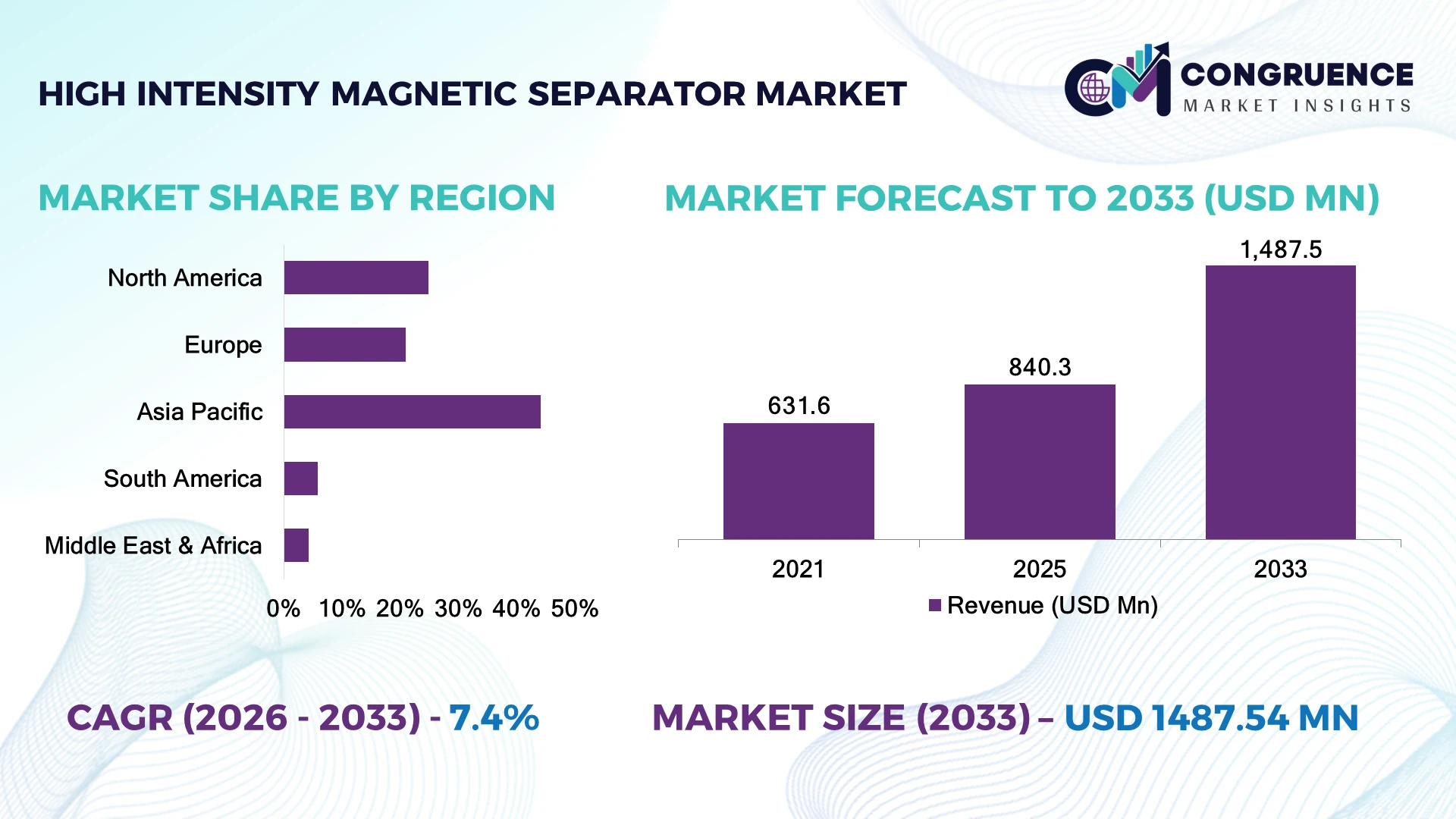
China dominates the global high intensity magnetic separator market with approximately 39% market share, supported by extensive rare earth processing, iron ore beneficiation, and battery mineral production. Compared with Australia, which focuses on large-scale mineral extraction, China operates a broader downstream mineral processing network utilizing advanced magnetic separation systems. More than 66% of newly commissioned critical mineral processing plants integrate high-intensity magnetic separation technologies. Ongoing geopolitical efforts to secure critical mineral supply chains continue accelerating investment in domestic mineral processing infrastructure and equipment modernization.
Manufacturers investing in energy-efficient separator technologies, intelligent process automation, and high-capacity beneficiation systems are strengthening competitive positioning across mining, recycling, and industrial mineral processing.
Market Size & Growth: USD 840.3 million (2025) to USD 1,487.5 million (2033) at 7.4% CAGR, supported by critical mineral processing and recycling expansion.
Top Growth Drivers: Critical minerals (+32%), recycling capacity (+27%), ore beneficiation (+24%).
Short-Term Forecast: By 2028, mineral recovery efficiency improves 21% while energy consumption declines 16%.
Emerging Technologies: AI process optimization, sensor-based sorting, and superconducting magnetic systems accelerate adoption.
Regional Leaders: Asia-Pacific (~USD 690 million), North America (~USD 320 million), Europe (~USD 250 million), driven by mineral processing modernization.
Consumer/End-User Trends: More than 61% of new beneficiation facilities deploy automated magnetic separation systems.
Pilot/Case Example: A 2026 rare earth processing upgrade improved magnetic recovery by 19%.
Competitive Landscape: Top five manufacturers control approximately 46% market share, led by Metso, Eriez, SLon Magnetic Separator, Multotec, and STEINERT.
Regulatory & ESG Impact: Advanced separators reduce mineral processing waste by approximately 18%.
Investment & Funding: More than USD 6.4 billion supports critical mineral processing and beneficiation infrastructure.
Innovation & Future Outlook: High-gradient magnetic separation and digital process automation redefine mineral recovery strategies.
High intensity magnetic separators are becoming essential across mining, recycling, ceramics, glass, and industrial minerals where higher recovery efficiency and product purity are operational priorities. Intelligent control systems, high-gradient magnetic circuits, and automated process monitoring improve separation efficiency by approximately 22%, while supply-chain diversification for critical minerals is accelerating deployment of advanced beneficiation technologies. These developments establish the foundation for the market's evolving strategic direction.
High intensity magnetic separators have become strategically important as governments and mining companies prioritize domestic processing of critical minerals, higher-grade concentrate production, and resource efficiency. Supply-chain restructuring for rare earth elements, lithium-bearing minerals, and industrial metals is driving investment in advanced beneficiation facilities, while stricter environmental requirements are encouraging more efficient mineral recovery processes with lower waste generation and improved resource utilization.
Modern high-gradient magnetic separators achieve approximately 23% higher recovery efficiency than conventional magnetic separation systems while reducing processing energy consumption by nearly 17% through optimized magnetic field control and automated material handling. China leads deployment through its integrated mineral processing ecosystem, whereas Australia focuses on expanding value-added beneficiation capacity for export-oriented mining operations. Over the next two to three years, more than 57% of newly commissioned critical mineral processing plants are expected to integrate automated magnetic separation and digital process monitoring technologies.
Mining equipment manufacturers are expanding production capacity, strengthening engineering partnerships, and investing in intelligent beneficiation platforms combining AI-driven process optimization with real-time monitoring. Advanced separators are increasingly deployed in rare earth processing, battery mineral refinement, and industrial recycling operations. Companies capable of delivering higher recovery rates, lower operating costs, and digitally integrated mineral processing solutions will establish stronger long-term competitive advantage in the evolving global critical minerals industry.
Growing investment in critical mineral beneficiation is accelerating deployment of high intensity magnetic separators as mining companies seek higher recovery rates from lower-grade ore deposits. More than 63% of newly developed rare earth and battery mineral processing facilities now integrate advanced magnetic separation technologies, while concentrate recovery has improved by approximately 24% and impurity removal efficiency by nearly 19%. China continues expanding domestic critical mineral processing capacity to strengthen supply-chain resilience and reduce dependence on imported refined materials. This structural shift increases demand for high-gradient separation systems capable of processing complex ores. Equipment manufacturers are responding through production expansion, automation upgrades, and strategic engineering partnerships focused on energy-efficient, high-capacity magnetic separation solutions.
Capital-intensive equipment, specialized magnetic assemblies, and increasing energy costs continue limiting adoption among small and mid-sized mineral processing operators. Permanent magnet material prices remain approximately 18% above historical averages, while maintenance expenditure for high-gradient systems has increased by nearly 15% due to component complexity. Export controls affecting critical magnetic materials and specialized industrial components continue disrupting equipment procurement for several manufacturers. These factors increase project costs, delay commissioning schedules, and reduce profitability for beneficiation facilities. Companies are mitigating risk through localized component sourcing, long-term procurement agreements, modular equipment design, and expanded refurbishment services that improve lifecycle economics and reduce dependence on imported assemblies.
Digital mineral processing platforms are creating substantial opportunities by combining AI-driven process optimization, sensor-based ore characterization, and automated magnetic separation. Intelligent process control improves concentrate recovery by approximately 21%, while automated plant optimization lowers energy consumption by nearly 17%. Australia continues encouraging downstream critical mineral processing investments, increasing deployment of digitally integrated beneficiation facilities. Equipment suppliers are investing in predictive analytics, remote performance monitoring, and collaborative technology partnerships to strengthen operational efficiency. A significant strategic opportunity lies in retrofitting existing processing plants with intelligent magnetic separation systems, allowing operators to improve recovery rates without constructing entirely new beneficiation infrastructure.
Maintaining consistent separation efficiency across increasingly variable ore compositions remains a major long-term operational challenge. Feed grade variability can reduce separation performance by approximately 16%, while inconsistent mineral liberation lowers concentrate quality by nearly 14% during continuous processing. Brazil's expanding iron ore beneficiation sector faces increasing pressure to process lower-grade deposits while maintaining commercial recovery standards. Manufacturers must develop adaptive magnetic control systems, advanced process monitoring, and integrated mineral characterization technologies to sustain operational consistency. Long-term competitiveness will depend on delivering highly flexible separation platforms capable of maintaining performance across changing ore characteristics and increasingly demanding mineral processing environments.
High-Gradient Systems Advance: Mining companies are replacing conventional separators with high-gradient magnetic systems that improve mineral recovery by approximately 22% while reducing tailings losses by nearly 16%. Rising demand for battery minerals and stricter concentrate quality requirements are accelerating deployment. Manufacturers are expanding production capacity and introducing modular separation platforms for large beneficiation facilities.
Digital Plant Integration Expands: Automated process control is becoming standard across modern beneficiation plants, increasing equipment utilization by approximately 24% and reducing manual process adjustments by nearly 20%. Industrial digitalization and skilled labor shortages are driving adoption. Companies are integrating AI-assisted monitoring, cloud-based performance analytics, and centralized process management into magnetic separation operations.
Recycling Applications Accelerate: High intensity magnetic separators are increasingly deployed in electronic waste and metal recycling facilities, improving valuable metal recovery by approximately 19% while reducing landfill disposal by nearly 17%. Circular economy initiatives and stricter material recovery targets are reshaping investment priorities. Equipment suppliers are developing specialized recycling-focused separation technologies and expanding strategic partnerships with recycling operators.
Energy-Efficient Equipment Gains: Energy optimization has become a primary purchasing criterion, with next-generation separator designs lowering electricity consumption by approximately 15% while increasing processing throughput by nearly 13%. Rising industrial energy costs are accelerating equipment replacement cycles. Manufacturers are investing in optimized magnetic circuits, lightweight designs, and intelligent power management systems to strengthen long-term operating efficiency.
Wet High Intensity Magnetic Separators (WHIMS) account for approximately 58% of the global market owing to their superior recovery efficiency in processing fine particles, weakly magnetic minerals, and low-grade ores. Their ability to achieve higher concentrate purity while operating continuously makes them the preferred solution across iron ore, rare earth, and industrial mineral beneficiation plants. Dry High Intensity Magnetic Separators remain strategically important for water-constrained mining operations, recycling facilities, and industrial material processing where lower operating complexity and reduced water consumption are operational priorities.
Dry High Intensity Magnetic Separators represent the fastest-growing segment as mining companies expand operations in arid regions and industrial recyclers seek lower operating costs. Processing efficiency has improved by approximately 19%, while energy optimization has reduced operating expenditure by nearly 16% through advanced magnetic circuit design. Equipment manufacturers are expanding modular product portfolios, investing in intelligent control systems, and collaborating with mining engineering firms to improve separation performance. Investment priorities increasingly favor flexible separator platforms capable of processing diverse mineral streams while minimizing resource consumption.
According to 2026 operational findings published by the Society for Mining, Metallurgy & Exploration (SME), advanced dry magnetic separation technologies continue gaining adoption in critical mineral projects where water conservation and operational efficiency remain strategic priorities.
Mineral processing represents the largest application segment with approximately 52% market share, driven by increasing beneficiation of iron ore, rare earth elements, lithium-bearing minerals, and industrial minerals. High intensity magnetic separators are essential for improving concentrate grade, reducing impurities, and maximizing recovery from increasingly complex ore bodies. Recycling remains a strategically expanding application supporting metal recovery from electronic waste, while ceramic and glass manufacturing continue utilizing magnetic separation to remove iron contamination and improve final product quality.
Recycling is the fastest-growing application as circular economy initiatives and critical material recovery programs accelerate worldwide. Advanced separation systems improve valuable metal recovery by approximately 23%, while automated sorting reduces manual processing requirements by nearly 20%. Equipment suppliers are integrating digital monitoring, expanding recycling-focused product lines, and strengthening partnerships with material recovery facilities. Demand is steadily shifting toward high-throughput magnetic separation systems capable of simultaneously improving recovery efficiency, product purity, and sustainable resource utilization across industrial recycling operations.
Industry assessments released during 2025 by the International Council on Mining and Metals indicated increasing deployment of advanced magnetic separation technologies to improve mineral recovery efficiency and support responsible resource utilization.
Mining companies account for approximately 63% of total market demand due to continuous investment in ore beneficiation, critical mineral processing, and production optimization. Large-scale mining operations depend on high intensity magnetic separators to improve concentrate quality, maximize resource recovery, and maintain processing efficiency across lower-grade deposits. Recycling operators continue expanding equipment purchases as material recovery targets increase, while industrial mineral processors remain consistent buyers focused on product quality improvement and impurity removal.
Recycling companies represent the fastest-growing end-user segment as electronic waste processing, battery recycling, and industrial scrap recovery become increasingly important. Automated separation systems have increased material recovery efficiency by approximately 22%, while operating costs have declined by nearly 17% through integrated process automation. Equipment manufacturers are introducing customized recycling solutions, expanding long-term technical partnerships, and strengthening aftermarket service capabilities to improve customer retention. Competitive positioning increasingly depends on delivering application-specific separator technologies tailored to evolving recycling and critical mineral recovery requirements.
According to a 2026 enterprise survey conducted by the Bureau of International Recycling, material recovery operators continue increasing investment in advanced magnetic separation technologies to improve recovery efficiency, product purity, and processing productivity.
Asia-Pacific accounted for the largest market share at 44.1% in 2025 however, North America is expected to register the fastest growth, expanding at a CAGR of 7.8% between 2026 and 2033.
Critical Mineral Processing Strengthens Equipment Modernization
North America represents approximately 24.8% of the global high intensity magnetic separator market, supported by expanding critical mineral processing, battery material refining, and advanced metal recycling infrastructure. Mining operators are modernizing beneficiation facilities with intelligent magnetic separation technologies to improve concentrate quality and reduce operational waste. More than 58% of newly commissioned mineral processing projects incorporate automated magnetic separation systems integrated with digital plant controls. Rising investment in domestic rare earth and lithium processing is accelerating demand for high-gradient separators, while equipment manufacturers continue expanding engineering capabilities, localized manufacturing, and aftermarket technical services to strengthen long-term customer support.
United States Market Outlook: The United States leads the regional market through substantial investment in domestic critical mineral processing, industrial recycling, and advanced mining technologies. Federal initiatives supporting secure mineral supply chains continue encouraging beneficiation infrastructure expansion and equipment modernization. More than 64% of new rare earth processing projects include advanced magnetic separation systems, while manufacturers increasingly integrate AI-enabled process optimization and predictive maintenance into mineral processing operations to improve plant productivity and operational resilience.
Resource Efficiency Drives Industrial Modernization
Europe accounts for approximately 21% of global demand, supported by industrial mineral processing, metal recycling, and sustainability-driven manufacturing upgrades. Advanced magnetic separation systems are increasingly deployed to improve raw material utilization, recover valuable metals, and reduce production waste across mining and recycling operations. Nearly 49% of newly upgraded recycling facilities now utilize automated magnetic separation technologies to improve material recovery and operational consistency. Equipment suppliers continue introducing energy-efficient systems aligned with stricter environmental and resource-efficiency objectives.
Germany Market Outlook: Germany leads the European market through its advanced recycling infrastructure, industrial equipment manufacturing, and engineering expertise. Strong investment in circular economy initiatives continues supporting deployment of intelligent magnetic separation technologies across metal recovery, industrial minerals, and specialty manufacturing. Automated processing facilities increasingly integrate digital separator monitoring to improve throughput, equipment utilization, and recovered material quality.
Large-Scale Mineral Processing Sustains Market Leadership
Asia-Pacific dominates the global market with extensive mining activity, rare earth processing capacity, and rapidly expanding battery mineral value chains. China, Australia, and India continue investing in downstream beneficiation infrastructure to improve domestic processing capabilities and reduce dependence on imported refined materials. Approximately 67% of newly installed magnetic separation capacity is concentrated within large-scale mineral processing facilities serving iron ore, rare earth, and lithium production. Equipment manufacturers continue expanding localized production, automation capabilities, and engineering support to meet growing industrial demand.
China Market Outlook: China remains the largest national market due to its integrated mining, mineral processing, and rare earth refining ecosystem. Continuous modernization of beneficiation plants and expansion of battery material processing facilities support sustained equipment demand. High-capacity automated separators are increasingly deployed across strategic mineral projects, strengthening productivity, concentrate quality, and domestic processing competitiveness.
Iron Ore Beneficiation Expands Equipment Deployment
South America continues strengthening demand for high intensity magnetic separators through iron ore beneficiation, industrial mineral processing, and growing investment in value-added mineral production. Brazil and Chile are expanding processing capacity to maximize recovery from lower-grade deposits while improving export competitiveness. Around 42% of recent beneficiation facility upgrades include advanced magnetic separation systems designed to improve concentrate purity and operational efficiency. Infrastructure development continues supporting long-term expansion despite equipment import dependence and project execution challenges in selected mining regions.
Brazil Market Outlook: Brazil dominates the regional market through its globally significant iron ore industry and continued investment in beneficiation modernization. Mining companies increasingly deploy high-gradient magnetic separators to improve recovery from complex ore bodies and enhance concentrate quality. Expansion of integrated processing facilities and digital mine operations continues supporting sustained demand for advanced separation technologies across major mining hubs.
Mining Infrastructure Investment Accelerates Modernization
The Middle East & Africa market is gaining strategic importance through expanding mining infrastructure, industrial mineral development, and government-supported resource diversification initiatives. Countries with significant phosphate, iron ore, and base metal reserves are modernizing mineral processing facilities to improve domestic value addition. Nearly 37% of newly developed mineral processing projects incorporate advanced magnetic separation technologies to improve recovery efficiency and reduce material losses. Equipment suppliers are strengthening regional partnerships, technical service capabilities, and localized maintenance networks to support increasing industrial deployment.
South Africa Market Outlook: South Africa leads the regional market through its established mining industry, mineral processing expertise, and extensive reserves of iron ore, manganese, and industrial minerals. Mining companies continue investing in beneficiation technologies that improve processing efficiency and product quality while reducing operational waste. Increasing automation across processing plants is strengthening demand for digitally integrated high intensity magnetic separation systems capable of supporting continuous, high-volume mineral production.
Global equipment leaders including Metso, Eriez, STEINERT, Multotec, and SLon Magnetic Separator compete directly with regional beneficiation equipment manufacturers and low-cost OEMs serving domestic mining markets. The top five companies collectively account for approximately 47% of global market activity. Competition centers on separation efficiency, automation capability, lifecycle cost, and engineering support rather than equipment pricing alone. Advanced high-gradient systems improve mineral recovery by nearly 22%, digital process controls reduce operating costs by approximately 16%, and modular plant integration shortens commissioning time by around 18%. Leading suppliers are expanding manufacturing capacity, partnering with EPC contractors, integrating digital monitoring platforms, and offering turnkey beneficiation solutions. Competition is shifting from standalone equipment sales toward complete processing circuits with lifecycle service agreements. High engineering expertise, proprietary magnetic technology, and extensive application testing create significant entry barriers. Winning requires superior recovery performance, integrated digital capabilities, responsive technical support, and application-specific customization.
Metso
Eriez
STEINERT GmbH
Multotec
SLon Magnetic Separator Ltd.
Mineral Technologies
LONGi Magnet Co., Ltd.
Nippon Magnetics Inc.
GTEK Magnet
Bunting Magnetics
MAGQUIP
Malvern Engineering
High-gradient magnetic separation, intelligent process control, and modular beneficiation systems are redefining mineral processing performance. Advanced electromagnetic matrices improve fine-particle recovery by approximately 23%, while automated magnetic field optimization lowers energy consumption by nearly 16%. Around 62% of newly commissioned critical mineral beneficiation facilities now integrate digitally controlled magnetic separation platforms, enabling higher concentrate quality, reduced operator intervention, and improved process stability under varying ore conditions.
Emerging technologies include AI-assisted ore characterization, digital twins, predictive maintenance, and sensor-based process optimization integrated with centralized plant management systems. Compared with conventional separators, next-generation high-gradient systems deliver nearly 28% higher recovery efficiency and approximately 19% lower maintenance requirements through adaptive magnetic control. Global technology leaders benefit through premium equipment positioning, while mining operators gain from reduced downtime, improved plant utilization, and stronger operational consistency across complex mineral streams.
Between 2026 and 2028, autonomous beneficiation workflows, cloud-connected process diagnostics, and rare-earth optimized magnetic assemblies will accelerate digital transformation across mining operations. Suppliers investing in intelligent automation, modular plant integration, and predictive service platforms will strengthen competitive differentiation as critical mineral processors increasingly prioritize operational efficiency, energy optimization, and lifecycle performance over standalone equipment procurement.
December 2024 – Metso received an order from Mesabi Metallics to supply beneficiation equipment, including Low Intensity Magnetic Separators, for a new U.S. DR-grade iron ore project, strengthening domestic mineral processing capabilities. Source: Cision News
April 2024 – Eriez showcased its High Intensity Magnetic Filters at Ceramitec, highlighting electromagnetic matrix technology generating magnetic fields up to 10,000 gauss for high-purity ceramic processing, strengthening its position in advanced industrial separation solutions. Source: Eriez
July 2024 – STEINERT introduced the UMP Multipol permanent magnet system featuring alternating magnetic poles to enhance ferrous concentrate cleaning and improve impurity removal while simplifying integration into existing processing plants. Source: Steinert Global
April 2025 – Metso completed the acquisition of Swiss Tower Mills Minerals, expanding its energy-efficient minerals processing portfolio and strengthening integrated beneficiation technology offerings for mining customers. Source: Industry announcement.
This report provides comprehensive analysis of the global high intensity magnetic separator market across wet and dry separator types, key applications, end-user industries, and major regional markets. It evaluates demand across mineral processing, recycling, ceramics, glass, and industrial minerals while assessing technology deployment, equipment adoption patterns, operational efficiency, and competitive positioning. More than 60% of advanced beneficiation projects now incorporate automated magnetic separation technologies, reflecting the industry's transition toward intelligent mineral processing.
The study further examines high-gradient magnetic systems, AI-enabled process optimization, predictive maintenance, modular beneficiation plants, and digital monitoring technologies shaping market evolution between 2026 and 2033. Strategic assessment includes company benchmarking, deployment trends, investment priorities, regional industrial dynamics, and emerging opportunities in critical minerals, battery materials, and recycling. The report supports investment planning, capacity expansion, technology selection, partnership evaluation, and competitive decision-making by identifying high-value application segments, evolving procurement strategies, and future operational priorities across the global mineral processing value chain.
| Report Attribute/Metric | Report Details |
|---|---|
|
Market Revenue in 2025 |
USD 840.3 Million |
|
Market Revenue in 2033 |
USD 1,487.5 Million |
|
CAGR (2026 - 2033) |
7.4% |
|
Base Year |
2025 |
|
Forecast Period |
2026 - 2033 |
|
Historic Period |
2021 - 2025 |
|
Segments Covered |
By Type
By Application
By End-User
|
|
Key Report Deliverable |
Revenue Forecast, Growth Trends, Market Dynamics, Segmental Overview, Regional and Country-wise Analysis, Competition Landscape |
|
Region Covered |
North America, Europe, Asia-Pacific, South America, Middle East, Africa |
|
Key Players Analyzed |
Metso, Eriez, STEINERT GmbH, Multotec, SLon Magnetic Separator Ltd., Mineral Technologies, LONGi Magnet Co., Ltd., Nippon Magnetics Inc., GTEK Magnet, Bunting Magnetics, MAGQUIP, Malvern Engineering |
|
Customization & Pricing |
Available on Request (10% Customization is Free) |




