
Reports
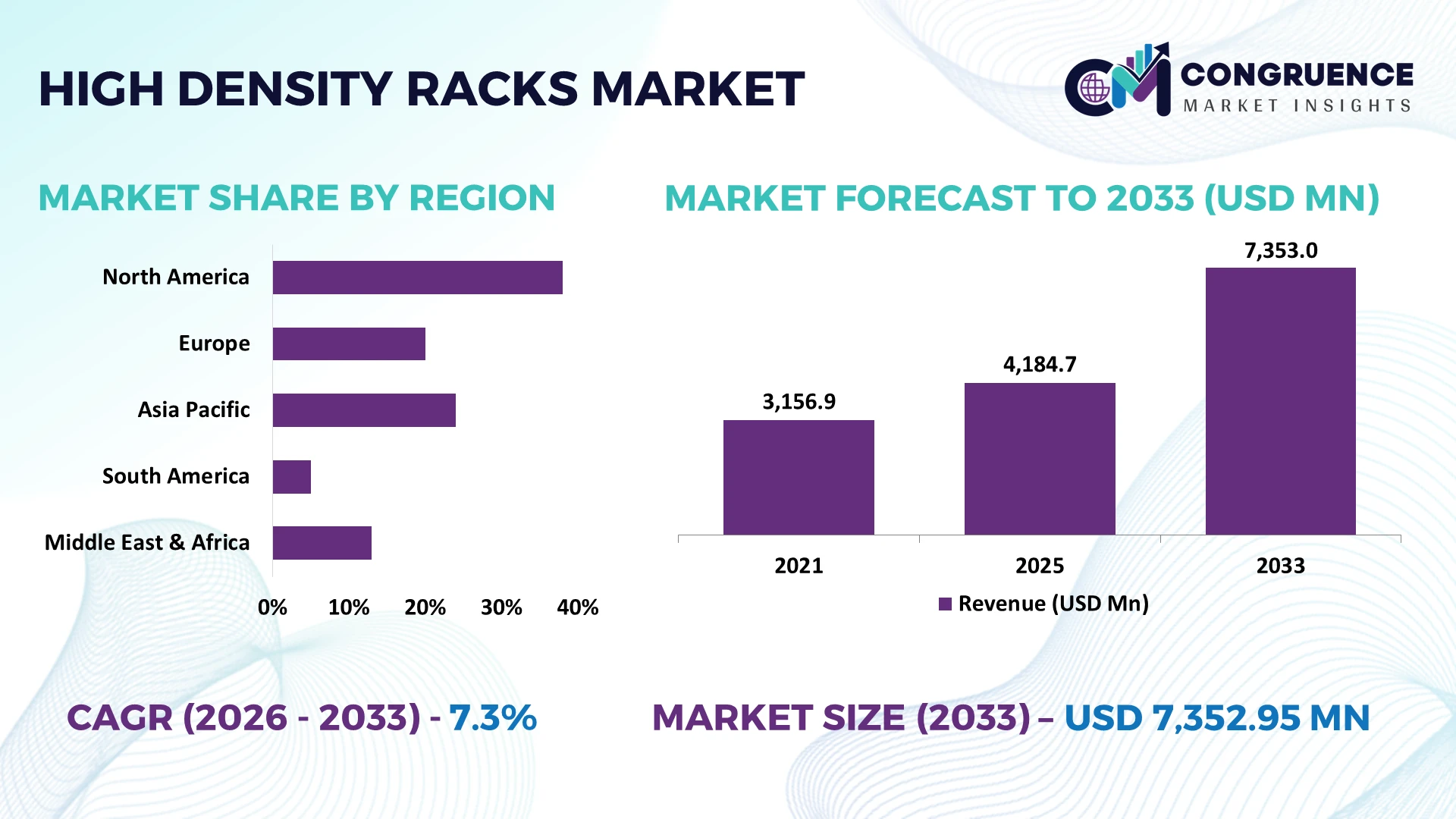
The Global High-Density Racks Market was valued at USD 4184.7 Million in 2025 and is anticipated to reach a value of USD 7352.95 Million by 2033 expanding at a CAGR of 7.3% between 2026 and 2033. Growth is being driven by AI/HPC rack densities exceeding 40–100 kW, accelerating liquid-cooling deployment and higher-capacity power distribution architectures.
The United States remains the leading deployment center, supported by hyperscale AI infrastructure and approximately 27 kW average rack density in 2026, up from 16 kW in 2025. U.S. hyperscalers are directing more than USD 730 billion toward AI infrastructure in 2026, while China is accelerating domestic AI capacity amid U.S. semiconductor export controls. Europe trails North America in deployment scale but is increasing liquid-cooled capacity as power and sustainability constraints tighten.
The strategic priority is to invest in modular, liquid-ready racks capable of supporting rapidly escalating AI power densities without extensive facility redesign.
Market Size & Growth: USD 4.18 billion in 2025 is projected to reach USD 7.35 billion by 2033 at 7.3% CAGR, driven by AI/HPC rack-density escalation.
Top Growth Drivers: AI infrastructure 31%, liquid cooling 29%, hyperscale expansion 21% are the leading demand accelerators.
Short-Term Forecast: Average rack density increased from 16 kW in 2025 to 27 kW in 2026, an approximately 69% rise.
Emerging Technologies: Direct-to-chip cooling, AI-based thermal monitoring, and high-voltage DC architectures are supporting 60–120 kW and higher-density racks.
Regional Leaders: North America ~USD 2.65 billion, Asia-Pacific ~USD 2.30 billion, and Europe ~USD 1.60 billion represent the largest projected regional opportunities by 2033.
Consumer/End-User Trends: Hyperscale operators already represent 44% of global data-center capacity, strengthening demand for scalable rack architectures.
Pilot/Case Example: 2026 AI data-center designs are targeting 100 MW facilities with 100 kW+ rack densities, shifting procurement toward integrated cooling and power systems.
Competitive Landscape: Vertiv leads with an estimated 15–18% share of the global high-density rack infrastructure segment, followed by Schneider Electric, Rittal, Eaton, and Huawei, with competition centered on liquid cooling, modular power, and AI-ready rack integration.
Regulatory & ESG Impact: Rising grid constraints and sustainability requirements are accelerating liquid-cooling adoption, with direct-to-chip systems supporting 60–120 kW densities.
Investment & Funding: The top 9 global cloud providers are projected to invest approximately USD 830 billion in 2026, with CapEx rising 79% year over year.
Innovation & Future Outlook: Next-generation racks are moving toward 200 kW+ configurations, modular pods, liquid cooling, intelligent power management, and higher-voltage architectures.
High-density rack demand is shifting from conventional enterprise deployments toward AI training, inference, hyperscale cloud, and high-performance computing environments. Average rack density reaching 27 kW in 2026 is forcing operators to redesign thermal and power infrastructure rather than simply add cabinets. Direct-to-chip cooling, modular rack systems, and intelligent monitoring are gaining traction, while supply-chain localization is becoming increasingly important as AI infrastructure construction accelerates. These shifts strengthen the strategic case for scalable, liquid-ready rack platforms.
High-density racks are becoming a strategic infrastructure layer because AI workloads are changing data-center economics. Conventional cabinets increasingly struggle with 30 kW+ loads, while AI deployments are moving toward 50–100 kW configurations. This concentration of compute increases pressure on power distribution, thermal management, floor utilization, and facility modernization, making rack architecture a competitive infrastructure decision rather than a basic equipment purchase.
Infrastructure modernization and supply-chain restructuring are reinforcing this shift. U.S. data-center vacancy is around 2%, while the development pipeline exceeds 160 GW, intensifying demand for retrofit-compatible rack systems and faster equipment availability. India is expanding hyperscale capacity from a smaller installed base, while U.S. operators increasingly upgrade existing facilities for AI workloads. This contrast is creating distinct opportunities for both greenfield and retrofit-oriented rack suppliers.
Technology selection is becoming decisive. Direct liquid cooling has reached approximately 33% adoption among surveyed operators, compared with about 68% relying on perimeter air cooling. Over the next 2–3 years, suppliers are prioritizing liquid-ready cabinets, integrated cooling distribution, modular power systems, and intelligent monitoring. Companies combining rack, cooling, and power capabilities will gain stronger competitive positioning as compute becomes increasingly concentrated.
AI acceleration is the strongest structural driver, with high-density deployments moving from conventional 10–20 kW configurations toward 50–100 kW racks. In 2026, 30 kW+ peak rack densities are increasingly common, while direct liquid cooling adoption has reached approximately 33%. U.S. hyperscale expansion is shifting procurement toward integrated rack-power-cooling platforms. Manufacturers are expanding liquid-ready portfolios, forming cooling partnerships, and developing modular architectures. The non-obvious advantage is higher compute utilization: increased rack density allows operators to generate more processing capacity from constrained floor space without proportionally expanding the facility footprint.
Infrastructure bottlenecks are limiting high-density rack deployment despite strong AI infrastructure requirements. U.S. data-center vacancy remains near 2%, while the development pipeline exceeds 160 GW, intensifying pressure on grid connections, electrical equipment, construction capacity, and rack-component availability. Material volatility affecting copper, aluminum, power electronics, and cooling components further complicates procurement. Companies are responding through multi-sourcing, regional manufacturing, longer-term contracts, and standardized rack platforms. The direct business impact is deployment delays and higher project costs. Suppliers with localized inventory, qualified component alternatives, and stronger procurement networks gain an important advantage when hyperscale customers operate under compressed construction schedules.
The strongest near-term opportunity lies in racks engineered for mixed air-liquid environments and rapid AI retrofits. Direct liquid cooling has reached approximately 33% adoption, while high-density workloads are becoming the primary trigger for advanced cooling deployment. Modular liquid-ready systems allow operators to introduce AI clusters without completely rebuilding existing data halls. Suppliers are expanding integrated cooling distribution units, intelligent monitoring, rear-door heat exchangers, and modular power shelves. Over the next 2–3 years, retrofit-compatible platforms should gain particular traction in the United States, India, and Southeast Asia, where operators need faster capacity deployment. The strategic opportunity is to sell rack infrastructure as an integrated capacity-enablement platform rather than a standalone cabinet.
Extreme rack densities create execution complexity across power delivery, cooling, networking, floor loading, controls, and maintenance. AI infrastructure is progressing toward deployments approaching 1 MW at the pod or deployment level, substantially increasing the consequences of thermal or electrical design errors. Approximately 71% of data-center operators report outages costing more than USD 100,000, making reliability a direct financial priority. Companies must therefore invest in digital twins, predictive monitoring, redundant power paths, liquid-cooling expertise, and specialized workforce training. The critical challenge is maintaining consistent performance across rapidly changing AI hardware generations. Competitive advantage will increasingly depend on validated infrastructure integration rather than rack capacity alone.
AI Rack Density Accelerates: Average rack density reached 27 kW in 2026 from 16 kW previously, a 69% increase, while 74% of surveyed operators plan AI-capable infrastructure. U.S. hyperscalers are shifting toward liquid-ready racks, higher-capacity busways, and modular power systems to increase compute without proportional floor-space expansion.
Liquid Cooling Becomes Standard: JLL identifies 40–100+ kW as the typical density range for AI-training racks, making liquid cooling increasingly necessary. New facilities are moving toward direct-to-chip and rear-door heat exchangers, while brownfield operators are retrofitting existing halls instead of waiting for new campuses, improving deployment speed and asset utilization.
Brownfield Upgrades Gain Momentum: Power scarcity and construction delays are pushing operators toward existing facilities, where modular rack retrofits can introduce AI capacity without complete site redevelopment. Schneider Electric’s 2026 reference designs demonstrate both greenfield and retrofit configurations, encouraging suppliers to develop interchangeable cooling, power, and rack components for faster deployment.
Data-Center Footprints Decentralize: JLL reported that 64% of North American construction pipeline capacity was outside traditional mature hubs, reflecting movement toward Texas and other emerging locations. This geographic shift is changing rack supply chains: manufacturers are expanding regional inventory, service networks, and assembly capabilities to reduce logistics delays and support faster commissioning.
42U remains the installed-base leader while 48U gains AI momentum.
42U racks represent the leading type at approximately 38% market share, supported by broad server compatibility, standardized data-hall layouts, and lower replacement complexity. Their mature installed base keeps procurement and maintenance predictable, while 45U racks serve facilities requiring incremental vertical capacity without major infrastructure changes. 48U racks are gaining faster adoption as operators increase equipment density and seek additional usable rack space without expanding floor area.
48U racks are estimated to be the fastest-growing type, with adoption increasing roughly 15–18% as AI and HPC deployments require greater equipment concentration. 52U racks remain specialized for new hyperscale and high-density facilities, where maximum vertical utilization justifies higher structural and cooling requirements. Manufacturers are consequently prioritizing reinforced frames, modular accessories, and liquid-cooling compatibility, while retaining 42U platforms for enterprise replacement cycles.
AI and HPC are reshaping rack specifications.
Data Center Servers remain the leading application, accounting for approximately 42% of market demand because conventional cloud, enterprise, and colocation workloads continue to occupy the largest installed equipment base. AI & HPC Systems represent the fastest-growing application, supported by GPU-intensive workloads requiring substantially higher rack power and thermal capacity. Their share is estimated at about 27%, with AI deployments increasingly specifying liquid-ready infrastructure.
Network Equipment retains strong relevance across telecommunications and hyperscale facilities, while Storage Systems support data-intensive workloads but generally operate at lower thermal intensity than AI clusters. AI & HPC deployments can require more than twice the rack power density of traditional infrastructure, accelerating demand for advanced cooling, high-capacity power distribution, and structural reinforcement. Companies are therefore reallocating engineering resources toward AI-ready rack platforms while maintaining standardized server and network configurations for established customers.
Cloud providers dominate scale while colocation targets flexible AI capacity.
Cloud Service Providers lead the end-user segment with approximately 44% market share, reflecting large-scale hyperscale deployments and standardized procurement across multiple data-center campuses. Their rack purchases prioritize high power density, rapid installation, thermal integration, and lifecycle service. Enterprises account for a significant mature-use base, particularly in financial services and data-intensive industries, while Telecommunications operators favor compact, resilient configurations for network-heavy environments.
Colocation Providers represent the fastest-growing buyer group, with demand increasing approximately 18–20% as enterprises and AI developers seek ready-to-deploy capacity instead of constructing dedicated facilities. Colocation operators are consequently investing in liquid-ready racks, flexible power allocation, and modular infrastructure capable of supporting different customer hardware. Suppliers are responding with configurable platforms and ecosystem partnerships. This shift strengthens demand for racks that can support multiple workload profiles without costly facility-level redesign.
North America accounted for the largest market share at 35.5% in 2025 however, Asia-Pacific is expected to register the fastest growth, expanding at a CAGR of 8.0% between 2026 and 2033.
AI infrastructure is shifting rack procurement from cabinets to integrated power-cooling platforms.
North America remains the principal deployment center for high-density racks, supported by hyperscale campuses, colocation expansion, and rapid AI infrastructure modernization. The United States represents roughly 72% of the regional data-center rack market, concentrating procurement around Virginia, Texas, California, and other major computing hubs. More than 160 GW of U.S. data-center capacity is in development, increasing demand for rack systems engineered around constrained power and cooling availability. Liquid-ready configurations are gaining traction as AI workloads push rack densities beyond 50 kW. Manufacturers are responding through modular rack platforms, integrated cooling distribution, and localized inventory strategies. The competitive advantage increasingly rests on deployment speed and retrofit compatibility rather than cabinet capacity alone.
United States Market Outlook: The United States dominates North American deployment because hyperscalers and AI-cloud providers are concentrating capital in large-scale computing campuses. Rack requirements are shifting toward 100 kW-class architectures, forcing suppliers to integrate power distribution, thermal management, monitoring, and structural reinforcement into single infrastructure packages. Localized manufacturing and shorter component lead times are becoming important purchasing criteria.
Power efficiency and regulatory modernization are redefining European rack specifications.
Europe is transitioning toward higher-density infrastructure while balancing AI capacity expansion with energy-efficiency requirements. The United Kingdom remains the largest European data-center market, with London accounting for more than 80% of national supply, creating a concentrated procurement environment for advanced rack systems. Germany, France, and the Netherlands are also expanding high-performance computing and cloud capacity. European operators increasingly favor liquid-compatible racks, efficient airflow containment, and intelligent power monitoring to accommodate AI workloads within tighter energy constraints. Manufacturers are responding with modular systems designed for rapid facility upgrades rather than complete infrastructure replacement. Sustainability requirements are therefore becoming a product-selection factor, particularly where operators face limited grid capacity and stricter facility-efficiency expectations.
United Kingdom Market Outlook: The United Kingdom provides Europe’s strongest concentration of high-density rack opportunities, with London remaining the dominant deployment cluster. Hyperscaler take-up continues to exceed new supply, increasing pressure on existing facilities to maximize usable capacity. Suppliers with retrofit-ready cabinets, advanced cooling integration, and compact power architectures are positioned to capture modernization projects as operators expand AI-ready capacity without relocating workloads.
Manufacturing scale is converging with hyperscale AI infrastructure expansion.
Asia-Pacific is the fastest-developing high-density rack market, combining China’s manufacturing ecosystem with expanding digital infrastructure across India, Japan, Singapore, Malaysia, and Indonesia. The region accounts for approximately 30.5% of global high-density rack demand, while AI and cloud infrastructure investment is accelerating procurement of liquid-ready cabinets and high-capacity power systems. Technology companies are increasing AI capital expenditure sharply, with regional data-center development increasingly linked to GPU-intensive workloads. Indonesia has emerged as a new deployment destination, with three AI-focused data centers announced in 2026 by a major AI-cloud provider. Suppliers are strengthening regional production, distribution, and technical partnerships to reduce delivery times and address increasingly localized infrastructure requirements.
China Market Outlook: China combines extensive rack manufacturing capabilities with large domestic cloud and AI deployments, creating an integrated supply environment. Domestic technology providers increasingly favor locally engineered cooling and power solutions as semiconductor restrictions encourage greater infrastructure self-reliance. High-density rack suppliers benefit from proximity to component ecosystems, enabling faster customization and supporting large-scale AI and telecommunications deployments.
Brazil is converting hyperscale demand into large-scale AI-ready infrastructure.
South America remains a smaller but increasingly strategic deployment market, with Brazil accounting for the largest share of regional data-center activity. Demand is concentrated around São Paulo and other established connectivity hubs, where cloud, financial services, telecommunications, and AI workloads are driving higher rack densities. In 2026, a major Brazilian data-center operator announced USD 1.2 billion of investment for 150 MW of new capacity, including facilities designed for rack densities reaching 1 MW. This represents a significant shift from conventional enterprise installations toward purpose-built AI infrastructure. Suppliers are responding with liquid-cooling compatibility, modular power architectures, and locally supported rack systems. However, power availability and project execution remain important procurement considerations.
Brazil Market Outlook: Brazil is emerging as Latin America’s principal high-density infrastructure hub because of its established hyperscale ecosystem and strong connectivity base. The planned 150 MW capacity expansion demonstrates the scale of AI-oriented deployment. Suppliers that combine local service capability with liquid-ready rack architectures can secure stronger positions as cloud and GPU infrastructure expands around São Paulo.
Sovereign AI investment is accelerating the region’s transition toward high-density digital infrastructure.
The Middle East & Africa market is being reshaped by government-backed digital transformation, sovereign AI programs, cloud localization, and hyperscale investment. Saudi Arabia and the United Arab Emirates are leading deployment, with Saudi Arabia’s operational data-center capacity increasing from 68 MW in 2021 to 440 MW in 2025. The region’s high-density rack requirements increasingly center on AI computing, financial services, telecommunications, and government platforms. Extreme heat and water constraints are strengthening demand for efficient cooling architectures and careful facility design. Suppliers are expanding through infrastructure partnerships, local integration, and high-efficiency thermal systems. The region’s distinctive opportunity is the ability to design new facilities around high-density workloads rather than retrofit legacy enterprise halls.
Saudi Arabia Market Outlook: Saudi Arabia has become a major digital-infrastructure investment destination, supported by large-scale national technology programs and substantial power and land availability. Data-center capacity reached 440 MW in 2025, creating a substantial base for high-density rack deployment. Suppliers offering energy-efficient cooling, modular infrastructure, and locally supported maintenance can align closely with the Kingdom’s accelerated AI and cloud modernization agenda.
Vertiv, Schneider Electric, Rittal, Eaton, and Huawei compete across high-density rack infrastructure, while regional fabricators and specialized cooling suppliers challenge them on customization and delivery speed. The top five players collectively control an estimated 43% of the market, leaving substantial room for regional specialists. Competition increasingly centers on technology, with liquid-ready architectures improving thermal capacity by roughly 20–30% versus conventional air-only configurations, while modular designs can shorten deployment cycles by 15–25%. Vertiv and Schneider Electric are strengthening integrated rack-power-cooling portfolios; Rittal is emphasizing modular data-center infrastructure; Eaton is expanding power-management integration; and Huawei is targeting high-density AI deployments. The competitive shift is moving from cabinet manufacturing toward vertically integrated infrastructure platforms as AI rack densities exceed 100 kW. Entry barriers include engineering validation, thermal expertise, hyperscale qualification, and supply-chain scale. Winning suppliers must combine rapid customization, dependable component availability, liquid-cooling capability, and lifecycle service rather than compete on rack price.
Vertiv
Schneider Electric
Rittal
Eaton
Huawei Technologies
Legrand
nVent Electric
Delta Electronics
Panduit
Chatsworth Products
Black Box
Supermicro
Lenovo
Fujitsu
Current rack technology is centered on liquid cooling, intelligent PDUs, and modular thermal management. Direct-to-chip cooling supports racks above 100 kW, while intelligent power distribution improves monitoring accuracy and reduces manual intervention by about 5–10%. Adoption is strongest in AI and HPC facilities, where thermal stability directly protects GPU performance and uptime.
Emerging architectures are integrating racks with 800 VDC power, coolant distribution units, rear-door heat exchangers, and digital-twin controls. Compared with legacy air-cooled designs, liquid cooling can improve thermal efficiency by roughly 20–30% at high densities and reduce cooling energy by 10–15%. Modular systems also shorten deployment schedules by up to 35%, benefiting hyperscalers and colocation operators prioritizing rapid AI capacity expansion.
Disruptive development is moving toward rack-scale infrastructure exceeding 200 kW and eventually megawatt-class AI pods, supported by standardized power and cooling interfaces. By 2028, suppliers with interoperable liquid cooling, intelligent monitoring, and high-voltage distribution will gain advantage as operators retrofit constrained facilities and build AI-ready campuses while improving space utilization, serviceability, and energy visibility across heterogeneous computing environments. Companies acting now can avoid stranded rack capacity, reduce redesign cycles, and secure stronger positions in the high-density infrastructure ecosystem as rack specifications evolve faster than facility refresh cycles.
June 2026, Vertiv launched Rack Extreme for AI deployments, delivering up to 2x higher dynamic capacity and 1.3x higher static capacity than conventional designs. The platform supports heavier equipment and integrated airflow, improving installation flexibility for high-density operators and hyperscalers. Source: DCD
January 2026, Eaton partnered with Flexnode on modular rack and power infrastructure, reducing deployment schedules by 35% on average. The collaboration targets 3.5–35 MW data halls, combining racks, backup power, cable management, and 800 VDC architecture for faster AI rollout. Source: Eaton
October 2025, Rittal introduced its MGX Architecture Rack with NVIDIA collaboration, supporting 1,400 kg dynamic loads and busbar capacity up to 1,400 A. The cabinet strengthens deployment readiness for GB200, GB300, and Vera Rubin systems while simplifying standardized infrastructure procurement. Source: Rittal
December 2024, Schneider Electric and NVIDIA introduced a reference design supporting liquid-cooled AI clusters up to 132 kW per rack. Its Galaxy VXL UPS delivered 52% space savings versus industry average, strengthening power infrastructure for dense AI deployments and modernization. Source: Euronext
The High-Density Racks Market report covers 42U, 45U, 48U, and 52U configurations across Data Center Servers, AI & HPC Systems, Network Equipment, and Storage Systems. End-user analysis includes Cloud Service Providers, Colocation Providers, Enterprises, and Telecommunications, with emphasis on rack density, thermal architecture, power distribution, modularity, and deployment requirements.
Geographic coverage spans North America, Europe, Asia-Pacific, South America, and the Middle East & Africa, with country-level assessment of infrastructure concentration, manufacturing capability, AI deployment, and modernization activity. The report evaluates direct-to-chip cooling, rear-door heat exchangers, intelligent rack PDUs, liquid-cooling integration, 800 VDC architectures, and automation. With AI-oriented racks increasingly exceeding 100 kW, the analysis supports investment planning, capacity expansion, supplier selection, competitive positioning, and technology roadmaps, procurement priorities, partnership decisions, and infrastructure planning through 2026–2033.
| Report Attribute/Metric | Report Details |
|---|---|
|
Market Revenue in 2025 |
USD 4184.7 Million |
|
Market Revenue in 2033 |
USD 7352.95 Million |
|
CAGR (2026 - 2033) |
7.3% |
|
Base Year |
2025 |
|
Forecast Period |
2026 - 2033 |
|
Historic Period |
2021 - 2025 |
|
Segments Covered |
By Type
By Application
By End-User
|
|
Key Report Deliverable |
Revenue Forecast, Growth Trends, Market Dynamics, Segmental Overview, Regional and Country-wise Analysis, Competition Landscape |
|
Region Covered |
North America, Europe, Asia-Pacific, South America, Middle East, Africa |
|
Key Players Analyzed |
Vertiv, Schneider Electric, Rittal, Eaton, Huawei Technologies, Legrand, nVent Electric, Delta Electronics, Panduit, Chatsworth Products, Black Box, Supermicro, Lenovo, Fujitsu |
|
Customization & Pricing |
Available on Request (10% Customization is Free) |




