
Reports
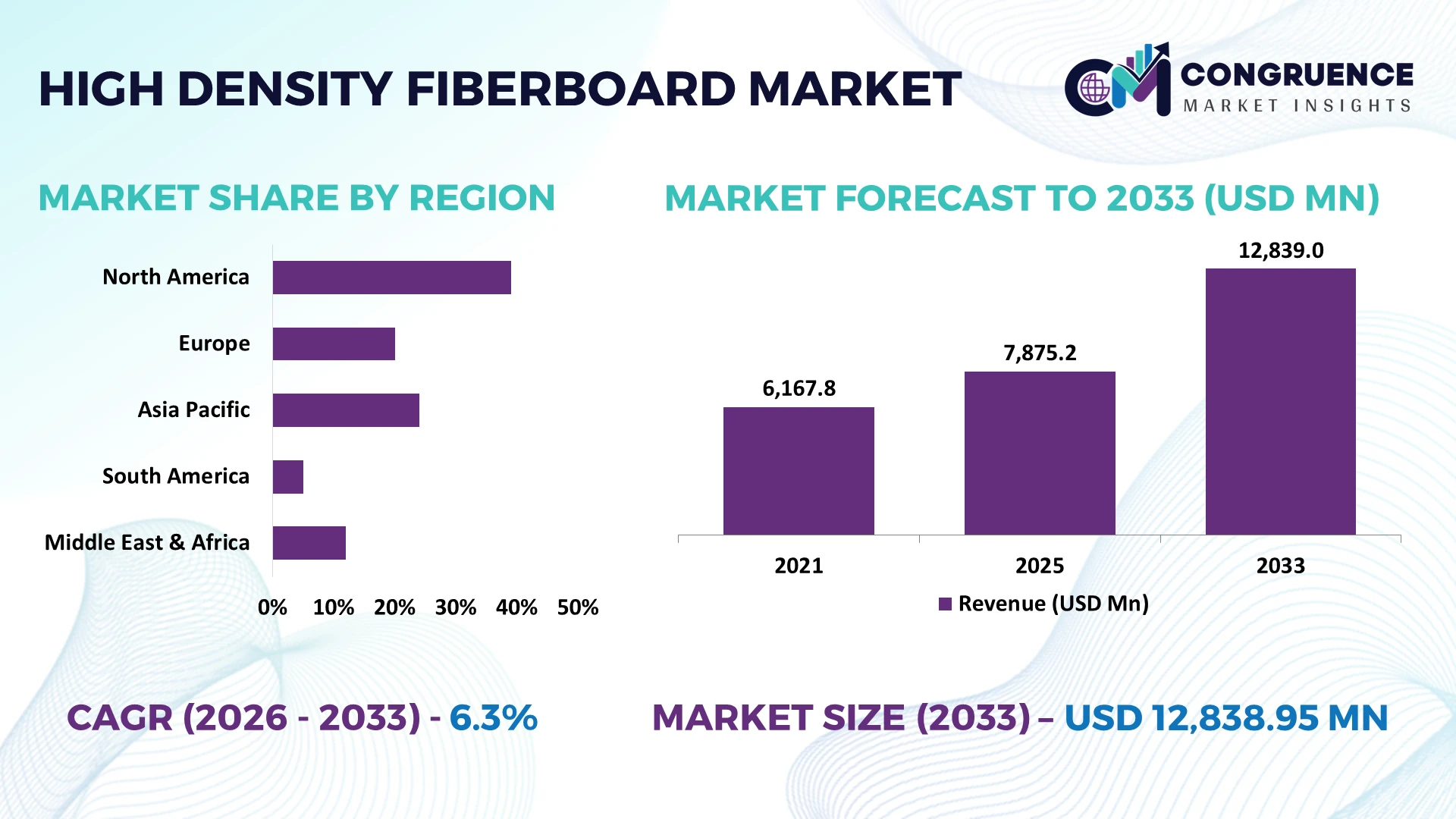
The Global High Density Fiberboard Market was valued at USD 7875.23 Million in 2025 and is anticipated to reach a value of USD 12838.95 Million by 2033 expanding at a CAGR of 6.3% between 2026 and 2033. Growth is driven by laminated flooring, modular furniture, interior doors, low-emission engineered panels, continuous-press modernization, and rising substitution of solid wood with precision fiberboard.
China anchors global High Density Fiberboard manufacturing through a wood-panel industry representing 45% of worldwide production and 41% of consumption. Its fiberboard capacity reached about 40 million m³ annually across 220 enterprises in 2025, while HDF exports increased 37.24%. A Guangxi medium/high-density line adds 350,000 m³ capacity from RMB 501 million investment; India remains substantially smaller but is rapidly expanding continuous-press capacity.
U.S. tariff restructuring and intensifying Southeast Asian price competition make efficient continuous pressing, low-emission certification, and diversified fiber sourcing decisive for capacity and procurement strategies.
Market Size & Growth: USD 7.88 billion in 2025 reaches USD 12.84 billion by 2033 at 6.3%, supported by laminated flooring and modular furniture conversion.
Top Growth Drivers: Laminated HDF holds 65.7%, global wood-panel output increased 5%, and Chinese HDF exports advanced 37.24%.
Short-Term Forecast: By 2027, Greenply targets full utilization of 1,000 CBM/day capacity versus approximately 70% during 2025, supporting value-added panel output.
Emerging Technologies: Dry processing commands 80.75% adoption, while continuous presses, automated resin dosing, and ultra-thin HDF lines increase high-volume manufacturing precision.
Regional Leaders: Normalized 2033 projections place Asia-Pacific near USD 7.9 billion, Europe USD 2.6 billion, and North America USD 0.9 billion, led by laminated-HDF adoption.
Consumer/End-User Trends: Laminated HDF captured 65.7% of 2025 demand, reflecting preference for flooring, furniture surfaces, cabinetry, and decorative interior panels.
Pilot/Case Example: Greenpanel’s 2025 Andhra Pradesh expansion lifted capacity 35% by adding 231,000 CBM and introduced 1.5–1.7 mm thin panels using ContiPress technology.
Competitive Landscape: China controls 45% of global wood-based-panel production; Kronospan, ARAUCO, Greenpanel, SWISS KRONO, and Pfleiderer compete through scale, certification, and finishing capability.
Regulatory & ESG Impact: China’s HDF import prices fell 27.91% in 2025 as tighter competition increased pressure for certified, low-emission, higher-value boards.
Investment & Funding: Guangxi’s RMB 501 million project is installing 350,000 m³ annual medium/high-density fiberboard capacity using an imported German continuous press.
Innovation & Future Outlook: China’s average fiberboard line scale continues rising despite total capacity declining 3.5%, accelerating consolidation around automated, efficient, differentiated production.
High Density Fiberboard demand is concentrating in laminate flooring, modular furniture, cabinetry, doors, and precision interior components. China’s HDF exports rose 37.24% in 2025 even as average export prices fell 12.18%, revealing a shift from volume competition toward thinner, low-emission and higher-specification boards. U.S. tariff changes and Southeast Asian pricing pressure now sharpen the strategic importance of technology, sourcing, and product differentiation.
High Density Fiberboard is becoming strategically important as furniture, flooring, cabinetry, doors, and interior-component manufacturers prioritize dimensional consistency, machinability, and scalable substitutes for solid timber. China produces about 45% of global wood-based panels, but falling export prices and U.S. trade measures are restructuring supply chains toward Southeast Asia and domestic manufacturing. Producers are consequently competing through specialized grades rather than volume alone.
Continuous presses provide the key technology advantage, enabling uninterrupted board formation, tighter thickness tolerances, lower material losses, and higher throughput than legacy multi-daylight presses. Modern lines can operate above 90% utilization while producing HDF below 2 mm. China dominates manufacturing scale, Europe leads low-emission and process technology, while India is rapidly installing continuous-press capacity to reduce import dependence and serve furniture and flooring manufacturers.
Greenpanel’s Andhra Pradesh expansion illustrates this pathway: 231,000 CBM of additional capacity increased its MDF capability 35% and enabled 1.5–1.7 mm panels. Through 2026–2028, manufacturers are prioritizing thin boards, automated resin control, recycled fiber, low-formaldehyde binders, and localized capacity. Competitive advantage will increasingly depend on converting manufacturing scale into consistent specialty-board quality, lower conversion costs, and reliable downstream supply.
Furniture and interior manufacturing is shifting from solid timber toward engineered panels that provide repeatable density, smooth finishing, CNC machinability, and high-volume economics. Laminated HDF represents approximately 65.7% of demand, dry-process manufacturing accounts for about 80.8% of production, and Chinese HDF exports increased 37.2% in 2025. Modular furniture and flooring manufacturers increasingly require standardized panels compatible with automated cutting, lamination, and edge-processing lines. India illustrates the industrial response as domestic producers expand continuous-press capacity to displace imports and support organized furniture manufacturing. Greenpanel increased MDF capacity 35% through its Andhra Pradesh expansion. Producers are investing in thin-board capability, decorative surfaces, automated finishing, and downstream distribution. Strategically, standardized HDF increasingly functions as an automation-enabling input, not simply a lower-cost timber substitute.
Wood-fiber availability and aggressive panel pricing constrain manufacturing economics because fiber, resin, energy, and logistics represent substantial variable costs. China’s total fiberboard capacity declined approximately 3.5% even as average production-line scale increased, indicating consolidation toward larger efficient mills. Simultaneously, Chinese HDF export prices fell 12.2% in 2025 and import prices dropped 27.9%, intensifying margin pressure for less efficient producers. U.S. tariff actions further complicate sourcing decisions for exporters and downstream buyers dependent on Asian panels. Manufacturers are reducing exposure through captive plantations, recycled wood utilization, long-term fiber procurement, regional production, and higher-value laminated or specialty boards. The non-obvious constraint is utilization: additional capacity improves unit economics only when mills secure sufficient fiber and downstream offtake to keep continuous presses operating near optimal loads.
Ultra-thin, low-emission, moisture-resistant, and surface-engineered HDF creates attractive opportunities beyond conventional furniture panels. Greenpanel’s new continuous press can manufacture 1.5–1.7 mm boards, while its capacity expansion added 231,000 CBM, increasing installed capability by 35%. Laminated products already account for about 65.7% of demand, creating a platform for differentiated flooring substrates, door skins, drawer bottoms, wall systems, and precision interior components. India provides a particularly attractive localization opportunity as organized furniture and interior manufacturing expands alongside domestic board capacity. Producers are investing in continuous presses, automated sanding, resin optimization, digital quality inspection, and decorative finishing. The strategic opportunity lies in thickness reduction: extracting more finished surface area from comparable fiber input improves material productivity while opening applications previously served by plywood, plastics, and imported specialty panels.
Meeting tighter emissions and circularity requirements while preserving HDF strength creates a demanding manufacturing challenge. Dry processing represents roughly 80.8% of production, laminated boards hold 65.7% of demand, and modern high-throughput lines increasingly operate above 90% utilization, leaving limited tolerance for resin instability or quality interruptions. Formaldehyde restrictions in the United States and Europe require tighter control of adhesives, fiber moisture, pressing temperatures, and finished-board emissions. Lower-emitting resins can alter cure behavior and production economics, particularly when mills simultaneously increase recycled-fiber content. Producers must therefore invest in inline sensors, laboratory testing, resin formulation, emissions certification, and process automation. The strategic challenge is maintaining throughput while specifications tighten: manufacturers that cannot control density profile, emissions, moisture resistance, and surface quality consistently risk losing premium flooring, furniture, and export qualification.
Continuous Press Lines Gain Scale: HDF producers are replacing batch-oriented equipment with continuous pressing to improve thickness control, throughput, and surface consistency. Greenpanel added 231,000 CBM of capacity, increasing installed capability 35%, while China’s overall fiberboard capacity declined 3.5%. Producers are consolidating output into larger automated lines, using inline density monitoring and automated resin dosing to reduce variability and strengthen mill utilization.
Export Pricing Reshapes Product Mix: Chinese HDF exports increased 37.2% in 2025 while average export prices declined 12.2%, exposing manufacturers to stronger volume-led competition. Import prices fell 27.9%, reinforcing pressure from alternative Asian supply. Producers are responding by prioritizing laminated, moisture-resistant, thin, and certified boards rather than commodity output, using differentiated specifications to protect margins as trade measures alter established sourcing routes.
Low-Emission Resins Enter Production: Formaldehyde controls are accelerating adoption of lower-emission adhesive systems and tighter process monitoring. Dry-process technology already represents about 80.8% of manufacturing, while laminated HDF accounts for 65.7% of demand. Mills serving U.S. and European buyers are upgrading resin formulation, emissions testing, fiber preparation, and press controls, turning regulatory compliance into an increasingly important qualification requirement for export-oriented production.
Digital Inspection Reduces Quality Losses: Automated cameras, thickness scanners, moisture sensors, and process analytics are moving quality control directly onto HDF production lines. Modern continuous presses operate above 90% utilization, making unplanned quality interruptions disproportionately expensive. Manufacturers are deploying real-time monitoring and predictive maintenance to detect density, sanding, and surface defects earlier, improving first-pass yield while supporting thinner panels where small dimensional deviations can make downstream lamination or machining unacceptable.
Standard Grade represents an estimated 48% of High Density Fiberboard demand, supported by established furniture, cabinetry, door, and general interior applications where machinability and cost efficiency outweigh specialized performance requirements. High Density grades form the next important category, serving applications requiring greater mechanical strength and dimensional stability. Moisture Resistant boards are gaining importance in kitchens, bathrooms, and humid interiors as manufacturers differentiate products through water-resistant resin systems. Standard products retain manufacturing advantages because large continuous lines can run standardized formulations at high utilization, lowering conversion costs.
Moisture Resistant HDF is the fastest-growing type as modular kitchens, premium flooring, and moisture-exposed interiors require improved swelling resistance. Fire Resistant products remain specification-driven for commercial interiors, while Ultra-High Density boards address narrower performance-intensive applications. With dry-process manufacturing accounting for roughly 80.8% of production and modern continuous lines exceeding 90% utilization, producers are increasingly balancing commodity-scale Standard Grade output with higher-margin specialized grades, directing resin-development and finishing investments toward performance differentiation.
Furniture represents an estimated 42% of HDF application demand, reflecting extensive consumption in flat-pack products, tables, shelving, furniture backs, drawer components, and laminated interior surfaces. Cabinetry follows as a mature application where smooth machining, dimensional consistency, and compatibility with coatings and decorative laminates support repeat procurement. Flooring remains strategically important because laminated HDF already represents approximately 65.7% of product demand, demonstrating the scale of surface-finished applications. Producers serving these established channels are expanding sanding, lamination, coating, and precision-cutting capabilities alongside board production.
Wall Panels are the fastest-growing application as decorative interior systems increasingly use engineered substrates for acoustic, textured, digitally printed, and slatted surfaces. Doors provide another stable outlet through skins and engineered components requiring consistent density. Greenpanel’s 35% capacity expansion and capability to manufacture 1.5–1.7 mm panels demonstrate how suppliers are adapting production toward thinner downstream components. Investment is therefore shifting from basic board volume toward application-specific thicknesses, surfaces, moisture resistance, and finishing integration.
Furniture Manufacturers represent an estimated 40% of HDF end-user demand because standardized panels integrate efficiently with automated cutting, CNC routing, drilling, lamination, and flat-pack assembly. Cabinet Manufacturers provide another concentrated buyer group, emphasizing smooth surfaces, edge quality, moisture resistance, and predictable machining. Flooring Manufacturers consume significant volumes of high-density laminated substrates where dimensional stability and wear-layer compatibility are critical. Large buyers increasingly negotiate specifications and supply contracts directly with mills, encouraging producers to offer customized thicknesses, surface treatments, and dependable high-volume delivery.
Interior Designers are the fastest-growing end-user group as decorative wall systems, customized furniture, textured panels, and digitally finished interiors broaden specification-led HDF consumption. Construction Companies remain important for doors, wall panels, fit-outs, and prefabricated interiors, although purchasing is more project-dependent. Chinese HDF exports increased 37.2% in 2025, demonstrating strong downstream availability but intensifying price competition. Manufacturers are therefore strengthening dealer networks, OEM relationships, customized finishing, and certified specialty portfolios to secure recurring professional demand rather than compete solely through board pricing.
Asia-Pacific accounted for the largest market share at 61% in 2025 however, Asia-Pacific is expected to register the fastest growth, expanding at a CAGR of 7.1% between 2026 and 2033.

Certified Panels Reshape Procurement Standards
North America represents approximately 7% of High Density Fiberboard demand, concentrated in furniture, cabinetry, laminate flooring, doors, retail fixtures, and interior remodeling. U.S. procurement increasingly favors CARB Phase 2 and TSCA Title VI-compliant composite wood, making formaldehyde performance a commercial qualification requirement rather than an optional product attribute. Domestic manufacturers compete with Canadian, European, and Asian supply, while tariffs and trade investigations are changing landed-cost economics for imported panels. Automated furniture and cabinet factories favor consistent density profiles, tight thickness tolerances, and reliable machining characteristics, strengthening demand for technically standardized HDF. Housing repair and remodeling provides an important consumption channel even when new construction fluctuates. Suppliers are responding through certified low-emission boards, localized inventories, distributor partnerships, and specialized moisture-resistant and laminated products designed for downstream processors.
United States Market Outlook: The United States provides the region’s largest downstream base through furniture manufacturing, cabinetry, flooring, doors, remodeling, and commercial interiors. TSCA Title VI requires regulated composite-wood products to meet formaldehyde-emission requirements, raising barriers for uncertified imports. Suppliers with domestic warehousing, verified certification, dependable dimensions, and short replenishment cycles hold an advantage as trade measures increase uncertainty around imported panel costs.
Circular Manufacturing Elevates Fiber Efficiency
Europe accounts for approximately 20% of HDF demand, supported by mature furniture, laminate flooring, cabinetry, doors, and interior-component industries in Germany, Poland, Italy, Türkiye, and neighboring manufacturing hubs. Producers compete through continuous pressing, recycled wood utilization, low-emission resins, precision finishing, and integrated decorative surfaces rather than commodity volume alone. European panel manufacturing has developed extensive wood-recycling infrastructure, allowing recovered fiber to supplement virgin feedstock and improve resource productivity. Regulatory pressure surrounding formaldehyde, sustainable forestry, waste recovery, and product circularity is strengthening traceability requirements across downstream supply chains. Large producers increasingly integrate particleboard, MDF/HDF, flooring, laminates, and recycling operations to capture more value per fiber unit. This favors companies with established collection networks and modern presses capable of maintaining density and surface quality despite increasingly diversified raw-material inputs.
Germany Market Outlook: Germany remains strategically significant through advanced wood-processing machinery, automated furniture manufacturing, flooring production, and stringent environmental specifications. German technology suppliers underpin continuous pressing, sanding, resin application, and digital process control globally. Domestic panel users increasingly prioritize recycled content, certified fiber, low emissions, and manufacturing consistency, supporting premium suppliers that can document both technical performance and material provenance.
China Scale Meets Indian Capacity Expansion
Asia-Pacific commands approximately 61% of global HDF demand, reflecting China’s dominant wood-panel ecosystem alongside expanding furniture, flooring, cabinetry, and construction industries in India, Vietnam, Indonesia, and Malaysia. China accounts for roughly 45% of worldwide wood-based-panel production and approximately 41% of consumption, giving domestic mills substantial procurement, processing, and export advantages. Its fiberboard capacity nevertheless declined about 3.5%, indicating consolidation toward larger and more productive lines rather than unrestricted capacity additions. India is moving in the opposite direction, installing continuous presses and expanding domestic MDF/HDF manufacturing to capture demand previously served by imports. Vietnam and Southeast Asian manufacturing hubs add export-oriented furniture demand. Producers are prioritizing automated presses, thin-board production, local fiber sourcing, decorative surfaces, and higher-specification grades to protect margins against intense commodity pricing.
China Market Outlook: China remains the decisive manufacturing center, with approximately 40 million m³ of annual fiberboard capacity distributed across about 220 enterprises in 2025. HDF exports increased 37.2% while average export prices declined 12.2%, forcing mills toward consolidation, automation, laminated products, and differentiated specifications. Producers with large continuous presses and integrated downstream finishing are positioned to withstand price compression better than smaller commodity-focused mills.
Plantation Fiber Supports Integrated Production
South America represents approximately 6% of HDF demand, with Brazil providing the strongest manufacturing and consumption base through plantation forestry, furniture production, cabinetry, construction, flooring, and export-oriented wood processing. Brazil’s highly productive eucalyptus plantations create a structural fiber advantage for engineered-board mills, supporting integrated operations with shorter harvesting cycles than many temperate forestry systems. Large panel manufacturers combine plantation ownership or contracted fiber supply with modern continuous pressing, reducing exposure to imported raw materials. Furniture clusters in southern Brazil provide concentrated downstream consumption, while domestic housing and interior renovation support standardized panels. Currency volatility and logistics distances remain operating constraints, particularly for imported machinery, chemicals, and specialized resins. Producers are therefore emphasizing plantation integration, mill-scale efficiency, local distribution, and value-added surfaces rather than relying primarily on imported board supply.
Brazil Market Outlook: Brazil benefits from approximately 10 million hectares of planted forests, dominated by eucalyptus and pine, providing industrial-scale feedstock for pulp and engineered wood products. Major furniture clusters in Paraná, Santa Catarina, and Rio Grande do Sul support recurring panel consumption. Efficient forestry logistics and integrated fiber sourcing give domestic manufacturers a defensible cost position in standard and value-added HDF production.
Construction Programs Expand Import-Led Demand
Middle East & Africa represents approximately 6% of HDF demand, characterized by strong import dependence and concentrated consumption in furniture, hospitality interiors, cabinetry, doors, retail fit-outs, and residential construction. Saudi Arabia and the UAE are driving specification-led demand through large housing, tourism, hotel, commercial, and entertainment projects, while Türkiye and African suppliers influence surrounding trade flows. Limited industrial forestry across Gulf markets makes imported finished boards and furniture components structurally important, increasing sensitivity to freight costs and supplier lead times. Large developments increasingly require certified, moisture-resistant, fire-resistant, and decorative panels rather than basic commodity boards. Distributors and manufacturers are responding through regional warehouses, local cutting and lamination operations, specification partnerships, and diversified sourcing from Asia and Europe. Local finishing therefore offers a practical route to capture value without replicating fiber-intensive upstream manufacturing.
Saudi Arabia Market Outlook: Saudi Arabia offers the strongest demand-side transformation through Vision 2030 housing, hospitality, tourism, entertainment, and commercial development. The Kingdom’s limited domestic timber resource keeps HDF structurally import-dependent, but local furniture and interior-processing capacity is expanding. Suppliers able to maintain project-scale inventories and provide moisture-resistant, fire-rated, decorative, and precisely machined panels are positioned for specification-driven procurement.
Kronospan, ARAUCO, EGGER, Kastamonu Entegre, and Greenpanel compete through manufacturing scale, fiber integration, continuous-press technology, and downstream finishing, while Chinese producers challenge established brands through lower-cost export supply. The top five account for approximately 28% of HDF activity, leaving substantial production distributed among regional manufacturers. Competition is intensifying as Chinese HDF exports increased 37.2% while average export prices fell 12.2%, and China’s fiberboard capacity contracted 3.5%. Kronospan and EGGER emphasize vertically integrated panels and decorative surfaces; ARAUCO leverages plantation resources; Kastamonu combines regional scale with downstream products; Greenpanel targets thin and value-added boards. Producers are expanding automated capacity, recycled-fiber processing, specialty grades, and localized distribution. The competitive shift favors differentiated, certified products over commodity volume. Fiber security, continuous-press capital, emissions compliance, and distribution access remain barriers. Winning requires low conversion costs, dependable fiber, specification breadth, automated quality control, and downstream customer integration.
Kronospan
ARAUCO
EGGER Group
Kastamonu Entegre
Greenpanel Industries Limited
Greenply Industries Limited
SWISS KRONO Group
Pfleiderer Group
Sonae Arauco
Finsa
Dongwha Enterprise Co., Ltd.
Duratex S.A.
Dare Power Dekor Home Co., Ltd.
Rushil Décor Limited
Current High Density Fiberboard technology centers on continuous pressing, dry-process fiber refining, automated resin dosing, precision sanding, and inline density control. Dry processing represents about 80.8% of production, while Greenply’s press extension increased designed MDF output from 800 to 1,000 CBM daily, a 25% improvement without installing another production line. Compared with legacy batch presses, continuous systems deliver uninterrupted forming, tighter thickness tolerances, faster changeovers, and better suitability for thin HDF, lowering conversion variability for high-volume furniture and flooring customers.
Emerging technology is shifting toward ultra-thin panels, moisture-resistant resin chemistry, low-emission binders, recycled fiber integration, and machine-vision inspection. Greenpanel’s CPS+ continuous line added 231,000 CBM of capacity, increasing installed capability 35%, while enabling 1.5–1.7 mm thin panels. High-density waterproof boards reaching 1,100 kg/m³ extend HDF into kitchens, bathrooms, commercial interiors, and load-intensive furniture. Producers combining process automation with specialty formulations gain pricing power than commodity-board suppliers.
From 2026–2028, disruptive investment will concentrate on AI-assisted process control, predictive maintenance, digital twins, formaldehyde reduction, and higher recycled-fiber utilization. Mills that connect fiber preparation, press parameters, sanding, inspection, and finishing data can stabilize quality while increasing specialty-board output. Acting now protects utilization, export qualification, and downstream design wins as buyers tighten performance specifications.
May 2024 Adlerwud invested over INR 80 crore in an imported thin-MDF manufacturing line designed for sub-6-mm MDF/HDF, including 4-mm and 5.5-mm XDHMR boards. The expansion strengthened India’s domestic capability for precision thin-panel production and downstream furniture applications. Source: plyreporter.com
December 2025 Greenpanel launched DuroBOIL BWP HDF at 1,100 kg/m³ density, available in 12-mm and 18-mm thicknesses with a 25-year warranty. The product moved HDF into moisture-intensive kitchens, bathrooms, marine interiors, and premium high-traffic commercial applications nationwide. Source: greenpanel.com
March 2025 Kronospan agreed to acquire ZG Timber’s Sebeș plant, safeguarding 500 jobs and complementing Romanian MDF operations exporting to 75 countries. The acquisition strengthened fiber integration, sawmill access, and supply resilience around its regional wood-panel manufacturing platform. Source: kronospan.com
February 2026 Greenply approved a Gujarat MDF expansion adding 600–700 CBM daily to existing 1,000-CBM capacity, backed by INR 425 crore investment. The project expands domestic engineered-panel supply while supporting higher utilization, broader product availability, and import substitution. Source: business-standard.com
The High Density Fiberboard Market report covers Standard Grade, Moisture Resistant, Fire Resistant, High Density, and Ultra-High Density products across Furniture, Flooring, Cabinetry, Doors, and Wall Panels. End-user analysis spans Furniture Manufacturers, Construction Companies, Interior Designers, Cabinet Manufacturers, and Flooring Manufacturers, with North America, Europe, Asia-Pacific, South America, and Middle East & Africa assessed for manufacturing scale, demand concentration, trade exposure, and product specification trends.
Technology coverage includes continuous pressing, dry-process fiber refining, automated resin dosing, machine-vision inspection, low-emission binders, moisture-resistant chemistry, recycled fiber integration, and ultra-thin HDF. Recent continuous-press projects have lifted individual plant capacity by 25–35% and enabled 1.5–1.7 mm panels. The report supports investment planning, localization decisions, capacity expansion, product differentiation, supplier benchmarking, and competitive positioning through 2026–2033, including niche opportunities in waterproof, fire-resistant, low-emission, and precision thin-board applications.
| Report Attribute/Metric | Report Details |
|---|---|
Market Revenue in 2025 | USD 7875.23 Million |
Market Revenue in 2033 | USD 12838.95 Million |
CAGR (2026 - 2033) | 6.3% |
Base Year | 2025 |
Forecast Period | 2026 - 2033 |
Historic Period | 2021 - 2025 |
Segments Covered | By Type
By Application
By End-User
|
Key Report Deliverable | Revenue Forecast, Growth Trends, Market Dynamics, Segmental Overview, Regional and Country-wise Analysis, Competition Landscape |
Region Covered | North America, Europe, Asia-Pacific, South America, Middle East, Africa |
Key Players Analyzed | Kronospan, ARAUCO, EGGER Group, Kastamonu Entegre, Greenpanel Industries Limited, Greenply Industries Limited, SWISS KRONO Group, Pfleiderer Group, Sonae Arauco, Finsa, Dongwha Enterprise Co., Ltd., Duratex S.A., Dare Power Dekor Home Co., Ltd., Rushil Décor Limited |
Customization & Pricing | Available on Request (10% Customization is Free) |




