
Reports
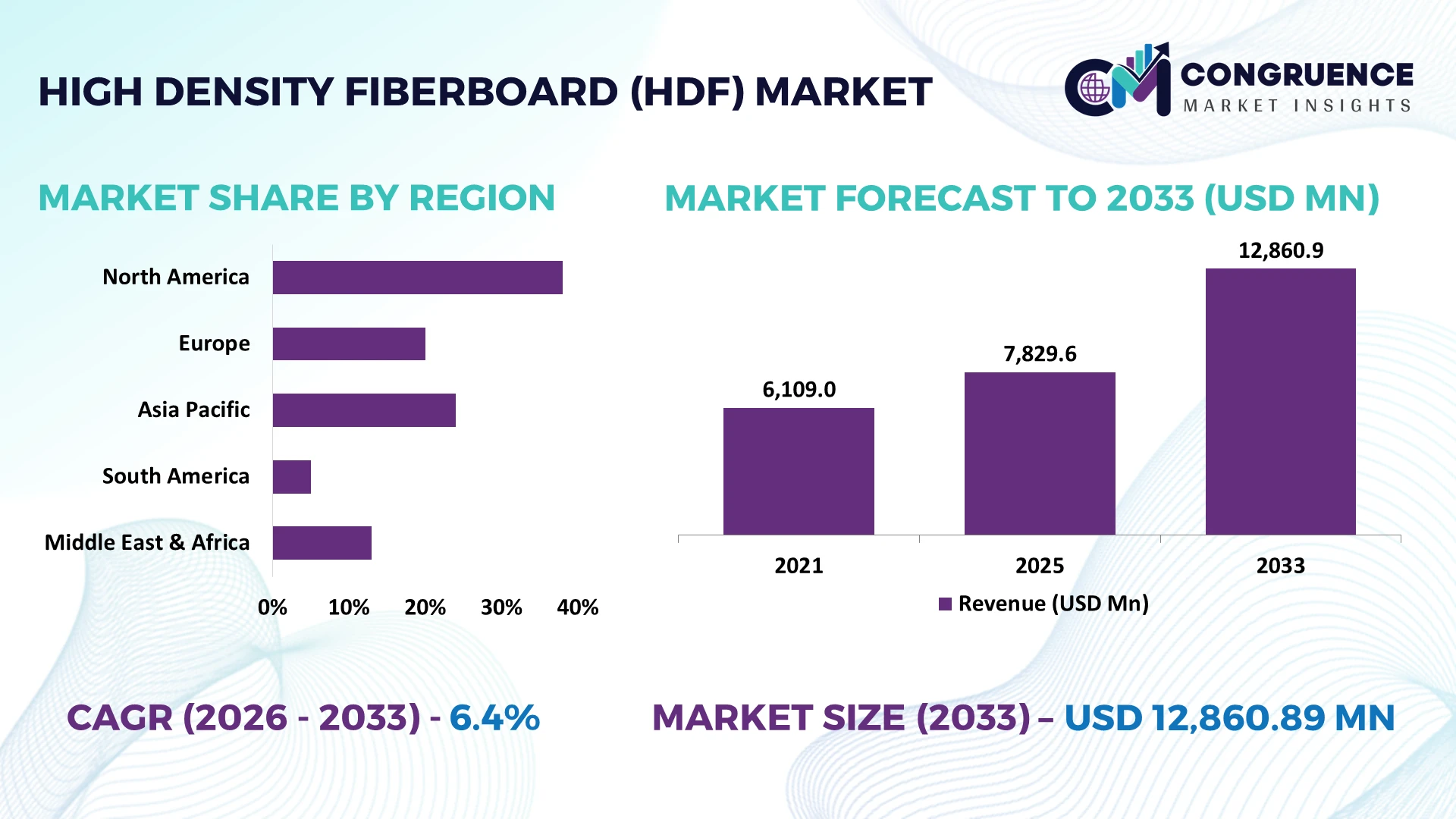
The Global High density Fiberboard (HDF) Market was valued at USD 7829.57 Million in 2025 and is anticipated to reach a value of USD 12860.89 Million by 2033 expanding at a CAGR of 6.4% between 2026 and 2033. Growth is driven by engineered wood flooring, ready to assemble furniture, interior doors, cabinetry, automated continuous pressing, and substitution of solid timber with dimensionally consistent high density panels.
China anchors global HDF supply through its extensive fiberboard manufacturing infrastructure, furniture ecosystem, flooring production, and export processing base. National fiberboard capacity reached 40.37 million cubic meters annually in 2025 across 244 production lines, while the ten largest producing provinces controlled 89% of capacity. Shandong alone held 17.1%, exceeding Jiangsu at 13.3%. Despite US China trade friction, Chinese producers continue upgrading larger continuous lines as domestic capacity consolidates around efficient manufacturing clusters.
HDF suppliers combining efficient continuous pressing, certified fiber sourcing, low emission resins, and proximity to furniture and flooring clusters hold the strongest strategic position.
Market Size & Growth: USD 7,829.57 million in 2025 reaches USD 12,860.89 million by 2033 at 6.4% CAGR, supported by engineered flooring and furniture substitution.
Top Growth Drivers: Furniture applications contribute about 40%, flooring near 25%, and construction related interior applications around 20% of HDF consumption.
Short Term Forecast: By 2028, continuous pressing and automated process control can improve line productivity by 10% to 15% versus older batch oriented production configurations.
Emerging Technologies: Continuous presses, AI process monitoring, recycled fiber processing, and low formaldehyde binders are increasing material consistency while reducing manufacturing variability by over 10%.
Regional Leaders: By 2033, Asia Pacific approaches USD 6.0 billion, Europe USD 3.0 billion, and North America USD 2.3 billion as automated panel processing expands.
End User Trends: Furniture and flooring together account for roughly 65% of HDF demand, concentrating purchasing around dimensional stability, machining quality, and surface finish.
Pilot/Case Example: China commissioned 9 fiberboard lines during 2025, adding 1.89 million cubic meters of annual capacity while industry consolidation removed older capacity.
Competitive Landscape: Kronospan holds an estimated 15% global position, competing with EGGER, ARAUCO, Swiss Krono, and Kastamonu Entegre across integrated wood panel manufacturing.
Regulatory & ESG Impact: IKEA reduced wood consumption 30% since 2019 through recycling and reuse, signaling stronger downstream pressure for resource efficient engineered wood products.
Investment & Funding: Large integrated HDF and MDF facilities require investments exceeding USD 100 million, favoring producers capable of financing continuous presses, resin systems, energy recovery, and fiber preparation.
Innovation & Future Outlook: China's average fiberboard line capacity reached 165,000 cubic meters annually in 2025, confirming a structural shift toward fewer, larger, more automated production assets.
The High density Fiberboard HDF Market is increasingly concentrated around furniture, laminate flooring, cabinetry, interior doors, and precision machined components requiring uniform density and smooth surfaces. China's fiberboard capacity declined 3.5% in 2025 while average capacity per production line reached 165,000 cubic meters annually, confirming consolidation toward larger assets. Continuous pressing, recycled fiber preparation, low emission adhesives, and digital process control are improving panel consistency. Meanwhile, European deforestation requirements are intensifying wood traceability, making verified fiber sourcing strategically important for exporters and downstream manufacturers.
High density fiberboard is becoming strategically important as furniture, flooring, cabinetry, and interior manufacturers replace variable solid timber with precisely machinable engineered panels. China operated 244 fiberboard production lines with 40.37 million cubic meters of annual capacity in 2025, while tighter European wood traceability requirements are increasing procurement emphasis on documented fiber origins, recycled content, and efficient material utilization.
Continuous presses provide steadier density profiles and higher throughput than older batch based pressing, with modern process control capable of improving line productivity by 10% to 15%. China leads through manufacturing scale, while Germany emphasizes automation, low emission panels, and precision finishing. Through 2028, larger continuous lines, automated fiber preparation, digital quality monitoring, and lower emission resin systems will increasingly determine plant competitiveness.
A modern HDF flooring line can integrate continuous pressing, automated sanding, digital thickness control, and surface inspection, reducing downstream machining variability. Producers are investing in larger lines, recycled fiber processing, energy recovery, and furniture and flooring partnerships. The strategic advantage is shifting from installed capacity toward consistent panel quality, verified fiber sourcing, energy efficiency, and proximity to downstream processing clusters.
Furniture industrialization is strengthening HDF consumption because automated cutting, routing, laminating, and assembly require uniform density and dimensional consistency. Furniture applications represent about 40% of HDF demand, while flooring contributes roughly 25% and interior construction applications around 20%. China remains pivotal, with its ten largest fiberboard producing provinces controlling 89% of national capacity in 2025. Ready to assemble furniture and standardized cabinetry are reinforcing substitution away from variable solid timber toward engineered panels compatible with automated machining. Producers are responding through continuous press upgrades, precision sanding, higher density control, and partnerships with flooring and furniture processors. The strategic advantage lies in reducing downstream rejects: tighter panel tolerances improve machining repeatability and allow customers to run faster automated production without frequent tool or process adjustments.
HDF manufacturing remains structurally exposed to wood fiber availability, resin pricing, electricity, thermal energy, and transportation costs because pressing and fiber preparation are energy intensive. China's fiberboard capacity declined 3.5% in 2025, while average line capacity increased to 165,000 cubic meters annually, showing that inefficient assets face mounting consolidation pressure. Wood procurement is also tightening as European traceability requirements increase documentation obligations across imported forest products. Smaller mills face disproportionate compliance and modernization costs, weakening competitiveness against integrated producers controlling forestry, resin procurement, and energy systems. Companies are responding through long term fiber contracts, recycled wood utilization, biomass energy, localized sourcing, and plant consolidation. The operational pressure point is utilization: larger continuous lines require consistently high throughput to spread fixed energy and compliance costs efficiently.
Recycled wood processing offers a strategic pathway to expand fiber availability while reducing dependence on virgin timber. Furniture and flooring together represent roughly 65% of HDF demand, creating substantial downstream volumes that can eventually reenter engineered wood supply chains. Modern cleaning, sorting, refining, and contaminant removal technologies enable producers to incorporate higher recycled fiber content while maintaining surface quality. IKEA has reduced wood consumption by 30% since 2019 through greater recycling and reuse, demonstrating the downstream shift toward resource efficiency. Between 2026 and 2028, digital fiber classification and low emission adhesive systems will strengthen this model. Producers are investing in recycling infrastructure, collection partnerships, and resin optimization. The non obvious opportunity is geographic: mills positioned near furniture manufacturing clusters can secure both production residues and end use demand, lowering inbound fiber transport and outbound panel logistics simultaneously.
Scaling HDF production without sacrificing density profile, moisture control, thickness tolerance, surface smoothness, and internal bond strength remains a critical execution challenge. China operated 244 fiberboard lines in 2025, with average annual capacity reaching 165,000 cubic meters per line and the largest ten provinces controlling 89% of capacity. Larger assets increase throughput but magnify losses when fiber moisture, resin distribution, press temperature, or sanding calibration deviates from specification. Digital process control therefore becomes essential rather than optional. Producers must integrate inline moisture measurement, automated thickness control, predictive maintenance, and surface inspection while developing technicians capable of interpreting process data. Investment in sensor networks, workforce training, equipment partnerships, and preventive maintenance is required. Long term competitiveness depends on converting greater line scale into repeatable quality rather than merely maximizing installed capacity.
Continuous Lines Replace Smaller Assets: China operated 244 fiberboard lines with 40.37 million cubic meters of capacity in 2025, while capacity declined 3.5%. Average line capacity nevertheless reached 165,000 cubic meters, showing consolidation toward larger assets. Producers are retiring inefficient equipment and concentrating capital on continuous pressing, automated sanding, and inline control to raise utilization and stabilize panel tolerances.
Low Emission Panels Gain Priority: Formaldehyde control is reshaping resin selection and product qualification across furniture and interior applications. European E1 panels are limited to 0.124 mg per cubic meter under chamber testing, while stricter specifications push emissions lower. Producers are reformulating binders, tightening process control, and expanding certified portfolios, allowing furniture and flooring customers to meet indoor air requirements without abandoning scalable wood fiber processing.
Digital Quality Control Moves Inline: High capacity plants are replacing periodic laboratory checks with continuous moisture, thickness, density, and surface monitoring. China's ten largest fiberboard producing provinces control 89% of national capacity, increasing the operational consequences of downtime at concentrated facilities. Manufacturers are deploying sensors, automated press adjustments, and predictive maintenance to detect deviations earlier, improving throughput while reducing downgrade volumes and downstream machining disruptions.
Decorative Integration Shortens Processing: Laminated and Pre Finished HDF increasingly combine structural panel production with surface finishing, reducing separate downstream processing stages. Furniture and flooring together represent roughly 65% of HDF demand, creating scale for integrated finishing. Producers are adding lamination, coating, and digital surface technologies, enabling customers to procure application ready boards while shifting competition from basic panel capacity toward surface quality and customization.
Standard HDF represents an estimated 48% of market demand, supported by scalable production, established machining characteristics, and broad compatibility with furniture components, doors, cabinets, and decorative processing. Its mature manufacturing base delivers cost advantages where exposure to moisture or fire is limited. Laminated HDF and Pre Finished HDF are gaining relevance because downstream manufacturers increasingly favor panels requiring fewer finishing operations. Moisture Resistant HDF commands stronger positioning in kitchens and humidity exposed interiors, while Fire Resistant HDF remains specification driven where building requirements justify additional treatment.
Moisture Resistant HDF is the fastest advancing type as kitchens, cabinets, flooring related components, and humid interior environments demand improved dimensional stability. Specialty treatment can reduce thickness swelling materially compared with untreated boards, supporting longer service life. Producers are redirecting product development toward moisture resistant binders, improved surface protection, and integrated finishing. Investment priorities increasingly favor differentiated boards that protect margins rather than additional commodity Standard HDF capacity.
Furniture leads HDF applications with an estimated 40% share, reflecting intensive use in routed components, drawer bottoms, furniture backs, molded parts, and decorative surfaces. Flooring represents roughly 25% of demand, supported by HDF's dense core, dimensional consistency, and compatibility with precision profiling. Cabinets benefit from smooth machining and surface finishing, while Doors use HDF skins and components requiring consistent density. Decorative Panels and Wall Panels occupy increasingly design oriented applications where surface quality carries greater commercial value.
Decorative Panels are advancing fastest as manufacturers integrate lamination, embossing, digital printing, and finished surfaces into panel production. This shifts value from unfinished board toward application ready materials and reduces secondary processing for interior manufacturers. Flooring producers continue demanding precise thickness and edge machining, whereas Furniture remains volume intensive and cost sensitive. HDF companies are expanding finishing lines, surface technology partnerships, and customized panel formats. The business implication is clear: producers capturing both substrate manufacturing and decorative processing gain more control over customer specifications and downstream margins.
Furniture Manufacturers represent the dominant end user group with an estimated 38% share because HDF supports high volume cutting, routing, profiling, coating, and assembly across standardized furniture production. Flooring Manufacturers form another concentrated buyer group, demanding dense panels with controlled thickness and machining performance. Cabinet Manufacturers prioritize smooth surfaces and dimensional consistency, while Door Manufacturers require uniform skins and engineered components. Construction Companies and Interior Designers purchase more selectively around project specifications, decorative finishes, acoustic requirements, and interior fit outs.
Interior Designers represent the fastest evolving buyer group as decorative Wall Panels, customized surfaces, and ready finished interiors increase specification influence beyond traditional commodity panel procurement. Furniture and Flooring Manufacturers together account for more than 60% of downstream HDF consumption, keeping industrial buyers central to supplier capacity decisions. Producers are targeting these groups through customized thicknesses, moisture resistant grades, decorative surfaces, contract supply, and processing partnerships. Competitive differentiation increasingly depends on delivering application ready panels that reduce finishing steps for customers.
Asia Pacific accounted for the largest market share at 46% in 2025 however, Asia Pacific is expected to register the fastest growth, expanding at a CAGR of 7.2% between 2026 and 2033.
Renovation Sustains Engineered Panel Demand
North America represents an estimated 21% of global HDF demand, supported by furniture, cabinetry, laminate flooring, doors, remodeling, and interior finishing. The United States anchors consumption through a large residential improvement ecosystem and automated woodworking sector, while Canada contributes substantial wood fiber availability and panel manufacturing expertise. HDF suppliers increasingly compete through moisture resistance, low emission binders, decorative surfaces, and precision thickness control rather than basic panel availability. Housing renovation remains particularly important because replacement flooring, cabinets, doors, and wall finishes consume engineered panels without requiring new construction. Producers are strengthening distributor relationships and aligning panel specifications with automated cutting and lamination operations. Import exposure also keeps freight, tariff policy, and regional sourcing relevant, encouraging buyers to diversify procurement between domestic mills and established overseas suppliers.
United States Market Outlook: The United States combines large furniture, cabinetry, flooring, and home improvement channels with highly automated woodworking operations. Repair and remodeling expenditures exceed USD 600 billion annually, sustaining downstream panel processing even when new housing construction moderates. HDF suppliers benefit by targeting renovation intensive applications with moisture resistant cores, finished surfaces, and precise machining characteristics.
Traceability Reshapes Panel Procurement
Europe accounts for an estimated 24% of global HDF demand, with Germany, Poland, Italy, and Turkey supporting major furniture, flooring, interior, and engineered wood processing clusters. The market increasingly favors certified fiber, low emission resins, energy efficient pressing, and panels designed for automated downstream processing. European deforestation regulation is strengthening traceability expectations for wood based products, pushing manufacturers toward documented procurement systems and closer forestry relationships. Germany remains technologically important through advanced woodworking machinery and automated furniture manufacturing, while Poland combines furniture export scale with competitive panel processing. Producers are investing in recycled wood preparation, biomass energy, continuous presses, and decorative finishing. The operational advantage is moving toward plants that can document fiber origin while maintaining consistent density and surface performance, allowing downstream manufacturers to meet environmental requirements without sacrificing machining productivity.
Germany Market Outlook: Germany's furniture, flooring, door, and interior manufacturing base creates sustained demand for precisely engineered panels. Manufacturing contributes about 18% of national economic output, reinforcing industrial processing intensity. German buyers increasingly prioritize documented wood sourcing, low emission performance, machining consistency, and energy efficient production, rewarding HDF suppliers capable of combining technical specifications with regulatory traceability.
China Consolidates Production at Scale
Asia Pacific controls about 46% of global HDF demand, reflecting China's extensive fiberboard capacity alongside large furniture, flooring, cabinetry, and interior manufacturing industries in India, Vietnam, Malaysia, and other production hubs. China operated 244 fiberboard lines with 40.37 million cubic meters of annual capacity in 2025. Average capacity reached 165,000 cubic meters per line as smaller facilities exited and larger continuous assets gained importance. Vietnam's export furniture ecosystem and India's expanding organized furniture production provide additional downstream demand. Manufacturers are deploying continuous presses, automated sanding, digital thickness control, and improved resin systems to increase consistency. The regional shift is therefore not simply capacity expansion: production is concentrating in efficient industrial clusters capable of supplying both domestic processors and export oriented furniture manufacturers with standardized panels.
China Market Outlook: China remains the central HDF production and processing hub, with its ten largest fiberboard producing provinces controlling 89% of national capacity. Shandong alone represents 17.1%, while Jiangsu accounts for 13.3%. This concentration strengthens supplier access to wood processing, furniture manufacturing, flooring production, logistics infrastructure, and technical labor, supporting efficient large scale panel operations.
Plantation Forestry Supports Panel Integration
South America represents an estimated 5% of global HDF demand, led by Brazil's furniture manufacturing, plantation forestry, cabinetry, doors, and interior construction industries. Brazil holds a structural feedstock advantage through extensive eucalyptus and pine plantations, supporting integrated wood panel manufacturing and reducing dependence on imported fiber. Chile also combines commercial forestry with established engineered wood processing. Brazilian producers increasingly integrate forestry ownership, fiber preparation, resin systems, panel manufacturing, and downstream distribution to improve cost control. Furniture clusters in southern Brazil create concentrated demand for machinable panels and decorative surfaces. Export logistics and domestic freight remain operational constraints because panel products are bulky relative to value. Producers are therefore prioritizing mills close to plantation resources and furniture clusters, reducing fiber transport requirements while strengthening supply reliability for domestic processors.
Brazil Market Outlook: Brazil's planted forest base exceeds 10 million hectares, providing a scalable fiber resource for engineered wood production. Integrated forestry and panel manufacturers can control wood quality, harvesting schedules, and mill supply more effectively than import dependent producers. Furniture clusters in Paraná, Santa Catarina, and Rio Grande do Sul strengthen demand for HDF used in cabinetry, components, doors, and decorative interiors.
Construction Expands Interior Panel Consumption
Middle East and Africa represents an estimated 4% of global HDF demand, with Turkey, Saudi Arabia, the UAE, Egypt, and South Africa supporting construction, furniture, cabinetry, hospitality, and interior fit out consumption. Limited local forest resources across Gulf countries increase reliance on imported engineered panels, making logistics availability and distributor inventories important competitive factors. Saudi Arabia's large housing and tourism development pipeline is expanding demand for doors, cabinets, furniture, flooring, and decorative interiors. Turkey provides a stronger manufacturing position through established wood panel and furniture industries, allowing domestic producers to serve both local and export markets. Suppliers are strengthening distribution, decorative product portfolios, and moisture resistant grades suited to demanding interior environments. Construction led demand increasingly rewards suppliers that combine reliable imports with local stocking and processing capabilities.
Saudi Arabia Market Outlook: Saudi Arabia's Vision 2030 construction program is expanding hotels, housing, entertainment facilities, offices, and mixed use developments, creating downstream requirements for cabinets, doors, furniture, flooring, and decorative panels. Import dependent HDF suppliers gain operational advantage through local warehousing, project specification relationships, moisture resistant products, and dependable delivery schedules for large interior contractors.
Kronospan, EGGER, ARAUCO, Kastamonu Entegre, and Swiss Krono compete through integrated forestry, large panel plants, decorative surfaces, and downstream distribution, while Chinese producers challenge established groups on manufacturing scale and price. The top five account for an estimated 38% of global HDF supply, leaving substantial production distributed across national and regional manufacturers. Integrated leaders gain procurement advantages from captive or contracted fiber, while continuous pressing can improve productivity 10% to 15% against older production configurations. Chinese average fiberboard line capacity reached 165,000 cubic meters in 2025, intensifying scale competition. Producers are investing in automated presses, recycled fiber processing, low emission resins, decorative finishing, and localized distribution. Competition is shifting from commodity board volume toward certified sourcing, application ready surfaces, and manufacturing efficiency. Capital intensive continuous presses, dependable fiber access, emission compliance, and customer qualification remain formidable entry barriers. Winning requires scale, consistent density, secure fiber, efficient energy use, and differentiated surfaces.
Kronospan
EGGER Group
ARAUCO
Swiss Krono Group
Kastamonu Entegre
Sonae Arauco
Finsa
Greenpanel Industries
Action TESA
Dongwha Enterprise
Duratex
Pfleiderer
West Fraser
Masisa
Current HDF manufacturing is shifting toward continuous pressing, automated fiber preparation, inline moisture sensing, and digital thickness control. Continuous flat presses represented 66.6% of Chinese fiberboard capacity in 2025, demonstrating broad adoption. Compared with older multi opening presses, continuous systems can raise line productivity by 10% to 15% while improving density consistency, reducing sanding losses and downstream machining variation.
Emerging technology centers on recycled fiber recovery, low emission resin chemistry, machine vision, and predictive process analytics. Recycling can now incorporate up to 20% recovered MDF fiber into new MDF and HDF panels, while digital sensors continuously control moisture, mat formation, press temperature, and thickness. Producers integrating these systems gain lower raw material exposure, tighter specifications, and stronger qualification with automated furniture and flooring manufacturers.
From 2026 through 2028, AI assisted process control, formaldehyde reducing binders, energy recovery, and ultra thin board production will reshape competitive investment. China's average fiberboard line reached 165,000 cubic meters of annual capacity in 2025, increasing the financial impact of every process deviation. Large integrated producers benefit most because sensor data, recycling infrastructure, resin optimization, and continuous presses operate as one system. Investment now protects yield, regulatory compliance, fiber security, and customer retention.
February 2025 Greenpanel commissioned its Tirupati MDF line, lifting capacity from 660,000 to 891,000 cubic meters and starting thin board production at 1.5 to 1.7 millimeters, strengthening supply for precision furniture and interior applications. Source: ETManufacturing
September 2025 Sonae Arauco started its Mangualde industrial fiberboard recycling line after an €8 million investment. The system targets up to 20% recycled MDF fiber incorporation into new MDF and HDF panels, substantially reducing virgin fiber dependence materially. Source: SonaeArauco
September 2026 EGGER acquired 100% of Italian recycler Lenocart, collecting around 10,000 tonnes of recovered wood annually. The transaction strengthens recycled feedstock access and collection logistics, supporting circular material availability across EGGER's European wood panel operations. Source: WoodworkingNetwork
July 2024 ARAUCO approved conversion of sections of its Trupán MDF1 line into OSB production, committing USD 100 million and targeting 110,000 cubic meters capacity. The shift reallocates panel assets toward Chilean construction demand and portfolio diversification. Source: ACOFORAG
The High density Fiberboard HDF Market Report evaluates five product types: Standard HDF, Moisture Resistant HDF, Fire Resistant HDF, Laminated HDF, and Pre Finished HDF. Application coverage spans Flooring, Furniture, Doors, Wall Panels, Cabinets, and Decorative Panels, while end user analysis examines Furniture Manufacturers, Flooring Manufacturers, Construction Companies, Interior Designers, Door Manufacturers, and Cabinet Manufacturers. Technology assessment includes continuous pressing, recycled fiber recovery, digital process control, low emission resins, and automated finishing.
Regional analysis covers North America, Europe, Asia Pacific, South America, and Middle East and Africa, examining production concentration, fiber availability, regulatory requirements, processing infrastructure, and downstream manufacturing. Competitive assessment covers 14 influential participants alongside emerging recycled fiber and specialty panel opportunities. The report supports 2026 through 2033 capacity planning, geographic expansion, technology investment, supplier positioning, partnership strategy, and product portfolio decisions.
| Report Attribute/Metric | Report Details |
|---|---|
Market Revenue in 2025 | USD 7829.57 Million |
Market Revenue in 2033 | USD 12860.89 Million |
CAGR (2026 - 2033) | 6.4% |
Base Year | 2025 |
Forecast Period | 2026 - 2033 |
Historic Period | 2021 - 2025 |
Segments Covered | By Type
By Application
By End-User
|
Key Report Deliverable | Revenue Forecast, Growth Trends, Market Dynamics, Segmental Overview, Regional and Country-wise Analysis, Competition Landscape |
Region Covered | North America, Europe, Asia-Pacific, South America, Middle East, Africa |
Key Players Analyzed | Kronospan, EGGER Group, ARAUCO, Swiss Krono Group, Kastamonu Entegre, Sonae Arauco, Finsa, Greenpanel Industries, Action TESA, Dongwha Enterprise, Duratex, Pfleiderer, West Fraser, Masisa |
Customization & Pricing | Available on Request (10% Customization is Free) |




