
Reports
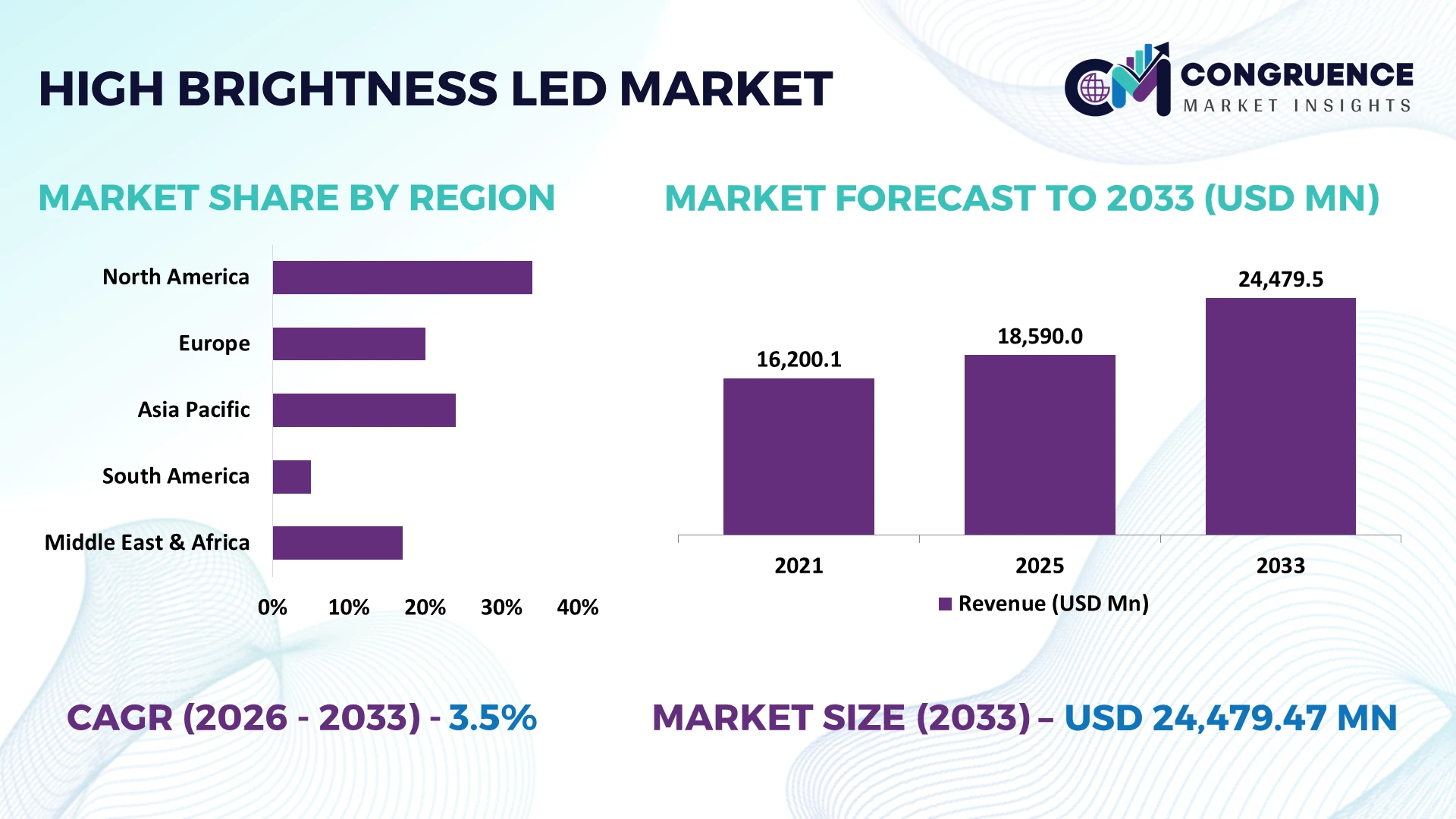
The Global High Brightness LED Market was valued at USD 18590 Million in 2025 and is anticipated to reach a value of USD 24479.47 Million by 2033 expanding at a CAGR of 3.5% between 2026 and 2033. Growth is driven by adaptive automotive lighting, Mini/Micro LED displays, UV/IR emitters, horticultural systems, and higher-efficacy replacement lighting as OEMs prioritize brightness, power efficiency, thermal performance, and compact semiconductor architectures.
China remains the dominant high-brightness LED manufacturing and deployment ecosystem, supported by automotive, display, electronics, and industrial lighting supply chains. OEM channels represented 82.52% of China’s automotive LED lighting activity in 2025, while Mini/Micro LED attracted RMB 23.8 billion of Chinese optoelectronic-display investment during H1 2025. Malaysia, by comparison, is strengthening advanced LED fabrication capacity amid global semiconductor supply-chain diversification and U.S.–China trade pressure.
Strategically, suppliers should prioritize automotive-grade emitters, Mini/Micro LED, high-power UV/IR products, and geographically diversified wafer and packaging capacity rather than competing primarily through commodity general-lighting volume.
Market Size & Growth: USD 18.59 billion in 2025 advances toward USD 24.48 billion by 2033 at 3.5%, supported by automotive, Mini/Micro LED, UV/IR, and intelligent lighting applications.
Top Growth Drivers: Automotive OEM integration reached 82.52%, China passenger cars represented 69.02%, while new automotive LED installations held 61.78%, concentrating demand in factory-installed advanced lighting.
Short-Term Forecast: By 2027, Mini/Micro LED commercialization accelerates as chip miniaturization, improved transfer yields, and automated packaging progressively lower system-level manufacturing costs.
Emerging Technologies: Micro LED, Mini LED, adaptive driving beam, pixelated headlights, UV-C LEDs, and smart optical sensing are shifting high-brightness components toward higher-value semiconductor functionality.
Regional Leaders: Asia-Pacific remains manufacturing-led, North America concentrates automotive and specialty-lighting demand, while Europe emphasizes premium vehicle illumination and energy-efficient regulated lighting.
Consumer/End-User Trends: Exterior automotive lighting represented 77.96% of China’s automotive LED market in 2025, demonstrating sustained preference for high-output safety, styling, and communication functions.
Pilot/Case Example: In 2025, UV-C single-chip packages reached 135 mW at Nichia and 115 mW at ams OSRAM, broadening compact disinfection and purification designs.
Competitive Landscape: Nichia, ams OSRAM, Lumileds, Seoul Semiconductor, and San’an compete through efficacy, automotive qualification, patents, wavelength control, Mini/Micro LED scale, and vertically integrated manufacturing.
Regulatory & ESG Impact: LED lamps deliver 80–90% energy savings versus incandescent lighting and 50–60% versus fluorescent systems, strengthening regulatory replacement economics and lifecycle efficiency.
Investment & Funding: Chinese Mini/Micro LED projects attracted RMB 23.8 billion during H1 2025, representing 23% of optoelectronic-display investment despite tighter capital allocation.
Innovation & Future Outlook: San’an’s planned Lumileds acquisition valued at USD 239 million signals consolidation around automotive, specialty LED, patents, and international customer access as commodity pricing pressure intensifies.
High Brightness LED Market demand is increasingly concentrated in adaptive vehicle headlights, premium displays, industrial illumination, horticulture, UV sterilization, and optical sensing. Automotive exterior lighting already represents nearly 78% of China’s automotive LED activity, while Micro LED miniaturization and high-output UV-C devices expand addressable applications. Tariff pressure and semiconductor localization are simultaneously reshaping sourcing, establishing the strategic context for future competition.
High Brightness LEDs are strategically important because automotive lighting, premium displays, industrial illumination, UV systems, and smart infrastructure increasingly require compact emitters with higher efficacy, thermal stability, and optical control. China’s localization push is reshaping automotive LED sourcing, while manufacturers are diversifying production footprints to reduce exposure to geopolitical and trade disruption. This shift is moving competition away from commodity brightness toward application-specific performance, reliability, and integrated optics.
LED technology already delivers 80–90% lower energy use than incandescent lighting and 50–60% savings versus fluorescent systems, giving high-output devices a strong operating-cost advantage. China remains the largest manufacturing ecosystem, while Japan and Europe retain strengths in premium automotive and specialty LEDs. By 2028, Mini/Micro LED, adaptive driving beams, UV-C emitters, and pixel-level lighting will command greater engineering investment as OEMs demand tighter control over power, heat, and beam precision.
A practical example is automotive lighting, where exterior applications account for nearly 78% of China’s automotive LED activity. Suppliers are responding through Mini LED investment, chip miniaturization, vertical integration, and automotive-grade packaging partnerships. Long-term advantage will favor companies combining device efficiency, optical performance, manufacturing yield, qualification speed, and geographically resilient supply.
Automotive lighting is the strongest structural demand driver as OEMs replace conventional lamps with adaptive, pixelated, and matrix LED systems. In China, OEM channels represented 82.52% of automotive LED activity in 2025, exterior lighting accounted for 77.96%, and passenger cars represented 69.02% of demand. Localization policies are simultaneously pushing domestic automakers toward locally qualified emitters and modules, increasing price pressure but widening supplier access. The impact is clear: lighting content per vehicle is rising through daytime running lights, adaptive beams, interior ambient systems, and communication displays. Suppliers are expanding automotive-grade packaging, Mini LED backlighting, and thermal-management capability. The strategic insight is that unit growth matters less than LED content intensity per vehicle, making design wins and qualification cycles more valuable than commodity shipment volume.
Pricing pressure remains the principal structural restraint, particularly in automotive and general high-power LED categories. Automotive LED prices declined in 2025 as China’s localization policies intensified competition, contributing to a 2% contraction in overall automotive LED market value and a 3% decline in automotive lighting LEDs. China’s automotive lighting LED market fell 6%, highlighting margin compression even amid high deployment volumes. The direct impact is lower profitability for suppliers lacking differentiated optics, packaging, or proprietary phosphor technologies. Companies are reducing exposure through manufacturing localization, product-mix upgrades, long-term OEM contracts, and expansion into UV, IR, Mini LED, and specialty illumination. A non-obvious constraint is customer concentration: stringent automotive qualification locks suppliers into long development cycles, limiting their ability to rapidly reprice products when wafer, packaging, or logistics costs move unfavorably.
Micro LED creates the strongest next-generation opportunity because extreme brightness, compact pixel size, lifetime, and sensor integration open applications beyond conventional displays. Commercialization is moving into smartwatches, automotive displays, transparent panels, AR systems, and optical sensing. Current development focuses on lowering manufacturing cost and improving transfer yield, while large-display applications remain the most mature. Micro LED devices can achieve substantially higher brightness than OLED alternatives, making them particularly attractive for outdoor and automotive environments. Companies are positioning through chip miniaturization, mass-transfer R&D, vertical integration, and partnerships between Chinese chipmakers and display brands. The strategic opportunity extends beyond panels: Micro LED emitters can integrate sensing and communication functions, creating new semiconductor content per device. Suppliers that master yield and packaging economics can capture value across displays, wearables, vehicles, and non-display optical systems.
Execution risk increasingly centers on manufacturing yield, thermal management, optical consistency, and application-specific qualification rather than basic LED efficacy. Micro LED commercialization remains constrained by transfer accuracy, defect repair, and high production cost, while automotive emitters must maintain stable output across temperature, vibration, and long duty cycles. In automotive LEDs, the top ten suppliers still hold about 92.6% share, showing how difficult qualification barriers remain for new entrants. Service life can extend five to ten years in conventional LED applications, raising expectations for reliability across higher-output devices. Companies must invest in automated inspection, wafer-level testing, advanced substrates, thermal packaging, and tighter binning controls. The strategic challenge is maintaining brightness uniformity while shrinking die size: higher pixel density increases defect sensitivity, so competitive durability depends on yield engineering as much as headline luminance.
Digital Headlamps Gain Pixel Density: Automotive lighting is moving from static illumination toward software-controlled projection. More than 10 vehicle models adopted Micro LED headlamps in 2026, while leading modules now integrate 25,600–41,140 controllable pixels. Suppliers are combining LEDs with ADAS and software-defined vehicle platforms, increasing semiconductor content while automakers use dynamic beams, road projections, and safety signaling to differentiate premium vehicles.
Mini LED Backlights Improve Efficiency: Display manufacturers are scaling Mini LED backlighting as televisions, monitors, automotive displays, and notebooks demand higher brightness and local dimming. BOE shipped approximately 140,000 MLED products in 2024, while optimized Mini LED systems can reduce display power consumption by around 30%. Manufacturers are integrating drivers, shrinking dies, and improving optical uniformity to lower component counts and accelerate premium-display commercialization.
Upstream Integration Reshapes Supply Chains: Panel manufacturers are moving directly into LED chips to control technology, cost, and availability. TCL CSOT acquired an 80% stake in Prima in 2025, while its Suzhou Mini LED line reached 6,000 square meters of monthly capacity. BOE, AUO, Hisense, and Samsung are pursuing similar upstream strategies, reducing coordination costs between emitter development and finished displays while strengthening supply-chain control.
Application Pricing Becomes More Polarized: Chinese automotive OEMs increasingly prioritize component cost while European premium manufacturers emphasize optical performance and design. Chinese automotive lighting LED prices declined about 5% quarter-on-quarter during Q3 2025, while Asia’s automotive LED activity expanded 2% for the year. Suppliers are responding by localizing production, restructuring product portfolios, and reserving advanced pixelated emitters for higher-margin applications.
High-Power LEDs represent the leading type, with an estimated 36% share, supported by their established position across automotive headlights, outdoor luminaires, industrial fixtures, and high-output commercial lighting. Commercial high-performance LED packages can reach approximately 200 lm/W under favorable conditions, although practical high-current operation typically delivers around 130–160 lm/W depending on color temperature. Surface-Mount LEDs follow with an estimated 25% share, benefiting from automated assembly, compact footprints, and high-volume electronics integration. Discrete LEDs remain relevant for indicators and specialized low-component-count systems.
Ultra-High-Power LEDs are the fastest-advancing type as automotive projection, stadium illumination, industrial systems, and specialty optical equipment require greater luminous density from smaller footprints. Chip-on-Board LEDs retain strategic importance because closely packed dies provide strong thermal management and uniform illumination; COB efficacy has exceeded 150 lm/W in commercial applications. Manufacturers are therefore shifting R&D toward higher current density, improved phosphors, advanced substrates, and lower thermal resistance, while Surface-Mount suppliers prioritize automated packaging scale and cost optimization.
General Lighting remains the largest application, with an estimated 38% share, reflecting extensive deployment across commercial buildings, factories, warehouses, residential properties, and institutional facilities. High-brightness LEDs deliver 80–90% energy savings against incandescent lamps and approximately 50–60% against fluorescent lighting, reinforcing replacement economics. Outdoor Lighting follows through streetlights, transport infrastructure, stadiums, and architectural illumination, where long operating cycles magnify efficiency benefits. Signage remains a stable application requiring high luminance and outdoor visibility, while Display Backlighting increasingly shifts toward Mini LED architectures for higher contrast and localized dimming.
Automotive Lighting is the fastest-growing strategic application as illumination becomes integrated with driver assistance, vehicle communication, and styling. LED headlight penetration already reached approximately 96% among electric vehicles in 2024, compared with 75% for conventional passenger cars. Manufacturers are expanding ADB, matrix LED, Micro LED, ambient lighting, and projection systems. This shifts competitive investment from basic luminous output toward pixel-level control, thermal reliability, optical precision, and automotive-grade qualification.
Commercial end-users represent the leading segment with an estimated 31% share, supported by offices, retail facilities, hospitality, warehouses, institutional buildings, and other environments where long operating hours make lighting efficiency economically critical. Industrial users account for approximately 22%, emphasizing high-lumen fixtures with thermal durability for factories, logistics centers, and hazardous environments. Residential adoption is comparatively mature and increasingly influenced by smart controls rather than brightness alone, while Consumer Electronics demand is moving toward Mini LED displays, premium monitors, televisions, and specialized optical devices.
Automotive is the fastest-growing high-value end-user as manufacturers add adaptive headlights, full-width light bars, digital projection, communication lighting, and advanced cabin displays. In 2026, more than 10 vehicle models had adopted Micro LED headlamps, while commercial solutions reached 25,600 individually controllable pixels. LED suppliers are consequently targeting automakers through joint development, application-specific modules, automotive qualification, and integrated driver electronics. Future competitive value is shifting toward sophisticated optical functionality rather than commodity emitter volume.
Asia-Pacific accounted for the largest market share at 47% in 2025 however, Middle East & Africa is expected to register the fastest growth, expanding at a CAGR of 5.1% between 2026 and 2033.
Infrastructure Retrofits Shift Toward Connected Lighting
North America represents approximately 21% of the High Brightness LED Market, supported by commercial retrofits, roadway modernization, automotive lighting, industrial facilities, horticulture, and specialty UV applications. The United States remains the operational center as efficiency standards and utility programs accelerate replacement of fluorescent and conventional high-intensity lighting. LED products already deliver roughly 50–60% energy savings versus fluorescent alternatives, strengthening lifecycle economics in warehouses, offices, factories, and municipal infrastructure. Automotive OEMs are simultaneously adopting matrix headlights, intelligent beam control, and illuminated vehicle interfaces, increasing demand for automotive-grade emitters. Suppliers are responding with higher-efficacy packages, connected controls, advanced optics, and domestic engineering capabilities. The operational shift is increasingly toward integrated lighting systems where sensors and controls generate additional savings beyond improvements in emitter efficacy alone.
United States Market Outlook: The United States combines extensive commercial building stock with automotive engineering, data centers, controlled-environment agriculture, and municipal infrastructure replacement. Federal efficiency requirements have effectively removed most general-service incandescent lamps from mainstream applications, while DOE solid-state lighting programs continue advancing efficacy. Suppliers increasingly target higher-margin connected commercial, horticultural, UV, outdoor, and automotive applications rather than commodity replacement bulbs.
Regulation Accelerates High-Efficiency Replacement
Europe accounts for approximately 18% of global High Brightness LED Market activity, with Germany, France, Italy, and the United Kingdom providing substantial commercial, industrial, automotive, and infrastructure demand. Ecodesign requirements and the phaseout of fluorescent lighting are accelerating LED conversion, particularly after restrictions covering T5 and T8 fluorescent lamps tightened under RoHS rules. Europe’s automotive manufacturing base creates an additional premium channel for matrix LED, adaptive driving beam, projection, and vehicle-signaling technologies. Suppliers such as ams OSRAM compete through optical precision, automotive qualification, semiconductor integration, and high-reliability packages rather than commodity pricing. Municipalities are also combining roadway LED replacement with intelligent controls to reduce electricity consumption and maintenance intervention. This regulatory-led transition increasingly favors luminaires offering repairability, control compatibility, longer operating life, and verifiable energy performance.
Germany Market Outlook: Germany holds strategic importance through its premium automotive ecosystem, advanced industrial facilities, engineering capability, and stringent efficiency standards. German vehicle manufacturers have been early adopters of matrix, digital, and adaptive headlighting, creating a demanding development environment for high-brightness emitters. Domestic semiconductor expertise also supports integration between LEDs, drivers, sensors, optics, and software-controlled lighting architectures.
Manufacturing Scale Drives Technology Localization
Asia-Pacific dominates with approximately 47% market share, reflecting concentrated LED epitaxy, chip fabrication, packaging, display manufacturing, consumer electronics, and automotive production across China, Japan, South Korea, and Taiwan. China provides the strongest volume advantage, while Japan retains significant intellectual property and premium emitter expertise and South Korea anchors advanced display integration. Chinese Mini/Micro LED projects attracted RMB 23.8 billion of investment during the first half of 2025, demonstrating continued capital allocation toward next-generation display technology. Regional manufacturers are vertically integrating wafers, chips, packages, modules, and displays to improve yields and shorten commercialization cycles. Automotive localization adds another structural shift as Chinese EV manufacturers increase domestic component sourcing. Scale increasingly rewards suppliers capable of combining low manufacturing costs with Mini LED, Micro LED, automotive-grade, and specialty wavelength portfolios.
China Market Outlook: China combines the world’s deepest LED manufacturing supply chain with extensive display, electric-vehicle, electronics, signage, and infrastructure demand. OEM channels represented 82.52% of Chinese automotive LED lighting activity in 2025, demonstrating factory-installation concentration. San’an, NationStar, MLS and other domestic suppliers are advancing vertical integration and higher-value technologies to reduce dependence on imported premium components.
Infrastructure Modernization Concentrates Demand
South America represents approximately 6% of High Brightness LED Market activity, with Brazil dominating commercial lighting, industrial facilities, automotive production, roadway illumination, and large-scale infrastructure replacement. Electricity-cost management makes high-efficacy LEDs particularly relevant for warehouses, retail chains, factories, municipalities, and outdoor facilities operating extended hours. Brazil’s vehicle manufacturing base also supports demand for headlamps, daytime running lights, signaling, and interior illumination, although advanced pixelated systems remain less deeply deployed than in China, Germany, or Japan. Municipal LED programs increasingly combine luminaire replacement with smart-city controls and remote monitoring, reducing maintenance requirements alongside electricity consumption. Currency volatility, imported component dependence, and uneven project financing constrain deployment consistency outside major economic centers. Suppliers respond through local distribution, assembly partnerships, standardized product portfolios, and financing-oriented infrastructure contracts.
Brazil Market Outlook: Brazil provides the region’s strongest operating base through large metropolitan areas, automotive assembly, industrial production, retail infrastructure, and public-lighting concessions. São Paulo and other major cities provide substantial retrofit density, while public-private streetlighting projects create recurring demand for high-output luminaires. Local assembly and distributor networks remain strategically important for controlling import exposure and servicing geographically dispersed installations.
Megaproject Investment Accelerates Smart Lighting
Middle East & Africa accounts for approximately 8% of market activity but presents strong deployment momentum through Gulf infrastructure investment, smart-city construction, hospitality, airports, stadiums, industrial facilities, and roadway modernization. Saudi Arabia and the UAE lead specification of high-output architectural, outdoor, commercial, and connected lighting systems, while South Africa anchors established African demand. Saudi giga-projects are creating large greenfield environments where LED luminaires, sensors, digital controls, and building-management platforms can be designed together rather than retrofitted separately. Extreme temperatures place additional emphasis on thermal management, driver durability, and lumen maintenance, favoring technically differentiated products. Across Africa, unreliable grids and constrained municipal budgets limit uniform adoption, while solar-linked LED streetlighting provides an alternative deployment model. Vendors are expanding through project partnerships, local distributors, system integrators, and specification-led sales.
Saudi Arabia Market Outlook: Saudi Arabia combines Vision 2030 construction programs with extensive investment in tourism, entertainment, transport, commercial districts, and smart infrastructure. NEOM and other giga-projects create demand for high-output architectural and connected illumination designed around energy management from inception. Suppliers offering heat-resistant packages, intelligent controls, project customization, and reliable local technical support hold a clear procurement advantage.
Nichia, ams OSRAM, Seoul Semiconductor, Lumileds, and San’an compete across premium automotive, display, industrial, and specialty high-brightness LEDs, with Chinese suppliers challenging Japanese and European technology leaders through scale and pricing. The top five control approximately 55% of addressable high-performance activity, while automotive concentration is substantially higher. Competition centers on efficacy, thermal reliability, optical precision, patents, and qualification speed; leading white LED packages exceed 200 lm/W, LEDs deliver 50–60% energy savings over fluorescent systems, and exterior applications represent nearly 78% of China’s automotive LED activity. Players are expanding Mini/Micro LED capacity, vertically integrating chips and packaging, forming automotive partnerships, and localizing production. Competition is shifting from commodity illumination toward pixelated automotive, specialty wavelength, and display technologies. Qualification cycles, intellectual property, epitaxy expertise, and manufacturing yield create formidable entry barriers. Winning requires application-specific innovation, scalable production, resilient sourcing, superior efficiency, and defensible customer design wins globally.
Nichia Corporation
ams OSRAM AG
Seoul Semiconductor Co., Ltd.
Lumileds Holding B.V.
San’an Optoelectronics Co., Ltd.
Samsung Electronics Co., Ltd.
Toyoda Gosei Co., Ltd.
Everlight Electronics Co., Ltd.
LITE-ON Technology Corporation
Stanley Electric Co., Ltd.
NationStar Optoelectronics Co., Ltd.
MLS Co., Ltd.
Dominant Opto Technologies
Lumens Co., Ltd.
Current High Brightness LED technology centers on high-power packages, chip-scale packaging, COB architectures, advanced phosphors, and intelligent drivers. Commercial white LED packages can exceed 200 lm/W, while typical high-current devices operate around 160 lm/W. Compared with fluorescent lighting, advanced LEDs reduce electricity consumption by roughly 50–60%, giving commercial, industrial, and outdoor users lower operating costs and longer maintenance intervals.
Emerging development is concentrating on Micro LED, Mini LED, pixelated automotive lighting, UV-C emitters, and integrated optical control. Nichia’s latest 280-nm UV-C device reaches 7.4% wall-plug efficiency, approximately 2.5 times its 2021 level. Automotive microLED systems now integrate over 25,000 individually controllable pixels, enabling adaptive beams, road projection, and selective illumination. Premium automakers and vertically integrated LED suppliers gain the strongest competitive advantage.
Through 2026–2028, disruptive progress will come from higher-voltage emitters, automated optical sensing, wafer-level packaging, and digitally controlled lighting. Seoul Semiconductor’s 12V automotive opto-semiconductor reduces driver components by over 10% and power consumption by about 10%. Suppliers investing now in thermal management, Mini/Micro LED manufacturing yield, software-linked controls, and specialty wavelengths can secure higher-value design wins while commodity producers face intensifying price pressure.
September 2024 ams OSRAM and ELEPN launched the MLP3000 Micro LED smart projector using EVIYOS Shape, extending automotive-grade technology into urban projection. Its high-brightness, low-power architecture opened new commercial applications in signage, entertainment, machine vision, and smart-city systems. Source: ams-osram.com
January 2025 Nichia began mass production of its NCSU434D 280-nm deep-UV LED, delivering 7.4% wall-plug efficiency and 135 mW radiant flux. The device improved energy efficiency roughly 2.5 times versus 2021 performance, strengthening mercury-free sterilization and purification applications. Source: nichia.co.jp
August 2025 San’an Optoelectronics agreed to acquire Lumileds Holding for USD 239 million, with San’an expected to indirectly own 74.5% after completion. The transaction strengthens patent access, automotive LED reach, packaging capability, and international customer penetration. Source: trendforce.com
May 2026 Seoul Semiconductor entered mass production of 12V HV opto-semiconductors with four automotive brands, targeting 10 vehicle models by year-end. The technology reduces driver-related components by over 10% and power consumption by approximately 10%, simplifying EV architectures. Source: seoulsemicon.com
The High Brightness LED Market report covers High-Power LEDs, Ultra-High-Power LEDs, Chip-on-Board LEDs, Surface-Mount LEDs, and Discrete LEDs across General Lighting, Automotive Lighting, Display Backlighting, Signage, and Outdoor Lighting. End-user analysis spans Residential, Commercial, Automotive, Industrial, and Consumer Electronics, supported by regional assessment across North America, Europe, Asia-Pacific, South America, and Middle East & Africa. High-Power LEDs represent approximately 36% of type demand, while commercial applications remain the largest end-user concentration.
The report evaluates Mini LED, Micro LED, pixelated automotive lighting, UV-C emitters, advanced phosphors, thermal packaging, intelligent drivers, and optical-control integration through 2026–2033. It also examines manufacturing localization, automotive qualification, supply-chain restructuring, semiconductor integration, and specialty wavelength opportunities. Competitive benchmarking and country-level deployment analysis support investment planning, capacity expansion, technology partnerships, portfolio positioning, and long-term strategic decisions.
| Report Attribute/Metric | Report Details |
|---|---|
Market Revenue in 2025 | USD 18590 Million |
Market Revenue in 2033 | USD 24479.47 Million |
CAGR (2026 - 2033) | 3.5% |
Base Year | 2025 |
Forecast Period | 2026 - 2033 |
Historic Period | 2021 - 2025 |
Segments Covered | By Type
By Application
By End-User
|
Key Report Deliverable | Revenue Forecast, Growth Trends, Market Dynamics, Segmental Overview, Regional and Country-wise Analysis, Competition Landscape |
Region Covered | North America, Europe, Asia-Pacific, South America, Middle East, Africa |
Key Players Analyzed | Nichia Corporation, ams OSRAM AG, Seoul Semiconductor Co., Ltd., Lumileds Holding B.V., San’an Optoelectronics Co., Ltd., Samsung Electronics Co., Ltd., Toyoda Gosei Co., Ltd., Everlight Electronics Co., Ltd., LITE-ON Technology Corporation, Stanley Electric Co., Ltd., NationStar Optoelectronics Co., Ltd., MLS Co., Ltd., Dominant Opto Technologies, Lumens Co., Ltd. |
Customization & Pricing | Available on Request (10% Customization is Free) |




