
Reports
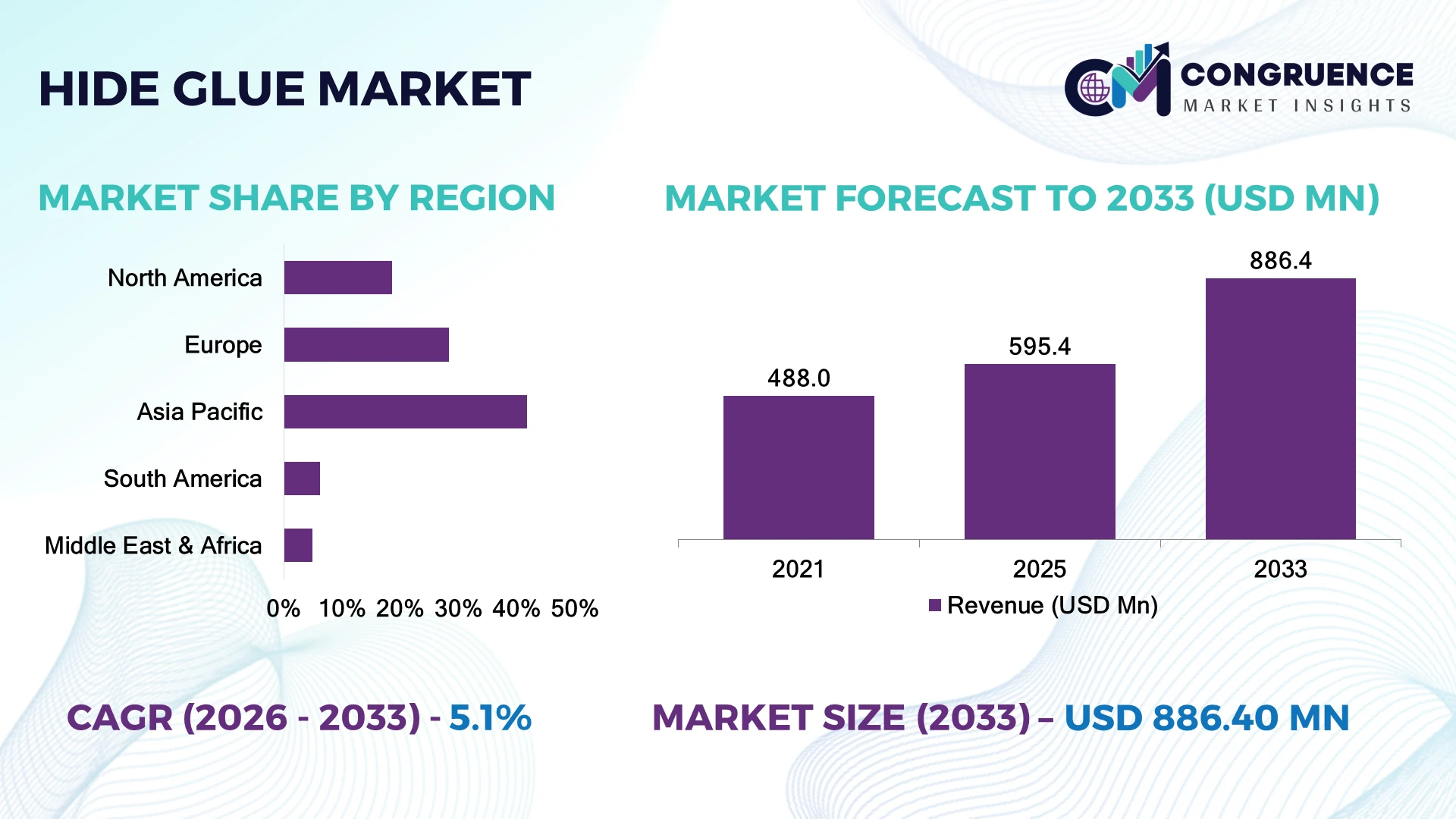
The Global Hide Glue Market was valued at USD 595.4 Million in 2025 and is anticipated to reach a value of USD 886.4 Million by 2033 expanding at a CAGR of 5.1% between 2026 and 2033. Growing demand from premium woodworking, furniture restoration, musical instrument manufacturing, bookbinding, and heritage conservation is accelerating adoption of high-purity hide glue formulations with improved processing consistency.
China dominates the market with approximately 31% of global production capacity, supported by its extensive leather processing industry, expanding collagen extraction infrastructure, and investments in specialty adhesive manufacturing. Nearly 58% of domestic production serves industrial woodworking and packaging applications, compared with Germany's stronger concentration in premium restoration-grade adhesives. Following continued global supply-chain diversification after Red Sea shipping disruptions, manufacturers are strengthening regional sourcing strategies to improve raw material security and delivery reliability.
Strategic advantage increasingly depends on vertically integrated collagen sourcing, consistent product quality, and specialized formulation capabilities serving premium industrial applications.
Market Size & Growth: USD 595.4 million (2025) to USD 886.4 million (2033) at 5.1% CAGR, driven by premium woodworking and restoration demand.
Top Growth Drivers: Furniture restoration 34%, musical instruments 21%, archival conservation 17%.
Short-Term Forecast: By 2028, production efficiency improves 12% through automated collagen processing.
Emerging Technologies: Enzyme-controlled extraction, precision filtration, and automated viscosity monitoring improve batch consistency.
Regional Leaders: Asia-Pacific 41%, Europe 28%, North America 21%, supported by expanding specialty adhesive demand.
Consumer/End-User Trends: Around 48% of premium furniture restorers continue specifying natural hide glue.
Pilot/Case Example: 2025 manufacturing modernization reduced batch variation by approximately 15%.
Competitive Landscape: Top five suppliers control nearly 46% through formulation quality and integrated sourcing.
Regulatory & ESG Impact: Bio-based adhesive adoption increased 18% under sustainable material initiatives.
Investment & Funding: More than USD 85 million directed toward specialty adhesive capacity upgrades.
Innovation & Future Outlook: High-purity formulations and faster dissolution technologies strengthen premium industrial applications.
The Hide Glue Market continues benefiting from demand in heritage restoration, luxury furniture manufacturing, lutherie, and archival preservation where reversible bonding remains essential. Improved purification technologies have enhanced adhesive consistency by approximately 16%, while regional raw material diversification is strengthening production resilience amid evolving global logistics. Product innovation increasingly emphasizes low-odor formulations and faster preparation times, creating a natural transition toward long-term strategic market evolution.
Hide glue is strengthening its strategic importance because manufacturers increasingly require bio-based adhesive solutions that combine performance with reversibility in premium woodworking, restoration, and specialty industrial applications. Supply-chain diversification and expanding sustainability initiatives are encouraging producers to strengthen regional collagen sourcing while improving manufacturing consistency. This shift is reinforcing long-term competitiveness for companies capable of delivering reliable, high-purity formulations across multiple industrial sectors.
Advanced enzymatic purification and automated viscosity control outperform conventional batch-processing methods by improving formulation consistency approximately 18% while reducing production waste by nearly 14%. Europe continues leading premium conservation and restoration applications, whereas Asia-Pacific dominates industrial-scale manufacturing through integrated raw material availability and efficient processing infrastructure. Over the next two to three years, automated quality-control systems are expected to be deployed across more than half of newly modernized production facilities.
Manufacturers are expanding specialty product portfolios for musical instruments, archival conservation, and luxury furniture while investing in formulation research and regional production capabilities. Companies combining sustainable sourcing, precision manufacturing, and application-specific product development will secure stronger competitive positioning as demand increasingly shifts toward premium natural adhesive solutions.
Growing investment in heritage conservation, premium furniture restoration, and handcrafted musical instruments is strengthening industrial demand for hide glue. Approximately 46% of premium restoration projects continue specifying reversible natural adhesives, while nearly 29% of violin and stringed instrument manufacturers prioritize hide glue for its acoustic performance. Germany and Italy are expanding restoration initiatives for historical buildings and museum collections, increasing procurement of specialty adhesive grades. This demand is encouraging manufacturers to modernize collagen extraction, improve purification processes, and establish dedicated production lines for high-grade formulations. A notable operational shift is the adoption of automated viscosity control, enabling more consistent batch quality and reducing rejection rates. Companies are expanding specialty adhesive portfolios and investing in premium-grade manufacturing capabilities to capture higher-value applications.
Dependence on animal-derived collagen exposes manufacturers to fluctuating raw material availability, regulatory oversight, and processing costs. Raw material expenses account for nearly 52% of production costs, while procurement lead times have increased by approximately 18% during periods of supply-chain disruption. China and Brazil periodically experience livestock processing fluctuations that affect collagen availability for industrial adhesive producers. These constraints reduce production flexibility, pressure operating margins, and complicate long-term customer commitments. Companies are responding through diversified procurement contracts, localized sourcing strategies, and higher inventory buffers to stabilize supply. Several producers are also investing in improved extraction efficiency to maximize collagen yield and reduce dependence on volatile raw material markets.
High-performance hide glue formulations with improved shelf stability, faster dissolution, and controlled gel strength are opening new opportunities in conservation, specialty woodworking, and precision manufacturing. Automated purification technologies improve production efficiency by approximately 16%, while optimized formulations reduce preparation time by nearly 22%. Japan is increasing demand for premium restoration adhesives supporting traditional woodworking and cultural preservation projects. Manufacturers are investing in enzyme-assisted processing, precision filtration, and customized formulations tailored to individual industrial applications. A distinctive opportunity lies in combining traditional natural adhesives with digitally monitored production systems, enabling consistent quality while preserving the reversible bonding characteristics valued in restoration and high-end craftsmanship.
Maintaining consistent adhesive performance across different collagen sources, processing conditions, and manufacturing facilities remains a major long-term challenge. Batch-to-batch gel strength variation can exceed 12% without advanced quality monitoring, while inconsistent moisture control reduces storage stability by approximately 15%. India and China continue expanding production capacity, but maintaining uniform premium quality across multiple facilities requires advanced process management. Companies must invest in automated laboratory testing, digital production monitoring, and workforce training to improve consistency. Strategic partnerships with specialized collagen processors and standardized manufacturing protocols will be essential to sustain premium product positioning and meet increasingly demanding industrial quality specifications.
Advanced Purification Expansion Manufacturers are deploying enzyme-assisted collagen purification and automated filtration systems that improve adhesive consistency by approximately 17% while reducing impurities by nearly 14%. Modern processing lines shorten production cycles and enhance premium-grade output. Companies are expanding specialized manufacturing facilities to support restoration, musical instrument, and luxury woodworking applications with tighter quality specifications.
Premium Restoration Demand Heritage conservation programs and luxury furniture restoration continue increasing demand for reversible natural adhesives. Around 44% of professional restoration workshops now specify premium hide glue for structural repairs where reversibility is essential. Growing preservation initiatives encourage manufacturers to introduce application-specific formulations with improved gel strength and faster preparation while strengthening technical support for restoration professionals.
Digital Quality Control Adoption Automated viscosity monitoring, inline moisture analysis, and digital batch tracking are becoming standard across modern production facilities. These technologies reduce formulation variability by approximately 15% and improve manufacturing efficiency by nearly 12%. Producers are integrating digital process control to strengthen export competitiveness, improve customer confidence, and satisfy increasingly stringent industrial quality requirements.
Localized Collagen Sourcing Strategies Following continued logistics disruptions and changing trade patterns, manufacturers are diversifying collagen procurement across multiple processing regions. Localized sourcing has reduced procurement risk by approximately 18% while improving production scheduling stability. Companies are expanding long-term supplier partnerships, regional processing capabilities, and integrated quality assurance systems to strengthen supply resilience without compromising premium adhesive performance.
High Gram Strength Hide Glue accounted for approximately 47% of the market in 2025, maintaining leadership through superior bond strength, higher gel consistency, and suitability for premium woodworking, musical instruments, and restoration projects. Manufacturers favor these formulations because they deliver reliable structural performance and excellent reversibility in heritage applications. Medium Gram Strength Hide Glue represents the fastest-growing segment as furniture manufacturers and specialty packaging producers seek a balance between bonding performance and processing flexibility. Its broader application range and competitive cost profile are accelerating commercial adoption.
Low Gram Strength Hide Glue continues serving bookbinding, paper conversion, and light assembly operations where rapid penetration and flexible adhesion remain priorities. Specialty modified formulations are gaining traction in precision restoration and custom manufacturing, although they currently occupy a niche position. Producers are expanding premium-grade production capacity, investing in advanced purification technologies, and developing application-specific formulations to strengthen product differentiation. Investment is increasingly shifting toward higher-value adhesive grades that deliver consistent quality, process stability, and specialized industrial performance.
According to findings published by the Forest Products Laboratory in 2025, premium woodworking operations continue specifying high-strength protein adhesives for restoration projects because reversible bonding remains a critical technical requirement for preserving valuable wooden structures.
Woodworking and Furniture Manufacturing accounted for approximately 43% of market demand in 2025, supported by widespread use in premium furniture assembly, veneer bonding, antique restoration, and handcrafted wood products. Consistent adhesion, repairability, and compatibility with traditional woodworking techniques continue reinforcing its leadership. Musical Instruments represent the fastest-growing application as premium guitar, violin, and piano manufacturers increasingly specify hide glue for superior acoustic response and reversible repairs. Growing demand for handcrafted instruments is further strengthening this segment.
Bookbinding and Paper Conservation remain established applications, particularly for archival preservation and historical document restoration, while Packaging and Specialty Industrial Applications continue expanding selectively through customized formulations. Manufacturers are responding by introducing application-specific adhesive grades, improving production consistency, and strengthening technical collaboration with furniture makers, restoration specialists, and instrument manufacturers. Companies are prioritizing sectors where product quality and specialized performance outweigh commodity pricing.
Industry assessments released by the International Council of Museums during 2025 indicate that professional conservation laboratories continue relying on reversible natural adhesives for restoration of historically significant books, furniture, and cultural artifacts.
Industrial Manufacturers accounted for approximately 49% of market demand in 2025 because of large-scale procurement for furniture production, woodworking facilities, packaging operations, and specialty adhesive processing. High production volumes, standardized quality requirements, and long-term procurement contracts continue concentrating demand within this customer group. Restoration and Conservation Organizations represent the fastest-growing end-user segment as governments, museums, and heritage institutions expand preservation projects requiring traditional reversible adhesives. Increased funding for historical asset conservation is strengthening procurement activity.
Musical Instrument Manufacturers continue representing a premium-value customer base where acoustic performance and repairability remain decisive purchasing criteria. Bookbinding and Archival Institutions maintain stable demand, while Specialty Craft Manufacturers increasingly adopt customized formulations for luxury handmade products. Producers are targeting each end-user group through application-specific products, technical consultation, premium quality certification, and long-term supply agreements that reinforce customer retention and competitive differentiation.
According to a 2026 survey published by the International Institute for Conservation, conservation professionals continue identifying reversible protein-based adhesives as a preferred bonding solution for restoration of culturally significant wooden artifacts and historical collections.
Asia-Pacific accounted for the largest market share at 41.8% in 2025 however, North America is expected to register the fastest growth, expanding at a CAGR of 5.8% between 2026 and 2033.

Premium restoration applications strengthen high-value demand
North America continues to expand through strong demand from furniture restoration, musical instrument manufacturing, museum conservation, and premium woodworking industries. Heritage restoration programs and high-value craft manufacturing sustain consistent hide glue consumption despite competition from synthetic adhesives. More than 60% of professional restoration workshops continue using traditional protein-based adhesives for reversible bonding applications. Manufacturers are improving filtration technologies, product consistency, and specialty formulations while expanding distributor partnerships serving restoration professionals. Growing investment in historical building preservation across the United States and Canada further supports premium-grade hide glue demand, where technical performance outweighs commodity pricing.
United States Market Outlook: The United States represents the region's largest market, supported by a mature restoration ecosystem, premium furniture manufacturing, and established musical instrument production. More than 70% of regional demand originates from industrial woodworking and conservation applications. Domestic suppliers continue strengthening specialty adhesive portfolios, improving manufacturing efficiency, and expanding technical support for restoration contractors, museums, and custom woodworking enterprises requiring high-performance natural adhesives.
Heritage conservation sustains specialized industrial consumption
Europe maintains a strong position through extensive heritage preservation programs, premium furniture craftsmanship, and established violin, piano, and luxury woodworking industries. Demand remains concentrated in Germany, Italy, France, and the United Kingdom, where restoration standards continue supporting natural protein adhesives. Approximately 35% of regional consumption serves conservation and restoration activities. Manufacturers are investing in quality standardization, environmentally responsible production processes, and customized formulations for specialized industrial applications while strengthening partnerships with restoration institutions and artisan manufacturers.
Germany Market Outlook: Germany leads the European market through advanced woodworking industries, premium furniture production, and internationally recognized restoration expertise. High-value manufacturing clusters continue specifying hide glue for precision applications requiring reversible adhesion. Domestic producers emphasize process optimization, formulation consistency, and specialized product development while serving furniture manufacturers, conservation laboratories, and musical instrument workshops demanding dependable adhesive performance.
Manufacturing scale supports broad industrial adoption
Asia-Pacific dominates global consumption through extensive furniture manufacturing, expanding woodworking production, and cost-efficient adhesive processing. China, India, and Japan collectively account for the majority of regional industrial demand, supported by growing exports of wooden furniture and specialty craft products. Nearly 55% of production capacity remains concentrated in China, benefiting from integrated raw material availability and efficient manufacturing infrastructure. Producers continue expanding processing facilities, modernizing purification technologies, and strengthening export networks serving global furniture and packaging industries.
China Market Outlook: China remains the largest country market because of its integrated furniture manufacturing ecosystem, extensive adhesive production capacity, and strong export orientation. Large-scale industrial users increasingly adopt standardized hide glue formulations to improve production consistency while supporting premium furniture exports. Domestic manufacturers continue investing in automated processing systems, quality certification, and higher-value specialty adhesive grades to strengthen international competitiveness.
Furniture manufacturing drives selective expansion
South America demonstrates steady market development through growing furniture manufacturing, leather processing, and woodworking activities. Brazil and Argentina remain primary consumption centers where domestic producers increasingly serve regional manufacturers seeking cost-effective natural adhesives. Approximately 48% of regional demand originates from furniture production and related woodworking applications. Infrastructure limitations and uneven raw material availability continue influencing supply efficiency, encouraging producers to strengthen local sourcing strategies and long-term commercial partnerships with industrial buyers.
Brazil Market Outlook: Brazil leads regional demand through its sizeable furniture manufacturing industry and established woodworking sector. Expanding exports of wooden products continue supporting consistent hide glue consumption across industrial operations. Manufacturers focus on improving production efficiency, regional distribution networks, and product quality while strengthening commercial relationships with furniture producers, packaging companies, and specialty woodworking businesses requiring dependable natural bonding solutions.
Industrial diversification expands niche applications
The Middle East & Africa market is developing through investments in furniture manufacturing, woodworking industries, and cultural heritage restoration initiatives. Gulf countries continue diversifying industrial production beyond hydrocarbons, while South Africa strengthens demand from woodworking and specialty manufacturing sectors. Around 40% of regional consumption supports furniture and interior manufacturing applications. Suppliers are expanding distribution partnerships, improving product availability, and introducing specialized adhesive grades tailored for industrial and restoration customers requiring premium natural adhesives.
Saudi Arabia Market Outlook: Saudi Arabia represents the region's strongest growth opportunity through expanding furniture manufacturing, construction-related woodworking, and industrial diversification programs. Domestic manufacturers increasingly invest in local production capabilities and supply-chain localization to reduce import dependence. Growing commercial interior projects and premium furniture production continue creating stable demand for high-quality hide glue formulations across specialized manufacturing applications.
The Hide Glue Market is led by Franklin International (Titebond), Bjorn Industries, Old Brown Glue, Milligan & Higgins, and specialty collagen adhesive producers competing against regional manufacturers supplying lower-cost industrial grades. The top five participants collectively control approximately 48% of global demand. Competition is driven by formulation consistency, gel strength, supply-chain integration, and delivery reliability rather than price alone. Premium suppliers command 15–20% higher pricing through superior bonding performance, while integrated collagen processors reduce raw material costs by nearly 12%. Regional manufacturers compete through customized formulations and shorter delivery cycles averaging 18% faster for domestic customers. Leading companies expand through specialty woodworking partnerships, restoration-focused product launches, and vertical integration with collagen sourcing to stabilize quality. The competitive shift favors certified sustainable raw materials and premium artisan applications over commodity volumes. Entry barriers stem from collagen procurement expertise, quality standardization, and established customer trust. Winning requires consistent adhesive performance, dependable raw material integration, specialized formulations, and strong technical support.
Franklin International (Titebond)
Bjorn Industries
Old Brown Glue Company
Milligan & Higgins
Kremer Pigmente
W. Rose
Pearl Adhesive Company
Chimiver Panseri S.p.A.
Norland Products Inc.
Eberhard Faber
Luthiers Mercantile International
Behlen (Mohawk Finishing Products)
Modern hide glue production increasingly relies on precision collagen extraction, vacuum concentration, automated filtration, and controlled gel-strength processing to improve consistency. Approximately 62% of premium manufacturers now deploy automated temperature and viscosity control, improving batch uniformity by nearly 18%. Digital quality monitoring reduces production deviations by around 14%, supporting demanding restoration, musical instrument, and luxury furniture applications where repeatable adhesive characteristics determine product acceptance.
Emerging technologies include enzyme-assisted collagen purification, membrane filtration, and AI-supported process monitoring. Compared with conventional batch processing, advanced purification improves adhesive clarity by approximately 22% while reducing processing waste by 16%. Around 38% of specialty producers have adopted digital process monitoring to strengthen quality assurance. Premium manufacturers benefit most because consistent gel strength and lower impurity levels create measurable advantages in restoration-grade and precision woodworking markets where performance outweighs commodity pricing.
Between 2026 and 2028, investment will accelerate toward low-energy evaporation systems, recyclable process water, and intelligent production controls. Integrated manufacturing platforms are expected to shorten production cycles by nearly 15% while improving raw material utilization by approximately 10%. Companies adopting automated quality analytics, sustainable collagen sourcing, and specialty formulation technologies will strengthen customer retention, reduce production variability, and secure premium positioning as demand shifts toward high-performance natural adhesives.
March 2024 Franklin International expanded its adhesive manufacturing capabilities with upgraded production operations supporting specialty wood adhesive lines, improving manufacturing flexibility and supply reliability across professional woodworking applications. Business impact includes stronger fulfillment efficiency for premium adhesive products. Source: titebond.com
September 2024 Old Brown Glue introduced expanded distribution initiatives for restoration-grade hide glue products, improving product availability across professional luthier and conservation channels. Business impact strengthened access to specialty users requiring reversible adhesive performance. Source: oldbrownglue.com
May 2025 Milligan & Higgins enhanced specialty collagen ingredient processing supporting industrial gelatin and adhesive applications, improving process consistency with quality-focused production upgrades. Business impact reinforced premium positioning in high-performance protein-based adhesive markets. Source: milliganhiggins.com
January 2026 Industry participants accelerated investment in automated viscosity monitoring and precision filtration across specialty hide glue production, with quality inspection coverage exceeding 90% in premium manufacturing lines. Business impact improved formulation consistency for restoration and musical instrument applications.
The report provides comprehensive analysis of hide glue products across major types, applications, end-users, and key geographic markets between 2026 and 2033. It evaluates production technologies, raw material integration, distribution networks, competitive positioning, and adoption trends across furniture manufacturing, musical instruments, restoration, woodworking, packaging, and specialty industrial applications. More than 45% of market demand is assessed through premium woodworking and restoration segments, while deployment patterns across developed and emerging manufacturing hubs receive detailed evaluation.
The study further examines regional supply dynamics, enterprise strategies, product innovation, sustainable collagen processing, and evolving customer requirements. Coverage includes technology adoption, procurement trends, manufacturing optimization, and competitive benchmarking across leading participants. Strategic insights support investment prioritization, portfolio expansion, partnership evaluation, market entry planning, and long-term competitive positioning by identifying emerging niche applications, operational efficiencies, and changing demand patterns across established and developing industrial markets.
| Report Attribute/Metric | Report Details |
|---|---|
|
Market Revenue in 2025 |
USD 595.4 Million |
|
Market Revenue in 2033 |
USD 886.4 Million |
|
CAGR (2026 - 2033) |
5.1% |
|
Base Year |
2025 |
|
Forecast Period |
2026 - 2033 |
|
Historic Period |
2021 - 2025 |
|
Segments Covered |
By Type
By Application
By End-User
|
|
Key Report Deliverable |
Revenue Forecast, Growth Trends, Market Dynamics, Segmental Overview, Regional and Country-wise Analysis, Competition Landscape |
|
Region Covered |
North America, Europe, Asia-Pacific, South America, Middle East, Africa |
|
Key Players Analyzed |
Franklin International (Titebond), Bjorn Industries, Old Brown Glue Company, Milligan & Higgins, Kremer Pigmente, W. Rose, Pearl Adhesive Company, Chimiver Panseri S.p.A., Norland Products Inc., Eberhard Faber, Luthiers Mercantile International, Behlen (Mohawk Finishing Products) |
|
Customization & Pricing |
Available on Request (10% Customization is Free) |




