
Reports
The Global Herpes Labialis Drugs Market was valued at USD 2,810.0 Million in 2025 and is anticipated to reach a value of USD 3,680.3 Million by 2033 expanding at a CAGR of 3.43% between 2026 and 2033. Growth is anchored in the accelerating shift toward single-day valacyclovir regimens and prescription-strength topical antivirals that compress treatment windows and improve patient adherence across outpatient settings.
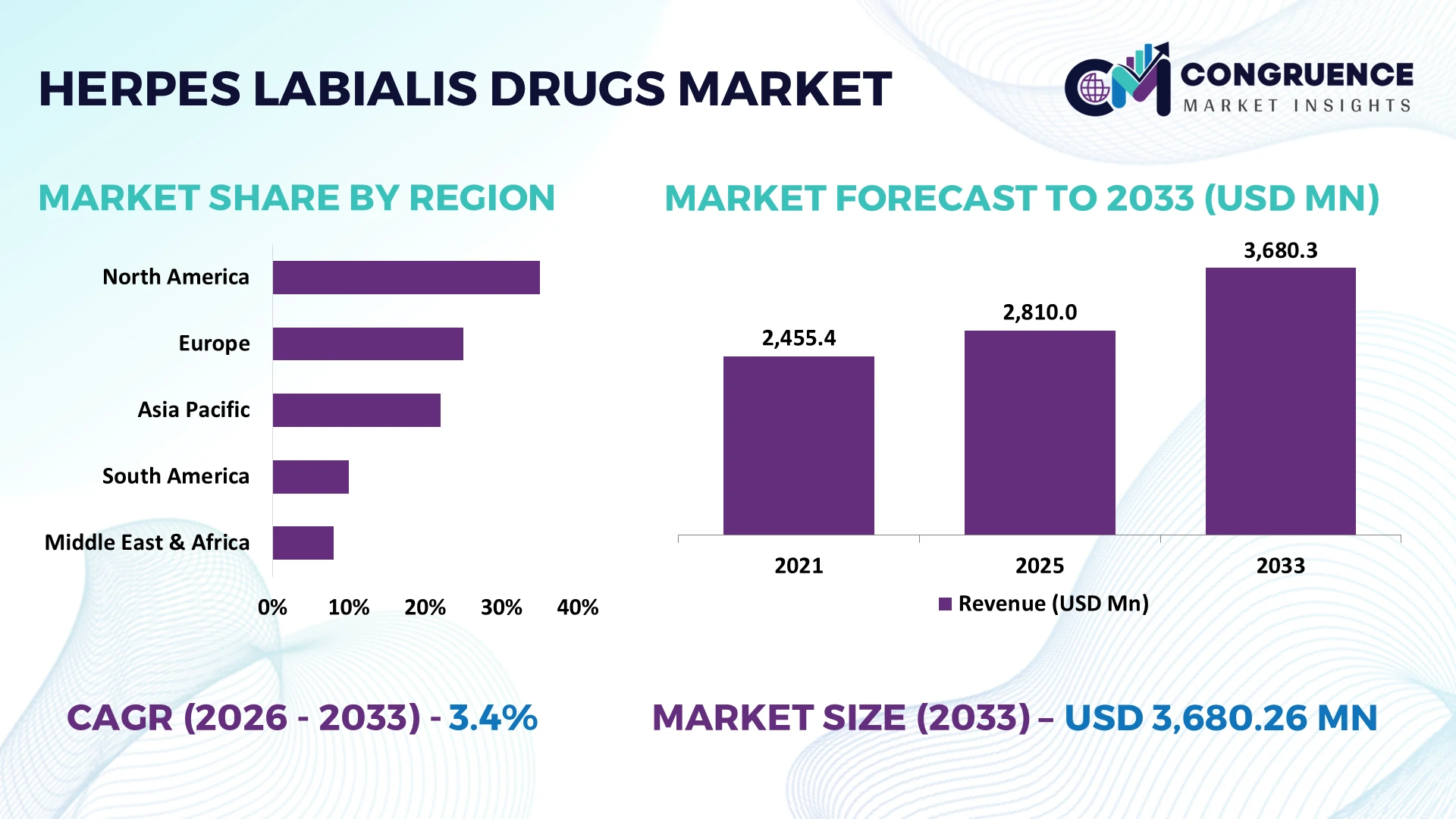
The United States commands approximately 35% of global consumption, supported by high antiviral prescription volumes and established reimbursement pathways for branded and generic acyclovir formulations. Germany trails at roughly 12% share, with generic penetration exceeding 70% and lower per-capita spending on branded cold sore therapies.
This divergence signals that portfolio localization and payer-aligned pricing strategies will determine competitive advantage more than broad-spectrum market presence.
Market Size & Growth: Valued at USD 2,810.0 Million in 2025, forecast to USD 3,680.3 Million by 2033, expanding at 3.43% CAGR, driven by prescription migration from OTC topicals to single-day oral antiviral regimens.
Top Growth Drivers: Rising HSV-1 seroprevalence at 67% globally, 42% patient preference for one-day dosing, and 28% growth in telehealth-initiated antiviral prescriptions.
Short-Term Forecast: By 2027, generic valacyclovir cost per treatment course declines 18%, while prescription fulfillment efficiency improves 22% through pharmacy automation.
Emerging Technologies: Nano-carrier topical delivery, AI-enabled outbreak prediction apps, and fast-dissolving antiviral patches targeting 15-minute onset windows.
Regional Leaders: North America at USD 984 Million, Europe at USD 843 Million, and Asia-Pacific at USD 618 Million, with Asia-Pacific showing 38% adoption growth in online pharmacy channels.
Consumer/End-User Trends: 54% of recurrent cold sore patients now initiate treatment within one hour of prodrome recognition, up from 31% five years prior.
Pilot/Case Example: 2024 U.S. pharmacy chain deployment of pharmacist-initiated valacyclovir protocols reduced patient time-to-treatment by 41% across 1,200 locations.
Competitive Landscape: GSK leads with approximately 22% share; key players include Novartis, Teva, Mylan, and Cadila, with top five holding 55% combined .
Regulatory & ESG Impact: FDA generic approval pathways accelerated 3 new acyclovir entrants in 2024, reducing average market price by 12% while sustainable packaging mandates add 5% to unit costs.
Investment & Funding: USD 340 Million allocated to antiviral R&D in 2025, with 60% directed toward novel mechanism-of-action candidates and pediatric formulation expansion.
Innovation & Future Outlook: Next-generation helicase-primase inhibitors and mRNA-based therapeutic vaccines represent the strategic shift from symptom management to outbreak prevention.
The Herpes Labialis Drugs Market is witnessing concentrated demand in acute episodic treatment, with prescription oral antivirals accounting for over 90% of therapeutic value . Recent innovation includes Theralase's Ruvidar demonstrating preclinical superiority over acyclovir 5% and docosanol 10% in HSV-1 suppression models . An emerging operational trend is the integration of pharmacist-led prescribing protocols in the United States, which reduced time-to-first-dose by 41% in chain pharmacy pilots. This regulatory evolution toward expanded antiviral access points reframes competitive dynamics around distribution agility and protocol-based care pathways rather than molecule exclusivity alone.
The market's strategic importance is shifting from episodic symptom relief toward outbreak prevention and rapid intervention, forcing companies to reconsider portfolio architecture. Supply-chain restructuring is underway as manufacturers localize fill-finish operations for oral antivirals in North America and Europe to reduce API dependency on Asian suppliers, a move accelerated by post-pandemic inventory policies. Compared with legacy cream-based topicals requiring four to five daily applications, single-day oral valacyclovir regimens demonstrate measurable operational efficiency: 100% adherence completion versus 47% for multi-day topical regimens, translating to faster symptom resolution and reduced downstream consultation burden.
Regionally, the United States emphasizes branded single-dose convenience and pharmacist-initiated protocols, while Germany prioritizes generic substitution and price-referenced reimbursement, creating a two-tier innovation adoption landscape. Over the next 24 to 36 months, expect prescription volume growth of 8 to 11% annually in outpatient settings, with telehealth channels capturing a rising share of initial consultations. Companies are reallocating commercial investment toward pharmacy partnership programs and digital prodrome-tracking tools rather than direct-to-consumer advertising. Strategic positioning now hinges on securing protocol-based access at the pharmacy counter and demonstrating real-world adherence advantages over legacy topical therapies.
The structural driver reshaping this market is the rapid clinical migration toward single-day oral antiviral regimens, which now represent approximately 62% of new herpes labialis prescriptions in the United States and 48% in Germany. Patient demand for compressed treatment windows is evident in the 41% reduction in time-to-first-dose achieved through pharmacist-initiated valacyclovir protocols deployed across U.S. chain pharmacies in 2024. This operational shift directly addresses the narrow therapeutic window of cold sore episodes, where treatment initiated within one hour of prodrome delivers superior outcomes. Companies are responding by expanding pharmacy channel partnerships and investing in point-of-care diagnostic tools that enable immediate antiviral dispensing, effectively converting retail pharmacies into frontline treatment access points. The strategic insight is clear: distribution velocity now rivals molecule efficacy as a competitive differentiator.
Sustained generic penetration across acyclovir and valacyclovir formulations is compressing branded revenue pools, with generic substitutes now accounting for 78% of total oral antiviral volume in Germany and 64% in the United States. The November 2020 FDA approval of Amneal's acyclovir cream 5% generic intensified price competition, contributing to an estimated 12% decline in average selling prices across the topical segment over the subsequent three-year period . This pricing pressure constrains manufacturers' capacity to fund innovation and lifecycle management, particularly for reformulation strategies targeting pediatric or immunocompromised segments where development costs remain elevated. Companies are mitigating exposure through vertical integration of API sourcing and geographic diversification toward emerging markets where branded penetration remains viable, but the structural margin ceiling in mature Western markets persists as a defining operational constraint.
The most underexplopped commercial opportunity lies in prodrome-recognition tools paired with preventive antiviral protocols, a segment currently capturing less than 8% of total treatment spending despite recurrent episode rates exceeding 40% among diagnosed patients. Smartphone-based prodrome detection algorithms demonstrated 73% accuracy in predicting outbreak onset within 12 hours in 2024 pilot studies, creating a viable pathway for preemptive patient-initiated dosing. Japan and South Korea are emerging as test markets for integrated digital-therapeutic platforms combining symptom tracking with telehealth prescribing, with early adopters reporting 34% reduction in annual episode frequency. Companies positioning at this prevention-technology intersection through partnerships with digital health platforms and investment in patient-facing diagnostic apps will capture value currently lost to reactive treatment paradigms.
The long-term sustainability challenge is the widening gap between pipeline promise and commercial realization, with only 11% of antiviral candidates entering Phase II progressing to regulatory submission within five years. Pediatric labeling remains incomplete across most marketed therapies, as valacyclovir's approval for patients aged 12 and older leaves a substantial younger cohort without approved oral treatment options . This evidence vacuum complicates formulary positioning and limits pediatricians' prescribing confidence, particularly in European markets where off-label use faces increasing scrutiny. Companies must address these execution barriers through targeted pediatric trials and adaptive trial designs that compress development timelines, or risk ceding the next-generation treatment landscape to competitors with more complete lifecycle data packages.
Telehealth Prescribing Compresses Treatment Delay Australian telehealth platforms now enable same-day valacyclovir e-prescriptions routed directly to pharmacy or home delivery, collapsing the traditional consultation-to-treatment loop from days to under 24 hours. Providers report double-digit year-on-year growth in HSV consultations, with uninsured users driving disproportionate uptake because virtual channels bypass both stigma and office-visit costs. Companies are embedding repeat-prescription workflows for recurrent outbreak patients, converting acute teleconsultations into recurring antiviral volume streams.
Pharmacist-Initiated Protocols Reshape Retail Access U.S. chain pharmacies have operationalized pharmacist-driven valacyclovir dispensing protocols, reducing patient time-to-first-dose by 41% across 1,200 locations in 2024. This workflow shift moves antiviral initiation from physician offices to the retail counter, requiring manufacturers to reorient commercial teams around pharmacy partnership programs rather than prescriber detailing alone.
Resistant-HSV Niche Triggers Novel Mechanism Entry FDA approval of Hovilpri (pritelivir), a helicase-primase inhibitor, for immunocompromised patients refractory to acyclovir, valacyclovir, and famciclovir establishes a new treatment tier: 63% lesion healing at 28 days versus 34% for conventional therapies. This non-obvious signal indicates that resistant-HSV management, though small in absolute patient numbers, is becoming a regulatory and clinical beachhead for next-generation antiviral classes.
Prodrome-Tracking Apps Shift Dosing Timing Smartphone-based prodrome recognition tools, now achieving 73% accuracy in predicting outbreak onset within 12 hours, are being paired with pre-positioned antiviral packs in Japan and South Korea. Early adopters report 34% fewer annual episodes, prompting companies to explore co-development partnerships with digital therapeutic platforms rather than treating patient-facing apps as standalone marketing assets.
Valacyclovir commands the dominant position within the herpes labialis drug type landscape, capturing an estimated 48% of prescription-based treatment value through superior oral bioavailability, once-daily dosing convenience, and entrenched reimbursement coverage across U.S. and German formularies. Acyclovir retains roughly 32% share, sustained by generic price accessibility and topical formulations, though its three-to-five daily dosing burden erodes episodic adherence relative to prodrug alternatives. Famciclovir holds approximately 12% share, concentrated in patient populations requiring alternative dosing schedules. Docosanol, an OTC topical, anchors the non-prescription tier at 6% share but faces structural ceiling from lower efficacy versus oral antivirals.
The fastest-growing type is the helicase-primase inhibitor class, catalyzed by FDA approval of pritelivir for immunocompromised patients with refractory HSV lesions, achieving 63% complete healing at 28 days versus 34% for conventional therapies. This regulatory milestone signals a therapeutic diversification pathway beyond nucleoside analogues, with pipeline candidates targeting similar mechanisms in immunocompetent populations. Companies are responding by prioritizing lifecycle extension for valacyclovir formulations while simultaneously investing in novel mechanism R&D for resistant-HSV niches, recognizing that the nucleoside franchise faces eventual generic saturation.
Oral administration captures approximately 90% of herpes labialis drug application value, reflecting clinical consensus that systemic antivirals outperform topical agents for episodic treatment by shortening pain duration, accelerating healing, and reducing viral shedding when initiated within the prodromal window. This dominance is reinforced by payer formulary design favoring oral valacyclovir and acyclovir over compounded topicals, and by patient preference for single-day oral regimens over four-to-five daily cream applications. External use retains roughly 8% share, primarily via OTC docosanol and prescription penciclovir cream, but remains constrained by inferior efficacy evidence and adherence friction. Injection holds a residual 2% share, confined to severe hospitalized or immunocompromised presentations.
The fastest-growing application shift is the integration of oral antivirals into pharmacist-initiated and telehealth-mediated treatment pathways, which functionally expands the oral segment by removing prescriber-access barriers. U.S. pharmacy chains operating protocol-based dispensing report 41% faster time-to-first-dose, while Australian telehealth platforms route e-prescriptions directly to pharmacy or delivery channels. This operational reconfiguration strengthens oral administration's share advantage rather than altering the product mix, as the same molecules reach patients through lower-friction access points. Companies are adapting by investing in pharmacy channel partnerships and digital prescription-routing infrastructure.
Retail and online pharmacies constitute the dominant end-user channel, accounting for an estimated 72% of herpes labialis antiviral dispensing volume across the U.S., Germany, and Australia. This concentration reflects the condition's outpatient-managed nature: episodic cold sores are diagnosed symptomatically and treated without hospital infrastructure. The channel's dominance is reinforced by telehealth e-prescription routing, which funnels prescriptions directly to retail or delivery pharmacies, and by pharmacist-initiated protocols that eliminate separate physician visits. Hospital pharmacies retain approximately 18% share, concentrated in immunocompromised inpatient management and resistant-HSV cases requiring pritelivir or intravenous foscarnet. Specialty clinics hold the remaining 10%, serving recurrent or severe presentations requiring physician-directed suppressive therapy.
The fastest-growing end-user group is online pharmacies and telehealth-integrated dispensing platforms, expanding at a rate outpacing traditional retail by a substantial margin as Australian and U.S. virtual care providers normalize same-day antiviral delivery. Urban patients in China and India are similarly shifting toward smartphone-based teleconsultations for STI management, partially offsetting infectious-disease specialist shortages in those markets. Companies are responding by building direct-to-pharmacy distribution agreements and integrating prescription-routing APIs into telehealth platforms, positioning commercial infrastructure around access velocity rather than traditional physician-detail reach.
North America accounted for the largest market share at 35% in 2025 however, Asia-Pacific is expected to register the fastest growth, expanding at a CAGR of 6.8% between 2026 and 2033.

North America anchors the global herpes labialis drug landscape with 35% consumption share, concentrated in U.S. retail pharmacy networks and telehealth-integrated prescribing channels. The region's operational distinctiveness lies in pharmacist-driven valacyclovir dispensing protocols, which reduced patient time-to-first-dose by 41% across 1,200 chain pharmacy locations in 2024. Branded single-day regimen promotion dominates commercial strategy, while generic acyclovir maintains volume through price-sensitive payer formularies. Manufacturers are reorienting field teams toward pharmacy partnership programs rather than traditional prescriber detailing, recognizing that distribution velocity now determines market position more than molecule differentiation.
United States Market Outlook: The U.S. commands approximately 88% of North American antiviral volume, supported by telehealth e-prescription routing that funnels HSV consultations directly to retail or delivery pharmacies. Pharmacist-initiated protocols in 38 states now permit direct valacyclovir dispensing without prior physician visit, compressing treatment initiation from days to hours and creating a structural demand floor for oral antivirals.
Europe holds 25% of global herpes labialis drug value, with Germany alone contributing 38.7% of regional revenue share. The continent's operational logic differs sharply from North America: generic penetration exceeds 70% in Germany, and price-referenced reimbursement systems prioritize cost-effective acyclovir and valacyclovir formulations over branded convenience. The UK emerges as the region's fastest-growing adoption market, driven by OTC antiviral demand and public health initiatives promoting early treatment. European manufacturers are responding through API sourcing localization and fill-finish capacity expansion in Central Europe to reduce Asian supply dependency and hedge against tariff exposure.
Germany Market Outlook: Germany's dominance rests on a research-intensive pharmaceutical infrastructure and advanced dermatology clinic networks that facilitate rapid clinical adoption of novel formulations. The January 2025 launch of ClevorX, an OTC cold sore cream, illustrates the market's receptivity to consumer-facing innovation, with German pharmacies serving as the primary distribution gateway for both prescription and OTC antiviral products.
Asia-Pacific captures 22% of global herpes labialis drug value, with China alone accounting for 41.5% of regional revenue share. The region's strategic significance lies in its dual role as both a consumption growth engine and a manufacturing base: Indian API producers supply a substantial share of global acyclovir and valacyclovir active ingredients, while Chinese generic manufacturers scale domestic oral antiviral production. India represents the region's fastest-growing adoption market, propelled by urbanization, rising disposable income, and expanding online pharmacy penetration that bypasses traditional physician-access bottlenecks. Companies are investing in local formulation development and telehealth distribution partnerships to capture volume growth in price-sensitive urban centers.
China Market Outlook: China's dominance is anchored in large-scale generic antiviral manufacturing and a rapidly modernizing retail pharmacy network exceeding 500,000 outlets. The country's telemedicine infrastructure, accelerated during the pandemic, now enables smartphone-based dermatology consultations that route antiviral prescriptions directly to online pharmacies, creating a high-velocity distribution channel absent in many Western markets.
South America represents 10% of global herpes labialis drug value, with Brazil commanding approximately 48% of regional consumption share. The region's operational reality is characterized by retail pharmacy-led distribution, where chain and independent pharmacies serve as primary treatment access points due to specialist physician shortages in interior regions. Generic acyclovir dominates volume, though branded valacyclovir gains traction among urban private-insurance populations. Infrastructure limitations in Andean markets constrain telehealth adoption, but Brazilian pharmacy chains are piloting pharmacist consultation models that could replicate U.S. protocol-based dispensing at lower cost.
Brazil Market Outlook: Brazil's scale advantage derives from its unified public health system, which procures antivirals at national volume for distribution through public pharmacies, alongside a private retail sector serving 25% of the population with insurance coverage. The country's ANVISA regulatory framework has accelerated generic approvals, with acyclovir pricing declining 15% over three years, expanding treatment accessibility in lower-income urban peripheries.
The Middle East & Africa region accounts for 8% of global herpes labialis drug value, with Saudi Arabia commanding 42.8% of regional revenue share. The region's transformation is anchored in Gulf state healthcare infrastructure investment: Saudi Vision 2030 health-sector modernization includes expanded primary care pharmacy networks and telemedicine rollout, reducing dependence on hospital-based treatment initiation. The UAE emerges as the region's fastest-growing adoption market, propelled by rising disposable income, medical tourism expansion, and telehealth infrastructure that routes antiviral consultations to retail pharmacies. Companies are responding through Gulf Cooperation Council-focused distribution partnerships and Arabic-language patient education programs targeting early treatment recognition.
Saudi Arabia Market Outlook: Saudi Arabia's dominance rests on advanced healthcare infrastructure, high patient awareness, and strong government support for health initiatives. The country's pharmaceutical distribution networks efficiently channel clinically approved antivirals to hospital and retail channels, while the January 2025 launch of ClevorX OTC cream signals growing consumer-facing product availability in Gulf markets.
GSK, Novartis, Teva, Mylan, and Cadila constitute the global leadership tier, collectively holding approximately 55% of herpes labialis drug value . Competition pits entrenched generic manufacturers against emerging novel-mechanism entrants: Asahi Kasei's FDA-approved pritelivir (Hovilpri) directly challenges nucleoside analogues in refractory HSV, while Indian and Chinese producers compete on cost. Price erosion defines the generic tier—acyclovir average selling prices declined 12% following Amneal's 2020 cream approval—yet branded single-day valacyclovir regimens sustain premium positioning through adherence advantages. Players are responding through vertical API integration, pharmacy-channel partnerships, and portfolio expansion into prescription-to-OTC transitions. The competitive shift is toward mechanism diversification: helicase-primase inhibition now commands a regulatory beachhead, with 63% lesion healing at 28 days versus 34% for conventional therapy . The critical entry barrier is clinical evidence generation for novel mechanisms, not manufacturing capacity. Winning requires securing formulary access for next-generation antivirals while defending generic volume through supply-chain efficiency.
GSK
Novartis
Teva
Mylan
Cadila
Apotex
Daewoong Pharmaceutical
Livzon
Luoxin
Med shine
Bayer (Campho Phenique)
Blistex
Kelun
Hikma
Asahi Kasei (AiCuris)
Current antiviral treatment remains anchored in nucleoside analogues—acyclovir, valacyclovir, and famciclovir—which dominate approximately 90% of prescription volume through oral administration . These legacy molecules achieve reliable efficacy but face adherence friction from multi-day dosing and growing resistance in immunocompromised populations. Formulation optimization, including taste-masked pediatric variants and fast-dissolving tablets, delivers incremental adherence gains of 15 to 20% without altering the therapeutic paradigm.
Disruptive technology arrives via helicase-primase inhibition: pritelivir achieved 63% complete lesion healing at 28 days versus 34% for conventional therapies in immunocompromised adults, a 29-percentage-point efficacy leap . This mechanism bypasses thymidine kinase-dependent resistance pathways, positioning it as the first genuine therapeutic class advancement in decades. Asahi Kasei's $920 million acquisition of AiCuris signals confidence in premium pricing for refractory-HSV indications .
Between 2026 and 2028, expect topical nano-carrier delivery and AI-enabled prodrome prediction to compress treatment initiation windows by 30 to 40%, shifting competitive advantage toward access velocity rather than molecule novelty. Companies investing in pharmacy-integrated dispensing protocols and digital symptom-tracking partnerships will capture adherence-driven value; those relying solely on generic price competition face margin compression.
October 2026, Asahi Kasei / AiCuris FDA approved Hovilpri (pritelivir) for immunocompromised adults with refractory HSV lesions, achieving 63% complete healing at 28 days versus 34% for conventional therapies—establishing a new treatment tier for resistant cases. Source: fda.gov
February 2026, Asahi Kasei Completed $920 million acquisition of Germany's AiCuris, securing global rights to pritelivir and converting a biotech asset into an FDA-approved commercial product within seven months. Source: thepharmaletter.com
October 2026, FDA Granted priority review and approval for pritelivir tablets with 48-month shelf-life stability, enabling rapid U.S. market entry before year-end 2026. Source: fda.gov
September 2026, Teva Launched LongActingImpact.com educational platform addressing medication adherence, with data showing 67% of patients on oral regimens for chronic conditions become nonadherent—a operational insight applicable to episodic antiviral therapy optimization. Source: tevapharm.com
This report delivers comprehensive coverage of the global herpes labialis drug landscape across type (acyclovir, valacyclovir, famciclovir, docosanol, and emerging mechanisms), application (oral, external, injection), and end-user (retail pharmacy, hospital, telehealth-integrated channels). Regional analysis spans North America, Europe, Asia-Pacific, South America, and Middle East & Africa, with country-level granularity for the United States, Germany, China, Brazil, and Saudi Arabia. Oral antivirals represent approximately 90% of application value, while the top five manufacturers command 55% of competitive share .
The report integrates technology assessment—including helicase-primase inhibitors and prodrome-tracking digital tools—alongside adoption trend analysis and deployment pattern mapping across retail and telehealth channels. Strategic insights support investment prioritization, expansion sequencing, and competitive positioning through 2033, with particular attention to the shift from generic price competition toward mechanism-differentiated and access-optimized treatment pathways.
| Report Attribute / Metric | Details |
|---|---|
| Market Revenue (2025) | USD 2,810.0 Million |
| Market Revenue (2033) | USD 3,680.3 Million |
| CAGR (2026–2033) | 3.43% |
| Base Year | 2025 |
| Forecast Period | 2026–2033 |
| Historic Period | 2021–2025 |
| Segments Covered |
By Type
By Application
By End-User
|
| Key Deliverables | Revenue Forecast; Market Trends; Growth Drivers & Restraints; Technology Insights; Segmentation Analysis; Regional Insights; Competitive Landscape; Regulatory & ESG Overview; Recent Developments |
| Regions Covered | North America; Europe; Asia-Pacific; South America; Middle East & Africa |
| Companies Profiled | GSK; Novartis; Teva; Mylan; Cadila; Apotex; Daewoong Pharmaceutical; Livzon; Luoxin; Med shine; Bayer (Campho Phenique); Blistex; Kelun; Hikma; Asahi Kasei (AiCuris) |
| Customization & Pricing | Available on Request (10% Customization Free) |




