
Reports
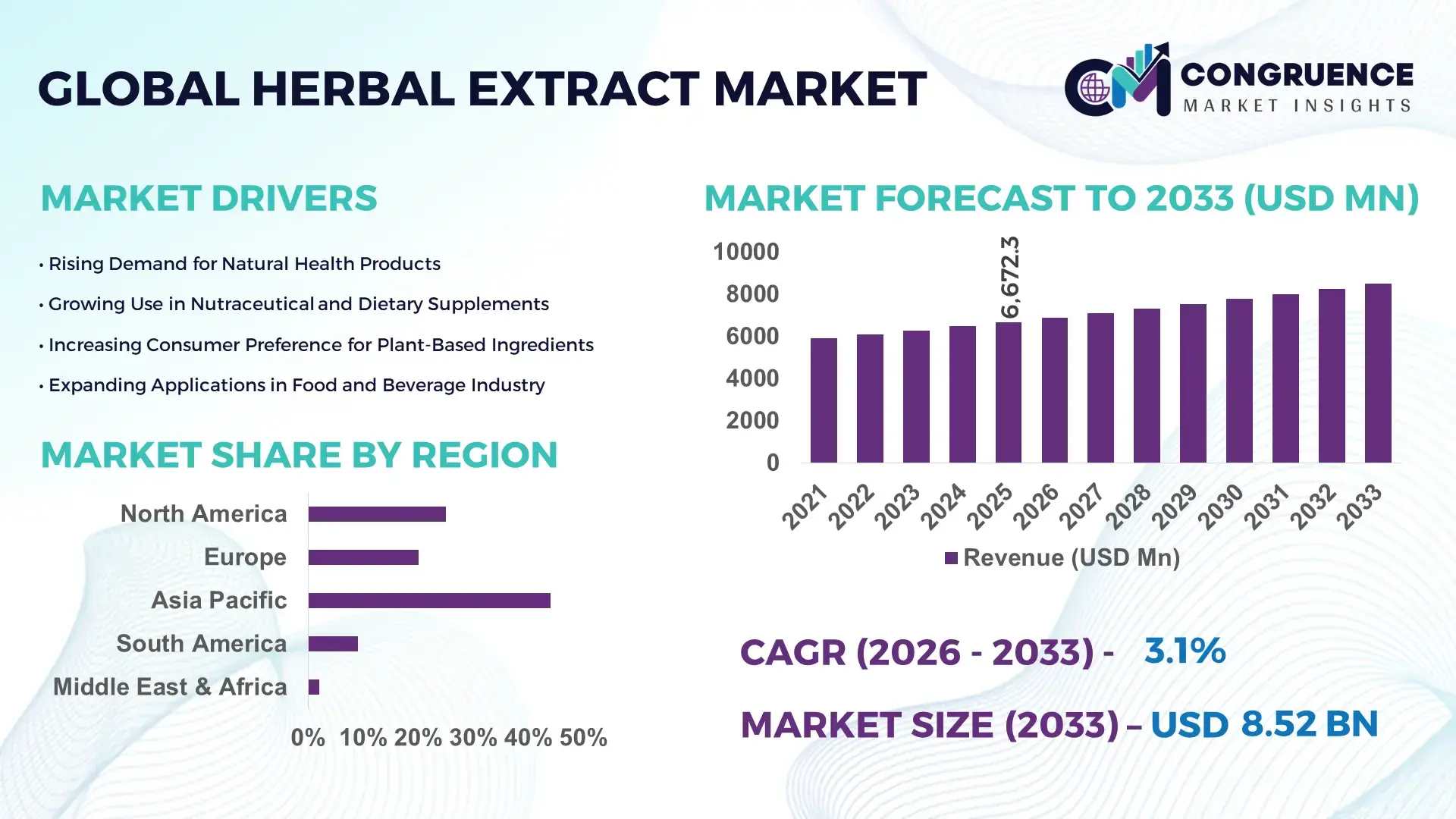
The Global Herbal Extract Market was valued at USD 6,672.31 Million in 2025 and is anticipated to reach a value of USD 8,518.15 Million by 2033 expanding at a CAGR of 3.1% between 2026 and 2033. Rising consumer preference for plant-based ingredients in pharmaceuticals, nutraceuticals, cosmetics, and functional foods is a major factor accelerating demand for herbal extract formulations worldwide.
China maintains one of the largest herbal extract processing bases with over 3,000 botanical extraction facilities and annual herbal raw material production exceeding 4 million tons. More than 65% of herbal extracts produced are utilized in pharmaceuticals, nutraceutical supplements, and traditional medicine applications across Asia and Europe.
• Market Size & Growth: The global Herbal Extract Market reached USD 6672.31 million in 2025 and is forecast to grow to USD 8518.15 million by 2033 with a CAGR of 3.1%, supported by increasing demand for plant-based pharmaceuticals, botanical nutraceuticals, and natural cosmetic ingredients.
• Top Growth Drivers: Natural product adoption in healthcare products (58%), consumer shift toward organic ingredients (47%), and rising functional food consumption (41%).
• Short-Term Forecast: By 2028, advanced botanical extraction processes are expected to reduce processing costs by nearly 18% while improving active compound concentration efficiency by about 22%.
• Emerging Technologies: Supercritical CO₂ extraction, ultrasound-assisted extraction, and enzyme-based bio-extraction technologies are improving purity levels and increasing phytochemical yield across commercial herbal extraction operations.
• Regional Leaders: Asia Pacific projected to exceed USD 3300 million by 2033 driven by traditional medicine demand; North America expected to surpass USD 2100 million with strong nutraceutical consumption; Europe likely to reach USD 1700 million supported by herbal cosmetic product adoption.
• Consumer/End-User Trends: Nutraceutical manufacturers account for nearly 42% of herbal extract consumption, followed by pharmaceutical applications at 34% and personal care formulations representing approximately 18% of total demand.
• Pilot or Case Example: In 2024, a botanical extraction facility in India deployed automated phytochemical separation technology that improved extraction efficiency by 26% while reducing solvent usage by 19%.
• Competitive Landscape: The leading manufacturer holds approximately 14% of the global herbal extract market share, followed by major competitors including Naturex, Martin Bauer Group, Indena, and Sabinsa.
• Regulatory & ESG Impact: Governments across Europe and North America are implementing botanical traceability standards and sustainability certifications requiring up to 30% reduction in chemical solvent usage in herbal extraction processes by 2030.
• Investment & Funding Patterns: More than USD 1.2 billion has been invested globally since 2023 in botanical processing facilities, sustainable cultivation projects, and advanced extraction technologies supporting large-scale herbal ingredient manufacturing.
• Innovation & Future Outlook: Increasing integration of precision extraction systems, AI-assisted phytochemical analysis, and sustainable plant cultivation practices are expected to drive the next generation of high-purity herbal extract products across healthcare, food, and cosmetic sectors.
Pharmaceutical applications account for nearly 34% of herbal extract utilization, while nutraceutical products contribute around 38% of consumption globally. Recent innovations in solvent-free extraction technologies and bioactive compound standardization are improving product consistency, regulatory compliance, and expanding the use of herbal extracts in advanced functional foods and therapeutic formulations.
The Herbal Extract Market plays a strategic role in supporting the global shift toward natural health products, plant-based pharmaceuticals, and sustainable cosmetic ingredients. Botanical extracts are increasingly integrated into functional foods, nutraceuticals, and herbal medicines, with more than 60% of new dietary supplement formulations incorporating plant-derived active compounds. Advanced extraction technologies are enabling higher purity and stronger bioactive concentration for pharmaceutical and clinical applications.
Supercritical CO₂ extraction delivers nearly 32% higher phytochemical yield compared to conventional solvent extraction, improving efficiency and product safety in large-scale herbal extract manufacturing. Asia Pacific dominates in production volume due to extensive medicinal plant cultivation, while North America leads in adoption with nearly 48% of nutraceutical companies incorporating standardized herbal extracts into commercial formulations.
By 2028, AI-assisted phytochemical analysis and automated extraction monitoring are expected to improve active ingredient consistency by nearly 25% across industrial herbal extraction facilities. Firms are committing to sustainability initiatives such as 40% reduction in chemical solvents and increased recyclable processing systems by 2030. In 2024, an Indian botanical manufacturer implemented automated supercritical extraction technology that improved extraction efficiency by 28% while lowering solvent consumption by 21%. These advancements position the Herbal Extract Market as a critical pillar of resilience, regulatory compliance, and sustainable growth across global healthcare and natural ingredient industries.
The Herbal Extract Market is experiencing steady expansion driven by increasing consumer demand for plant-based health products and natural ingredients in pharmaceuticals, nutraceuticals, and cosmetics. Rising global awareness regarding preventive healthcare, combined with growing functional food consumption, is strengthening market demand. Advances in botanical extraction technology, expanding medicinal plant cultivation, and regulatory support for herbal medicines are further shaping the competitive and technological landscape of the Herbal Extract industry.
Growing consumer preference for natural dietary supplements is significantly boosting the demand for herbal extract ingredients. More than 55% of global consumers now prefer plant-based wellness products due to perceived safety and health benefits. Nutraceutical manufacturers increasingly incorporate botanical extracts such as ginseng, turmeric, and green tea into functional products. The global dietary supplement sector recorded more than 420 million regular users in 2024, driving large-scale demand for standardized herbal extract formulations used in capsules, powders, beverages, and therapeutic nutrition products.
Variability in medicinal plant cultivation and harvesting conditions creates challenges in maintaining consistent phytochemical content in herbal extracts. Climate changes, soil conditions, and farming practices can cause fluctuations in active compound concentration by up to 30%. This inconsistency increases quality control costs for manufacturers and complicates regulatory compliance for pharmaceutical-grade herbal extracts. Additionally, the limited availability of certified organic medicinal plants and complex global supply chains further restrict stable production capacity in several botanical ingredient markets.
The growing global functional food sector is creating significant opportunities for herbal extract manufacturers. More than 38% of new health beverages and fortified food products introduced in 2024 incorporated botanical ingredients such as turmeric, ginger, and elderberry extracts. Food manufacturers are increasingly integrating plant-based antioxidants, adaptogens, and immunity-boosting phytochemicals into packaged foods and beverages. The expansion of herbal ingredients in sports nutrition products, herbal teas, and wellness beverages is opening new large-scale commercial applications for standardized herbal extracts.
Regulatory compliance for herbal extract products remains complex across major markets due to varying safety, labeling, and quality standards. Pharmaceutical-grade botanical extracts must meet strict clinical validation and purity benchmarks. In the European Union, more than 1,200 herbal ingredients require detailed safety documentation under traditional herbal medicinal product directives. Meeting these regulatory requirements increases product development timelines and testing costs for manufacturers seeking approval for new herbal extract formulations in pharmaceutical and nutraceutical markets.
• Rising Demand for Standardized Botanical Extracts: Pharmaceutical and nutraceutical manufacturers are increasingly prioritizing standardized herbal extracts to ensure consistent bioactive compound levels. Nearly 62% of herbal supplement manufacturers adopted standardized plant extract formulations in 2024, while over 48% of new botanical products launched globally included quantified active phytochemical concentrations such as curcuminoids, flavonoids, or ginsenosides.
• Expansion of Sustainable Cultivation Practices: Sustainable medicinal plant farming is gaining traction as companies address supply chain risks and environmental concerns. Around 44% of herbal raw material suppliers introduced certified organic cultivation programs in 2024, while sustainable farming initiatives improved medicinal plant yield by approximately 19% through optimized soil and water management techniques across Asia and Latin America.
• Integration of Advanced Extraction Technologies: Advanced extraction technologies are improving efficiency and purity levels in herbal extract production. More than 38% of new processing facilities installed supercritical CO₂ extraction systems, increasing phytochemical recovery rates by nearly 27% and reducing solvent usage by approximately 21% compared to conventional ethanol extraction methods.
• Growth in Functional Food and Beverage Applications: Herbal extracts are increasingly incorporated into functional foods and wellness beverages targeting immunity and digestive health. Nearly 36% of new functional beverage products introduced in 2024 contained botanical extracts such as ginger, turmeric, and elderberry, while herbal ingredient usage in fortified food products increased by approximately 24% across global health-focused consumer markets.
The Herbal Extract Market is segmented by type, application, and end-user industries. Liquid extracts account for significant demand due to their higher absorption rates and widespread use in pharmaceuticals and nutraceuticals. Powdered herbal extracts are widely utilized in functional foods and dietary supplements. Pharmaceutical applications represent the largest demand segment, while nutraceutical and personal care industries show expanding adoption. Key end-users include pharmaceutical companies, food manufacturers, and cosmetic product developers integrating plant-based ingredients into advanced formulations and wellness products.
Liquid herbal extracts currently account for nearly 46% of market adoption due to their rapid absorption properties and extensive use in pharmaceutical tinctures and nutraceutical syrups. Powdered extracts hold approximately 34% share and remain widely used in dietary supplements and functional food formulations. However, standardized dry extracts are the fastest-growing type, expanding at an estimated CAGR of 4.6% as pharmaceutical companies increasingly demand consistent phytochemical concentrations for therapeutic applications. Other extract types, including semi-solid and oil-based herbal concentrates, collectively contribute around 20% of the market and are primarily used in cosmetic formulations and aromatherapy products.
Pharmaceutical applications dominate the Herbal Extract Market with approximately 41% adoption, driven by increasing integration of botanical compounds into herbal medicines and plant-based therapeutic products. Nutraceutical applications account for nearly 33% of the market as dietary supplement manufacturers expand herbal ingredient usage in immunity and wellness products. Functional food and beverage applications represent the fastest-growing segment with an estimated CAGR of 5.2%, supported by increasing consumer demand for natural ingredients in fortified beverages, herbal teas, and plant-based health foods. Other applications, including personal care and cosmetic formulations, collectively account for nearly 26% of the market.
Pharmaceutical companies represent the leading end-user segment, accounting for nearly 39% of the Herbal Extract Market due to the widespread use of botanical ingredients in traditional medicine and modern plant-based therapeutic products. Nutraceutical manufacturers follow with approximately 31% adoption as global demand for herbal dietary supplements continues to expand. Food and beverage manufacturers are the fastest-growing end-user segment with an estimated CAGR of 5.6%, driven by increasing use of herbal extracts in functional beverages, herbal teas, and fortified nutrition products. Cosmetic and personal care companies collectively contribute around 30% of demand through natural skincare and plant-based beauty formulations.
Asia Pacific accounted for the largest market share at 44% in 2025 however, Region North America is expected to register the fastest growth, expanding at a CAGR of 4.3% between 2026 and 2033.
Asia Pacific processes over 5 million tons of medicinal plants annually, while China and India together contribute nearly 58% of global botanical raw material supply. North America represents about 26% of global herbal extract consumption, driven by nutraceutical demand, while Europe holds approximately 22%. Functional food applications account for nearly 35% of regional usage, and pharmaceutical applications exceed 40% across Asia Pacific and Europe.
How is the growing demand for botanical supplements transforming regional industry dynamics?
North America accounts for approximately 26% of the global Herbal Extract Market, supported by strong demand from pharmaceutical, nutraceutical, and functional beverage industries. The United States dominates regional consumption, representing nearly 78% of total demand, followed by Canada at around 15%. The dietary supplement sector alone uses more than 42% of herbal extract supply in the region. Government regulations emphasizing botanical product safety and labeling standards have increased product transparency and quality assurance across the industry. Advanced extraction technologies, including supercritical CO₂ processing and automated phytochemical analysis systems, are being adopted by nearly 33% of botanical processing facilities to improve purity levels. A regional botanical manufacturer expanded its standardized turmeric extract production capacity by 25% in 2024 to meet growing demand from supplement companies. Consumer behavior shows high adoption of herbal wellness products, with nearly 60% of adults regularly using plant-based dietary supplements.
What regulatory and sustainability factors are shaping botanical ingredient adoption?
Europe holds approximately 22% share of the global Herbal Extract Market, driven by strong pharmaceutical and cosmetic industry demand. Germany, the United Kingdom, and France collectively account for nearly 64% of regional herbal extract consumption. Botanical extracts are widely used in herbal medicines, natural skincare products, and functional foods. Strict regulatory frameworks governing botanical ingredients have strengthened product safety and traceability across the region. Sustainability initiatives encouraging organic cultivation and environmentally responsible extraction methods have increased adoption of solvent-free extraction technologies by nearly 28% of processing facilities. A leading European botanical ingredient producer expanded its herbal extraction facility in Germany to increase capacity for standardized plant extracts used in pharmaceutical formulations. Consumer preferences favor certified natural and organic ingredients, with nearly 52% of herbal supplement buyers prioritizing eco-labeled botanical products.
What factors are driving large-scale botanical production and consumption growth?
Asia Pacific represents the largest volume market for herbal extracts, contributing nearly 44% of global consumption. China, India, and Japan are the leading producers and consumers, collectively accounting for over 70% of regional herbal extract demand. More than 4,000 botanical processing facilities operate across the region, supported by extensive medicinal plant cultivation networks. China processes nearly 3 million tons of medicinal plants annually, while India cultivates over 1,200 species used in traditional medicine formulations. The region is also witnessing rapid adoption of advanced botanical processing technologies including ultrasound-assisted extraction and automated phytochemical testing. A Chinese botanical manufacturer expanded its extraction plant capacity by 30% to support increasing exports of ginseng and green tea extracts. Consumer behavior is strongly influenced by traditional medicine practices, with nearly 65% of households regularly using herbal remedies.
How are biodiversity resources supporting botanical ingredient development?
South America accounts for approximately 5% of the global Herbal Extract Market, with Brazil and Argentina representing nearly 72% of regional consumption. The region benefits from rich biodiversity, supporting cultivation of medicinal plants such as guarana, maca, and yerba mate used in nutraceutical and functional beverage products. Brazil alone produces more than 200,000 tons of botanical raw materials annually for herbal ingredient processing. Government incentives supporting sustainable forest-based agriculture and medicinal plant cultivation have increased commercial farming activities by nearly 18% since 2023. Local botanical ingredient companies are expanding processing facilities to meet rising export demand for natural plant extracts. Regional consumer behavior shows strong interest in herbal energy drinks and plant-based wellness products, with nearly 39% of consumers purchasing botanical supplement products regularly.
How is modernization of healthcare and natural wellness trends shaping demand?
The Middle East & Africa region accounts for approximately 3% of the global Herbal Extract Market but shows increasing demand for botanical healthcare products and natural cosmetic ingredients. The United Arab Emirates and South Africa represent nearly 58% of regional consumption. Growing healthcare investments and wellness tourism are supporting the adoption of herbal ingredients in pharmaceuticals and spa-based therapeutic products. Several countries are promoting medicinal plant cultivation and herbal product manufacturing through agricultural diversification initiatives. Technological modernization in botanical processing facilities has improved extraction efficiency by nearly 17% across new manufacturing plants. A South African botanical ingredient producer recently expanded cultivation of rooibos plants to support rising export demand for herbal tea extracts. Consumer demand is strongly influenced by traditional remedies, with approximately 46% of households using plant-based health products.
• China – 28% market share: China leads the Herbal Extract Market due to extensive medicinal plant cultivation, more than 3,000 botanical processing facilities, and strong demand from traditional medicine and nutraceutical industries.
• United States – 21% market share: The United States dominates the Herbal Extract Market in North America driven by high consumer adoption of dietary supplements, advanced extraction technologies, and strong pharmaceutical and nutraceutical product innovation.
The Herbal Extract Market remains moderately fragmented with more than 350 active global manufacturers and ingredient suppliers operating across pharmaceutical, nutraceutical, and cosmetic supply chains. The top five companies collectively account for approximately 32% of the market, reflecting strong competition and diversified product portfolios. Leading players focus heavily on standardized botanical extracts, advanced extraction technologies, and sustainable medicinal plant sourcing. Strategic initiatives such as facility expansions, partnerships with nutraceutical manufacturers, and new product launches have increased significantly, with more than 70 new herbal extract product formulations introduced globally during 2024 alone. Companies are also investing in AI-assisted phytochemical analysis systems and solvent-free extraction methods to improve quality control and operational efficiency, strengthening their competitive positioning in high-value pharmaceutical and nutraceutical applications.
Naturex
Martin Bauer Group
Indena
Sabinsa Corporation
Bio-Botanica Inc.
Givaudan Active Beauty
Hunan Nutramax Inc.
Xi'an Greena Biotech Co., Ltd.
Shaanxi Jiahe Phytochem Co., Ltd.
Vidya Herbs Pvt. Ltd.
Arjuna Natural Pvt. Ltd.
Herbal Creations LLC
Plant Extracts International Inc.
Nexira
Organic Herb Inc.
Technological advancements in extraction and processing are significantly transforming the Herbal Extract Market by improving efficiency, purity, and scalability of botanical ingredient production. Supercritical CO₂ extraction technology has become widely adopted due to its ability to isolate high-purity phytochemicals while reducing solvent residues. Nearly 38% of modern botanical processing plants now utilize supercritical extraction units capable of improving active compound recovery by up to 25% compared to traditional solvent-based methods.
Ultrasound-assisted extraction (UAE) and microwave-assisted extraction (MAE) technologies are gaining traction in research laboratories and industrial facilities. UAE can reduce extraction time by nearly 30% while improving phytochemical yield by approximately 20%, making it increasingly attractive for nutraceutical and pharmaceutical ingredient manufacturers.
Automation and digital monitoring systems are also reshaping production facilities. Around 32% of new herbal processing plants now integrate automated chromatography and spectroscopic analysis systems to ensure consistent concentrations of key bioactive compounds such as flavonoids, alkaloids, and polyphenols. In addition, spray-drying and nano-encapsulation technologies are improving the stability and bioavailability of herbal extract powders used in dietary supplements and functional foods. Artificial intelligence-driven phytochemical analysis platforms are emerging as a new frontier, enabling rapid screening of plant compounds and accelerating botanical product development across pharmaceutical and nutraceutical industries.
• In March 2025, Indena announced the expansion of its botanical extraction facility in Settala, Italy, increasing production capacity for standardized plant extracts used in pharmaceutical and nutraceutical products. The upgrade includes advanced purification systems designed to improve phytochemical consistency and manufacturing efficiency. Source: www.indena.com
• In October 2024, Givaudan completed the acquisition of a majority stake in a botanical ingredients business specializing in plant extracts used in beauty and wellness products. The move strengthens its active beauty portfolio and expands access to natural ingredient technologies used in cosmetic and personal care formulations.
• In May 2024, Arjuna Natural launched a new turmeric-derived botanical extract formulated for cardiovascular and metabolic health applications. The product utilizes enhanced extraction and purification techniques to deliver higher concentrations of bioactive curcuminoids for nutraceutical and functional food manufacturers. Source: www.arjunanatural.com
• In January 2025, Nexira expanded its natural ingredient production facility in France to increase capacity for plant-based extracts used in functional foods and dietary supplements. The expansion supports rising demand for botanical ingredients in clean-label nutrition products and wellness formulations.
The Herbal Extract Market Report provides a comprehensive analysis of global industry dynamics, covering more than 20 major plant-derived extract categories including turmeric, ginseng, green tea, echinacea, and garlic extracts. The report evaluates over 35 product types such as liquid extracts, powdered extracts, standardized botanical concentrates, and essential oil-based derivatives used across pharmaceutical, nutraceutical, cosmetic, and functional food applications.
Geographically, the study assesses market activity across five major regions and more than 25 key countries, analyzing production hubs, medicinal plant cultivation capacity, and regional consumption patterns. The report also evaluates technological innovations in botanical processing including supercritical CO₂ extraction, ultrasound-assisted extraction, nano-encapsulation, and advanced phytochemical standardization techniques.
Industry analysis includes more than 300 active manufacturers and ingredient suppliers operating across the botanical supply chain. The report also examines regulatory frameworks affecting herbal ingredients, emerging plant-based wellness products, and the integration of herbal extracts into modern pharmaceutical and nutraceutical formulations, offering strategic insights for manufacturers, investors, and industry stakeholders.
| Report Attribute/Metric | Report Details |
|---|---|
|
Market Revenue in 2025 |
USD V2025 Million |
|
Market Revenue in 2033 |
USD V2033 Million |
|
CAGR (2026 - 2033) |
3.1% |
|
Base Year |
2025 |
|
Forecast Period |
2026 - 2033 |
|
Historic Period |
2021 - 2025 |
|
Segments Covered |
By Types
By Application
By End-User
|
|
Key Report Deliverable |
Revenue Forecast, Growth Trends, Market Dynamics, Segmental Overview, Regional and Country-wise Analysis, Competition Landscape |
|
Region Covered |
North America, Europe, Asia-Pacific, South America, Middle East, Africa |
|
Key Players Analyzed |
Naturex, Martin Bauer Group, Indena, Sabinsa Corporation, Bio-Botanica Inc., Givaudan Active Beauty, Hunan Nutramax Inc., Xi'an Greena Biotech Co., Ltd., Shaanxi Jiahe Phytochem Co., Ltd., Vidya Herbs Pvt. Ltd., Arjuna Natural Pvt. Ltd., Herbal Creations LLC, Plant Extracts International Inc., Nexira, Organic Herb Inc. |
|
Customization & Pricing |
Available on Request (10% Customization is Free) |




