
Reports
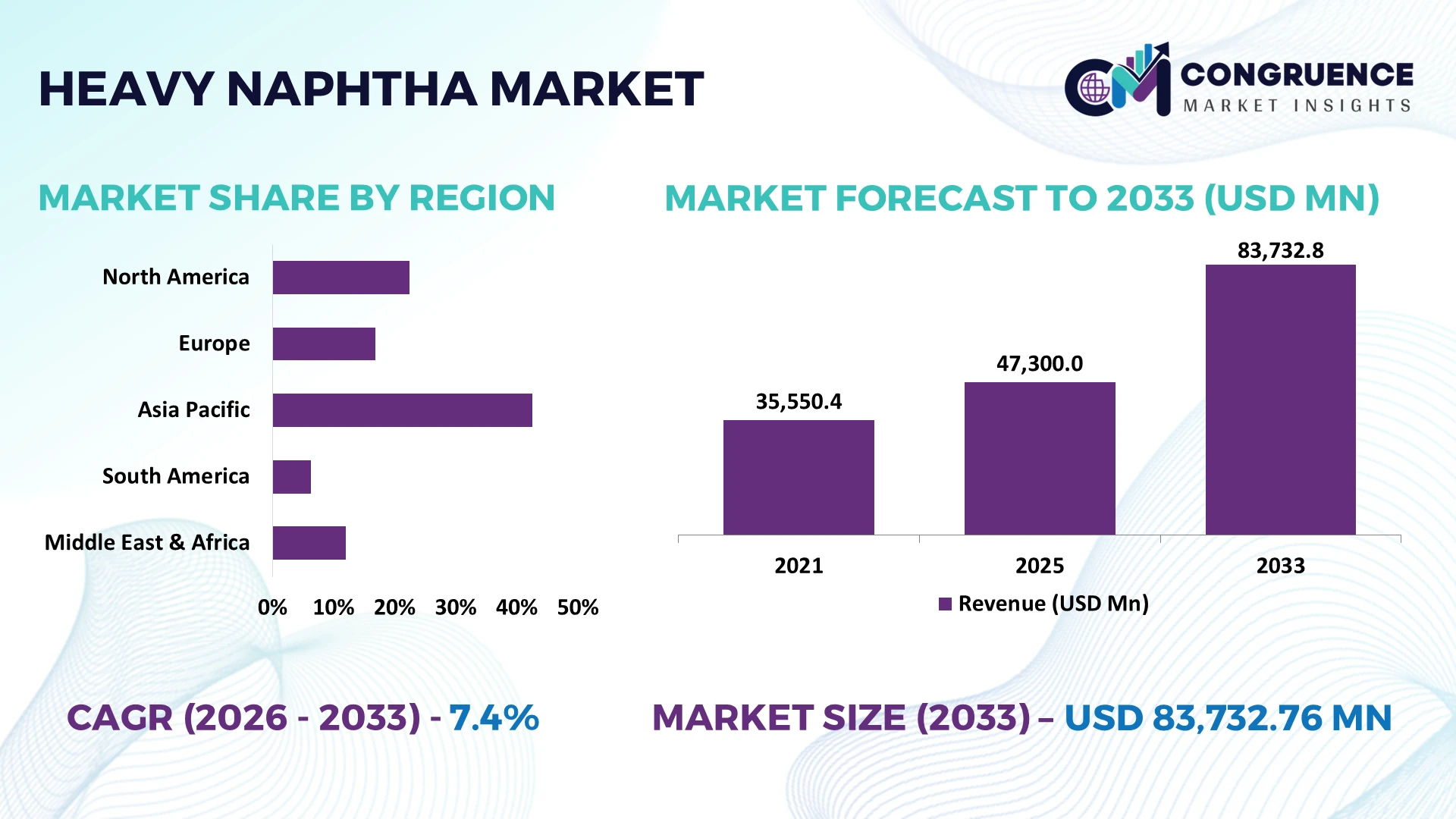
The Global Heavy Naphtha Market was valued at USD 47,300.0 Million in 2025 and is anticipated to reach a value of USD 83,732.8 Million by 2033 expanding at a CAGR of 7.4% between 2026 and 2033. Expanding aromatic hydrocarbon production, integrated refinery-petrochemical complexes, and increasing catalytic reforming requirements for high-octane gasoline are accelerating heavy naphtha consumption.
China dominates heavy naphtha consumption, supported by its extensive refining infrastructure and downstream petrochemical manufacturing capabilities. The country possesses approximately 18 million barrels per day of refining capacity, compared with India's approximately 5.2 million barrels per day. China's refining infrastructure represents around 17% of global capacity, while investments in integrated petrochemical complexes and Middle Eastern feedstock partnerships strengthen domestic aromatic production capabilities.
Securing diversified feedstock supplies and integrating catalytic reforming with downstream aromatic production will determine long-term profitability and competitive positioning.
Market Size & Growth: USD 47,300.0 Million in 2025, reaching USD 83,732.8 Million by 2033 at 7.4% CAGR, driven by petrochemical integration.
Top Growth Drivers: Aromatic production (42%), gasoline blending (35%), and petrochemical feedstock requirements (23%), based on indicative driver weightings.
Short-Term Forecast: By 2028, advanced process optimization targets 5–8% improvements in reforming energy efficiency.
Emerging Technologies: AI-enabled process control, continuous catalyst regeneration, and advanced hydroprocessing target 3–5% yield improvements.
Regional Leaders: Indicative 2033 projections include Asia Pacific (USD 38,517.1 Million; petrochemical integration), North America (USD 17,583.9 Million; refinery modernization), and Europe (USD 12,559.9 Million; cleaner processing).
Consumer/End-User Trends: Refineries and petrochemical manufacturers represent an estimated 80% of industrial consumption.
Pilot/Case Example: Saudi Aramco's 2024 crude-to-chemicals technology development targets conversion of approximately 70% of crude into chemicals.
Competitive Landscape: Saudi Aramco holds an indicative 12% share, competing with Sinopec, ExxonMobil, Shell, and Reliance Industries.
Regulatory & ESG Impact: IMO regulations reduced permissible marine fuel sulfur content from 3.5% to 0.5%, influencing refinery configurations.
Investment & Funding: Saudi Aramco's USD 7 Billion Shaheen project strengthens integrated petrochemical production.
Innovation & Future Outlook: Advanced reforming catalysts and digital optimization target 5–10% operational efficiency improvements, prioritizing higher-value chemical production.
The Heavy Naphtha Market serves catalytic reforming, aromatic extraction, gasoline blending, and petrochemical manufacturing applications. Continuous catalyst regeneration and advanced hydrotreating technologies support higher product purity and operational reliability. Modern catalytic reforming units can achieve liquid product yields exceeding 80%, depending on feedstock characteristics. Expanding Middle Eastern refinery-petrochemical integration is redirecting feedstock allocation toward higher-value chemical production, reinforcing the market's strategic importance.
Heavy naphtha is becoming a strategic intermediary connecting petroleum refining with high-value petrochemical manufacturing, enabling refiners to diversify beyond conventional transportation fuels. Increasing benzene, toluene, and xylene requirements are reshaping refinery configurations, particularly in China, Saudi Arabia, and India. Integrated manufacturing facilities are prioritizing chemical conversion capabilities as vehicle electrification gradually alters long-term gasoline consumption patterns.
Continuous catalyst regeneration technology enables uninterrupted catalyst reactivation, unlike conventional semi-regenerative reforming systems requiring periodic shutdowns. Advanced reforming configurations target 5–10% improvements in operational efficiency, depending on plant design. China emphasizes large-scale aromatic production, whereas the United States prioritizes refinery optimization and high-octane blending. Through 2028–2029, modernization projects are expected to target 3–5% reductions in specific energy consumption through advanced process control.
Saudi Aramco's Shaheen project in South Korea demonstrates the transition toward integrated refining and chemical production, with planned ethylene capacity of approximately 1.8 million tonnes annually. Companies are redirecting capital toward feedstock flexibility, advanced catalysts, and downstream manufacturing partnerships. Competitive advantage increasingly depends on maximizing chemical conversion yields, securing reliable crude supplies, and maintaining flexible production configurations capable of responding to changing fuel and petrochemical demand.
Increasing demand for benzene, toluene, and xylenes is strengthening heavy naphtha utilization across integrated refining and petrochemical facilities. Approximately 65–70% of global paraxylene consumption is associated with polyester fiber production, while PET packaging represents another major downstream application. Modern catalytic reforming units can achieve liquid product yields exceeding 80%, supporting commercially attractive aromatic recovery. China's expansion of integrated refining complexes is increasing domestic feedstock conversion capabilities and reducing dependence on imported aromatic intermediates. Sinopec, Reliance Industries, and Saudi Aramco are strengthening downstream integration through capacity expansion and manufacturing partnerships. Direct integration allows refiners to capture additional chemical processing margins while reducing intermediary transportation and procurement costs.
Heavy naphtha profitability remains exposed to crude oil price fluctuations, variable refining margins, and competition from alternative petrochemical feedstocks. Brent crude's average annual price declined approximately 18% between 2022 and 2023, illustrating substantial feedstock pricing exposure. Naphtha-based steam cracking typically delivers ethylene yields of approximately 25–35%, compared with around 75–80% for ethane-based configurations. Abundant natural gas liquids in the United States strengthen cost competition from ethane-based producers, particularly during periods of elevated crude prices. Refiners are mitigating exposure through diversified procurement contracts, flexible feedstock configurations, and integrated aromatic production. Heavy naphtha's economic advantage increasingly depends on monetizing multiple coproduct streams rather than competing solely on ethylene production costs.
Emerging crude-to-chemicals technologies and circular petrochemical feedstocks create opportunities for higher-value heavy naphtha processing. Advanced crude-to-chemicals configurations target chemical conversion rates approaching 70%, compared with approximately 10–20% in conventional fuel-oriented refinery configurations. The European Union's packaging regulations establish a 30% recycled-content requirement for specified PET contact-sensitive packaging categories by 2030, encouraging alternative hydrocarbon feedstock development. Companies including Shell, BASF, and Saudi Aramco are investing in chemical recycling, advanced conversion technologies, and integrated processing infrastructure. Heavy naphtha-compatible facilities equipped with advanced purification systems gain opportunities to process selected recycled hydrocarbon streams. Feedstock flexibility creates additional commercial value through diversified sourcing and access to circular chemical supply chains.
Reducing emissions from catalytic reforming, hydrotreating, and associated hydrogen production presents a long-term execution challenge for heavy naphtha processors. Conventional fossil-based pathways account for more than 95% of global hydrogen production, creating substantial upstream emissions exposure. The European Union's emissions reduction target of at least 55% by 2030 intensifies pressure on energy-intensive refining operations. Advanced heat integration and process optimization projects target 5–10% reductions in specific energy consumption, although implementation requires significant infrastructure modifications. Refiners are investing in lower-emission hydrogen, electrified process heating, and advanced energy management systems. Maintaining catalyst performance, feedstock purity, and uninterrupted production during infrastructure upgrades remains essential to protecting processing margins and long-term operational competitiveness.
Feedstock Procurement Diversification: Asian refiners are restructuring heavy naphtha procurement as geopolitical disruptions increase supply uncertainty. Russia historically supplied approximately 20% of Europe's naphtha imports before sanctions, while the Strait of Hormuz handles around 20% of global petroleum liquids consumption. Japanese and South Korean refiners are diversifying suppliers and strengthening long-term procurement arrangements to maintain operational continuity.
Digital Refinery Quality Management: Refineries are deploying online composition analyzers and advanced process control to manage feedstock variability. Heavy naphtha typically contains hydrocarbons within the C7–C12 range, while digital optimization targets 3–5% reductions in off-specification production. Honeywell and Yokogawa are expanding automated monitoring solutions, enabling faster feedstock qualification and more consistent reformer performance.
Flexible Refinery Product Allocation: Changing transportation fuel consumption is encouraging refiners to adjust heavy naphtha allocation between gasoline blending and chemical processing. Global electric car sales exceeded 17 million units in 2024, representing over 20% of new car sales. Chinese refiners are adopting flexible production scheduling to protect margins against changing gasoline demand patterns.
Specialized Feedstock Quality Differentiation: Petrochemical buyers are increasingly specifying narrow boiling ranges, sulfur concentrations, and hydrocarbon composition. Heavy naphtha generally distills between approximately 90°C and 200°C, while reformer feed sulfur specifications frequently remain below 1 ppm. Suppliers are expanding customized fractionation and quality certification capabilities, strengthening pricing differentiation and reducing downstream catalyst contamination risks.
Straight Run Heavy Naphtha represents the leading product type, accounting for an estimated 48.5% of the market in 2025. Its dominance reflects extensive availability from conventional crude distillation, established refinery infrastructure, and compatibility with catalytic reforming applications. Straight run grades offer relatively predictable hydrocarbon composition compared with cracked feedstocks, supporting consistent downstream processing. Large integrated refineries operated by Sinopec, Saudi Aramco, and Reliance Industries utilize these grades extensively for gasoline component manufacturing and aromatic production, reinforcing their established commercial position.
Hydrotreated Heavy Naphtha represents the projected fastest-growing segment, accounting for an estimated 34.0% of market demand. Advanced hydrotreating processes can remove more than 99% of sulfur contaminants under suitable operating conditions, improving reforming catalyst performance. Cracked Heavy Naphtha remains commercially significant through its availability from catalytic cracking, hydrocracking, and coking operations, although additional purification requirements influence processing economics. Refiners are prioritizing hydrotreating capacity upgrades, selective fractionation, and feedstock quality optimization to strengthen product differentiation and downstream compatibility.
Catalytic Reforming represents the leading application, accounting for an estimated 38.5% of heavy naphtha consumption in 2025. Its dominant position reflects the extensive deployment of reforming units for producing high-octane reformate and aromatic hydrocarbons. Modern catalytic reforming processes typically achieve liquid product yields of approximately 80–90%, depending on feedstock composition and operating severity. Gasoline Blending remains an established application, supported by fuel quality requirements, while Hydrogen Production benefits from hydrogen generated as a catalytic reforming byproduct for refinery hydrotreating operations.
Aromatics Production represents the projected fastest-growing application, supported by expanding benzene, toluene, and xylene manufacturing capabilities in China and India. Petrochemical Feedstock applications account for an estimated 24.5% of consumption, reflecting demand from integrated chemical manufacturing facilities. Industrial Solvents maintain specialized demand across coatings, adhesives, and chemical processing applications requiring controlled hydrocarbon composition. Companies including Sinopec, ExxonMobil, and Saudi Aramco are expanding reforming capabilities, optimizing aromatic recovery systems, and restructuring feedstock allocation to prioritize higher-value industrial applications.
Petroleum Refining represents the leading end-user segment, accounting for an estimated 45.5% of heavy naphtha demand in 2025. Established crude distillation, hydrotreating, and catalytic reforming infrastructure supports continuous feedstock consumption across large-scale refining operations. Heavy naphtha serves as a critical intermediate for producing high-octane reformate, aromatic hydrocarbons, and refinery hydrogen. Integrated refining complexes benefit from internal feedstock transfers, reducing external procurement requirements and logistical exposure. Companies including Saudi Aramco, Indian Oil Corporation, and Reliance Industries maintain substantial processing capabilities supporting this segment's dominance.
The Petrochemical Industry represents the projected fastest-growing end-user segment, holding an estimated 32.5% market share. Expanding aromatic extraction and downstream polymer manufacturing are encouraging direct procurement agreements and integrated processing partnerships. Chemical Manufacturing companies require specialized heavy naphtha grades for solvent production and chemical synthesis, while Fuel Production remains dependent on reformate availability and gasoline quality requirements. Refiners and chemical manufacturers are strengthening long-term supply contracts, customized feedstock specifications, and integrated manufacturing arrangements to improve production reliability and reduce intermediate handling costs.
Asia Pacific accounted for the largest market share at 42.5% in 2025 however, North America is expected to register the fastest growth, expanding at a CAGR of 8.6% between 2026 and 2033.

North America accounted for 22.4% of the global Heavy Naphtha Market in 2025, supported by extensive petroleum refining infrastructure, advanced catalytic reforming capabilities, and established petrochemical manufacturing operations. The United States and Canada maintain substantial crude processing capacities, enabling consistent heavy naphtha production for gasoline blending and aromatic manufacturing. North American refiners are prioritizing feedstock optimization, automated process monitoring, and selective refinery modernization to improve processing margins. ExxonMobil's Beaumont refinery expansion added approximately 250,000 barrels per day of crude processing capacity, strengthening regional intermediate feedstock availability. Competition from ethane-based petrochemical production encourages heavy naphtha suppliers to prioritize aromatic recovery and high-octane reformate applications. Integrated manufacturing facilities along the U.S. Gulf Coast benefit from established pipeline networks, storage terminals, and export infrastructure, supporting efficient domestic distribution and international feedstock supply.
United States Market Outlook: The United States dominates North American heavy naphtha processing through approximately 18.4 million barrels per day of operable crude distillation capacity in early 2025. Established catalytic reforming infrastructure across Texas and Louisiana supports high-octane gasoline manufacturing and aromatic recovery. ExxonMobil, Chevron, and Marathon Petroleum are prioritizing refinery reliability, feedstock flexibility, and processing efficiency to maintain competitiveness against alternative hydrocarbon feedstocks.
Europe accounted for 16.8% of the global Heavy Naphtha Market in 2025, supported by established chemical manufacturing clusters, sophisticated refining infrastructure, and specialized aromatic production facilities. Germany, the Netherlands, Belgium, and France represent important consumption centers for catalytic reforming and downstream chemical processing. Restrictions on Russian petroleum product imports have accelerated procurement diversification, encouraging European refiners to strengthen supply relationships with Middle Eastern and American producers. Meanwhile, INEOS's Project ONE in Antwerp incorporates approximately 1.45 million tonnes of annual ethylene production capacity using ethane, intensifying competition against conventional naphtha-based cracking operations. European refiners are responding through selective capacity restructuring, advanced feedstock purification, and greater emphasis on specialty chemical intermediates. Regulatory pressure and elevated industrial energy costs are reinforcing investment priorities around processing efficiency, product differentiation, and higher-value aromatic recovery.
Germany Market Outlook: Germany maintains a strategically significant position through its integrated chemical manufacturing infrastructure and extensive industrial demand for aromatic hydrocarbons. The country possesses approximately 2 million barrels per day of petroleum refining capacity. Chemical manufacturing clusters in Ludwigshafen, Leuna, and the Rhine-Ruhr industrial corridor support specialized feedstock consumption, while manufacturers prioritize procurement reliability and energy-efficient processing to address elevated operating costs.
Asia Pacific accounted for 42.5% of the global Heavy Naphtha Market in 2025, supported by large-scale refinery-petrochemical integration, expanding aromatic manufacturing capacity, and substantial downstream polymer consumption. China, India, South Korea, and Japan represent major processing centers, with demand concentrated across catalytic reforming, gasoline blending, and chemical feedstock applications. India's Panipat refinery expansion is designed to increase crude processing capacity from 15 million to 25 million tonnes annually, strengthening domestic intermediate feedstock availability. South Korean and Japanese refiners are optimizing imported naphtha procurement through diversified supply contracts and advanced processing configurations. Expanding polyester, packaging, and synthetic fiber manufacturing reinforces aromatic hydrocarbon consumption. Regional companies are investing in integrated production complexes, specialized fractionation systems, and feedstock flexibility to reduce external procurement dependency and capture greater value from downstream chemical manufacturing.
China Market Outlook: China dominates regional heavy naphtha consumption through approximately 18 million barrels per day of refining capacity and extensive downstream aromatic manufacturing infrastructure. Zhejiang Petrochemical operates an integrated refining complex with approximately 40 million tonnes of annual crude processing capacity. Sinopec, PetroChina, and private integrated refiners are strengthening domestic chemical production capabilities, reducing intermediate import dependency, and prioritizing higher-value petrochemical conversion.
South America accounted for 6.3% of the global Heavy Naphtha Market in 2025, with demand concentrated across petroleum refining, gasoline manufacturing, and established petrochemical production facilities. Brazil and Argentina represent principal consumption centers, supported by domestic crude production and industrial chemical manufacturing infrastructure. Petrobras's 2025–2029 business plan allocated approximately USD 19.6 billion toward refining, transportation, marketing, petrochemicals, and fertilizers, supporting infrastructure modernization and processing reliability. Regional refiners are prioritizing domestic feedstock availability to reduce exposure to imported petroleum intermediates and international freight costs. However, uneven refinery configurations, limited advanced aromatic recovery infrastructure, and capital constraints restrict processing flexibility across smaller markets. Companies are responding through selective refinery upgrades, improved crude utilization, and long-term procurement arrangements. Established industrial clusters benefit from integrated supply networks, although infrastructure development remains essential for broader petrochemical expansion.
Brazil Market Outlook: Brazil leads South American heavy naphtha consumption through its extensive petroleum refining network and established petrochemical manufacturing industry. Petrobras's REPLAN refinery possesses approximately 434,000 barrels per day of crude processing capacity, supporting substantial intermediate hydrocarbon production. Braskem's downstream chemical manufacturing operations reinforce domestic feedstock requirements, while refinery modernization and improved logistics strengthen supply reliability for industrial customers.
Middle East & Africa accounted for 12.0% of the global Heavy Naphtha Market in 2025, supported by abundant crude oil resources, export-oriented refining infrastructure, and expanding integrated petrochemical manufacturing capabilities. Saudi Arabia, the United Arab Emirates, and Kuwait represent major production centers, while African refinery investments are strengthening domestic petroleum processing capacity. Nigeria's Dangote refinery possesses approximately 650,000 barrels per day of crude processing capacity, expanding regional availability of petroleum intermediates and exportable products. Middle Eastern producers benefit from established maritime logistics, competitive crude procurement, and large-scale industrial infrastructure. Companies are increasingly directing heavy naphtha toward downstream chemical conversion rather than exclusively supplying international feedstock markets. Investments in catalytic reforming, aromatic extraction, and integrated manufacturing partnerships are strengthening value capture, while African refiners prioritize domestic fuel security and reduced petroleum product import dependency.
Saudi Arabia Market Outlook: Saudi Arabia maintains a leading regional position through extensive crude production, integrated refining infrastructure, and strategic downstream investments. The SATORP refinery in Jubail possesses approximately 440,000 barrels per day of crude processing capacity. Saudi Aramco and TotalEnergies are strengthening downstream integration through the Amiral petrochemical complex, designed to include approximately 1.65 million tonnes of annual ethylene production capacity, supporting feedstock commercialization and chemical manufacturing diversification.
Saudi Aramco, Sinopec, ExxonMobil, Shell, and Reliance Industries compete through integrated refining infrastructure, feedstock availability, and downstream petrochemical capabilities. The top five players collectively account for an estimated 42.5% of the global market, reflecting a moderately concentrated competitive structure. Middle Eastern producers leverage competitive crude procurement, while Chinese refiners prioritize domestic aromatic production and integrated manufacturing. Advanced catalytic reforming configurations achieve liquid product yields of approximately 80–90%, strengthening processing economics. Automated refinery optimization targets 3–5% reductions in energy consumption, improving operational competitiveness. ExxonMobil and Reliance Industries emphasize processing flexibility, while Saudi Aramco strengthens downstream integration through international partnerships. Shell prioritizes selective portfolio restructuring and higher-value chemical intermediates. Competition is shifting from conventional feedstock trading toward integrated chemical conversion and customized product specifications. Capital-intensive processing infrastructure, catalyst management, and reliable crude procurement create substantial entry barriers. Winning requires consistent feedstock quality, competitive processing costs, diversified supply networks, and established downstream customer relationships.
Saudi Aramco
Sinopec
PetroChina Company Limited
ExxonMobil Corporation
Shell plc
Reliance Industries Limited
Chevron Corporation
TotalEnergies SE
BP plc
Indian Oil Corporation Limited
Kuwait Petroleum Corporation
ADNOC
Marathon Petroleum Corporation
Petrobras
Continuous catalyst regeneration, advanced hydrotreating, and automated fractionation represent core technologies shaping heavy naphtha processing. Continuous regeneration maintains catalyst activity without periodic regeneration shutdowns, targeting 5–10% higher operational availability than conventional semi-regenerative configurations. Advanced hydrotreating achieves sulfur removal exceeding 99% under suitable conditions, protecting downstream reforming catalysts. These technologies are established across large integrated refining complexes, supporting consistent product quality and improved processing economics.
Emerging technologies include artificial intelligence, digital twins, online hydrocarbon composition analyzers, and predictive maintenance systems. Advanced process control targets 3–5% reductions in specific energy consumption, while predictive maintenance programs target 10–15% reductions in unplanned equipment downtime. Deployment is expanding across technologically advanced refineries operated by Saudi Aramco, Sinopec, and ExxonMobil. Real-time feedstock characterization enables operators to adjust processing conditions dynamically, improving production consistency and minimizing off-specification material.
Disruptive crude-to-chemicals technologies are targeting chemical conversion rates approaching 70%, compared with approximately 10–20% in conventional fuel-oriented refinery configurations. Commercial adoption remains concentrated within selected integrated petrochemical projects. Between 2026 and 2028, advanced catalyst systems, automated optimization, and flexible feedstock processing will influence refinery modernization priorities. Integrated producers benefit most through improved intermediate utilization, reduced handling requirements, and diversified product portfolios. Early technology investment strengthens processing flexibility and long-term competitive positioning.
December 2025, Saudi Aramco and ExxonMobil signed a Venture Framework Agreement to evaluate upgrading the Samref refinery, which processes over 400,000 barrels of crude daily. The proposed investment targets expanded chemical production, improved energy efficiency, and greater downstream feedstock conversion capabilities. Source: aramco.com
September 2025, ExxonMobil commenced Group II base stock shipments from its upgraded Singapore refining complex, adding 20,000 barrels of daily production capacity. The modernization diversifies refinery output, strengthens manufacturing flexibility, and improves supply reliability through advanced processing of residual hydrocarbon streams. Source: exxonmobil.com
August 2025, Reliance Industries reported a 34.4% decline in paraxylene-naphtha margins during its 2024–2025 financial year. Integrated producers responded by optimizing production allocation between paraxylene and gasoline, highlighting the commercial importance of flexible heavy naphtha utilization amid global petrochemical oversupply pressures. Source: ril.com
September 2024, TotalEnergies detailed the Amiral petrochemical complex integrating Saudi Arabia’s SATORP refinery with a mixed-feed cracker designed for 1.65 million tonnes of annual ethylene production. The project strengthens downstream utilization of refinery-generated naphtha and supports expanded specialty chemical manufacturing capabilities. Source: totalenergies.com
The Heavy Naphtha Market Report provides comprehensive analysis across Straight Run Heavy Naphtha, Hydrotreated Heavy Naphtha, and Cracked Heavy Naphtha. Application coverage includes Catalytic Reforming, Gasoline Blending, Aromatics Production, Petrochemical Feedstock, Hydrogen Production, and Industrial Solvents. End-user analysis encompasses Petroleum Refining, Petrochemical Industry, Chemical Manufacturing, and Fuel Production. The report evaluates market positioning across North America, Europe, Asia Pacific, South America, and the Middle East & Africa.
The study examines advanced hydrotreating, continuous catalyst regeneration, automated fractionation, and emerging crude-to-chemicals technologies. Competitive analysis covers 14 major companies, assessing refining capabilities, feedstock procurement strategies, capacity expansion, partnerships, and downstream integration. The report also evaluates supply-chain dynamics, regulatory pressures, processing economics, and specialized feedstock requirements, supporting investment planning, production optimization, geographic expansion, and competitive positioning between 2026 and 2033.
| Report Attribute / Metric | Details |
|---|---|
| Market Revenue (2025) | USD 47,300.0 Million |
| Market Revenue (2033) | USD 83,732.8 Million |
| CAGR (2026–2033) | 7.4% |
| Base Year | 2025 |
| Forecast Period | 2026–2033 |
| Historic Period | 2021–2025 |
| Segments Covered |
By Type
By Application
By End-User
|
| Key Report Deliverables | Revenue Forecast; Market Trends; Growth Drivers & Restraints; Technology Insights; Segmentation Analysis; Regional Insights; Competitive Landscape; Regulatory & ESG Overview; Recent Developments |
| Regions Covered | North America; Europe; Asia-Pacific; South America; Middle East & Africa |
| Key Players Analyzed | Saudi Aramco; Sinopec; PetroChina Company Limited; ExxonMobil Corporation; Shell plc; Reliance Industries Limited; Chevron Corporation; TotalEnergies SE; BP plc; Indian Oil Corporation Limited; Kuwait Petroleum Corporation; ADNOC; Marathon Petroleum Corporation; Petrobras |
| Customization & Pricing | Available on Request (10% Customization Free) |




