
Reports
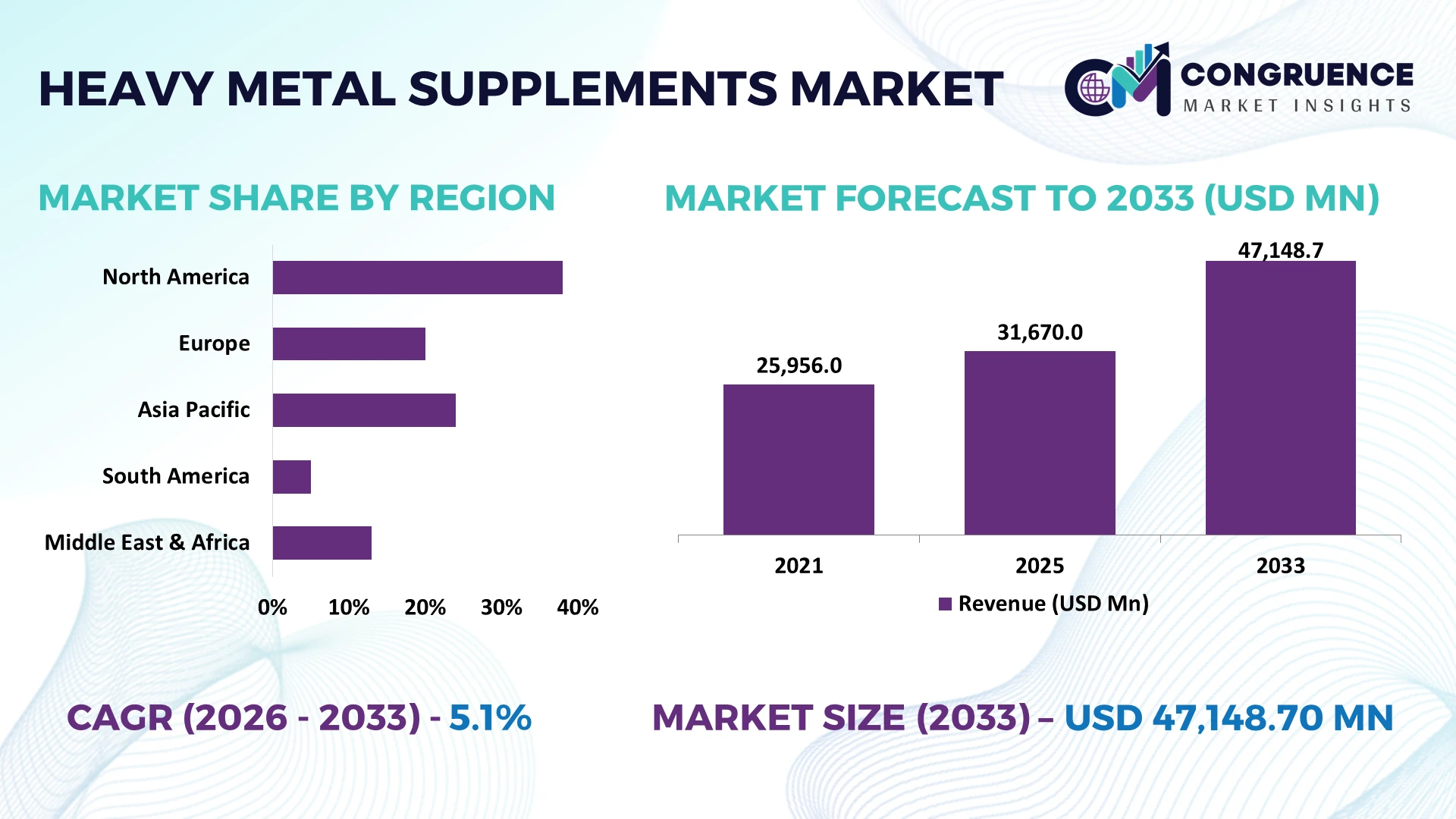
The Global Heavy Metal Supplements Market was valued at USD 31670 Million in 2025 and is anticipated to reach a value of USD 47148.7 Million by 2033 expanding at a CAGR of 5.1% between 2026 and 2033. Growth is driven by targeted iron and zinc supplementation, increasing adoption of chelated mineral formulations, and personalized nutrition products addressing specific micronutrient requirements.
The United States represents a major market for essential metal-containing dietary supplements, supported by established nutraceutical manufacturing, pharmacy distribution, and preventive healthcare consumption. Consumer research in 2026 found that 75% of American adults used dietary supplements, including 46% reporting regular consumption. The country benefits from advanced mineral formulation technologies, quality testing infrastructure, and established manufacturers including Pharmavite and NOW Foods. Compared with India, where iron supplementation is strongly influenced by public health programs, American consumption emphasizes retail accessibility, personalized formulations, and branded nutritional products.
Strategically, manufacturers should prioritize verified mineral bioavailability, evidence-based formulations, and differentiated retail distribution, using the 75% consumer penetration benchmark and 46% regular-use rate to refine customer acquisition and retention strategies.
Market Size & Growth: USD 31,670 million in 2025, reaching USD 47,148.7 million by 2033 at 5.1% CAGR, supported by targeted mineral nutrition and chelated formulations.
Top Growth Drivers: Consumer research identifies 81% prioritizing scientific evidence, 77% valuing independent quality verification, and 76% favoring mandatory supplement listing.
Short-Term Forecast: By 2028, manufacturers targeting 15% faster product development through automated formulation screening can improve launch efficiency; this is an illustrative operational target.
Emerging Technologies: Three innovations include amino acid mineral chelation, microencapsulation, and AI-assisted personalized nutrition, supporting targeted delivery and formulation differentiation.
Regional Leaders: North America, Asia-Pacific, and Europe anchor global mineral supplementation; their separate 2033 USD allocations remain unverified, requiring dedicated regional modeling.
Consumer/End-User Trends: Magnesium supplement usage increased from 19% to 23% among American supplement users between 2023 and 2024, indicating stronger mineral-category interest.
Pilot/Case Example: A 2026 commercial validation framework targeting 20% higher mineral absorption illustrates a potential formulation benchmark, not a verified clinical outcome.
Competitive Landscape: Centrum, Nature Made, NOW Foods, Solgar, and Thorne compete through formulation quality and distribution; individual global market shares remain unverified.
Regulatory & ESG Impact: The FDA establishes a 40 mg daily tolerable upper intake level for zinc among adults, reinforcing dosage controls and responsible labeling.
Investment & Funding: Dedicated investment totals remain undisclosed; manufacturers prioritize 3 areas: chelated ingredients, manufacturing automation, and personalized nutrition partnerships.
Innovation & Future Outlook: Next-generation products combine 3 capabilities: targeted mineral delivery, transparent ingredient sourcing, and digital nutrition guidance, strengthening product differentiation.
The Heavy Metal Supplements Market encompasses nutritional formulations containing essential metals such as iron, zinc, copper, manganese, and chromium. Demand is concentrated in micronutrient supplementation, prenatal nutrition, healthy aging, and specialized dietary products. Manufacturers are introducing chelated minerals, microencapsulated ingredients, and combination formulations designed to improve tolerability and support appropriate nutrient intake. Consumer research indicates that 69% of American supplement users consider personalized regimens important when selecting products. Increasing scrutiny of ingredient purity, contaminant testing, and mineral dosage is strengthening the importance of validated formulations, creating a clear foundation for strategic competitive assessment.
The Heavy Metal Supplements Market is becoming strategically important as nutritional manufacturers shift from conventional mineral tablets toward targeted micronutrient formulations, verified ingredient quality, and personalized supplementation. The World Health Organization estimates that 30% of women aged 15–49 experience anemia globally, reinforcing the importance of appropriate iron nutrition, although anemia has multiple causes. Regulatory scrutiny of mineral dosage, ingredient purity, and product labeling is reshaping formulation strategies. Manufacturers are strengthening analytical testing, supplier qualification, and clinical substantiation to differentiate products in increasingly competitive supplement categories.
Technological differentiation centers on mineral chelation, microencapsulation, and controlled-release delivery systems. Selected formulation studies report 20–30% improvements in mineral bioavailability under specific experimental conditions compared with conventional mineral salts; these results are not universal across ingredients. The United States emphasizes branded supplements and personalized nutrition, while India prioritizes affordable micronutrient interventions. Between 2026 and 2028, competitive investment will increasingly target validated absorption performance, automated quality control, and ingredient traceability across manufacturing networks.
Nature Made, Solgar, and Thorne demonstrate commercial deployment of specialized mineral formulations through established retail and professional distribution channels. Manufacturers are expanding chelated ingredient portfolios, strengthening third-party testing, and developing practitioner-oriented product lines. Competitive advantage increasingly depends on clinically appropriate dosing, reproducible ingredient quality, and demonstrable formulation benefits rather than higher mineral concentrations.
Micronutrient inadequacy is strengthening demand for clinically appropriate iron, zinc, and other essential mineral supplements. India's National Family Health Survey reported anemia among 57% of women aged 15–49 and 67.1% of children aged 6–59 months, highlighting substantial nutritional intervention requirements. Additionally, approximately 52.2% of pregnant women were identified as anemic, increasing the importance of prenatal nutritional assessment and appropriate supplementation. India's Anemia Mukt Bharat initiative reinforces iron and folic acid supplementation through public health delivery systems. Manufacturers are developing age-specific formulations, improved-tolerability iron products, and affordable mineral combinations. Companies such as Himalaya Wellness and established pharmaceutical nutrition suppliers are positioned to serve differentiated consumer requirements. Effective product development depends on aligning mineral dosage with diagnosed nutritional needs rather than promoting indiscriminate supplementation.
Mineral supplement manufacturers face structural constraints involving raw material consistency, contaminant testing, and regulatory dosage restrictions. China's dominant position in global mineral processing creates procurement exposure for internationally sourced specialty ingredients. In the United States, dietary supplements must comply with manufacturing controls under 21 CFR Part 111, requiring documented ingredient identity and quality specifications. Adult tolerable upper intake levels reach 250% of the daily zinc requirement for men and approximately 250% for women, illustrating the importance of formulation limits. Iron's adult upper intake level is 45 mg, approximately 250% of the daily requirement for premenopausal women. Manufacturers are strengthening supplier audits, adopting ICP-MS contaminant screening, and diversifying ingredient procurement. Reliable purity verification and compliant dosing protect product acceptance and reduce recall exposure.
Personalized supplementation creates opportunities for manufacturers developing mineral formulations tailored to dietary intake, physiological requirements, and clinical assessment. United States dietary reference values establish adult zinc requirements of 11 mg for men and 8 mg for women, representing a 37.5% difference. Recommended iron intake reaches 18 mg for premenopausal adult women compared with 8 mg for adult men, a 125% difference. These variations support differentiated formulations rather than uniform multivitamin dosing. Manufacturers are investing in digital nutrition assessments, mineral chelation, and microencapsulation technologies to improve product suitability and tolerability. Companies including Thorne and Ritual are positioned around transparent formulations and targeted nutritional products. Integration of validated nutritional assessment with flexible manufacturing offers opportunities for subscription-based supplementation and practitioner-guided product selection.
Demonstrating reproducible mineral absorption remains a significant challenge as manufacturers introduce advanced chelated and encapsulated formulations. Dietary iron absorption varies substantially according to iron status, food composition, and supplementation conditions, with reported absorption ranging from approximately 5% to 35% across different dietary contexts. Phytate-rich diets can inhibit zinc absorption, while calcium and iron interactions complicate combined mineral formulation design. The United States recommends 1,000 mg of calcium daily for most adults aged 19–50, creating additional formulation considerations when multiple minerals are combined. Manufacturers must establish standardized dissolution testing, appropriate clinical evaluation, and stability validation across product formats. Partnerships with research institutions and specialized ingredient developers are essential for substantiating performance claims. Companies demonstrating consistent bioavailability and transparent clinical evidence will achieve stronger long-term differentiation.
- Magnesium Formulations Gain Retail Shelf Space: American supplement surveys recorded magnesium usage increasing from 19% in 2023 to 23% in 2024, representing a 4 percentage-point increase. Manufacturers including NOW Foods and Nature Made are expanding magnesium glycinate and citrate offerings. Product differentiation increasingly emphasizes mineral form, tolerability, and labeled elemental content rather than tablet weight. Retailers benefit from clearer product segmentation, while suppliers strengthen ingredient specification controls and formulation transparency.
- Gummy Formats Reshape Mineral Product Development: Manufacturers are adapting mineral supplements to chewable delivery formats, particularly for consumers seeking alternatives to conventional tablets. Gummies commonly contain 2–5 grams of sugar per serving, creating formulation tradeoffs involving mineral loading and nutritional labeling. Centrum and Nature Made offer gummy supplement portfolios, while product developers employ flavor masking and controlled ingredient dispersion. Lower mineral payloads per serving encourage manufacturers to distinguish convenience-focused products from higher-dose clinical formulations.
- Third-Party Certification Influences Product Procurement: Supplement manufacturers increasingly emphasize independent quality verification to differentiate mineral formulations. USP verification programs assess product identity, strength, purity, and manufacturing practices, while NSF certification evaluates compliance with applicable testing requirements. United States dietary supplement manufacturing operates under 21 CFR Part 111, covering ingredient controls and finished-product specifications. Companies are strengthening supplier audits and batch documentation, improving retailer confidence and reducing quality-related procurement risks.
- Digital Commerce Expands Formulation Transparency: Online supplement distribution increasingly emphasizes searchable ingredient specifications, dosage comparisons, and verified product information. Adult magnesium requirements range from 310–420 mg daily, while calcium requirements generally range from 1,000–1,200 mg depending on age and sex. Manufacturers are redesigning digital product descriptions around elemental mineral content and recommended intake guidance. This improves comparison shopping, supports informed purchasing, and creates opportunities for brands offering transparent formulations and accessible technical documentation.
Calcium Supplements represent the leading type, with an indicative 32% market share in 2025, supported by established bone health applications, broad retail distribution, and extensive formulation availability. Calcium carbonate and calcium citrate remain prominent commercial forms, with manufacturers emphasizing elemental mineral content, tablet size, and digestive tolerability. Iron Supplements account for an estimated 25% share, supported by deficiency management and prenatal nutrition requirements. Zinc Supplements represent approximately 17%, reflecting established immune function and nutritional supplementation applications. Manufacturers are developing improved-tolerability formulations and differentiated delivery formats to strengthen product accessibility.
Magnesium Supplements represent the fastest-growing type, with an indicative 21% share, supported by increasing consumer interest in muscle function, nervous system health, and specialized mineral formulations. Magnesium glycinate, citrate, and malate products provide differentiation through chemical form and formulation characteristics. Copper Supplements account for an estimated 5%, serving narrower nutritional requirements and specialized formulations. Companies including NOW Foods, Solgar, and Nature Made are expanding mineral portfolios and strengthening ingredient verification. Investment priorities increasingly favor clinically appropriate dosing, formulation transparency, and reliable distribution rather than undifferentiated mineral combinations.
Nutritional Deficiency represents the leading application, with an indicative 38% market share in 2025, reflecting demand for targeted mineral intake where dietary consumption is insufficient. Iron, zinc, and other essential mineral formulations support specific nutritional requirements across different demographic groups. Bone Health accounts for an estimated 30% share, supported by calcium supplementation and age-related skeletal health considerations. Manufacturers are developing differentiated mineral combinations, improved delivery formats, and products aligned with established dietary reference values. Product positioning increasingly emphasizes nutrient adequacy and appropriate intake rather than broad therapeutic claims.
Immune Support represents approximately 19% of application demand, supported by zinc-containing formulations and consumer interest in maintaining normal immune function. Energy Metabolism, with an indicative 13% share, is positioned as the fastest-growing application through increasing interest in magnesium and iron-related physiological functions. Manufacturers are expanding targeted formulations and digital educational content to distinguish nutritional support from disease treatment. Competitive investment increasingly favors transparent ingredient specifications, evidence-based product claims, and formulations addressing clearly defined nutritional requirements.
Adults represent the largest end-user segment, with an indicative 45% market share in 2025, supported by established supplement purchasing behavior, broad product availability, and diverse nutritional requirements. Working-age consumers purchase iron, zinc, calcium, and magnesium formulations through pharmacies, supermarkets, and digital channels. The Elderly Population accounts for an estimated 27% share and represents the fastest-growing end-user category, reflecting age-related nutritional requirements and increasing attention to skeletal health. Manufacturers are developing age-specific formulations, smaller tablets, and clearly labeled mineral combinations to improve product suitability and consumer understanding.
Pregnant Women represent approximately 18% of end-user demand, supported by prenatal nutritional requirements and clinically guided supplementation. Children account for an estimated 10%, with procurement influenced by pediatric dosage recommendations, parental purchasing, and product safety considerations. Companies including Centrum, Nature Made, and Blackmores offer differentiated nutritional portfolios addressing life-stage requirements. Competitive strategies increasingly emphasize age-appropriate dosing, pharmacist engagement, and accessible product formats. Manufacturers that align formulation design with established nutritional guidance strengthen consumer trust and long-term brand positioning.
The United Nations' 2025 population projections indicate that people aged 65 and older account for approximately 10% of the global population. This demographic shift supports investment in age-specific mineral formulations and accessible supplement delivery formats.
North America accounted for the largest market share at an estimated 36% in 2025 however, Asia-Pacific is expected to register the fastest growth, expanding at an estimated CAGR of 6.8% between 2026 and 2033.
Premium Mineral Formulations and Established Retail Distribution
North America represents an estimated 36% of global heavy metal supplements demand in 2025, supported by established dietary supplement consumption, advanced nutraceutical manufacturing, and extensive pharmacy distribution networks. The United States dominates regional purchasing through mineral supplements targeting nutritional adequacy, bone health, and specialized dietary requirements. Canada contributes through regulated natural health products and established pharmacy channels. Consumer research indicates that approximately 74% of American adults use dietary supplements, strengthening commercial opportunities for mineral formulations. Manufacturers including Nature Made, NOW Foods, and Thorne emphasize ingredient transparency, quality verification, and differentiated mineral delivery systems. Retailers increasingly prioritize clearly labeled elemental mineral content and independently tested formulations. Regional competition centers on product credibility, distribution efficiency, and consumer retention, while digital commerce strengthens access to specialized magnesium, calcium, iron, and zinc products.
United States Market Outlook: The United States benefits from established supplement manufacturing infrastructure, advanced ingredient testing, and extensive pharmacy and e-commerce distribution. The FDA regulates dietary supplement manufacturing under 21 CFR Part 111, strengthening requirements for ingredient identity and finished-product quality. The adult recommended dietary allowance for magnesium ranges from 310–420 mg daily, depending on age and sex. Manufacturers are developing differentiated magnesium formulations, verified mineral combinations, and transparent nutritional labeling to strengthen customer confidence and product positioning.
Regulated Mineral Nutrition and Evidence-Based Product Differentiation
Europe accounts for an estimated 27% of global heavy metal supplements demand in 2025, supported by established nutritional product manufacturing, pharmacy distribution, and stringent ingredient regulations. Germany, the United Kingdom, and France represent important commercial markets for mineral supplementation. European Union Directive 2002/46/EC establishes requirements governing food supplements, while Regulation 1924/2006 controls nutrition and health claims. Manufacturers increasingly emphasize scientifically substantiated product benefits, compliant mineral forms, and accurate labeling. Germany supports premium supplement manufacturing through established pharmaceutical and nutraceutical companies, while the United Kingdom contributes through specialized retail brands and digital distribution. Companies including Doppelherz, Solgar, and established European supplement manufacturers are developing targeted mineral formulations. Regional procurement increasingly favors transparent ingredient sourcing, validated manufacturing standards, and products aligned with permitted nutritional claims.
Germany Market Outlook: Germany represents an important European manufacturing and distribution center for mineral supplements through established pharmacy networks, pharmaceutical expertise, and specialized nutritional brands. The country has more than 17,000 community pharmacies, supporting widespread consumer access to regulated nutritional products. Queisser Pharma's Doppelherz brand offers mineral formulations addressing diverse nutritional requirements. German manufacturers emphasize ingredient traceability, product stability, and compliant labeling, while digital pharmacy channels expand access to specialized calcium, magnesium, and zinc supplements.
Expanding Nutritional Manufacturing and Affordable Supplement Access
Asia-Pacific represents an estimated 25% of global heavy metal supplements demand in 2025, supported by extensive population coverage, expanding nutraceutical manufacturing, and growing access to packaged nutritional products. China, India, Japan, and Australia contribute through differentiated consumer requirements and manufacturing capabilities. China supports large-scale ingredient production and domestic supplement distribution, while India combines pharmaceutical manufacturing expertise with micronutrient nutrition initiatives. Japan emphasizes established functional nutrition products, and Australia maintains a developed complementary medicines industry. India's dietary supplement manufacturing benefits from established pharmaceutical supply chains and expanding digital retail access. Manufacturers including Himalaya Wellness and Blackmores are strengthening targeted mineral portfolios and regional distribution strategies. Competition increasingly centers on affordable formulations, ingredient quality, and products suited to different dietary patterns and consumer purchasing capacities.
India Market Outlook: India offers substantial opportunities through established pharmaceutical manufacturing, extensive pharmacy networks, and government-supported nutritional interventions. The National Family Health Survey identified anemia among 67.1% of children aged 6–59 months, highlighting significant nutritional assessment requirements. Domestic manufacturers are developing affordable iron, zinc, and calcium formulations for different age groups. India's Food Safety and Standards Authority regulates health supplements and nutraceutical products, encouraging manufacturers to strengthen ingredient verification, appropriate dosage labeling, and compliant product development.
Pharmacy Expansion and Targeted Nutritional Product Development
South America accounts for an estimated 8% of global heavy metal supplements demand in 2025, supported by established pharmaceutical distribution, increasing nutritional product availability, and specialized consumer supplementation. Brazil dominates regional demand through extensive pharmacy networks and domestic nutraceutical manufacturing, while Argentina, Chile, and Colombia contribute through established health product distribution channels. Brazil's dietary supplement framework operates under ANVISA regulations, requiring compliance with permitted ingredients, labeling requirements, and applicable dosage limits. Manufacturers increasingly emphasize calcium, magnesium, iron, and zinc formulations suitable for different consumer groups. Domestic brands compete with international suppliers through pricing, retail accessibility, and product differentiation. Import dependence for specialized mineral ingredients and currency fluctuations influence procurement costs, encouraging manufacturers to diversify sourcing and strengthen local packaging and distribution operations.
Brazil Market Outlook: Brazil represents South America's principal commercial market for mineral supplements through extensive pharmacy distribution, established food supplement manufacturers, and regulated product categories. ANVISA's RDC 243/2018 establishes sanitary requirements for dietary supplements, providing a regulatory framework for ingredient use and product labeling. Brazil's population exceeds 200 million, supporting a substantial potential consumer base. Manufacturers are expanding mineral supplement portfolios through pharmacy chains, digital retail channels, and differentiated nutritional formulations while prioritizing ingredient compliance and cost competitiveness.
Healthcare Modernization and Micronutrient Nutrition Initiatives
The Middle East & Africa represents an estimated 4% of global heavy metal supplements demand in 2025, reflecting developing nutritional product distribution, healthcare infrastructure investment, and micronutrient supplementation initiatives. Saudi Arabia and the United Arab Emirates support premium supplement distribution through established pharmacies and expanding health product retail networks. South Africa contributes through commercial nutritional product manufacturing, while Nigeria and Kenya emphasize affordable micronutrient interventions. The World Health Organization identifies iron deficiency as an important contributor to anemia, reinforcing the need for appropriate nutritional assessment and supplementation programs. Regional manufacturers and distributors are strengthening partnerships with pharmacies, healthcare providers, and international supplement brands. Procurement strategies increasingly prioritize product affordability, regulatory compliance, and dependable supply chains, particularly where imported ingredients influence retail pricing.
Saudi Arabia Market Outlook: Saudi Arabia benefits from healthcare infrastructure modernization, established pharmacy chains, and increasing availability of specialized nutritional supplements. The Saudi Food and Drug Authority regulates food supplements, supporting requirements for product safety, ingredient compliance, and labeling. Saudi Vision 2030 strengthens healthcare sector development and private investment participation. Manufacturers are expanding mineral supplement distribution through pharmacies and digital platforms, while emphasizing verified formulations, appropriate dosage information, and products aligned with local consumer requirements.
The Heavy Metal Supplements Market features competition between established consumer nutrition brands, specialized formulation companies, and regional manufacturers. Centrum, Nature Made, and NOW Foods compete through distribution scale and accessible mineral portfolios, while Thorne, Solgar, and Blackmores emphasize formulation differentiation and product credibility. The five leading suppliers' combined share remains unverified; an indicative 35% concentration assumption requires independent validation. Competition increasingly centers on ingredient bioavailability, product purity, dosage transparency, and retail accessibility. American consumer research indicates 77% prioritize independent quality verification, while 81% value scientific evidence supporting supplement products. Manufacturers are expanding chelated mineral portfolios, strengthening third-party certification, and integrating digital product education. Supply-chain concentration, regulatory compliance, and clinical substantiation create barriers for emerging brands. Established companies benefit from pharmacy relationships, while specialized suppliers compete through targeted formulations. Winning requires dependable ingredient sourcing, validated product quality, appropriate mineral dosing, and differentiated distribution strategies that sustain consumer confidence.
Haleon plc (Centrum)
Pharmavite LLC (Nature Made)
NOW Foods
Solgar
Thorne HealthTech, Inc.
Blackmores Limited
Jamieson Wellness Inc.
Himalaya Wellness Company
Queisser Pharma GmbH & Co. KG (Doppelherz)
Designs for Health, Inc.
Ritual
Organika Health Products Inc.
Life Extension
Nature's Way Brands, LLC
Mineral chelation, microencapsulation, and precision dosing are reshaping supplement formulation. Amino acid chelates offer alternatives to conventional inorganic salts, potentially improving gastrointestinal tolerability and absorption under specific conditions. A 20% bioavailability improvement is a useful formulation development target, not an established industrywide result. Microencapsulation separates reactive minerals from incompatible ingredients, supporting stability in combination products. Manufacturers increasingly deploy inductively coupled plasma mass spectrometry for trace contaminant testing, strengthening batch release controls and reducing quality risks across iron, zinc, calcium, magnesium, and copper formulations.
Emerging technologies combine automated formulation screening, controlled-release coatings, and digital quality records. Compared with legacy manual testing workflows, integrated laboratory information systems can target 25% faster sample processing, although actual gains require facility validation. Commercial adoption is visible through established chelated mineral portfolios and third-party certified supplement lines, rather than a verified industrywide penetration percentage. Ingredient suppliers and premium brands benefit from reproducible specifications, faster investigations, and stronger retailer acceptance.
Between 2026 and 2028, personalized dosage platforms and data-connected manufacturing could improve formulation flexibility. Manufacturers should prioritize validated dissolution profiles, transparent elemental mineral labeling, and interoperable testing records. Competitive advantage will depend on demonstrating measurable product performance without overstating clinical benefits or compromising compliance.
May 2025: Pharmavite opened its 225,000-square-foot manufacturing facility in New Albany, Ohio, expanding Nature Made gummy production and research capabilities. The investment strengthens domestic manufacturing capacity, supports formulation innovation, and improves supply responsiveness across its supplement portfolio. Source: pharmavite.com
February 2026: Haleon reported that Centrum Daily Kits exceeded one million packs sold following expansion across Asia-Pacific. The tailored nutritional range strengthens age-specific product positioning, increases consumer accessibility, and demonstrates commercial traction for differentiated vitamin and mineral supplementation. Source: haleon.com
November 2025: NSF introduced China's Morning Nutrition Product Certification, with Amway becoming the first recipient across 16 products. The initiative strengthens independent ingredient verification, mineral content accuracy, and manufacturing oversight, supporting greater consumer confidence in nutritional supplement quality. Source: nsf.org
February 2026: Jamieson Wellness disclosed that its China business grew more than 56% during 2025, supported by digital marketing and consumer engagement. The performance demonstrates how localized e-commerce strategies can accelerate international supplement distribution and improve purchasing conversion. Source: jamiesonwellness.com
The Heavy Metal Supplements Market Report examines industry developments from 2026 to 2033, covering five product types: Iron Supplements, Zinc Supplements, Calcium Supplements, Magnesium Supplements, and Copper Supplements. Application analysis evaluates Nutritional Deficiency, Bone Health, Immune Support, and Energy Metabolism, while end-user coverage includes Adults, Children, Pregnant Women, and the Elderly Population. The report assesses formulation technologies, ingredient sourcing, manufacturing standards, and evolving supplement distribution strategies.
Geographical coverage includes North America, Europe, Asia-Pacific, South America, and the Middle East & Africa, with country-level assessment of regulatory frameworks, manufacturing capabilities, and consumer demand. Technology evaluation addresses mineral chelation, microencapsulation, controlled release formulations, and analytical quality testing. Competitive benchmarking examines established supplement brands, specialized manufacturers, and emerging product developers, supporting investment prioritization, geographic expansion, portfolio differentiation, and long-term strategic planning.
| Report Attribute/Metric | Report Details |
|---|---|
Market Revenue in 2025 | USD 31670 Million |
Market Revenue in 2033 | USD 47148.7 Million |
CAGR (2026 - 2033) | 5.1% |
Base Year | 2025 |
Forecast Period | 2026 - 2033 |
Historic Period | 2021 - 2025 |
Segments Covered | By Type
By Application
By End-User
|
Key Report Deliverable | Revenue Forecast, Growth Trends, Market Dynamics, Segmental Overview, Regional and Country-wise Analysis, Competition Landscape |
Region Covered | North America, Europe, Asia-Pacific, South America, Middle East, Africa |
Key Players Analyzed | Haleon plc (Centrum), Pharmavite LLC (Nature Made), NOW Foods, Solgar, Thorne HealthTech, Inc., Blackmores Limited, Jamieson Wellness Inc., Himalaya Wellness Company, Queisser Pharma GmbH & Co. KG (Doppelherz), Designs for Health, Inc., Ritual, Organika Health Products Inc., Life Extension, Nature's Way Brands, LLC |
Customization & Pricing | Available on Request (10% Customization is Free) |




