
Reports
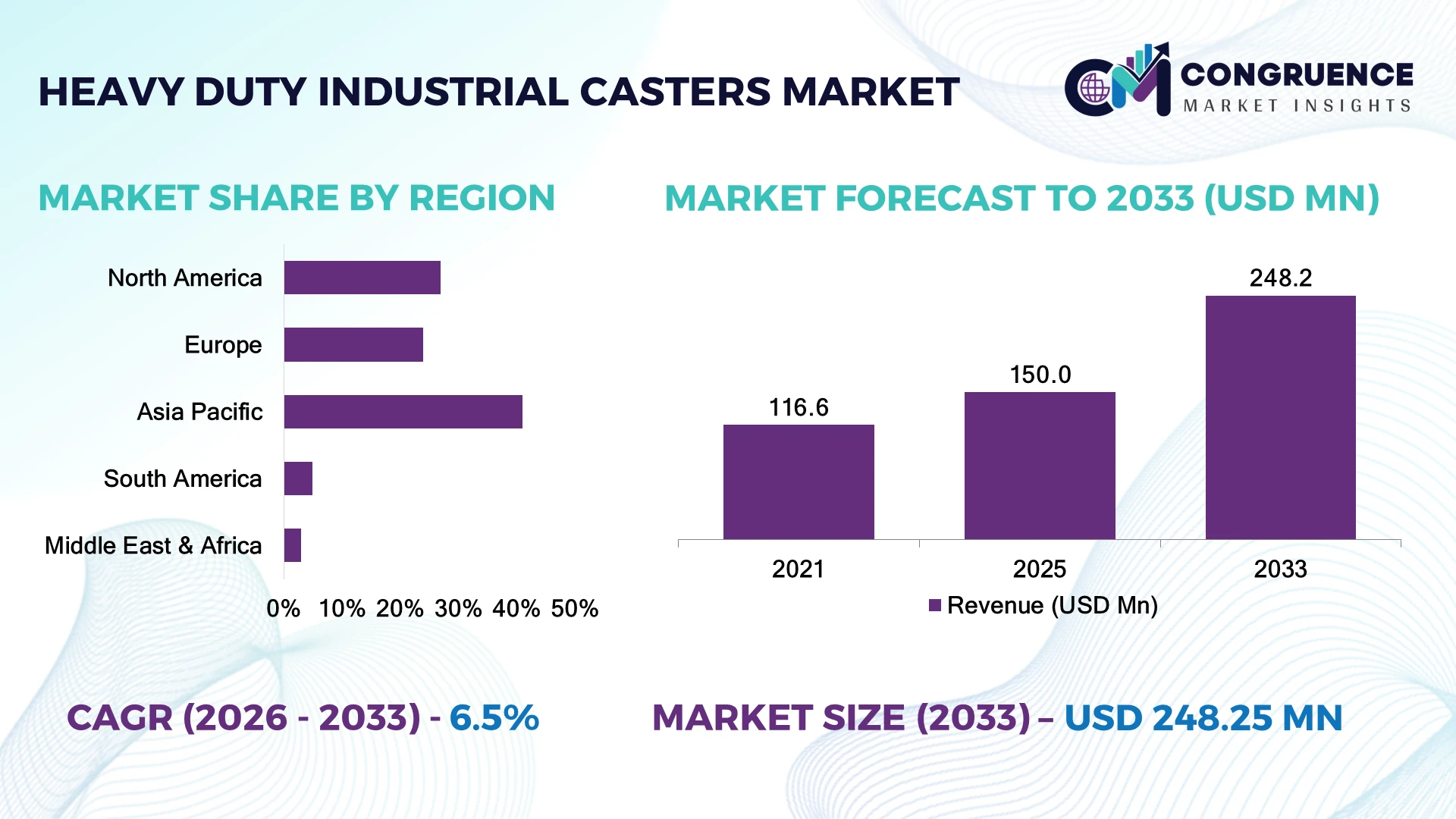
The Global Heavy Duty Industrial Casters Market was valued at USD 150.0 Million in 2025 and is anticipated to reach a value of USD 248.2 Million by 2033 expanding at a CAGR of 6.5% between 2026 and 2033. Growth is primarily driven by warehouse automation expansion, rising industrial material-handling requirements, and modernization of manufacturing and logistics infrastructure requiring higher-load mobility systems.
China dominates the market with an estimated 34% share of global production capacity, supported by over 120 major industrial equipment clusters and strong investments in smart manufacturing. Industrial automation penetration across large factories exceeds 45%, compared with approximately 31% in India. The country benefits from integrated steel, automotive, and logistics industries, while supply-chain realignments following global trade disruptions have accelerated localized caster production and deployment across high-capacity facilities.
Manufacturers prioritizing advanced load-bearing designs, automation-compatible mobility solutions, and localized production networks are securing stronger positioning across industrial modernization projects.
Market Size & Growth: USD 150.0 Million in 2025, reaching USD 248.2 Million by 2033, driven by warehouse automation, smart factories, and industrial mobility upgrades.
Top Growth Drivers: Automation adoption (+28%), warehouse capacity expansion (+22%), industrial equipment modernization (+19%).
Short-Term Forecast: By 2028, material-handling efficiency is expected to improve by 15% while maintenance downtime declines by 12%.
Emerging Technologies: AI-enabled fleet monitoring, advanced polyurethane wheels, and predictive maintenance platforms accelerate deployment.
Regional Leaders: Asia-Pacific (USD 95 Million), North America (USD 62 Million), Europe (USD 48 Million); automation-led demand remains strongest.
Consumer/End-User Trends: Over 52% of large logistics facilities prioritize high-load mobility systems for operational flexibility.
Pilot/Case Example: In 2024, an automated distribution center project improved internal transport efficiency by 18%.
Competitive Landscape: Top manufacturers control nearly 38% share; key players include Colson Group, TENTE, Blickle, Hamilton Caster, and RWM Casters.
Regulatory & ESG Impact: Lightweight wheel materials reduce energy consumption during transport operations by up to 10%.
Investment & Funding: More than USD 300 Million has been directed toward factory automation and mobility equipment expansion projects.
Innovation & Future Outlook: Smart casters with embedded sensors support real-time asset tracking and advanced industrial mobility strategies.
Heavy Duty Industrial Casters Market demand is increasingly concentrated in automated warehouses, automotive assembly plants, aerospace facilities, and heavy manufacturing environments. Recent innovations include sensor-enabled casters, advanced polyurethane compounds, and low-resistance wheel technologies that improve operational efficiency by up to 15%. Growing nearshoring initiatives and supply-chain resilience programs are accelerating localized equipment procurement, creating new opportunities across industrial logistics networks and setting the stage for broader strategic transformation.
Heavy duty industrial casters have become a strategic component of modern industrial operations as manufacturers, logistics operators, and infrastructure developers focus on productivity, flexibility, and equipment mobility. Supply-chain restructuring across North America and Asia is accelerating investments in warehouse automation, production-line optimization, and advanced material-handling systems. As industrial facilities seek faster internal movement of high-load assets, caster performance increasingly influences operational efficiency and equipment utilization.
Advanced polyurethane and precision-bearing caster systems deliver up to 20% lower rolling resistance than conventional steel-wheel configurations, reducing equipment strain and improving movement efficiency. China leads large-scale manufacturing deployment, while Germany and Japan focus on high-performance engineered mobility solutions for precision industries. Over the next two to three years, smart factory adoption is expected to increase the integration of sensor-enabled mobility components across industrial facilities.
A practical example is automated distribution centers deploying heavy-duty casters within mobile racks and transport carts to improve workflow continuity. Companies are expanding production footprints, strengthening supplier partnerships, and investing in smart mobility technologies. Organizations that align mobility infrastructure with automation strategies will achieve stronger operational resilience, improved asset utilization, and sustainable competitive differentiation.
Warehouse automation deployments have increased by more than 25% across major logistics hubs, creating substantial demand for heavy-duty mobility systems capable of supporting higher operational throughput. Manufacturing facilities implementing automated guided vehicles and mobile workstations report productivity improvements of 15–20%, increasing the need for durable caster assemblies. Ongoing industrial policy initiatives in China and the United States continue to encourage factory modernization and equipment upgrades. This structural shift improves internal logistics efficiency, reduces equipment handling time, and supports flexible manufacturing layouts. In response, manufacturers are expanding production capacity, introducing higher-load polyurethane solutions, and developing automation-compatible caster platforms. A notable strategic insight is that mobility infrastructure is increasingly becoming a performance-critical component rather than a simple equipment accessory.
Steel, polyurethane, and specialty bearing materials remain vulnerable to procurement volatility, creating cost pressure across the value chain. Industrial steel price fluctuations have exceeded 12% during recent procurement cycles, while imported bearing lead times have increased by nearly 18% in some manufacturing sectors. Supply-chain disruptions linked to global shipping bottlenecks continue to affect component availability and production scheduling. These factors directly influence pricing stability, inventory management, and manufacturing profitability. To mitigate risks, companies are localizing supplier networks, securing long-term procurement agreements, and increasing multi-source component sourcing strategies. A key operational insight is that procurement resilience increasingly determines margin stability and delivery performance in industrial mobility equipment markets.
The emergence of sensor-enabled industrial equipment presents a significant opportunity for next-generation caster solutions. More than 30% of large industrial facilities are evaluating predictive maintenance technologies, while connected asset tracking deployments have increased by approximately 22%. Smart casters equipped with load-monitoring and location-tracking capabilities can improve equipment visibility and reduce maintenance interruptions. Japan and South Korea are actively advancing intelligent manufacturing initiatives that support connected mobility infrastructure. Companies are investing in R&D partnerships, embedded sensor technologies, and digital monitoring ecosystems to capture this opportunity. A unique strategic advantage lies in transforming casters from passive hardware components into valuable operational data sources that support efficiency optimization and asset management.
Integrating advanced mobility systems into existing industrial environments remains operationally complex. Nearly 35% of industrial facilities operate mixed-age equipment fleets, creating compatibility challenges for standardized mobility upgrades. Workforce shortages in industrial maintenance and automation engineering have increased by roughly 14% across several manufacturing economies, slowing implementation timelines. As digital monitoring capabilities expand, companies must also address data integration, maintenance standardization, and long-term infrastructure consistency. These challenges affect deployment efficiency and reduce the speed of technology adoption. Manufacturers are responding through engineering partnerships, modular product architectures, and workforce training programs. A critical strategic insight is that successful scaling depends as much on operational integration capabilities as on product innovation itself.
Smart Casters Enter Operations Industrial facilities are increasingly integrating sensor-enabled casters into mobile equipment fleets, with connected asset monitoring deployments rising by nearly 24% over the past two years. Real-time load tracking and predictive maintenance capabilities have reduced unplanned equipment downtime by approximately 15%. Labor shortages across manufacturing hubs in the United States and Germany are accelerating adoption, prompting suppliers to expand digital mobility portfolios and establish partnerships with industrial automation providers.
Warehouse Mobility System Upgrades Distribution centers are replacing conventional transport platforms with high-performance caster systems designed for automated workflows. Automated storage facilities now account for more than 30% of new caster deployments, while internal material movement speeds have improved by 12% in large logistics operations. Supply-chain resilience initiatives are driving investments in modular warehouse layouts, encouraging manufacturers to scale production and customize solutions for high-throughput environments.
Advanced Polyurethane Wheel Adoption Polyurethane-based heavy-duty casters have gained substantial traction, representing nearly 48% of newly specified industrial mobility systems. These products reduce floor wear by around 20% and lower rolling resistance by up to 18% compared with traditional alternatives. Industrial operators are prioritizing lifecycle cost reduction and maintenance efficiency, leading companies to expand premium wheel portfolios and strengthen engineered-material development programs.
Localized Manufacturing Expansion Industrial buyers are increasingly favoring regionally sourced mobility components, with localized procurement activity increasing by approximately 22% since recent global logistics disruptions. Lead-time reductions of 10–14% are improving inventory planning and operational continuity. China, India, and Mexico continue attracting production investments as manufacturers restructure supply networks, diversify supplier bases, and establish localized assembly capabilities to improve responsiveness and delivery reliability.
Polyurethane casters represent the leading segment, accounting for approximately 38% of market demand due to their superior load-bearing capability, floor protection characteristics, and lower rolling resistance. Their broad deployment across logistics centers, automotive plants, and manufacturing facilities continues to support dominance. Steel casters remain essential in extreme-load environments where durability and impact resistance are critical. Rubber casters maintain relevance in facilities prioritizing noise reduction and floor protection, particularly within institutional and light-industrial settings. Polyurethane casters are also the fastest-growing category as automated warehouses and smart manufacturing environments require smoother movement and reduced maintenance. Adoption within automated material-handling systems has increased by nearly 20%, while maintenance-related operating costs have declined by approximately 12% among large-scale users. Stainless steel variants are gaining attention in food processing and pharmaceutical applications where hygiene compliance is becoming increasingly important. Manufacturers are expanding polyurethane product lines, developing advanced compounds, and investing in engineered wheel technologies to address evolving industrial mobility requirements. The shift toward performance-based procurement is directing investment toward specialized caster solutions rather than commodity products.
Material handling accounts for approximately 42% of total market demand, making it the dominant application segment. Warehouses, manufacturing facilities, and logistics centers depend heavily on heavy-duty casters for carts, mobile racks, transport platforms, and automated equipment. Rising throughput requirements and internal logistics optimization initiatives continue to strengthen deployment. Industrial machinery applications remain a significant segment due to the need for equipment mobility during maintenance, reconfiguration, and production-line adjustments. The fastest-growing application is warehouse automation, supported by increasing deployment of automated guided vehicles, mobile storage systems, and intelligent transport equipment. Automated logistics operations have expanded by nearly 18% across major industrial economies, while internal movement efficiency improvements frequently exceed 15%. Aerospace and healthcare applications are also gaining strategic relevance due to specialized mobility requirements and higher equipment utilization rates. Companies are expanding automation-compatible product offerings, enhancing load capacities, and integrating low-maintenance components to address increasingly complex operational environments. Demand is shifting toward applications where mobility directly influences productivity and facility flexibility.
Manufacturing remains the dominant end-user segment, representing approximately 45% of overall demand. Automotive, metal fabrication, machinery production, and industrial equipment facilities require continuous deployment of heavy-duty mobility systems to support production flexibility and equipment movement. High operational intensity and ongoing factory modernization efforts sustain demand concentration. Logistics and warehousing constitute another major buyer group as distribution networks expand and fulfillment operations become increasingly automated. Logistics and warehousing is the fastest-growing end-user segment, driven by rapid expansion of e-commerce infrastructure and distribution center modernization. Deployment of mobile storage systems and automated transport platforms has increased by roughly 21% across large logistics facilities. Healthcare and food processing sectors are also expanding adoption due to stricter operational efficiency and hygiene requirements. Manufacturers are responding through customized product configurations, industry-specific solutions, and strategic partnerships with equipment integrators. Future demand is increasingly shifting toward sectors where operational uptime, automation compatibility, and workflow flexibility directly influence competitive performance.
Asia-Pacific accounted for the largest market share at 41% in 2025 however, North America is expected to register the fastest growth, expanding at a CAGR of 7.2% between 2026 and 2033.
North America represents approximately 27% of global market demand, supported by extensive deployment across logistics facilities, manufacturing plants, aerospace operations, and distribution networks. The region continues to accelerate investments in warehouse automation, advanced material handling systems, and flexible production infrastructure. Heavy-duty casters are increasingly integrated into automated guided vehicles, mobile workstations, and high-capacity transport platforms. More than 35% of newly upgraded logistics facilities now incorporate automation-compatible mobility systems to improve workflow efficiency and reduce handling bottlenecks. Growing reshoring initiatives are also increasing demand for industrial equipment modernization across manufacturing hubs. Companies are expanding local production capabilities, strengthening supplier partnerships, and introducing higher-load engineered mobility solutions to support evolving operational requirements. The market benefits from strong adoption of predictive maintenance technologies and smart facility management practices.
United States Market Outlook: The United States remains the most influential market due to its extensive manufacturing base, advanced logistics infrastructure, and large-scale warehouse automation deployment. Industrial modernization programs across automotive, aerospace, and e-commerce sectors continue to drive demand for high-performance mobility systems. More than 40% of large distribution facilities have adopted automated internal transport solutions, increasing the need for durable caster platforms. Domestic manufacturers are prioritizing localized supply chains, advanced polyurethane wheel technologies, and intelligent mobility integrations to enhance operational productivity and equipment flexibility.
Europe accounts for nearly 24% of global market activity, supported by strong industrial engineering capabilities and advanced manufacturing ecosystems. Demand remains concentrated in automotive production, industrial machinery, pharmaceuticals, and food processing operations. Sustainability initiatives are encouraging adoption of energy-efficient mobility systems with lower rolling resistance and longer service life. Industrial operators increasingly prioritize lifecycle performance, maintenance reduction, and workplace ergonomics when selecting heavy-duty caster solutions. More than 30% of newly specified industrial mobility equipment now incorporates advanced wheel compounds designed to reduce operational wear. Companies across the region are investing in engineered materials, production optimization, and specialized mobility systems that align with evolving industrial efficiency objectives. Regulatory emphasis on workplace safety and operational reliability further supports product innovation and deployment.
Germany Market Outlook: Germany serves as the region’s strategic center for industrial mobility technologies due to its strong machinery manufacturing sector and advanced factory automation landscape. The country maintains extensive deployment across automotive production facilities, engineering operations, and industrial equipment manufacturing. Automated production environments account for a significant share of caster demand, with mobility solutions increasingly specified for precision material handling applications. German manufacturers continue investing in engineered caster systems, intelligent production technologies, and export-oriented product development to strengthen industrial competitiveness and operational performance.
Asia-Pacific leads the global market with approximately 41% share, driven by large-scale manufacturing output, infrastructure development, and expanding logistics networks. The region serves as a major production hub for industrial equipment, automotive components, electronics, and warehouse systems. Industrial mobility requirements continue to increase as manufacturers adopt flexible production models and modern material-handling infrastructure. More than 45% of new manufacturing facility investments in key industrial economies incorporate advanced internal mobility solutions. Rapid warehouse construction, export-oriented manufacturing growth, and industrial automation deployment support sustained demand for heavy-duty casters. Companies are expanding manufacturing capacity, localizing production, and developing application-specific mobility systems to meet diverse industrial requirements. Strong supply-chain integration further enhances the region’s strategic importance within the market.
China Market Outlook: China remains the dominant country market due to its extensive industrial production base, large logistics sector, and advanced manufacturing expansion programs. The country contributes over one-third of global production capacity for numerous industrial mobility components. Smart manufacturing adoption continues to accelerate across major industrial clusters, increasing demand for high-load and automation-compatible caster systems. Domestic enterprises are investing heavily in production efficiency, warehouse modernization, and export-focused manufacturing capabilities, strengthening the country’s leadership across industrial mobility applications.
South America represents approximately 5% of global market demand, with growth supported by expanding logistics operations, industrial modernization initiatives, and infrastructure development programs. Material handling requirements continue to increase across mining, food processing, manufacturing, and distribution sectors. Industrial operators are gradually upgrading mobility equipment to improve operational efficiency and workplace productivity. Recent warehouse expansion projects have increased demand for heavy-duty transport systems by nearly 14% within key industrial corridors. While infrastructure limitations and supply-chain challenges continue to affect deployment speed, investment activity remains focused on operational modernization. Companies are strengthening regional distribution networks, expanding aftermarket support capabilities, and introducing cost-efficient mobility solutions designed for demanding industrial environments.
Brazil Market Outlook: Brazil is the region’s largest market due to its extensive manufacturing activity, mining operations, logistics infrastructure, and industrial workforce. The country continues to invest in warehouse expansion, transportation modernization, and production efficiency initiatives across major industrial centers. Industrial equipment mobility requirements have increased significantly as companies seek greater flexibility within manufacturing and distribution operations. Domestic and international suppliers are expanding local partnerships and technical support capabilities to address growing demand for durable heavy-duty caster solutions across diverse industrial applications.
The Middle East & Africa region accounts for approximately 3% of global market demand, supported by industrial diversification strategies, logistics infrastructure investments, and large-scale construction activity. Growth remains concentrated around industrial zones, transportation hubs, manufacturing facilities, and warehouse developments. Governments and enterprises are prioritizing modernization projects that require advanced material-handling and equipment mobility systems. Industrial logistics investments have increased by more than 16% across several key markets, strengthening demand for heavy-duty mobility components. Companies are expanding regional distribution footprints, establishing strategic partnerships, and improving technical service capabilities to support project execution. Ongoing infrastructure transformation programs continue to create opportunities for industrial equipment deployment and mobility system integration.
Saudi Arabia Market Outlook: Saudi Arabia stands as the region’s most strategically important market due to extensive industrial diversification initiatives, logistics corridor development, and manufacturing expansion projects. Large-scale industrial cities and integrated logistics hubs are generating significant demand for material-handling infrastructure and equipment mobility systems. Industrial facility investments continue to increase across mining, energy, manufacturing, and warehousing sectors. Enterprises are adopting advanced operational technologies and expanding localized industrial capabilities, creating sustained demand for heavy-duty caster systems designed to support large-scale infrastructure and industrial transformation projects.
The competitive landscape is led by global manufacturers such as Colson Group, Blickle Räder+Rollen, TENTE International, Hamilton Caster, and RWM Casters, which collectively control approximately 38% of market activity. Competition primarily occurs between global engineering-focused brands and regional cost-competitive manufacturers, while OEM-integrated mobility suppliers increasingly challenge traditional caster specialists. Technology leadership, customization capability, delivery speed, and supply-chain control remain the main competitive factors. Premium manufacturers achieve up to 20% lower rolling resistance and 15% longer service life through advanced wheel compounds and precision-bearing designs, while regional suppliers compete through 10–15% lower procurement costs. Companies are strengthening positions through manufacturing expansion, localized distribution networks, polyurethane innovation, and strategic partnerships with automation equipment providers. Vertical integration is becoming increasingly important as producers seek tighter control over raw materials and lead times. Consolidation activity is reshaping supplier relationships, creating higher entry barriers through engineering expertise, certification requirements, and customer qualification processes. Winning requires differentiated performance, application-specific engineering, resilient supply networks, and rapid customer support capabilities.
Blickle Räder+Rollen GmbH
TENTE International GmbH
Hamilton Caster & Manufacturing Co.
RWM Casters
Caster Concepts Inc.
Albion Casters
Payson Casters
Jarvis Caster Corporation
Uchimura Caster Co., Ltd.
Tellure Rôta S.p.A.
Flywheel Metalwork Ltd.
Rhombus Rollen Holding GmbH
Caster Connection
Industrial mobility systems are undergoing rapid technological advancement through smart monitoring, advanced wheel materials, and automation integration. Sensor-enabled casters capable of load monitoring, movement tracking, and predictive maintenance are gaining traction across logistics and manufacturing facilities. Adoption within advanced industrial environments has surpassed 18%, while predictive maintenance programs have reduced equipment downtime by approximately 15%. Companies deploying connected mobility systems gain stronger asset visibility and operational control compared with conventional passive equipment.
Advanced polyurethane technologies are replacing legacy rubber and steel-wheel configurations in many industrial applications. Modern engineered polyurethane solutions deliver up to 20% lower rolling resistance and nearly 18% lower floor wear while maintaining high load-bearing performance. More than 45% of newly specified heavy-duty mobility systems now incorporate advanced polymer compounds. These technologies improve workplace efficiency, reduce maintenance interventions, and support higher throughput operations. Manufacturers focused on engineered materials and specialized wheel formulations are strengthening competitive positioning in demanding industrial environments.
Between 2026 and 2028, intelligent mobility ecosystems will become increasingly integrated with warehouse automation, industrial analytics, and asset management platforms. Automated facilities are expected to increase smart mobility deployment by more than 25%, creating operational advantages through real-time monitoring and workflow optimization. Companies that combine connected mobility, advanced materials, and automation-ready designs will achieve stronger productivity, faster equipment utilization, and improved long-term operational resilience.
April 2025 – Blickle announced the opening of its new sales subsidiary in Vietnam, strengthening direct market access in Southeast Asia and expanding its international presence. The move increased Blickle’s global sales-company network and improved regional customer support capabilities. Source: blickle.com
November 2025 – Blickle and Rodamex established the Rodamex-Blickle Colombia joint venture, extending direct operations into South America. The initiative expanded Blickle’s presence to 22 sales companies worldwide and strengthened technical support capacity for industrial mobility customers across Colombia. Source: blickle.com Colombia News
July 2025 – Colson Group acquired ESCO Plastics, a manufacturer of custom-molded polyurethane components. The acquisition strengthened U.S.-based manufacturing capabilities, expanded polyurethane expertise, and improved supply-chain integration for advanced wheel and caster production. Source: Colson Group Press Release
April 2026 – Blickle launched new high-performance polyurethane tread technologies engineered for continuous-duty, high-speed, and extreme-load applications. The development enhanced durability and operational performance for demanding industrial environments while expanding the company’s advanced mobility solutions portfolio. Source: blickle.com News
The report provides comprehensive analysis of the Heavy Duty Industrial Casters Market across major product categories, applications, end-user industries, and regional markets. Coverage includes polyurethane, steel, rubber, stainless steel, and specialized caster technologies deployed across material handling, industrial machinery, warehouse automation, aerospace, healthcare, and related sectors. The assessment evaluates deployment trends, production dynamics, industrial adoption patterns, and competitive positioning across North America, Europe, Asia-Pacific, South America, and the Middle East & Africa.
The study examines automation integration, advanced wheel materials, smart mobility technologies, predictive maintenance capabilities, and supply-chain localization strategies shaping market evolution between 2026 and 2033. More than 40% of demand concentration is analyzed within large-scale manufacturing and logistics operations, while emerging opportunities across intelligent mobility systems and specialized industrial applications are assessed. The report supports investment planning, expansion prioritization, partnership evaluation, product development strategies, competitive benchmarking, and long-term operational decision-making for manufacturers, suppliers, investors, and industrial stakeholders.
| Report Attribute / Metric | Details |
|---|---|
| Market Revenue (2025) | USD 150.0 Million |
| Market Revenue (2033) | USD 248.2 Million |
| CAGR (2026–2033) | 6.5% |
| Base Year | 2025 |
| Forecast Period | 2026–2033 |
| Historic Period | 2021–2025 |
| Segments Covered |
By Type
By Application
By End-User
|
| Key Deliverables | Revenue Forecast; Market Trends; Growth Drivers & Restraints; Technology Insights; Segmentation Analysis; Regional Insights; Competitive Landscape; Regulatory & ESG Overview; Recent Developments |
| Regions Covered | North America; Europe; Asia-Pacific; South America; Middle East & Africa |
| Companies Profiled | Colson Group; Blickle Räder+Rollen GmbH; TENTE International GmbH; Hamilton Caster & Manufacturing Co.; RWM Casters; Caster Concepts Inc.; Albion Casters; Payson Casters; Jarvis Caster Corporation; Uchimura Caster Co., Ltd.; Tellure Rôta S.p.A.; Rhombus Rollen Holding GmbH; Caster Connection; Flywheel Metalwork Ltd. |
| Customization & Pricing | Available on Request (10% Customization Free) |




