
Reports
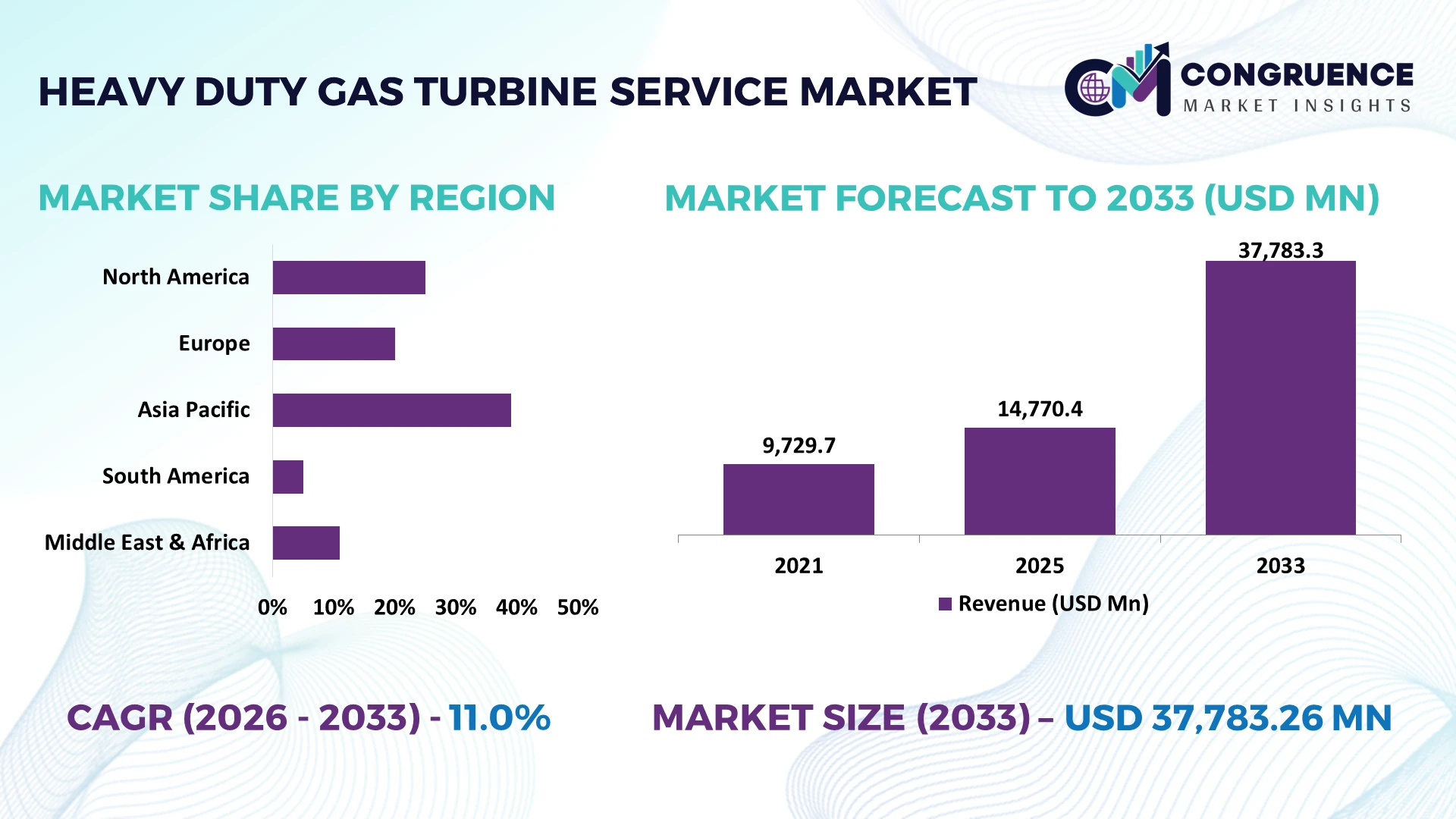
The Global Heavy Duty Gas Turbine Service Market was valued at USD 14770.41 Million in 2025 and is anticipated to reach a value of USD 37783.26 Million by 2033 expanding at a CAGR of 11% between 2026 and 2033. Growth is driven by aging F-class turbine fleets, higher combined-cycle utilization, life-extension overhauls, digital predictive maintenance, and service requirements created by coal-to-gas generation transitions.
The United States dominates heavy duty gas turbine servicing, supported by natural gas supplying about 40% of national electricity generation and an installed gas-fired fleet exceeding 500 GW. Utilities increasingly deploy remote monitoring, combustion optimization, and condition-based maintenance to extend inspection intervals and improve availability. Germany operates a smaller gas fleet but is adding dispatchable capacity as renewable penetration rises. Europe’s post-2022 energy-security restructuring has simultaneously increased the strategic value of flexible gas assets capable of balancing intermittent renewable generation.
The service opportunity is shifting toward long-term agreements, component life extension, digital diagnostics, and efficiency upgrades that maximize output from existing turbine fleets rather than relying solely on new-unit installations.
Market Size & Growth: USD 14,770.41 million in 2025 reaches USD 37,783.26 million by 2033 at 11% CAGR, driven by aging turbine fleets and life-extension servicing.
Top Growth Drivers: Fleet aging above 40%, gas-generation utilization near 40%, and digital maintenance adoption exceeding 30% are strengthening inspection, repair, and overhaul requirements.
Short-Term Forecast: By 2028, predictive analytics and condition-based servicing can reduce unplanned turbine downtime by 10–20%, improving plant availability and maintenance scheduling.
Emerging Technologies: AI diagnostics, digital twins, robotic inspection, and advanced thermal-barrier coatings are moving maintenance from fixed intervals toward component-specific intervention based on operating condition.
Regional Leaders: By 2033, North America approaches USD 13.5 billion, Asia-Pacific USD 11.0 billion, and Europe USD 8.0 billion as operators expand digital, lifecycle, and flexibility services.
End-User Trends: Combined-cycle plants exceeding 60% thermal efficiency increasingly prioritize performance upgrades and outage optimization because incremental heat-rate improvement directly lowers fuel consumption.
Pilot/Case Example: Advanced turbine upgrades deployed during 2025 demonstrate approximately 1–2% efficiency improvement through combustion, hot-gas-path, controls, and aerodynamic enhancements on suitable installed units.
Competitive Landscape: GE Vernova leads with an estimated 30%+ service position across addressable heavy-duty fleets, competing with Siemens Energy, Mitsubishi Power, Ansaldo Energia, and Solar Turbines.
Regulatory & ESG Impact: Modern combined-cycle gas plants emit approximately 50% less CO₂ than conventional coal generation per electricity unit, sustaining upgrade demand during coal-to-gas transitions.
Investment & Funding: More than USD 100 billion of announced global gas-power and supporting infrastructure investment strengthens demand for long-term service agreements, component repair, upgrades, and localized maintenance capacity.
Innovation & Future Outlook: Hydrogen-capable combustion targeting 30%+ hydrogen blends, additive-manufactured components, and autonomous diagnostics are shifting service portfolios toward fuel flexibility and digitally managed lifecycle performance.
The Heavy Duty Gas Turbine Service Market is increasingly concentrated around combined-cycle power plants, utility-scale generation fleets, industrial cogeneration, and flexible capacity supporting renewable-heavy grids. Service innovation now centers on digital twins, AI-enabled diagnostics, robotic inspection, advanced coatings, and hot-gas-path component upgrades, with predictive maintenance capable of reducing unplanned downtime by approximately 10–20%. Longer equipment lead times and grid reliability requirements are encouraging operators to extend existing turbine life through targeted modernization, establishing lifecycle optimization as the central strategic consideration for subsequent market analysis.
Heavy duty gas turbine service is becoming strategically critical as utilities prioritize extracting more dispatchable capacity from installed assets while renewable penetration reshapes operating cycles. Aging F and H class fleets, more frequent starts, and flexible-load operation increase hot-gas-path inspection requirements. Digital adoption is simultaneously moving maintenance from scheduled intervention toward condition-based servicing, allowing operators to protect availability while avoiding unnecessary component replacement.
Modern predictive diagnostics can reduce unplanned downtime by roughly 10–20%, compared with legacy calendar-based maintenance that often requires intervention regardless of actual component condition. North American operators emphasize fleet modernization and long-term service agreements, while Japan and Germany increasingly prioritize efficiency, fuel flexibility, and cycling performance. Through 2028, remote monitoring and digital-twin deployment should become standard across a growing share of premium service contracts.
A practical pathway involves retrofitting existing combined-cycle turbines with upgraded controls, combustion hardware, coatings, and digitally monitored hot-section components rather than replacing complete generating assets. GE Vernova, Siemens Energy, Mitsubishi Power, and other service providers are expanding repair capacity, analytics platforms, and localized service networks. Competitive advantage will increasingly depend on guaranteeing availability, extending component life, shortening outages, and supporting increasingly flexible turbine operation.
Gas-fired generation supplies roughly 40% of U.S. electricity, while natural gas represents more than 40% of installed utility-scale generating capacity, creating a substantial recurring service base. Mature F-class fleets increasingly require hot-gas-path inspections, rotor life assessment, combustion tuning, and controls modernization as cycling intensity rises. Combined-cycle efficiency above 60% also raises the economic value of maintaining heat-rate performance. The rapid expansion of intermittent wind and solar generation is changing turbine duty from predictable baseload operation toward frequent starts and ramping, accelerating component fatigue. Service providers are responding with long-term agreements, advanced inspection technologies, component repair programs, and outage optimization. The strategic insight is clear: renewable expansion increases, rather than eliminates, specialized servicing requirements for flexible gas assets supporting grid reliability.
Heavy duty turbine servicing remains constrained by specialized component availability, concentrated OEM intellectual property, and expensive hot-section materials. Replacement blades, vanes, coatings, and combustion hardware can represent more than 30% of major maintenance expenditure, while unexpected component deterioration can extend planned outage durations by 10–20%. Nickel-based superalloy and precision-casting supply chains remain exposed to aerospace competition and geopolitical disruption, limiting rapid procurement flexibility. Operators using proprietary turbine architectures also face restricted third-party interchangeability, strengthening dependence on approved repair channels. Utilities are responding by securing multi-year parts agreements, qualifying independent repair providers, increasing strategic inventories, and localizing component refurbishment. The non-obvious constraint is inventory economics: holding critical spares improves availability but ties capital to high-value components that can become obsolete following fleet upgrades.
Digital lifecycle services create an attractive expansion path because performance improvements can be captured without constructing new generation assets. AI-enabled anomaly detection and digital twins can reduce unplanned downtime by approximately 10–20%, while optimized combustion and controls upgrades can improve heat-rate performance by around 1–3% on suitable turbines. Hydrogen-ready combustion represents another service layer as Japan, Germany, and South Korea test lower-carbon thermal generation pathways. By 2028, condition-based maintenance, remote diagnostics, and automated inspection are positioned to penetrate a substantially larger portion of premium service agreements. Providers are investing in analytics platforms, additive repair, robotic inspection, and hydrogen-capable retrofit packages. A less obvious opportunity lies in independent service ecosystems, where digitally verified component condition can support targeted repair instead of conservative replacement, lowering lifecycle expenditure while extending asset utilization.
Future servicing must address operating profiles that many installed turbines were not originally optimized to withstand. Frequent starts, rapid ramping, low-load operation, and fuel-composition changes increase thermal cycling, combustion instability, and hot-section fatigue; cycling can shorten inspection intervals by 15–25% under demanding duty profiles. At the same time, connected monitoring expands the cybersecurity surface across plant controls, sensors, and remote service interfaces, while experienced turbine technicians are retiring faster than specialist capabilities can be replaced in several mature markets. Hydrogen blending adds another engineering challenge because flame characteristics and material exposure differ from conventional natural-gas operation. Service companies must therefore invest simultaneously in cybersecurity, workforce training, combustion engineering, remote-support centers, and advanced inspection. Long-term competitiveness depends on maintaining reliability as turbine operating conditions become progressively less predictable.
Outage Windows Become More Compressed: Utilities are concentrating major inspections into tighter planned outages, with advanced borescope workflows and automated inspection cutting assessment time by roughly 20–30%. Digital work packages can reduce technician documentation effort by 15–20%. GE Vernova and Siemens Energy are expanding remote engineering support and pre-outage analytics, allowing component decisions before disassembly and returning critical generating capacity to service faster.
Repair Replaces Premature Parts Replacement: Operators are increasingly refurbishing high-value blades, vanes, and combustion components instead of automatically purchasing new hardware. Advanced coating restoration and additive repair can extend selected component life by 20–40% and reduce replacement expenditure by 15–30%. Supply-chain pressure on superalloys reinforces the shift. Service companies are expanding repair centers and localized component capabilities to shorten turnaround times and preserve scarce spares.
Cycling Creates New Service Workflows: Renewable-heavy grids are forcing turbines designed for steadier operation into more frequent starts and load changes. Aggressive cycling can increase equivalent operating-hour accumulation by 10–25% depending on duty profile. Operators are therefore tracking starts, thermal gradients, and component-specific damage rather than hours alone. OEMs are recalibrating inspection schedules and introducing cycling-focused service packages that protect availability without unnecessarily shortening every maintenance interval.
Robotics Move Into Hot Sections: Robotic and remotely assisted inspection is reducing dependence on manual confined-space work, with targeted inspection durations falling approximately 20–40% in suitable applications. Digital image comparison also improves defect repeatability between outages. Skilled-technician shortages are accelerating deployment. Service providers are integrating robotics, computer vision, and automated defect mapping, turning inspection records into reusable component histories that improve subsequent repair planning.
Maintenance Services represent the leading type with an estimated 29% share, reflecting recurring combustion inspections, preventive interventions, condition monitoring, lubrication management, and scheduled component servicing across operating fleets. Their dominance comes from repeatability and direct linkage to availability targets rather than episodic capital events. Overhaul Services remain substantial because mature turbines require rotor, compressor, and hot-section restoration, while Repair Services extend expensive component utilization. Inspection Services increasingly incorporate borescopes and nondestructive examination. Parts Replacement remains essential where thermal damage exceeds repair limits.
Upgrades are the fastest-growing type as operators modernize existing turbines instead of replacing complete generating assets. Controls, combustion, aerodynamic, and hot-gas-path modifications can improve applicable fleet performance by roughly 1–3%, while selected component-life programs extend service intervals by 15–25%. OEMs and independent providers are expanding upgrade packages, repair capabilities, digital inspection tools, and bundled lifecycle agreements. Investment priorities are consequently moving from transactional maintenance toward performance-linked interventions that combine reliability improvement with asset-life extension.
Combined Cycle Plants lead application demand with an estimated 46% share because large F, H, and advanced-class turbines operate within high-value generating blocks where heat rate, availability, and outage duration directly influence plant economics. Thermal efficiency above 60% in modern installations makes compressor cleanliness, combustion tuning, hot-section condition, and controls performance commercially significant. Power Generation provides the broader service base, while Industrial Power and Cogeneration prioritize reliability where electricity and process heat are operationally linked.
Peaking Plants are the fastest-growing application as higher wind and solar penetration increases demand for dispatchable capacity capable of rapid starts and load following. Frequent cycling can raise maintenance-equivalent operating exposure by 10–25% under demanding profiles, shifting servicing toward start-based diagnostics and thermal-fatigue monitoring. Mechanical Drive remains specialized around continuous industrial processes. Service companies are adapting with cycling-specific maintenance schedules, remote fleet monitoring, rapid-response outage teams, and combustion upgrades designed to preserve reliability under increasingly variable operating regimes.
Utilities represent the leading end-user group with an estimated 42% share, supported by extensive centralized generating fleets, formal availability requirements, and multi-year maintenance planning. Their purchasing increasingly favors long-term service agreements combining inspections, parts, repairs, analytics, and performance upgrades. Independent Power Producers follow with stronger emphasis on outage economics and contractual availability, while Industrial Plants and Manufacturing operators prioritize predictable production continuity. Oil & Gas users require specialized servicing for turbines operating in demanding environments, while District Energy and Marine remain smaller, application-specific customer groups.
Independent Power Producers are the fastest-growing end-user segment as merchant and contracted generators seek higher utilization from existing gas assets while controlling lifecycle expenditure. Predictive servicing can reduce unplanned downtime by roughly 10–20%, and digitally optimized outage planning can shorten selected maintenance activities by 15–25%. Service providers are targeting IPPs through performance-based contracts, remote monitoring, flexible parts programs, and independent repair options. Competitive differentiation is shifting toward guaranteed availability and measurable outage execution rather than labor-based servicing alone.
North America accounted for the largest market share at 36.4% in 2025 however, Asia-Pacific is expected to register the fastest growth, expanding at a CAGR of 12.8% between 2026 and 2033.
Aging Fleet Modernization Deepens Service Intensity
North America represented approximately 36.4% of global service demand in 2025, anchored by the United States’ extensive F-class and advanced-class turbine fleet. Natural gas supplies roughly 40% of U.S. electricity, making turbine availability strategically important as utilities simultaneously integrate larger volumes of variable renewables. Service activity is shifting toward hot-gas-path refurbishment, rotor life assessment, combustion optimization, digital monitoring, and controls modernization rather than basic scheduled maintenance. Data-center electricity requirements are creating another operational trigger by strengthening demand for dependable dispatchable generation. Canadian operators provide additional demand through cogeneration and industrial installations. OEMs are expanding long-term service agreements and component repair capabilities, while independent providers compete through outage flexibility and alternative-parts strategies. Maintaining mature assets efficiently is becoming more valuable than maximizing maintenance frequency.
United States Market Outlook: The United States offers the deepest regional service opportunity because its natural-gas generating fleet exceeds 500 GW across combined-cycle, combustion-turbine, and steam-integrated configurations. Large installed fleets support specialized repair shops, field-service teams, spare-parts inventories, and remote monitoring centers. Increasing electricity requirements from data centers and manufacturing reinforce investment in availability upgrades, faster outage execution, and component-life extension.
Flexibility Upgrades Reshape Service Economics
Europe accounted for approximately 20.6% of global service activity in 2025, with Germany, Italy, the United Kingdom, Spain, and the Netherlands maintaining substantial gas-fired generation fleets. Post-2022 energy-security restructuring has changed turbine operating economics: plants increasingly provide balancing, reserve, and flexible generation as wind and solar penetration expands. This raises requirements for combustion tuning, cycling assessments, emissions-system maintenance, and control-system modernization. The EU’s tightening decarbonization framework is also directing service investment toward efficiency upgrades and hydrogen-ready combustion rather than simple life extension. Modern combined-cycle assets exceeding 60% efficiency remain commercially important during periods of low renewable output. OEMs are consequently positioning service portfolios around fuel flexibility, digital diagnostics, outage optimization, and selective component upgrades, enabling operators to retain dispatchable capacity while reducing fuel and emissions intensity.
Germany Market Outlook: Germany is strategically significant because its power-system transition requires flexible generation alongside rapidly expanding renewable capacity. Government planning has targeted up to 20 GW of new hydrogen-ready gas-fired capacity, strengthening the future installed service base. Operators are emphasizing conversion-compatible combustion systems, emissions compliance, digital controls, and cycling resilience, creating demand beyond conventional inspection and overhaul work.
Fleet Expansion Builds Future Service Scale
Asia-Pacific represented approximately 27.8% of global demand in 2025, with Japan, China, South Korea, India, and Southeast Asian economies supporting increasingly diverse service requirements. Japan maintains technologically advanced combined-cycle fleets, while China continues adding high-efficiency gas capacity near industrial and urban load centers. South Korea’s generation transition supports advanced turbine utilization alongside nuclear and renewables, whereas Southeast Asian LNG-to-power investment is creating newer serviceable fleets. India provides a different opportunity centered on improving utilization of existing gas assets as domestic production and LNG infrastructure evolve. Manufacturers are expanding local repair, field-service, and component capabilities because cross-border outage logistics increase turnaround exposure. Hydrogen and ammonia-related combustion development in Japan adds a distinctive technology pathway, positioning fuel-flexibility expertise as an increasingly valuable service differentiator.
China Market Outlook: China combines manufacturing scale, expanding gas infrastructure, and large industrial electricity requirements, with installed gas-fired generation capacity exceeding 120 GW. Domestic operators increasingly require localized component repair, inspection, controls support, and fleet analytics. Local service capability reduces dependence on international outage logistics while giving global OEMs an incentive to deepen engineering partnerships and in-country component support.
Hydropower Variability Strengthens Flexible Generation
South America accounted for approximately 5.8% of global service demand in 2025, with Brazil, Argentina, Chile, Colombia, and Peru providing the principal installed base. Gas turbines perform an important balancing function where hydropower output fluctuates with reservoir and rainfall conditions, making seasonal availability especially valuable. Brazil combines grid-scale generation with industrial cogeneration, while Argentina’s domestic gas resources support substantial thermal capacity. Chile’s power transition increasingly requires flexible assets to complement rapidly expanding solar and wind generation. Service execution remains constrained by imported component lead times and geographically dispersed installations, encouraging operators to maintain strategic spares and pursue localized repair arrangements. OEMs and independent service providers are strengthening field support, remote diagnostics, and outage planning, with availability-focused contracts gaining importance where replacement-power costs rise sharply during hydrological stress.
Brazil Market Outlook: Brazil provides the strongest regional service platform through its large interconnected electricity system and diversified thermal fleet. Natural gas generation becomes particularly important during weaker hydrological conditions, creating utilization swings that complicate fixed maintenance schedules. Operators increasingly align inspections with dispatch expectations and reservoir conditions, rewarding providers capable of flexible mobilization, condition assessment, and rapid component turnaround.
High Utilization Drives Lifecycle Modernization
Middle East & Africa represented approximately 9.4% of global service activity in 2025, led by Saudi Arabia, the UAE, Egypt, Algeria, and South Africa. Gulf power systems combine high summer cooling loads with extensive gas-fired capacity, producing demanding operating profiles for compressors, combustion systems, and hot-section components. Saudi Arabia’s generation transformation includes large-scale combined-cycle additions as the country reduces direct oil burning in electricity production. The UAE complements established gas generation with nuclear and solar, increasing requirements for flexible thermal operation. Across Africa, aging assets and constrained maintenance infrastructure create greater dependence on outage planning and component availability. OEMs are expanding regional repair centers, localization partnerships, remote monitoring, and long-term agreements, reducing international turnaround times while developing technical capability closer to installed fleets.
Saudi Arabia Market Outlook: Saudi Arabia represents the strongest service concentration as the power sector replaces liquid-fuel generation with more efficient gas-fired and renewable capacity. The national generation mix transformation targets roughly 50% renewables by 2030 alongside gas-fired balancing capacity. This creates sustained requirements for advanced-class turbine servicing, efficiency upgrades, localized parts support, combustion optimization, and technician development.
GE Vernova, Siemens Energy, Mitsubishi Power, Ansaldo Energia, and independent service specialists compete across installed heavy-duty turbine fleets, with OEMs defending proprietary technology while independents target price-sensitive repairs and mature assets. The top five providers hold an estimated 70–75% combined share. OEM advantages center on engineering data, original parts, digital platforms, and long-term agreements; independents can deliver selected repairs at 15–30% lower cost and shorten turnaround by 10–20% through localized workshops. Competition is shifting toward availability guarantees, predictive diagnostics, additive repair, controls modernization, and hydrogen-compatible upgrades. GE Vernova and Siemens Energy leverage extensive installed fleets, while Mitsubishi Power emphasizes advanced-class technology and lifecycle integration. Providers are expanding repair centers, partnerships, and regional parts inventories to reduce outage exposure. Proprietary component designs, certification requirements, specialist labor, and installed digital ecosystems create substantial entry barriers. Winning requires verified component expertise, rapid outage execution, localized supply capability, and measurable performance guarantees across fleets.
GE Vernova Inc.
Siemens Energy AG
Mitsubishi Heavy Industries, Ltd.
Ansaldo Energia S.p.A.
Sulzer Ltd.
EthosEnergy Group
Chromalloy Gas Turbine LLC
Doosan Enerbility Co., Ltd.
Kawasaki Heavy Industries, Ltd.
MAN Energy Solutions SE
Mechanical Dynamics & Analysis LLC
Allied Power Group, LLC
TransCanada Turbines Ltd.
ProEnergy Services, LLC
Current heavy-duty turbine servicing is moving from interval-based maintenance toward condition-based execution using digital twins, remote diagnostics, borescope imaging and AI anomaly detection. Continuous monitoring can reduce unplanned downtime by 10–20%, while automated inspection can shorten selected assessment workflows by roughly 20%. Adoption is strongest under long-term service agreements, where operators integrate operating data, parts planning and outage engineering to improve fleet availability without increasing maintenance frequency.
Emerging technologies combine robotic hot-section inspection, additive component repair, advanced thermal-barrier coatings and predictive remaining-life models. Additive repair can reduce material consumption by 20–30% on suitable components, while upgraded coatings extend exposure tolerance and component utilization. Compared with legacy calendar-based servicing, condition-based systems can cut unnecessary intervention by approximately 15%, giving large utilities and independent power producers a cost advantage through better spare-parts allocation and shorter planned outages.
Disruptive service models are integrating autonomous diagnostics, hydrogen-combustion analytics and fleet-wide digital orchestration. By 2026–2028, premium service contracts will increasingly embed automated fault detection and remote tuning, reducing engineering response times by 20–30% in digitally connected fleets. OEMs with proprietary operating datasets benefit most because model accuracy improves across installed fleets. Acting now secures data histories, technician capability and digital infrastructure needed for performance-based maintenance.
August 2024 Siemens Energy reported Gas Services orders more than doubled year over year, alongside a €120 billion company backlog. The surge strengthened visibility for turbine lifecycle work, supporting expanded service capacity as utilities increased gas-generation investment.
January 2025 GE Vernova committed USD 20 million to its Singapore HA repair center, adding AI-enabled robotics and more than 100 technical roles. The expansion localizes advanced hot-gas-path repairs, reducing regional turnaround exposure significantly for Asian operators.
May 2025 Ansaldo Energia completed the MXL3 upgrade at ENGIE’s Combigolfe plant, adding 31 MW and improving gas-turbine efficiency 2.3%. The retrofit also enabled 45% hydrogen co-combustion, extending maintenance intervals to 40,000 equivalent operating hours.
June 2026 Mitsubishi Power signed a long-term parts and services agreement covering M501G turbines at the 1,278 MW Ilijan plant in the Philippines. Hot-parts supply, repairs and technical advisory support strengthen reliability at a critical Luzon generator.
The Heavy Duty Gas Turbine Service Market Report covers Inspection Services, Maintenance Services, Repair Services, Overhaul Services, Upgrades, and Parts Replacement across Power Generation, Combined Cycle Plants, Peaking Plants, Industrial Power, Cogeneration, and Mechanical Drive applications. Analysis extends across Utilities, Independent Power Producers, Industrial Plants, Oil & Gas, Manufacturing, District Energy, and Marine users, with Maintenance Services representing approximately 29% of service activity.
Regional assessment covers North America, Europe, Asia-Pacific, South America, and Middle East & Africa, alongside country-level fleet and service dynamics. Technology coverage evaluates predictive diagnostics, digital twins, robotic inspection, additive repair, advanced coatings, hydrogen-compatible upgrades, and remote monitoring. The 2026–2033 framework benchmarks OEM and independent-service positioning, localization strategies, outage requirements, installed-fleet modernization, and emerging performance-based contracts, supporting investment allocation, service-network expansion, partnership selection, and competitive positioning.
| Report Attribute/Metric | Report Details |
|---|---|
Market Revenue in 2025 | USD 14770.41 Million |
Market Revenue in 2033 | USD 37783.26 Million |
CAGR (2026 - 2033) | 11% |
Base Year | 2025 |
Forecast Period | 2026 - 2033 |
Historic Period | 2021 - 2025 |
Segments Covered | By Type
By Application
By End-User
|
Key Report Deliverable | Revenue Forecast, Growth Trends, Market Dynamics, Segmental Overview, Regional and Country-wise Analysis, Competition Landscape |
Region Covered | North America, Europe, Asia-Pacific, South America, Middle East, Africa |
Key Players Analyzed | GE Vernova Inc., Siemens Energy AG, Mitsubishi Heavy Industries, Ltd., Ansaldo Energia S.p.A., Sulzer Ltd., EthosEnergy Group, Chromalloy Gas Turbine LLC, Doosan Enerbility Co., Ltd., Kawasaki Heavy Industries, Ltd., MAN Energy Solutions SE, Mechanical Dynamics & Analysis LLC, Allied Power Group, LLC, TransCanada Turbines Ltd., ProEnergy Services, LLC |
Customization & Pricing | Available on Request (10% Customization is Free) |




