
Reports
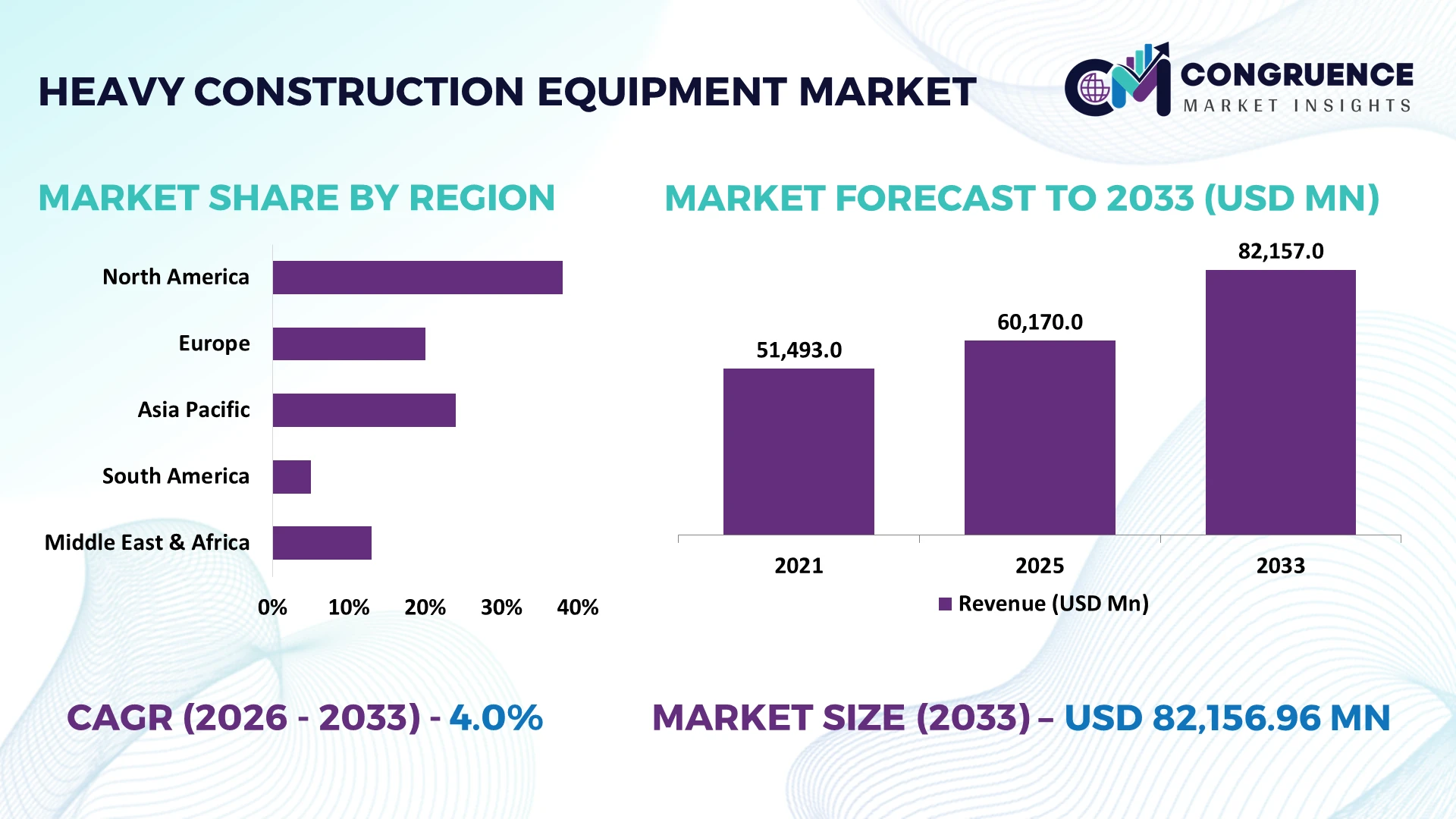
The Global Heavy Construction Equipment Market was valued at USD 60170 Million in 2025 and is anticipated to reach a value of USD 82156.96 Million by 2033 expanding at a CAGR of 3.97% between 2026 and 2033. Growth is driven by infrastructure modernization, mining expansion, fleet replacement, stricter emissions standards, and accelerating adoption of connected, electric, and automated machinery.
China remains the dominant country, supported by 235,257 excavators sold in 2025, including 116,739 exports, representing 49.6% of total excavator sales. Infrastructure construction accounted for 45.87% of China’s construction equipment demand, while electric excavator penetration remained below 1%, creating substantial transition potential. India recorded 136,995 construction equipment units in FY2026, with exports increasing 32%, compared with China’s significantly higher excavator volume. US-China supply-chain realignment and geopolitical trade pressures are accelerating manufacturing localization and export diversification.
Manufacturers should prioritize China-scale production efficiency while expanding localized electric, connected, and export-ready equipment portfolios.
Market Size & Growth: USD 60.17 billion in 2025 to USD 82.16 billion by 2033 at 3.97% CAGR, supported by infrastructure upgrades and fleet replacement.
Top Growth Drivers: Infrastructure modernization 45.87%, equipment replacement 32%, and exports 31.5% are reshaping high-growth demand.
Short-Term Forecast: By 2028, connected equipment deployment is positioned to reduce unplanned downtime by 10% and improve fleet utilization by 8%.
Emerging Technologies: AI telematics, autonomous operation, and electric drivetrains are targeting productivity improvements of more than 10% across selected heavy-equipment applications.
Regional Leaders: Asia Pacific is projected to reach USD 106.49 billion by 2030, North America USD 114.08 billion by 2033, and Europe approximately USD 58.32 billion, with electrification driving technology adoption.
Consumer/End-User Trends: More than 70% of India’s FY2025 construction equipment sales came from earthmoving machines, maintaining excavators and loaders as priority procurement categories.
Pilot/Case Example: China’s electric excavator penetration reached 0.14% in January 2025, establishing an early commercial base for zero-emission construction machinery.
Competitive Landscape: Caterpillar accounts for approximately 15.2% of global construction equipment sales, alongside Komatsu, XCMG, John Deere, and Liebherr.
Regulatory & ESG Impact: China’s emissions-driven equipment upgrades and India’s CEV Stage V transition are increasing demand for lower-emission powertrains and cleaner machinery.
Investment & Funding: India’s construction equipment exports increased 32% in FY2026, strengthening OEM localization, international partnerships, and manufacturing expansion.
Innovation & Future Outlook: AI-assisted operation, autonomous haulage, electric machinery, predictive maintenance, and remote fleet management are shifting competition toward technology-enabled equipment ecosystems.
The Heavy Construction Equipment Market is seeing strongest demand from road construction, mining, commercial development, energy infrastructure, and large-scale urban projects requiring higher equipment utilization and faster project completion. Excavators, loaders, cranes, bulldozers, and material-handling equipment remain core procurement categories, while electric and connected machinery are gaining traction. More than 30% growth in India’s equipment exports highlights increasing global supply-chain diversification, while tighter emissions requirements are accelerating investment in low-emission powertrains, telematics, and automated controls. These demand and technology shifts are creating clear opportunities for manufacturers to strengthen regional production, fleet intelligence, and advanced equipment portfolios.
Heavy construction equipment is becoming strategically important as infrastructure execution, mining expansion, emissions regulation, and supply-chain localization reshape capital-equipment competition. China sold 152,320 excavators in the first half of 2026, up 26.4%, while exports increased 33.5%, demonstrating how production scale and international distribution are becoming competitive advantages. India presents a contrasting structure, with domestic construction equipment sales declining about 7% in FY2026 while exports increased 32%.
Technology is accelerating this shift. Connected telematics and automated controls enable predictive maintenance and utilization optimization, while electric equipment reduces local emissions and energy consumption compared with conventional diesel systems. China remains ahead in manufacturing scale and export deployment, whereas India is strengthening localized production and export competitiveness. India's CEV Stage V implementation from January 2025 is also pushing manufacturers toward cleaner powertrains and upgraded engine systems.
Over the next 2–3 years, manufacturers are expected to prioritize intelligent fleet platforms, electric models, localized components, and export-oriented production. Chinese OEMs are expanding overseas channels, while Indian manufacturers are leveraging a 32% export increase to improve plant utilization and international reach. Companies combining equipment reliability, digital fleet intelligence, regulatory compliance, and regional manufacturing partnerships will strengthen operational positioning and long-term competitiveness.
Infrastructure modernization and technology-led fleet renewal are strengthening equipment demand, particularly for excavators, loaders, cranes, and road-building machinery. India's earthmoving equipment accounted for 71% of construction equipment sales in FY2025, while exports increased 32% in FY2026 despite a 7% domestic decline. China recorded 26.4% growth in excavator sales during the first half of 2026, with exports rising 33.5%. This divergence is pushing manufacturers to balance domestic project exposure with export channels. OEMs are increasing localized production, digital telematics, and overseas distribution partnerships. The non-obvious advantage is utilization balancing: export-oriented capacity can offset temporary infrastructure execution delays in individual countries.
Higher compliance costs and project-financing pressure are restricting near-term equipment replacement in price-sensitive markets. India's domestic construction equipment sales declined 6.7% in FY2026, while stricter CEV Stage V requirements increased equipment prices and financing pressure. China also faces an uneven domestic market as manufacturers increasingly depend on overseas demand, with exports representing nearly half of 2025 excavator sales. Commodity volatility and geopolitical disruption around the Strait of Hormuz add further cost exposure for diesel-intensive construction activity. Manufacturers are responding through supplier localization, longer procurement contracts, modular components, and export diversification. Controlling input exposure is becoming as important as increasing machine volumes.
Electrification and intelligent machinery are opening higher-value opportunities beyond conventional equipment replacement. China recorded 152,320 excavator sales in the first half of 2026, while electric excavators remained a small fraction of total volume, indicating substantial whitespace for battery-powered and hybrid models. India's 32% export increase also demonstrates rising international acceptance of locally manufactured equipment. Over the next several years, OEMs can target urban construction, indoor projects, and low-noise applications where electric machines provide operational advantages. Partnerships with battery suppliers, charging providers, software developers, and fleet operators can reduce technology-development costs while accelerating ecosystem adoption. The strongest opportunity lies in combining machinery with recurring digital fleet-management services.
Scaling intelligent and low-emission equipment creates execution complexity across charging infrastructure, software integration, workforce capabilities, and aftermarket support. China exported 73,295 excavators during the first half of 2026, up 33.5%, increasing the operational footprint that manufacturers must support across diverse markets. Meanwhile, India's CEV Stage V requirements have increased engineering and compliance demands across equipment categories. Connected fleets also require consistent data architectures, cybersecurity controls, and technician training. Companies must therefore invest in interoperable telematics platforms, regional service networks, technician upskilling, and standardized digital diagnostics. The strategic challenge is not simply deploying smarter machines, but maintaining reliable digital and physical support across geographically dispersed fleets.
AI-Enabled Fleet Intelligence: AI-based telematics, predictive maintenance, and machine-control systems are moving from pilot deployments into routine construction workflows. Connected equipment can reduce unplanned downtime by around 10% and improve fleet utilization by approximately 8%, encouraging OEMs to integrate diagnostics, remote monitoring, and automated control into standard equipment packages. Contractors are using equipment-health data to schedule servicing before component failures, improving machine availability and reducing maintenance-related project delays.
Export-Oriented Production Shifts: Chinese excavator exports increased 33.5% in the first half of 2026, while India’s construction equipment exports increased 32% in FY2026. Manufacturers are responding by expanding overseas distribution, localized assembly, regional component sourcing, and service networks. This supply-chain shift is reducing dependence on individual domestic markets while improving factory utilization. The non-obvious change is the growing role of export capacity as a balancing mechanism when domestic construction activity weakens.
Autonomous Mining Deployment: Autonomous haulage is moving from controlled pilots toward larger commercial fleet deployments, with ultra-class autonomous trucks reaching 1,000 commissioned units in 2026. Mining operators are integrating autonomous haulage with fleet-management platforms, dispatch systems, and site analytics to improve cycle consistency and reduce dependence on operator availability. Equipment manufacturers are expanding automation partnerships and developing higher-capacity machinery specifically designed for continuous-duty mining environments and digitally coordinated material movement.
Connected Project Workflows: Digital machine guidance, equipment tracking, 3D control, and real-time project dashboards are becoming integrated into major construction workflows. Connected systems are targeting productivity improvements of 5–10% through better equipment allocation, faster grading, reduced idle time, and improved coordination between machines and project teams. Large contractors are increasingly connecting machine data with project-management platforms, while OEMs are developing interoperable software ecosystems. This is shifting equipment procurement toward integrated hardware, software, and data-management capabilities.
Excavators lead the Heavy Construction Equipment Market with approximately 29% share, supported by extensive deployment across excavation, mining, demolition, foundation preparation, material handling, and utility construction. Loaders account for about 18%, while bulldozers and motor graders together represent nearly 16%, maintaining strong relevance in earthmoving, site preparation, and surface finishing. Dump trucks represent one of the faster-expanding equipment categories as mining operations and infrastructure projects require higher-capacity material transportation. Companies are prioritizing excavators with telematics, automated controls, fuel-efficient hydraulic systems, and interchangeable attachments to improve utilization across multiple applications. Cranes remain critical for industrial and high-rise construction, while pavers support road modernization and motor graders provide precision finishing. Manufacturers are therefore concentrating investment on multifunctional excavators, high-capacity haulage equipment, electric variants, and connected fleet technologies.
Infrastructure Development represents approximately 32% of Heavy Construction Equipment Market demand, supported by highways, bridges, airports, railways, ports, utilities, and large civil-engineering projects requiring continuous deployment of excavators, cranes, graders, dump trucks, and pavers. Road Construction accounts for about 24%, while Mining remains a high-intensity application because equipment operates through extended production cycles. Building Construction continues to favor versatile excavators and loaders, whereas Oil & Gas, Quarrying, and Demolition require specialized high-capacity machinery. Companies are increasingly deploying telematics and machine-control systems to coordinate fleets, reduce idle time by approximately 8%, and improve project scheduling. The increasing complexity of infrastructure projects is shifting procurement toward multifunctional equipment capable of supporting excavation, grading, lifting, hauling, and material-handling activities without extensive fleet duplication.
Construction Contractors represent approximately 40% of Heavy Construction Equipment Market demand because EPC firms, civil contractors, and fleet operators require continuous access to excavators, loaders, cranes, graders, dump trucks, and specialized attachments. Infrastructure Developers contribute around 22%, while Mining Companies generate intensive equipment utilization through continuous material-handling operations. Quarry Operators, Oil & Gas Companies, and Government Agencies maintain more specialized purchasing requirements. Mining Companies represent a faster-expanding buyer group as autonomous haulage, high-capacity equipment, and predictive fleet management improve material movement. Manufacturers are responding through customized fleet packages, equipment financing, maintenance agreements, telematics subscriptions, operator training, and application-specific attachments. Procurement is increasingly shifting from machine acquisition price toward total cost of ownership, uptime, fuel efficiency, service responsiveness, and lifecycle productivity.
Asia-Pacific accounted for the largest market share at approximately 38% in 2025 however, South America is expected to register the fastest growth, supported by mining expansion, infrastructure modernization, and equipment replacement.
Fleet Modernization and Technology-Led Productivity
North America remains a high-value heavy construction equipment market, supported by highway rehabilitation, energy infrastructure, commercial construction, mining, and equipment replacement. The region represented approximately 27% of global construction equipment demand in 2025, with the United States accounting for the majority of regional activity. Caterpillar reported a 6% increase in North American sales in 2025, reflecting stronger equipment volumes and end-user demand. Contractors are increasingly deploying telematics, machine-control systems, and autonomous functions to address labor shortages and improve utilization. Manufacturers are expanding dealer networks, digital services, and rental partnerships while prioritizing fuel-efficient and low-emission equipment. Infrastructure modernization and reshoring-related industrial construction are keeping demand concentrated around excavators, loaders, cranes, and material-handling equipment.
United States Market Outlook: The United States remains the region's largest equipment deployment base, supported by large-scale transportation, energy, manufacturing, and data-center construction. Equipment manufacturers are strengthening localized production, dealer coverage, rental channels, and technology integration to capture replacement demand and improve fleet productivity.
Regulatory Modernization Reshapes Equipment Fleets
Europe's heavy construction equipment market is being reshaped by infrastructure renewal, emissions regulation, labor shortages, and energy-transition investment. Construction equipment sales increased 4.6% in 2025 after a sharp downturn, while civil engineering and infrastructure activity increased approximately 3%, offsetting weaker residential construction. Germany represents about 23% of European equipment sales and remains a critical market for industrial machinery, road equipment, and fleet replacement. Regulatory pressure is accelerating adoption of electric, hybrid, low-emission, and digitally monitored machinery, particularly in urban projects. Manufacturers are responding through localized engineering, battery partnerships, dealer modernization, and lifecycle service contracts. The key operational shift is toward higher-specification machines that combine emissions compliance with automation, remote diagnostics, and lower operating costs, allowing contractors to meet tighter environmental requirements without sacrificing utilization.
Germany Market Outlook: Germany remains Europe's largest national equipment market, supported by industrial construction, road modernization, logistics facilities, and advanced manufacturing. Equipment sales increased approximately 6% in 2025, strengthening replacement activity. OEMs are prioritizing efficient powertrains, automation, and precision-control systems to meet stringent operating requirements.
Manufacturing Scale Meets Export Expansion
Asia-Pacific represents the largest equipment deployment base, accounting for approximately 39% of global construction equipment volume in 2025. China remains the dominant manufacturing and consumption center, while India is strengthening its position through infrastructure development and export-oriented production. Chinese manufacturers sold 235,257 excavators in 2025, including 116,739 exports, representing 49.6% of total sales. India recorded 136,995 construction equipment units in FY2026, while exports increased 32%. Japan and South Korea contribute advanced hydraulics, automation, robotics, and precision-engineered machinery. Companies are expanding localized production, strengthening overseas dealer networks, and developing electric and connected equipment. The region's strategic advantage combines manufacturing scale with rapidly expanding infrastructure deployment, creating an increasingly competitive base for global equipment exports and technology commercialization.
China Market Outlook: China holds the strongest manufacturing position in Asia-Pacific, supported by extensive OEM capacity, domestic infrastructure activity, mining applications, and export networks. Nearly half of excavator sales in 2025 were exported, demonstrating the country's transition from domestic equipment supplier to global machinery competitor. Manufacturers are accelerating electrification and intelligent-machine development.
Mining Investment Drives Specialized Equipment Demand
South America's heavy construction equipment demand is concentrated around mining, infrastructure, quarrying, energy, and agricultural logistics projects. The region accounted for approximately 4% of global equipment volume in 2025, with Brazil representing the dominant national market due to its mining scale, infrastructure requirements, and industrial base. Mining and quarrying applications generate particularly high equipment utilization, increasing demand for excavators, dump trucks, loaders, and specialized material-handling systems. Brazil's mining investment pipeline is encouraging OEMs to strengthen dealer networks, aftermarket support, financing programs, and high-capacity equipment portfolios. Equipment localization remains more limited than in Asia-Pacific, increasing reliance on imported components and machinery. Manufacturers are therefore balancing expansion with localized service infrastructure, while contractors increasingly prioritize fuel efficiency, machine availability, and maintenance responsiveness.
Brazil Market Outlook: Brazil remains the strategic center of South American equipment demand, supported by iron ore, aggregates, road construction, ports, and industrial infrastructure. Mining operations create intensive equipment cycles, encouraging OEMs to expand regional service capabilities and introduce higher-capacity machines. Manufacturers with strong financing and aftermarket coverage are positioned to capture replacement and expansion demand.
Mega-Projects and Mining Reshape Fleet Deployment
Middle East & Africa equipment demand is increasingly concentrated around mega-infrastructure projects, urban development, mining, oil and gas, ports, and logistics corridors. The region represented approximately 10% of global construction equipment volume in 2025, with Saudi Arabia and the United Arab Emirates driving major equipment deployment through large-scale urban and transportation projects. Saudi Arabia's infrastructure and giga-project pipeline is accelerating demand for excavators, cranes, loaders, graders, and concrete equipment. African mining markets are simultaneously increasing demand for high-capacity earthmoving machinery. Manufacturers are expanding dealer networks, equipment financing, local service centers, and strategic partnerships to improve uptime in challenging operating environments. The major operational shift is toward fleet packages combining equipment, maintenance, telematics, and financing, reducing procurement complexity for contractors executing large multi-year projects.
Saudi Arabia Market Outlook: Saudi Arabia represents the region's strongest equipment opportunity because of large-scale urban, tourism, transportation, and industrial development programs. Heavy equipment deployment is increasingly tied to integrated project packages rather than individual machine purchases. OEMs are strengthening local partnerships, service infrastructure, fleet monitoring, and high-capacity equipment portfolios to support demanding project schedules.
The Heavy Construction Equipment Market is led by Caterpillar, Komatsu, XCMG, SANY, and Liebherr, with OEMs against Chinese manufacturers and regional producers. The top five players collectively account for approximately 35% of the market, indicating a fragmented structure where scale does not eliminate regional competition. Competition centers on equipment pricing, fuel efficiency, automation, dealer reach, and customization, with connected-machine adoption improving fleet productivity by 5–10% and advanced powertrains targeting 10%+ lower operating costs. Caterpillar and Komatsu emphasize technology, aftermarket support, and global distribution, while XCMG and SANY compete through manufacturing scale, competitive pricing, and export expansion. Liebherr strengthens its position through specialized engineering and high-value applications. The competitive shift is moving toward localized production, digital platforms, electric machinery, and integrated service contracts. Entry barriers remain high because certification, dealer networks, component supply, financing, and service infrastructure require substantial capital. Winning requires cost discipline, technology differentiation, dependable support, and regional execution.
Caterpillar Inc.
Komatsu Ltd.
XCMG Group
SANY Heavy Industry Co., Ltd.
Liebherr Group
Volvo Construction Equipment
Hitachi Construction Machinery Co., Ltd.
JCB
Deere & Company
CNH Industrial N.V.
Hyundai Construction Equipment
Kobelco Construction Machinery Co., Ltd.
Doosan Bobcat
Zoomlion Heavy Industry Science & Technology Co., Ltd.
Connected telematics, 3D machine control, predictive diagnostics, and remote fleet monitoring are now core technologies, improving equipment utilization by 5–8% and reducing avoidable downtime by 5–10%. Caterpillar reported more than 1.6 million connected assets in 2025, showing that connectivity has moved beyond pilot fleets. Integration with fleet-management platforms gives contractors visibility into fuel use, machine health, cycle times, and operator performance.
Emerging electric drivetrains, battery systems, edge computing, and AI-assisted operator tools are shifting equipment design from mechanical productivity toward software-enabled performance. Electric machines can reduce energy and operating costs by 10–15% in duty cycles, while automated machine-control functions can improve grading or excavation precision by roughly 5–10%. Adoption is strongest in controlled urban, quarry, and mining applications where charging, workflows, or remote operation can be standardized.
Disruptive autonomy and physical AI are becoming the competitive layer. Komatsu commissioned its 1,000th autonomous ultra-class haul truck in 2026, while Caterpillar is extending autonomous technology from mining into construction. By 2028, connected diagnostics, autonomous functions, and AI-based workflow optimization are expected to move into mainstream fleets. New systems can deliver approximately 5–10% better utilization than conventional manual workflows, benefiting OEMs and contractors that combine hardware, software, data, and service capabilities.
January 2026 Caterpillar unveiled five autonomous construction machines and expanded AI integration with NVIDIA, targeting safer, more productive jobsites. The initiative included a $25 million workforce commitment, strengthening commercialization of autonomy, AI-assisted operations, and digital workforce readiness across heavy equipment. Source: caterpillar.com
April 2026 Komatsu commissioned its 1,000th ultra-class autonomous haul truck, a 290-metric-ton payload machine at Nevada Gold Mines. The milestone demonstrates commercial-scale autonomous mining deployment and strengthens Komatsu’s position in automated haulage, supporting productivity, safety, and continuous-duty operations. Source: komatsu.jp
June 2025 Volvo Construction Equipment announced a $261 million production expansion for crawler excavators across South Korea, Sweden, and the United States. The investment increases regional manufacturing flexibility, reduces long-distance logistics exposure, and strengthens supply resilience for high-demand excavator markets. Source: volvogroup.com
March 2026 The Association of Equipment Manufacturers reported construction equipment manufacturing employment increased 2.9% in 2025. The resilience contrasts with broader equipment-sector weakness and signals sustained industrial capability, supporting workforce stability and production capacity for North American construction equipment manufacturers. Source: aem.org
The Heavy Construction Equipment Market Report covers major equipment types including excavators, loaders, bulldozers, dump trucks, motor graders, cranes, and pavers, with analysis across Road Construction, Building Construction, Mining, Infrastructure Development, Oil & Gas, Quarrying, and Demolition applications. End-user coverage includes construction contractors, mining companies, infrastructure developers, quarry operators, oil and gas companies, and government agencies.
Regional assessment spans North America, Europe, Asia-Pacific, South America, and the Middle East & Africa, with country-level analysis of major manufacturing and deployment markets. The report evaluates connected telematics, AI, autonomous operation, electrification, predictive maintenance, machine control, and digital fleet platforms, alongside adoption patterns, competitive positioning, and supply-chain shifts. More than 70% earthmoving concentration in India's equipment sales illustrates the value of segment-level analysis for investment planning, market expansion, product prioritization, partnerships, and competitive strategy through 2033.
| Report Attribute/Metric | Report Details |
|---|---|
Market Revenue in 2025 | USD 60170 Million |
Market Revenue in 2033 | USD 82156.96 Million |
CAGR (2026 - 2033) | 3.97% |
Base Year | 2025 |
Forecast Period | 2026 - 2033 |
Historic Period | 2021 - 2025 |
Segments Covered | By Type
By Application
By End-User
|
Key Report Deliverable | Revenue Forecast, Growth Trends, Market Dynamics, Segmental Overview, Regional and Country-wise Analysis, Competition Landscape |
Region Covered | North America, Europe, Asia-Pacific, South America, Middle East, Africa |
Key Players Analyzed | Caterpillar Inc., Komatsu Ltd., XCMG Group, SANY Heavy Industry Co., Ltd., Liebherr Group, Volvo Construction Equipment, Hitachi Construction Machinery Co., Ltd., JCB, Deere & Company, CNH Industrial N.V., Hyundai Construction Equipment, Kobelco Construction Machinery Co., Ltd., Doosan Bobcat, Zoomlion Heavy Industry Science & Technology Co., Ltd. |
Customization & Pricing | Available on Request (10% Customization is Free) |




