
Reports
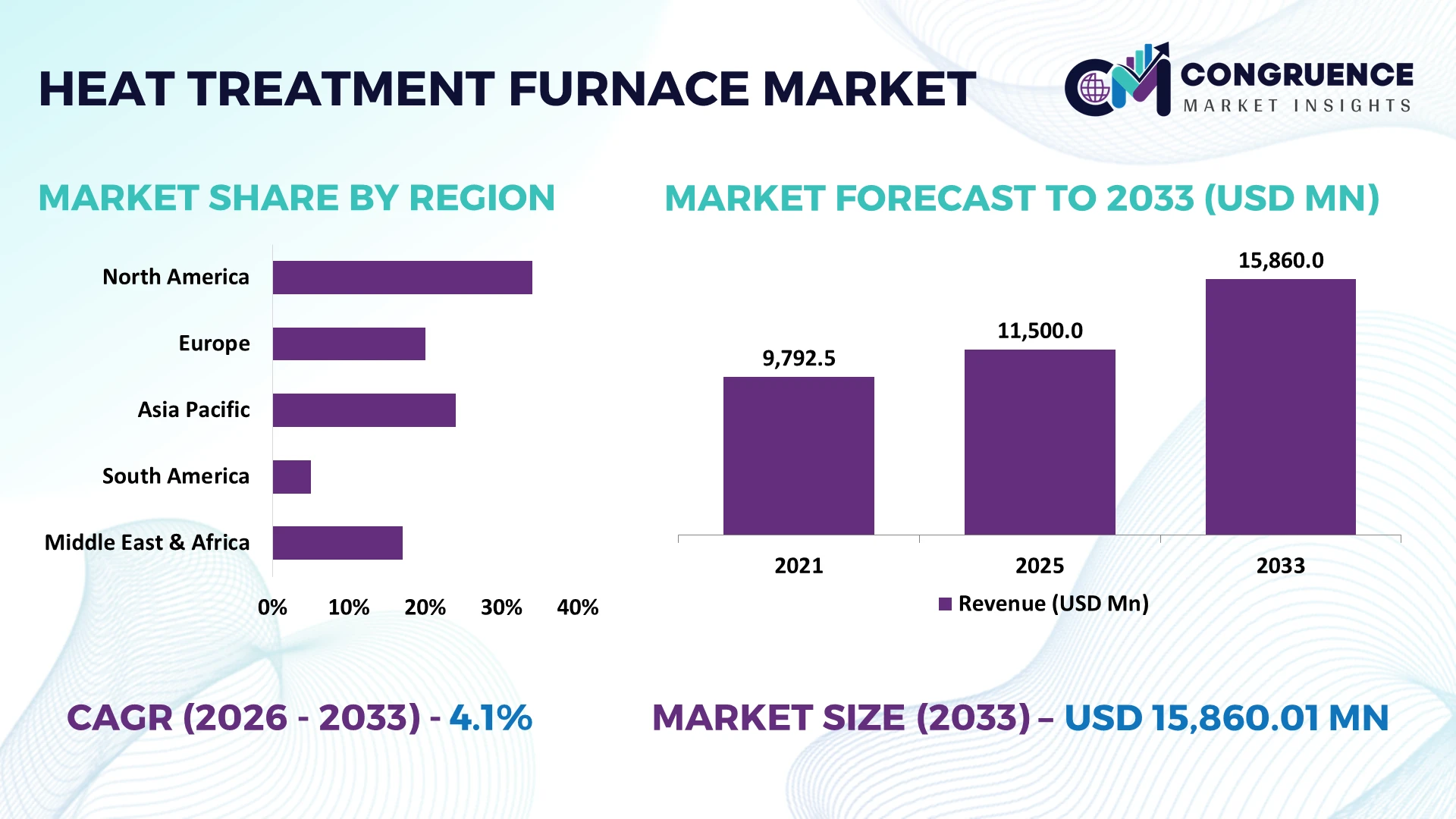
The Global Heat Treatment Furnace Market was valued at USD 11500 Million in 2025 and is anticipated to reach a value of USD 15860.01 Million by 2033 expanding at a CAGR of 4.1% between 2026 and 2033. Growth is driven by automotive electrification, aerospace alloy processing, localized semiconductor manufacturing, and replacement of gas-fired furnaces with electrically heated, vacuum, and atmosphere-controlled systems.
China remains the dominant heat treatment furnace manufacturing and consumption hub, supported by more than 30% of global manufacturing value added and steel production exceeding 1 billion tonnes annually. Automotive, machinery, bearings, aerospace, and EV supply chains underpin utilization, while automated temperature control, vacuum processing, and digital monitoring are penetrating advanced production lines. China’s steel output remains over 10 times Japan’s, reinforcing its furnace-processing scale. China’s manufacturing localization, alongside U.S. CHIPS Act-driven industrial investment and European decarbonization mandates, is accelerating demand for energy-efficient thermal processing platforms.
Strategically, furnace suppliers combining electrification, automation, atmosphere precision, and lifecycle energy optimization will capture the strongest replacement and greenfield opportunities.
Market Size & Growth: USD 11.50 billion in 2025 advances toward USD 15.86 billion by 2033 at 4.1% CAGR, supported by vacuum-processing and industrial electrification upgrades.
Top Growth Drivers: Automotive electrification, aerospace manufacturing, and furnace modernization represent three critical demand engines, with industrial efficiency programs targeting approximately 10–30% energy reductions.
Short-Term Forecast: By 2028, advanced furnace retrofits targeting digital controls, optimized insulation, and heat recovery can reduce thermal-processing energy requirements by approximately 10–20%.
Emerging Technologies: AI-based process optimization, robotic material handling, digital twins, and vacuum carburizing are pushing temperature uniformity toward ±3–5°C across advanced installations.
Regional Leaders: Asia-Pacific leads global installations, while North America and Europe accelerate high-value replacement demand; electric and vacuum furnace adoption increasingly exceeds 30% within advanced processing environments.
Consumer/End-User Trends: Automotive, aerospace, machinery, tooling, and metal-component manufacturers increasingly specify automated furnaces, with connected monitoring capable of reducing process deviations by 10–20%.
Pilot/Case Example: 2025 industrial modernization programs integrating predictive maintenance and sensor-based temperature management demonstrated potential downtime reductions approaching 15% across digitally managed thermal-processing operations.
Competitive Landscape: The top supplier group commands an estimated 25–35% combined presence, led by established specialists including Ipsen, SECO/WARWICK, Tenova, Aichelin, and ECM Technologies.
Regulatory & ESG Impact: European industrial decarbonization and energy-efficiency requirements are accelerating electric furnace conversion, with modern thermal systems targeting approximately 15–30% lower energy consumption.
Investment & Funding: Multi-billion-dollar semiconductor, EV, aerospace, and localized manufacturing investments are expanding downstream heat-treatment requirements, particularly across the United States, China, India, and Europe.
Innovation & Future Outlook: By 2030, AI optimization, hydrogen-compatible heating, digital twins, and low-emission electric furnaces will shift competition toward traceability, automation, and 20%+ lifecycle energy savings.
The global Heat Treatment Furnace Market is increasingly shaped by automotive components, aerospace alloys, tool steels, bearings, EV drivetrains, and precision manufacturing. Vacuum carburizing, intelligent controls, predictive maintenance, and electric heating are improving process consistency, with advanced configurations delivering roughly 15–25% energy savings. Decarbonization requirements and supply-chain localization are strengthening replacement demand, establishing the foundation for deeper strategic market assessment.
Heat treatment furnaces are becoming strategically important as automotive, aerospace, defense, tooling, bearing, and specialty-steel manufacturers tighten metallurgical consistency while reducing energy intensity. Supply-chain localization is shifting thermal-processing capacity closer to component manufacturing hubs, particularly in China, India, the United States, and Germany. China produced about 961 million tonnes of crude steel in 2025, while India reached roughly 165 million tonnes, reinforcing substantial downstream requirements for annealing, carburizing, hardening, and tempering equipment.
Technology economics increasingly favor vacuum, electric, and digitally controlled furnaces over older atmosphere-fired systems. Modern insulation, regenerative heating, variable-speed drives, and optimized process controls can lower furnace energy consumption by roughly 15–25%, while automated recipe control reduces temperature variation and rejected batches. Europe prioritizes electrification and emissions reduction, whereas China emphasizes scale and automation; India combines capacity expansion with modernization of automotive and engineering supply chains.
Through 2027–2029, connected condition monitoring, predictive maintenance, and low-pressure carburizing will penetrate more production lines. A gear manufacturer replacing batch atmosphere carburizing with automated vacuum carburizing can shorten processing cycles while reducing post-treatment cleaning. Furnace suppliers are consequently expanding service networks, controls expertise, localization, and technology partnerships. Competitive advantage will increasingly depend on delivering repeatable metallurgy with lower energy use, faster throughput, and traceable process data.
Industrial electrification and tighter metallurgy specifications are accelerating replacement of aging heat treatment equipment. Modern electric, vacuum, and controlled-atmosphere furnaces can reduce energy consumption by approximately 15–25%, while advanced insulation and process controls improve thermal efficiency by another 5–10% in optimized installations. India’s crude steel production increased about 10% in 2025, strengthening demand from automotive components, bearings, rail equipment, forgings, and industrial machinery. At the same time, aerospace and EV drivetrain manufacturers require tighter hardness profiles and distortion control. This shift moves purchasing criteria from furnace capacity toward process repeatability and lifecycle energy performance. Suppliers are responding through localized assembly, automated loading systems, predictive-maintenance software, and vacuum-processing investment. The operational advantage is significant: higher furnace utilization now directly supports both manufacturing throughput and quality assurance.
High electricity prices, capital-intensive retrofits, and inconsistent industrial infrastructure constrain furnace modernization, particularly for energy-intensive continuous systems. Heat treatment can account for roughly 10–20% of energy consumption within metal-component processing operations, making power-price volatility a direct margin risk. Germany’s industrial electricity costs remain structurally higher than those in several competing manufacturing locations, while converting legacy gas furnaces to electric platforms can require substantial upgrades to transformers, controls, and plant distribution systems. Smaller commercial heat treaters therefore face longer investment payback periods despite efficiency advantages approaching 15–25%. Equipment suppliers are reducing exposure through modular retrofits, hybrid heating architectures, long-term service contracts, and staged automation packages. The critical constraint is not furnace technology availability but whether customers possess sufficient electrical capacity and utilization levels to economically justify conversion.
Low-pressure carburizing, vacuum hardening, digital twins, and AI-assisted recipe optimization create a high-value opportunity beyond conventional furnace replacement. Vacuum systems can eliminate much of the oxidation and post-process washing associated with atmosphere carburizing, while optimized cycle control can lower processing energy requirements by roughly 15–20% and reduce distortion-related rework by around 10%. India’s steel output expanded more than 10% during 2025, creating an attractive installed base for advanced thermal processing across automotive, defense, tooling, and bearing clusters. Over the next three years, closed-loop temperature control and predictive maintenance will increasingly shift furnace economics toward uptime and quality-per-kilowatt rather than equipment capacity alone. Manufacturers are positioning through R&D partnerships, application laboratories, localized service teams, and integrated controls. The non-obvious opportunity lies in recurring software, process-development, and lifecycle optimization services surrounding the furnace asset.
The transition toward connected furnaces creates execution challenges around controls integration, cybersecurity, metallurgical expertise, and operator capability. Modern installations combine PLCs, supervisory software, oxygen probes, mass-flow controllers, robotics, and plant-level manufacturing systems; even a 5–10% degradation in equipment availability can materially weaken the economics of automated heat treatment cells. Cybersecurity exposure also rises as remote diagnostics and cloud-connected condition monitoring become standard. In the United States and Germany, aging industrial workforces intensify shortages of furnace technicians, controls engineers, and metallurgists capable of commissioning advanced systems. Companies must therefore invest in standardized control architectures, remote service platforms, operator training, simulation, and technology partnerships. The decisive long-term issue is deployment consistency: advanced furnaces generate operational advantage only when manufacturers can maintain process knowledge, software integrity, calibration discipline, and service capability across multiple production locations.
Vacuum Processing Moves Mainstream: Commercial heat treaters are shifting selected carburizing and hardening workloads from atmosphere furnaces toward low-pressure carburizing and vacuum quenching. Newer installations can cut post-process cleaning by 20–30%, improve cycle repeatability by 10–15%, and reduce atmosphere-gas consumption substantially. Automotive gear, transmission, and aerospace-component suppliers are adding multi-chamber systems while furnace manufacturers scale application engineering, automated loading, and recipe-management capabilities.
Retrofit Automation Accelerates: Manufacturers are upgrading installed furnaces rather than replacing complete thermal-processing lines. PLC modernization, oxygen probes, automated recipe control, and predictive maintenance can reduce unplanned downtime by 10–20% while improving furnace utilization by approximately 5–10%. Skilled-labor shortages in Germany, Japan, and the United States are reinforcing this shift. Suppliers are responding with modular controls, remote diagnostics, and standardized digital service packages.
Production Footprints Shift Eastward: China and India are attracting additional thermal-processing capacity as automotive, forging, bearing, railway, and machinery supply chains expand locally. Asian automotive output exceeded 60% of worldwide production in 2025, while India’s steel output increased approximately 10%. Heat treaters are consequently adding localized batch, continuous, and induction capacity, while equipment vendors expand service centers, spare-parts inventories, and engineering partnerships closer to industrial clusters.
Quality Traceability Becomes Mandatory: Furnace purchasing increasingly incorporates digital batch records, temperature-uniformity monitoring, atmosphere analytics, and automated compliance documentation. Connected systems can reduce manual inspection effort by 15–25% and shorten deviation investigation by more than 20%. Aerospace and precision-component manufacturers are driving adoption because auditability now carries operational value beyond quality control. Vendors are integrating MES connectivity, cloud diagnostics, and sensor-rich controls into standard furnace platforms.
Batch furnaces account for an estimated 30–33% of the Heat Treatment Furnace Market, supported by their flexibility across hardening, tempering, annealing, stress relieving, and mixed production runs. Their dominance is strongest among commercial heat treaters, toolmakers, forging companies, and automotive component suppliers requiring frequent recipe changes. Modern batch systems incorporating automated charging, atmosphere regulation, and programmable thermal cycles can improve utilization by approximately 8–12% compared with older manually controlled installations. Continuous furnaces remain strategically important for high-volume automotive, bearing, fastener, and steel-component production where stable throughput offsets lower processing flexibility.
Vacuum furnaces represent the fastest-growing type as aerospace, drivetrain, tooling, and specialty-component manufacturers prioritize clean processing, low-pressure carburizing, and distortion control. Vacuum configurations can reduce secondary cleaning requirements by 20–30%, shifting investment toward multi-chamber systems and high-pressure gas quenching. Atmosphere furnaces retain a substantial installed base because of proven economics in carburizing and hardening, while induction furnaces gain relevance where localized heating and short cycle times are critical. Suppliers are expanding modular vacuum platforms while upgrading batch and continuous lines with automation and digital controls.
Hardening leads application demand with an estimated 27–30% market share because gears, bearings, shafts, dies, cutting tools, fasteners, and structural components require controlled hardness and wear resistance at production scale. Automotive transmission and industrial machinery suppliers maintain particularly high furnace utilization for quenching and hardening cycles. Automated temperature regulation and quench control can reduce hardness variation and rejected components by approximately 8–15%. Annealing remains a mature, high-volume application across steel, non-ferrous metals, forgings, and fabricated products, while tempering remains closely tied to hardening operations for balancing strength and toughness.
Carburizing is the fastest-modernizing application as low-pressure vacuum carburizing replaces selected conventional atmosphere processes in high-value drivetrain and precision-engineering workloads. Advanced LPC installations eliminate internal oxidation while delivering carbon penetration from approximately 0.1–5 mm, strengthening adoption for gears and transmission components. Stress relieving remains essential for welded structures, machining-intensive parts, and additive-manufactured components where residual stress affects dimensional stability. Furnace manufacturers are responding with integrated carburizing-quenching cells, automated recipe control, and higher-throughput batch systems as customers prioritize metallurgical consistency over furnace capacity alone.
Automotive accounts for an estimated 34–37% of Heat Treatment Furnace Market demand, reflecting extensive heat treatment requirements for gears, shafts, bearings, transmission components, suspension parts, fasteners, molds, and increasingly EV drivetrain systems. China produced 34.53 million vehicles in 2025, up 10.4%, while new-energy vehicle production reached 16.63 million units, expanding requirements for precision thermal processing across localized component ecosystems. Metalworking remains the second major purchasing group because machining, forging, casting, and fabricated-metal operations depend on annealing, stress relieving, and hardening capacity.
Aerospace is the fastest-growing end-user segment as higher aircraft production, defense programs, superalloy components, and tighter process certification increase demand for vacuum heat treatment. Aerospace furnaces command higher specification levels for temperature uniformity, contamination control, and digital traceability than mainstream automotive equipment. Tool manufacturing continues adopting vacuum hardening and tempering for improved dimensional stability, while energy-equipment manufacturers require thermal processing for turbines, valves, shafts, and power-generation components. Suppliers are responding with aerospace-qualified vacuum systems, automotive-focused continuous lines, and application-specific service partnerships, shifting competition toward process validation and lifecycle support.
Asia-Pacific accounted for the largest market share at 43% in 2025 however, Asia-Pacific is expected to register the fastest growth, expanding at a CAGR of 5.2% between 2026 and 2033.

Aerospace and Reshoring Drive Precision Processing
North America represents approximately 23% of global heat treatment furnace demand, anchored by aerospace, automotive, defense, toolmaking, and commercial heat-treatment networks. U.S. reshoring of semiconductor, defense, EV, and precision-component manufacturing is increasing requirements for vacuum hardening, annealing, carburizing, and controlled-atmosphere processing. Aerospace production creates particularly stringent demand for vacuum systems offering traceability and tight temperature uniformity. Industrial users are simultaneously retrofitting legacy furnaces with digital controllers, automated loading, condition monitoring, and improved insulation, delivering energy reductions approaching 15–25% in optimized installations. Mexico strengthens regional furnace utilization through automotive manufacturing clusters in Guanajuato, Nuevo León, and Coahuila. Equipment vendors are responding with domestic service capabilities, modular retrofits, remote diagnostics, and application engineering, making lifecycle support increasingly important alongside furnace performance.
United States Market Outlook: The United States dominates North American demand through its extensive aerospace, defense, automotive, machinery, and commercial heat-treatment infrastructure. Manufacturing construction investment associated with semiconductor and advanced industrial reshoring has exceeded historical norms, strengthening downstream requirements for thermally processed tooling and components. Vacuum processing and digitally documented thermal cycles are gaining priority where aerospace qualification, metallurgical consistency, and production traceability directly influence supplier approval.
Decarbonization Reshapes Furnace Modernization
Europe holds approximately 21% of global demand, with Germany, Italy, France, the United Kingdom, and Poland supporting dense automotive, aerospace, machinery, tooling, and commercial heat-treatment ecosystems. The structural shift is from conventional gas-intensive equipment toward electric heating, vacuum processing, regenerative burners, heat recovery, and digitally optimized furnace controls. European industrial decarbonization policies make lifecycle energy consumption a stronger procurement criterion, particularly for energy-intensive thermal operations. Advanced retrofits can lower furnace energy requirements by approximately 15–25%, supporting modernization despite challenging industrial electricity economics. Poland and Central European manufacturing hubs are attracting additional vacuum and automotive component-processing capacity as supply chains diversify. Furnace manufacturers are consequently combining new equipment sales with modernization packages, energy-management systems, automation, and service contracts, creating competition around operating economics rather than installed capacity alone.
Germany Market Outlook: Germany remains Europe’s strategically important furnace market because of its automotive engineering, machine-tool, bearing, aerospace, and specialty-metal base. The country produced more than 4 million passenger cars in 2025, sustaining intensive thermal-processing requirements across powertrain, chassis, tooling, and precision components. German manufacturers increasingly prioritize electric heating, process-data documentation, automation, and energy recovery to reconcile demanding metallurgical specifications with decarbonization requirements.
Manufacturing Scale Anchors Global Leadership
Asia-Pacific commands approximately 43% of the global market, supported by exceptional concentrations of steel, automotive, machinery, electronics, shipbuilding, tooling, and industrial-component production. China, India, Japan, and South Korea collectively create substantial installed demand for batch, continuous, atmosphere, induction, and vacuum furnaces. Asia produced more than 59 million motor vehicles in 2025, exceeding 60% of global output and sustaining large-scale hardening, carburizing, annealing, and tempering requirements. India’s steel production also expanded by roughly 10%, strengthening furnace utilization across forgings, bearings, railways, defense, and capital equipment. Investment is progressively moving beyond capacity toward automation, low-pressure carburizing, energy optimization, and digital process control. Global furnace suppliers are localizing engineering and service operations, while Asian manufacturers compete aggressively through scalable systems, shorter delivery cycles, and cost-efficient customization.
China Market Outlook: China provides the market’s deepest manufacturing ecosystem, combining approximately 961 million tonnes of annual crude steel production with 34.5 million vehicles produced in 2025. This scale supports extensive heat-treatment demand across gears, bearings, EV drivetrains, industrial machinery, aerospace components, and tooling. Domestic manufacturers are advancing automated continuous lines and intelligent controls, while premium applications increasingly require vacuum processing, tighter temperature uniformity, and digitally traceable metallurgical cycles.
Industrial Modernization Concentrates Around Brazil
South America represents approximately 6% of global furnace demand, with Brazil providing the primary industrial base and Argentina, Chile, and Colombia contributing specialized metal-processing requirements. Automotive production, mining equipment, agricultural machinery, steel processing, oilfield components, and aftermarket manufacturing underpin furnace utilization. Brazil produces more than 2 million vehicles annually, sustaining hardening, tempering, carburizing, and stress-relieving workloads across localized component supply chains. Modernization remains uneven because smaller processors operate aging batch and atmosphere furnaces, while imported equipment, financing costs, and electrical infrastructure constrain rapid technology replacement. Larger manufacturers are adopting automated controls, improved burners, induction heating, and selective vacuum capacity to reduce energy consumption and quality variation. Suppliers increasingly compete through retrofit packages, local technical support, spare-parts availability, and financing flexibility rather than large greenfield installations.
Brazil Market Outlook: Brazil combines South America’s strongest automotive, steel, mining-equipment, aerospace, and agricultural-machinery manufacturing base. São Paulo and Minas Gerais concentrate substantial metalworking and component-processing capacity, while Embraer’s aerospace ecosystem creates demand for higher-specification thermal processing. Modernization increasingly targets programmable controls, efficient combustion, induction systems, and vacuum equipment where component value and metallurgical tolerances justify higher capital intensity.
Industrial Diversification Expands Processing Capacity
Middle East & Africa accounts for approximately 7% of global demand, with Saudi Arabia, the UAE, Türkiye, and South Africa anchoring industrial furnace requirements across steel, oil and gas equipment, defense, aerospace, automotive, and heavy engineering. Saudi industrial diversification is particularly important as localization programs expand domestic manufacturing of machinery, energy equipment, castings, forgings, and automotive components. The Kingdom targets manufacturing and localized supply chains as core elements of Vision 2030, creating requirements for annealing, hardening, tempering, and stress-relieving infrastructure. The UAE is developing specialized aerospace and precision-engineering capabilities, while South Africa maintains established mining-equipment and metalworking demand. Furnace vendors are pursuing local partnerships, service infrastructure, training, and modular equipment strategies because technical support and qualified operators remain decisive deployment considerations.
Saudi Arabia Market Outlook: Saudi Arabia offers the strongest emerging industrialization pathway through Vision 2030, localization mandates, defense manufacturing, energy-equipment production, and developing automotive clusters. The Kingdom aims to manufacture more industrial products domestically, increasing requirements for metallurgical processing infrastructure. New automotive and machinery investments create an opportunity to install digitally controlled, energy-efficient furnaces directly rather than replicate legacy thermal-processing configurations common in mature manufacturing economies.
Global specialists Ipsen, SECO/WARWICK, Tenova, Aichelin, and ECM Technologies compete against regional furnace manufacturers and application-focused thermal-processing suppliers across automotive, aerospace, tooling, and metalworking accounts. The top five players collectively hold an estimated 28–32% share, indicating a moderately fragmented structure where engineering capability outweighs pure scale. Premium suppliers compete through vacuum processing, low-pressure carburizing, automation, and lifecycle services, while cost-focused manufacturers challenge them through localized production and customization. Advanced systems can deliver 15–25% energy savings and 10–20% lower downtime, making operating economics central to procurement. Leaders are expanding service networks, forming technology partnerships, localizing assembly, and integrating predictive maintenance and digital controls. Competition is shifting from standalone furnace hardware toward connected thermal-processing ecosystems with traceability and energy optimization. Qualification requirements, metallurgical expertise, installed service infrastructure, and capital intensity remain formidable entry barriers. Winning requires validated process performance, rapid support, application-specific engineering, and demonstrably lower lifecycle operating costs.
Ipsen
SECO/WARWICK
Tenova
Aichelin Group
ECM Technologies
Nabertherm
ALD Vacuum Technologies
Gasbarre Products
Surface Combustion
Lindberg/MPH
CAN-ENG Furnaces International
Abbott Furnace Company
Cieffe Thermal Systems
THERELEK Engineers
Current heat treatment technology is shifting toward electric heating, high-pressure vacuum quenching, low-pressure carburizing, and closed-loop atmosphere control. Modern vacuum systems typically improve energy efficiency by 15–25% while reducing oxidation-related rework by 10–20% versus legacy atmosphere furnaces. Automated PLC/SCADA controls, oxygen probes, recipe management, and robotic charging are increasingly standard in new automotive, aerospace, bearing, and tooling installations, with connected monitoring deployed across roughly 30–40% of advanced furnace lines.
Emerging platforms combine digital twins, AI-assisted cycle optimization, predictive maintenance, and sensor-based pyrometry. Condition analytics can reduce unplanned downtime by 10–15%, while intelligent recipe control improves thermal consistency by approximately 5–10%. Multi-chamber vacuum furnaces and high-pressure gas quenching are gaining deployment where distortion control and clean surfaces matter. Compared with conventional gas-fired batch equipment, digitally controlled electric or vacuum furnaces can deliver roughly 20% lower energy use, strengthening competitiveness for high-utilization manufacturers.
Disruptive development centers on hydrogen-compatible heating, zero-emission electric furnaces, autonomous material handling, and integrated MES traceability. Between 2026 and 2028, adoption will concentrate in aerospace, EV drivetrain, defense, and precision engineering plants. Suppliers combining furnace hardware with software, remote diagnostics, and lifecycle optimization gain a commercial advantage because customers increasingly purchase verified process performance rather than heating capacity alone.
June 2024 — SECO/VACUUM secured a nine-furnace contract comprising three Vector vacuum furnaces and six tempering furnaces for a North American heat treater already operating 12 units, accelerating its strategic transition from atmosphere processing toward cleaner vacuum heat treatment. Source: ASM
April 2025 — AICHELIN introduced its energy-efficient roller-hearth furnace for isothermal annealing, supporting batch weights up to 1,200 kg and throughput reaching 4,000 kg/hour while reducing protective-gas consumption, surface scaling, post-processing requirements, and operating complexity for industrial heat treaters. Source: AICHELIN
January 2026 — Ipsen secured its largest equipment order from an aerospace manufacturer after 2025 new-equipment unit sales increased 45% year-over-year, demonstrating accelerating investment in mission-critical thermal processing across aviation, defense, space, medical technology, advanced manufacturing, and energy applications. Source: Airframer
July 2026 — SECO/WARWICK agreed to supply Godrej Aerospace a high-efficiency horizontal vacuum furnace under a turnkey project combining European furnace manufacturing with Indian auxiliary equipment, bringing critical heat treatment in-house while strengthening local production capabilities and supply-chain resilience. Source: SECO/WARWICK
The Heat Treatment Furnace Market Report evaluates batch, continuous, vacuum, atmosphere, and induction furnaces across annealing, hardening, tempering, carburizing, and stress-relieving applications. End-user coverage spans automotive, aerospace, metalworking, tool manufacturing, and energy equipment, while regional assessment covers North America, Europe, Asia-Pacific, South America, and Middle East & Africa. Asia-Pacific represents approximately 43% of market activity, reflecting concentrated automotive, steel, machinery, and component manufacturing.
Technology coverage examines vacuum processing, low-pressure carburizing, high-pressure gas quenching, furnace electrification, AI-enabled controls, predictive maintenance, digital twins, and automated material handling. The report also evaluates modernization opportunities within legacy furnace fleets and emerging precision-processing requirements. Through 2026–2033, these insights support capacity planning, technology investment, geographic expansion, supplier benchmarking, partnership decisions, and competitive positioning as procurement priorities shift toward energy efficiency, process traceability, metallurgical consistency, automation, and lifecycle operating performance.
| Report Attribute/Metric | Report Details |
|---|---|
Market Revenue in 2025 | USD 11500 Million |
Market Revenue in 2033 | USD 15860.01 Million |
CAGR (2026 - 2033) | 4.1% |
Base Year | 2025 |
Forecast Period | 2026 - 2033 |
Historic Period | 2021 - 2025 |
Segments Covered | By Type
By Application
By End-User
|
Key Report Deliverable | Revenue Forecast, Growth Trends, Market Dynamics, Segmental Overview, Regional and Country-wise Analysis, Competition Landscape |
Region Covered | North America, Europe, Asia-Pacific, South America, Middle East, Africa |
Key Players Analyzed | Ipsen, SECO/WARWICK, Tenova, Aichelin Group, ECM Technologies, Nabertherm, ALD Vacuum Technologies, Gasbarre Products, Surface Combustion, Lindberg/MPH, CAN-ENG Furnaces International, Abbott Furnace Company, Cieffe Thermal Systems, THERELEK Engineers |
Customization & Pricing | Available on Request (10% Customization is Free) |




