
Reports
The Global Heat Sinks Market was valued at USD 734.0 Million in 2025 and is anticipated to reach a value of USD 1,163.7 Million by 2033 expanding at a CAGR of 5.93% between 2026 and 2033. Rising thermal-density requirements in AI servers, EV power electronics, 5G infrastructure, and advanced semiconductor packages are driving adoption of high-performance aluminum, copper, vapor-chamber, and liquid-assisted heat-dissipation solutions.
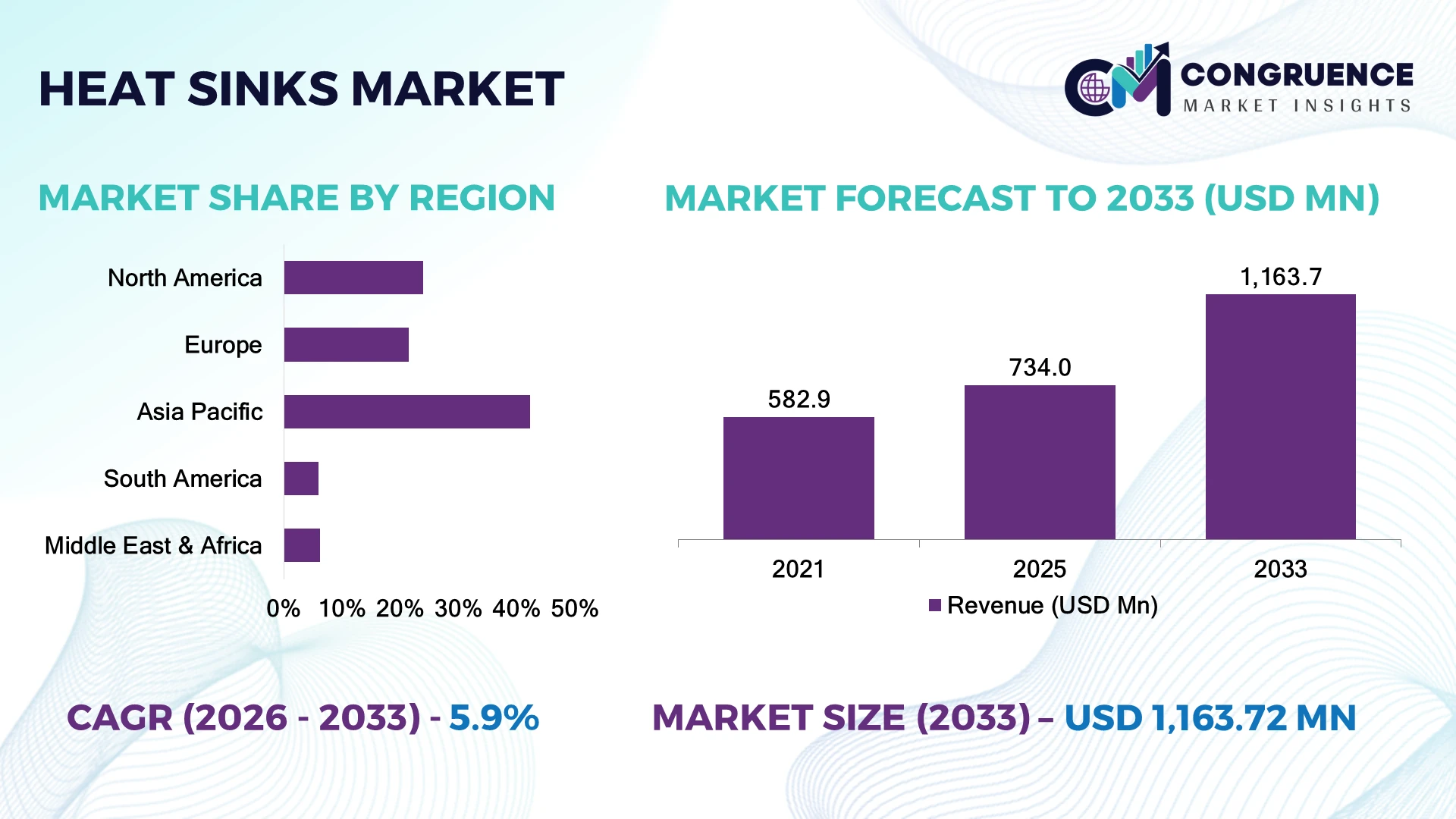
China dominates with an estimated 31% share, supported by extensive electronics, semiconductor, EV, and data-center manufacturing, while the U.S. follows at about 22% with strong AI-server and hyperscale data-center investment. Advanced cooling adoption in new high-density computing deployments is increasingly exceeding 40%, reinforcing Asia-Pacific manufacturing dominance.
Strategically, suppliers with localized production and advanced thermal-management capabilities are best positioned to capture high-density electronics demand.
Market Size & Growth: USD 734.0 million in 2025 to USD 1,163.7 million by 2033 at 5.93% CAGR, driven by AI computing and higher chip thermal loads.
Top Growth Drivers: AI data-center deployment 35%; EV power electronics 28%; 5G infrastructure 24%.
Short-Term Forecast: By 2028, advanced heat-sink adoption is expected to increase about 18%, while optimized thermal designs reduce cooling-related energy consumption by 10–15%.
Emerging Technologies: Vapor chambers, microchannel designs, AI-assisted thermal optimization, and advanced graphite composites are reshaping high-density cooling.
Regional Leaders: Asia-Pacific is projected at USD 560 million by 2033, North America at USD 340 million, and Europe at USD 180 million, supported by data-center, EV, and semiconductor adoption.
Consumer/End-User Trends: Data-center and telecom applications account for more than 45% of advanced thermal-management usage, reflecting rising computational density.
Pilot/Case Example: In 2025, high-density AI-server cooling deployments using advanced thermal architectures delivered approximately 20% lower thermal resistance than conventional finned systems.
Competitive Landscape: Leading suppliers collectively hold an estimated 30% share, with Boyd Corporation, Aavid Thermalloy, Advanced Thermal Solutions, Wakefield-Vette, and CUI Devices competing through customized thermal architectures.
Regulatory & ESG Impact: Energy-efficiency requirements are accelerating thermal optimization, with improved heat dissipation supporting approximately 10% lower cooling energy consumption in optimized installations.
Investment & Funding: More than USD 2 billion in recent semiconductor, AI infrastructure, and data-center thermal-management investments is strengthening demand for localized heat-sink manufacturing and engineering partnerships.
Innovation & Future Outlook: Next-generation vapor chambers, liquid-assisted heat sinks, additive manufacturing, and AI-driven thermal modeling are shifting competition toward application-specific, energy-efficient thermal engineering.
The heat sinks market is seeing strongest demand from AI processors, EV inverters, telecom equipment, gaming hardware, and industrial power electronics, where thermal loads are becoming increasingly concentrated. Advanced vapor-chamber and microchannel designs can deliver roughly 15–25% better thermal performance than conventional configurations. Supply-chain localization and semiconductor capacity expansion in Asia are also encouraging regional thermal-component manufacturing, creating new opportunities for integrated cooling partnerships.
Heat sinks are becoming a strategic component of electronics competitiveness because increasing processor density, EV electrification, and power-conversion requirements are pushing thermal limits closer to system-performance thresholds. In AI servers, a 10–20% improvement in thermal resistance can directly support higher compute utilization while reducing dependence on oversized cooling infrastructure.
The technology transition is particularly visible in the shift from conventional extruded aluminum fins toward vapor chambers, copper composites, microchannels, and hybrid thermal architectures. Advanced designs can reduce thermal resistance by around 15–25% versus legacy configurations. China retains manufacturing scale, while the U.S. leads high-value demand from AI infrastructure and hyperscale data centers; Japan and South Korea remain important for semiconductor-linked precision thermal engineering.
Over the next 2–3 years, companies are prioritizing localized machining, automated production, simulation-led design, and strategic partnerships with semiconductor and server manufacturers. A practical deployment example is AI-server cooling, where compact vapor-chamber solutions enable higher component density without proportionally increasing equipment footprint. The strategic advantage will shift toward suppliers capable of combining thermal performance, rapid customization, supply continuity, and energy efficiency.
AI accelerators and high-performance processors are increasing thermal loads, with advanced computing platforms frequently requiring cooling architectures capable of handling substantially higher heat flux than conventional systems. AI data-center deployments are driving roughly 35% growth in demand for advanced thermal-management configurations, while vapor-chamber and microchannel adoption is increasing by about 20%. U.S. hyperscale expansion and accelerated AI infrastructure investment are pushing server manufacturers toward compact, high-conductivity designs. Suppliers are responding through copper-aluminum hybrid structures, precision machining, and direct partnerships with server OEMs. The non-obvious advantage is not simply heat removal: lower thermal resistance allows manufacturers to increase compute density without proportionally expanding rack footprints, improving infrastructure utilization and deployment economics.
Copper and aluminum remain major cost inputs, exposing heat-sink manufacturers to material-price volatility and procurement pressure. Copper-intensive designs can carry material costs approximately 20–30% above standard aluminum configurations, while complex machining can increase manufacturing costs by 15% or more. Supply-chain disruptions affecting Asian metal processing and semiconductor manufacturing have reinforced the need for procurement diversification. Companies in China, Japan, and the U.S. are increasingly using multi-source contracts, recycled aluminum inputs, and hybrid material architectures to control exposure. The key operational constraint is that higher thermal conductivity often requires premium materials, creating a direct trade-off between cooling performance and unit economics that suppliers must solve through design optimization rather than simple material substitution.
Vapor chambers and microchannel heat sinks are creating an attractive upgrade pathway as electronics manufacturers seek greater thermal performance within smaller footprints. Advanced architectures can improve heat-transfer performance by approximately 15–25%, while compact designs can reduce required cooling-module space by around 10–20%. India's expanding electronics and semiconductor ecosystem presents an emerging manufacturing opportunity alongside established production hubs in China, Taiwan, Japan, and South Korea. Additive manufacturing and computational thermal simulation are enabling more complex internal geometries that conventional machining cannot efficiently produce. Companies are positioning through R&D partnerships, localized fabrication, and co-development with chip, EV, and server manufacturers. A strategic opportunity lies in selling engineered thermal solutions rather than standardized heat sinks.
Modern electronics increasingly require heat sinks to operate as part of integrated thermal-management systems rather than standalone components. Around 20% of advanced cooling projects can involve significant redesign or integration work when package geometry, airflow, fans, liquid loops, and mounting constraints change simultaneously. AI accelerators and EV power modules intensify this complexity because localized hotspots demand precise thermal pathways. Workforce shortages in thermal simulation, computational fluid dynamics, and precision manufacturing add further execution pressure, particularly across rapidly expanding production hubs. Companies must invest in automated simulation, digital-twin workflows, testing infrastructure, and engineering partnerships to maintain consistency. The critical long-term challenge is achieving repeatable thermal performance across high-volume production while accommodating increasingly customized electronics architectures.
AI Cooling Architectures Accelerate: AI processors are pushing thermal loads beyond 1,000 W per accelerator, while high-density racks increasingly reach 100–200 kW. Companies are shifting from conventional fin arrays toward vapor chambers, hybrid heat sinks, and chip-level cooling, with advanced designs targeting 15–25% lower thermal resistance and tighter rack footprints.
Automotive Thermal Integration Expands: Electric-vehicle power electronics are increasing demand for compact thermal solutions, with automotive heat-sink adoption tracking a shift toward 800 V architectures and silicon-carbide modules. Advanced designs can improve thermal performance by 15–20% while reducing component space by roughly 10%. Manufacturers are expanding copper-aluminum structures and co-development programs with automotive electronics suppliers.
Localized Production Gains Priority: Supply-chain restructuring across China, Taiwan, Japan, and the U.S. is encouraging regional heat-sink fabrication, with localized sourcing initiatives targeting 10–15% shorter component lead times and 8–12% lower logistics exposure. Companies are adding automated extrusion, precision machining, and regional supplier networks to reduce dependence on concentrated manufacturing corridors.
Advanced Materials Reshape Design: Copper composites, graphite, microchannel structures, and additive-manufactured geometries are gaining traction as electronics become smaller and hotter. Copper provides nearly twice aluminum’s thermal conductivity, while optimized composite designs can reduce thermal resistance by 10–20%. Companies are increasing simulation-led engineering and material partnerships, particularly for AI, telecom, and high-power industrial electronics.
Passive heat sinks accounted for approximately 54.3% of the global market in 2025, retaining leadership because they require no auxiliary power, offer simple integration, and provide favorable cost-performance for consumer electronics, industrial equipment, and telecom hardware. Their mature manufacturing base supports high-volume aluminum extrusion and die-cast production, while active heat sinks are gaining traction where thermal loads exceed conventional fin-array capabilities. Hybrid heat sinks remain strategically relevant for equipment requiring adaptive cooling without continuous fan operation.
Active heat sinks represent the fastest-changing type, supported by AI servers, EV inverters, and high-power RF electronics. Adoption is increasing as heat flux requirements move toward 85–150 W/cm² in advanced computing environments, while high-density AI racks increasingly operate at 100–200 kW. Companies are responding with variable-speed fans, temperature-controlled airflow, vapor chambers, and integrated monitoring.
Consumer electronics represented approximately 36% of heat-sink demand in 2025, supported by smartphones, laptops, gaming systems, processors, and compact computing devices. High-volume electronics favor lightweight aluminum structures because they combine manufacturability with controlled unit costs. Telecommunications remains a stable application, particularly for 5G infrastructure, optical transceivers, and outdoor equipment, while industrial applications increasingly require customized thermal assemblies for drives, converters, and automation systems.
Automotive is the fastest-expanding application, driven by EV inverters, power modules, onboard chargers, and increasingly dense electronic control architectures. Automotive thermal requirements are shifting toward 800 V systems and silicon-carbide components, raising demand for copper bases, hybrid materials, and precision-machined structures. Companies are expanding automotive-specific engineering and supplier partnerships, while telecommunications manufacturers prioritize compact fanless designs.
OEMs represent the dominant end-user group, accounting for an estimated 70% of heat-sink demand because they integrate thermal components directly into computers, automotive electronics, telecom systems, industrial equipment, and other finished products. Their purchasing decisions emphasize thermal resistance, dimensional consistency, qualification cycles, and high-volume supply reliability. Aftermarket demand remains smaller but important for replacement, performance upgrades, workstation cooling, industrial maintenance, and specialized electronics.
OEM procurement is increasingly shifting toward co-engineered thermal assemblies, with customized solutions representing roughly 20–25% more engineering involvement than standardized components. Aftermarket buyers remain more price-sensitive, while OEMs prioritize reliability and lifecycle performance. Companies are responding by establishing dedicated application-engineering teams, long-term supply agreements, and joint-development programs with electronics manufacturers. AI servers and EV power electronics are strengthening demand for engineered assemblies, while medical, aerospace, and industrial buyers maintain stringent qualification requirements.
Asia-Pacific accounted for the largest market share at 42.3% in 2025 however, Asia-Pacific is expected to register the fastest growth, expanding at a CAGR of 6.82% between 2026 and 2033.
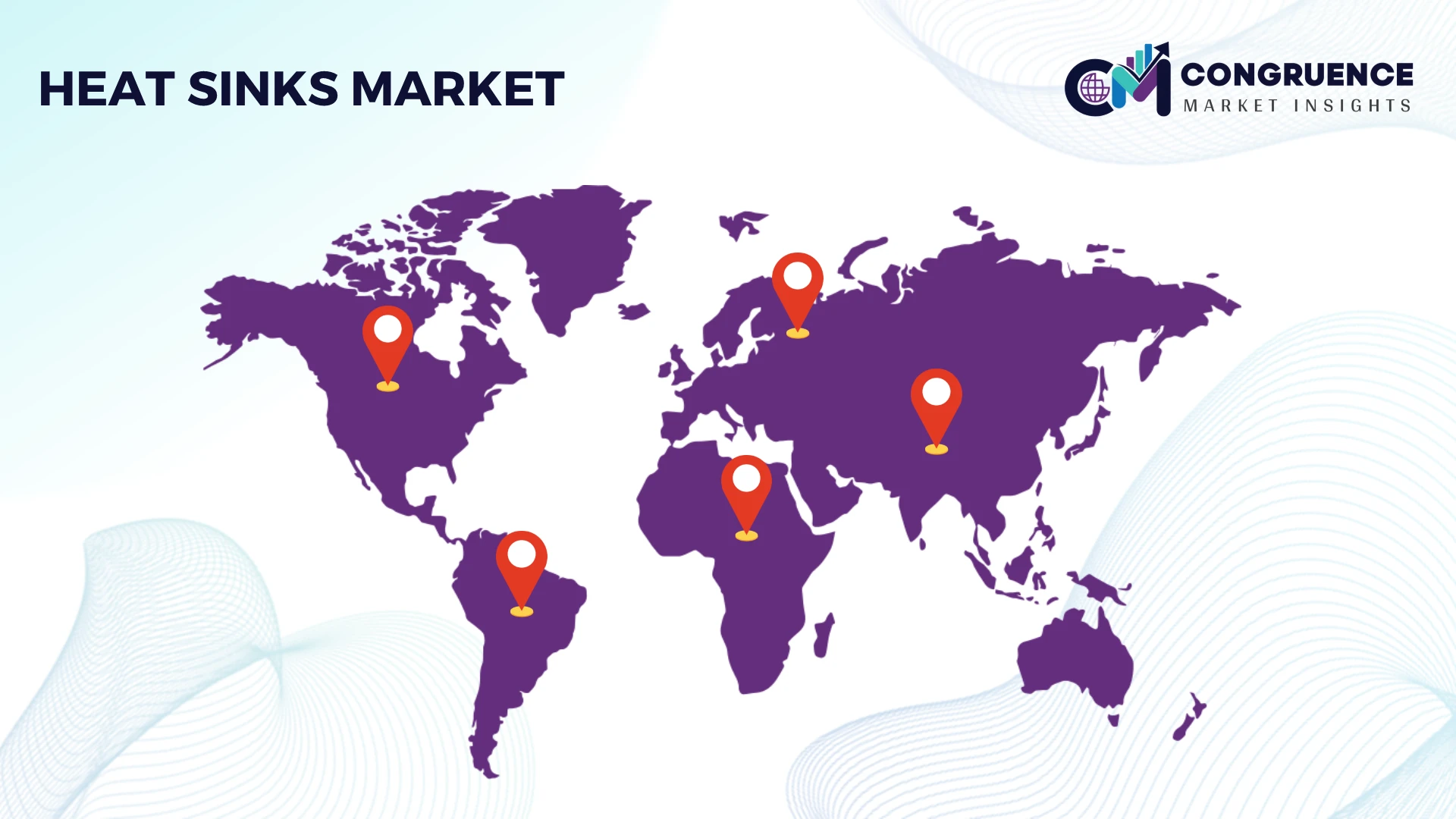
North America represented approximately 24.0% of global heat-sink demand in 2025, supported by hyperscale computing, automotive electronics, aerospace systems, and industrial power equipment. The United States remains the principal demand center, with Northern Virginia, Texas, and Dallas-Fort Worth concentrating major data-center deployments. North American data-center supply expanded 36% during 2025, while net absorption increased 38%, strengthening demand for high-performance thermal assemblies. AI infrastructure is also increasing processor heat density, accelerating adoption of vapor chambers, copper bases, and hybrid cooling architectures. Companies are responding through localized manufacturing, engineering partnerships, and expanded production near major electronics and data-center clusters. The strategic shift is toward design-in thermal partnerships rather than commodity component procurement.
United States Market Outlook: The United States remains North America's strongest heat-sink demand center because of hyperscale computing, semiconductor development, EV electronics, and defense applications. Northern Virginia alone absorbed 1,102 MW of data-center capacity in 2025, while Texas is rapidly expanding its position as a major AI infrastructure hub. This concentration supports premium thermal-component demand and encourages suppliers to establish shorter, more responsive domestic supply chains.
Europe captured approximately 21.5% of global heat-sink demand in 2025, supported by automotive electronics, industrial automation, renewable-energy equipment, telecom infrastructure, and advanced manufacturing. Germany, France, Italy, and the United Kingdom remain important demand centers, while European procurement increasingly favors energy-efficient and recyclable thermal architectures. Automotive electrification is strengthening demand for copper-aluminum assemblies, precision-machined bases, and customized thermal interfaces. Germany's planned €5.6 billion data-center investment near Rostock further reinforces demand for advanced cooling infrastructure, with initial capacity planned at 240 MW. Companies are responding with regional engineering centers, recycled-material programs, and partnerships with automotive and semiconductor manufacturers. Sustainability requirements are also shifting procurement toward longer-life components and lower-material-waste manufacturing.
Germany Market Outlook: Germany is Europe's most strategically significant market because of its automotive manufacturing base, industrial automation capabilities, and growing data-center infrastructure. Its thermal-management demand is increasingly tied to EV power electronics, factory automation, and high-performance computing. The planned Rostock data-center project is designed to scale from 240 MW initially toward 1 GW, strengthening the country's requirements for efficient thermal infrastructure and localized engineering capabilities.
Asia-Pacific accounted for approximately 42.3% of global heat-sink demand in 2025, maintaining the strongest position through electronics manufacturing, semiconductor production, EV assembly, telecommunications, and industrial equipment. China, Taiwan, Japan, and South Korea form an interconnected production ecosystem that shortens component-development cycles and supports high-volume thermal-component procurement. Taiwan's ODM ecosystem is particularly important for AI-server thermal modules, while China's EV manufacturing scale sustains demand for power-electronics cooling. The region also benefits from integrated metal-processing and electronics supply chains, allowing manufacturers to combine extrusion, machining, finishing, and assembly within shorter production cycles. Companies are expanding automated production and application-specific thermal engineering, with investment increasingly directed toward vapor chambers, liquid-assisted modules, and precision copper structures.
China Market Outlook: China remains the largest individual manufacturing center for heat sinks because of its electronics, EV, semiconductor, telecom, and industrial-equipment ecosystem. Its integrated aluminum and copper-processing capabilities support high-volume production and rapid customization. China's new-energy vehicle manufacturing scale also creates substantial demand for thermal components in inverters, battery systems, onboard chargers, and power modules, encouraging suppliers to expand localized production and OEM partnerships.
South America represented approximately 6.0% of global heat-sink demand in 2025, with Brazil accounting for the largest portion through automotive manufacturing, industrial machinery, telecommunications, renewable-energy systems, and commercial electronics. Demand remains concentrated around major industrial corridors where imported components are integrated into locally assembled equipment. Brazil's expanding data-center, renewable-energy, and industrial automation activity is creating additional requirements for reliable thermal management, while local manufacturing depth remains below that of Asia-Pacific. Companies are responding through distributor partnerships, localized assembly, and inventory positioning closer to industrial customers. The non-obvious opportunity is in customized mid-volume thermal assemblies, where regional buyers prioritize delivery reliability and engineering support over the lowest component price. Infrastructure quality and import dependence continue to influence deployment economics.
Brazil Market Outlook: Brazil is the region's strongest opportunity because of its diversified industrial base and comparatively large electronics, automotive, telecommunications, and energy markets. Heat-sink demand is increasingly connected to industrial automation and renewable-energy equipment, where power electronics require reliable thermal control. Suppliers with local inventory and technical support can reduce import-related lead times and improve responsiveness for industrial OEM customers.
Middle East & Africa accounted for approximately 6.2% of global heat-sink demand in 2025, with the Gulf states representing the strongest concentration of advanced cooling requirements. Saudi Arabia and the United Arab Emirates are expanding data centers, digital infrastructure, telecommunications networks, and smart-city systems, creating demand for high-reliability thermal assemblies. Extreme ambient temperatures increase the importance of thermal performance and system efficiency, particularly in outdoor telecom and energy applications. Regional infrastructure programs are also supporting industrial automation and renewable-energy deployment. Companies are responding through regional distribution networks, project-based partnerships, and customized cooling configurations designed for high-temperature operating environments. The strategic distinction is that thermal performance is increasingly tied to infrastructure reliability rather than simply component efficiency, encouraging buyers to prioritize qualified suppliers and service capability.
Saudi Arabia Market Outlook: Saudi Arabia is emerging as the region's most strategically significant market because large-scale digital infrastructure, industrial diversification, renewable-energy development, and data-center projects are increasing demand for reliable thermal management. High ambient temperatures create additional cooling requirements compared with temperate markets, strengthening the value of high-conductivity and robust heat-sink architectures. Suppliers are increasingly positioning through local partnerships and project-specific engineering support.
Boyd, Advanced Thermal Solutions, Wakefield Thermal, CUI Devices, and Fischer Elektronik compete across global thermal-component markets, with integrated suppliers challenging regional cost-focused manufacturers and specialist thermal innovators. The top five players are estimated to control about 18% combined share, indicating a fragmented structure. Competition centers on customization, thermal performance, delivery speed, and supply continuity, with premium engineered solutions commanding roughly 15–25% higher pricing than standard extrusions. Advanced designs can improve thermal resistance by 10–20%, while localized manufacturing can shorten lead times by 10–15%. Boyd is expanding liquid-cooling capacity, ATS is developing application-specific heat sinks, and Wakefield emphasizes broad standard-product availability. The competitive shift is moving from commodity aluminum profiles toward engineered assemblies incorporating vapor chambers, heat pipes, and hybrid materials. Entry barriers include thermal-design expertise, qualification requirements, tooling, and OEM design-in cycles. Winners will combine scalable manufacturing, rapid engineering customization, reliable regional supply, and validated performance for increasingly dense electronics.
Boyd Corporation
Advanced Thermal Solutions, Inc.
Wakefield Thermal
CUI Devices
Fischer Elektronik GmbH & Co. KG
Mechatronics Fan Group
CTX Thermal Solutions GmbH
Advanced Cooling Technologies, Inc.
Ohmite Manufacturing Company
ABL Components
T-Global Technology
Sunonwealth Electric Machine Industry Co., Ltd.
Delta Electronics, Inc.
Advanced vapor chambers, skived fins, microchannels, and hybrid copper-aluminum structures are becoming core technologies for high-heat-flux electronics. Vapor-chamber integration can improve heat spreading by roughly 15–25% versus conventional aluminum-only bases, while skived geometries reduce interface resistance. Adoption is strongest in AI servers, power electronics, and compact computing, where engineered cooling increasingly represents more than 30% of thermal-design activity. Companies benefiting most are suppliers with precision fabrication and co-design capabilities.
Liquid-assisted cooling is moving from specialist deployments into mainstream AI infrastructure, supported by cold plates, coolant distribution units, and direct-to-chip architectures. Compared with legacy air cooling, optimized liquid systems can reduce thermal-management energy requirements by about 20–30% in high-density installations. Boyd’s 2025 delivery of 5 million liquid cold plates demonstrates the scale of this transition. Suppliers are integrating heat sinks with heat pipes, vapor chambers, sensors, and liquid loops to provide complete thermal pathways.
From 2026–2028, AI accelerators, EV power modules, and edge-computing hardware will accelerate adoption of automated thermal simulation, 3D vapor chambers, advanced composites, and additive manufacturing. Digital design tools can shorten thermal iteration cycles by approximately 20%, giving early adopters faster qualification. Competitive advantage will increasingly favor companies combining materials science, simulation, manufacturing automation, and regional supply resilience.
March 2025 Advanced Thermal Solutions introduced heat sinks for AMD Kria K26 SOMs, offering four passive and two active versions. The launch expands application-specific cooling for smart-city and factory systems, strengthening ATS’s embedded-AI thermal portfolio at scale today. Source: qats.com
February 2025 Boyd expanded its Juarez, Mexico thermal campus from 217,000 to approximately 460,000 square feet. The more-than-doubling of manufacturing capacity strengthens supply for AI data centers and hyperscale customers, supporting larger regional production programs worldwide at scale. Source: boydcorp.com
May 2024 Molex introduced Drop Down Heat Sink technology for high-speed optical modules, targeting 224 Gbps PAM-4 systems with nearly 4X power density. The design supports more than 100 insertion cycles, improving durability as data-center interconnect speeds increase. Source: molex.com
September 2024 CTX Thermal Solutions announced a partnership display with PADA Engineering and highlighted liquid-cooled heat sinks delivering 25% higher efficiency. The collaboration broadens customized cooling capacity for high-power electronics and strengthens CTX’s European solution portfolio significantly today. Source: ctx.eu
The Heat Sinks Market Report covers the thermal-management ecosystem across passive and active heat-sink types, including extruded, stamped, skived, bonded, vapor-chamber, and application-specific configurations. Application coverage spans consumer electronics, telecommunications, automotive, industrial equipment, computing, and high-power electronics, while end-user analysis evaluates OEMs, system integrators, distributors, and aftermarket buyers. The study assesses adoption across North America, Europe, Asia-Pacific, South America, and Middle East & Africa, with country-level emphasis on major manufacturing and deployment hubs.
The report evaluates advanced materials, thermal-interface integration, heat pipes, microchannels, liquid-assisted cooling, digital thermal simulation, and high-density AI cooling architectures. It identifies shifting segments, supply-chain localization, manufacturing strategies, and key participants shaping product innovation. The analysis supports investment planning, manufacturing expansion, partnership selection, competitive positioning, technology prioritization, and strategic decisions for 2026–2033, including opportunities in AI infrastructure, EV power electronics, and edge-computing systems.
| Report Attribute / MetricDetails | Details |
|---|---|
| Market Revenue (2025) | USD 734.0 Million |
| Market Revenue (2033) | USD 1,163.7 Million |
| CAGR (2026–2033) | 5.93% |
| Base Year | 2025 |
| Forecast Period | 2026–2033 |
| Historic Period | 2021–2025 |
| Segments Covered |
By Type
By Application
By End-User
|
| Key Deliverables | Revenue Forecast; Market Trends; Growth Drivers & Restraints; Technology Insights; Segmentation Analysis; Regional Insights; Competitive Landscape; Regulatory & ESG Overview; Recent Developments |
| Regions Covered | North America; Europe; Asia-Pacific; South America; Middle East & Africa |
| Companies Profiled | Boyd Corporation; Advanced Thermal Solutions, Inc.; Wakefield Thermal; CUI Devices; Fischer Elektronik GmbH & Co. KG; Mechatronics Fan Group; CTX Thermal Solutions GmbH; Advanced Cooling Technologies, Inc.; Ohmite Manufacturing Company; ABL Components; T-Global Technology; Sunonwealth Electric Machine Industry Co., Ltd.; Delta Electronics, Inc. |
| Customization & Pricing | Available on Request (10% Customization Free) |




