
Reports
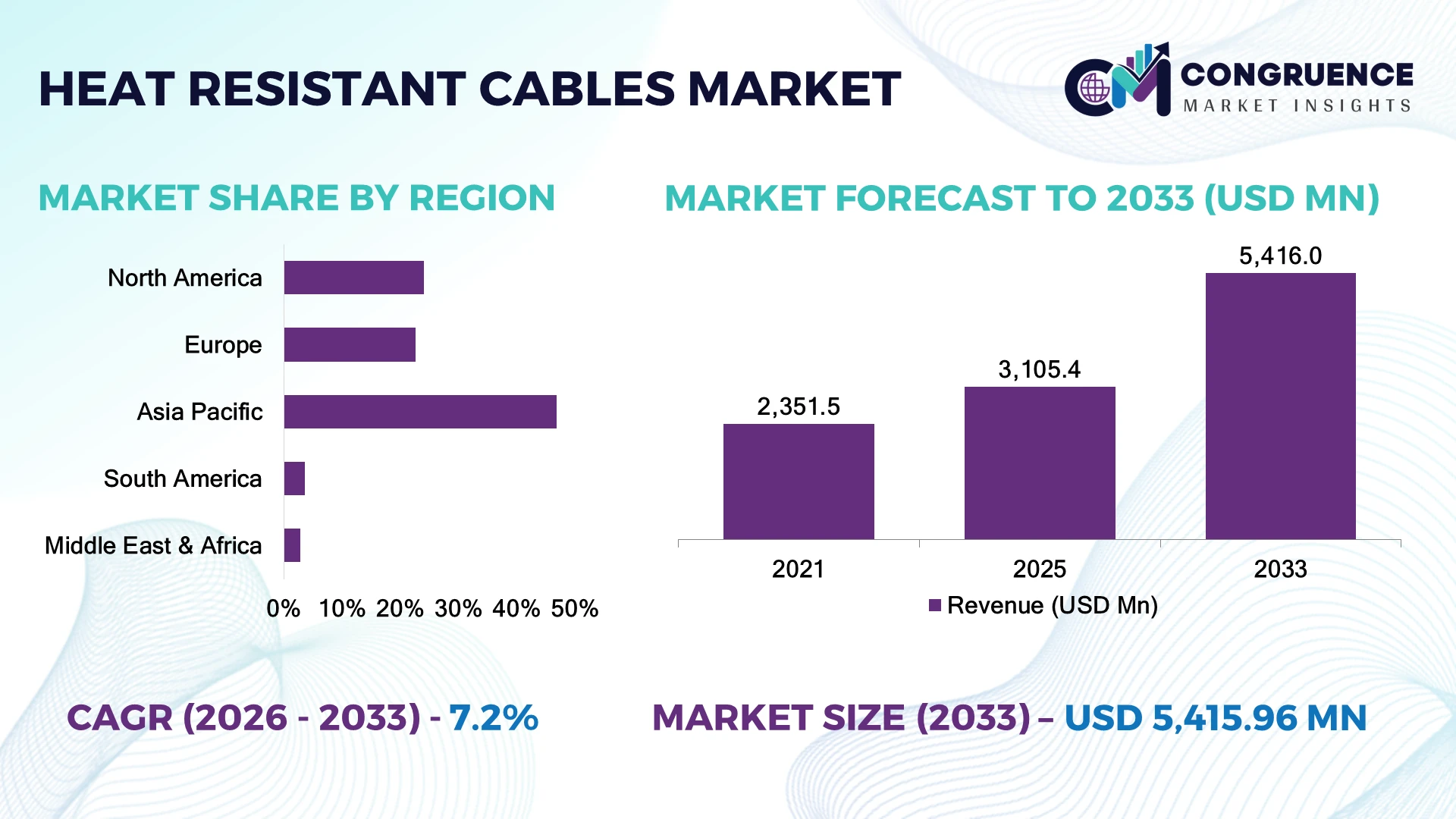
The Global Heat Resistant Cables Market was valued at USD 3,105.4 Million in 2025 and is anticipated to reach a value of USD 5,416.0 Million by 2033 expanding at a CAGR of 7.2% between 2026 and 2033. Growth is driven by expanding renewable energy infrastructure, industrial electrification, electric vehicle manufacturing, and stringent fire safety standards requiring high-temperature cable performance.
China accounts for approximately 34% of global heat resistant cable manufacturing capacity, supported by sustained investments in power infrastructure, semiconductor fabrication, rail electrification, and electric vehicle production. Compared with Germany, China manufactures nearly 2.8 times more industrial heat-resistant cable volume, while over 61% of new high-voltage industrial installations utilise advanced silicone and cross-linked polymer insulated cables. Ongoing supply-chain diversification following geopolitical trade realignments is strengthening regional production resilience and localisation strategies.
Manufacturers investing in advanced insulation technologies, vertically integrated production, and application-specific cable solutions will secure stronger positions across critical infrastructure and industrial electrification projects.
Market Size & Growth: USD 3,105.4 million in 2025 to USD 5,416.0 million by 2033 at 7.2% CAGR, supported by industrial electrification and advanced insulation technologies.
Top Growth Drivers: Renewable energy installations (+29%), EV manufacturing (+24%), industrial automation (+21%).
Short-Term Forecast: By 2028, cable failure rates decline approximately 16% through improved insulation materials.
Emerging Technologies: Silicone insulation, XLPE innovation, and smart cable monitoring improve operational reliability.
Regional Leaders: Asia-Pacific (~USD 2.6 billion), Europe (~USD 1.1 billion), North America (~USD 920 million), driven by infrastructure upgrades.
Consumer/End-User Trends: Approximately 58% of industrial projects specify fire-resistant, high-temperature cable systems.
Pilot/Case Example: 2026 industrial plant modernisation improved cable service life by nearly 22%.
Competitive Landscape: Leading supplier holds approximately 15% share alongside Prysmian, Nexans, LS Cable & System, and NKT.
Regulatory & ESG Impact: Enhanced fire-safety standards reduce electrical incident risks by approximately 19%.
Investment & Funding: More than USD 5.8 billion committed to power transmission, manufacturing expansion, and grid modernisation.
Innovation & Future Outlook: Advanced polymer insulation and digital cable monitoring are redefining infrastructure resilience.
The Heat Resistant Cables Market is increasingly supported by power generation, steel manufacturing, rail transport, electric vehicles, and petrochemical facilities requiring reliable performance under extreme operating temperatures. Approximately 47% of new industrial cable specifications now incorporate enhanced thermal insulation materials, while stricter electrical safety regulations and regional manufacturing localisation continue reshaping procurement strategies, creating a strong foundation for long-term strategic investment.
Heat resistant cables have become a strategic component of industrial infrastructure as manufacturers, utilities, and transportation operators modernise facilities to support higher operating temperatures, improved electrical reliability, and stricter fire safety requirements. Infrastructure modernisation, renewable energy integration, and industrial automation are accelerating demand for advanced cable technologies capable of maintaining performance in demanding operating environments. Supply-chain restructuring is also encouraging regional production expansion to reduce dependence on imported specialty cable materials.
Modern silicone rubber and cross-linked polymer insulated cables deliver approximately 27% greater thermal endurance than conventional PVC-insulated products while reducing maintenance interventions by nearly 18% in continuous industrial operations. Asia-Pacific leads large-scale manufacturing through integrated cable production and expanding infrastructure investment, whereas Europe focuses on premium fire-resistant technologies and regulatory-driven product innovation. Over the next two to three years, more than 55% of newly commissioned heavy industrial facilities are expected to specify advanced heat resistant cable systems supporting digital monitoring and enhanced operational safety.
Power generation plants, electric vehicle manufacturing facilities, and steel processing complexes increasingly deploy heat resistant cables to improve operational continuity in high-temperature environments. Cable manufacturers are expanding specialty production capacity, strengthening partnerships with EPC contractors, and investing in advanced insulation compounds tailored for critical infrastructure. Companies combining material innovation, certified product performance, and resilient regional manufacturing capabilities will strengthen competitive positioning as industrial electrification and infrastructure upgrades continue to reshape long-term market demand.
Industrial electrification across energy, transportation, metals, and manufacturing is accelerating demand for heat resistant cables capable of operating under continuous thermal stress. Approximately 64% of new heavy industrial electrical installations now specify high-temperature cable systems, while advanced insulation materials improve thermal endurance by nearly 24% and reduce unplanned cable failures by approximately 18%. India's rapid expansion of renewable power projects and industrial corridors is increasing procurement of fire-resistant cable infrastructure for substations and process industries. Higher operational reliability directly lowers maintenance costs and plant downtime. Cable manufacturers are expanding silicone rubber and XLPE production, investing in material innovation, and strengthening partnerships with EPC contractors to deliver certified cable systems tailored for demanding industrial environments.
Heat resistant cable production remains highly exposed to fluctuations in copper, aluminium, silicone compounds, and specialty polymer prices, creating persistent pressure on manufacturing margins. Raw materials represent approximately 57% of production costs, while insulation compound prices have fluctuated by nearly 14% during recent supply-chain adjustments. Germany continues facing procurement challenges for selected specialty insulation materials due to shifting global trade patterns and energy-intensive manufacturing costs. These conditions reduce pricing flexibility and complicate long-term project bidding for cable suppliers. Manufacturers are mitigating risk through strategic sourcing agreements, localisation of compound production, material substitution, and expanded recycling programmes that improve supply stability without compromising cable performance.
The integration of intelligent monitoring technologies into power infrastructure and industrial facilities is opening high-value opportunities for advanced heat resistant cables. Approximately 38% of new smart grid projects incorporate condition-monitoring cable systems, while predictive maintenance solutions reduce unexpected electrical failures by nearly 21% and maintenance costs by approximately 16%. Japan is accelerating investment in resilient energy infrastructure, encouraging adoption of digitally monitored high-temperature cable networks. Manufacturers are developing sensor-integrated cable systems, expanding research into next-generation insulation materials, and partnering with automation companies to deliver intelligent electrical infrastructure. An emerging opportunity lies in combining thermal resilience with real-time asset monitoring for mission-critical industrial applications.
Meeting diverse international fire safety, electrical performance, and industrial certification standards remains a significant execution challenge for heat resistant cable manufacturers. Approximately 34% of product development cycles require additional qualification testing for multiple export markets, while certification timelines increase commercial launch periods by nearly 19%. The United States continues tightening performance expectations for critical infrastructure cable systems, requiring extensive validation across industrial and utility applications. Extended testing requirements increase development costs and delay product commercialisation despite growing market demand. Manufacturers must invest in advanced testing laboratories, harmonised product engineering, regulatory expertise, and collaborative certification programmes to maintain competitiveness across increasingly complex global infrastructure projects.
Advanced Insulation Materials Expand: Approximately 46% of newly specified industrial cable systems now utilise upgraded silicone rubber and cross-linked insulation technologies, improving thermal stability by nearly 23% and extending operational life by approximately 17%. Stricter fire safety requirements are encouraging manufacturers to accelerate material innovation and premium product development.
Digital Cable Monitoring Grows: Intelligent cable monitoring systems have been adopted across nearly 35% of newly commissioned critical infrastructure projects, reducing fault detection time by approximately 28% and maintenance interventions by nearly 19%. Utilities and industrial operators are integrating predictive diagnostics with electrical asset management to improve network reliability and reduce operational disruption.
Localised Manufacturing Accelerates: Supply-chain diversification has prompted manufacturers to increase regional production capacity, with approximately 32% of new cable investments supporting local manufacturing and shorter delivery cycles. Companies are restructuring supplier networks, expanding compound production, and strengthening strategic partnerships to improve procurement resilience amid changing global trade conditions.
Fire Safety Standards Tighten: Nearly 54% of major industrial construction projects now specify enhanced fire-resistant cable systems exceeding previous thermal performance requirements. Engineering contractors increasingly prioritise certified high-temperature solutions for power plants, tunnels, and transportation infrastructure, prompting cable producers to expand testing capabilities, certification programmes, and application-specific product portfolios.
Cross-Linked Polyethylene (XLPE) Heat Resistant Cables account for approximately 44% of the global market due to their superior thermal stability, mechanical strength, and cost-effective deployment across power transmission, industrial plants, and renewable energy infrastructure. Their compatibility with medium- and high-voltage installations makes them the preferred solution for large-scale electrification projects. Silicone Rubber Heat Resistant Cables represent the fastest-growing segment as industries requiring continuous operation above 180°C increasingly prioritise enhanced flexibility and fire performance. Mineral Insulated, Fluoropolymer (PTFE/FEP), and EPR-insulated cables continue serving specialised applications in petrochemical processing, aerospace, railways, and nuclear facilities where extreme operating conditions demand premium insulation performance.
Silicone cable adoption has increased by approximately 26% across high-temperature manufacturing environments, while XLPE cable deployment improves lifecycle reliability by nearly 19% compared with conventional insulation systems. Manufacturers are investing in advanced polymer compounds, expanding speciality cable production, and partnering with industrial EPC contractors to deliver application-specific cable solutions. Investment priorities continue shifting toward premium insulation technologies supporting electrification, automation, and critical infrastructure resilience.
According to a 2026 technical assessment published by the International Cablemakers Federation, industrial infrastructure developers increasingly specify advanced XLPE and silicone-insulated cables for high-temperature applications requiring enhanced operational reliability and longer service life.
Power Generation accounts for approximately 37% of global Heat Resistant Cables demand, driven by thermal power stations, renewable energy facilities, substations, and grid modernisation projects requiring reliable high-temperature electrical systems. These environments demand cables capable of maintaining electrical integrity under continuous thermal and mechanical stress. Oil & Gas represents a mature application supported by refinery and offshore operations, while Industrial Manufacturing, Railways, Automotive, Aerospace & Defence, and Building & Construction continue expanding demand as electrification and safety standards evolve. High-performance cable systems remain essential where operational continuity directly affects productivity and infrastructure reliability.
Electric Vehicle Manufacturing is the fastest-growing application segment as battery production facilities and EV assembly plants require specialised high-temperature cable networks. Approximately 29% of newly commissioned industrial electrical systems now incorporate enhanced thermal-resistant cables, while digital plant automation has increased cable specification upgrades by nearly 18%. Manufacturers are expanding certified product portfolios, integrating smart monitoring compatibility, and strengthening engineering partnerships to support increasingly demanding industrial applications where long-term operational reliability is becoming business critical.
A 2025 enterprise infrastructure survey by the International Electrotechnical Commission identified thermal performance and fire resistance as leading procurement priorities for electrical cable systems across modern industrial and energy facilities.
Utilities account for approximately 41% of global Heat Resistant Cables procurement because of extensive investments in transmission networks, substations, renewable energy integration, and grid reliability programmes. Large utility operators require certified cable systems capable of supporting continuous operation under elevated temperatures while ensuring long-term network resilience. Industrial Manufacturing Companies remain another major buyer group through steel, cement, chemical, mining, and processing facilities. EPC Contractors, Transportation Infrastructure Operators, Renewable Energy Developers, and Commercial Construction Companies continue expanding procurement as electrical safety, automation, and infrastructure modernisation become strategic priorities.
Renewable Energy Developers represent the fastest-growing end-user segment, with procurement increasing by approximately 24% as utility-scale solar, wind, and battery storage installations expand globally. Custom-engineered cable specifications have increased by nearly 21% for critical infrastructure projects requiring enhanced thermal endurance and fire performance. Manufacturers are responding through customised engineering support, long-term supply agreements, localisation strategies, and collaborative product development to strengthen competitive positioning across infrastructure-intensive industries.
According to a 2026 industry assessment by the International Energy Agency, expanding electricity networks and renewable energy infrastructure continue increasing demand for high-performance cable systems designed for reliable long-term operation in challenging environments.
Asia-Pacific accounted for the largest market share at 46.8% in 2025 however, Middle East & Africa is expected to register the fastest growth, expanding at a CAGR of 8.1% between 2026 and 2033.
Grid Modernisation Strengthens Premium Cable Demand
North America accounts for approximately 24.1% of the global Heat Resistant Cables market, supported by power grid upgrades, industrial automation, data centre expansion, and renewable energy integration. Utilities, petrochemical facilities, semiconductor plants, and electric vehicle manufacturing continue increasing demand for high-temperature cable systems capable of operating in critical environments. Nearly 49% of new industrial electrical projects now specify enhanced fire-resistant cable solutions, while investments in transmission infrastructure are accelerating deployment of advanced insulation technologies. Cable manufacturers are expanding domestic production, strengthening engineering partnerships with EPC firms, and introducing digitally monitored cable systems that improve operational reliability while meeting stricter electrical safety standards.
United States Market Outlook: The United States leads regional demand through extensive investments in transmission networks, semiconductor manufacturing, defence infrastructure, and electric vehicle production. Large industrial operators increasingly specify certified heat resistant cable systems for mission-critical applications requiring long-term reliability. Approximately 53% of utility-scale electrical infrastructure upgrades now include advanced thermal-resistant cable technologies, encouraging manufacturers to expand local production capacity, testing facilities, and customised engineering support.
Fire Safety Compliance Drives Product Innovation
Europe represents approximately 22.6% of the global market, supported by stringent fire safety regulations, industrial electrification, railway modernisation, and renewable energy deployment. Demand is concentrated in advanced manufacturing, energy infrastructure, and transportation projects where operational reliability and low-smoke cable performance are critical. Around 44% of newly specified industrial cable systems incorporate enhanced fire-resistant insulation technologies. Manufacturers continue investing in halogen-free compounds, premium insulation materials, and regional production capabilities while strengthening certification programmes to address evolving infrastructure and sustainability requirements.
Germany Market Outlook: Germany remains Europe's leading market due to its advanced industrial manufacturing sector, electrical engineering expertise, and large-scale infrastructure modernisation programmes. Automotive production, industrial automation, and renewable energy projects continue supporting demand for high-performance cable systems. Approximately 46% of heavy industrial electrical installations specify premium heat resistant cables, encouraging suppliers to strengthen material innovation, manufacturing efficiency, and technical application support.
Manufacturing Scale Powers Market Leadership
Asia-Pacific contributes approximately 46.8% of the global Heat Resistant Cables market through large-scale cable manufacturing, rapid industrialisation, expanding power infrastructure, and strong investment in renewable energy and transportation networks. China, India, Japan, and South Korea continue increasing demand for high-temperature cable systems across utilities, industrial plants, electric vehicle production, and rail infrastructure. Nearly 59% of new industrial electrical installations in the region utilise advanced insulation technologies capable of supporting demanding operating conditions. Manufacturers are expanding regional production facilities, localising specialty material sourcing, and strengthening partnerships with infrastructure developers to improve supply resilience.
China Market Outlook: China dominates the regional market through integrated cable manufacturing, extensive power infrastructure expansion, and leadership in industrial electrification. Large investments in renewable energy, high-speed rail, and advanced manufacturing continue supporting strong procurement of premium cable systems. Approximately 63% of new utility and industrial transmission projects incorporate advanced heat resistant cable technologies, reinforcing the country's position as the leading production and deployment hub.
Infrastructure Investment Expands Industrial Cable Adoption
South America is experiencing steady growth in heat resistant cable demand through power transmission upgrades, mining operations, industrial processing, and renewable energy development. Brazil and Chile continue modernising electrical infrastructure to improve reliability in high-temperature operating environments. Approximately 31% of new industrial projects specify upgraded fire-resistant cable systems, while investment in renewable generation is accelerating demand for specialised electrical infrastructure. Manufacturers are expanding regional distribution networks and technical support capabilities while balancing growth opportunities with dependence on imported specialty insulation materials and varying project execution timelines.
Brazil Market Outlook: Brazil represents the largest regional market owing to its diversified industrial base, expanding transmission infrastructure, and large renewable energy portfolio. Mining, utilities, and manufacturing industries continue upgrading electrical systems requiring high-temperature cable performance. Approximately 39% of new industrial electrification projects include advanced heat resistant cable installations, encouraging suppliers to strengthen local inventory, engineering services, and project-specific product offerings.
Energy Infrastructure Modernisation Accelerates Investment
The Middle East & Africa market is expanding through major investments in power generation, oil and gas facilities, desalination plants, and smart infrastructure developments requiring high-performance electrical cable systems. Industrial diversification programmes and utility expansion continue increasing demand for advanced heat resistant cables capable of operating under extreme environmental conditions. Approximately 36% of recently commissioned industrial facilities incorporate premium fire-resistant cable solutions, while infrastructure modernisation projects are driving procurement of specialised insulation technologies. Manufacturers are establishing regional supply hubs, expanding technical service networks, and collaborating with EPC contractors to support long-term infrastructure programmes.
Saudi Arabia Market Outlook: Saudi Arabia leads regional demand through extensive investment in power infrastructure, petrochemical complexes, industrial cities, and large-scale energy transition projects. High-temperature operating conditions and critical industrial processes require durable cable systems with superior thermal performance. Approximately 42% of new energy and industrial developments specify advanced heat resistant cables, encouraging manufacturers to expand regional partnerships, local assembly capabilities, and technical engineering support for strategic infrastructure projects.
Global leaders Prysmian, Nexans, NKT, LS Cable & System, and Sumitomo Electric compete against regional manufacturers through technology leadership, project execution, and manufacturing scale rather than price alone. The top five companies collectively account for approximately 49% of the global market. Competition centres on advanced insulation materials, fire-performance certification, and supply reliability, with premium cable systems extending service life by nearly 22% and reducing maintenance requirements by approximately 18%. Manufacturers are expanding production capacity, securing long-term utility contracts, integrating compound production, and partnering with EPC contractors to strengthen project delivery. The competitive shift favours vertically integrated suppliers capable of controlling raw material sourcing and specialty insulation development while meeting increasingly stringent certification requirements. High qualification costs, specialised testing infrastructure, and long customer approval cycles remain key entry barriers. Success depends on combining certified high-temperature performance, resilient manufacturing capacity, engineering support, and dependable supply chains for critical infrastructure projects.
Prysmian S.p.A.
Nexans S.A.
NKT A/S
Sumitomo Electric Industries, Ltd.
LS Cable & System Ltd.
Furukawa Electric Co., Ltd.
Southwire Company, LLC
Elsewedy Electric
Taihan Cable & Solution Co., Ltd.
Hengtong Group Co., Ltd.
TPC Wire & Cable Corp.
Tratos Group
HELUKABEL GmbH
SAB Bröckskes GmbH & Co. KG
Heat resistant cable technology is advancing through silicone rubber insulation, cross-linked polyethylene (XLPE), fluoropolymer compounds, and halogen-free flame-retardant materials. Approximately 63% of new industrial cable installations now specify advanced insulation systems that improve thermal endurance by nearly 24% while reducing maintenance frequency by approximately 17%. Smart cable monitoring integrated with industrial automation platforms is also gaining traction across utilities and manufacturing facilities, improving fault detection and asset reliability.
Compared with conventional PVC-insulated cables, modern silicone and fluoropolymer cable systems withstand temperatures approximately 35% higher while extending operational service life by nearly 28%. Around 41% of newly commissioned power infrastructure projects now integrate condition-monitoring technologies supporting predictive maintenance. Utilities, EPC contractors, renewable energy developers, and industrial manufacturers benefit most from these innovations through reduced downtime, improved safety, and lower lifecycle operating costs, strengthening their competitive position in critical infrastructure projects.
Between 2026 and 2028, sensor-enabled cable systems, recyclable insulation compounds, and AI-assisted asset diagnostics will accelerate deployment across energy, transportation, and heavy industry. More than 58% of new critical infrastructure projects are expected to incorporate digitally monitored cable networks, reducing unexpected failures by approximately 21%. Manufacturers investing early in intelligent cable technologies, advanced material engineering, and automated production will secure stronger differentiation as infrastructure resilience and operational reliability become decisive procurement priorities.
July 2024 Prysmian completed the acquisition of Encore Wire for USD 4.2 billion, significantly expanding its North American manufacturing footprint and strengthening domestic cable production for utilities, industrial infrastructure, and electrification projects. Source: Reuters
November 2024 Nexans announced €1.2 billion in planned capital expenditure for 2025–2028 to expand electrification-focused operations and strengthen grid and end-user cable businesses, reinforcing long-term manufacturing competitiveness. Source: Reuters
June 2026 NKT completed the expansion of its medium-voltage cable production facility in Denmark, increasing manufacturing output through a new production hall, upgraded testing facilities, and enhanced production flow to support accelerating grid modernisation. Source: Cision News
May 2026 NKT achieved its first zero-carbon manufacturing facility at Nordenham, Germany by eliminating Scope 1 and 2 operational emissions, strengthening sustainable cable production and supporting customer decarbonisation objectives. Source: NKT Press Centre
The report provides comprehensive analysis of the Heat Resistant Cables market across insulation types, voltage classes, applications, end-user industries, and major geographic regions. It evaluates XLPE, silicone rubber, fluoropolymer, mineral insulated, EPR, and other specialty cable technologies deployed across power generation, industrial manufacturing, oil and gas, transportation, renewable energy, commercial infrastructure, and critical process industries. Regional assessment covers North America, Europe, Asia-Pacific, South America, and the Middle East & Africa, with detailed evaluation of procurement patterns, industrial deployment, and manufacturing concentration. More than 60% of the assessment focuses on infrastructure-intensive and industrial applications requiring high thermal endurance.
The report further examines insulation technologies, smart cable monitoring, fire-resistant materials, certification requirements, and manufacturing innovation shaping future market competitiveness. It benchmarks leading manufacturers, evaluates deployment trends, supply-chain strategies, and investment priorities, while identifying emerging opportunities in intelligent cable systems and advanced industrial electrification. Strategic insights support capacity planning, market expansion, supplier selection, competitive positioning, and long-term infrastructure investment decisions between 2026 and 2033.
| Report Attribute/Metric | Report Details |
|---|---|
|
Market Revenue in 2025 |
USD 3,105.4 Million |
|
Market Revenue in 2033 |
USD 5,416.0 Million |
|
CAGR (2026 - 2033) |
7.2% |
|
Base Year |
2025 |
|
Forecast Period |
2026 - 2033 |
|
Historic Period |
2021 - 2025 |
|
Segments Covered |
By Type
By Application
By End-User
|
|
Key Report Deliverable |
Revenue Forecast, Growth Trends, Market Dynamics, Segmental Overview, Regional and Country-wise Analysis, Competition Landscape |
|
Region Covered |
North America, Europe, Asia-Pacific, South America, Middle East, Africa |
|
Key Players Analyzed |
Prysmian S.p.A., Nexans S.A., NKT A/S, Sumitomo Electric Industries, Ltd., LS Cable & System Ltd., Furukawa Electric Co., Ltd., Southwire Company, LLC, Elsewedy Electric, Taihan Cable & Solution Co., Ltd., Hengtong Group Co., Ltd., TPC Wire & Cable Corp., Tratos Group, HELUKABEL GmbH, SAB Bröckskes GmbH & Co. KG |
|
Customization & Pricing |
Available on Request (10% Customization is Free) |




