
Reports
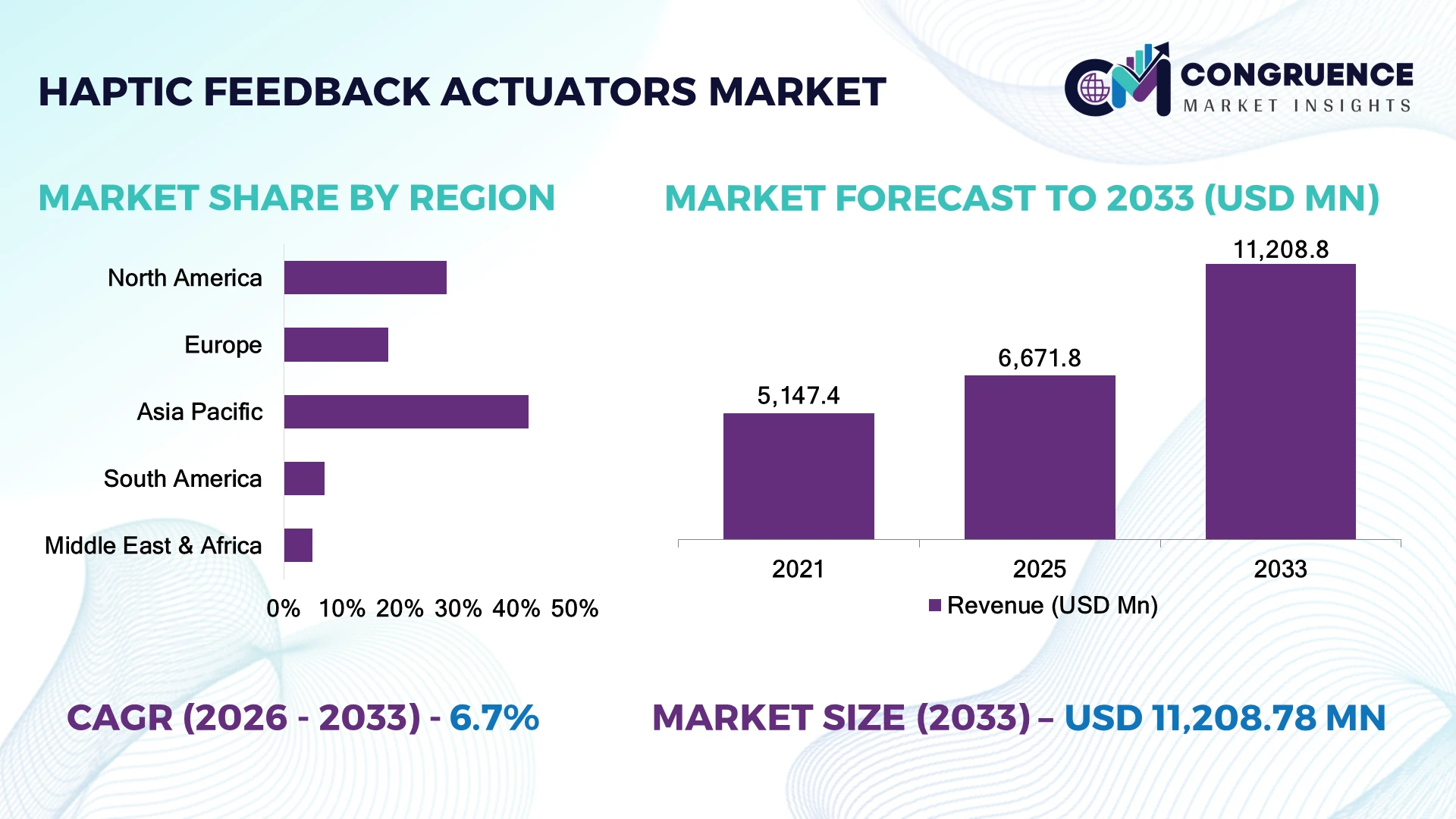
The Global Haptic Feedback Actuators Market was valued at USD 6,671.8 Million in 2025 and is anticipated to reach a value of USD 11,208.8 Million by 2033 expanding at a CAGR of 6.7% between 2026 and 2033. Growth is driven by rising adoption of tactile interfaces in smartphones, automotive touch systems, gaming devices, and advanced wearable electronics.
China dominates the market with approximately 34% share due to large-scale consumer electronics manufacturing, automotive technology investments, and strong actuator production capacity. Japan and South Korea collectively contribute over 25% through semiconductor expertise and premium device innovation. The automotive sector in China recorded more than 30% growth in intelligent vehicle adoption, while Europe focuses on safety-driven haptic cockpit integration.
Strategic partnerships between actuator manufacturers and electronics OEMs will determine future competitive positioning.
Market Size & Growth: USD 6.67 billion in 2025 to USD 11.21 billion by 2033 at 6.7% CAGR, driven by advanced touch interfaces and automotive digitization.
Top Growth Drivers: Smartphone integration 40%, automotive haptic adoption 28%, gaming device expansion 22%.
Short-Term Forecast: By 2028, actuator miniaturization reduces component footprint by 20% and improves response efficiency by 25%.
Emerging Technologies: AI-enabled tactile feedback, piezoelectric actuators, and advanced electromagnetic vibration systems accelerate product innovation.
Regional Leaders: Asia-Pacific reaches USD 5.1 billion with electronics manufacturing growth; North America reaches USD 3.2 billion with automotive adoption; Europe reaches USD 2.4 billion through smart mobility deployment.
Consumer/End-User Trends: Over 60% of premium smartphones integrate advanced haptic systems for enhanced user interaction.
Pilot/Case Example: 2024 automotive cockpit projects achieved nearly 18% faster driver response through integrated tactile feedback controls.
Competitive Landscape: AAC Technologies leads with around 15% share, followed by TDK, Alps Alpine, Texas Instruments, and Nidec.
Regulatory & ESG Impact: Energy-efficient actuator designs reduce device power consumption by approximately 10% while supporting sustainable electronics initiatives.
Investment & Funding: More than USD 1 billion invested in tactile technology, semiconductor partnerships, and smart device manufacturing expansion.
Innovation & Future Outlook: Next-generation actuators focus on AI personalization, ultra-thin designs, and immersive digital interaction ecosystems.
Haptic Feedback Actuators are becoming essential components across consumer electronics, automotive interfaces, industrial controls, and extended reality platforms. Demand is increasing as manufacturers prioritize realistic touch experiences, with more than 35% of new premium electronic products incorporating advanced tactile feedback features. Supply-chain localization in Asia and increasing automotive software integration are shaping the next phase of market development.
The Haptic Feedback Actuators Market is becoming strategically important as industries shift from visual-only interfaces toward immersive and intelligent user experiences. Automotive manufacturers, smartphone companies, and gaming platforms are investing in tactile technologies to differentiate products and improve interaction quality. Supply-chain restructuring in semiconductor and electronic component manufacturing is encouraging localized production across China, India, Japan, and Southeast Asia.
Advanced piezoelectric actuators provide faster response times and lower energy consumption compared with traditional vibration motors, reducing power usage by nearly 15% in selected applications. North America emphasizes premium automotive and industrial deployments, while Asia-Pacific maintains leadership through high-volume electronics production and component manufacturing capabilities.
Over the next 2–3 years, companies are increasing partnerships with automotive OEMs and consumer electronics manufacturers to integrate compact actuators into smart dashboards, wearables, and gaming devices. For example, electric vehicle manufacturers are adopting tactile feedback controls to replace conventional physical switches. Strategic investment in miniaturization, reliability improvement, and supply-chain resilience will define competitive advantage and long-term market relevance.
Rising demand for realistic touch interaction is accelerating actuator adoption across smartphones, vehicles, gaming systems, and wearable devices. Premium smartphone models with advanced haptic engines represent over 60% of flagship device launches, while automotive manufacturers are increasing tactile interface integration by more than 25%. The shift toward software-defined vehicles and smart cockpits is creating new demand for precision vibration technologies. Companies are responding through investments in compact actuator designs, strategic partnerships with OEMs, and expanded manufacturing capacity in China, Japan, and South Korea.
Dependence on specialized materials and semiconductor components creates supply-chain challenges for actuator manufacturers. Rare material price fluctuations impact nearly 10–15% of production costs, while supplier concentration in East Asia increases procurement risks. Compatibility requirements across multiple operating systems and hardware platforms also slow large-scale deployment. Companies are reducing exposure through supplier diversification, regional manufacturing expansion, and long-term component agreements. The operational challenge remains maintaining cost efficiency while meeting higher performance requirements for automotive and consumer applications.
Increasing adoption of intelligent vehicles and immersive technologies creates new opportunities for advanced haptic solutions. Automotive haptic controls are expected to expand as more than 40% of new vehicles incorporate digital cockpit technologies. Extended reality devices and industrial simulation platforms are creating additional demand for precise tactile feedback. Companies are developing AI-driven adaptive actuators and collaborating with technology providers to improve user experience. Emerging manufacturing hubs in India and Southeast Asia provide opportunities for localized production and ecosystem development.
Complex integration with software platforms, sensors, and embedded electronics remains a major challenge for widespread actuator deployment. More than 30% of advanced electronic systems require customized calibration to achieve consistent tactile performance. Cybersecurity concerns in connected vehicles and smart devices further increase engineering requirements. Companies must invest in advanced testing platforms, software integration capabilities, and collaborative development models to ensure reliability. Long-term competitiveness depends on achieving scalable actuator solutions that deliver consistent performance across diverse applications.
AI-Driven Tactile Personalization: Automotive and consumer electronics companies are integrating AI-based haptic algorithms that improve feedback accuracy by nearly 20% and reduce calibration time by approximately 15%. Smart cockpit manufacturers in Germany and Japan are shifting toward adaptive touch systems that modify vibration patterns based on user behavior. Companies are responding through software-hardware partnerships and embedded AI development to improve user experience and reduce engineering complexity.
Miniaturized Actuator Integration: Demand is shifting toward ultra-thin and lightweight actuators as device manufacturers reduce component space by 25% and improve energy efficiency by nearly 18%. Smartphone and wearable producers are adopting compact piezoelectric solutions to support thinner product designs. Supply-chain pressure for smaller electronic components has accelerated supplier collaboration, with manufacturers expanding precision fabrication capabilities in China and South Korea.
Automotive Touchless Transition: Vehicle manufacturers are replacing physical controls with digital haptic interfaces, with more than 35% of new premium vehicles incorporating tactile feedback features. Regulatory emphasis on safer driver interaction systems in Europe is accelerating cockpit redesigns. Companies are investing in integrated sensor-actuator platforms that improve response speed and reduce mechanical component dependency.
Localized Manufacturing Expansion: Electronics supply-chain restructuring is driving actuator production diversification, with India and Southeast Asia attracting more than 20% growth in component manufacturing investments. Companies are establishing regional assembly facilities to reduce logistics delays by nearly 30% and improve supply reliability. A key operational shift is the move from centralized sourcing toward multi-country manufacturing networks for critical electronic components.
Electromagnetic actuators represent the leading segment, accounting for approximately 55% of the Haptic Feedback Actuators Market due to their high reliability, cost efficiency, and widespread integration across smartphones, gaming devices, and automotive systems. Their established manufacturing ecosystem enables faster scalability, with more than 60% of consumer electronics haptic applications using electromagnetic-based technologies. Companies continue improving magnetic efficiency and reducing component size to maintain competitiveness. Piezoelectric actuators are emerging as the fastest-growing type, supported by demand for ultra-thin devices, faster response rates, and lower power consumption. Adoption is increasing by nearly 25% in premium electronics and next-generation vehicle interfaces. While eccentric rotating mass and linear resonant actuators remain important for cost-sensitive applications, investment is shifting toward compact and precision-driven solutions. Manufacturers are expanding R&D partnerships to develop advanced actuator designs for smart mobility and immersive technologies.
Consumer electronics remains the dominant application segment with approximately 50% market share due to extensive integration in smartphones, tablets, gaming controllers, and wearable devices. The segment benefits from high production volumes, with premium smartphones achieving more than 70% adoption of advanced haptic systems. Companies are focusing on compact actuator designs and software optimization to enhance user interaction while reducing device power consumption. Automotive applications represent the fastest-growing segment as digital cockpits and intelligent vehicle systems expand globally. Adoption of haptic controls is increasing by around 30% as manufacturers replace traditional buttons with tactile interfaces. Industrial automation, healthcare devices, and gaming applications continue gaining traction through specialized feedback requirements. Companies are forming partnerships with vehicle manufacturers and automation providers to expand deployment and improve system reliability.
Consumer electronics manufacturers represent the leading end-user segment with approximately 48% market share due to large-scale production requirements and rapid product refresh cycles. Companies such as smartphone and wearable device producers prioritize actuator suppliers that provide miniaturized components, consistent performance, and high-volume manufacturing capability. More than 65% of premium electronic devices now emphasize enhanced tactile interaction as a product differentiation feature. Automotive OEMs are the fastest-growing end-user group, driven by digital cockpit expansion, electric vehicle adoption, and demand for intuitive controls. Automotive adoption is increasing by nearly 35% as manufacturers integrate haptic feedback into steering systems, displays, and safety interfaces. Industrial equipment producers and healthcare technology companies are also expanding usage for precision control applications. Suppliers are responding through customized actuator platforms, long-term OEM partnerships, and localized production strategies.
Asia-Pacific accounted for the largest market share at 42% in 2025 however, North America is expected to register the fastest growth, expanding at a CAGR of 7.4% between 2026 and 2033.

North America accounted for approximately 28% of the global Haptic Feedback Actuators Market in 2025, supported by strong automotive innovation, consumer electronics development, and industrial automation adoption. The United States represents the largest contributor due to investments in electric vehicles, smart cockpit technologies, and gaming hardware ecosystems. More than 35% of premium vehicle programs in the region are incorporating advanced tactile controls to improve driver interaction. Companies are expanding partnerships with automotive OEMs and semiconductor suppliers to develop compact, energy-efficient actuator solutions for next-generation interfaces.
United States Market Outlook: The United States holds a dominant position within North America due to its advanced technology ecosystem, automotive software development, and high consumer electronics penetration. Over 60% of premium electronic device manufacturers operating in the country prioritize enhanced tactile experiences. Investments in electric vehicle platforms, autonomous driving systems, and industrial robotics are strengthening demand for advanced actuator technologies.
Europe accounted for nearly 18% of the global Haptic Feedback Actuators Market in 2025, supported by automotive engineering leadership, digital cockpit modernization, and strict vehicle safety standards. Germany, France, and the United Kingdom represent major deployment hubs, with automotive manufacturers increasingly integrating tactile interfaces into premium vehicles. Around 30% of new vehicle development programs in Europe emphasize advanced human-machine interaction technologies. Regulatory focus on safer in-vehicle controls and energy-efficient electronics is encouraging manufacturers to invest in precision actuator solutions and localized supply chains.
Germany Market Outlook: Germany remains the leading European market due to its automotive manufacturing base, engineering capabilities, and strong presence of premium vehicle producers. More than 40% of European automotive R&D investments are linked to advanced vehicle technologies, including digital interfaces and smart cockpit systems. German manufacturers are strengthening collaborations with actuator suppliers to enhance vehicle interaction performance.
Asia-Pacific accounted for approximately 42% of the global Haptic Feedback Actuators Market in 2025, driven by large-scale electronics manufacturing, semiconductor production, and high-volume smartphone assembly. China, Japan, South Korea, and Taiwan dominate regional supply chains, contributing significantly to actuator production capacity. China alone represents nearly 30% of global consumer electronics manufacturing output, supporting extensive actuator integration. Companies are expanding regional production facilities and strengthening supplier networks to reduce component shortages and improve manufacturing efficiency.
China Market Outlook: China leads the Asia-Pacific market due to its electronics manufacturing ecosystem, automotive electrification programs, and extensive component supply base. More than 70% of global smartphone production involves Chinese manufacturing networks, creating strong demand for compact haptic solutions. Government-backed electric vehicle expansion and smart manufacturing initiatives continue encouraging local actuator innovation and production scaling.
South America accounted for approximately 7% of the global Haptic Feedback Actuators Market in 2025, with adoption concentrated in Brazil, Argentina, and Chile. Growth is supported by increasing smartphone usage, automotive technology upgrades, and industrial automation investments. Brazil contributes more than 45% of regional electronics and automotive manufacturing activity, creating the largest demand base. However, limited local component production and dependence on imported electronic parts influence deployment costs. Companies are addressing these challenges through regional distribution partnerships and improved supply-chain coordination.
Brazil Market Outlook: Brazil represents the strongest market in South America due to its automotive industry, expanding consumer electronics sector, and manufacturing infrastructure. The country accounts for more than half of regional vehicle production, creating opportunities for haptic-enabled automotive systems. Technology suppliers are increasingly partnering with local manufacturers to improve access and deployment efficiency.
Middle East & Africa accounted for approximately 5% of the global Haptic Feedback Actuators Market in 2025, supported by smart city initiatives, luxury automotive demand, and digital infrastructure modernization. The United Arab Emirates and Saudi Arabia are leading adoption through technology-focused investments and advanced mobility projects. More than 25% of regional technology infrastructure spending is directed toward digital transformation initiatives. Companies are targeting high-value applications such as premium vehicles, industrial automation, and interactive consumer technologies through strategic partnerships.
United Arab Emirates Market Outlook: The United Arab Emirates represents the leading market in the region due to smart city development, advanced transportation projects, and strong technology adoption. Dubai’s smart mobility initiatives and digital infrastructure investments are accelerating demand for intelligent interface systems. Companies are expanding partnerships with technology integrators to introduce advanced haptic solutions across automotive and commercial applications.
The Haptic Feedback Actuators Market features competition between global component specialists such as AAC Technologies, TDK, Alps Alpine, Nidec, and Immersion against regional electronics suppliers and automotive technology providers. The top five players collectively account for approximately 45% market share, creating a moderately consolidated structure. Competition is centered on actuator precision, miniaturization, pricing, supply reliability, and customization, with leading firms achieving 15–25% improvements in response efficiency through advanced designs. Companies compete through OEM partnerships, manufacturing expansion, vertical integration, and investment in piezoelectric technologies. The market is shifting toward software-integrated haptic systems as automotive and consumer electronics companies demand adaptive feedback solutions. High precision manufacturing requirements, semiconductor dependency, and intellectual property ownership create significant entry barriers. Winning players must combine scalable production, rapid innovation cycles, strong supply networks, and customized solutions for diverse applications.
TDK Corporation
Alps Alpine Co., Ltd.
Nidec Corporation
Immersion Corporation
Texas Instruments Incorporated
Samsung Electro-Mechanics Co., Ltd.
Lofelt GmbH
Cirrus Logic, Inc.
Precision Microdrives Ltd.
Vishay Intertechnology, Inc.
Analog Devices, Inc.
The market is transitioning from traditional eccentric rotating mass (ERM) motors toward advanced linear resonant actuators (LRA) and piezoelectric technologies. Piezoelectric systems deliver approximately 20% faster response times and nearly 15% lower energy consumption compared with conventional vibration motors. Premium smartphones, automotive displays, and wearable devices are increasingly adopting precision haptic solutions, with advanced feedback systems integrated into more than 60% of flagship consumer devices.
AI-enabled adaptive haptic technology is becoming a competitive differentiator by allowing systems to modify feedback patterns based on user interaction. These intelligent platforms improve response accuracy by around 25% and reduce calibration requirements by nearly 15%. Automotive manufacturers benefit from AI-driven tactile interfaces for smart cockpits, while electronics companies use personalization capabilities to strengthen product differentiation.
Between 2026 and 2028, miniaturized actuators, sensor integration, and software-controlled feedback ecosystems will reshape product design strategies. Companies investing in compact architectures and integrated actuator modules will gain advantages through improved efficiency, reduced component complexity, and faster deployment across automotive, industrial, and consumer applications.
January 2025 Alps Alpine Co., Ltd. launched its compact Haptic Reactor “U-Type” for automotive applications, achieving approximately 90% volume reduction compared with previous models while maintaining vibration performance. The product supports tighter installation in steering wheels and touch controls, strengthening automotive HMI integration. Source: www.alpsalpine.com
May 2024 Immersion Corporation signed a multi-year haptic technology license agreement with Samsung Electronics, expanding deployment of Immersion’s TouchSense solutions across consumer electronics applications. The partnership strengthens software-based haptic ecosystem adoption and improves technology accessibility for device manufacturers. Source: www.immersion.com
December 2025 TDK Corporation showcased next-generation haptic technologies, including haptic VR gloves and a 15-inch haptic automotive display powered by actuators and MEMS technologies. The demonstration highlighted TDK’s expansion into AI-enabled interfaces and immersive interaction systems. Source: www.tdk.com
November 2025 Alps Alpine Co., Ltd. expanded its strategic technology direction through new sensing, connectivity, and mechatronics initiatives, including partnerships supporting software-defined vehicle applications. The company is strengthening integrated HMI solutions combining sensors, actuators, and digital control technologies.
The Haptic Feedback Actuators Market Report provides comprehensive coverage across actuator types, including electromagnetic, linear resonant, and piezoelectric technologies, along with applications spanning consumer electronics, automotive systems, gaming devices, industrial equipment, and healthcare technologies. The analysis evaluates end-users such as electronics manufacturers, automotive OEMs, and industrial technology providers across North America, Europe, Asia-Pacific, South America, and Middle East & Africa.
The report examines adoption patterns, technology advancements, competitive positioning, supply-chain dynamics, and emerging opportunities from 2026 to 2033. It highlights segment performance, regional deployment trends, innovation strategies, and enterprise-level investment priorities. With analysis of major industry participants and evolving interface technologies, the report supports strategic decisions related to expansion planning, partnerships, product development, and competitive positioning.
| Report Attribute / Metric | Details |
|---|---|
| Market Revenue (2025) | USD 6,671.8 Million |
| Market Revenue (2033) | USD 11,208.8 Million |
| CAGR (2026–2033) | 6.7% |
| Base Year | 2025 |
| Forecast Period | 2026–2033 |
| Historic Period | 2021–2025 |
| Segments Covered |
By Type
By Application
By End-User
|
| Key Deliverables | Revenue Forecast; Market Trends; Growth Drivers & Restraints; Technology Insights; Segmentation Analysis; Regional Insights; Competitive Landscape; Regulatory & ESG Overview; Recent Developments |
| Regions Covered | North America; Europe; Asia-Pacific; South America; Middle East & Africa |
| Companies Profiled | AAC Technologies Holdings Inc.; TDK Corporation; Alps Alpine Co., Ltd.; Nidec Corporation; Immersion Corporation; Texas Instruments Incorporated; Samsung Electro-Mechanics Co., Ltd.; Lofelt GmbH; Cirrus Logic, Inc.; Precision Microdrives Ltd.; Vishay Intertechnology, Inc.; Analog Devices, Inc. |
| Customization & Pricing | Available on Request (10% Customization Free) |




