
Reports
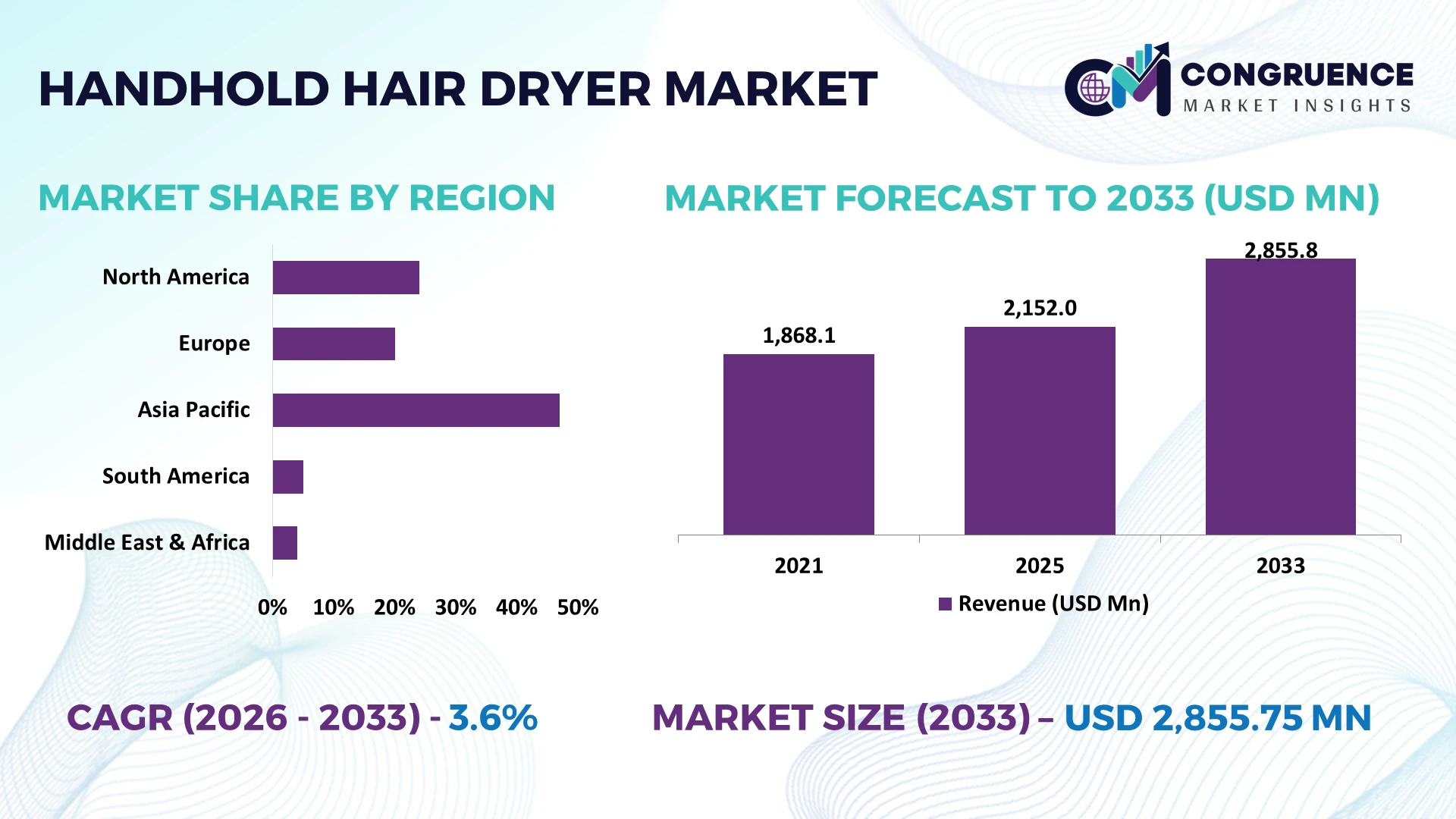
The Global Handhold Hair Dryer Market was valued at USD 2152 Million in 2025 and is anticipated to reach a value of USD 2855.75 Million by 2033 expanding at a CAGR of 3.6% between 2026 and 2033. High-speed brushless motors, intelligent heat control, ionic conditioning, premium home styling, and salon-grade performance migration are shifting replacement demand toward lighter, faster, digitally controlled handhold hair dryers.
China dominates global manufacturing, exporting approximately 174.5 million hair dryers in 2024, including 26.4 million units to the United States. Its Shenzhen–Dongguan appliance ecosystem supports large-scale motor, heater, PCB, and molding integration, while investment is shifting toward 100,000+ rpm brushless motors and sensor-controlled platforms. Among the five largest reported exporting countries, China represented roughly 91% of combined shipment volume. China shipped nearly 39 times Germany’s 2024 hair-dryer export volume, demonstrating a decisive manufacturing-scale advantage; meanwhile, premium product innovation remains stronger among technology-led brands in Japan, South Korea, Europe, and the United States. U.S.–China tariff and supply-chain restructuring is encouraging brands to qualify alternative assembly capacity in Southeast Asia without abandoning Chinese component ecosystems.
Manufacturers combining Chinese-scale sourcing with diversified final assembly, intelligent thermal protection, and premium high-speed platforms hold the strongest positioning as the global handhold hair dryer market shifts from basic airflow appliances toward performance-led personal styling systems.
Market Size & Growth: USD 2,152 million in 2025 advances to USD 2,855.75 million by 2033 at 3.6% CAGR, driven by high-speed brushless motors and premium home-styling substitution.
Top Growth Drivers: High-speed motor upgrades contribute approximately 30%, intelligent heat-control features 25%, and salon-to-home styling migration 20% of modeled incremental product demand.
Short-Term Forecast: By 2027, premium brushless platforms will deliver approximately 20–30% faster drying while reducing motor size and improving handheld weight distribution versus conventional AC-motor designs.
Emerging Technologies: Motors exceeding 100,000 rpm, infrared distance sensing, and automated temperature regulation are redefining premium dryers; Dyson platforms measure heat more than 40 times per second.
Regional Leaders: Asia-Pacific approaches USD 1.1 billion, North America about USD 700 million, and Europe approximately USD 650 million by the late forecast period, with premiumization strongest in developed markets.
Consumer/End-User Trends: Premium users increasingly prioritize heat protection and speed, with advanced dryers offering 3 airflow settings, 4 heat settings, and attachment-specific control for personalized styling.
Pilot/Case Example: Dyson’s 2024 Supersonic Nural introduced distance sensing that automatically maintains approximately 55°C at the scalp, reducing excessive thermal exposure during close-range drying.
Competitive Landscape: Dyson leads premium technology positioning with an estimated 15–18% premium-segment share, competing with Panasonic, SharkNinja, Conair, Philips, and Laifen on speed, heat control, and attachments.
Regulatory & ESG Impact: High-efficiency brushless motors can reduce operating energy requirements by approximately 10–20% through faster drying cycles, strengthening product differentiation as appliance efficiency scrutiny increases.
Investment & Funding: Chinese manufacturers shipped 174.5 million units globally in 2024, reinforcing capital allocation toward automated motor production, electronic control boards, precision molding, and export-oriented high-speed platforms.
Innovation & Future Outlook: Motors reaching 110,000 rpm, airflow multiplication near 3×, and sensor-based thermal protection are shifting competitive advantage toward integrated motor-control, scalp-care, and intelligent attachment ecosystems.
The Handhold Hair Dryer Market is shifting toward high-speed brushless motors, ionic conditioning, intelligent heat sensing, and salon-grade home styling. Premium devices now operate above 100,000 rpm, enabling faster airflow from smaller motor assemblies. China remains the core production hub, while supply-chain diversification into Southeast Asia is expanding, creating a stronger strategic focus on technology differentiation, manufacturing flexibility, and premium performance positioning.
The Handhold Hair Dryer Market is becoming strategically important as personal-care appliance competition shifts from basic wattage and airflow toward intelligent thermal management, compact high-speed motors, and premium styling ecosystems. Supply-chain restructuring is reinforcing this transition: China remains the dominant manufacturing base, while brands are diversifying final assembly and component sourcing into Vietnam and other Southeast Asian hubs to reduce tariff and logistics exposure.
High-speed brushless platforms operating above 100,000 rpm deliver approximately 20–30% faster drying than conventional AC-motor systems while enabling smaller, lighter housings. Sensor-led models now adjust temperature automatically, with advanced products maintaining scalp-focused heat around 55°C. China dominates production scale, whereas Japan, South Korea, the United Kingdom, and the United States lead premium engineering, thermal-control, and attachment innovation.
Over the next 2–3 years, competitive investment will concentrate on brushless motors, intelligent heat sensing, magnetic attachment recognition, and quieter airflow systems. Dyson’s sensor-based pause detection, which automatically reduces heat and airflow when the dryer is placed down, illustrates how software-like functionality is entering routine styling. Brands are increasing R&D partnerships and diversifying assembly footprints. Long-term advantage will depend on combining production scale with differentiated performance, thermal protection, and ecosystem-based styling.
High-speed brushless motors are reshaping product architecture by delivering stronger airflow from smaller assemblies and enabling premium differentiation beyond basic wattage. Advanced dryers operating above 100,000 rpm can cut drying time by approximately 20–30%, while compact motor designs reduce appliance weight by roughly 10–20% versus conventional AC platforms. China’s Shenzhen–Dongguan electronics cluster remains central to motor, PCB, heater, and molding integration, accelerating commercialization. The shift from salon-only performance toward premium home styling directly raises replacement demand and average feature density. Brands including Dyson, Panasonic, SharkNinja, and emerging Chinese specialists are investing in high-speed motors, optimized impellers, and digital control systems. The strategic insight is that motor miniaturization creates room for sensors, acoustics engineering, and attachment intelligence without increasing overall appliance size.
The market remains structurally exposed to concentrated sourcing of brushless motors, electronic control boards, magnets, heating elements, and precision-molded components. China supplies the majority of global hair-dryer export volumes, creating procurement sensitivity to tariffs, shipping disruptions, and currency movements. Premium brushless platforms can carry component costs approximately 20–35% above conventional AC-motor systems, while sophisticated sensor packages add another 5–10% to bill-of-material complexity. U.S.–China trade friction has therefore increased pressure on brands dependent on single-country manufacturing. Margin compression is strongest in mid-priced products where retailers resist rapid price increases. Manufacturers are responding by qualifying Vietnamese assembly partners, dual-sourcing motors and PCBs, standardizing internal platforms, and negotiating longer supplier contracts. The key constraint is not demand; it is maintaining premium feature economics while reducing dependence on concentrated component ecosystems.
The strongest opportunity lies in transforming hair dryers into sensor-led personal-care systems rather than simple heating appliances. Time-of-flight sensing, accelerometers, Hall sensors, and digitally regulated heaters already enable automatic temperature adaptation, attachment recognition, and pause detection. Advanced scalp-protection platforms maintain operating temperatures near 55°C during close-range drying, while intelligent controllers can sample thermal conditions dozens of times per second. Adoption is expanding fastest in premium urban consumers across China, South Korea, Japan, and the United States, where styling and scalp-care functions increasingly overlap. Companies are investing in proprietary algorithms, magnetic accessory ecosystems, quieter airflow, and app-adjacent personalization. The non-obvious opportunity is attachment monetization: once dryers recognize and optimize individual accessories, brands can create recurring premium accessory ecosystems rather than relying solely on replacement appliance sales.
The long-term challenge is reproducing premium motor speed, acoustic control, heat stability, and sensor accuracy consistently across mass-production volumes. High-speed motors above 100,000 rpm require tight balancing tolerances, while poorly calibrated thermal systems can undermine scalp-protection claims and accelerate component wear. Premium models increasingly integrate 3–4 heat settings, multiple airflow modes, motion sensors, and magnetic attachment recognition, raising validation complexity by roughly 20–30% compared with conventional fixed-control dryers. China’s manufacturing scale supports rapid production, but brands expanding into Vietnam or other new assembly hubs must replicate tooling precision, quality-control expertise, and supplier coordination. Companies must invest in automated motor balancing, inline thermal testing, firmware validation, and supplier-development programs. Competitive sustainability will depend on achieving premium-level consistency at high volume without allowing added electronics and mechanical complexity to erode reliability or warranty economics.
Professional Designs Move Into Homes: Salon-engineered dryers are moving directly into consumer channels as brands commercialize lighter professional platforms. Dyson’s Supersonic r entered wider consumer distribution in 2025 with a design 30% smaller and 20% lighter than the original Supersonic. Professional-grade attachment control and concentrated airflow are therefore becoming household features. Manufacturers are restructuring premium portfolios around salon-tested products, increasing direct-to-consumer launches and using stylist partnerships to accelerate credibility outside professional channels.
Thermal Intelligence Replaces Fixed Heating: Sensor-controlled drying is replacing fixed-temperature operation in premium models. Advanced systems measure temperature more than 40 times per second, maintain approximately 55°C near the scalp, and automatically reduce heater output when users move closer. Distance sensing and motion detection now alter airflow without manual adjustment. Brands are adding firmware-controlled thermal protection, improving consistency while reducing excessive heat exposure. The operational shift moves product differentiation from maximum wattage toward active thermal management and repeatable styling outcomes.
Compact Architectures Reshape Product Design: Foldable bodies, smaller motors, concentrated heaters, and lightweight airflow channels are gaining priority as consumers demand travel-compatible performance. High-density motor platforms operating near 110,000 rpm allow housings to shrink approximately 20–30% without sacrificing airflow. Airlines, compact urban living, and mobile professional styling reinforce this shift. Manufacturers are reorganizing internal layouts, reducing handle weight, and developing dual-voltage or compact platforms. A non-obvious benefit is lower packaging volume, improving warehouse density and e-commerce fulfillment efficiency.
Mid-Premium Competition Intensifies Rapidly: Feature compression is pushing ionic conditioning, brushless motors, magnetic attachments, and sub-70 dB acoustics into lower price bands. In India, emerging direct-to-consumer brands already represent roughly 6–8% of value in selected professional dryer channels, while private-label suppliers account for approximately 10–12% of unit activity. Brands are increasing online launches, localized assembly, and retailer-specific models. Supply-chain diversification and shorter development cycles are forcing premium incumbents to defend differentiation through proprietary airflow systems and intelligent attachments.
Ionic Hair Dryers hold the leading position with approximately 31–34% of segmented demand, supported by broad availability across household, salon, and professional channels. Negative-ion systems remain attractive because they target static reduction, smoother finishes, and faster moisture dispersion without requiring complex user interaction. Ceramic Hair Dryers represent an established secondary segment, particularly for temperature distribution and controlled heating, while Professional Hair Dryers retain strong value concentration through higher duty cycles, stronger motors, replaceable filters, and salon-oriented attachments. Their higher specification requirements sustain premium pricing despite lower unit volumes.
Cordless Hair Dryers are the fastest-expanding type as improved lithium-ion packs, compact brushless motors, and portable grooming behavior reduce the historical performance gap with corded platforms. Foldable Hair Dryers remain strategically important for travel and space-constrained households, especially where compact storage outweighs continuous-duty performance. Manufacturers are shifting R&D toward lighter motor assemblies, thermal management, battery efficiency, and modular attachments. Investment priorities increasingly favor platforms that combine ionic conditioning with professional airflow rather than treating each technology as a standalone product category.
Home Hair Drying represents approximately 42–45% of application demand, reflecting the installed base of household dryers and recurring replacement requirements across developed and urbanizing consumer markets. Hair Styling follows as a higher-value application because concentrators, diffusers, ionic systems, and thermal controls encourage users to perform salon-like routines at home. Quick-Dry Use is gaining relevance where high-speed motors and concentrated airflow reduce preparation time, particularly among working consumers and dense urban households. Brands are therefore positioning faster drying as a measurable productivity benefit rather than simply a power specification.
Salon Styling is the fastest-growing application in premium product value as professional platforms increasingly incorporate lighter bodies, precise airflow, intelligent attachments, and lower acoustic output. Travel Grooming remains smaller but strategically relevant through foldable, compact, and dual-voltage models. Manufacturers are adapting by developing application-specific kits, magnetic attachments, diffuser ecosystems, and lighter professional designs. Competitive demand is strengthening where one device can shift between drying, smoothing, curl definition, and precision styling without requiring multiple heated appliances.
Individual Consumers account for approximately 61–65% of end-user demand because household ownership, replacement purchases, e-commerce availability, and home styling create the broadest deployment base. Hair Salons represent the second-largest operational buyer group, demanding higher-duty motors, washable filters, concentrated airflow, and equipment capable of repeated daily use. Professional Stylists purchase fewer units but influence premium specifications and brand visibility disproportionately because tool weight, balance, heat control, and attachment precision directly affect productivity during extended styling sessions.
Professional Stylists are the fastest-advancing end-user segment in premium adoption as lighter dryers reduce repetitive handling and high-speed platforms shorten service workflows. Beauty Clinics increasingly select controlled-temperature models where scalp treatments and post-procedure grooming require lower thermal exposure, while Hotels prioritize reliability, wall storage, safety controls, and standardized guest-room deployment. Manufacturers are targeting these groups through salon partnerships, professional education, bulk hotel contracts, extended warranties, and differentiated attachment bundles. Future positioning increasingly depends on matching product architecture to duty cycle rather than offering identical specifications across consumer and professional channels.
Asia-Pacific accounted for the largest market share at 38% in 2025 however, Middle East & Africa is expected to register the fastest growth, expanding at a CAGR of 5.2% between 2026 and 2033.
Premium Technology Reshapes Replacement Demand
North America represents approximately 26% of global Handhold Hair Dryer demand, led by high household penetration, salon infrastructure, e-commerce replacement cycles, and premium styling adoption. U.S. consumers increasingly differentiate products through high-speed motors, intelligent heat control, attachment ecosystems, and quieter operation rather than wattage alone. Professional technology is also migrating into households: Dyson expanded its Supersonic r beyond professional channels with a platform 30% smaller and 20% lighter than its original Supersonic. Retail competition is consequently shifting toward $100-plus premium and mid-premium devices, while mass-market suppliers retain volume through accessible ionic and ceramic models. U.S.–China trade exposure is encouraging brands to diversify assembly and component procurement. Suppliers are responding through direct-to-consumer launches, retailer-exclusive configurations, stylist partnerships, and broader service coverage to protect premium positioning.
United States Market Outlook: The United States concentrates roughly 80% of North American demand and supports more than 10,000 tracked salons and independent professionals within major industry datasets. Its advantage lies in high e-commerce penetration, strong professional influence, rapid premium-product launches, and extensive specialty beauty retail. Brands increasingly use U.S. salons as validation channels before transferring high-speed, lightweight, and sensor-controlled technologies into household portfolios.
Efficiency Rules Accelerate Product Redesign
Europe accounts for approximately 23% of global demand, supported by mature household ownership, dense salon networks, premium appliance consumption, and stringent electrical-product requirements. Germany, the United Kingdom, Italy, France, and Spain anchor deployment, although product strategies differ between professional salon tools and household replacements. EU ecodesign and right-to-repair initiatives are strengthening attention to energy consumption, durability, spare-part availability, and product lifecycle management. Manufacturers are responding with brushless motors, washable filters, replaceable components, and more efficient thermal control. Italy retains particular importance through professional styling-equipment expertise, while the United Kingdom remains influential in premium innovation. High-speed architectures that shorten drying cycles by approximately 20–30% offer a practical route to lower electricity consumption per use. Competition increasingly rewards products combining styling performance with durability rather than disposable, feature-light architectures.
United Kingdom Market Outlook: The United Kingdom is strategically important for premium product development and early technology adoption. Dyson’s engineering footprint has helped establish intelligent heat sensing, digital motors, and attachment-led styling as competitive benchmarks. With advanced systems monitoring temperature more than 40 times per second, British-led innovation increasingly influences specifications adopted by international brands targeting high-value consumers and professional stylists.
Manufacturing Scale Meets Premium Innovation
Asia-Pacific holds approximately 38% of global Handhold Hair Dryer demand and an even larger share of production, anchored by China’s integrated appliance supply chain. China exported approximately 174.5 million hair dryers in 2024, demonstrating exceptional scale across motors, heating elements, PCBs, housings, and final assembly. Shenzhen, Dongguan, Ningbo, and surrounding manufacturing clusters enable rapid product iteration and increasingly support 100,000–110,000 rpm brushless platforms. Japan and South Korea contribute advanced thermal management and premium beauty technology, while India provides expanding online and value-premium demand. Supply-chain diversification is directing selected assembly toward Vietnam, but China retains a substantial component advantage. Manufacturers are automating motor balancing, molding, and inspection while expanding direct-to-consumer channels. The strategic shift is from low-cost OEM production toward proprietary high-speed platforms capable of competing directly with established premium international brands.
China Market Outlook: China combines manufacturing scale with increasingly sophisticated domestic brands, making it the market’s most important production ecosystem. Its 174.5 million exported units in 2024 included approximately 26.4 million shipped to the United States. Integrated motor, magnet, electronics, tooling, and molding suppliers allow Chinese manufacturers to shorten development cycles and compete aggressively in high-speed dryer architectures.
Salon Formalization Strengthens Premium Demand
South America represents approximately 7% of global demand, with Brazil accounting for the majority through its large beauty-services economy, household appliance base, and extensive professional salon network. Ionic and ceramic dryers dominate mainstream replacement, while high-speed brushless platforms are entering premium urban channels in São Paulo, Rio de Janeiro, Buenos Aires, Santiago, and Bogotá. Import duties, currency volatility, and dependence on Asian components constrain premium affordability, encouraging local distributors to balance imported technology with regionally assembled models. Brazil’s 127V and 220V electrical environments also require differentiated inventory management, increasing SKU complexity for national suppliers. Brands are expanding through beauty retailers, salon distributors, marketplaces, and professional education partnerships. Compact motors and lower product weight create particular value for stylists performing repeated daily drying sessions, strengthening professional rather than purely discretionary premium demand.
Brazil Market Outlook: Brazil anchors regional consumption through one of the world’s largest beauty and personal-care ecosystems and a highly fragmented salon base. Dual-voltage requirements create an operational advantage for suppliers capable of localized electrical configurations. Professional channels increasingly prioritize durable AC or brushless motors, ionic conditioning, removable filters, and ergonomic designs capable of supporting intensive daily salon workloads.
Hospitality Expansion Broadens Premium Deployment
Middle East & Africa accounts for approximately 6% of global demand, with the United Arab Emirates, Saudi Arabia, South Africa, and major tourism centers driving higher-specification deployment. Gulf hospitality expansion is increasing institutional demand for compact, safety-certified dryers across hotels, serviced apartments, spas, and premium residential developments. Saudi Arabia’s tourism strategy targets 150 million annual visits by 2030, expanding the addressable installed base for hospitality grooming equipment. Dubai’s large hotel inventory similarly supports bulk replacement cycles, while affluent consumers strengthen demand for premium imported styling technologies. South Africa provides the region’s strongest established beauty-retail and salon ecosystem. Suppliers are adapting through hotel procurement partnerships, localized distribution, heat-resistant components, and region-specific electrical configurations. Institutional buyers emphasize reliability, safety cutoffs, wall-mount compatibility, and replacement support more heavily than consumer-focused feature differentiation.
United Arab Emirates Market Outlook: The UAE combines high hotel density, international beauty retail, affluent consumers, and rapid premium-product availability. Dubai alone operates more than 150,000 hotel rooms, creating a substantial installed base for compact dryers and recurring replacements. Luxury salons and beauty retailers simultaneously provide launch channels for high-speed, ionic, and intelligent thermal-control platforms targeting premium users.
Dyson, Panasonic, SharkNinja, Philips, and Conair compete against Laifen and Chinese OEM specialists across premium, mid-market, and value segments. The top five brands hold an estimated 42–47% combined share, leaving substantial volume with regional labels and contract manufacturers. Dyson leads technology differentiation through digital motors and sensing, while Panasonic emphasizes hair-care engineering; SharkNinja competes through multifunction styling, and Conair and Philips leverage distribution breadth. High-speed brushless platforms deliver 20–30% faster drying, intelligent controls reduce excessive thermal exposure, and compact architectures cut product weight by 15–30%. Players are accelerating proprietary motor development, stylist partnerships, direct-to-consumer launches, localized assembly, and attachment ecosystems. Competition is shifting from wattage toward airflow engineering, software-controlled heat, acoustics, and ergonomics. Motor precision, safety certification, thermal validation, and scalable component sourcing create entry pressure. Winning requires premium performance at controlled cost, reliable manufacturing, differentiated styling functionality, and channel-specific product positioning across professional and household users.
Dyson
Panasonic
SharkNinja
Philips
Conair
Laifen
BaByliss
GHD
T3 Micro
Remington
Dreame
Xiaomi
TESCOM
Bio Ionic
Current Handhold Hair Dryer technology centers on high-speed brushless motors, ionic conditioning, intelligent heat sensing, and compact airflow engineering. Motors above 100,000 rpm can shorten drying time by 20–30%, while digital thermal control reduces overheating exposure by roughly 10–15%. Premium deployment is strongest across professional and upper-tier consumer models, where lighter housings and magnetic attachments improve handling speed and styling consistency.
Emerging systems integrate RFID-enabled attachments, distance sensors, motion detection, and adaptive temperature algorithms. Compared with conventional AC-motor dryers, modern brushless platforms can be 20–30% smaller and 15–25% lighter while maintaining stronger airflow. Adoption is expanding through salon-to-home product migration, enabling brands to differentiate on scalp protection, acoustic control, and personalized styling rather than wattage alone. Professional stylists and premium direct-to-consumer brands benefit most from these efficiency gains.
From 2026–2028, disruptive development will focus on AI-assisted thermal regulation, cordless high-output architectures, recyclable material systems, and sensor-linked accessory ecosystems. Automated motor balancing and inline quality inspection can improve manufacturing consistency by 5–10% while reducing warranty exposure. Companies integrating proprietary motors, smart controls, and scalable Asian supply chains will gain the strongest competitive advantage as performance, safety, portability, and ecosystem compatibility become decisive purchase criteria across both household and professional purchasing channels.
March 2024 — SharkNinja launched SpeedStyle Pro and Pro Flex, adding Scalp Shield technology that automatically regulates temperature to 50°C while maintaining airflow. The foldable platform expanded professional-grade scalp protection into household styling and strengthened Shark’s premium competitive position. Source: sharkninja.com
March 2025 — Dyson released Supersonic r to consumers after professional deployment, making its redesigned platform 30% smaller and 20% lighter than the original Supersonic. Wider availability transferred salon-developed ergonomics and RFID-enabled attachment intelligence directly into premium household styling. Source: nbcnews.com
May 2025 — Panasonic introduced refreshed nanoe hair dryers EH-NA9N and EH-NA7M, using moisture-rich nanoe technology delivering 1,000 times more moisture than regular negative ions. The launch strengthened Panasonic’s premium differentiation around hydration, scalp care, and heat-managed home styling. Source: panasonic.com
September 2026 — Laifen launched Swift 4, integrating a 115,000-rpm fourth-generation brushless motor with 400 million negative ions and 70 million positive ions. The product shifted high-speed drying toward nutrient-infusion functionality, expanding Laifen from performance-led drying into beauty technology.
The Handhold Hair Dryer Market report evaluates Cordless Hair Dryers, Foldable Hair Dryers, Ionic Hair Dryers, Ceramic Hair Dryers, and Professional Hair Dryers across Home Hair Drying, Hair Styling, Travel Grooming, Salon Styling, and Quick-Dry Use. End-user coverage includes Individual Consumers, Hair Salons, Beauty Clinics, Hotels, and Professional Stylists, with individual consumers representing approximately 61–65% of demand.
Regional analysis spans North America, Europe, Asia-Pacific, South America, and Middle East & Africa, including country-level manufacturing, retail, salon, and technology dynamics. Technology coverage examines 100,000+ rpm brushless motors, ionic conditioning, intelligent thermal sensing, RFID-enabled attachments, compact architectures, and emerging cordless systems. The 2026–2033 framework supports capacity planning, product-development priorities, geographic expansion, channel strategy, supplier diversification, and competitive benchmarking as brands shift investment toward high-speed performance, thermal protection, ergonomics, and integrated styling ecosystems.
| Report Attribute/Metric | Report Details |
|---|---|
Market Revenue in 2025 | USD 2152 Million |
Market Revenue in 2033 | USD 2855.75 Million |
CAGR (2026 - 2033) | 3.6% |
Base Year | 2025 |
Forecast Period | 2026 - 2033 |
Historic Period | 2021 - 2025 |
Segments Covered | By Type
By Application
By End-User
|
Key Report Deliverable | Revenue Forecast, Growth Trends, Market Dynamics, Segmental Overview, Regional and Country-wise Analysis, Competition Landscape |
Region Covered | North America, Europe, Asia-Pacific, South America, Middle East, Africa |
Key Players Analyzed | Dyson, Panasonic, SharkNinja, Philips, Conair, Laifen, BaByliss, GHD, T3 Micro, Remington, Dreame, Xiaomi, TESCOM, Bio Ionic |
Customization & Pricing | Available on Request (10% Customization is Free) |




