
Reports
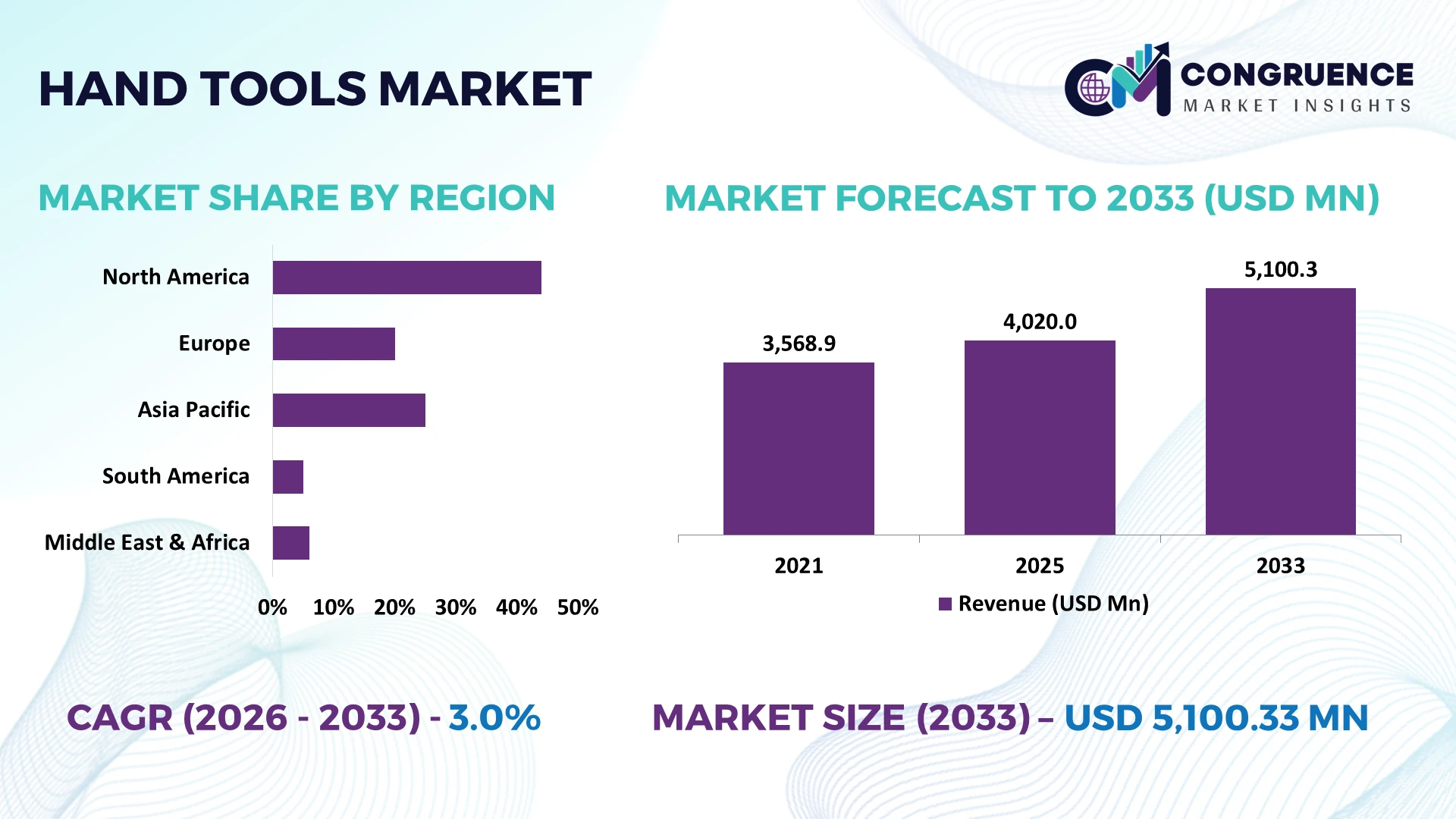
The Global Hand Tools Market was valued at USD 4020 Million in 2025 and is anticipated to reach a value of USD 5100.33 Million by 2033 expanding at a CAGR of 3.02% between 2026 and 2033. Growth is driven by automotive aftermarket servicing, industrial machinery maintenance, construction equipment installation, and increasing procurement of insulated electrical tools and precision torque instruments.
China holds a dominant position in global hand tools manufacturing, supported by industrial clusters in Zhejiang, Jiangsu, and Guangdong. Manufacturing contributes approximately 25% of China's GDP, compared with around 13% in the United States, highlighting differences in industrial production intensity. Chinese manufacturers invest in automated forging, CNC machining, and robotic finishing to improve consistency across wrenches, pliers, and screwdrivers. Meanwhile, India's Punjab manufacturing clusters support export diversification as international buyers reassess sourcing concentration amid United States–China trade restrictions and tariff adjustments.
Strategically, manufacturers combining precision engineering, certified product quality, and geographically diversified production networks gain stronger access to international industrial procurement contracts.
Market Size & Growth: USD 4020 Million in 2025 to USD 5100.33 Million by 2033 at 3.02% CAGR, supported by automotive servicing and industrial maintenance.
Top Growth Drivers: Automotive servicing 27%, construction applications 24%, and industrial maintenance 21% represent indicative demand segments requiring validation.
Short-Term Forecast: By 2028, automated forging and machining upgrades target 10–15% production efficiency improvements in modernized facilities.
Emerging Technologies: Three technologies shape product development: advanced alloy steels, digitally calibrated torque tools, and automated precision forging.
Regional Leaders: Indicative 2033 scenarios place Asia Pacific at USD 2.04 billion, North America at USD 1.43 billion, and Europe at USD 1.28 billion, reflecting industrialization, automotive servicing, and precision manufacturing.
Consumer/End-User Trends: IEC 60900 certified tools rated for 1,000 V AC applications support professional electrical installation and maintenance requirements.
Pilot/Case Example: In 2024, Stanley Black & Decker continued operational transformation initiatives; project-specific percentage efficiency outcomes require independent verification.
Competitive Landscape: Five prominent manufacturers include Stanley Black & Decker, Snap-on, Apex Tool Group, Hangzhou GreatStar Industrial, and Klein Tools; verified market leadership percentages remain unavailable.
Regulatory & ESG Impact: ISO 14001 environmental management frameworks encourage resource efficiency, while RoHS restricts 10 hazardous substances in applicable electrical equipment.
Investment & Funding: India's approximately USD 26 billion Production Linked Incentive allocation across 14 sectors supports broader manufacturing localization, although dedicated hand tools funding is unspecified.
Innovation & Future Outlook: Lightweight composites, modular fastening systems, and precision torque technologies advance product differentiation across three applications: aerospace, automotive, and electrical infrastructure.
The Global Hand Tools Market serves construction contractors, automotive repair networks, aerospace maintenance facilities, and industrial equipment manufacturers requiring durable fastening, gripping, cutting, and measuring instruments. Product development increasingly incorporates chrome vanadium alloys, anti-slip composite handles, corrosion-resistant coatings, and electronic torque measurement. IEC 60900 certification supports tools designed for work on electrical systems up to 1,000 V AC, strengthening procurement requirements for qualified electricians. Meanwhile, supply-chain diversification is expanding opportunities for Indian and Southeast Asian manufacturers supplying international distributors. These developments establish the basis for evaluating competitive positioning, technology investment priorities, and specialized product opportunities.
The Hand Tools Market is becoming strategically important as manufacturers compete on precision engineering, product durability, and industrial procurement reliability rather than production volume alone. Automotive electrification, infrastructure modernization, and increasingly specialized maintenance requirements are reshaping purchasing decisions. Electric vehicle servicing introduces high voltage safety requirements, with IEC 60900 certified insulated tools designed for applications up to 1,000 V AC. Manufacturers are consequently expanding specialized product portfolios, strengthening technical certification capabilities, and investing in advanced metallurgy to secure long-term relationships with automotive manufacturers, electrical contractors, and industrial distributors.
Technology modernization is improving production economics through automated forging, CNC finishing, and digitally controlled torque calibration. In suitable high-volume applications, automated machining can target 10–15% shorter processing cycles compared with conventional manual operations, depending on product geometry. China maintains advantages in integrated forging and component supply chains, while Germany specializes in precision torque instruments and professional engineering applications. India's Jalandhar manufacturing cluster offers alternative sourcing opportunities as international buyers diversify procurement networks. Between 2026 and 2028, manufacturers are expected to prioritize traceable calibration, automated inspection, and improved production consistency.
Automotive maintenance workshops illustrate this transition through adoption of calibrated torque wrenches for controlled fastening of safety-critical assemblies. Manufacturers are responding with ergonomic product development, distributor partnerships, and investments in quality assurance infrastructure. Competitive advantage increasingly depends on application-specific engineering, dependable certification, and efficient international distribution.
Industrial maintenance requirements are strengthening demand for professional hand tools as manufacturers prioritize equipment reliability, preventive servicing, and workplace safety. India's automotive industry produced approximately 31 million vehicles during FY2024–25, supporting extensive assembly, maintenance, and aftermarket tool requirements. Automotive electrification introduces additional demand for insulated pliers, precision torque wrenches, and specialized fastening equipment. India's infrastructure capital expenditure allocation increased approximately 10% in FY2024–25, reinforcing construction and installation activity. Meanwhile, China's manufacturing sector contributes approximately 25% of national economic output, sustaining demand for industrial servicing equipment. Manufacturers are expanding corrosion-resistant product ranges, investing in automated forging, and developing specialized tool kits for automotive workshops and electrical contractors. Standardized maintenance tool assortments also improve distributor inventory efficiency.
Steel price fluctuations, alloy availability, and dependence on specialized forging inputs constrain hand tools manufacturing profitability. Steel typically represents a substantial proportion of forged tool material costs, making procurement economics sensitive to chromium, vanadium, and carbon steel pricing. China's approximately 54% share of global crude steel production highlights the concentration of upstream manufacturing capacity. The European Union's Carbon Border Adjustment Mechanism entered its definitive phase in 2026, increasing emissions documentation requirements for covered steel imports. Additionally, stainless steel contains at least 10.5% chromium, exposing corrosion-resistant tool production to alloy pricing changes. Manufacturers are negotiating longer-term steel supply contracts, diversifying component sourcing, and improving material utilization through precision forging. Procurement flexibility increasingly determines manufacturers' ability to protect margins without compromising tool durability.
Electric vehicle servicing creates specialized opportunities for insulated hand tools, electronic torque instruments, and digitally traceable maintenance equipment. Global electric car sales exceeded 17 million units in 2024, representing more than 20% of new car sales and expanding the installed base requiring specialized maintenance. China's electric car sales share exceeded 40%, while India's emerging electric mobility ecosystem presents opportunities for localized professional tool manufacturing. Bluetooth-enabled torque instruments and digital calibration records are creating opportunities to integrate fastening verification with workshop management systems. Manufacturers are investing in sensor-integrated tools, application-specific insulation systems, and partnerships with automotive training institutions. The strongest differentiation lies in supplying verified fastening data alongside physical tools, allowing professional distributors to develop calibration services and recurring maintenance relationships.
Scaling advanced hand tools production requires consistent metallurgical properties, repeatable heat treatment, and reliable calibration across multiple manufacturing facilities. ISO 6789 establishes requirements for hand torque tools, including conformity assessment and calibration procedures, creating technical obligations beyond conventional mechanical tool production. Torque tool accuracy classes commonly specify permissible deviations of approximately 4% or 6%, depending on tool type and operating range. Meanwhile, India's National Apprenticeship Promotion Scheme supports industrial skill development, reflecting the importance of trained technical personnel in manufacturing modernization. Manufacturers face execution challenges when integrating automated inspection, controlled hardening, and digital quality records into established production lines. Investment in metrology laboratories, workforce certification, and standardized manufacturing procedures is essential. Sustained competitiveness depends on achieving consistent product performance across geographically distributed production facilities.
•
Expansion of Ergonomic Tool Design: Professional hand tool manufacturers are improving grip geometry, weight distribution, and handle materials to reduce operator fatigue. Ergonomic redesign targets 10–20% lower gripping effort, depending on tool configuration. Multicomponent handles and spring-assisted mechanisms improve repetitive task performance. Manufacturers are expanding ergonomic product portfolios and incorporating operator feedback into development to strengthen differentiation in industrial procurement.
•
Growth of Professional Tool Kits: Industrial buyers are adopting standardized tool assortments containing 50–200 pieces to simplify maintenance workflows and technician onboarding. Consolidated procurement can target 10–15% lower purchasing administration costs compared with individually ordered tools. Manufacturers are introducing modular storage systems, application-specific configurations, and replacement programs, improving inventory availability and strengthening distributor relationships.
•
Shift Toward Advanced Surface Treatments: Nickel-chrome plating, phosphate coatings, and specialized surface finishing are improving hand tool durability in demanding operating environments. Salt-spray testing commonly evaluates coating performance over 24–240 hours, depending on specification requirements. Manufacturers are upgrading finishing processes and introducing corrosion-resistant product lines, reducing premature replacement and supporting premium positioning in industrial supply contracts.
•
Increasing Focus on Distribution Digitization: Professional distributors are integrating electronic catalogs, barcode inventory tracking, and automated replenishment systems. Digital platforms managing thousands of SKUs improve product identification and ordering accuracy. Barcode-enabled stock management targets 15–25% faster inventory reconciliation compared with manual processes. Manufacturers are expanding electronic procurement integration and warehouse automation to reduce fulfillment delays and improve supply-chain responsiveness.
Wrenches represent the leading segment of the Hand Tools Market, with an estimated 27% share, supported by extensive utilization in mechanical fastening, equipment assembly, and industrial servicing. Combination wrenches, adjustable wrenches, and socket-based configurations remain essential across automotive workshops and manufacturing facilities. Pliers account for approximately 19% of demand, benefiting from gripping, bending, and wire-handling applications. Screwdrivers maintain established purchasing volumes through standardized fastening requirements, while hammers and striking tools serve structural installation, material positioning, and general workshop operations. Manufacturers are expanding hardened steel product ranges and improving dimensional consistency to strengthen professional customer retention.
Measuring tools represent a potentially faster-growing category as industrial buyers prioritize dimensional verification, precision alignment, and quality-controlled assembly. Digital calipers, micrometers, and electronic measuring instruments increasingly complement conventional mechanical gauges. Cutting tools remain important for fabrication and installation activities requiring consistent edge retention. Manufacturers are investing in improved measurement resolution, calibration capabilities, and specialized product assortments. The competitive shift favors suppliers offering application-specific precision and documented performance rather than broad product availability alone.
Maintenance represents a leading application in the Hand Tools Market, with an indicative 25% share, supported by recurring servicing requirements across manufacturing plants, commercial facilities, and industrial equipment installations. Preventive maintenance schedules sustain purchasing of wrenches, pliers, screwdrivers, and measuring instruments throughout equipment operating cycles. Repair activities contribute additional replacement demand, while assembly applications prioritize repeatable fastening and efficient workstation organization. Construction remains important for structural fitting and site installation, with contractors favoring durable multipurpose equipment. Manufacturers are developing maintenance-specific tool assortments and standardized storage solutions to strengthen institutional procurement relationships.
Electrical work is positioned among the faster-expanding applications as power distribution upgrades, renewable energy installations, and electrical infrastructure modernization increase specialized tool requirements. IEC 60900 covers insulated hand tools intended for work up to 1,000 V AC and 1,500 V DC, reinforcing the importance of certified equipment. Automotive service increasingly requires controlled fastening and compact access tools, while plumbing depends on pipe gripping, cutting, and installation instruments. Suppliers are expanding certified electrical portfolios, developing specialized repair kits, and improving distributor training to address application-specific purchasing criteria.
Construction represents a leading end-user segment of the Hand Tools Market, with an indicative 28% share, reflecting widespread deployment across residential development, commercial building projects, and infrastructure installation. Contractors purchase fastening, cutting, measuring, and striking instruments for multiple trades, supporting substantial equipment replacement requirements. Manufacturing remains an important institutional buyer through production-line servicing and equipment assembly. Automotive customers emphasize workshop productivity and controlled fastening, while plumbing contractors prioritize durable gripping and pipe-handling equipment. Suppliers are expanding contractor-oriented product assortments, strengthening wholesale distribution, and introducing professional tool packages designed for demanding operating environments.
Electrical end-users represent a potentially faster-growing buyer category as grid reinforcement, renewable power connections, and industrial electrification increase requirements for specialized equipment. The United States allocated approximately USD 10.5 billion through its Grid Resilience and Innovation Partnerships program, supporting modernization activity across electricity infrastructure. Aerospace customers maintain stringent requirements for calibrated instruments and foreign-object-damage prevention, while maintenance services increasingly purchase standardized tools for multisite operations. Manufacturers are responding through certified product development, technical distributor partnerships, and improved tool traceability. Competitive positioning increasingly depends on meeting distinct occupational requirements rather than supplying identical products across every industry.
Asia-Pacific accounted for the largest market share at approximately 42% in 2025 however, Asia-Pacific is expected to register the fastest growth, expanding at a CAGR of approximately 3.8% between 2026 and 2033.

Professional Tool Modernization and Industrial Maintenance Demand
North America represents an estimated 28% of the global Hand Tools Market, supported by established automotive aftermarket networks, industrial maintenance operations, and construction equipment servicing. The United States anchors regional demand through professional workshops, aerospace manufacturing facilities, and industrial distributors requiring reliable fastening and measuring instruments. Canada's construction and energy industries support procurement of heavy-duty gripping tools, adjustable wrenches, and specialized maintenance equipment. Mexico contributes through automotive component manufacturing and cross-border industrial supply chains. Regional manufacturers emphasize ergonomic design, lifetime warranty programs, and specialized professional tool assortments. The United States Infrastructure Investment and Jobs Act authorized approximately USD 1.2 trillion in infrastructure spending, supporting construction and maintenance activity. Industrial distributors are strengthening electronic procurement systems and localized inventory networks to improve product availability and shorten replacement cycles.
United States Market Outlook: The United States maintains a strong position in premium hand tools through Stanley Black & Decker, Snap-on, and specialized professional equipment manufacturers. The country operates more than 280 million registered motor vehicles, creating an extensive installed base requiring inspection, repair, and mechanical servicing. Automotive workshop networks prioritize calibrated torque instruments, specialized sockets, and durable professional tool systems. Domestic manufacturers increasingly emphasize product engineering, distribution efficiency, and professional customer retention.
Precision Engineering and Certified Tool Procurement
Europe accounts for an estimated 23% of global hand tools demand, characterized by sophisticated manufacturing requirements, industrial safety standards, and established professional equipment distribution networks. Germany leads precision-oriented purchasing through automotive engineering, mechanical equipment production, and industrial assembly operations. France supports demand through construction renovation and electrical infrastructure maintenance, while Italy maintains specialized metalworking and professional tool manufacturing capabilities. European buyers increasingly emphasize product traceability, ergonomic performance, and compliance with applicable workplace safety requirements. The European Union's revised Energy Performance of Buildings Directive entered into force in 2024, establishing a framework for building renovation and energy-efficiency improvements. Manufacturers are expanding insulated electrical tool portfolios, introducing recyclable packaging, and improving production material utilization. Competition increasingly favors suppliers combining technical certification, reliable distribution, and application-specific product engineering.
Germany Market Outlook: Germany maintains a technologically advanced hand tools manufacturing ecosystem, supported by companies such as Knipex, Wera, and Gedore. The country's automotive industry produced approximately 4.1 million passenger cars in 2024, reinforcing demand for precision fastening and assembly instruments. German manufacturers emphasize controlled heat treatment, specialized alloy formulations, and calibrated torque systems. Established industrial apprenticeship programs also support technically demanding production processes and professional equipment applications.
Manufacturing Scale and Export Supply Chain Integration
Asia-Pacific dominates the Hand Tools Market through extensive manufacturing capacity, competitive production economics, and established industrial export networks. China leads high-volume production of wrenches, pliers, screwdrivers, and cutting instruments, supported by integrated steel processing, forging, machining, and finishing industries. India strengthens regional manufacturing diversity through Punjab's hand tool production clusters, while Taiwan specializes in precision sockets, ratchets, and professional tool components. Japan maintains capabilities in high-quality measuring instruments and specialized workshop equipment. China's crude steel production exceeded 1 billion metric tons in 2024, illustrating the scale of its upstream metalworking ecosystem. Manufacturers are investing in automated production equipment, expanding overseas distribution partnerships, and developing higher-specification products. International sourcing diversification is creating additional opportunities for export-oriented suppliers capable of maintaining consistent dimensional accuracy and delivery performance.
China Market Outlook: China retains a central role in global hand tools manufacturing through Zhejiang, Jiangsu, and Guangdong industrial clusters. The country produced approximately 31.3 million motor vehicles in 2024, supporting substantial domestic assembly and aftermarket equipment requirements. Chinese suppliers benefit from integrated component sourcing, established export logistics, and extensive manufacturing subcontractor networks. Investment in robotic polishing, automated heat treatment, and precision machining supports improved production consistency and international product positioning.
Mining Operations and Industrial Infrastructure Modernization
South America represents an estimated 4% of the global Hand Tools Market, with demand concentrated in mining, construction, agricultural machinery maintenance, and industrial equipment servicing. Brazil anchors regional consumption through automotive production, manufacturing facilities, and established professional distribution networks. Chile's copper mining industry requires durable fastening, gripping, and cutting tools for equipment maintenance under demanding operating conditions. Argentina supports demand through agricultural machinery servicing and industrial repair activities. Regional buyers emphasize corrosion resistance, replacement availability, and cost-effective professional equipment. Chile produced approximately 5.5 million metric tons of copper in 2024, highlighting the scale of maintenance-intensive mining operations. Manufacturers are expanding relationships with industrial distributors and mining equipment service providers. Import dependence, currency fluctuations, and inland transportation costs influence procurement strategies, encouraging localized inventory management and application-specific tool selection.
Brazil Market Outlook: Brazil maintains South America's most diversified industrial hand tools demand base, supported by automotive manufacturing, construction, and agricultural equipment production. The country manufactured approximately 2.55 million motor vehicles in 2024, sustaining demand for assembly instruments and automotive servicing equipment. São Paulo's industrial concentration supports specialized distribution and technical servicing networks. Manufacturers are strengthening domestic supply partnerships, improving professional product availability, and targeting maintenance contractors requiring durable equipment for continuous industrial operations.
Infrastructure Investment and Industrial Localization Programs
The Middle East & Africa accounts for an estimated 3% of the global Hand Tools Market, supported by infrastructure construction, energy facility maintenance, industrial diversification, and utility network development. Saudi Arabia and the United Arab Emirates generate demand through large-scale construction, industrial installations, and equipment servicing. South Africa supports professional tool consumption through mining operations, manufacturing facilities, and infrastructure maintenance. Regional purchasing emphasizes durable cutting instruments, mechanical fastening equipment, and corrosion-resistant tools suitable for demanding environmental conditions. Saudi Arabia's Vision 2030 industrial diversification program encourages domestic manufacturing and technical workforce development. Industrial procurement increasingly favors suppliers providing dependable replacement inventories, technical specifications, and contractor-focused product assortments. Manufacturers are strengthening distributor partnerships, developing localized warehousing capabilities, and targeting specialized maintenance contracts associated with energy and industrial infrastructure projects.
Saudi Arabia Market Outlook: Saudi Arabia represents a strategically important hand tools market through industrial expansion, infrastructure construction, and energy-sector maintenance requirements. The National Industrial Development and Logistics Program supports manufacturing localization across multiple industrial value chains. Major development projects, including NEOM and associated infrastructure programs, require extensive mechanical installation and maintenance equipment. Suppliers are expanding contractor distribution relationships, improving local product availability, and developing specialized tool portfolios for industrial applications.
Stanley Black & Decker, Snap-on, Apex Tool Group, Techtronic Industries, and Bosch compete as global scale leaders, while Klein Tools, Knipex, Wiha, and Asian manufacturers pressure specialist and value segments. The top five players hold about 42% combined share, leaving room for regional brands. Competition centers on price, material engineering, ergonomics, distribution, and customization: premium tools can command 10–20% higher pricing, while procurement-led buyers can achieve 5–12% savings through standardized tool sets. Leaders are expanding professional portfolios, strengthening distributor networks, partnering on connected-tool ecosystems, and integrating manufacturing to secure component availability. Specialists counter with precision products, faster customization, and technician-focused channels. The competitive shift is moving from durability toward ecosystem compatibility, traceability, and faster product refresh cycles. Entry barriers remain high because certification, tooling, brand trust, and channel access require substantial investment. Winning requires reliability, targeted innovation, dependable supply, and distribution reach without losing cost competitiveness.
Stanley Black & Decker, Inc.
Snap-on Incorporated
Apex Tool Group
Techtronic Industries Co. Ltd.
Robert Bosch GmbH
Klein Tools, Inc.
Knipex-Werk C. Gustav Putsch KG
Wiha Werkzeuge GmbH
Wera Werkzeuge GmbH
Channellock, Inc.
Hangzhou Great Star Industrial Co., Ltd.
Akar Tools Limited
Tajima Tool Corporation
Ideal Industries, Inc.
Current hand tools increasingly use advanced alloy steels, precision CNC machining, laser heat treatment, and ergonomic polymer grips to improve strength, fatigue resistance, and handling. Precision manufacturing can improve dimensional consistency by 1–2%, while optimized ergonomics can reduce user fatigue by 2–4%. These technologies are already widely deployed across professional-grade wrenches, pliers, sockets, and screwdrivers, giving established manufacturers an advantage through consistent quality and lower defect rates.
Emerging smart-tool integration adds RFID identification, Bluetooth connectivity, digital torque measurement, and usage tracking to professional tool systems. Connected torque tools can improve measurement accuracy by 1–2%, while digital tracking can reduce tool-search and inventory time by 3–5%. Adoption remains concentrated in industrial maintenance, automotive service, and managed technician fleets. These capabilities favor premium suppliers with software, service, and distribution ecosystems.
Disruptive development through embedded sensors, edge analytics, and AI-assisted torque control will push hand tools toward condition-aware operation during 2026–2028. Compared with conventional manual torque verification, digitally controlled systems can improve process consistency by 5–10%. Early adopters in aerospace, automotive, and advanced manufacturing gain stronger traceability and compliance. Companies combining precision hardware with connected workflows will outcompete low-cost manufacturers as buyers prioritize measurable productivity.
August 2026 Stanley Black & Decker announced a $1 billion U.S. investment through 2028, allocating about 50% to R&D and 50% to manufacturing and product development, strengthening domestic hand-tool innovation and supply capacity for professional trades across America and export markets.
2024 Klein Tools opened Klein Tools Europe GmbH with a Munich office and an additional warehouse in Greven, Germany, expanding European distribution infrastructure and improving regional access to professional electrical, construction, plumbing, and industrial tools across key European markets and channels.
2025 Snap-on outlined 2025 priorities to expand product innovation, improve manufacturing and supply-chain productivity, and increase capacity investment. Its Snap-on Tools Group reported $1.99 billion in 2024 sales, providing substantial scale for professional tool development and channel expansion worldwide competitively.
April 2025 NITI Aayog proposed world-class hand-tool manufacturing clusters and targeted 25% of global hand-tool exports by 2035. Punjab already accounts for 80% of India’s hand-tool exports, concentrating production and strengthening the country’s potential as an alternative supply base globally over time.
The Hand Tools Market Report covers product types including wrenches, pliers, screwdrivers, hammers, cutters, sockets, ratchets, clamps, measuring tools, and specialty tools. Analysis spans automotive, construction, industrial manufacturing, electrical, plumbing, maintenance, aerospace, and DIY applications, with segmentation by professional, commercial, and residential end-users. Regional coverage includes North America, Europe, Asia Pacific, Latin America, and the Middle East & Africa, while emerging production hubs and niche precision-tool applications receive focused assessment.
The report evaluates material engineering, ergonomic design, precision manufacturing, smart-tool integration, digital measurement, connected inventory systems, and automation-enabled production. It tracks adoption patterns across professional and industrial users, manufacturing concentration, distribution structures, and competitive positioning. The analysis supports investment planning, market-entry decisions, regional expansion, supplier selection, product portfolio development, and competitive benchmarking while identifying technology priorities and demand shifts shaping market direction from 2026 through 2033.
| Report Attribute/Metric | Report Details |
|---|---|
Market Revenue in 2025 | USD 4020 Million |
Market Revenue in 2033 | USD 5100.33 Million |
CAGR (2026 - 2033) | 3.02% |
Base Year | 2025 |
Forecast Period | 2026 - 2033 |
Historic Period | 2021 - 2025 |
Segments Covered | By Type
By Application
By End-User
|
Key Report Deliverable | Revenue Forecast, Growth Trends, Market Dynamics, Segmental Overview, Regional and Country-wise Analysis, Competition Landscape |
Region Covered | North America, Europe, Asia-Pacific, South America, Middle East, Africa |
Key Players Analyzed | Stanley Black & Decker, Inc., Snap-on Incorporated, Apex Tool Group, Techtronic Industries Co. Ltd., Robert Bosch GmbH, Klein Tools, Inc., Knipex-Werk C. Gustav Putsch KG, Wiha Werkzeuge GmbH, Wera Werkzeuge GmbH, Channellock, Inc., Hangzhou Great Star Industrial Co., Ltd., Akar Tools Limited, Tajima Tool Corporation, Ideal Industries, Inc. |
Customization & Pricing | Available on Request (10% Customization is Free) |




