
Reports
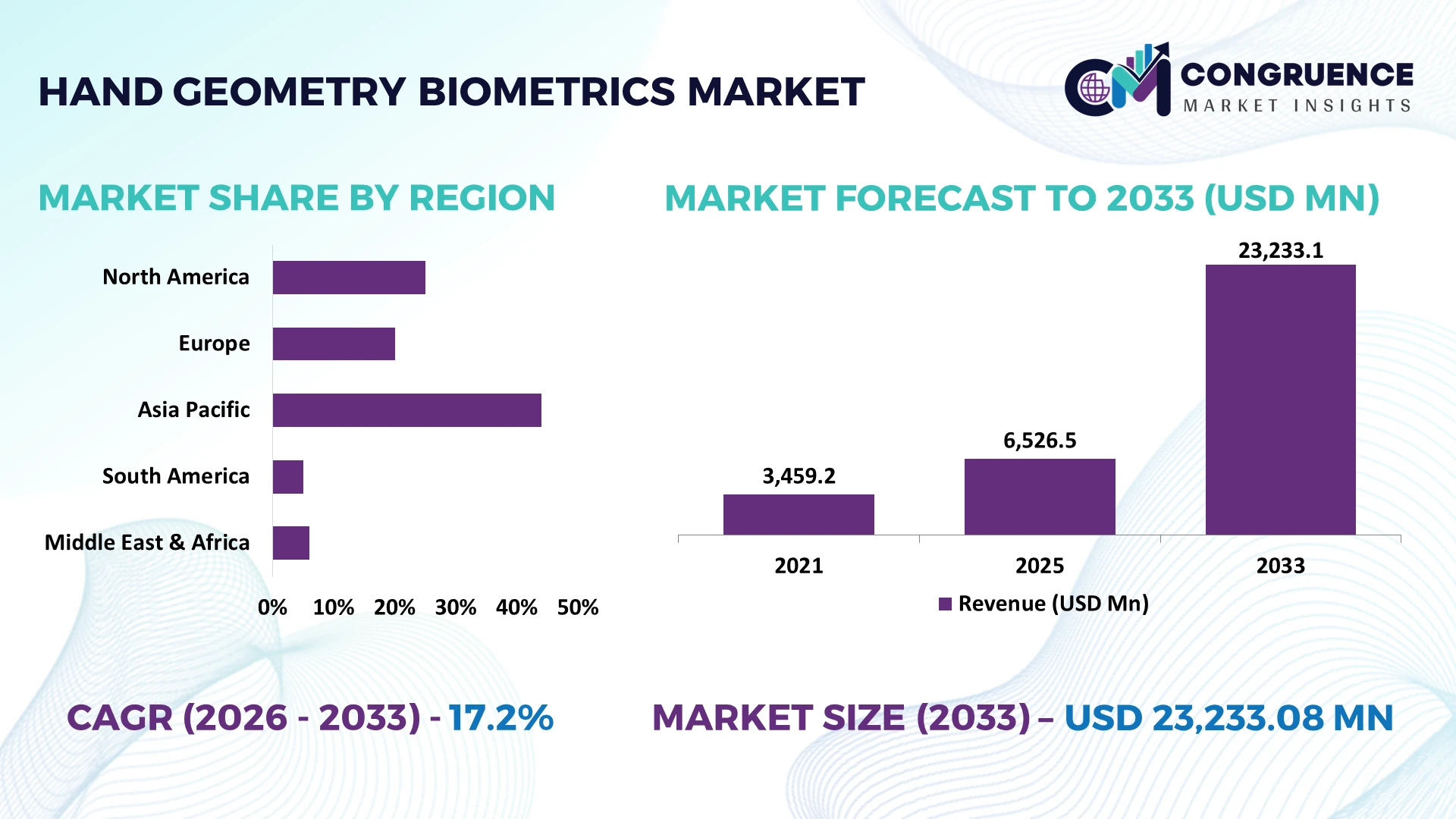
The Global Hand Geometry Biometrics Market was valued at USD 6526.5 Million in 2025 and is anticipated to reach a value of USD 23233.08 Million by 2033 expanding at a CAGR of 17.2% between 2026 and 2033. Growth is driven by modernization of physical access control, automated workforce attendance verification, contactless hand recognition, and integration of biometric terminals with enterprise security infrastructure.
The United States is a significant market for hand geometry and related palm recognition technologies, supported by corporate security, healthcare, aviation, and workforce management applications. HID's 2025 industry survey found 35% of organizations using biometric access technologies, with another 13% planning adoption. Amazon previously deployed palm recognition across more than 500 Whole Foods stores before withdrawing retail services in 2026, highlighting commercialization risks. Compared with China, where Tencent supports palm recognition deployments, American suppliers face greater pressure to demonstrate recurring utilization and operational returns.
Strategically, suppliers should prioritize enterprise contracts, interoperable access systems, and measurable utilization rather than large retail hardware rollouts.
Market Size & Growth: USD 6,526.5 million in 2025, reaching USD 23,233.08 million by 2033 at 17.2% CAGR, supported by contactless authentication modernization.
Top Growth Drivers: 35% biometric access deployment, 13% planned adoption, and 58% organizational biometric utilization indicate broader access security demand.
Short Term Forecast: By 2028, vendors targeting a 13 percentage point adoption increase align with the 2025 survey pipeline, subject to conversion.
Emerging Technologies: 3D hand geometry, palm vein recognition, and AI assisted matching expand multimodal identity verification capabilities.
Regional Leaders: North America, Asia Pacific, and Europe represent major deployment ecosystems; independently validated regional USD projections are unavailable.
Consumer/End User Trends: 21% of organizations surveyed by Ponemon reported palmprint authentication usage, indicating specialized enterprise demand.
Pilot/Case Example: In 2026, Amazon discontinued retail palm authentication after deployment across more than 500 Whole Foods locations, demonstrating adoption constraints.
Competitive Landscape: Fujitsu, Tencent, HID, and ZKTeco compete across hand authentication technologies; verified standalone market leadership percentages remain unavailable.
Regulatory & ESG Impact: GDPR Article 9 establishes special protections for biometric identification data, influencing procurement and template storage.
Investment & Funding: Enterprise access modernization remains an investment priority, with 39% of surveyed organizations identifying biometrics for planned access improvements.
Innovation & Future Outlook: Cloud access integration and multimodal authentication gain relevance as 27% of surveyed organizations operate hybrid access infrastructure.
The Hand Geometry Biometrics Market covers measurement based hand recognition and adjacent palm authentication technologies serving industrial facilities, healthcare institutions, commercial buildings, and secure workforce environments. Traditional systems measure finger dimensions and hand contours, while newer platforms incorporate 3D imaging, palm patterns, and vascular recognition. The 2025 Ponemon Institute research identified 21% organizational palmprint usage, demonstrating interest in hand based authentication beyond conventional fingerprints. Amazon's 2026 retail withdrawal highlights the importance of sustained utilization, while enterprise access modernization creates a clearer pathway toward strategic investment in specialized biometric hardware and integrated identity management.
Hand geometry biometrics is becoming strategically important as industrial operators, healthcare institutions, and corporate security providers modernize physical access infrastructure. The transition from conventional hand dimension measurement toward contactless palm recognition and multimodal authentication is changing equipment procurement priorities. In 2025, HID reported that 35% of surveyed organizations used biometric access technologies, while another 13% planned adoption. This creates opportunities for suppliers offering integrated identity management, secure credential storage, and compatibility with existing access systems.
Contactless hand authentication reduces dependence on physical credentials and supports faster identity verification. A conventional badge system requires possession and credential presentation, whereas biometric terminals verify enrolled users directly. Modern palm recognition systems target authentication within 1 second, although actual performance depends on equipment and operating conditions. American enterprises emphasize security integration, while Chinese technology providers prioritize commercial payment authentication and high volume deployment. These differences influence sensor architecture, software development, and partnership strategies.
Between 2026 and 2028, manufacturers are prioritizing three dimensional imaging, encrypted biometric templates, and integrated workforce authentication. Industrial facilities provide practical deployment opportunities through employee attendance verification and restricted area access. Suppliers are strengthening partnerships with security integrators, semiconductor manufacturers, and enterprise software providers. Competitive advantage increasingly depends on recognition reliability, implementation economics, and scalable integration rather than standalone hardware performance.
Enterprise security modernization is strengthening demand for hand geometry recognition, contactless palm authentication, and integrated workforce identity systems. HID's 2025 security survey reported 35% existing biometric access adoption, 13% planned adoption, and 39% organizational interest in biometric access improvements. United States healthcare networks, industrial facilities, and commercial enterprises are replacing fragmented credential systems with centralized access management platforms. This shift reduces dependence on transferable identification cards and strengthens individual accountability. Technology providers are responding through integrated biometric terminals, secure credential management software, and partnerships with physical security integrators. Manufacturers combining hand recognition with established access infrastructure gain procurement advantages by minimizing installation complexity and supporting consistent authentication across multiple facilities.
Specialized hand recognition terminals require imaging components, enrollment infrastructure, software integration, and ongoing maintenance, creating procurement barriers for smaller enterprises. European GDPR requirements impose strict conditions on biometric identification processing, while Article 9 establishes special protection for sensitive biometric information. In the broader security market, 35% of surveyed organizations already use biometric access, while 13% plan adoption, demonstrating an existing deployment base alongside an incomplete transition. Germany's industrial facilities face additional integration requirements involving legacy access controllers and employee privacy obligations. Suppliers are reducing implementation costs through modular readers, software compatibility agreements, and localized technical support. The operational priority is minimizing hardware replacement expenses while maintaining regulatory compliance and reliable workforce authentication.
Contactless palm recognition creates opportunities in healthcare, industrial access management, and secure commercial authentication where shared physical surfaces introduce maintenance and hygiene concerns. The Ponemon Institute identified 21% organizational palmprint authentication usage, while HID's 2025 survey recorded 39% interest in biometric access improvements and 13% planned biometric adoption. China's commercial authentication ecosystem demonstrates opportunities for integrating palm recognition with payment terminals and connected service infrastructure. Emerging three dimensional imaging and vascular recognition technologies strengthen identity assurance beyond conventional hand geometry measurement. Manufacturers are investing in contactless capture modules, secure biometric templates, and integration partnerships. Suppliers combining palm recognition with enterprise access software can target recurring service contracts and reduce dependence on standalone hardware sales.
Scaling hand geometry authentication across industrial facilities requires consistent recognition performance despite variations in hand positioning, protective equipment, environmental conditions, and workforce characteristics. NIST biometric authentication guidance establishes a false match rate benchmark of 0.01% and recommends false nonmatch rates below 5% for applicable biometric systems. These thresholds illustrate demanding authentication requirements, although individual hand geometry products require separate validation. United States industrial operators face additional challenges integrating biometric readers with existing access controllers, emergency procedures, and identity administration platforms. Manufacturers must strengthen sensor calibration, presentation attack detection, and secure template management. Competitive sustainability depends on maintaining recognition accuracy across distributed facilities while supporting firmware updates, credential recovery, and reliable authentication under demanding operating conditions.
Legacy Hand Readers Enter Replacement Cycles: Industrial operators are reassessing installed hand geometry terminals as access controllers transition toward IP connectivity and centralized administration. Traditional readers measure finger length, width, and palm dimensions, while newer platforms support multiple credential formats. HID's 2025 survey identified 35% existing biometric access adoption and 13% planned adoption. Suppliers are prioritizing controller compatibility and migration services to preserve customer installations.
Mobile Credentials Reshape Authentication Workflows: Commercial building operators increasingly combine physical biometric readers with mobile identity credentials rather than maintaining separate access databases. The 2025 HID survey found 61% of security professionals identifying mobile credentials as an important access control trend, while 47% highlighted integrated security platforms. Vendors are connecting hand authentication events with centralized authorization software, reducing duplicate enrollment administration and improving security reporting across facilities.
Privacy Requirements Transform Biometric Storage: European organizations are reassessing biometric enrollment and retention practices under GDPR Article 9, which restricts processing biometric data for unique identification without an applicable legal basis and exception. The regulation establishes 1 harmonized framework across 27 European Union member states. Technology suppliers are introducing encrypted templates, configurable retention controls, and documented deletion workflows, reducing compliance exposure during enterprise procurement and security audits.
Contactless Recognition Faces Commercial Reassessment: Amazon's decision to discontinue Amazon One palm authentication in 2026 followed deployment across more than 500 Whole Foods locations. The withdrawal highlights the importance of utilization economics rather than terminal installation counts. Commercial operators are reassessing customer enrollment friction and recurring equipment costs. Vendors are shifting toward specialized institutional deployments where controlled user populations and predictable authentication frequency support operational justification.
Contact Based Systems represent the established segment of hand geometry biometrics, with an indicative market share of approximately 45% to 50%, reflecting their historical deployment across workforce attendance terminals, industrial facilities, and institutional access systems. Their fixed hand positioning mechanisms support repeatable geometric measurements and compatibility with established security infrastructure. Two Dimensional Scanners remain relevant for measuring hand silhouettes, finger lengths, and relative dimensions using conventional optical imaging. Their simpler hardware architecture supports maintenance affordability and integration into controlled indoor environments. Manufacturers serving existing installations prioritize replacement compatibility, durable components, and continued technical support.
Contactless Systems represent the fastest advancing category as enterprises seek touch free authentication and simplified user interaction. Three Dimensional Scanners strengthen this transition through depth imaging and volumetric hand measurements, supporting more detailed geometric feature extraction. The categories overlap because contactless systems can employ either two dimensional or three dimensional imaging. Suppliers are developing improved camera modules, automated positioning guidance, and secure template processing. Investment priorities increasingly favor systems offering measurable authentication reliability without requiring extensive changes to installed access infrastructure.
Access Control represents the leading application, with an indicative market share of approximately 40% to 45%, supported by deployment across manufacturing facilities, corporate offices, healthcare institutions, and restricted operational environments. Hand geometry terminals provide individual identity verification at controlled entry points, reducing dependence on transferable identification cards. Workforce Attendance remains an established application, particularly in factories and organizations requiring consistent employee verification across multiple shifts. Two dimensional hand recognition systems continue serving conventional attendance infrastructure, while integrated terminals increasingly connect authentication records with workforce administration software.
Identity Verification represents the fastest advancing application as organizations integrate contactless hand recognition into secure service access and institutional authentication workflows. The broader biometric access ecosystem recorded 35% existing adoption and 13% planned adoption in HID's 2025 survey, demonstrating procurement interest in biometric verification. Border Control remains a specialized application where stringent identity assurance requirements favor established biometric modalities, limiting standalone hand geometry deployment. Manufacturers are strengthening authentication software integration, centralized enrollment management, and multimodal verification capabilities. Suppliers providing adaptable access terminals gain advantages in institutional procurement and operational continuity.
Manufacturing represents the leading end user category, with an indicative market share of approximately 30% to 35%, supported by industrial workforce attendance, restricted production access, and established hand geometry terminal installations. Automotive plants, electronics factories, and industrial processing facilities require consistent employee identification across rotating shifts and controlled operating areas. Government remains an important institutional buyer for secure facility access and workforce verification, while Commercial Enterprises deploy hand authentication within corporate security and employee management systems. Established buyers prioritize equipment durability, authentication consistency, and compatibility with existing access controllers.
Healthcare represents the fastest advancing end user category as hospitals modernize clinical access management and reduce reliance on shared authentication credentials. Contactless hand recognition supports applications where physical interaction with authentication equipment is undesirable. Banking and Finance emphasizes secure employee access, controlled operational facilities, and integration with identity management infrastructure. The broader enterprise biometric market recorded 13% planned adoption in 2025, indicating an expanding procurement pipeline. Suppliers are developing healthcare compatible terminals, configurable security policies, and integrated software platforms to address specialized operating requirements.
North America accounted for the largest estimated market share at 34% in 2025 however, Asia Pacific is expected to register the fastest growth, expanding at a CAGR of 19.5% between 2026 and 2033.
Enterprise Access Modernization Strengthens Established Biometric Infrastructure
North America represents an estimated 34% of the global Hand Geometry Biometrics Market, supported by established industrial access systems, corporate security infrastructure, and biometric workforce management. The United States maintains significant installed infrastructure across manufacturing facilities, healthcare institutions, and commercial properties. HID's 2025 security survey reported that 35% of organizations used biometric access technologies, indicating substantial adoption across the broader physical security ecosystem. Canada's institutional security market emphasizes identity management integration, particularly within healthcare facilities and regulated commercial environments. Regional procurement increasingly prioritizes compatibility with existing access controllers, encrypted biometric templates, and centralized credential administration. Traditional hand geometry readers face replacement pressure as enterprises transition toward contactless authentication and integrated security platforms. Manufacturers are responding through modernization partnerships, modular terminal development, and software integration services that preserve existing infrastructure investments while improving authentication flexibility.
United States Market Outlook: The United States benefits from established security technology suppliers, advanced enterprise identity infrastructure, and institutional demand for reliable biometric access control. NIST SP 800 63B provides technical requirements for biometric authentication, influencing security system design and procurement. Healthcare networks, industrial facilities, and corporate campuses prioritize integrated authentication systems that support employee verification, controlled entry, and centralized identity administration. Suppliers are strengthening compatibility with existing access management platforms.
Privacy Regulation Accelerates Secure Biometric System Modernization
Europe holds an estimated 25% share of the global Hand Geometry Biometrics Market, supported by industrial security modernization, workforce authentication, and regulated institutional access. Germany, France, and the United Kingdom represent important deployment environments because of their manufacturing concentration, commercial infrastructure, and established physical security industries. The General Data Protection Regulation establishes strict requirements for processing biometric information used for unique identification, influencing procurement decisions and system architecture. European Union privacy rules apply across 27 member states, encouraging manufacturers to implement encrypted biometric templates and controlled retention mechanisms. Financial institutions and healthcare operators increasingly prioritize authentication platforms compatible with existing enterprise security infrastructure. Suppliers are strengthening partnerships with regional system integrators and certification providers to address data protection requirements. The shift toward contactless recognition also supports modernization of established access terminals without requiring complete replacement of institutional security networks.
Germany Market Outlook: Germany's industrial manufacturing base supports demand for biometric workforce verification and restricted facility access. Automotive manufacturers, engineering companies, and industrial equipment operators require reliable employee authentication across multiple production shifts. German data protection requirements influence the deployment of biometric attendance systems, particularly where employee consent and proportionality are relevant. Technology suppliers emphasize privacy preserving template storage, durable terminal construction, and compatibility with industrial access infrastructure.
Electronics Manufacturing Scale Supports Contactless Recognition Innovation
Asia Pacific accounts for an estimated 28% of global Hand Geometry Biometrics Market activity, supported by electronics manufacturing, industrial workforce management, and digital identity infrastructure expansion. China maintains an important position in biometric hardware manufacturing and contactless palm recognition development, while Japan contributes advanced imaging technologies and industrial automation capabilities. South Korea supports semiconductor integration and compact sensing components used in authentication devices. India's industrial facilities and commercial enterprises provide additional opportunities for biometric attendance and controlled access applications. Tencent's palm recognition initiatives demonstrate China's commercial interest in hand based authentication beyond conventional access terminals. Regional manufacturers benefit from established camera module supply chains, electronics assembly infrastructure, and proximity to semiconductor component suppliers. Companies are expanding partnerships between imaging specialists, software developers, and security equipment manufacturers to improve authentication integration, hardware availability, and deployment economics.
China Market Outlook: China benefits from extensive electronics manufacturing capabilities and an established digital payment infrastructure. Tencent has developed palm recognition technology combining palmprint and palm vein characteristics for contactless authentication. Chinese technology companies are integrating hand based recognition into commercial service environments, while industrial operators continue using biometric workforce management systems. Domestic imaging component production and software development capabilities support product customization and manufacturing scale.
Workforce Digitization Strengthens Institutional Authentication Demand
South America represents an estimated 7% of global Hand Geometry Biometrics Market demand, with Brazil accounting for the largest regional deployment opportunities. Manufacturing facilities, commercial buildings, healthcare institutions, and corporate security operators represent important application environments. Brazil's industrial workforce management requirements encourage integration between biometric attendance terminals and payroll administration systems. The country's General Personal Data Protection Law establishes requirements for processing sensitive biometric information, influencing enrollment procedures and authentication system architecture. Argentina and Chile contribute additional institutional demand through commercial security modernization and employee identification applications. However, imported imaging components, equipment acquisition costs, and uneven technical support infrastructure constrain deployment economics. Suppliers are responding through local distribution partnerships, modular terminal configurations, and software compatibility services. Commercial success increasingly depends on reliable maintenance networks, affordable replacement components, and integration with existing enterprise management platforms.
Brazil Market Outlook: Brazil's manufacturing and financial services sectors support biometric workforce management and institutional access control applications. The country's LGPD regulates biometric information as sensitive personal data, requiring appropriate safeguards during collection and processing. Industrial facilities increasingly prioritize attendance systems compatible with payroll administration, while commercial operators emphasize centralized access permissions. Suppliers offering localized software, maintenance contracts, and secure biometric enrollment gain stronger institutional positioning.
Digital Infrastructure Investment Advances Secure Access Modernization
The Middle East and Africa represent an estimated 6% of global Hand Geometry Biometrics Market activity, supported by government modernization, commercial infrastructure development, and institutional security investment. Saudi Arabia and the United Arab Emirates provide important deployment opportunities through smart building development, industrial facilities, and digital government initiatives. Saudi Arabia's Vision 2030 program supports infrastructure modernization and technology adoption across public and private institutions. The United Arab Emirates has expanded digital identity infrastructure through UAE Pass, creating opportunities for interoperable authentication technologies. South Africa contributes enterprise demand through financial institutions, commercial properties, and industrial security systems. Regional procurement emphasizes durable biometric terminals, reliable authentication, and integration with established access infrastructure. Manufacturers are strengthening partnerships with construction technology contractors, security integrators, and enterprise software providers to support installation, maintenance, and localized authentication requirements.
United Arab Emirates Market Outlook: The United Arab Emirates benefits from advanced commercial infrastructure, digital government modernization, and substantial investment in smart buildings. Dubai and Abu Dhabi provide opportunities for biometric access integration across corporate campuses, healthcare facilities, and restricted industrial environments. UAE Pass supports digital identity services, while enterprise operators require compatible physical access technologies. Suppliers emphasizing contactless authentication, encrypted credential management, and integration with building security systems are positioned to address institutional procurement requirements.
The global Hand Geometry Biometrics Market features competition between established access control suppliers HID and ZKTeco, contactless recognition innovators Fujitsu and Tencent, and enterprise authentication specialists Suprema, IDEMIA, and NEC. The leading five participants account for an indicative 35% to 40% combined share across the broader hand authentication ecosystem, although dedicated hand geometry concentration remains unverified. HID emphasizes installed infrastructure compatibility, while Fujitsu develops palm vein authentication and Tencent advances commercial palm recognition. Technology competition increasingly centers on contactless verification, recognition accuracy, and software interoperability. Broader biometric access adoption reached 35% among surveyed organizations in 2025, with another 13% planning implementation, reinforcing procurement opportunities. Suppliers are expanding integration partnerships, secure credential platforms, and specialized authentication hardware. Privacy compliance, sensor development expenses, and established distribution relationships constrain market entry. Competitive success requires reliable recognition, affordable deployment, differentiated technology, and integration with enterprise security infrastructure.
HID Global Corporation
ZKTeco Co., Ltd.
Fujitsu Limited
Tencent Holdings Limited
Suprema Inc.
IDEMIA Group
NEC Corporation
Thales Group
BioSec Group Ltd.
Mantra Softech (India) Pvt. Ltd.
Matrix Comsec Pvt. Ltd.
Anviz Global Inc.
Conventional hand geometry systems measure finger length, width, thickness, and palm dimensions through optical imaging and fixed positioning guides. These readers remain relevant for industrial attendance and restricted facility access, where established enrollment databases support operational continuity. Contactless palm recognition introduces camera based imaging and automated feature extraction, reducing physical interaction with shared terminals. In 2025, 35% of surveyed organizations reported biometric access deployment, indicating established demand across broader security infrastructure.
Emerging technologies combine three dimensional hand imaging, palm vein recognition, artificial intelligence assisted matching, and encrypted biometric templates. Fujitsu's PalmSecure technology uses near infrared imaging to identify vascular patterns, providing authentication without direct contact. Modern systems target verification within one second, compared with conventional guided placement workflows, although standardized percentage improvements remain deployment dependent. Secure local processing and centralized credential administration strengthen privacy controls and reduce reliance on separate identity databases.
Between 2026 and 2028, disruptive innovation will prioritize multimodal hand authentication, edge processing, and integration with intelligent building security platforms. HID, Fujitsu, and Tencent compete through recognition reliability, hardware integration, and application specialization. Healthcare institutions benefit from touchless verification, while manufacturing operators prioritize durable terminals and workforce integration. Suppliers investing in interoperable software, secure enrollment, and automated authentication workflows strengthen their competitive positioning across institutional deployments.
June 2024: Mastercard partnered with Ingenico, Fujitsu Frontech, and Scanntech to launch Uruguay's first palm payment pilot under its Biometric Checkout Program. The deployment introduced contactless payment verification, reducing checkout friction and expanding biometric transaction capabilities. Source: ingenico.com
November 2024: Tencent partnered with Visa to introduce palm recognition payments in Singapore, involving 3 participating banks: DBS, OCBC, and UOB. The initiative expanded contactless authentication internationally, connecting palm biometrics with established payment infrastructure and merchant acceptance. Source: tencent.com
September 2025: Ingenico and Cielo tested palm vein payments at Cielo's innovation facility in Barueri, Brazil. The system enabled transactions in under 5 seconds, demonstrating faster biometric checkout and supporting evaluation of commercial payment applications. Source: paymentmedia.com
January 2026: Amazon announced discontinuation of Amazon One palm authentication, previously deployed across more than 500 Whole Foods stores, citing limited customer adoption. The withdrawal highlighted commercial utilization challenges and redirected attention toward sustainable biometric deployment economics. Source: geekwire.com
The Hand Geometry Biometrics Market Report evaluates industry developments between 2026 and 2033 across 4 technology categories: Contact Based Systems, Contactless Systems, Two Dimensional Scanners, and Three Dimensional Scanners. Application coverage includes Access Control, Workforce Attendance, Identity Verification, and Border Control. End user analysis examines Government, Banking and Finance, Healthcare, Manufacturing, and Commercial Enterprises. Geographic assessment covers North America, Europe, Asia Pacific, South America, and the Middle East and Africa, emphasizing deployment infrastructure, regulatory requirements, and manufacturing capabilities.
The report evaluates optical hand measurement, contactless palm recognition, vascular imaging, and secure biometric authentication integration. Competitive coverage examines HID, Fujitsu, Tencent, Suprema, and specialized technology suppliers. Strategic analysis addresses equipment replacement cycles, enterprise adoption, procurement economics, and technology partnerships, supporting investment planning, regional expansion, and competitive positioning.
| Report Attribute/Metric | Report Details |
|---|---|
Market Revenue in 2025 | USD 6526.5 Million |
Market Revenue in 2033 | USD 23233.08 Million |
CAGR (2026 - 2033) | 17.2% |
Base Year | 2025 |
Forecast Period | 2026 - 2033 |
Historic Period | 2021 - 2025 |
Segments Covered | By Type
By Application
By End-User
|
Key Report Deliverable | Revenue Forecast, Growth Trends, Market Dynamics, Segmental Overview, Regional and Country-wise Analysis, Competition Landscape |
Region Covered | North America, Europe, Asia-Pacific, South America, Middle East, Africa |
Key Players Analyzed | HID Global Corporation, ZKTeco Co., Ltd., Fujitsu Limited, Tencent Holdings Limited, Suprema Inc., IDEMIA Group, NEC Corporation, Thales Group, BioSec Group Ltd., Mantra Softech (India) Pvt. Ltd., Matrix Comsec Pvt. Ltd., Anviz Global Inc. |
Customization & Pricing | Available on Request (10% Customization is Free) |




