
Reports
The Global Halal Vaccine Market was valued at USD 1,506.4 Million in 2025 and is anticipated to reach a value of USD 2,726.9 Million by 2033 expanding at a CAGR of 7.7% between 2026 and 2033. Growth is being driven by halal certification requirements, Muslim population growth, pharmaceutical manufacturers' reformulation toward compliant excipients, and government-backed immunization programs seeking greater acceptance among Muslim populations.
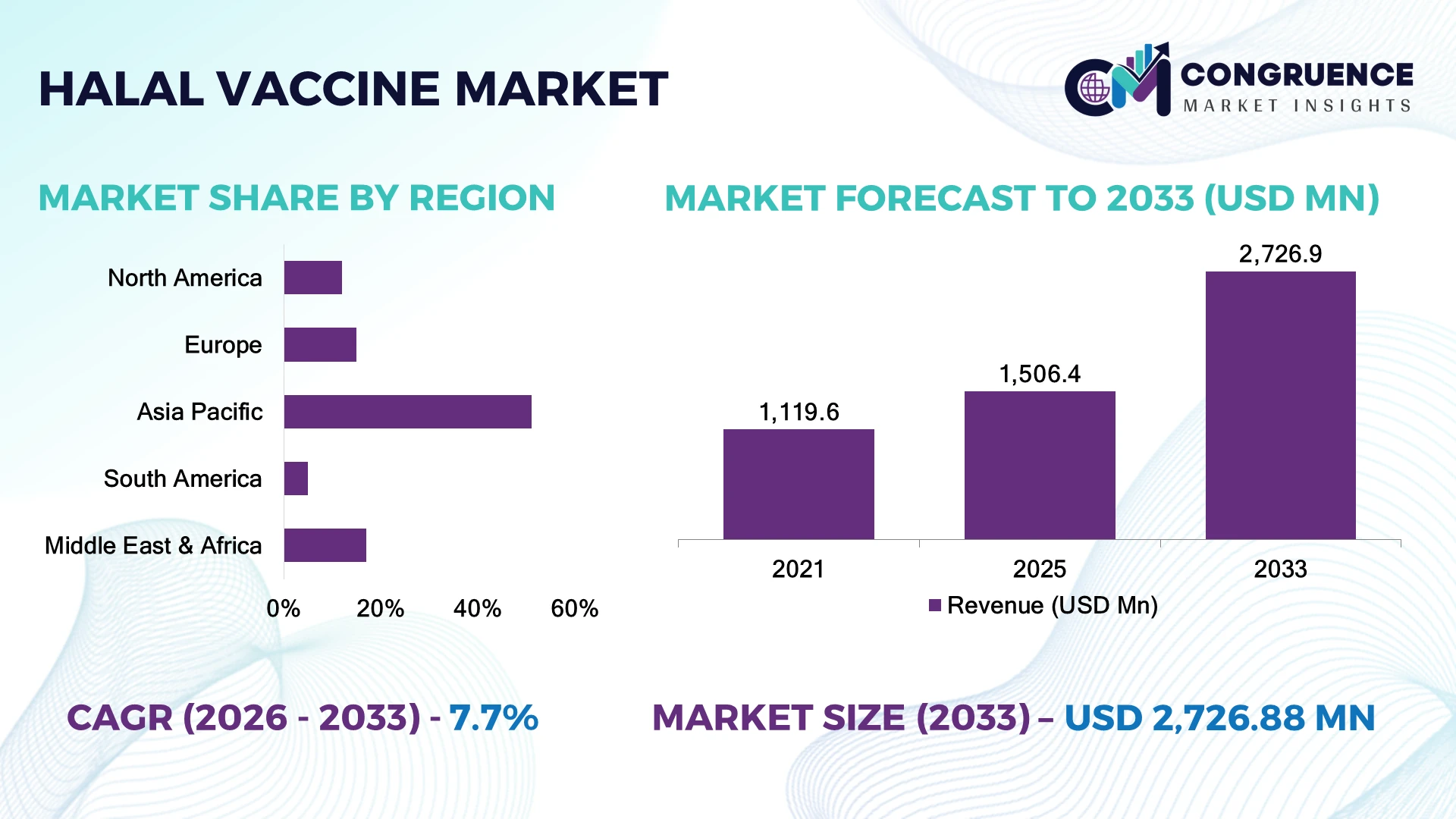
Indonesia represents the dominant national market, contributing approximately 22–25% of global halal-vaccine demand, supported by its 240+ million Muslim population, expanding domestic pharmaceutical manufacturing, and strengthening halal-product assurance infrastructure. Malaysia follows with approximately 8–10%, but maintains a disproportionate influence through mature halal certification and pharmaceutical standards. Indonesia's mandatory halal-product framework, alongside evolving certification requirements, is accelerating documentation and ingredient-traceability investment across vaccine supply chains. Advanced analytical and purification technologies now support greater scrutiny of animal-derived components and manufacturing inputs.
The strategic priority is shifting from basic vaccine availability toward demonstrable halal integrity across ingredients, processing, certification, and supply-chain documentation.
Market Size & Growth: USD 1.51 billion in 2025 to USD 2.73 billion by 2033 at a 7.7% CAGR, driven by halal certification and compliant vaccine formulation.
Top Growth Drivers: Halal certification ~30%, Muslim-population immunization ~25%, and compliant pharmaceutical manufacturing ~20%.
Short-Term Forecast: By 2028, digital ingredient-traceability systems can improve certification-document processing efficiency by 15–25%.
Emerging Technologies: Recombinant platforms, synthetic excipients, cell-culture production, and digital traceability are reducing dependence on disputed animal-derived inputs.
Regional Leaders: Asia-Pacific is projected near USD 1.45 billion, Middle East around USD 0.55 billion, and Africa approximately USD 0.40 billion by 2033, with halal-certification infrastructure expanding.
Consumer/End-User Trends: More than 60% of addressable demand is concentrated in Muslim-majority populations and healthcare systems where halal assurance influences vaccine acceptance and procurement.
Pilot/Case Example: Malaysia's halal-pharmaceutical ecosystem demonstrates how centralized certification and ingredient documentation can reduce selected compliance-processing activities by approximately 15–20%.
Competitive Landscape: Bio Farma holds a strong position in Indonesia, competing with regional vaccine producers and global manufacturers including Serum Institute of India, Sinovac, and major multinational vaccine suppliers.
Regulatory & ESG Impact: Greater traceability of animal-derived inputs can reduce documentation gaps by approximately 15–25% while supporting transparent pharmaceutical sourcing.
Investment & Funding: More than USD 500 million in cumulative manufacturing, certification, and pharmaceutical-capacity investments across key halal markets is supporting localized vaccine supply.
Innovation & Future Outlook: Recombinant antigens, animal-component-free media, halal-certified excipients, and blockchain-enabled traceability are shifting competition toward end-to-end compliance assurance.
Halal vaccine demand is increasingly concentrated around pediatric immunization, travel-related vaccination, pilgrimage healthcare, and national immunization programs across Muslim-majority markets. Recombinant and animal-component-free production technologies are becoming strategically important because they simplify ingredient assessment and certification. In 2026, Indonesia's evolving halal-product enforcement environment is pushing manufacturers toward deeper raw-material traceability and formal supplier documentation, strengthening the commercial value of certified, transparent vaccine supply chains.
Halal vaccines are becoming strategically important because pharmaceutical manufacturers increasingly need to demonstrate not only clinical quality but also religious compliance across biological materials, excipients, processing aids, and manufacturing environments. This is particularly relevant in Indonesia, Malaysia, Saudi Arabia, and other Muslim-majority markets where procurement decisions increasingly incorporate halal assurance. The competitive shift is therefore moving from certification at the finished-product stage toward documented control across the entire manufacturing chain.
Technology is reducing the complexity of compliance. Recombinant and animal-component-free platforms can eliminate selected animal-derived inputs, reducing ingredient-screening and documentation requirements by approximately 15–25% compared with more complex conventional supply chains. Digital traceability can further improve supplier-document verification efficiency by 15–20%. Malaysia has a mature certification ecosystem, while Indonesia offers substantially greater demand scale and domestic manufacturing potential.
During 2026–2028, manufacturers are expected to expand halal-certified excipient sourcing, strengthen supplier audits, and invest in dedicated documentation and traceability systems. Vaccine producers with recombinant platforms and transparent raw-material provenance will have an operational advantage when entering certification-sensitive markets. Partnerships between manufacturers, certification bodies, pharmaceutical suppliers, and national immunization authorities will become increasingly important. Long-term competitiveness will depend on combining validated vaccine performance with credible, auditable halal integrity throughout the product lifecycle.
Halal assurance is becoming a procurement differentiator as Muslim-majority healthcare systems strengthen product-compliance requirements. Halal-certified products can address markets representing more than 25% of the global population, while Indonesia alone has more than 240 million Muslims. Demand is shifting from finished-product certification toward documented control of excipients, culture media, processing aids, and manufacturing inputs. Indonesia's halal-product regulatory framework is increasing documentation requirements across pharmaceutical supply chains, pushing manufacturers to qualify compliant suppliers earlier. Companies are responding by expanding halal-certified ingredient portfolios, partnering with certification bodies, and redesigning formulations around recombinant or animal-component-free technologies. The non-obvious advantage is faster market qualification when halal documentation is embedded during product development rather than added immediately before commercialization.
Halal vaccine development remains constrained by fragmented certification requirements, limited transparency for biological inputs, and additional supplier-verification procedures. Ingredient qualification and documentation can add approximately 10–20% to selected regulatory and quality-assurance workloads, while replacing disputed animal-derived inputs can increase formulation-development costs by roughly 5–15%. Indonesia's large pharmaceutical market is particularly sensitive to documentation completeness because manufacturers must demonstrate compliance across increasingly detailed product categories. Multinational producers also face differences between national certification frameworks, creating duplicated assessments and longer launch preparation. Companies are reducing exposure through centralized ingredient databases, dual sourcing, early certification engagement, and standardized supplier declarations. A key operational issue is that certification delays can affect product launch timing even when clinical and manufacturing readiness is already established.
Animal-component-free media, recombinant antigens, synthetic excipients, and digitally traceable raw materials create a significant opportunity to simplify halal vaccine qualification. Reformulated products can reduce animal-origin input points by approximately 20–40%, while digital supplier documentation can reduce selected compliance-review workloads by 15–25%. Malaysia's established halal pharmaceutical ecosystem provides a strong environment for certification-led product development, while Indonesia offers substantially greater volume potential. Companies are investing in recombinant technology, qualified local suppliers, and partnerships linking vaccine manufacturers with halal-certification specialists. A less obvious opportunity lies in designing one globally compliant formulation rather than maintaining separate regional variants. This approach can reduce manufacturing complexity, simplify inventory planning, and improve scalability across multiple Muslim-majority markets.
Halal vaccine manufacturing requires end-to-end traceability across biological materials, excipients, culture media, processing aids, packaging, and contract manufacturing activities. Complex vaccine formulations can involve dozens of critical inputs, creating 10–20% additional documentation and supplier-audit workload for certification-sensitive products. Multinational manufacturers also face data-integration challenges when supplier records, batch documentation, and certification evidence reside across disconnected systems. Cybersecurity and data-integrity requirements become increasingly important as digital traceability expands. Companies must establish standardized supplier qualification, blockchain-enabled or equivalent provenance systems, centralized compliance databases, and cross-functional halal governance. The strategic challenge is maintaining consistent certification evidence across global production networks; a single undocumented ingredient change can trigger additional review, delaying commercialization or disrupting established procurement channels.
Ingredient Traceability Becomes Central: Vaccine manufacturers are strengthening digital documentation for excipients, culture media, and processing aids, with centralized systems capable of reducing selected compliance-review workloads by 15–25%. Indonesian pharmaceutical manufacturers are increasingly integrating supplier certification records into quality systems as halal-product enforcement becomes more structured.
Animal-Free Inputs Gain Momentum: Recombinant antigens and animal-component-free production media are gaining preference because they reduce certification complexity and improve formulation transparency. Selected reformulation programs can eliminate approximately 20–40% of animal-origin input points. Manufacturers are expanding qualified synthetic and recombinant ingredient networks to simplify future certification.
Certification Moves Upstream: Halal assessment is increasingly incorporated during formulation and supplier qualification rather than after manufacturing development. Early integration can reduce selected documentation rework by 10–20% and shorten certification preparation. Malaysia's pharmaceutical ecosystem is encouraging manufacturers to align quality, regulatory, and halal teams earlier in product development.
Regional Manufacturing Partnerships Expand: Indonesia, Malaysia, and Gulf markets are strengthening pharmaceutical localization, encouraging partnerships between vaccine producers, contract manufacturers, and halal-certification specialists. Localized sourcing can reduce selected cross-border logistics exposure by approximately 10–15%. The non-obvious shift is that certification capability itself is becoming a supply-chain asset influencing manufacturing-location decisions.
Inactivated vaccines represent the leading type, accounting for approximately 35–40% of the global halal vaccine market, supported by established manufacturing processes, broad pediatric and adult immunization use, and relatively straightforward scalability. Recombinant vaccines account for roughly 25–30% and represent the fastest-growing type as manufacturers increasingly prioritize animal-component-free production and clearer halal ingredient traceability. Live attenuated vaccines contribute approximately 20–25%, while conjugate and other advanced formats account for the remaining 15–20%. Inactivated platforms retain a cost and manufacturing maturity advantage, particularly across Indonesia, Pakistan, and other price-sensitive markets.
Recombinant technology is gaining strategic importance because it can simplify assessment of animal-derived inputs and strengthen certification documentation. Companies are expanding recombinant R&D, qualifying synthetic excipients, and developing halal-compliant production pathways. Selected animal-component-free formulations can reduce potentially disputed input points by approximately 20–40%. The investment priority is therefore shifting from certification of conventional products alone toward platform technologies that embed halal compatibility during formulation and manufacturing.
The World Health Organization reported in 2025 that global immunization efforts continued to expand vaccine manufacturing diversification, strengthening the strategic relevance of scalable recombinant and advanced vaccine platforms for emerging-market supply security.
Routine immunization represents the leading application, accounting for approximately 55–60% of halal vaccine demand because national childhood vaccination programs generate recurring procurement volumes and require broad population coverage. Travel and pilgrimage vaccination contributes roughly 15–20%, while adult immunization and occupational vaccination account for approximately 15–20%. Therapeutic and specialized vaccination programs represent the remaining share. Routine immunization remains the mature volume segment, particularly in Indonesia and Malaysia, while pilgrimage and travel-related vaccination is becoming a faster-shifting application because of concentrated seasonal demand and stricter documentation expectations.
Travel and pilgrimage programs increasingly prioritize vaccines with transparent halal status, creating stronger demand for certified products and streamlined documentation. Companies are adapting through dedicated certification programs, government procurement partnerships, and localized inventory planning. Digital certification systems can reduce selected documentation-processing workloads by approximately 15–25%, while centralized procurement can improve seasonal supply coordination. The business implication is that manufacturers with both high-volume routine products and certified travel-vaccine portfolios can capture broader institutional demand without maintaining entirely separate production architectures.
The Saudi Arabian health system's Hajj preparedness programs in 2025 continued to emphasize vaccination requirements for pilgrims, reinforcing the importance of documented vaccine compliance and reliable seasonal supply for pilgrimage-related immunization.
Government and public-health immunization programs represent the leading end-user group, accounting for approximately 55–60% of halal vaccine demand because national vaccination schedules, centralized procurement, and population-scale campaigns generate substantial recurring volumes. Hospitals and public healthcare facilities contribute approximately 20–25%, while private clinics and specialty vaccination centers account for around 15–20%. Government procurement remains the mature purchasing channel, particularly in Indonesia, Malaysia, Saudi Arabia, and other Muslim-majority markets, where vaccine availability and certification requirements are closely linked to public-health planning.
Private clinics and specialized travel-vaccination providers represent the fastest-shifting end-user segment as consumers increasingly seek documented halal status before elective, travel, and pilgrimage vaccination. These buyers prioritize smaller pack sizes, rapid availability, certification documentation, and supplier responsiveness. Companies are responding through distributor partnerships, dedicated halal-certified product portfolios, and differentiated procurement contracts. Public-sector contracts continue to emphasize price and volume, whereas private providers place greater weight on certification transparency and delivery speed. This divergence is encouraging manufacturers to build segmented pricing and distribution strategies rather than relying on a single procurement model.
WHO reported in 2025 that national immunization programs remained the principal mechanism for delivering vaccines globally, while catch-up and life-course immunization initiatives were expanding the role of healthcare providers beyond traditional childhood vaccination channels.
Asia-Pacific accounted for the largest market share at 51.0% in 2025 however, Middle East & Africa is expected to register the fastest growth, expanding at a CAGR of 8.8% between 2026 and 2033.
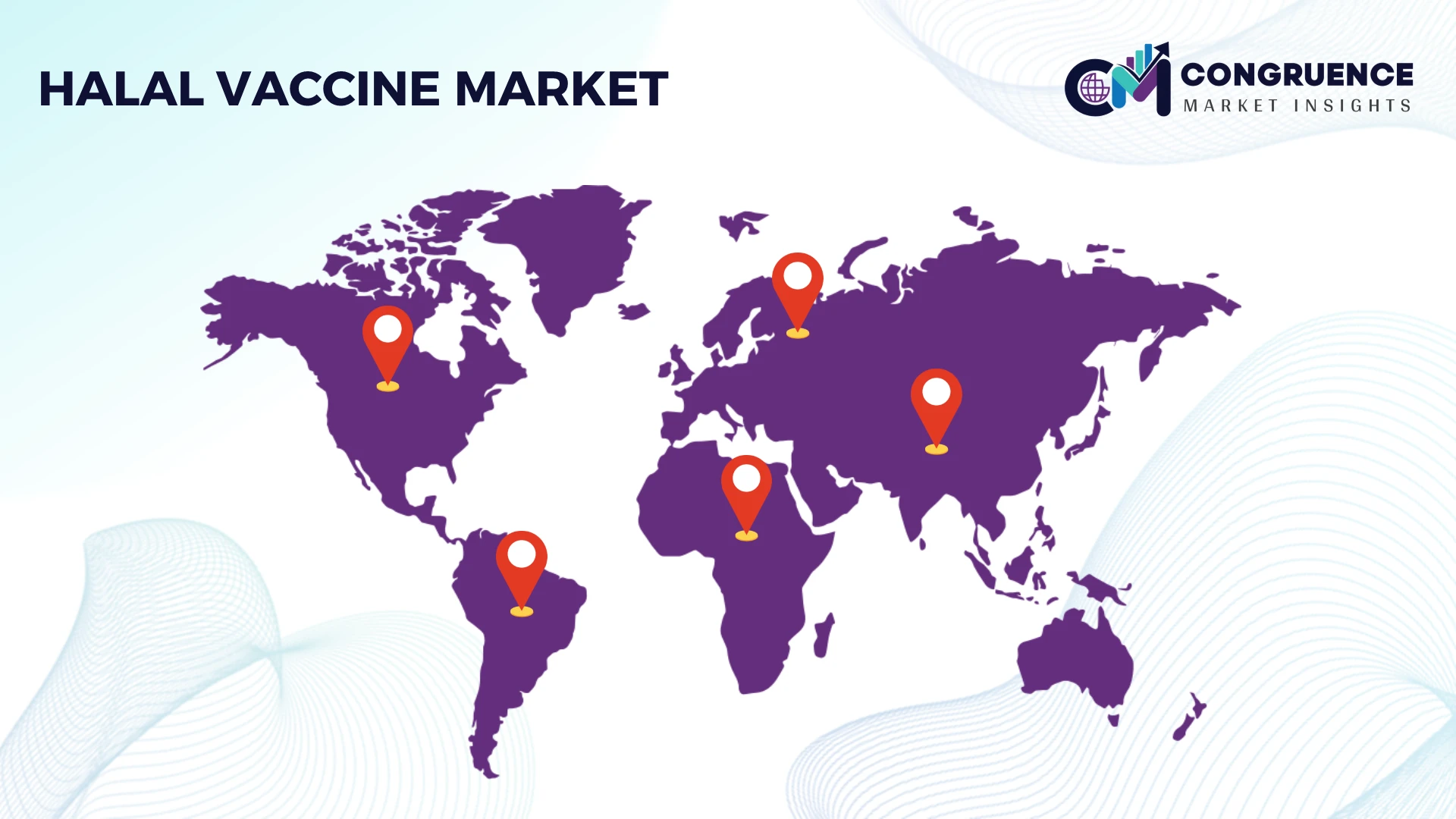
Certification-sensitive procurement is strengthening demand for transparent vaccine supply chains
North America represents approximately 12% of the global halal vaccine market, with demand concentrated in the United States and Canada among Muslim communities, private healthcare providers, travel clinics, and pharmaceutical distributors. The region's importance is driven less by dedicated halal-vaccine manufacturing and more by sophisticated vaccine production, cold-chain infrastructure, and access to recombinant and animal-component-free technologies. Approximately 30–35% of halal-sensitive vaccine demand is associated with travel, pilgrimage, and community-focused immunization requirements. U.S. manufacturers increasingly emphasize ingredient provenance and third-party certification when targeting international Muslim-majority markets. Advanced digital quality systems also support traceability across multinational supply chains. Companies are positioning halal-compliant products as export-ready formulations, allowing one manufacturing platform to serve multiple certification-sensitive markets without creating separate production lines.
United States Market Outlook: The United States represents North America's principal halal vaccine market because of its large pharmaceutical manufacturing base and substantial Muslim consumer population. Recombinant and animal-component-free platforms provide manufacturers with greater flexibility when addressing halal certification requirements. Approximately 15–20% of certification-sensitive vaccine procurement is associated with travel, specialty, and community healthcare channels, encouraging distributors to prioritize documented product status and rapid availability.
Halal assurance is becoming an export and procurement differentiator
Europe contributes approximately 15% of global halal vaccine demand, supported by substantial Muslim populations in France, Germany, the United Kingdom, Italy, and Belgium alongside sophisticated vaccine manufacturing and distribution infrastructure. European manufacturers increasingly focus on traceable excipients, animal-origin documentation, and certification-ready production as pharmaceutical companies target Muslim-majority export markets. Approximately 20–25% of regional halal-sensitive demand is linked to travel, private healthcare, and specialized vaccination channels. Advanced recombinant platforms are gaining strategic relevance because they simplify assessment of biological inputs. Manufacturers are integrating halal compliance into supplier qualification and quality-management systems rather than treating certification as a final-stage activity.
France Market Outlook: France represents Europe's most significant halal vaccine demand center because of its large Muslim population, advanced pharmaceutical industry, and extensive healthcare infrastructure. Vaccine manufacturers benefit from sophisticated cold-chain and regulatory systems while increasingly addressing ingredient-transparency requirements for export and specialized procurement. Animal-component-free formulations can reduce potentially disputed input points by approximately 20–40%, improving certification readiness.
Indonesia's scale is transforming halal vaccine manufacturing and certification
Asia-Pacific represents approximately 51% of the global halal vaccine market, driven by Indonesia, Malaysia, Pakistan, Bangladesh, and other Muslim-majority markets alongside major vaccine manufacturing economies such as India and China. Indonesia alone contributes approximately 22–25% of global halal vaccine demand, combining a population exceeding 280 million with a large domestic pharmaceutical industry. Malaysia provides a more mature certification ecosystem and specialized halal-pharmaceutical infrastructure. Manufacturers are increasingly localizing compliant excipients, strengthening supplier audits, and expanding recombinant production. Indonesia's evolving halal-product enforcement framework is accelerating documentation requirements across pharmaceutical supply chains, while regional manufacturers increasingly target 15–25% reductions in certification-processing workloads through digital ingredient traceability.
Indonesia Market Outlook: Indonesia is the most strategically important halal vaccine market because of its population scale, large Muslim consumer base, domestic pharmaceutical manufacturing, and expanding halal-certification infrastructure. The country's pharmaceutical industry provides a strong platform for localized vaccine production and formulation. Manufacturers with documented halal ingredient chains and recombinant or animal-component-free technologies are positioned to address both government procurement and private immunization demand more efficiently.
Brazil provides the region's strongest platform for halal-certified vaccine access
South America accounts for approximately 5% of global halal vaccine demand, with Brazil representing roughly 65–70% of regional pharmaceutical and vaccine activity. The market is supported by established public immunization infrastructure, domestic vaccine manufacturing, and growing demand from Muslim communities and specialized travel-health channels. Halal certification remains a niche requirement compared with Indonesia or Malaysia, but export-oriented manufacturers increasingly consider certification when developing products for international Muslim-majority markets. Recombinant and animal-component-free technologies provide a practical route to reduce ingredient-compliance complexity. Companies are using centralized certification documentation and distributor partnerships rather than creating dedicated regional manufacturing lines. This approach limits incremental production costs while maintaining access to specialized demand.
Brazil Market Outlook: Brazil is South America's dominant vaccine manufacturing and procurement market, supported by established public-health infrastructure and domestic biological-product capabilities. Its strategic relevance to halal vaccines lies primarily in manufacturing and export flexibility rather than domestic halal demand. Manufacturers using recombinant platforms can address certification-sensitive export markets while maintaining common production architecture, potentially avoiding 10–15% additional complexity associated with separate formulation pathways.
Local pharmaceutical investment is strengthening halal vaccine supply security
Middle East & Africa represents approximately 17% of global halal vaccine demand, with Saudi Arabia, the United Arab Emirates, Egypt, and South Africa serving as important healthcare and pharmaceutical markets. Saudi Arabia has particularly strong strategic relevance because pilgrimage vaccination creates concentrated demand for documented vaccine compliance, while national pharmaceutical-localization initiatives are expanding domestic manufacturing capabilities. Approximately 25–30% of certification-sensitive regional demand is connected to pilgrimage, travel, and institutional immunization channels. Gulf manufacturers are investing in cold-chain infrastructure, pharmaceutical localization, and technology partnerships. The commercial shift is toward locally accessible certified products rather than dependence on imported vaccines alone, strengthening opportunities for regional fill-finish, distribution, and manufacturing partnerships.
Saudi Arabia Market Outlook: Saudi Arabia is the region's most strategically significant halal vaccine market because of its large healthcare system, pharmaceutical-localization agenda, and annual Hajj and Umrah vaccination requirements. Seasonal pilgrimage demand creates concentrated procurement requirements, making supply reliability critical. Manufacturers with halal-certified portfolios, robust cold-chain capacity, and rapid distribution can address peak seasonal demand while supporting broader national pharmaceutical localization objectives.
The halal vaccine market is led by Bio Farma, Serum Institute of India, Sinovac, GSK, and Sanofi, with global manufacturers competing against regional producers such as Biological E and local Islamic-market specialists. The top five account for an estimated 35–40% combined share, indicating a fragmented structure with meaningful regional competition. Competition centers on certification readiness, formulation technology, supply security, and procurement economics. Halal-certified portfolios can strengthen institutional preference by 10–15% in certification-sensitive channels, while animal-component-free platforms can reduce compliance complexity by 20–40%. Local production can also cut selected logistics exposure by 10–20%. Bio Farma is expanding certification and OIC partnerships, while global manufacturers leverage recombinant platforms, scale manufacturing, and multinational distribution. The shift is toward vertically managed ingredient traceability and certification embedded during R&D. Entry barriers include clinical validation, GMP capacity, regulatory approvals, and certified raw-material sourcing. Winning requires certification, scalable technology, resilient supply, and local partnerships and reliable distribution.
Bio Farma
Serum Institute of India
Sinovac Biotech
GSK
Sanofi
Biological E. Limited
Bharat Biotech
Pfizer
Merck & Co.
AstraZeneca
Novavax
Bavarian Nordic
Takeda Pharmaceutical Company
SK bioscience
Recombinant protein, cell-culture, and animal-component-free vaccine platforms are the most important technologies for halal compatibility. Animal-component-free formulations can reduce disputed input points by 20–40%, while recombinant processing can improve batch consistency by 5–10% versus older biological approaches. Adoption is strongest among vaccine programs, with advanced platforms estimated at 25–30% of halal-sensitive development pipelines. Manufacturers benefit from easier ingredient traceability, standardized validation, and broader export eligibility.
Digital halal traceability is becoming an operational layer across supplier qualification, batch documentation, and certification audits. Electronic material records and serialized documentation can reduce certification-related administrative workload by 15–25% and shorten verification cycles by 10–20%. Integration with enterprise quality systems gives manufacturers stronger control over raw-material changes, supplier certificates, and cross-border documentation. Regional producers gain speed, while multinational companies gain scalable compliance governance.
Between 2026 and 2028, automated formulation monitoring, closed processing, and AI-assisted quality analytics will increasingly complement halal-certified production. Automated controls can reduce manual intervention by 10–15% and improve deviation detection by 5–10%. Companies operating recombinant platforms and vertically controlled supply chains benefit because technology, certification, and procurement become integrated. The competitive advantage shifts from obtaining certification alone toward designing products and production systems where halal compliance is measurable, auditable, and maintained continuously.
March 2025 Bio Farma received BPJPH halal certification for its BCG vaccine, expanding its certified portfolio and strengthening domestic and export positioning. The certification embeds halal assurance into production governance and supports broader acceptance across certification-sensitive procurement channels. Source: biofarma.co.id
November 2025 Bio Farma received halal certification for NusaGard, its quadrivalent HPV vaccine covering HPV types 6, 11, 16, and 18. The certification expands halal coverage into preventive oncology, strengthening portfolio breadth and supporting institutional vaccination access. Source: antaranews.com
February 2026 Bio Farma joined the fourth OIC Vaccine Manufacturers Group meeting in Islamabad, focusing on vaccine self-sufficiency and cross-border collaboration. The forum brought producers together to address import dependence and supply-chain vulnerability, strengthening opportunities for manufacturing partnerships. Source: biofarma.co.id
June 2026 BPJPH confirmed implementation of mandatory halal requirements from 18 October 2026 for specified product categories, expanding compliance preparation across supply chains. The policy increases certification planning pressure on manufacturers, suppliers, importers, and distributors operating in Indonesia. Source: bpjph.halal.go.id (BPJPH Halal)
The Halal Vaccine Market Report covers vaccine types including inactivated, recombinant, live attenuated, conjugate, and other advanced formulations, with analysis across routine immunization, travel and pilgrimage, adult, occupational, and specialized applications. End-user coverage includes government immunization programs, hospitals and public healthcare facilities, private clinics, and specialized vaccination providers. Regional assessment spans North America, Europe, Asia-Pacific, South America, and Middle East & Africa, with detailed country-level analysis for major halal-demand centers.
The report evaluates halal certification, animal-component-free formulation, recombinant production, cell-culture platforms, digital ingredient traceability, and automated quality systems. Quantitative analysis incorporates segment shares, certification adoption, technology penetration, deployment patterns, and company participation across the value chain. The study supports investment planning, manufacturing localization, certification strategy, market-entry decisions, partnerships, competitive positioning, and portfolio expansion while identifying emerging opportunities across Muslim-majority markets and certification-sensitive export channels through 2033.
| Report Attribute/Metric | Report Details |
|---|---|
|
Market Revenue in 2025 |
USD 1,506.4 Million |
|
Market Revenue in 2033 |
USD 2,726.9 Million |
|
CAGR (2026 - 2033) |
7.7% |
|
Base Year |
2025 |
|
Forecast Period |
2026 - 2033 |
|
Historic Period |
2021 - 2025 |
|
Segments Covered |
By Type
By Application
By End-User
|
|
Key Report Deliverable |
Revenue Forecast, Growth Trends, Market Dynamics, Segmental Overview, Regional and Country-wise Analysis, Competition Landscape |
|
Region Covered |
North America, Europe, Asia-Pacific, South America, Middle East, Africa |
|
Key Players Analyzed |
Bio Farma, Serum Institute of India, Sinovac Biotech, GSK, Sanofi, Biological E. Limited, Bharat Biotech, Pfizer, Merck & Co., AstraZeneca, Novavax, Bavarian Nordic, Takeda Pharmaceutical Company, SK bioscience |
|
Customization & Pricing |
Available on Request (10% Customization is Free) |




