
Reports
The Global Hair Wax Stick Market was valued at USD 278.3 Million in 2025 and is anticipated to reach a value of USD 386.89 Million by 2033 expanding at a CAGR of 4.2% between 2026 and 2033. Growth is driven by rising adoption of sleek hairstyles, social-commerce influence, demand for precision flyaway control, and the introduction of multifunctional wax formulations combining flexible hold, humidity resistance, and conditioning benefits.
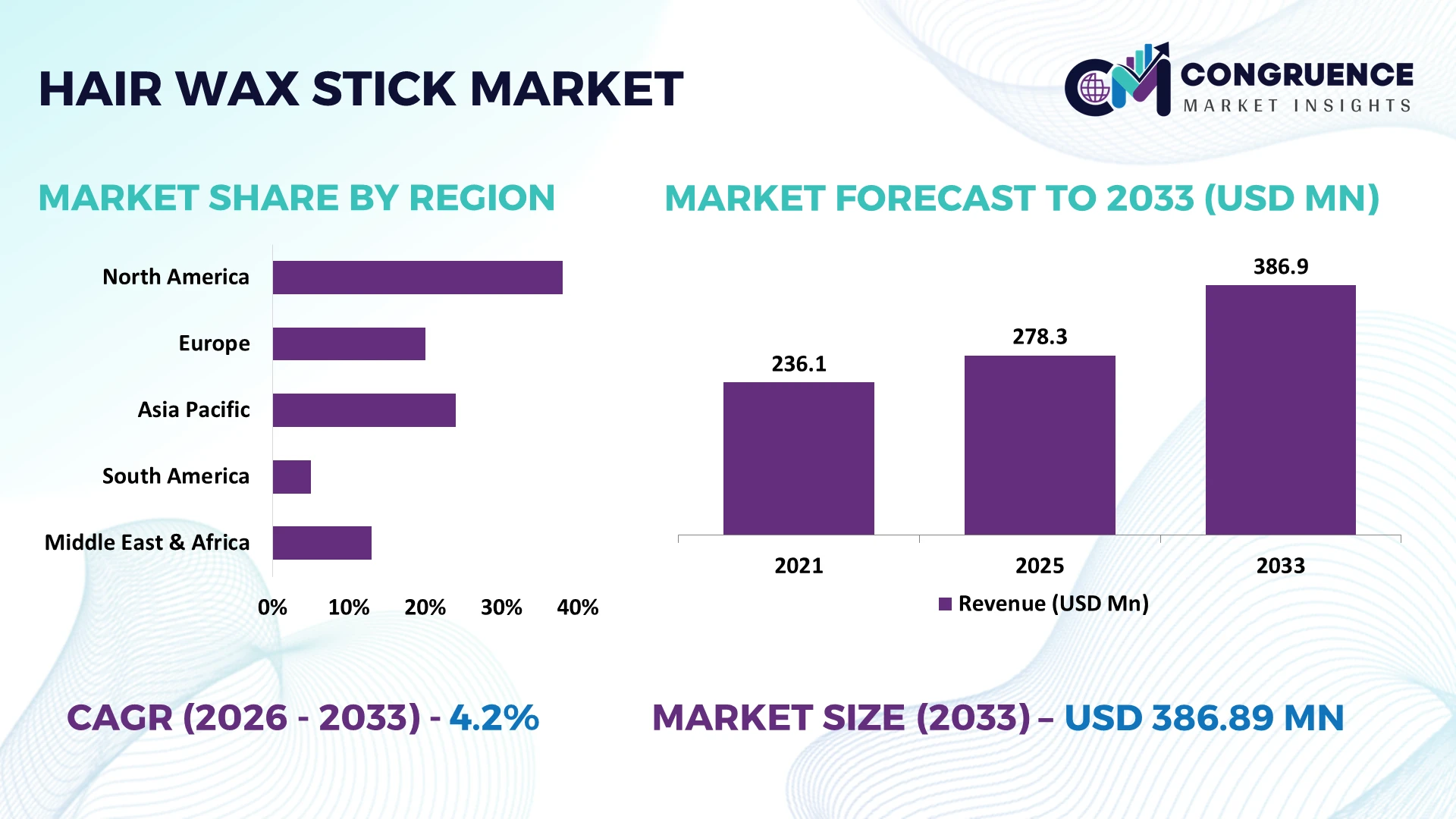
North America maintains a dominant position, with approximately 35% of the global hair wax stick market in 2025, supported by premium beauty spending, established salon networks, and strong online retail penetration. The United States anchors regional consumption through established brands and high-volume e-commerce distribution. In comparison, India represents an emerging opportunity, where hair-styling category penetration remains approximately 14%, indicating considerable scope for format expansion. US-China trade tensions and sourcing diversification are also influencing procurement strategies for beauty manufacturers, particularly those dependent on Asian production networks.
Manufacturers prioritizing differentiated formulations, competitive pricing, and diversified sourcing are positioned to strengthen market penetration and profitability.
Market Size & Growth: USD 278.3 million in 2025 to USD 386.89 million by 2033, at 4.2% CAGR, driven by precision styling and multifunctional product innovation.
Top Growth Drivers: Social-commerce influence (35%), convenience-led grooming (30%), and natural formulation preferences (25%) represent indicative demand drivers, not independently verified market contributions.
Short-Term Forecast: By 2028, manufacturers targeting a 10–15% reduction in packaging material and improved formulation stability will strengthen cost efficiency and product differentiation.
Emerging Technologies: Water-soluble wax blends, plant-derived conditioning ingredients, and precision applicator designs are improving application control, finish consistency, and formulation versatility.
Regional Leaders: North America, Europe, and Asia-Pacific lead commercial opportunities, with North America accounting for approximately 35% of the market and Asia-Pacific benefiting from expanding beauty e-commerce and manufacturing capabilities.
Consumer/End-User Trends: Consumer retail represents approximately 70% of hair wax stick sales, while professional salons contribute 30%, highlighting the importance of direct-to-consumer distribution.
Pilot/Case Example: In March 2026, Oribe introduced Supershine Smoothing Wax Stick, reporting 66% immediate frizz reduction and humidity protection for up to 48 hours, strengthening premium product positioning.
Competitive Landscape: The market remains fragmented, with no reliably established global company-level market share. Key competitors include Unilever, L'Oréal, Kitsch, Samnyte, and KeraCare.
Regulatory & ESG Impact: California Proposition 65 chemical disclosure requirements and growing packaging sustainability expectations are increasing formulation scrutiny and recyclable-packaging priorities.
Investment & Funding: No consolidated hair wax stick-specific global investment total is publicly established. Investment activity is concentrated in premium product launches, contract manufacturing, digital distribution, and sustainable packaging partnerships.
Innovation & Future Outlook: Multifunctional styling sticks, refill-compatible packaging, scalp-conscious formulations, and gender-inclusive product positioning are driving the next competitive shift toward differentiated consumer grooming solutions.
The hair wax stick market is expanding across everyday flyaway control, sleek bun styling, edge definition, and professional hairstyling applications. Product innovation increasingly combines flexible-hold waxes with conditioning ingredients, humidity protection, and non-greasy finishes. Oribe's 2026 product introduction, reporting 66% immediate frizz reduction, demonstrates the growing emphasis on measurable performance differentiation. Meanwhile, online retail accounts for approximately 70% of market sales, reinforcing the importance of digital product discovery and direct consumer engagement. Sustainable packaging development and US-China sourcing uncertainty are further influencing manufacturing and procurement strategies, creating opportunities for brands that combine formulation performance with supply-chain resilience.
The hair wax stick market is becoming strategically important as beauty manufacturers shift from conventional styling products toward portable, precision-based formulations that combine styling performance with convenience. Rising interest in hair wax products, reflected in a 12.1% year-over-year increase in US search popularity during 2024–2025, is strengthening product innovation and digital merchandising priorities. Companies are competing through application precision, residue control, ingredient differentiation, and premium positioning rather than relying exclusively on conventional wax formulations.
The transition from traditional wax jars to solid applicator sticks simplifies direct application, eliminates finger-to-product contact, and improves styling convenience, although no standardized industry-wide efficiency comparison is established. The United States leads premium product innovation, while India and China offer manufacturing flexibility and opportunities for affordable product expansion. US cosmetic compliance requirements under MoCRA, including biennial facility registration and annual product-listing updates, are also influencing manufacturing and distribution decisions.
Over the next 2–3 years, manufacturers will prioritize lightweight formulations, refill-conscious packaging, and digitally driven product launches. Companies are strengthening contract manufacturing relationships, investing in botanical ingredients, and expanding online distribution. Competitive advantage will increasingly depend on formulation consistency, regulatory readiness, and differentiated application performance.
Growing preference for controlled hairstyling and portable grooming formats is strengthening hair wax stick adoption. US hair wax search popularity increased 12.1% year over year during 2024–2025, while texturizing powder popularity surged 348.2%, indicating stronger consumer interest in specialized styling solutions. Demand for sleek buns, defined edges, and flyaway control is encouraging manufacturers to introduce non-greasy wax blends, botanical conditioning ingredients, and precision applicators. Social-commerce demonstrations further accelerate product discovery. Companies are responding through smaller packaging formats, influencer partnerships, and formulation diversification. The strategic advantage lies in converting routine styling requirements into repeat-purchase products with differentiated performance.
Maintaining consistent wax hardness, spreadability, fragrance stability, and application performance across changing temperatures remains a significant manufacturing constraint. Solid formulations require carefully balanced waxes, oils, and conditioning agents, increasing formulation testing and quality-control requirements. Variations in beeswax, plant-derived oils, and specialty cosmetic ingredients expose manufacturers to procurement volatility, particularly when sourcing depends on concentrated supplier networks. For smaller manufacturers, even moderate ingredient-cost fluctuations directly compress margins and restrict premium formulation development. Companies are mitigating these pressures through multiple-source procurement, standardized ingredient specifications, regional contract manufacturing, and longer-term supplier agreements. Production consistency, rather than product variety alone, determines scalable commercial positioning.
Botanical hair wax sticks offer an attractive differentiation opportunity through formulations incorporating amla, bhringraj, coconut oil, and other conditioning ingredients. India provides a particularly relevant commercialization opportunity because established herbal beauty preferences support product positioning beyond conventional styling performance. US hair styling product popularity increased 20.7% year over year across March 2025–February 2026, reinforcing the broader innovation opportunity. Manufacturers can capture additional value through humidity-resistant formulations, fragrance-free variants, and products designed for textured hair. Investment in application testing and localized product development will strengthen differentiation. Partnerships with Indian beauty retailers and digital-first brands can accelerate distribution without requiring extensive physical retail infrastructure.
Maintaining long-term competitiveness requires manufacturers to address formulation safety, ingredient traceability, labeling accuracy, and consistent performance across international markets. Under US MoCRA requirements, cosmetic facilities generally renew registration every 2 years, while marketed product listings require annual updates. As of June 2026, the FDA recorded 16,398 active facility registrations and 1,298,361 active cosmetic product listings, illustrating the scale of regulatory administration. Different national ingredient and labeling requirements further complicate international expansion. Companies must strengthen product documentation, stability testing, supplier audits, and regulatory monitoring. The critical challenge is establishing repeatable product quality across manufacturing locations while maintaining compliance as distribution expands.
Precision Application and Format Optimization: Hair styling brands are shifting toward compact, twist-up applicators that improve product placement around hairlines and flyaways. US hair wax popularity increased 12.1% year over year in 2025, while texturizing powder rose 348.2%. Manufacturers are prioritizing controlled dispensing, reduced product wastage, and portable packaging to differentiate solid styling formats from conventional jars.
Ingredient Transparency and Formulation Refinement: Botanical oils, lightweight conditioning agents, and residue-controlled wax blends are gaining attention as consumers scrutinize formulation quality. A 2025 US consumer survey found 71% prioritized natural ingredients in haircare purchasing. Manufacturers are responding with ingredient traceability, cleaner formulation positioning, and performance testing to balance styling hold with consumer expectations.
Digital Retail and Product Discovery: Online purchasing is reshaping beauty-product distribution, with US salon and independent-stylist e-commerce sourcing increasing from 19% in 2023 to 26% in 2024. Short-form demonstrations are strengthening product discovery for edge styling and sleek hairstyles. Brands are expanding digital-first launches, creator partnerships, and targeted merchandising to improve customer acquisition and retail conversion.
Multifunctional Styling and Hair Health: Haircare positioning is increasingly combining styling performance with conditioning and scalp-conscious formulations. Euromonitor's 2025 survey identified efficacy-focused beauty purchasing, while 77% of DIY beauty users prioritized product effectiveness. Manufacturers are developing lightweight, multifunctional products that address styling and appearance simultaneously, creating opportunities for premium differentiation and stronger repeat-purchase positioning.
Water-Based Wax Sticks represent an important formulation category because their water-compatible compositions support easier application, lighter finishes, and straightforward removal. However, audited global market-share data specifically separating hair wax sticks by formulation and hold strength is not publicly established; assigning a precise percentage to the leading type would create unsupported market estimates. Oil-Based Wax Sticks retain relevance for conditioning and smoother application, while Strong-Hold Wax Sticks address structured hairstyles requiring longer-lasting control. Flexible-Hold Wax Sticks appeal to consumers prioritizing natural movement and restyling convenience.
Frizz-Control Wax Sticks and Natural Wax Sticks offer additional differentiation through targeted performance and ingredient positioning. Frizz-control formulations benefit from humidity-management requirements, while natural variants address botanical ingredient preferences. Manufacturers are increasingly prioritizing lightweight formulations, improved spreadability, and residue control. Investment priorities are shifting toward application-specific product development rather than undifferentiated wax formulations, allowing brands to serve distinct styling requirements without excessive portfolio duplication.
Flyaway Control represents a central application because it addresses a frequent styling requirement across everyday grooming, professional hairstyling, and polished appearance management. Nevertheless, application-specific hair wax stick market shares are not independently verified through publicly available industry datasets. Edge Styling remains commercially relevant for precision hairline definition, particularly in sleek hairstyles. Bun and Ponytail Styling supports repeat usage among consumers seeking controlled finishes, while Sleek Hairstyling benefits from demand for smooth, structured appearances. These established applications provide a broad foundation for product positioning.
Frizz Control is an important emerging application as consumers increasingly prioritize humidity resistance and manageable finishes. Hair Smoothing complements this requirement through products designed to control surface irregularities without requiring full styling treatments. US hair wax popularity increased 12.1% in 2025, while broader hair styling product popularity increased 20.7% in 2026. Manufacturers are expanding application-specific messaging, developing flexible-hold formulations, and using digital demonstrations to target distinct styling routines. The strongest commercial opportunity lies in multifunctional products that combine flyaway control with frizz management.
Individual Consumers represent the principal target customer group because hair wax sticks support convenient, at-home styling without professional equipment or salon appointments. However, independently verified global market-share percentages for individual consumers and professional buyers are unavailable. US consumer research indicates that 86% of adults use shampoo or conditioner, while 18% use serums, masks, or leave-in products, demonstrating the established role of at-home haircare routines. Professional Hair Salons represent an important commercial segment through repeated styling applications, product recommendations, and professional retail sales. Barbershops also provide opportunities for products designed for precise hairline finishing and structured hairstyles.
Beauty and Styling Studios and Makeup and Fashion Professionals represent specialized purchasing groups, particularly for editorial styling, fashion shoots, event preparation, and long-lasting appearance management. Professional buyers prioritize consistent application, reliable hold, and product performance across multiple hair types. YouGov's 2025 research found that 15% of higher-income US consumers purchased haircare products through salons, compared with 8% of the general population. Manufacturers are strengthening salon partnerships, developing professional-size packaging, and introducing differentiated pricing strategies. Future commercial positioning increasingly depends on balancing individual retail volumes with professional endorsement and repeat institutional purchasing.
Asia-Pacific accounted for the largest share of the broader global hair wax market at approximately 39.3% in 2025, while the Middle East & Africa represents an emerging expansion opportunity.
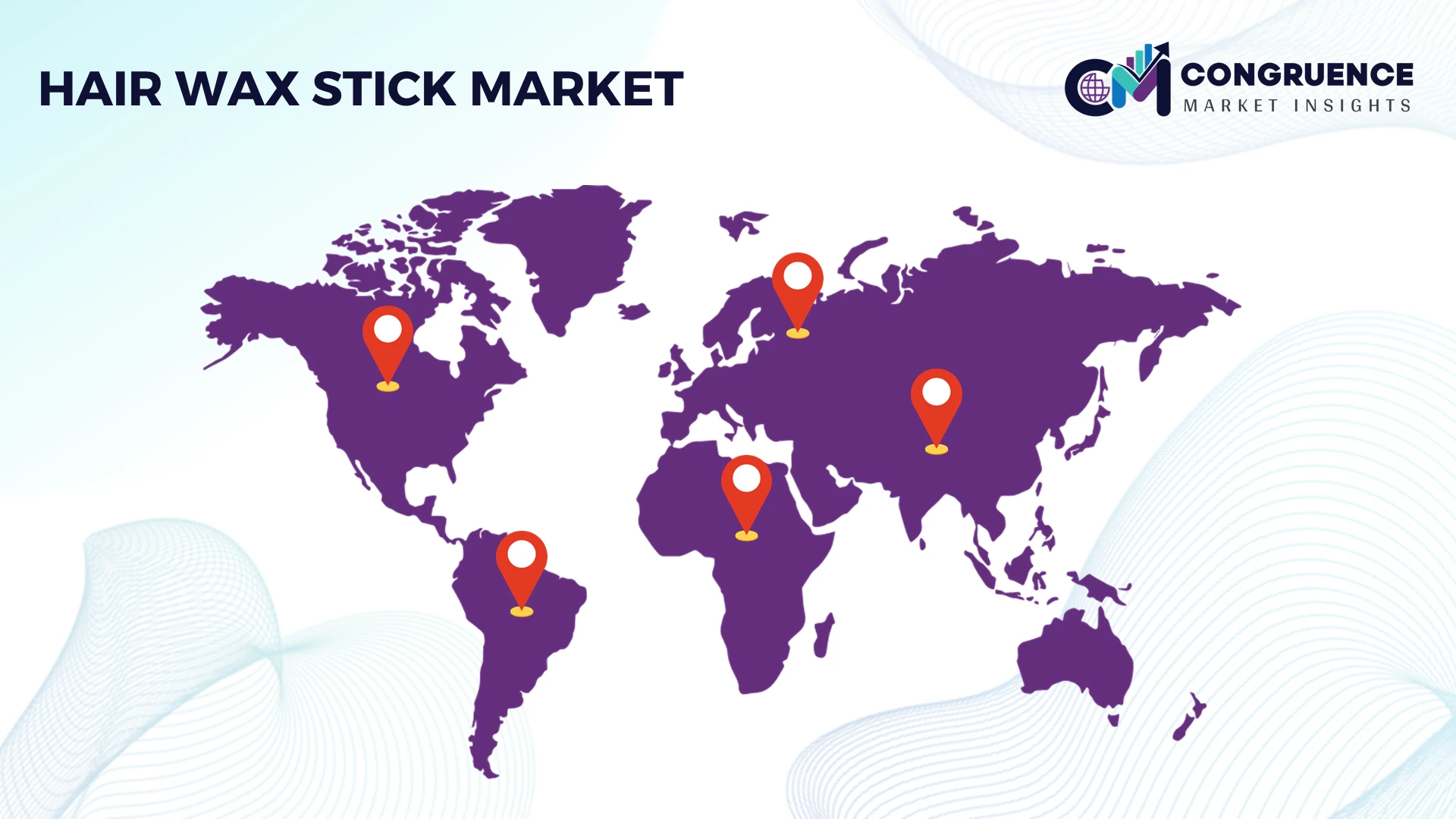
Premium Product Differentiation and Digital Retail Expansion
North America represents a strategically important market for premium hair wax sticks, supported by established beauty retail infrastructure, professional hairstyling networks, and strong brand recognition. The United States drives regional commercialization through specialty beauty retailers, salon distribution, and direct-to-consumer platforms. Online channels account for approximately 41% of US beauty and personal care sales, strengthening opportunities for product demonstrations, targeted advertising, and rapid consumer acquisition. Manufacturers are emphasizing flexible-hold formulations, residue control, botanical ingredients, and application-specific packaging. Premium brands compete through formulation quality and professional endorsement, while accessible brands prioritize pricing and distribution scale. Companies are expanding digital merchandising, influencer partnerships, and specialty retail availability to strengthen customer retention and improve product visibility.
United States Market Outlook: The United States leads North American premium haircare commercialization through established beauty companies, advanced contract manufacturing networks, and extensive specialty retail distribution. Its 41% online beauty and personal care sales penetration creates an effective route for launching differentiated hair wax sticks without relying exclusively on physical retail expansion. Manufacturers are prioritizing salon partnerships, premium positioning, and targeted digital campaigns to capture repeat-purchase demand.
Regulatory Compliance and Sustainable Formulation Development
Europe's hair wax stick market benefits from established cosmetic manufacturing capabilities, premium personal-care brands, and sophisticated ingredient-development networks. France, Germany, Italy, and the United Kingdom provide important commercial and distribution centers. The European Union's Cosmetics Regulation requires safety assessments and Cosmetic Products Notification Portal registration before products enter the market, increasing the importance of formulation documentation and ingredient traceability. European beauty e-commerce recorded 10% online sales growth in 2025, supporting digital distribution expansion. Manufacturers are increasingly emphasizing recyclable packaging, transparent ingredient declarations, and formulations aligned with regional consumer preferences. These requirements favor companies with established regulatory capabilities and integrated product-development processes. Smaller brands are increasingly relying on specialized contract manufacturers to reduce compliance complexity and accelerate market entry.
France Market Outlook: France maintains a strategic advantage through its established cosmetics manufacturing ecosystem, formulation expertise, and internationally recognized beauty brands. Its cosmetics industry supports advanced product development, ingredient evaluation, packaging innovation, and export-oriented distribution. Hair wax stick manufacturers can leverage established cosmetic laboratories and specialist suppliers to develop premium formulations while meeting European safety and labeling requirements. Competition increasingly rewards formulation differentiation and regulatory readiness.
Manufacturing Scale and Digital Beauty Commercialization
Asia-Pacific holds the strongest structural position in the broader hair wax category through manufacturing capacity, extensive consumer markets, and established cosmetic ingredient supply chains. China, India, Japan, and South Korea support different competitive advantages, ranging from mass production to premium formulation development. India's beauty e-commerce website traffic increased 116% year over year in the first quarter of 2026, strengthening digital product discovery and online distribution opportunities. Chinese manufacturers benefit from established packaging, wax formulation, and private-label production networks, while South Korean companies contribute advanced cosmetic formulation capabilities. Manufacturers are expanding localized product portfolios, contract manufacturing, and cross-border e-commerce partnerships. The region's non-obvious advantage lies in combining affordable production with rapid product customization for international beauty brands.
China Market Outlook: China offers significant manufacturing advantages through established cosmetic ingredient suppliers, packaging producers, and large-scale private-label manufacturing facilities. Its digital beauty ecosystem also enables rapid product testing and commercialization through online marketplaces and livestream retail. Manufacturers can use these capabilities to introduce multiple formulation variations, optimize production volumes, and supply international beauty brands seeking competitive procurement and shorter product-development cycles.
Digital Beauty Retail and Premium Grooming Expansion
South America's hair wax stick market is supported primarily by Brazil's established beauty consumption, professional hairstyling culture, and expanding digital retail infrastructure. Brazil and Mexico represent important commercial markets for international and domestic personal-care companies. Online beauty purchasing in Brazil remains less developed than in the United States, where e-commerce represents 41% of beauty and personal care sales, creating opportunities for distribution expansion. Regional beauty retail growth is encouraging brands to strengthen localized product portfolios, affordable packaging, and partnerships with specialty retailers. However, currency fluctuations, import costs, and distribution inconsistencies complicate pricing strategies. Manufacturers are responding through local distributor agreements, targeted product launches, and flexible pricing structures. Regional success increasingly depends on balancing imported formulation quality with accessible consumer pricing.
Brazil Market Outlook: Brazil provides the strongest commercial platform in South America through its established cosmetics industry, domestic beauty brands, and extensive salon distribution networks. Approximately 51% of surveyed Brazilian consumers increased their beauty purchasing frequency over the preceding year in 2025, demonstrating stronger category engagement. Manufacturers can capitalize on this behavior through localized styling products, professional retail partnerships, and accessible premium formulations.
Premium Beauty Investment and Modern Retail Expansion
The Middle East & Africa hair wax stick market is developing through premium beauty retail, expanding professional grooming services, and modern shopping infrastructure. Saudi Arabia and the UAE are important commercial centers, supported by international beauty brands, specialty retailers, and growing online distribution. Premium beauty positioning is particularly relevant in the Gulf markets, where consumers have access to international personal-care brands and professional styling services. African markets present a different opportunity through affordable grooming products and distributor-led expansion. However, import dependence, fragmented retail networks, and price sensitivity restrict uniform market penetration. Manufacturers are prioritizing regional distributors, localized pricing, and products suited to different hair textures. Investment in modern retail and digital commerce is strengthening market access without requiring extensive manufacturing localization.
Saudi Arabia Market Outlook: Saudi Arabia offers an attractive commercial environment through expanding beauty retail infrastructure, international brand distribution, and investment in consumer-facing businesses. Its Vision 2030 economic diversification agenda supports private-sector development and retail modernization. Hair wax stick manufacturers can strengthen market access through partnerships with established beauty distributors, specialty retailers, and professional styling networks, particularly for premium products targeting sleek hairstyles and controlled finishes.
The hair wax stick market is fragmented, with Unilever, L'Oréal, Henkel and Shiseido competing against specialists Kitsch, Samnyte, Avlon Industries and Shop Style Shark. Premium brands Oribe and Mermade Hair compete through formulation, finish and positioning, while mass-market suppliers emphasize accessible pricing, broad distribution and replenishment. A defensible combined share for the five largest hair-wax-stick players is not publicly disclosed; broader haircare shares cannot be transferred to this niche. Competition centers on hold performance, residue control, ingredient claims, applicator design and digital visibility. Online beauty sales grew nine times faster than in-store sales in 2025, intensifying pressure to convert social discovery into repeat purchases across price tiers and consumer groups. Brands respond with creator partnerships, targeted launches, salon placement and contract manufacturing. Regulatory documentation and formulation consistency create entry pressure, while low product complexity sustains private-label competition. Winners will combine proven performance, compliant formulations, distinctive positioning and efficient digital distribution.
Unilever PLC
L'Oréal S.A.
Henkel AG & Co. KGaA
Shiseido Company, Limited
Kao Corporation
Mandom Corporation
Revlon, Inc.
John Paul Mitchell Systems
Kitsch LLC
Samnyte
Avlon Industries, Inc.
Shop Style Shark
Mermade Hair
Emi Jay, Inc.
Hair wax stick technology is advancing through precision applicators, engineered wax blends, and multifunctional actives. Conventional jars require finger or tool transfer, whereas twist-up sticks apply product directly, reducing handling and improving placement during targeted styling routines. Formulation engineering balances carnauba, candelilla, synthetic or beeswax with emollients to control glide, hardness, and heat stability. Oribe reports 66% immediate frizz reduction against a clinical control group and up to 48-hour humidity protection, giving premium brands measurable performance claims.
Emerging systems combine styling wax with keratin, peptides, botanical oils, and bond-supporting ingredients. Indē Wild reports 32% less breakage after one use and 72-hour frizz control under 80% humidity for Champi Slick Stick. These are brand-reported clinical outcomes, not category-wide benchmarks. Curved applicators and narrow edges support broad smoothing and localized flyaway control, strengthening usability and premium product differentiation.
During 2026–2028, advantage will depend on stable formulations, reproducible testing, and packaging that protects stick integrity during transport and heat exposure. Automated dosing, molding, cooling, and weight checks improve batch consistency, although no category-wide efficiency benchmark exists. Large beauty groups benefit from testing infrastructure and salon access; specialists benefit from faster niche launches. Companies should prioritize heat-stability validation, applicator ergonomics, and substantiated claims before scaling production.
March 2025: Utena launched Matomage Homme Hair Stick Wax alongside a 10 mL point-design styling stick; the 13 g wax format targets controlled flyaway finishing. The dual-format launch extends men's grooming choices and broadens retail merchandising opportunities for men's grooming. Source: utena.co.jp
November 2025: Indē Wild launched Champi Slick Stick with Elsa Hosk, combining styling, repair, and frizz control. The brand reports 72-hour control at 80% humidity and 32% less breakage, positioning the product in performance-led botanical styling with keratin and peptides. Source: grazia.co.in
March 2026: Oribe introduced Supershine Smoothing Wax Stick with a curved precision applicator and conditioning ingredients. Clinical testing reports 66% immediate frizz reduction and 48-hour humidity protection, supporting premium salon distribution and measurable performance differentiation for professional and home styling. Source: modernsalon.com
March 2026: Developlus launched Color Oops Color Barrier+ Style Stick, combining hairline dye protection with flexible styling hold across four dye categories. The dual-purpose format extends use beyond finishing, creating cross-category relevance for at-home coloring and grooming for home users. Source: prnewswire.com
The Hair Wax Stick Market Report evaluates the market across Water-Based, Oil-Based, Strong-Hold, Flexible-Hold, Frizz-Control, and Natural Wax Sticks. Application coverage includes Flyaway Control, Edge Styling, Bun and Ponytail Styling, Sleek Hairstyling, Frizz Control, and Hair Smoothing. End-user analysis spans Individual Consumers, Professional Hair Salons, Barbershops, Beauty and Styling Studios, and Makeup and Fashion Professionals. Regional assessment covers North America, Europe, Asia-Pacific, South America, and the Middle East & Africa, including country-level manufacturing and retail dynamics.
The report examines wax-blend engineering, botanical and bond-supporting actives, precision applicators, formulation stability, packaging, and digital product discovery. It compares established styling formats with multifunctional and niche formulations, assessing performance differentiation, channel positioning, regulatory requirements, and competitive activity. These insights support portfolio prioritization, investment planning, market-entry decisions, distribution partnerships, and expansion strategies across 2026–2033, helping companies identify customer groups, operational constraints, and defensible opportunities.
| Report Attribute/Metric | Report Details |
|---|---|
Market Revenue in 2025 | USD 278.3 Million |
Market Revenue in 2033 | USD 386.89 Million |
CAGR (2026 - 2033) | 4.2% |
Base Year | 2025 |
Forecast Period | 2026 - 2033 |
Historic Period | 2021 - 2025 |
Segments Covered | By Type
By Application
By End-User
|
Key Report Deliverable | Revenue Forecast, Growth Trends, Market Dynamics, Segmental Overview, Regional and Country-wise Analysis, Competition Landscape |
Region Covered | North America, Europe, Asia-Pacific, South America, Middle East, Africa |
Key Players Analyzed | Unilever PLC, L'Oréal S.A., Henkel AG & Co. KGaA, Shiseido Company, Limited, Kao Corporation, Mandom Corporation, Revlon, Inc., John Paul Mitchell Systems, Kitsch LLC, Samnyte, Avlon Industries, Inc., Shop Style Shark, Mermade Hair, Emi Jay, Inc. |
Customization & Pricing | Available on Request (10% Customization is Free) |




