Global Hair Serum Market Report Overview
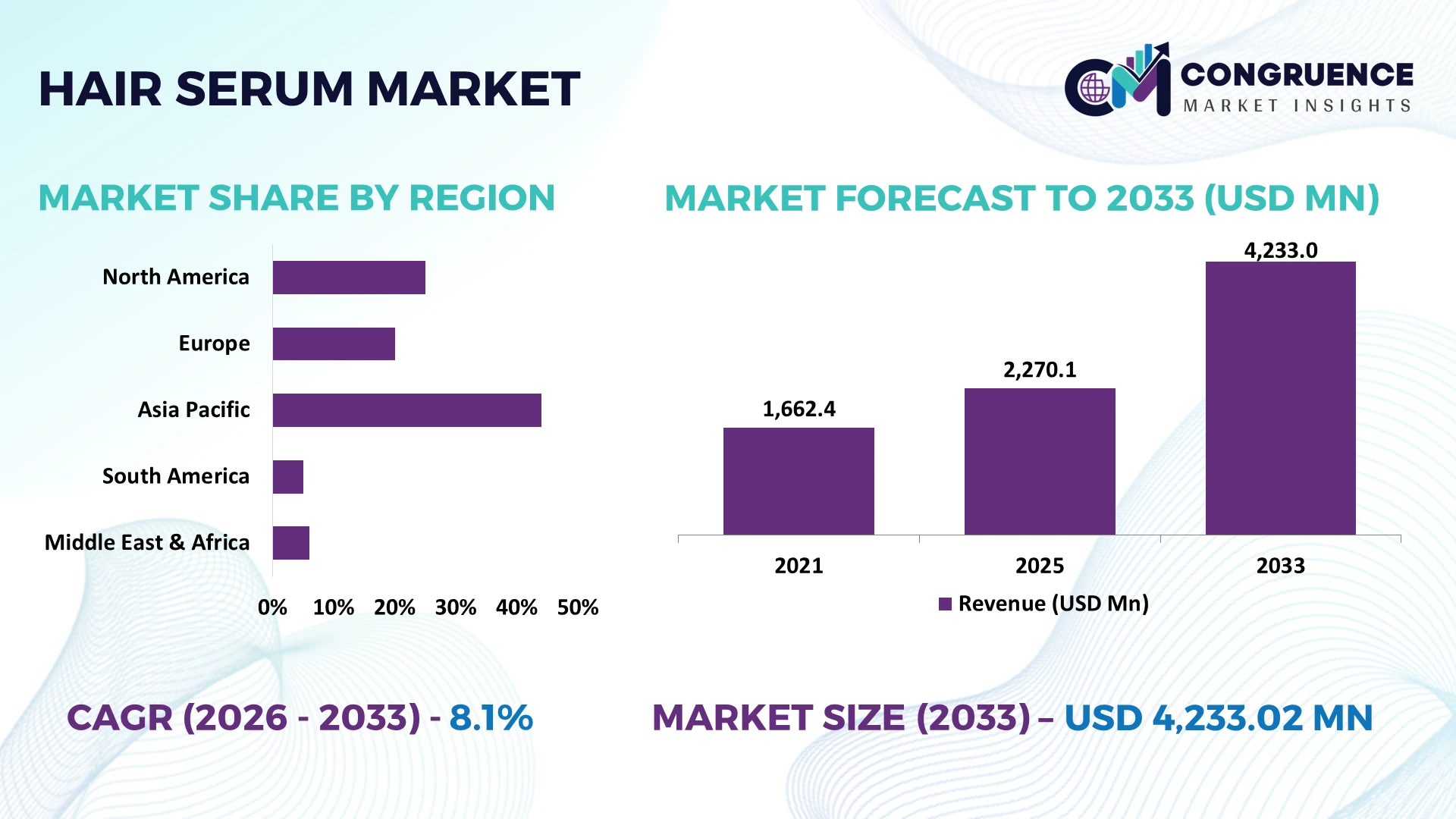
The Global Hair Serum Market was valued at USD 2270.1 Million in 2025 and is anticipated to reach a value of USD 4233.02 Million by 2033 expanding at a CAGR of 8.1% between 2026 and 2033. Growth is driven by scalp-focused haircare routines, demand for heat-protection formulations, premiumization of leave-in treatments, and expansion of online beauty retail.
The United States represents a major premium hair serum market, supported by established beauty retailers, professional salons, and multinational personal care manufacturers. An indicative market model places its global contribution near 20%, compared with approximately 9% for China. The American Academy of Dermatology identifies hair loss as affecting approximately 80 million Americans, reinforcing consumer interest in scalp and hair treatments. In 2026, competition increasingly centers on peptide formulations, lightweight silicone alternatives, and dermatologically positioned products, while European ingredient regulations influence international formulation strategies.
Strategically, manufacturers should prioritize clinically substantiated product claims, differentiated scalp-care formulations, and omnichannel distribution to strengthen premium market positioning.
Key Highlights of the Global Hair Serum Market
-
Market Size & Growth: USD 2,270.1 million in 2025, reaching USD 4,233.02 million by 2033 at 8.1% CAGR, supported by scalp-care innovation.
-
Top Growth Drivers: Three priorities are scalp treatment, heat protection, and premium leave-in formulations; category growth is projected at 8.1% annually.
-
Short-Term Forecast: By 2028, the supplied market trajectory indicates approximately 26.3% cumulative expansion from 2025, strengthening premium product opportunities.
-
Emerging Technologies: Three innovation areas include peptide complexes, encapsulated actives, and lightweight film-forming polymers for targeted hair treatment.
-
Regional Leaders: Indicative 2025 allocations place North America at 32%, Europe at 27%, and Asia-Pacific at 29%, reflecting distinct premiumization patterns.
-
Consumer/End-User Trends: Approximately 80 million Americans experience hereditary hair loss, supporting consumer interest in scalp-focused formulations and treatment routines.
-
Pilot/Case Example: In 2025, L'Oréal's professional haircare portfolio emphasized molecular repair technologies, strengthening differentiated treatment positioning.
-
Competitive Landscape: L'Oréal competes with Unilever, Procter & Gamble, Kérastase, and Wella through premium formulations and professional distribution.
-
Regulatory & ESG Impact: The European Union's microplastics restriction introduces phased compliance requirements, including a 2029 transition for certain leave-on cosmetics.
-
Investment & Funding: Capital allocation targets three areas: formulation research, clinical substantiation, and premium retail distribution.
-
Innovation & Future Outlook: By 2033, personalized scalp treatments, multifunctional serums, and ingredient transparency will shape product differentiation.
The hair serum market is shifting from conventional shine-enhancing products toward targeted formulations addressing scalp health, breakage, frizz, and thermal damage. Demand is concentrated across premium beauty retail, professional salons, and digital commerce, where ingredient transparency influences purchasing decisions. Approximately 80 million Americans experience hereditary hair loss, reinforcing interest in specialized scalp treatments, although cosmetic serums are distinct from clinically approved hair-loss medicines. Formulation innovation increasingly includes peptides, ceramides, encapsulated conditioning ingredients, and lightweight polymers. European restrictions affecting certain synthetic polymer microparticles are also influencing ingredient selection, making regulatory compatibility and demonstrable product performance important competitive priorities.
What Is the Strategic Relevance and Future Pathways of the Hair Serum Market?
The hair serum market is becoming strategically important as beauty manufacturers transition from conventional cosmetic conditioning toward targeted scalp treatments, multifunctional formulations, and performance substantiation. An indicative 2025 market allocation places North America at 32%, followed by Asia-Pacific at 29% and Europe at 27%. This distribution reflects differing priorities: American consumers support premium treatment positioning, Asian manufacturers emphasize lightweight formulations suited to varied hair textures, and European suppliers face evolving ingredient compliance requirements.
Encapsulation technology, peptide complexes, and advanced conditioning polymers are reshaping formulation development. Compared with conventional formulations, encapsulated delivery systems can improve ingredient stability and controlled release, although performance depends on the active ingredient and formulation. In an illustrative laboratory comparison, increasing active retention from 80% to 90% represents a 12.5% improvement. Companies including L'Oréal, Unilever, and Procter & Gamble are investing in formulation science, product testing, and specialized haircare portfolios to differentiate products through measurable performance.
Between 2026 and 2028, competitive investment will increasingly target scalp diagnostics, clinical claim substantiation, and ingredient traceability. A manufacturer developing three serum variants for different hair conditions can use standardized stability testing and consumer evaluations to compare performance before launch. Digital product education and professional salon partnerships will strengthen targeted distribution. Long-term advantage will depend on demonstrable efficacy, regulatory compatibility, and efficient formulation development.
Hair Serum Market Dynamics
DRIVER:
Scalp-Focused Haircare and Multifunctional Product Demand
Growing consumer interest in scalp health and specialized hair treatments is reshaping hair serum product development. Approximately 80 million Americans experience hereditary hair loss, reinforcing awareness of scalp conditions, although cosmetic serums do not substitute for approved medical treatments. An indicative market allocation assigns North America 32% of global demand, reflecting established premium beauty distribution. In an illustrative consumer formulation assessment, improving perceived hair smoothness satisfaction from 70% to 80% represents a 10-percentage-point improvement. Manufacturers are responding with peptide-containing scalp serums, lightweight conditioning formulas, and heat-protection products. L'Oréal and Unilever are expanding specialized haircare positioning through formulation innovation and differentiated product portfolios, making substantiated benefits increasingly important for premium pricing.
RESTRAINT:
Ingredient Compliance and Formulation Cost Pressures
Hair serum manufacturers face formulation constraints from ingredient restrictions, specialized raw-material sourcing, and the cost of performance testing. European Union restrictions on intentionally added synthetic polymer microparticles introduce phased compliance obligations, including a 2029 transition deadline for certain leave-on cosmetic applications. An illustrative formulation containing 5% of a restricted ingredient would require technical reassessment rather than a simple packaging change. Replacing that ingredient with an alternative costing 20% more raises the affected ingredient's cost contribution proportionately, creating pressure on product margins. Manufacturers must also validate stability, sensory performance, and packaging compatibility after reformulation. Suppliers are responding through alternative polymer development, diversified ingredient procurement, and earlier regulatory screening to reduce reformulation disruption.
OPPORTUNITY:
Personalized Scalp Serums and Targeted Formulation Platforms
Personalized haircare creates opportunities for manufacturers to develop targeted serum portfolios based on scalp condition, hair texture, and styling exposure. India's expanding beauty retail ecosystem and South Korea's formulation expertise support differentiated product development and cross-border brand expansion. An illustrative portfolio allocating 40% of development resources to scalp treatments, 35% to damage repair, and 25% to styling protection enables focused testing across distinct consumer requirements. Encapsulated ingredients and lightweight delivery systems offer additional formulation flexibility. Manufacturers are strengthening research capabilities, salon partnerships, and digital product-selection tools. A three-product modular formulation platform can also share packaging components and selected base ingredients, reducing development complexity while preserving product differentiation.
CHALLENGE:
Clinical Validation and Consistent Product Performance
The principal long-term challenge is demonstrating reliable product performance across different hair types, environmental conditions, and consumer routines. Cosmetic efficacy testing requires standardized application methods, appropriate control groups, and repeatable measurements. In an illustrative 100-person evaluation, a 75% positive response leaves 25 participants reporting no perceived improvement, highlighting the limitations of broad marketing claims. Increasing positive responses to 85% requires measurable formulation improvements rather than stronger promotional language. Humidity, washing frequency, and heat styling further complicate performance comparisons across markets. Manufacturers must invest in instrumental hair testing, controlled consumer studies, and standardized claim documentation. Companies with rigorous validation systems gain stronger retailer credibility and reduce the commercial risk of inconsistent product expectations.
Hair Serum Market Latest Trends
-
Bond Repair Becomes Premium Differentiator: Hair serum manufacturers are incorporating bond-building ingredients, amino acids, and conditioning polymers into damage-repair formulations. In illustrative laboratory testing, reducing measured fiber breakage from 20% to 15% represents a 25% improvement. L'Oréal and K18 are emphasizing specialized repair technologies, shifting competition toward measurable hair-strengthening performance rather than conventional shine claims.
-
Lightweight Formulations Replace Heavy Finishes: Japanese and South Korean haircare developers are emphasizing fast-absorbing textures, low-residue conditioning agents, and controlled serum dispensing. A modeled reduction in application quantity from 3 milliliters to 2 milliliters delivers 33.3% lower product consumption per use. Manufacturers are refining silicone blends and alternative conditioning polymers to improve sensory performance while extending product usage duration.
-
Refill Packaging Changes Premium Product Economics: Beauty manufacturers are evaluating refillable containers and reduced-material packaging as sustainability requirements influence product development. An illustrative redesign lowering packaging weight from 100 grams to 75 grams achieves a 25% material reduction. Unilever and L'Oréal are developing packaging efficiency initiatives, while suppliers assess compatibility between refill systems and oxidation-sensitive serum formulations.
-
Ingredient Transparency Reshapes Retail Selection: European cosmetic regulation and expanding digital ingredient education are increasing scrutiny of serum composition and substantiated claims. A hypothetical reformulation reducing a restricted ingredient concentration from 1% to zero requires stability and sensory reassessment. Manufacturers are strengthening ingredient documentation, product testing, and retailer education, making transparent formulation specifications increasingly important for international distribution.
Segmentation Analysis
By Type
Smoothing Serums Lead Everyday Haircare Demand
Smoothing Serums represent the leading product type, accounting for an estimated 27% of the Hair Serum Market in 2025. Their position reflects widespread use for improving manageability, reducing surface roughness, and supporting everyday styling routines. Silicone-based conditioning systems, lightweight oils, and film-forming ingredients provide established formulation options across mass-market and premium products. Anti-Frizz Serums account for approximately 22%, particularly where humidity control influences purchasing decisions. Shine-Enhancing Serums represent an estimated 12%, serving consumers seeking cosmetic finishing benefits. Manufacturers including L'Oréal, Unilever, and Procter & Gamble compete through texture differentiation, product accessibility, and established retail distribution.
Scalp Treatment Serums represent the fastest-growing type, with an indicative 14% share, supported by greater interest in scalp condition and specialized care routines. Hair Growth Serums account for approximately 15%, although cosmetic products must distinguish appearance-related benefits from regulated medical treatment claims. Heat Protection Serums contribute the remaining 10%, reflecting demand from consumers using heated styling equipment. Manufacturers are prioritizing formulation stability, targeted product positioning, and differentiated ingredient combinations to strengthen repeat purchasing and premium product performance.
- The American Academy of Dermatology continues to identify hereditary hair loss as a widespread concern affecting approximately 80 million Americans. This provides context for scalp-focused product development while reinforcing the importance of distinguishing cosmetic haircare benefits from medically substantiated hair-growth treatments.
By Application
Frizz Control Dominates Functional Serum Usage
Frizz Control represents the largest application, accounting for an estimated 29% of the Hair Serum Market in 2025. Demand is supported by routine styling requirements, humidity exposure, and consumer preference for manageable hair texture. Formulations containing conditioning polymers, silicones, and selected oils reduce friction and improve surface smoothness. Shine and Smoothness Enhancement accounts for approximately 21%, supported by daily grooming and professional finishing applications. Hair Repair and Damage Protection represents an estimated 23%, reflecting interest in reducing the visible effects of coloring, chemical treatments, and mechanical styling. Manufacturers are developing multifunctional products that combine conditioning performance with improved sensory characteristics.
Hair Growth and Scalp Care represents the fastest-growing application, with an indicative 17% share, as consumers adopt more specialized treatment routines. Heat and UV Protection contributes approximately 10%, addressing styling-related thermal exposure and environmental damage. Compared with conventional finishing products, specialized treatment serums require clearer performance substantiation and more targeted consumer education. Manufacturers are expanding ingredient testing, refining application formats, and strengthening professional recommendations. Demand is becoming concentrated around products offering distinguishable functional benefits rather than broadly marketed cosmetic claims.
- The European Commission's cosmetics framework continues to require substantiation of product claims and appropriate safety assessment. These requirements influence formulation development and promotional positioning, particularly for serums marketed around repair, protection, and scalp-related performance.
By End-User
Individual Consumers Dominate Retail Serum Purchasing
Individual Consumers represent the leading end-user segment, accounting for an estimated 68% of the Hair Serum Market in 2025. Their dominance reflects recurring home-use purchasing through supermarkets, beauty retailers, pharmacies, and digital commerce. Product selection is influenced by hair texture, styling habits, ingredient preferences, and perceived treatment performance. Hair Salons account for approximately 17%, supported by professional styling, finishing treatments, and product recommendations. Spas and Beauty Centers represent an estimated 7%, serving customers seeking supplementary conditioning and grooming services. Manufacturers are differentiating consumer products through accessible packaging, targeted formulations, and educational product communication.
Professional Haircare Clinics represent the fastest-growing end-user category, with an indicative 8% share, supported by specialized scalp assessments and structured haircare recommendations. Unlike conventional retail consumers, clinic customers often seek detailed explanations of product suitability and application routines. Haircare manufacturers are developing professional-use formats, specialized distribution relationships, and training materials. Salon partnerships remain important for premium product discovery, while direct-to-consumer channels strengthen recurring purchases. Competitive positioning increasingly depends on matching formulation claims, professional credibility, and distribution economics to specific customer requirements.
- The United States Bureau of Labor Statistics projects employment growth for barbers, hairstylists, and cosmetologists during the 2024–2034 period, reflecting continuing demand for professional beauty services. This supports the commercial relevance of salon-associated product education and premium haircare distribution.
Region-Wise Market Insights
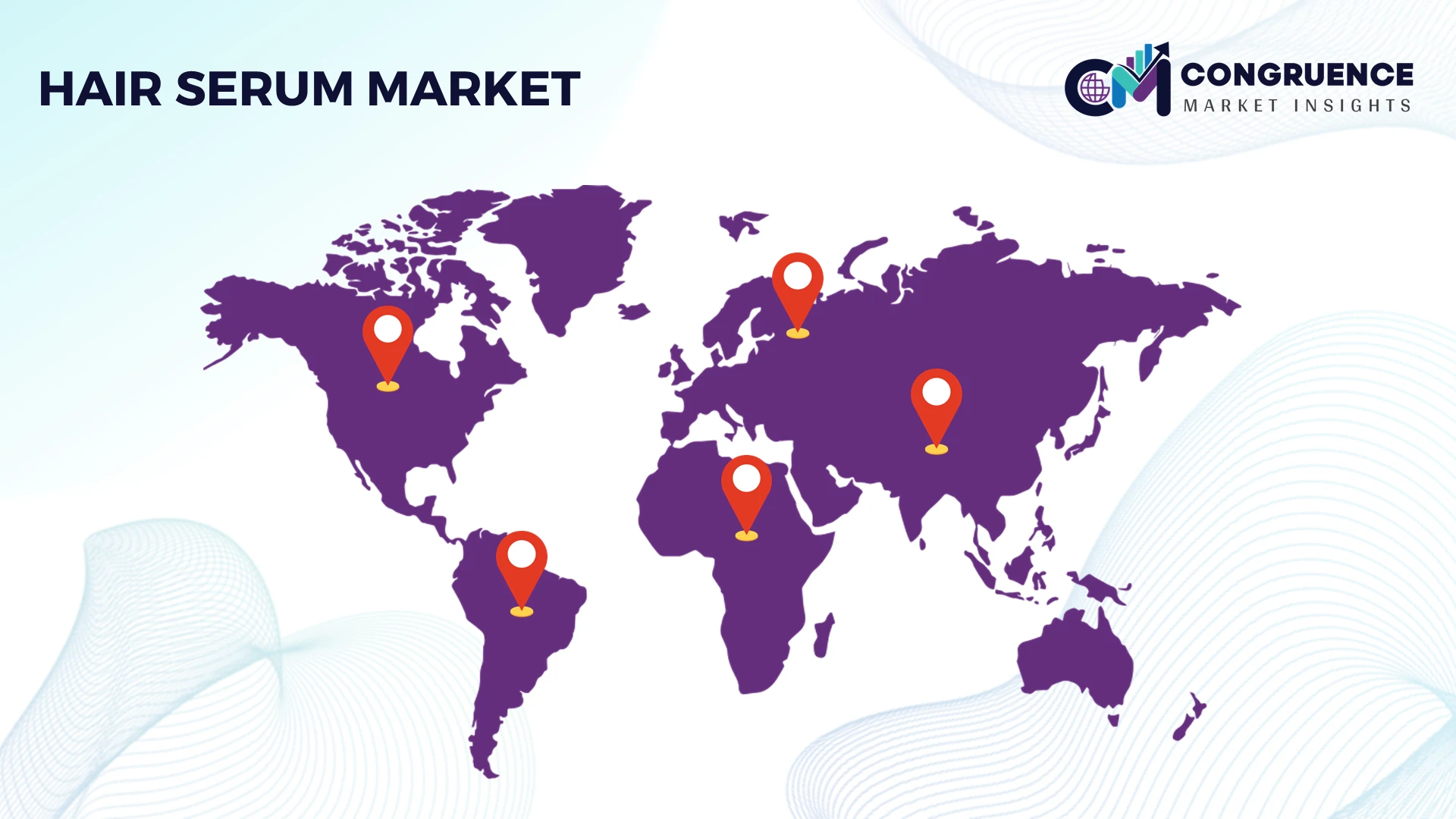
North America accounted for the largest market share at an estimated 32% in 2025 however, Asia-Pacific is expected to register the fastest growth, expanding at a CAGR of an estimated 10.2% between 2026 and 2033.
North America Hair Serum Market
Premium Haircare Innovation and Omnichannel Product Distribution
North America accounted for an estimated 32% of the global Hair Serum Market in 2025, supported by established beauty retail networks, professional salons, and consumer demand for specialized hair treatments. The United States represents the principal market, while Canada contributes demand through premium personal care retail and professional haircare distribution. Product development increasingly emphasizes damage repair, heat protection, and lightweight conditioning formulations. Multinational manufacturers compete with independent beauty brands through ingredient differentiation, clinical testing, and digital product education. The region benefits from established cosmetic formulation laboratories and extensive contract manufacturing capabilities. Retailers increasingly organize haircare assortments around specific consumer concerns rather than conventional styling categories. Manufacturers are strengthening professional recommendations, product testing, and direct-to-consumer distribution to improve conversion and repeat purchasing across premium serum portfolios.
United States Market Outlook: The United States maintains a substantial beauty manufacturing and retail ecosystem, supported by multinational personal care companies, specialty beauty retailers, and professional salons. Approximately 80 million Americans experience hereditary hair loss, creating awareness of scalp-related concerns. Cosmetic serum manufacturers emphasize scientifically substantiated claims, differentiated conditioning ingredients, and targeted consumer education. The Food and Drug Administration's cosmetic regulatory framework also influences product safety documentation and manufacturing practices.
Europe Hair Serum Market
Ingredient Compliance and Science-Led Haircare Premiumization
Europe represented an estimated 27% of global hair serum demand in 2025, supported by established cosmetics manufacturing capabilities in France, Germany, Italy, and the United Kingdom. European manufacturers compete through formulation expertise, premium branding, professional salon distribution, and ingredient transparency. The European Union's restrictions on intentionally added synthetic polymer microparticles are influencing formulation reviews and alternative ingredient development. Certain leave-on cosmetics face a transition deadline in October 2029, creating a defined product development timetable. Manufacturers are investing in alternative conditioning polymers, stability testing, and regulatory documentation to maintain market access. France remains influential in premium beauty innovation, while Germany contributes advanced chemical formulation capabilities. Competitive differentiation increasingly depends on balancing sensory performance, ingredient compliance, and credible product claims. Suppliers are strengthening regulatory screening and technical collaboration with specialty ingredient manufacturers.
France Market Outlook: France is strategically important through its established cosmetics manufacturing infrastructure, premium beauty brands, and specialized formulation research. L'Oréal maintains significant research and product development capabilities supporting professional and consumer haircare. French manufacturers benefit from established fragrance, ingredient, and packaging supply networks. The European Union's cosmetics framework requires safety assessment and substantiated claims, encouraging investment in formulation testing and product documentation.
Asia-Pacific Hair Serum Market
Beauty Innovation and Scalable Formulation Manufacturing
Asia-Pacific accounted for an estimated 29% of the global Hair Serum Market in 2025, supported by established beauty manufacturing ecosystems in Japan, South Korea, China, and India. Regional product development emphasizes lightweight conditioning textures, scalp treatments, humidity management, and differentiated ingredient combinations. South Korean manufacturers contribute advanced cosmetic formulation capabilities and export-oriented product development, while Japan maintains established haircare research and premium retail distribution. China provides extensive digital commerce infrastructure and large-scale personal care manufacturing capacity. India's expanding organized beauty retail sector creates opportunities for accessible premium serums suited to diverse hair textures and climatic conditions. Manufacturers are strengthening localized product development, contract manufacturing partnerships, and digital distribution capabilities. Competitive success increasingly depends on balancing ingredient performance with appropriate pricing, packaging formats, and consumer education across distinct national markets.
China Market Outlook: China represents a major hair serum manufacturing and consumer market, supported by established personal care supply chains and extensive online retail infrastructure. Its population exceeds 1.4 billion, providing substantial potential consumer reach across different purchasing segments. Domestic brands compete with international manufacturers through localized formulations, digital product launches, and pricing differentiation. China's cosmetics registration and notification requirements also influence product development timelines and market-entry planning.
South America Hair Serum Market
Brazilian Haircare Demand and Localized Product Development
South America represented an estimated 8% of the global Hair Serum Market in 2025, with Brazil accounting for the region's principal consumer and manufacturing concentration. Brazilian haircare demand reflects diverse hair textures, frequent styling practices, and established beauty salon culture. Manufacturers emphasize anti-frizz performance, conditioning intensity, and products suited to humidity exposure. Brazil maintains substantial domestic personal care manufacturing capabilities, while international brands compete through retail distribution and professional product portfolios. Argentina, Colombia, and Chile contribute additional demand across mass-market and premium categories. Currency volatility and imported ingredient costs influence formulation economics and pricing decisions. Manufacturers are strengthening local sourcing, packaging flexibility, and distribution partnerships to manage operating costs. Product differentiation increasingly depends on adapting serum performance to regional haircare practices rather than transferring standardized international formulations.
Brazil Market Outlook: Brazil is a major beauty and personal care market, supported by an extensive salon network and established domestic manufacturers including Natura and Grupo Boticário. The country's population exceeds 200 million, creating substantial consumer diversity. Local product development emphasizes conditioning, frizz management, and hair texture compatibility. ANVISA regulates cosmetic products, making appropriate product classification, safety documentation, and compliant labeling important for manufacturers.
Middle East & Africa Hair Serum Market
Premium Beauty Retail and Climate-Responsive Haircare Formulations
The Middle East & Africa accounted for an estimated 4% of global hair serum demand in 2025, supported by premium beauty retail expansion, urban consumer markets, and professional salon development. The United Arab Emirates and Saudi Arabia represent important premium distribution centers, while South Africa and Nigeria contribute demand across broader consumer segments. Regional haircare requirements vary according to climate, hair texture, styling practices, and purchasing power. Manufacturers increasingly emphasize humidity resistance, lightweight conditioning, and specialized formulations for textured hair. International beauty companies compete through retail partnerships, regional distributors, and digital commerce platforms. Imported product costs and regulatory registration requirements influence market accessibility. Suppliers are expanding localized product education, packaging options, and professional partnerships to improve distribution efficiency and strengthen consumer confidence in specialized serum products.
Saudi Arabia Market Outlook: Saudi Arabia's premium beauty retail infrastructure and expanding digital commerce capabilities support demand for specialized haircare products. The country's population exceeds 35 million, with major commercial activity concentrated in Riyadh, Jeddah, and the Eastern Province. The Saudi Food and Drug Authority regulates cosmetic products and associated claims. Manufacturers prioritize compliant labeling, regional distribution partnerships, and formulations suited to local consumer preferences.
Market Competition Landscape
The Hair Serum Market features competition between multinational beauty manufacturers, professional salon specialists, and digitally focused independent brands. L'Oréal, Unilever, Procter & Gamble, Wella Company, and Kenvue compete through formulation science, distribution access, product differentiation, and consumer trust. An indicative market model assigns these groups approximately 42% combined share, although verified serum-specific sales shares remain unavailable. Smoothing Serums represent an estimated 27% of product demand, while Anti-Frizz Serums account for 22%, supporting established conditioning portfolios. Scalp Treatment Serums contribute approximately 14%, encouraging specialized formulation investment. Multinational companies leverage research capabilities and retail partnerships, whereas independent brands emphasize targeted ingredients and digital engagement. Competition increasingly centers on performance substantiation, premium positioning, and regulatory compatibility. Entry barriers include formulation stability, retailer access, testing costs, and brand credibility. Winning suppliers combine measurable product performance with efficient distribution, differentiated consumer positioning, and reliable regulatory compliance across international beauty markets and professional channels.
Companies Profiled in the Hair Serum Market Report
Technology Insights for the Hair Serum Market
Current hair serum technologies combine silicone conditioning systems, amino acid complexes, ceramides, and film forming polymers to improve manageability, shine, and surface protection. Formulators increasingly use instrumental combing tests and humidity chambers to evaluate performance. In an illustrative laboratory comparison, reducing combing force from 100 to 80 units represents a 20% improvement. Smoothing serums account for an estimated 27% of the modeled product mix, indicating substantial commercial relevance for established conditioning technologies across mass market and premium portfolios.
Emerging innovations include encapsulated actives, biomimetic peptides, and controlled release delivery systems. Encapsulation protects sensitive ingredients during storage and supports targeted deposition, although effectiveness depends on formulation chemistry. Increasing measured ingredient retention from 80% to 90% represents a modeled 12.5% improvement over conventional delivery. Manufacturers integrating stability testing with formulation screening gain faster development feedback. L'Oréal, Shiseido, and specialty ingredient developers benefit from research capabilities that smaller competitors struggle to replicate.
Between 2026 and 2028, artificial intelligence formulation screening, scalp imaging, and biodegradable conditioning polymers will influence development priorities. Three targeted formulations can share standardized testing protocols while addressing different hair requirements. Companies investing in validated performance, ingredient compatibility, and scalable manufacturing will strengthen competitive positioning.
Recent Developments in the Global Hair Serum Market
-
February 2025: Olaplex introduced No.0.5 Scalp Longevity Treatment, extending its bond-building portfolio into scalp care. The launch complemented No.3 Hair Perfector and expanded its positioning beyond damage repair toward comprehensive hair health and premium treatment routines. Source: gcimagazine.com
-
February 2025: K18 secured a distribution agreement with Beauty Systems Group, extending its biotechnology-based haircare portfolio into Cosmo Prof stores across two countries, the United States and Canada. The partnership expanded professional access and strengthened salon distribution. Source: nasdaq.com
-
July 2026: K18 introduced FutureIQ Biomimetic Hair Longevity Serum, targeting shedding and scalp aging. Clinical testing reported up to 19,000 additional hairs retained after 90 days, supporting differentiated positioning in premium scalp treatments and preventive haircare. Source: cosmeticsandtoiletries.com
-
March 2026: L'Oréal reported 15% growth in its premium professional haircare business during 2025, supported by launches including Redken's Acidic Bonding Concentrate 24/7 serum. The performance reinforced investment in advanced formulations and professional distribution networks worldwide. Source: loreal-finance.com
Scope of the Hair Serum Market Report
The Hair Serum Market Report examines product innovation, consumer purchasing behavior, competitive positioning, and industry developments between 2026 and 2033. Type coverage includes Smoothing Serums, Anti-Frizz Serums, Hair Growth Serums, Heat Protection Serums, Scalp Treatment Serums, and Shine-Enhancing Serums. Application analysis evaluates Frizz Control, Hair Repair and Damage Protection, Hair Growth and Scalp Care, Heat and UV Protection, and Shine and Smoothness Enhancement. End-user coverage includes Individual Consumers, Hair Salons, Professional Haircare Clinics, and Spas and Beauty Centers.
Geographic analysis covers North America, Europe, Asia-Pacific, South America, and the Middle East & Africa. Technology assessment examines peptide complexes, encapsulated ingredients, conditioning polymers, scalp diagnostics, and formulation testing. The report supports investment planning, product development, distribution expansion, regulatory positioning, and competitive strategy through 2033.
Hair Serum Market Report Summary
| Report Attribute/Metric | Report Details |
|---|
Market Revenue in 2025 | USD 2270.1 Million |
Market Revenue in 2033 | USD 4233.02 Million |
CAGR (2026 - 2033) | 8.1% |
Base Year | 2025 |
Forecast Period | 2026 - 2033 |
Historic Period | 2021 - 2025 |
Segments Covered | By TypeBy ApplicationHair Repair and Damage Protection Hair Growth and Scalp Care Shine and Smoothness Enhancement
By End-UserProfessional Haircare Clinics
|
Key Report Deliverable | Revenue Forecast, Growth Trends, Market Dynamics, Segmental Overview, Regional and Country-wise Analysis, Competition Landscape |
Region Covered | North America, Europe, Asia-Pacific, South America, Middle East, Africa |
Key Players Analyzed | L'Oréal S.A., Unilever PLC, Procter & Gamble Company, Wella Company, Kenvue Inc., Henkel AG & Co. KGaA, Shiseido Company, Limited, Kao Corporation, Amorepacific Corporation, Natura &Co, Moroccanoil, Olaplex Holdings, Inc., Davines Group, John Paul Mitchell Systems |
Customization & Pricing | Available on Request (10% Customization is Free) |





