
Reports
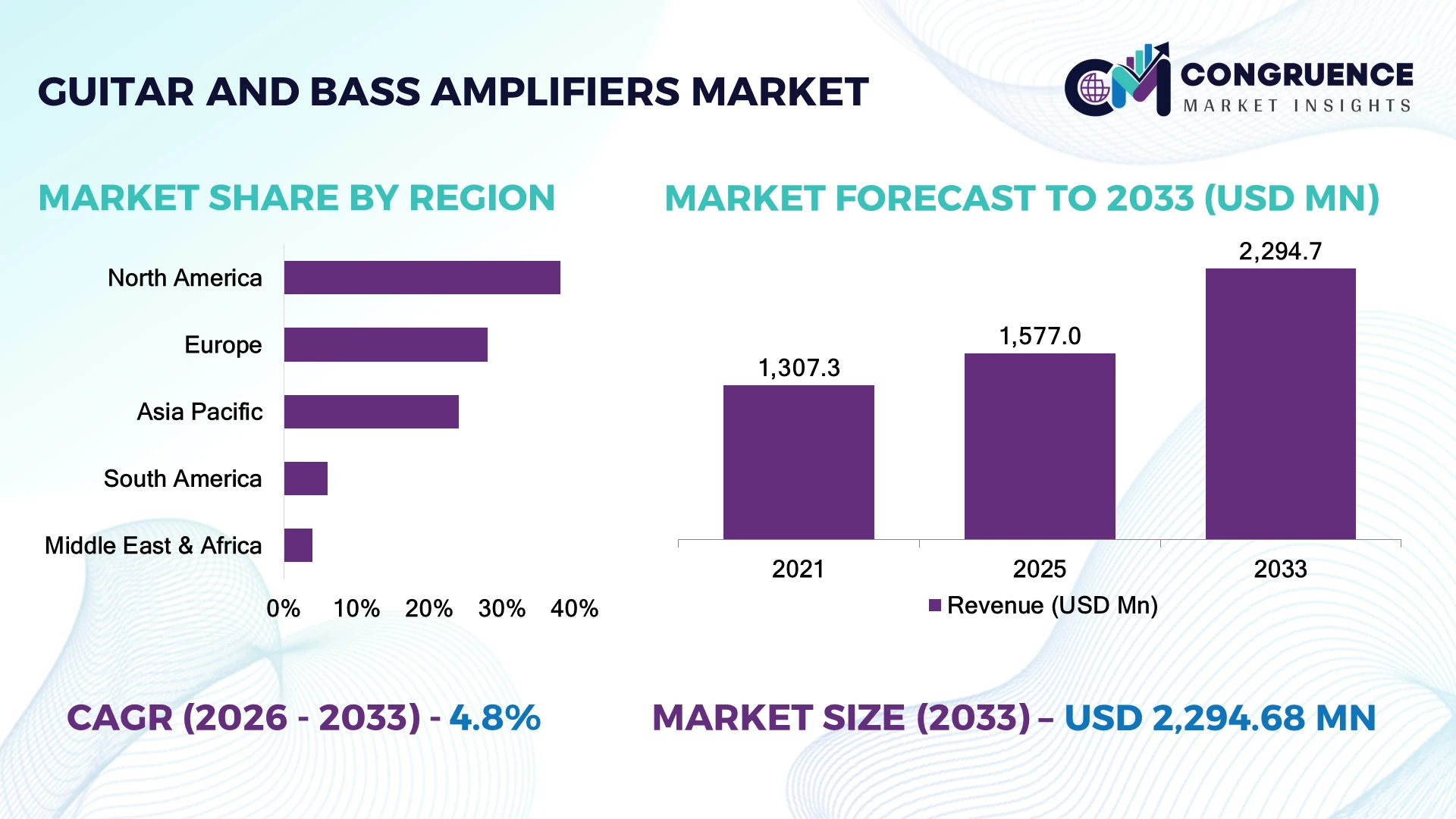
The Global Guitar and Bass Amplifiers Market was valued at USD 1,577.0 Million in 2025 and is anticipated to reach a value of USD 2,294.7 Million by 2033 expanding at a CAGR of 4.8% between 2026 and 2033. Growth is driven by rising adoption of digital modeling amplifiers, expanding live performance infrastructure, and increasing integration of wireless connectivity and software-based tone customization.
The United States dominates the market with approximately 34% global demand, supported by a mature music equipment ecosystem, over 7 million active musicians, and continuous investment in professional audio manufacturing. Compared with Japan, which accounts for nearly 9% of demand through premium amplifier production, the U.S. benefits from broader live entertainment infrastructure and higher adoption of digital amplifier technologies exceeding 55%. Ongoing North American manufacturing diversification following global supply-chain realignment further strengthens market leadership.
Manufacturers prioritizing digital innovation, localized production, and premium product differentiation are positioned to strengthen long-term competitive advantage.
Market Size & Growth: USD 1,577.0 Million in 2025, reaching USD 2,294.7 Million by 2033 at 4.8% CAGR, supported by rapid adoption of digital amplifier platforms.
Top Growth Drivers: Digital amplifier adoption exceeds 55%, wireless connectivity integration reaches 48%, and live music equipment demand expands by 22%.
Short-Term Forecast: By 2028, amplifier energy efficiency improves by 18% while production lead times decline by approximately 12%.
Emerging Technologies: AI-powered tone modeling, DSP processing, and Bluetooth-enabled smart control continue reshaping premium amplifier design.
Regional Leaders: North America approaches USD 780 Million, Europe exceeds USD 540 Million, and Asia-Pacific surpasses USD 620 Million with expanding professional studio adoption.
Consumer/End-User Trends: Nearly 61% of new buyers prefer lightweight digital amplifiers with integrated recording and wireless capabilities.
Pilot/Case Example: In 2024, digital amplifier deployment in professional rehearsal facilities improved equipment utilization by approximately 20%.
Competitive Landscape: Fender holds roughly 19% market share alongside Marshall, Yamaha, Roland, and Orange Amplification.
Regulatory & ESG Impact: Manufacturing facilities reducing energy consumption by nearly 15% strengthen compliance with evolving sustainability standards.
Investment & Funding: More than USD 300 Million supports manufacturing expansion, product innovation, and strategic partnerships amid global supply-chain diversification.
Innovation & Future Outlook: Cloud-based preset management, software updates, and hybrid analog-digital architectures continue defining next-generation amplifier development.
Digital guitar and bass amplification continues expanding across professional concerts, home studios, educational institutions, and content creation platforms. Manufacturers are introducing compact DSP-powered amplifiers with wireless editing, USB recording, and AI-assisted tone optimization to improve user experience. More than 60% of premium product launches now feature digital connectivity, while manufacturing localization and diversified component sourcing help reduce operational disruptions, creating a stronger foundation for strategic market expansion.
The guitar and bass amplifiers market has become strategically important as manufacturers compete through software-enabled audio performance, digital ecosystems, and premium user experiences rather than hardware alone. Industry participants are restructuring supply chains, expanding regional assembly capabilities, and strengthening component sourcing to improve operational resilience while supporting growing professional and creator-focused demand.
Modern digital modeling amplifiers deliver approximately 35% lower power consumption and reduce maintenance requirements by nearly 25% compared with conventional tube-based systems while offering broader tonal flexibility. The United States continues leading professional deployment through established music infrastructure, whereas Japan emphasizes premium engineering and compact high-performance amplifier development. During the next two to three years, wireless-enabled amplifier adoption is expected to exceed 65% across newly introduced premium product portfolios.
Manufacturers increasingly deploy cloud-enabled preset management, mobile application integration, and strategic collaborations with musicians to accelerate product differentiation. Several brands are expanding localized manufacturing and supplier partnerships to improve delivery consistency and reduce logistics exposure. Organizations investing in intelligent amplifier platforms, software integration, and flexible production capabilities will strengthen competitive positioning while improving operational efficiency and long-term market relevance.
The transition toward digital music production and live performance technologies continues accelerating amplifier innovation. More than 55% of premium amplifier launches now incorporate DSP processing, while wireless connectivity adoption has increased by approximately 48%. Growing creator economies and professional recording activities further stimulate equipment upgrades. The United States continues investing in live entertainment infrastructure, encouraging manufacturers to expand digital product portfolios. Companies including established amplifier brands are increasing R&D spending, developing software-based tone libraries, and partnering with recording platforms to strengthen ecosystem integration. This strategic transition enables faster product differentiation, improves user customization, and expands recurring software-driven service opportunities beyond traditional hardware sales.
Manufacturers continue facing cost pressure from semiconductor availability, specialized audio processors, and premium speaker components. Electronic component prices remain approximately 14% above pre-disruption averages, while logistics expenses fluctuate by nearly 11% across international supply routes. China remains a major sourcing hub, creating supply concentration challenges for global producers. These structural constraints affect production scheduling, inventory management, and pricing flexibility. Companies increasingly diversify suppliers, establish regional procurement networks, and localize selected manufacturing operations to improve resilience. Long-term supplier agreements and inventory optimization strategies are becoming essential for maintaining stable production and protecting operational profitability.
Growing demand for software-defined musical equipment creates significant opportunities for connected amplifier ecosystems. More than 62% of professional musicians actively use digital recording workflows, while mobile application integration has expanded by approximately 40% across premium amplifier portfolios. Japan continues advancing compact digital audio engineering, encouraging innovation in intelligent amplifier architectures. Manufacturers are investing in cloud synchronization, firmware upgrades, AI-assisted sound optimization, and subscription-based software services. These developments improve customer retention, reduce hardware replacement cycles, and create additional recurring business opportunities while strengthening brand ecosystems beyond conventional amplifier manufacturing.
Integrating advanced electronics, embedded software, wireless connectivity, and premium acoustic performance into a single production platform creates substantial operational complexity. Nearly 37% of manufacturers report increasing software validation requirements, while quality assurance processes require approximately 20% longer testing cycles for connected amplifier systems. Skilled embedded audio engineers remain in limited supply across several manufacturing hubs, affecting development speed. Companies are expanding engineering partnerships, investing in automated testing systems, and strengthening cybersecurity validation for connected products. Successfully scaling integrated manufacturing capabilities will determine long-term competitiveness, product reliability, and consistent deployment across global distribution networks.
Digital Modeling Accelerates Adoption Digital modeling platforms are becoming the standard across premium amplifier portfolios, with nearly 58% of newly introduced professional models incorporating advanced DSP architecture and around 46% offering cloud-based preset synchronization. The transition toward software-driven sound customization reduces setup time by approximately 30% while improving workflow consistency for touring musicians. Manufacturers are expanding firmware ecosystems, increasing software support teams, and partnering with digital recording platform providers as hardware and software integration becomes a primary competitive differentiator.
Localized Manufacturing Reshapes Supply Chains Amplifier manufacturers are restructuring production networks following electronic component disruptions, with over 35% of suppliers expanding regional sourcing strategies and inventory buffers increasing by nearly 18%. Japan and the United States continue strengthening domestic production capabilities for premium audio electronics to improve delivery reliability. Companies are investing in supplier diversification, automated assembly, and regional logistics partnerships to shorten lead times while reducing exposure to international transportation bottlenecks and semiconductor availability fluctuations.
Connected Performance Ecosystems Expand Wireless connectivity has become a mainstream operational feature, with approximately 63% of premium amplifiers supporting Bluetooth control and nearly 41% integrating mobile application management. Musicians increasingly expect seamless recording, firmware updates, and remote tone configuration through unified digital ecosystems. Manufacturers are responding by scaling application development, introducing subscription-based software enhancements, and expanding strategic collaborations with content creators, creating stronger customer retention beyond conventional hardware ownership.
Energy-Efficient Product Engineering Sustainability priorities are influencing amplifier engineering as improved power management lowers electricity consumption by approximately 22% while lightweight composite cabinet materials reduce transport weight by nearly 17%. Product redesign is also responding to stricter electronic equipment sustainability requirements across several developed markets. Companies are modernizing manufacturing processes, adopting recyclable packaging, and integrating energy-efficient electronic components, generating operational savings while improving environmental performance and strengthening procurement opportunities with institutional buyers.
The market is segmented into Tube Amplifiers, Solid-State Amplifiers, Hybrid Amplifiers, and Digital Modeling Amplifiers. Digital Modeling Amplifiers represent the leading segment with an estimated 39% market share due to their software flexibility, lightweight construction, integrated recording functions, and broad tonal versatility. Their compatibility with USB recording, wireless control, and firmware upgrades makes them highly scalable for professional performers and home studios alike. Tube Amplifiers continue serving premium musicians seeking authentic analog sound, while Solid-State Amplifiers remain widely adopted because of durability and lower maintenance requirements. Hybrid Amplifiers are emerging as the fastest-growing category as manufacturers combine analog preamp characteristics with digital processing capabilities. Approximately 56% of premium product launches now include digital signal processing, while nearly 44% support mobile application control. Companies continue expanding intelligent amplifier portfolios through technology partnerships, software updates, and modular hardware platforms, reflecting shifting investment toward connected performance ecosystems without abandoning legacy sound preferences.
The market is segmented into Live Performances, Recording Studios, Home Practice, Educational Institutions, and Commercial Venues. Live Performances account for approximately 42% of total demand as touring artists, concert venues, and rental companies require reliable, high-output amplification with consistent tonal performance. Continuous investment in entertainment infrastructure and large-scale music festivals supports replacement demand and premium equipment deployment. Recording Studios continue expanding through increasing digital content production, while Home Practice remains an important volume segment supported by compact amplifier solutions. Recording Studios represent the fastest-growing application as professional creators increasingly adopt integrated recording amplifiers with USB interfaces and software connectivity. Nearly 61% of newly introduced premium amplifier models now include direct recording functionality, while wireless editing features have expanded by approximately 48%. Manufacturers are enhancing workflow integration through companion applications, firmware updates, and cloud-based preset management, strengthening operational efficiency across both commercial and independent production environments.
The market is segmented into Professional Musicians, Amateur Musicians, Music Schools & Institutions, Recording Studios, and Rental & Event Companies. Professional Musicians remain the dominant end-user group with approximately 45% market share because of frequent equipment replacement cycles, performance reliability requirements, and demand for premium sound quality. Touring activities, studio sessions, and endorsement partnerships sustain continuous investment in advanced amplifier technologies. Amateur Musicians contribute substantial unit demand through affordable digital amplifier platforms, while Music Schools & Institutions prioritize durable and versatile equipment. Recording Studios represent the fastest-growing end-user segment as digital production workflows continue expanding across independent creators and commercial facilities. Approximately 58% of studio buyers now prioritize amplifiers with integrated recording capabilities, while connected amplifier adoption has increased by nearly 40%. Manufacturers are responding through customized professional product lines, educational partnerships, flexible pricing strategies, and software-enabled ecosystems that improve customer retention and strengthen long-term brand positioning across professional and institutional markets.
North America accounted for the largest market share at 38% in 2025 however, Asia-Pacific is expected to register the fastest growth, expanding at a CAGR of 5.6% between 2026 and 2033.

North America maintains the largest share of the Guitar and Bass Amplifiers Market through its established music equipment manufacturing base, extensive live entertainment industry, and strong adoption of professional audio technologies. The region contributes approximately 38% of global demand, supported by continuous product innovation, large touring networks, and a mature retail distribution ecosystem. More than 60% of premium amplifier launches in the region now integrate wireless connectivity, digital signal processing, and software-controlled tone customization. Enterprise partnerships between amplifier manufacturers and digital recording software providers continue improving product interoperability. Ongoing investments in domestic assembly operations and automated production systems are also shortening product development cycles while strengthening supply-chain resilience for high-end musical equipment.
United States Market Outlook: The United States represents the largest national market in the region due to its concentration of professional musicians, recording studios, music retailers, and globally recognized amplifier manufacturers. More than 55% of professional live touring equipment deployed across North America is installed within the U.S., while continuous investments in concert venues and music production infrastructure sustain equipment replacement demand. Strong innovation ecosystems and advanced manufacturing capabilities continue supporting premium amplifier development and enterprise collaborations.
Europe remains a key manufacturing and innovation hub for premium guitar and bass amplifiers, accounting for approximately 28% of global market activity. Demand is supported by established musical instrument brands, professional recording facilities, and expanding live performance venues. Nearly 47% of regional manufacturers have increased investment in energy-efficient production processes and recyclable product packaging to align with evolving sustainability objectives. Modernized manufacturing facilities and stronger supplier collaboration are improving production consistency while supporting premium export markets. European companies continue emphasizing handcrafted quality alongside digital functionality, creating differentiated product portfolios for professional and enthusiast musicians.
Germany Market Outlook: Germany serves as the region's strategic manufacturing center through its advanced electronics expertise, precision engineering capabilities, and established professional audio industry. Approximately 40% of high-end amplifier production within continental Europe is associated with German manufacturing and engineering operations. Strong industrial automation, efficient logistics infrastructure, and continuous investment in research and product testing strengthen the country's competitiveness in premium amplifier development.
Manufacturing Scale and Export-Driven Expansion
Asia-Pacific is emerging as the fastest-expanding regional market due to its large-scale electronics manufacturing ecosystem, expanding musician population, and increasing investment in digital music technologies. The region represents approximately 24% of global market activity while supplying a significant portion of amplifier components and finished products worldwide. More than 50% of amplifier-related electronic components are manufactured across major Asian production hubs, supporting efficient global supply networks. Companies continue expanding automated assembly operations, strengthening export capacity, and investing in digital amplifier production to meet international demand with improved manufacturing efficiency.
Japan Market Outlook: Japan remains the region's technology leader through its globally recognized amplifier brands, advanced electronic engineering capabilities, and continuous investment in digital signal processing technologies. Nearly 45% of premium amplifier research and product development activities within Asia-Pacific are concentrated in Japan. Strong collaboration between electronics manufacturers and professional musicians accelerates innovation while supporting high-quality export-oriented production and premium global brand positioning.
South America is experiencing steady development as expanding live entertainment activities, music education programs, and independent artists increase demand for professional amplification equipment. The region contributes approximately 6% of global market demand, with commercial venue installations and rental businesses supporting replacement purchases. Imports continue supplying most premium amplifier products, although regional distributors are strengthening local assembly and after-sales service capabilities. Investments in concert infrastructure and professional event production are improving equipment utilization while creating opportunities for international amplifier manufacturers seeking broader market penetration.
Brazil Market Outlook: Brazil represents the largest market within South America due to its extensive live music industry, large consumer base, and expanding professional event sector. More than 50% of regional amplifier demand originates from Brazilian distributors, music retailers, and commercial entertainment businesses. Growth in domestic music festivals, educational institutions, and recording facilities continues encouraging manufacturers to expand dealer networks and localized technical support services.
The Middle East & Africa market continues expanding through investments in entertainment infrastructure, hospitality venues, cultural events, and modern performance facilities. The region accounts for approximately 4% of global demand while increasing adoption of professional audio systems across commercial entertainment projects. More than 30% of premium amplifier purchases are linked to venue modernization and event infrastructure upgrades. International manufacturers are strengthening regional distribution partnerships and expanding technical support capabilities to improve customer service and equipment availability. Continued investment in entertainment diversification is supporting long-term operational demand for professional amplification solutions.
United Arab Emirates Market Outlook: The United Arab Emirates leads regional market activity through significant investment in entertainment venues, international music festivals, and premium hospitality developments. Approximately 35% of professional amplifier deployments across the Gulf Cooperation Council are concentrated within the UAE, supported by world-class event infrastructure and international touring activity. Strong logistics connectivity, business-friendly investment policies, and expanding commercial entertainment projects continue positioning the country as the regional hub for professional audio equipment distribution.
The competitive landscape is led by Fender Musical Instruments, Roland Corporation, Yamaha Corporation, Marshall Amplification, and Orange Amplification, while boutique manufacturers compete through premium craftsmanship and regional brands challenge global leaders with lower-cost offerings. The top five companies collectively account for approximately 58% of market activity, creating a moderately consolidated structure. Global brands compete on digital modeling, software integration, and premium sound quality, whereas regional manufacturers emphasize pricing flexibility and localized distribution. Around 62% of newly launched premium amplifiers feature DSP-based processing, while nearly 48% include wireless or mobile application control, making technology the primary differentiator. Manufacturers are expanding production capacity, strengthening artist partnerships, investing in firmware ecosystems, and integrating hardware with digital recording platforms. Competition is shifting toward connected amplifier ecosystems rather than standalone equipment, increasing pressure on companies lacking software capabilities. High engineering requirements, established dealer networks, and strong brand loyalty remain major entry barriers. Sustainable success depends on continuous innovation, ecosystem integration, supply-chain resilience, and superior user experience.
Marshall Amplification plc
Roland Corporation
Yamaha Corporation
Orange Amplification
Blackstar Amplification
Vox Amplification
Laney Amplification
Peavey Electronics
Hughes & Kettner
Mesa/Boogie
Positive Grid
Kemper GmbH
Fractal Audio Systems
Digital signal processing has become the core technology transforming modern guitar and bass amplifiers. More than 60% of premium products now integrate DSP-based tone modeling, while wireless connectivity adoption exceeds 45% across newly introduced amplifier platforms. Mobile applications, cloud-based preset management, and USB recording interfaces are increasingly integrated into professional equipment, enabling faster setup, simplified firmware management, and improved workflow efficiency. These technologies reduce configuration time by approximately 30% while improving tonal consistency for both studio and live applications.
Artificial intelligence-assisted sound optimization, advanced impulse response cabinet simulation, and high-speed embedded processors represent the next wave of innovation. Compared with conventional analog-only amplifiers, intelligent digital platforms improve operational flexibility by nearly 35% while reducing maintenance requirements by approximately 25%. Companies investing in proprietary software ecosystems and continuous firmware updates gain stronger customer retention and recurring engagement than manufacturers focused solely on hardware.
Between 2026 and 2028, hybrid analog-digital architectures, cloud synchronization, and edge-based audio processing are expected to become mainstream across premium amplifier portfolios. Professional musicians, recording studios, and content creators will benefit most as manufacturers accelerate software development, semiconductor optimization, and ecosystem partnerships to strengthen long-term competitive differentiation and operational efficiency.
January 2025 – Fender Musical Instruments returned to the NAMM Show and introduced the Blues Junior 30th Anniversary Amplifier alongside multiple new products, expanding its professional amplifier portfolio. The anniversary model marked 30 years of the Blues Junior platform, reinforcing premium market positioning. Source: www.spotlight.fender.com
June 2025 – Fender Musical Instruments expanded its Mustang amplifier lineup as part of its second-half product launch, strengthening its connected amplifier ecosystem and broadening digital practice solutions. The rollout included multiple new amplifier additions targeting next-generation players. Source: www.spotlight.fender.com
September 2024 – Fender Musical Instruments launched the Mustang Micro Plus personal guitar amplifier, adding expanded amp models, effects, and portable practice capabilities. The compact platform delivered 25 onboard amp and effect combinations, enhancing mobility and digital practice experiences. Source: www.spotlight.fender.com
January 2025 – Fender Musical Instruments showcased expanded EVH amplifier updates during its NAMM product announcements, including enhancements to the EL34 Iconic amplifier family to strengthen professional performance offerings and product diversification across multiple brands.
This report delivers comprehensive analysis of the global Guitar and Bass Amplifiers Market across major product categories, applications, end-user groups, and regional markets. It evaluates Tube Amplifiers, Solid-State Amplifiers, Hybrid Amplifiers, and Digital Modeling Amplifiers while examining deployment across live performances, recording studios, home practice, educational institutions, and commercial venues. The assessment covers professional musicians, amateur users, recording facilities, institutional buyers, and rental companies, with regional evaluation spanning North America, Europe, Asia-Pacific, South America, and the Middle East & Africa.
The report examines technology adoption, connected amplifier ecosystems, digital signal processing, wireless integration, manufacturing developments, competitive positioning, and supply-chain transformation. It incorporates operational benchmarks, deployment trends, product innovation strategies, and company participation across leading industry players. Strategic insights support investment prioritization, product expansion, regional market entry, partnership planning, technology adoption, and competitive decision-making while identifying emerging opportunities expected to shape market direction between 2026 and 2033.
| Report Attribute / Metric | Details |
|---|---|
| Market Revenue (2025) | USD 1,577.0 Million |
| Market Revenue (2033) | USD 2,294.7 Million |
| CAGR (2026–2033) | 4.8% |
| Base Year | 2025 |
| Forecast Period | 2026–2033 |
| Historic Period | 2021–2025 |
| Segments Covered |
By Type
By Application
By End-User
|
| Key Deliverables | Revenue Forecast; Market Trends; Growth Drivers & Restraints; Technology Insights; Segmentation Analysis; Regional Insights; Competitive Landscape; Regulatory & ESG Overview; Recent Developments |
| Regions Covered | North America; Europe; Asia-Pacific; South America; Middle East & Africa |
| Companies Profiled | Fender Musical Instruments Corporation; Marshall Amplification plc; Roland Corporation; Yamaha Corporation; Orange Amplification; Blackstar Amplification; Vox Amplification; Laney Amplification; Peavey Electronics; Hughes & Kettner; Mesa/Boogie; Positive Grid; Kemper GmbH; Fractal Audio Systems |
| Customization & Pricing | Available on Request (10% Customization Free) |




