
Reports
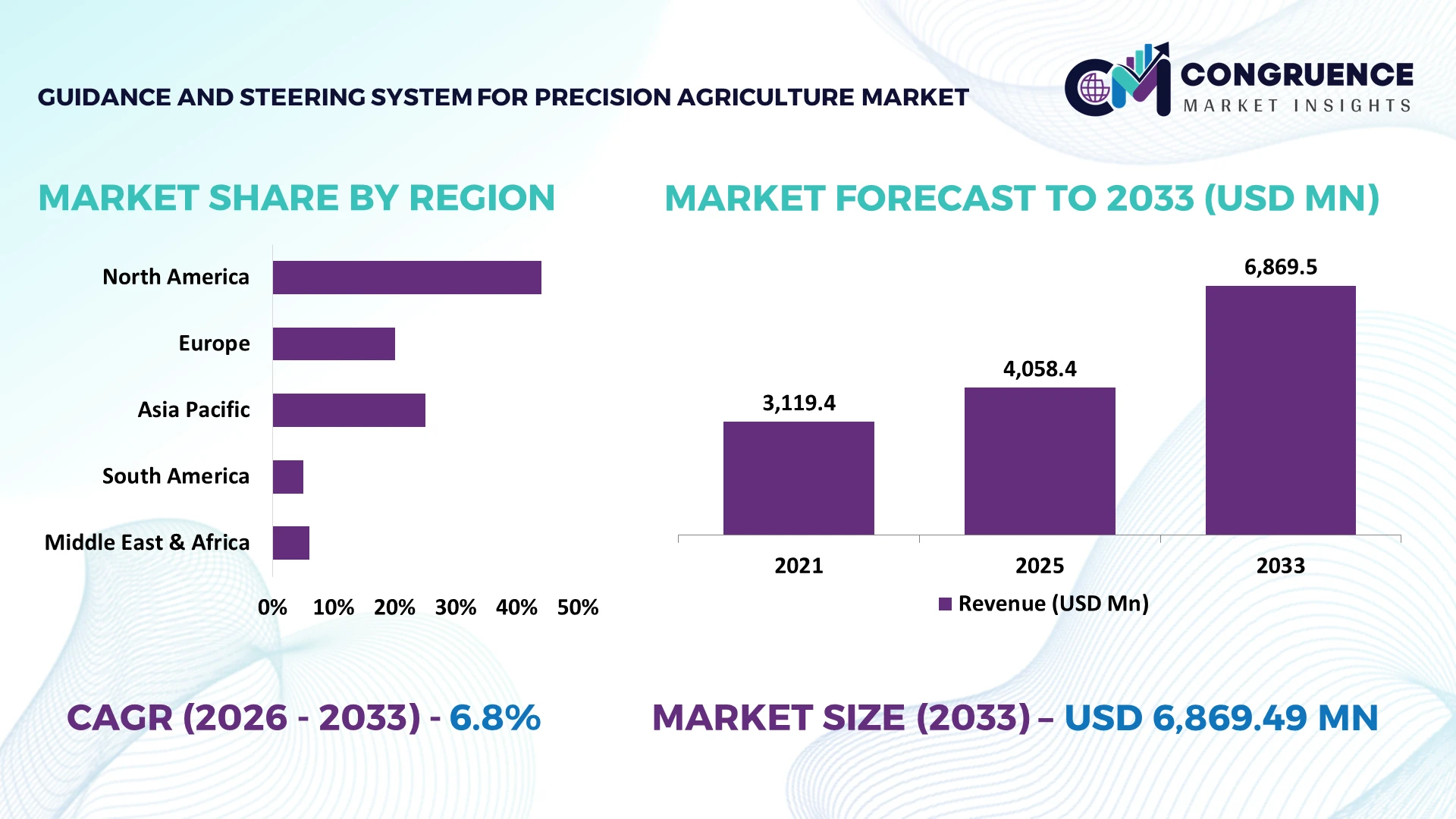
The Global Guidance and Steering System For Precision Agriculture Market was valued at USD 4058.4 Million in 2025 and is anticipated to reach a value of USD 6869.49 Million by 2033 expanding at a CAGR of 6.8% between 2026 and 2033.Growth is driven by RTK GNSS guidance adoption, autonomous tractor integration, and precision input placement that reduces overlapping field operations.
The United States represents a leading precision agriculture technology market, supported by extensive mechanized farming and established equipment manufacturers. USDA research reported guidance system adoption across approximately 70% of planted corn acreage in 2016, demonstrating substantial deployment before newer autonomy technologies emerged. By comparison, India's smaller average farm holdings constrain large machinery adoption. Deere & Company and AGCO are expanding automated steering capabilities, while the USDA's precision agriculture research and conservation initiatives support technology integration across commercial farming operations.
Strategically, equipment manufacturers should prioritize retrofit compatibility, centimeter level positioning, and scalable autonomy platforms to capture demand across established and emerging agricultural markets.
Market Size & Growth: USD 4,058.4 million in 2025, reaching USD 6,869.49 million by 2033 at 6.8% CAGR, driven by automated steering and GNSS modernization.
Top Growth Drivers: AGCO reports guidance penetration of 70% to 85% in North America, 60% to 75% in Europe, and 30% to 50% in Asia Pacific.
Short Term Forecast: By 2028, precision steering investments target reduced field overlap and improved machine utilization; verified percentage efficiency forecasts remain unavailable.
Emerging Technologies: Three advances dominate product development: RTK correction, AI assisted navigation, and machine vision autonomy.
Regional Leaders: Indicative 2025 market allocations imply North America USD 1,785.7 million, Europe USD 1,014.6 million, and Asia Pacific USD 852.3 million, using estimated shares of 44%, 25%, and 21%.
Consumer and End User Trends: USDA recorded autosteering adoption among 70% of large crop farms and 52% of midsize farms in 2023.
Pilot and Case Example: In 2025, Deere introduced second generation autonomous tractors using 16 cameras for complete 360 degree field perception.
Competitive Landscape: Deere leads a major integrated equipment ecosystem; its precise market share is undisclosed. AGCO, CNH, Topcon, and Hexagon provide competition.
Regulatory and ESG Impact: Guidance systems covered more than 50% of major United States row crop acreage in USDA research, supporting reduced overlapping applications.
Investment and Funding: AGCO's PTx Trimble transaction involved approximately USD 2 billion, strengthening precision positioning technology and independent dealer distribution.
Innovation and Future Outlook: Between 2026 and 2033, electric steering, correction subscriptions, and autonomous retrofits will reshape 3 equipment purchasing priorities: compatibility, accuracy, and connectivity.
The Guidance and Steering System For Precision Agriculture Market is shifting from basic satellite assisted navigation toward integrated machine control and autonomous field operations. RTK GNSS correction supports centimeter level positioning, enabling repeatable planting, spraying, and harvesting routes. Electric steering systems, machine vision, and connected fleet platforms increasingly influence equipment selection across grain farming, specialty crops, and agricultural contracting. AGCO's reported guidance penetration reaches 70% to 85% in North America, contrasting with 25% to 40% in South America. This deployment gap highlights the importance of affordable retrofits, dealer support, and positioning infrastructure in future competitive strategies.
Guidance and steering technologies are becoming central to agricultural equipment competitiveness as manufacturers transition from standalone positioning devices toward integrated autonomous field operations. Deere, AGCO, and CNH are connecting GNSS receivers, steering controllers, machine vision, and farm management platforms. This digital transition shifts purchasing decisions toward software compatibility, correction services, and equipment interoperability. USDA research identified guidance technology adoption across approximately 70% of planted corn acreage in 2016, establishing a substantial installed base for advanced automation upgrades.
RTK GNSS systems deliver positioning accuracy approaching 2.5 centimeters under suitable conditions, compared with approximately 1 to 3 meters for conventional standalone GNSS, representing over 97% improvement in positioning error against a 1 meter baseline. The United States benefits from established machinery distribution and correction infrastructure, while India faces fragmented landholdings and greater retrofit affordability constraints. Between 2026 and 2028, manufacturers will prioritize correction coverage, automated headland turning, and integrated implement guidance.
Deere's second generation autonomous tractor platform introduced in 2025 uses 16 cameras to support 360 degree environmental perception. AGCO's PTx Trimble strategy emphasizes retrofit technology and mixed fleet compatibility. Competitive advantage increasingly depends on reliable positioning, accessible service networks, and integration across machinery generations.
Agricultural labor constraints and rising machinery utilization requirements are accelerating automated guidance adoption across commercial farms. USDA research identified guidance system use on approximately 70% of planted corn acreage in 2016, reflecting established demand for repeatable field operations. RTK positioning reduces guidance error by more than 97% compared with a 1 meter conventional GNSS baseline under suitable operating conditions. Automated steering also eliminates manual steering corrections during straight field passes, allowing operators to concentrate on implement performance and application quality. Deere and CNH are integrating steering automation with machine control and digital farm platforms. Equipment manufacturers are expanding retrofit compatibility and correction subscriptions to strengthen adoption beyond new tractor purchases.
Guidance system deployment remains constrained by correction signal availability, hardware compatibility, and installation requirements across mixed machinery fleets. Conventional GNSS positioning errors of approximately 1 to 3 meters limit precision applications without additional correction services. RTK systems achieve approximately 2.5 centimeter accuracy under suitable conditions, but maintaining that performance requires dependable communications and correction infrastructure. India's fragmented agricultural holdings further complicate equipment investment economics, while older tractors frequently require additional steering controllers and electrical integration. Manufacturers including Topcon and PTx Trimble are expanding aftermarket configurations and flexible correction services. The operational priority is reducing installation complexity and ensuring consistent field performance without requiring complete machinery replacement.
Autonomous retrofit systems create opportunities to upgrade existing agricultural machinery without replacing entire tractor fleets. Deere's second generation autonomy platform introduced in 2025 incorporates 16 cameras providing 360 degree environmental perception, demonstrating the integration of machine vision with satellite positioning. RTK guidance supports approximately 2.5 centimeter positioning accuracy, enabling repeatable routes for planting, spraying, and harvesting. Brazil's large commercial farms offer substantial opportunities for integrated guidance and automated implement control, particularly where machinery operates across extensive field areas. AGCO is strengthening retrofit development through PTx Trimble, while equipment manufacturers are expanding software integration and connected service capabilities. The strategic opportunity lies in recurring correction services and equipment upgrades rather than hardware replacement alone.
Scaling autonomous guidance requires reliable perception, machine control integration, cybersecurity protection, and consistent operation under changing field conditions. Deere's autonomous platform uses 16 cameras for 360 degree perception, increasing the importance of sensor calibration, environmental recognition, and dependable processing systems. RTK positioning can achieve approximately 2.5 centimeter accuracy, but satellite interference, correction interruptions, and signal obstruction create operational continuity challenges. Agricultural machinery operating in dust, rain, and uneven terrain requires robust sensing and redundant safety mechanisms. Manufacturers must invest in software validation, remote diagnostics, operator training, and secure equipment connectivity. Long term competitiveness depends on maintaining dependable automated performance across crop types, machinery generations, and geographically diverse operating environments.
Satellite Correction Services Gain Importance: RTK guidance delivers approximately 2.5 centimeter positioning accuracy, compared with 1 to 3 meters for standalone GNSS. Farmers increasingly select correction subscriptions alongside steering hardware to maintain repeatable field paths. Deere and Topcon are expanding correction service integration, making network coverage and subscription continuity important determinants of equipment performance and customer retention.
Machine Vision Strengthens Field Navigation: Deere's second generation autonomous tractor technology, introduced in 2025, incorporates 16 cameras providing 360 degree environmental perception. Agricultural equipment manufacturers are integrating visual recognition with satellite positioning to improve obstacle detection and field navigation. This transition increases demand for onboard computing, sensor calibration, and specialized maintenance, shifting equipment servicing toward software diagnostics and electronic systems expertise.
Precision Implement Control Advances Coordination: Automated guidance increasingly connects tractor positioning with planter and sprayer control systems. Section control technology reduces repeated treatment across overlapping field areas, while RTK positioning supports approximately 2.5 centimeter path accuracy. CNH and AGCO are strengthening implement integration to improve application consistency, particularly where irregular field boundaries increase operational complexity and input management requirements.
Equipment Connectivity Reshapes Service Operations: Connected guidance platforms increasingly combine telematics, remote diagnostics, and positioning correction management. Deere's JDLink connectivity ecosystem supports machine monitoring, while PTx Trimble combines precision agriculture hardware and software capabilities following AGCO's 2024 transaction. Manufacturers are strengthening dealer service integration and remote technical support, reducing dependence on field visits for software troubleshooting and improving equipment maintenance coordination.
GPS/GNSS Based Systems represent the leading technology category, with an indicative market share of approximately 40% to 45%, although independently verified global segment distribution remains unavailable. Their dominance reflects broad compatibility with agricultural machinery, established satellite positioning infrastructure, and relatively accessible installation requirements. Conventional GNSS provides approximately 1 to 3 meter positioning accuracy, supporting basic navigation and field alignment. Manufacturers including Deere, Topcon, and Hexagon integrate satellite receivers with machine control platforms to improve equipment compatibility. Large commercial farms increasingly prioritize upgradeable receivers capable of supporting advanced correction services without complete hardware replacement.
RTK Guidance Systems represent the strongest premium technology opportunity, delivering approximately 2.5 centimeter positioning accuracy under suitable operating conditions. Auto Steering Systems are expanding through integrated machinery configurations and aftermarket installations, reducing manual steering requirements during repetitive field operations. Laser Guidance Systems remain relevant for specialized applications requiring local reference alignment. Technology suppliers are emphasizing correction reliability, interoperable steering controllers, and simplified installation to capture demand across different machinery generations and farm operating environments.
Tractor Guidance represents the leading application category, with an indicative market share of approximately 35% to 40%, although verified global application shares remain unavailable. Its dominance reflects extensive tractor utilization across planting, spraying, cultivation, and harvesting preparation. Satellite guidance improves route consistency and supports repeatable machinery positioning across agricultural operations. RTK correction provides approximately 2.5 centimeter positioning accuracy, strengthening field pass alignment. Deere, CNH, and AGCO are integrating guidance controls with tractor electronics and digital farm platforms, supporting equipment productivity and reducing operational dependence on continuous manual steering adjustments.
Automated Steering represents an expanding application as manufacturers integrate electronic steering controllers and connected machine management systems. Precision Planting benefits from repeatable row alignment, while Precision Spraying uses guidance information to coordinate application paths and minimize unnecessary overlap. Harvesting Guidance supports machine alignment and consistent field coverage during crop collection. Equipment manufacturers are strengthening software compatibility, steering calibration, and implement integration to address application specific operating requirements. Commercial differentiation increasingly depends on maintaining positioning consistency throughout interconnected field operations.
Large Scale Farms represent the dominant end user category, with an indicative market share of approximately 45% to 50%, although independently verified global distribution remains unavailable. Their position reflects extensive machinery fleets, high equipment utilization, and greater capacity to invest in advanced positioning infrastructure. USDA research reported autosteering adoption among approximately 70% of large crop farms in 2023, demonstrating established deployment across commercial agricultural operations. Large producers prioritize RTK correction, fleet connectivity, and integrated implement guidance to coordinate field activities. Deere and CNH are strengthening enterprise equipment platforms and connected support capabilities to address these requirements.
Small and Medium Farms represent an important expansion opportunity as affordable steering controllers and flexible correction subscriptions reduce initial adoption barriers. Agricultural Contractors utilize guidance systems to improve operational consistency across multiple customer fields, while Agricultural Cooperatives support shared equipment access and coordinated technology procurement. Manufacturers including AGCO and Topcon are expanding retrofit solutions and dealer partnerships to address machinery diversity. Future purchasing decisions increasingly emphasize installation simplicity, correction availability, and compatibility with existing agricultural equipment.
North America accounted for the largest market share at an estimated 44% in 2025 however, Asia Pacific is expected to register the fastest growth, expanding at an estimated CAGR of 8.5% between 2026 and 2033.
Advanced Autonomy and Integrated Agricultural Equipment Leadership
North America maintains a leading position in precision agriculture guidance through extensive commercial farming operations, advanced machinery manufacturing, and established satellite correction infrastructure. The region's estimated 44% market contribution reflects strong adoption among mechanized grain producers and agricultural contractors. Deere, AGCO, and CNH compete through integrated steering systems, connected machinery platforms, and precision implement control. In 2024, AGCO completed its approximately USD 2 billion PTx Trimble transaction, strengthening access to positioning technologies and mixed fleet guidance solutions. Canada contributes demand through extensive wheat and canola production, where repeatable field passes support efficient machinery utilization. Manufacturers are expanding correction subscriptions, dealer technical support, and automated field operation capabilities. Competitive differentiation increasingly depends on software interoperability, positioning reliability, and maintaining compatibility across existing equipment fleets.
United States Market Outlook: The United States benefits from established precision agriculture equipment manufacturing, agricultural technology research, and extensive commercial farm operations. Deere introduced its second generation autonomous tractor technology in 2025, incorporating 16 cameras for environmental perception. The country's agricultural equipment distribution infrastructure supports advanced steering installations, software upgrades, and connected fleet management. Manufacturers prioritize integrated automation and recurring technology services to strengthen equipment lifecycle value.
Precision Machinery Modernization and Digital Farming Integration
Europe's precision agriculture guidance industry is supported by established agricultural machinery manufacturing, satellite positioning infrastructure, and increasing integration of digital farming technologies. Germany, France, and the Netherlands maintain strong engineering capabilities in tractor automation, steering electronics, and agricultural equipment control. European manufacturers including CLAAS, CNH, and AGCO are expanding automated guidance functionality across commercial machinery portfolios. The European Union's Common Agricultural Policy for 2023 to 2027 encourages agricultural modernization and more efficient resource management. Galileo satellite navigation complements GPS positioning, strengthening access to multiple satellite constellations for agricultural guidance applications. Equipment suppliers are developing integrated steering controllers, implement management systems, and connected service platforms. Commercial opportunities concentrate on reliable positioning, interoperability, and machinery upgrades that improve operational efficiency without disrupting established agricultural workflows.
Germany Market Outlook: Germany maintains a strong agricultural machinery manufacturing ecosystem, supported by companies including CLAAS, Fendt, and specialized automation suppliers. The country's engineering expertise supports precision steering, GNSS integration, and automated implement control. Germany's agricultural sector operates approximately 16.6 million hectares of agricultural land, creating substantial demand for efficient field operations. Manufacturers are strengthening digital equipment platforms and dealer support capabilities to improve adoption across commercial farms.
Agricultural Mechanization and Affordable Guidance Technology Expansion
Asia Pacific represents an important expansion market for agricultural guidance systems, supported by mechanization initiatives, agricultural equipment manufacturing, and increasing availability of satellite positioning technologies. China, India, Japan, and Australia exhibit different adoption patterns based on farm size, machinery utilization, and agricultural infrastructure. China benefits from domestic GNSS technology development and BeiDou satellite navigation capabilities, while Japan emphasizes automated agricultural machinery and precision field management. Australia's extensive grain farming operations support advanced guidance adoption across large agricultural areas. India presents opportunities for affordable retrofit systems and shared machinery services, although fragmented holdings influence purchasing economics. Manufacturers are developing compact steering controllers, flexible correction services, and locally supported equipment configurations. Competitive positioning depends on affordability, positioning reliability, and distribution networks capable of serving diverse farming operations.
China Market Outlook: China benefits from its BeiDou satellite navigation system, domestic agricultural machinery manufacturing, and established electronics supply chains. BeiDou provides global navigation services through a constellation of more than 30 operational satellites. Agricultural technology suppliers are integrating satellite positioning with automated tractor steering and machinery management platforms. Domestic manufacturing capabilities support localized equipment development, while agricultural modernization initiatives encourage adoption of intelligent farming technologies across major grain production areas.
Commercial Crop Expansion and Machinery Productivity Optimization
South America's precision agriculture guidance industry is shaped by extensive commercial crop production, agricultural mechanization, and increasing demand for repeatable field operations. Brazil and Argentina maintain substantial soybean, corn, and wheat production activities, supporting adoption of automated tractor steering and satellite guidance technologies. Brazil's large agricultural enterprises utilize precision positioning to coordinate planting, spraying, and harvesting across extensive production areas. Argentina's established agricultural contracting industry supports equipment utilization across multiple farms. Deere, CNH, and AGCO compete through machinery integration, dealer networks, and positioning correction services. However, correction coverage, equipment financing, and technical support availability influence adoption outside major agricultural production corridors. Suppliers are strengthening aftermarket solutions and local service partnerships to address machinery diversity and operating conditions.
Brazil Market Outlook: Brazil represents the region's most significant precision agriculture equipment opportunity through its extensive commercial farming sector and established agricultural machinery manufacturing base. The country harvested more than 150 million tonnes of soybeans during the 2024 to 2025 crop season. Large farming operations increasingly integrate automated steering with planting and spraying equipment. Manufacturers emphasize equipment reliability, correction signal availability, and regional dealer support to serve major agricultural production areas.
Agricultural Modernization and Precision Equipment Deployment
The Middle East and Africa market is influenced by agricultural mechanization, irrigation efficiency requirements, and targeted investment in commercial farming infrastructure. South Africa maintains an established agricultural machinery industry supporting guidance adoption across grain production and commercial farming operations. Saudi Arabia and the United Arab Emirates emphasize controlled agricultural production and technology enabled resource management, while Morocco and Egypt present opportunities for modernizing mechanized field operations. Satellite positioning supports more consistent equipment navigation, particularly where large commercial farms operate multiple machinery types. However, equipment affordability, correction infrastructure, and limited technical service coverage constrain broader deployment. Manufacturers and distributors are developing retrofit solutions, training programs, and localized maintenance capabilities. Commercial opportunities concentrate on operations where machinery utilization and input efficiency justify technology investment.
South Africa Market Outlook: South Africa maintains the region's strongest established commercial agricultural machinery ecosystem, supported by mechanized grain production and agricultural equipment distribution networks. The country cultivates approximately 2.5 million hectares of maize annually, creating substantial demand for efficient planting and field management. Agricultural contractors and commercial producers are adopting satellite guidance and automated steering technologies to improve operational consistency. Suppliers prioritize dependable correction services, equipment compatibility, and technical support across major farming provinces.
Deere, CNH, and AGCO compete through integrated machinery ecosystems, while Topcon, Hexagon, and CHCNAV challenge established manufacturers through positioning hardware, retrofit compatibility, and specialized guidance solutions. The combined share of the five leading suppliers remains unverified because comparable global guidance system disclosures are unavailable. North America's estimated 44% market concentration supports premium integrated equipment demand, while Asia Pacific's indicative 8.5% growth outlook encourages localized product development. RTK positioning reduces guidance error by over 97% against a conventional 1 meter GNSS baseline, making correction reliability a major competitive differentiator. Deere emphasizes autonomous machinery integration, AGCO expands mixed fleet capabilities through PTx Trimble, and independent suppliers compete on installation flexibility and dealer accessibility. Market competition increasingly shifts toward software subscriptions, equipment interoperability, and connected technical services. Hardware compatibility, correction infrastructure, and installation expertise remain significant entry barriers. Winning requires reliable positioning, affordable deployment, and dependable service support.
Deere & Company
AGCO Corporation
CNH Industrial N.V.
Topcon Corporation
Hexagon AB
Trimble Inc.
CHC Navigation
CLAAS KGaA mbH
Kubota Corporation
Yanmar Holdings Co., Ltd.
Raven Industries
TeeJet Technologies
FJDynamics
Hemisphere GNSS
Current guidance technologies combine multisatellite GNSS receivers, RTK corrections, electronic steering controllers, and implement positioning systems. RTK delivers approximately 2.5 centimeter accuracy under suitable conditions, compared with 1 meter for conventional GNSS, reducing positioning error by 97.5%. This improvement enables repeatable planting and spraying routes, although equivalent percentage savings in inputs depend on field geometry. USDA research confirms substantial guidance adoption across major American crop operations. Deere and CNH integrate positioning hardware with tractor electronics, strengthening equipment performance and customer retention.
Emerging technologies combine machine vision, inertial navigation, and automated headland control. Deere's second generation autonomous platform incorporates 16 cameras for 360 degree environmental perception. Sensor fusion maintains navigation awareness when satellite reception deteriorates, while automated steering coordinates machinery movement with implement operation. AGCO and Topcon compete through retrofit compatibility and correction services. Verified percentage reductions in labor requirements remain unavailable, making field validation essential before procurement.
Between 2026 and 2028, artificial intelligence assisted perception, cloud connected diagnostics, and interoperable control platforms will shape investment priorities. Manufacturers are expanding software integration and correction coverage rather than relying exclusively on hardware upgrades. Equipment suppliers offering dependable positioning, accessible technical support, and compatibility across machinery generations will gain stronger competitive advantages in precision farming operations worldwide.
April 2024: AGCO and Trimble completed their PTx Trimble joint venture, with AGCO acquiring an 85% stake. The partnership combines guidance technologies and retrofit capabilities, strengthening mixed fleet precision agriculture offerings and expanding access to integrated agricultural automation. Source: trimble.com
January 2025: Deere unveiled its second generation autonomous 9RX tractor at CES, integrating 16 cameras for complete field perception. The technology expands autonomous tillage capabilities, supporting remote machine supervision and addressing skilled labor constraints in commercial agriculture. Source: deere.com
February 2025: CHC Navigation introduced the NX612 automated steering system, delivering ±2.5 centimeter positioning accuracy across operating speeds of 0.1 to 30 kilometers hourly. Its multisatellite compatibility supports precise seeding, spraying, and cultivation across diverse agricultural machinery. Source: einpresswire.com
April 2025: Topcon Agriculture launched Value Line Steering for smaller farming operations, supporting sub 5 centimeter accuracy on older tractors. The solution extends automated guidance access beyond premium machinery and supports affordable modernization through retrofit compatibility. Source: globenewswire.com
The report examines guidance and steering technology developments between 2026 and 2033 across GPS/GNSS Based Systems, RTK Guidance Systems, Auto Steering Systems, and Laser Guidance Systems. Application coverage includes Tractor Guidance, Automated Steering, Precision Planting, Precision Spraying, and Harvesting Guidance. End user analysis evaluates Large Scale Farms, Small and Medium Farms, Agricultural Contractors, and Agricultural Cooperatives. Technology assessment addresses satellite corrections, electronic steering controllers, machine vision, sensor fusion, and connected equipment management.
Regional coverage includes North America, Europe, Asia Pacific, South America, and the Middle East and Africa. Competitive analysis evaluates equipment manufacturers, positioning specialists, and retrofit technology suppliers. RTK positioning accuracy approaching 2.5 centimeters provides a measurable technology benchmark. The report supports investment planning, distribution expansion, product differentiation, and deployment strategies across established agricultural machinery markets and emerging automation applications.
| Report Attribute/Metric | Report Details |
|---|---|
Market Revenue in 2025 | USD 4058.4 Million |
Market Revenue in 2033 | USD 6869.49 Million |
CAGR (2026 - 2033) | 6.8% |
Base Year | 2025 |
Forecast Period | 2026 - 2033 |
Historic Period | 2021 - 2025 |
Segments Covered | By Type
By Application
By End-User
|
Key Report Deliverable | Revenue Forecast, Growth Trends, Market Dynamics, Segmental Overview, Regional and Country-wise Analysis, Competition Landscape |
Region Covered | North America, Europe, Asia-Pacific, South America, Middle East, Africa |
Key Players Analyzed | Deere & Company, AGCO Corporation, CNH Industrial N.V., Topcon Corporation, Hexagon AB, Trimble Inc., CHC Navigation, CLAAS KGaA mbH, Kubota Corporation, Yanmar Holdings Co., Ltd., Raven Industries, TeeJet Technologies, FJDynamics, Hemisphere GNSS |
Customization & Pricing | Available on Request (10% Customization is Free) |




