
Reports
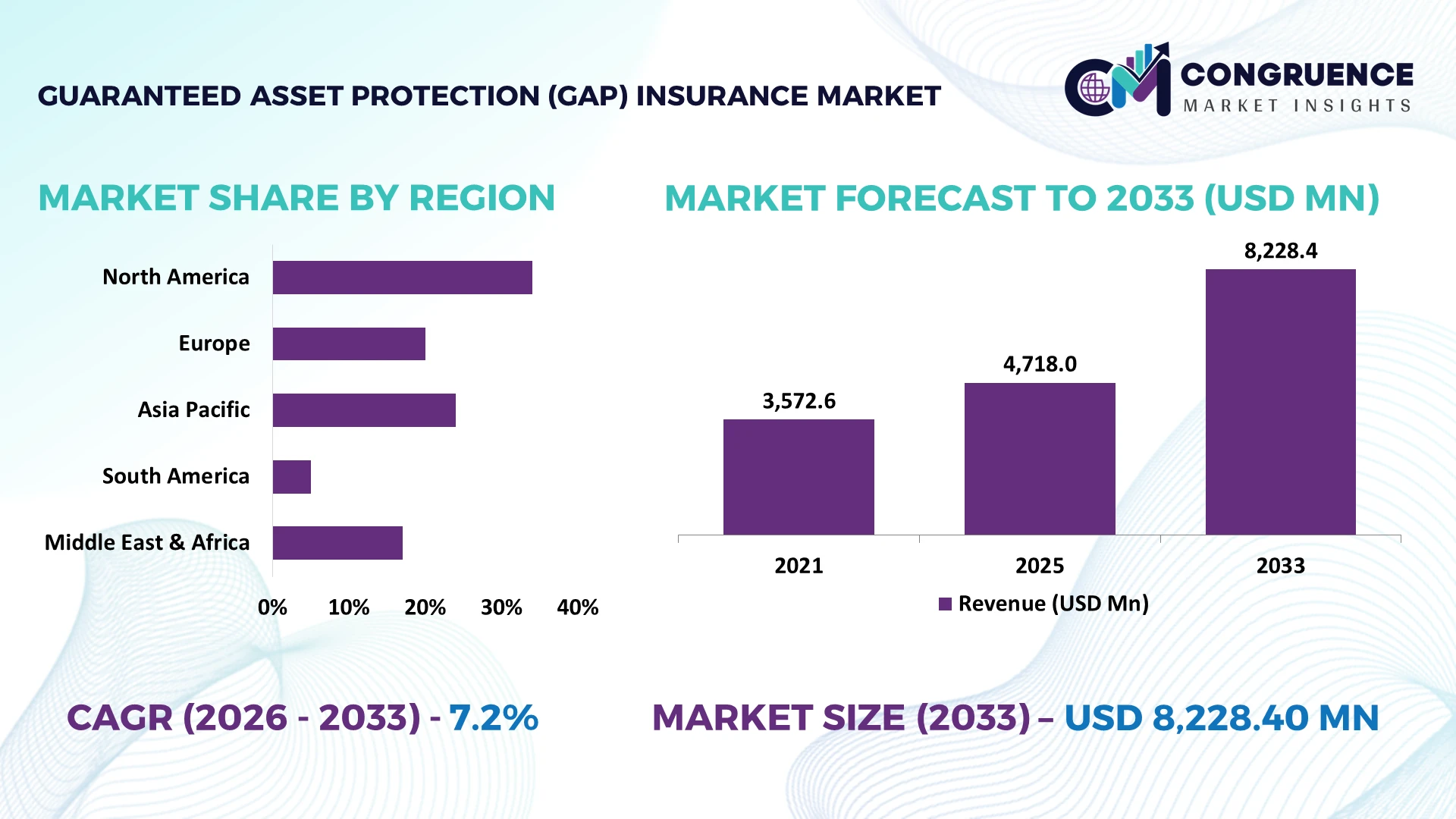
The Global Guaranteed Asset Protection (GAP) Insurance Market was valued at USD 4718 Million in 2025 and is anticipated to reach a value of USD 8228.4 Million by 2033 expanding at a CAGR of 7.2% between 2026 and 2033. Longer auto-finance exposure, rising vehicle replacement costs, higher financed balances, and expanding leasing are increasing the financial gap between outstanding vehicle debt and settlement values after total-loss events.
The United States remains the core demand center, supported by a highly developed auto-finance ecosystem where captives controlled 57.08% of new-vehicle financing in Q1 2025 and the average new-vehicle loan reached USD 41,720. In comparison, the UK underwent significant regulatory restructuring after FCA action covered firms representing 80% of its GAP insurance market, accelerating adoption of lower-commission, fair-value products.
Strategic implication: GAP insurers should prioritize lender-integrated U.S. distribution while strengthening product-value analytics, digital claims infrastructure, and commission controls as UK-style consumer-protection standards reshape mature insurance channels.
Market Size & Growth: USD 4,718 million in 2025 is projected to reach USD 8,228.4 million by 2033 at 7.2% CAGR, with larger financed vehicle balances expanding protection requirements.
Top Growth Drivers: 57.08% captive penetration in U.S. new-vehicle financing, 56.71% used-vehicle share of financed transactions, and 24.69% new-vehicle leasing penetration strengthen GAP distribution opportunities.
Short-Term Forecast: By 2027, insurers integrating automated underwriting, vehicle-valuation data and straight-through claims workflows are positioned to compress policy administration and claims-processing cycles as digital servicing scales.
Emerging Technologies: AI underwriting, API-based embedded insurance and automated vehicle valuation are becoming core technologies, while 61.2% of Q1 2025 global InsurTech deals went to AI-centered companies.
Regional Leaders: North America leads through mature lender-dealer integration; Europe is shifting toward fair-value distribution; Asia-Pacific represents a high-growth digital-finance opportunity as vehicle financing and embedded insurance ecosystems deepen.
Consumer/End-User Trends: U.S. new-vehicle leasing increased from 23.71% to 24.69% year over year in Q1 2025, expanding the addressable base for products protecting financed or contractual vehicle-value exposure.
Pilot/Case Example: In 2024, UK regulatory intervention targeted a GAP segment where only 6.26% of premiums had historically been returned through claims; the FCA estimated movement toward roughly 30% would improve consumer value by 23.74 percentage points.
Competitive Landscape: The global GAP insurance ecosystem spans major motor insurers, specialty underwriters, lenders and dealer-distribution partners, with scale increasingly determined by embedded finance integration, underwriting data and digital claims capabilities.
Regulatory & ESG Impact: UK regulators identified distribution arrangements where commissions reached as much as 70% of premiums; firms restarting GAP sales subsequently adopted materially lower commission structures under strengthened fair-value requirements.
Investment & Funding: USD 10.98 billion has flowed into auto/motor InsurTech companies since 2012, while global InsurTech funding reached USD 1.31 billion in Q1 2025, reinforcing investment in AI-led insurance infrastructure.
Innovation & Future Outlook: AI-centered firms captured USD 710.86 million across 61.2% of Q1 2025 InsurTech deals, signaling a strategic shift toward automated underwriting, claims intelligence and data-connected embedded insurance.
Guaranteed Asset Protection (GAP) Insurance demand is increasingly tied to financed vehicles, longer ownership obligations, leasing and exposure to rapid vehicle depreciation. Digital embedded-insurance platforms, AI-supported underwriting and automated valuation are modernizing policy distribution and claims. U.S. new-vehicle leasing reached 24.69% in Q1 2025, while UK fair-value intervention is reshaping commission economics, establishing a clearer strategic direction for insurers and distribution partners.
Guaranteed Asset Protection (GAP) insurance is becoming strategically important as lenders, dealers and insurers compete to control protection products within increasingly digital vehicle-finance journeys. In the United States, captives accounted for 57.08% of new-vehicle financing in Q1 2025, while leasing penetration reached 24.69%. These financing structures increase the relevance of protection against negative equity, particularly as higher vehicle replacement costs and extended loan terms widen exposure after total-loss settlements.
Technology is shifting GAP distribution from dealership-led paperwork toward embedded, API-connected insurance. Automated underwriting and vehicle-valuation engines can reduce quotation and policy-processing times by roughly 20–30% compared with manual workflows. The United States benefits from deeply integrated lender-dealer channels, whereas the UK is undergoing a regulatory reset after FCA intervention affected providers representing about 80% of GAP sales. By 2028, digital policy issuance and automated claims assessment should become standard across leading distribution networks.
Operationally, lenders can embed GAP selection directly into digital vehicle-finance checkout, eliminating separate applications and improving policy activation. Insurers are consequently investing in embedded-insurance APIs, AI-assisted claims, real-time valuation data and dealership partnerships. Competitive advantage will increasingly depend on controlling finance-linked customer data and delivering compliant protection precisely when negative-equity exposure originates.
Extended vehicle financing is structurally strengthening GAP insurance relevance because borrowers remain exposed to outstanding balances longer than vehicles retain equivalent market value. In the United States, approximately 70% of used-vehicle loans extend beyond 60 months, while 28.6% exceed 72 months; new-vehicle leasing penetration also reached 24.69% in Q1 2025. Higher financing duration combined with rapid early-stage depreciation increases potential settlement shortfalls after theft or total loss. The shift toward costlier EVs adds another layer because repair economics and residual-value uncertainty influence write-off decisions. Insurers, captive finance companies and dealerships are responding by integrating GAP protection into digital loan origination, expanding lender partnerships and using vehicle-specific valuation data to price exposure more accurately.
Regulatory intervention is placing immediate pressure on traditional high-commission GAP distribution models. In the UK, the Financial Conduct Authority found historical claims ratios of only 6.26%, while some distribution arrangements allocated commissions reaching 70% of premiums. Regulatory action subsequently affected providers responsible for approximately 80% of GAP sales, forcing product suspensions, reassessments and redesigned value propositions. The constraint directly compresses distributor economics and increases compliance expenditure for insurers dependent on dealership point-of-sale channels. Unlike ordinary underwriting volatility, this pressure targets the economics of the distribution chain itself. Providers are responding with lower commission structures, enhanced claims-value monitoring, direct-to-consumer channels and stronger product-governance controls. The strategic priority is shifting from maximizing attachment income toward demonstrating measurable customer value throughout the policy lifecycle.
Embedded insurance represents a high-value opportunity because GAP protection can be positioned at the exact point where vehicle-finance exposure originates. U.S. captive lenders controlled 57.08% of new-vehicle financing in Q1 2025, while leasing represented 24.69% of new financing and 56.71% of financed transactions involved used vehicles. Connecting GAP underwriting to digital loan platforms allows insurers to use loan-to-value, vehicle depreciation and financing-term data without duplicating customer inputs. AI-centered companies represented 61.2% of global InsurTech deals in Q1 2025, reinforcing investment momentum behind automated insurance infrastructure. Providers are building APIs, dealership integrations and lender partnerships that support real-time eligibility and pricing. The non-obvious opportunity lies in treating GAP as a finance-data product rather than a standalone insurance add-on.
Scaling digital GAP insurance requires reliable interoperability among lender systems, dealer platforms, vehicle-valuation databases and insurer claims infrastructure. The challenge intensifies as AI adoption accelerates: AI-focused businesses accounted for 61.2% of InsurTech transactions in Q1 2025, while U.S. captives already handle 57.08% of new-vehicle financing, creating large data environments requiring consistent governance. Automated total-loss assessment depends on accurate outstanding balances, vehicle values and settlement information; fragmented interfaces can undermine straight-through processing and pricing precision. Cybersecurity and model-governance requirements add long-term operational pressure as more policy decisions become automated. Insurers must invest in standardized APIs, secure data-sharing architecture, explainable underwriting models and lender-platform partnerships. Sustainable competitive advantage will depend on integration quality, not simply digital distribution scale.
Fair-Value Models Replace High Commissions: UK GAP distribution is undergoing measurable restructuring after regulators identified commission arrangements reaching 70% of premiums and historical claims ratios near 6.3%. Regulatory intervention covered providers representing roughly 80% of sales. Insurers are lowering commissions, strengthening product-value testing and redesigning dealer remuneration, shifting competitive differentiation from distributor incentives toward demonstrable policyholder outcomes.
Digital Claims Workflows Gain Scale: Insurers are replacing document-intensive claims administration with API connectivity, automated vehicle valuation and AI-supported triage. AI-focused businesses represented 61.2% of global InsurTech transactions in Q1 2025, while digital workflows can shorten routine insurance processing by approximately 20–30%. Providers are integrating lender balance data and valuation feeds to reduce manual verification, accelerate settlement decisions and control claims-handling costs.
Leasing Changes Protection Requirements: U.S. new-vehicle leasing penetration increased from 23.7% to 24.7% within one year, while leasing represents approximately 60% of new EV transactions. This creates different protection requirements from conventional ownership because contractual settlement exposure becomes central. GAP providers are adjusting coverage structures, integrating with leasing platforms and refining residual-value analytics rather than relying on standardized financed-vehicle products.
Negative Equity Reshapes Underwriting: Approximately 24% of U.S. new-vehicle trade-ins carried negative equity during early 2025, with average underwater balances exceeding USD 6,700. Longer loan structures compound this exposure as borrowers roll unpaid balances into replacement vehicles. Insurers and finance partners are tightening loan-to-value analytics, introducing risk-tiered eligibility and connecting underwriting systems directly with financing data to prevent disproportionate exposure accumulation.
Finance GAP leads the type segmentation with an estimated 40–45% share, reflecting its direct alignment with mainstream vehicle loans and straightforward integration into lender and dealership financing workflows. Its scalability is reinforced by longer financing periods and rising negative equity, particularly in the United States, where roughly 70% of used-vehicle loans extend beyond 60 months. Return-to-Invoice GAP remains important among buyers seeking protection against depreciation from the original invoice value, while Vehicle Replacement GAP commands a more specialized position because its broader replacement-cost protection generally requires higher premiums and more detailed underwriting.
Negative Equity GAP is emerging as the fastest-growing type as trade-in debt increasingly transfers into replacement financing. Around 24% of U.S. trade-ins involving new-vehicle purchases carried negative equity in early 2025, creating stronger demand for products addressing rolled-over balances. Contract Hire GAP remains strategically relevant to leasing fleets and contractual users. Providers are consequently prioritizing finance-linked underwriting, flexible coverage structures and lender integrations while developing more targeted negative-equity products.
New Vehicle Financing represents the leading application, accounting for an estimated 35–40% of GAP insurance demand because higher transaction values, longer repayment schedules and integrated dealership financing create substantial protection requirements. In the United States, captive finance companies controlled 57.1% of new-vehicle financing during Q1 2025, creating an established channel for embedding GAP products during loan origination. Auto Loans remain another substantial application because borrowers face persistent loan-to-value exposure, particularly when repayment periods extend beyond the steepest phase of vehicle depreciation.
Vehicle Leasing is the fastest-growing application as leasing penetration reached approximately 24.7% of U.S. new-vehicle financing in Q1 2025, up about one percentage point year over year. Used Vehicle Financing remains strategically important because longer loan terms and uncertain residual values increase settlement-gap exposure despite lower vehicle prices. Insurers are integrating policy eligibility into digital lending platforms, automating loan-balance verification and developing lease-specific protection structures. Investment is consequently shifting toward embedded distribution capable of serving financing and leasing transactions at origination.
Individual Vehicle Owners represent the dominant end-user group with an estimated 40–45% share because the ultimate financial exposure from vehicle depreciation, outstanding loan balances and total-loss settlements rests primarily with borrowers. Demand is especially concentrated among consumers using long-duration financing; approximately 70% of U.S. used-vehicle loans extend beyond 60 months. Auto Dealerships remain critical intermediaries because GAP can be incorporated directly into finance-and-insurance transactions, allowing protection to be presented when loan-to-value exposure is created.
Finance Companies are emerging as the fastest-growing end-user group as digital origination and embedded protection enable policies to be integrated directly into financing workflows. Captive finance providers represented 57.1% of U.S. new-vehicle financing in Q1 2025, illustrating the scale available to integrated distributors. Banks & Credit Unions maintain strong demand through conventional auto lending, while Leasing Companies require contract-specific protection against settlement shortfalls. Providers are targeting these buyers with API connectivity, risk-based pricing, white-label products and customized lender partnerships.
North America accounted for the largest market share at 42.8% in 2025 however, Asia-Pacific is expected to register the fastest growth, expanding at a CAGR of 9.1% between 2026 and 2033.

Embedded Auto Finance Strengthens GAP Distribution
North America holds approximately 42.8% of the global market, underpinned by high vehicle-financing penetration, long loan durations and mature dealership finance-and-insurance infrastructure. U.S. captive finance companies controlled 57.08% of new-vehicle financing in Q1 2025, creating an efficient point-of-sale channel for GAP products. Leasing represented 24.69% of new financing, while persistent negative equity is encouraging lenders to strengthen loan-to-value monitoring. Canada adds demand through bank-led auto lending and dealership protection products. Insurers are increasingly connecting policy issuance with digital loan-origination platforms, vehicle valuation feeds and automated claims systems. The operational advantage is shifting toward providers capable of combining borrower, vehicle and outstanding-balance data at underwriting, enabling more precise eligibility decisions and faster settlement workflows.
United States Market Outlook: Individual borrowers, captive lenders and dealer F&I networks give the United States exceptional distribution depth. Approximately 24.1% of new-vehicle trade-ins carried negative equity in Q1 2025, with affected consumers owing an average USD 6,880. This strengthens demand for finance-linked GAP structures while encouraging insurers to deploy risk-tiered underwriting and tighter lender integrations.
Fair-Value Regulation Restructures Distribution
Europe represents approximately 24–26% of global GAP insurance activity, with the UK, Germany, France and Italy forming important vehicle-finance markets. Regulatory modernization is fundamentally changing distribution economics, particularly in Britain, where intervention covered firms responsible for around 80% of GAP sales after concerns over customer value. Historical UK claims ratios near 6.3% and commissions reaching 70% in some arrangements triggered product reassessment, commission reductions and stronger governance. Germany and France retain more lender- and dealer-oriented protection ecosystems supported by substantial vehicle leasing and financing volumes. Across Europe, providers are emphasizing transparent pricing, digitally documented suitability and auditable claims outcomes. This restructuring favors insurers with efficient direct distribution and data-driven product governance rather than those relying primarily on high dealership commissions.
United Kingdom Market Outlook: The UK is strategically important because regulatory intervention is establishing a new operating benchmark for GAP products. Providers returning to distribution have reworked commission economics, product-value assessments and customer disclosures. The regulatory reset creates an advantage for digitally efficient insurers capable of maintaining viable underwriting economics while demonstrating substantially stronger policyholder value.
Digital Auto Finance Expands Addressable Demand
Asia-Pacific accounts for approximately 20–22% of global GAP insurance activity, with China, Japan, Australia and India offering distinctly different financing environments. China’s vehicle market exceeded 31 million annual sales in 2024, creating substantial potential for protection products as digital automotive lending becomes more integrated with dealership platforms. Australia already has mature vehicle-finance and insurance distribution, while India combines expanding passenger-vehicle ownership with rapid digital lending adoption. Japan’s established leasing and captive-finance structures support more standardized protection offerings. The region’s operational shift centers on embedding insurance within mobile lending, OEM finance and digital dealership journeys rather than replicating traditional standalone distribution. Insurers are developing API-based partnerships with lenders and automotive platforms, allowing eligibility, pricing and policy issuance to occur alongside financing approval and reducing customer acquisition friction.
China Market Outlook: China provides the strongest scale advantage, with new-energy vehicles accounting for more than 40% of new passenger-vehicle sales during 2024. Rapid EV adoption creates greater residual-value variability and evolving repair economics, strengthening the relevance of data-driven GAP underwriting. Captive finance, digital dealerships and connected vehicle ecosystems provide scalable routes for embedded protection.
Financing Recovery Broadens Protection Demand
South America represents approximately 6–7% of global GAP insurance activity, led by Brazil and supported by expanding vehicle credit in Argentina, Chile and Colombia. Brazil registered more than 2.6 million new light-vehicle registrations in 2024, providing a sizable transaction base for loan-linked protection products. The market remains more sensitive to borrowing costs and credit availability than the United States or Western Europe, making affordability and flexible policy structures operationally important. Digital banks and fintech-led auto financing are creating alternative distribution routes beyond conventional dealerships. Insurers are responding with simplified underwriting, installment-compatible premiums and lender partnerships. Currency volatility and uneven financing penetration constrain uniform deployment, making localized risk pricing and adaptable distribution more important than standardized continent-wide products.
Brazil Market Outlook: Brazil combines South America’s largest automotive base with increasingly digitized financial services. More than 2.6 million light vehicles were registered during 2024, strengthening the potential customer pool for GAP protection. Banks, fintech platforms and dealerships provide multiple distribution routes, while insurers can differentiate through localized credit-risk analytics and digitally issued coverage.
Digital Mobility Investment Reshapes Distribution
Middle East & Africa represents approximately 4–6% of global GAP insurance activity, with the UAE, Saudi Arabia and South Africa providing the strongest near-term commercial foundations. Gulf markets benefit from high-value vehicle purchases, expanding consumer finance and increasingly digital insurance distribution, while South Africa offers established banking and motor-insurance infrastructure. Saudi Arabia’s financial-sector modernization and rapid expansion of digital payments are enabling lenders and insurers to embed ancillary protection more efficiently into automotive financing. UAE dealerships increasingly combine financing, insurance and after-sales services within integrated digital customer journeys. Elsewhere, lower insurance penetration and fragmented credit infrastructure restrict deployment scale. Providers are therefore prioritizing partnerships with banks, automotive distributors and digital finance platforms rather than building costly standalone acquisition channels.
United Arab Emirates Market Outlook: The UAE combines high vehicle values, extensive dealership groups and advanced digital financial infrastructure. Digital transactions account for the overwhelming majority of retail payment activity, supporting seamless integration of GAP products into financing journeys. Insurers are positioning through dealership partnerships, automated onboarding and digitally managed motor-protection portfolios.
Allianz, Assurant, Zurich Insurance Group, AXA, Progressive and specialist automotive protection providers compete across lender, dealership and direct insurance channels, with global insurers challenging regional administrators through scale, underwriting data and embedded distribution. The top five participants collectively represent an estimated 35–40% share, leaving substantial space for specialized providers and captive-linked programs. Competition increasingly centers on digital integration: automated underwriting can shorten policy processing by 20–30%, while API-based distribution reduces manual onboarding and improves lender connectivity. Providers are also restructuring dealer commissions, particularly after UK regulatory intervention exposed arrangements reaching 70% of premiums. Allianz and Zurich leverage insurance scale; Assurant emphasizes automotive partnerships and protection ecosystems; direct insurers compete through pricing and digital servicing. Partnerships with lenders, dealerships and vehicle platforms are replacing isolated product distribution. Regulatory compliance, claims-value performance and access to finance-originated data remain significant entry barriers. Winning requires embedded distribution, disciplined pricing, rapid claims execution and demonstrable customer value.
Allianz SE
Assurant, Inc.
Zurich Insurance Group
AXA SA
Progressive Corporation
Allstate Corporation
Nationwide Mutual Insurance Company
American Family Insurance
State Farm Mutual Automobile Insurance Company
Chubb Limited
AIG
Suncorp Group
Direct Line Group
Admiral Group
Current GAP technology centers on API-based policy administration, automated vehicle valuation, digital contracting, and lender-platform connectivity. Straight-through workflows can cut quotation-to-issuance processing time by 20–30% versus manual F&I paperwork, while automated data validation can reduce administrative handling by 15–20%. Deployment is strongest among large insurers, captive lenders, and digitally enabled dealer groups integrating protection products directly into financing journeys.
Emerging capabilities combine AI claims triage, real-time loan-to-value monitoring, telematics, and predictive depreciation models. AI-focused companies represented 61.2% of InsurTech deals in early 2025, signaling accelerating deployment across underwriting and claims operations. Compared with legacy document-based assessment, automated claims orchestration can improve processing efficiency by roughly 25%, benefiting insurers and lenders with high policy volumes while reducing settlement friction for customers.
Disruptive development is moving toward embedded GAP infrastructure where eligibility, pricing, payment, policy issuance, and claims operate within one digital interface. Cloud APIs and machine-learning models increasingly connect OEMs, dealerships, lenders, and insurers without separate customer journeys. Between 2026 and 2028, leading providers are positioned to automate 50–60% of routine GAP servicing interactions. Companies acting now gain faster distribution, better risk selection, lower servicing costs, and stronger access to finance-originated customer data at the point of vehicle finance approval.
February 2024 — Financial Conduct Authority secured GAP sales pauses from insurers representing 80% of the UK market after claims payouts averaged 6% of premiums and some commissions reached 70%, forcing product redesign and fair-value reassessment before distribution resumed. Source: fca.org.uk
July 2025 — Roadzen partnered with a major UK independent vehicle retailer to embed Return-to-Invoice GAP across digital and showroom channels serving 60,000+ annual buyers, using one platform for pricing, issuance, payments and claims, expanding technology-led distribution nationally. Source: roadzen.io
June 2025 — The Motor Ombudsman introduced revised automotive Codes covering GAP insurance sales across a network exceeding 7,500 retailers and repairers, 46 vehicle manufacturers and 21 warranty providers, strengthening standardized customer protection and compliance processes across dealerships. Source: themotorombudsman.org
May 2026 — Assurant reported Q1 negative equity affecting roughly 30% of trade-in borrowers, averaging $7,200, while total-loss frequency reached 23.9% of claims; it responded by emphasizing advanced modeling, continuous monitoring and proactive GAP pricing discipline for dealers. Source: assurant.com
The report evaluates GAP insurance across Finance GAP, Return-to-Invoice GAP, Vehicle Replacement GAP, Contract Hire GAP and Negative Equity GAP, alongside New Vehicle Financing, Used Vehicle Financing, Vehicle Leasing and Auto Loans. End-user coverage spans individual vehicle owners, dealerships, banks and credit unions, leasing companies and finance companies. North America holds approximately 43% of market activity, while digital finance penetration is strengthening deployment across Asia-Pacific.
Regional assessment covers North America, Europe, Asia-Pacific, South America, and Middle East & Africa, incorporating regulatory restructuring, embedded insurance, AI underwriting, automated claims, API connectivity and vehicle-valuation technologies. The analysis also examines negative-equity protection, EV-linked depreciation and digitally distributed policies. With U.S. leasing penetration approaching 25% and finance workflows becoming increasingly embedded, the 2026–2033 outlook supports investment prioritization, geographic expansion, partnership selection, product positioning and competitive technology planning.
| Report Attribute/Metric | Report Details |
|---|---|
Market Revenue in 2025 | USD 4718 Million |
Market Revenue in 2033 | USD 8228.4 Million |
CAGR (2026 - 2033) | 7.2% |
Base Year | 2025 |
Forecast Period | 2026 - 2033 |
Historic Period | 2021 - 2025 |
Segments Covered | By Type
By Application
By End-User
|
Key Report Deliverable | Revenue Forecast, Growth Trends, Market Dynamics, Segmental Overview, Regional and Country-wise Analysis, Competition Landscape |
Region Covered | North America, Europe, Asia-Pacific, South America, Middle East, Africa |
Key Players Analyzed | Allianz SE, Assurant, Inc., Zurich Insurance Group, AXA SA, Progressive Corporation, Allstate Corporation, Nationwide Mutual Insurance Company, American Family Insurance, State Farm Mutual Automobile Insurance Company, Chubb Limited, AIG, Suncorp Group, Direct Line Group, Admiral Group |
Customization & Pricing | Available on Request (10% Customization is Free) |




