
Reports
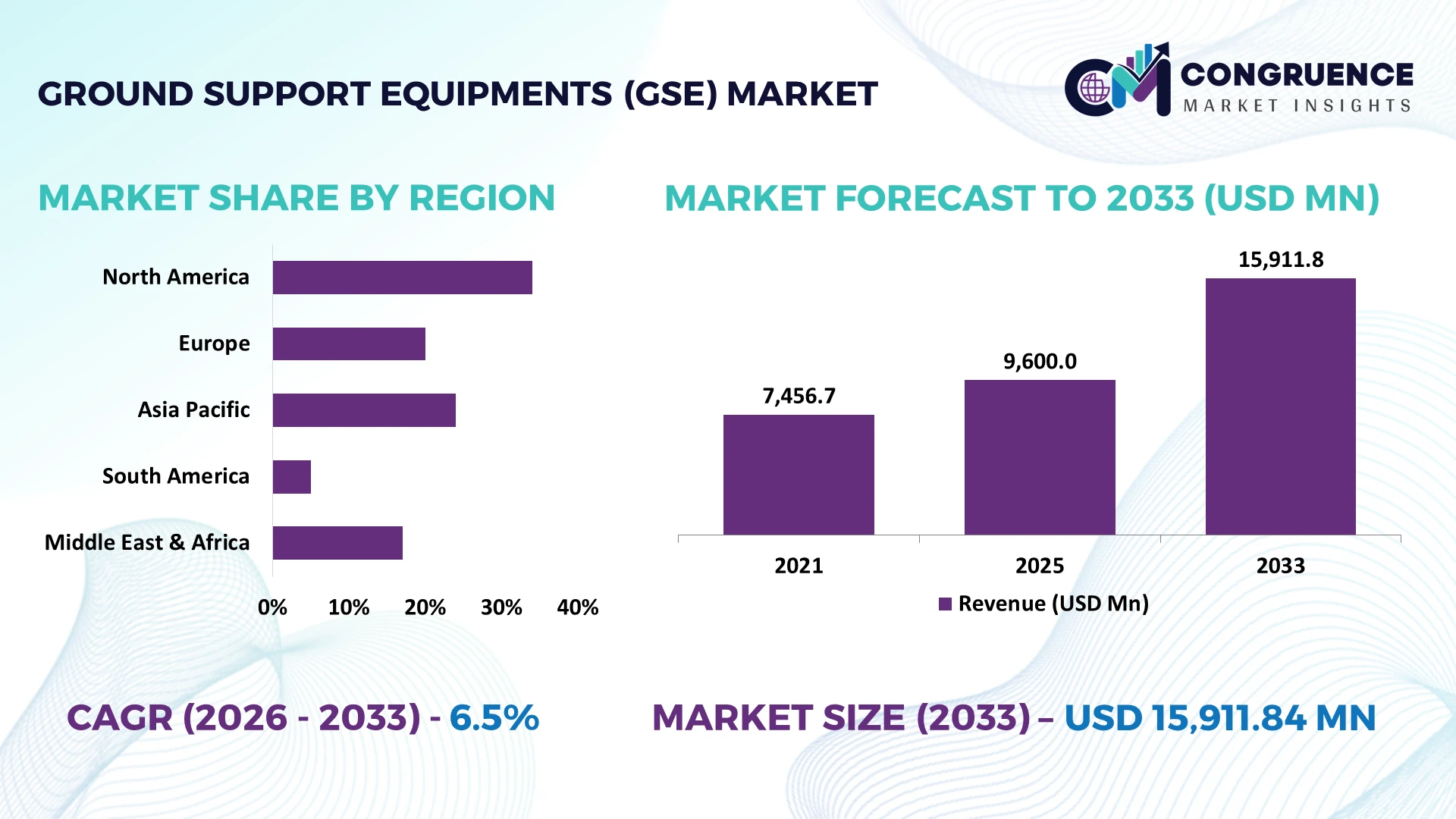
The Global Ground Support Equipments (GSE) Market was valued at USD 9600 Million in 2025 and is anticipated to reach a value of USD 15911.84 Million by 2033 expanding at a CAGR of 6.52% between 2026 and 2033. Growth is being accelerated by airport fleet electrification, automated handling systems, fixed ground-power deployment, and replacement of diesel equipment to meet tightening airside-emission requirements.
The United States dominates the country landscape, representing 27.5% of global GSE market value in 2025, with USD 1,486.7 million in market activity and electric equipment identified as its fastest-growing segment. India represented 3.4%, with electric GSE also the fastest-growing category, while its market reached USD 186.3 million. The U.S. advantage is reinforced by the Infrastructure Investment and Jobs Act, which allocated USD 15 billion for airport-related infrastructure, including sustainability projects, strengthening the investment pipeline for advanced airside equipment.
Strategically, suppliers should prioritize electrified, connected, and infrastructure-integrated GSE in the U.S. while targeting faster equipment conversion opportunities in India and other high-expansion aviation markets.
Market Size & Growth: USD 9,600M in 2025 to USD 15,911.84M by 2033 at 6.52%, driven by fleet electrification and airport modernization.
Top Growth Drivers: Electrification 9.3%, automation 7%, connected telematics 6% strengthen advanced GSE adoption.
Short-Term Forecast: By 2030, electrified fleets are positioned to reduce equipment operating costs by roughly 10–20% through lower energy and maintenance requirements.
Emerging Technologies: AI dispatching, battery-electric tractors, autonomous towing, and telematics are reshaping high-throughput ramp operations.
Regional Leaders: North America leads at 41.1%; Europe held 27.3%; Asia Pacific is the fastest-growing region and is projected to reach USD 2,776.7M by 2033.
Consumer/End-User Trends: Menzies Aviation reached 25% electric GSE globally in 2026, up from 22% in 2024, adding more than 620 electric assets during 2025.
Pilot/Case Example: A 2024 electric-GSE optimization study showed shared operator scheduling can cut airport operating costs 15–25% and delay time 26–39%.
Competitive Landscape: North America holds about 41.1%; key competitors include TLD Group, JBT, Textron GSE, Tronair, and ITW GSE.
Regulatory & ESG Impact: Electric GSE produces 35–52% less CO₂ per turnaround and 5.5–8.3 dB(A) less noise than traditional GSE in average EU-country conditions.
Investment & Funding: Menzies committed USD 200M to fleet modernization, supporting a measurable shift toward electric ground operations.
Innovation & Future Outlook: Next-generation GSE is shifting from standalone vehicles toward AI-coordinated, battery-integrated, digitally monitored airport operating systems.
Ground Support Equipments (GSE) demand is concentrating around baggage handling, aircraft towing, fixed electrical ground power, passenger boarding, and cargo servicing, where electrification directly improves airside economics. Menzies’ 25% electric-fleet milestone demonstrates that fleet conversion is moving beyond pilots into scaled operations. At the same time, airport operators are redesigning charging and power infrastructure alongside equipment procurement, reflecting the operational constraints exposed by global energy and supply-chain transitions.
Ground Support Equipments (GSE) is becoming a strategic aviation asset because turnaround speed, airside energy efficiency, and equipment availability increasingly influence airline and airport competitiveness. The shift from diesel fleets toward electric tractors, loaders, belt units, and ground-power systems is also restructuring procurement, with airports integrating charging infrastructure into broader modernization programs rather than treating GSE as standalone purchases.
Technology selection is creating measurable operating differences. Battery-electric GSE can reduce routine maintenance requirements by approximately 20–30% compared with diesel-powered equipment because of fewer moving components, while regenerative braking improves energy utilization during repetitive ramp cycles. The United States is prioritizing large-scale fleet replacement and charging deployment, whereas India is moving from limited electric pilots toward wider airport-level adoption as new aviation infrastructure expands.
Over the next 2–3 years, operators are expected to prioritize connected fleet management, predictive maintenance, and mixed electric-autonomous fleets, with utilization improvements of 8–12% achievable through better dispatch visibility. Practical deployment is shifting toward bundled partnerships covering vehicles, batteries, charging, software, and maintenance. Companies that control this integrated ecosystem will gain stronger equipment uptime, lower lifecycle costs, and a defensible position in increasingly technology-driven airport operations.
Airport electrification is the strongest structural driver, with electric GSE typically delivering 20–30% lower maintenance requirements and substantially lower local emissions than comparable diesel equipment. In the United States, airport sustainability programs are accelerating replacement cycles, while India is expanding modern airport capacity with greater emphasis on energy-efficient ground operations. Battery-electric tractors, baggage units, and ground-power systems are moving from isolated trials toward coordinated fleet procurement. Manufacturers are responding through modular platforms, localized servicing, and charging partnerships. The non-obvious advantage is operational standardization: airports can reduce spare-parts complexity when multiple GSE categories share battery, telemetry, and maintenance architectures.
The principal restraint is infrastructure readiness rather than equipment availability. High-power GSE charging can require 15–30% additional site electrical capacity at concentrated operating periods, while battery systems can account for a significant portion of equipment acquisition costs. India faces particular constraints at rapidly expanding airports where grid upgrades and charging installation must progress alongside terminal construction. Battery-cell and power-electronics supply dependencies also expose operators to procurement volatility. Companies are mitigating these pressures through multi-year supplier contracts, localized component sourcing, staged charging deployment, and standardized battery platforms. Strategically, airports that procure vehicles before validating electrical capacity risk underutilization and weaker asset economics.
Autonomous towing, AI-assisted dispatch, digital twins, and predictive maintenance are opening higher-value opportunities beyond equipment replacement. Connected GSE can improve fleet utilization by roughly 8–12%, while predictive maintenance programs can reduce unplanned downtime by 10–20% when telemetry coverage is sufficiently dense. Japan and Singapore are particularly relevant markets for automation-led deployment because of advanced airport infrastructure and technology-oriented operating models. Manufacturers are expanding beyond vehicle sales into software subscriptions, fleet analytics, and managed-service contracts. The strongest opportunity lies in integrating autonomous equipment with airport turnaround systems, allowing operators to optimize vehicle sequencing rather than merely automate individual GSE tasks.
Long-term deployment is challenged by fragmented control systems, mixed equipment generations, cybersecurity exposure, and shortages of technicians capable of servicing high-voltage and digitally connected fleets. Integrating legacy diesel GSE with electric, autonomous, and telematics-enabled assets can increase workflow complexity by 10–15% during transition periods. European airports face additional pressure from evolving emissions and noise requirements, forcing operators to coordinate compliance with operational continuity. Companies are responding through common data architectures, technician certification, cybersecurity controls, and supplier interoperability agreements. The critical strategic issue is not autonomous vehicle capability alone; it is achieving reliable machine-to-machine coordination across heterogeneous airport fleets without compromising turnaround consistency or safety.
Digital Fleet Visibility Expands: Airports and ground handlers are moving from basic equipment tracking to integrated telematics, AI diagnostics, and cloud-based fleet orchestration. Connected GSE can improve utilization by 8–12% and reduce idle periods by 10–15%. In 2026, operators are increasingly using equipment data to optimize fleet size, dispatching, and maintenance schedules rather than simply adding spare units.
Electric Equipment Moves Mainstream: Electric GSE is progressing from pilot programs toward operational fleet deployment as battery performance and charging infrastructure improve. Electric systems can lower routine maintenance requirements by 20–30% compared with conventional diesel equipment while reducing local emissions and apron noise. Swissport's electric aircraft turnaround activity at Geneva Airport demonstrates the transition toward coordinated low-emission operations.
Safety Systems Become Standard: Anti-collision sensors, aircraft-proximity detection, positioning technology, and automated docking are becoming important procurement criteria as operators target fewer ramp incidents and equipment-related disruptions. Enhanced safety technology can reduce operational risk by approximately 10–15% in appropriately monitored workflows. Manufacturers are responding by embedding safety intelligence directly into GSE architecture.
Baggage Operations Go Fully Digital: Baggage handling is shifting toward end-to-end tracking, real-time messaging, automated sorting, and connected GSE. Passenger demand is reinforcing this shift, with 81% seeking better baggage tracking and 88% expecting real-time mobile updates. Airlines, airports, and handlers are therefore investing in interoperable baggage platforms rather than isolated automation.
Aircraft Tugs & Tractors represent the leading type, accounting for approximately 29% of the Ground Support Equipments (GSE) Market, supported by high utilization across aircraft towing, pushback, and ramp positioning activities. Their frequent operating cycles make fuel efficiency, torque performance, and uptime critical purchasing criteria. Electric tugs can reduce routine maintenance requirements by approximately 20–30% compared with diesel alternatives, encouraging airports and ground handlers to prioritize battery-electric models. Baggage Handling Equipment remains another high-volume category because automated loaders and conveyors directly affect turnaround reliability.
Aircraft Ground Power Units are among the fastest-shifting categories as airports reduce aircraft auxiliary-engine operation at gates. Adoption is increasing as fixed electrical infrastructure expands, while Ground Support Vehicles benefit from replacement demand across passenger and cargo operations. Passenger Boarding Equipment remains strategically relevant for terminal modernization and accessibility. Manufacturers are responding through modular platforms, electric drivetrains, remote diagnostics, and bundled charging solutions, shifting investment toward equipment ecosystems rather than individual units.
Baggage Handling is the leading application, representing approximately 31% of market demand because equipment operates continuously across sorting, loading, transfer, and aircraft turnaround workflows. Automation can reduce repetitive manual handling requirements by roughly 15–20%, strengthening demand for connected loaders, conveyors, and tracking-enabled systems. Passenger Handling remains a mature application, supported by boarding equipment and terminal workflow modernization, while Aircraft Servicing continues to require specialized GSE for power, water, cabin support, and turnaround activities.
Cargo Handling is emerging as the fastest-growing application, with digitally upgraded facilities recording approximately 10–15% higher automation deployment as operators handle time-sensitive freight and tighter transfer windows. Aircraft Maintenance remains a specialized but essential application, increasingly incorporating connected diagnostics and condition monitoring. Companies are responding by integrating GSE with airport operating systems, expanding automation partnerships, and prioritizing equipment capable of sharing real-time operational data across handling workflows.
Commercial Airlines represent approximately 38% of Ground Support Equipments (GSE) demand because their large aircraft fleets require extensive equipment across pushback, baggage, passenger boarding, servicing, and maintenance operations. High equipment utilization makes lifecycle cost and availability central procurement criteria. Connected fleet systems can improve asset utilization by roughly 8–12%, encouraging airlines to combine equipment purchases with telematics, maintenance contracts, and performance monitoring. Airports remain major buyers where terminal expansion and airside modernization require coordinated fleet upgrades.
Ground Handling Companies are the fastest-growing end-user group, with adoption expanding approximately 10–15% as outsourced ramp operators face tighter turnaround requirements and labor constraints. Their purchasing behavior increasingly favors leasing, multi-brand fleet management, and flexible maintenance agreements. Cargo Airlines prioritize high-throughput loaders and tractors, while Military Air Bases emphasize ruggedized equipment, reliability, and mission readiness. Suppliers are responding through customized fleet packages, regional service partnerships, financing models, and integrated equipment-management platforms, positioning themselves around long-term operational relationships rather than one-time equipment sales.
North America accounted for the largest market share at 41.1% in 2025 however, Asia-Pacific is expected to register the fastest growth, expanding at a CAGR of 8.1% between 2026 and 2033.
Electrification and Fleet Modernization Reshape Airside Operations
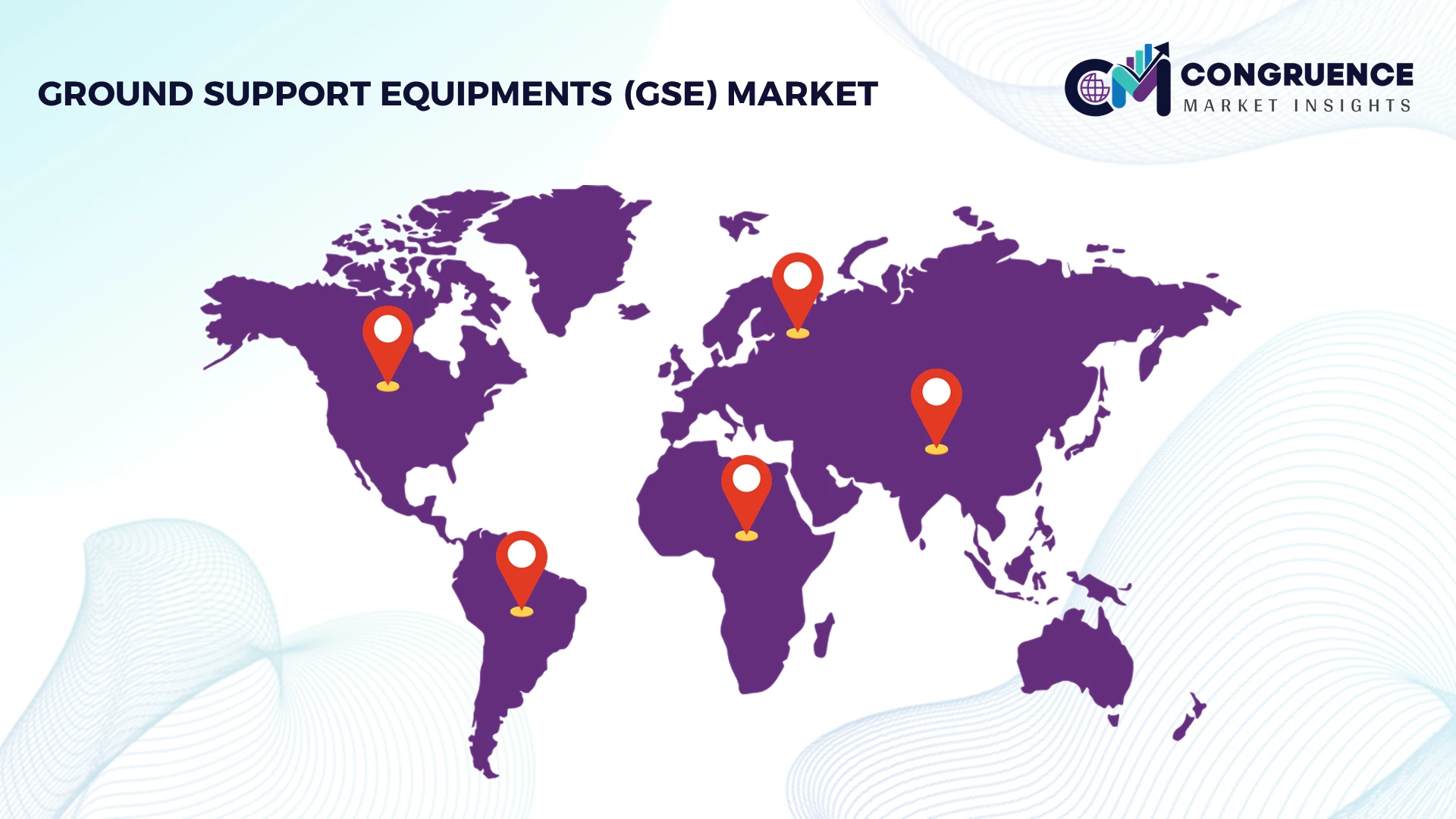
North America maintains the strongest GSE position because of its extensive airport network, high aircraft turnaround volumes, and established equipment manufacturing base. The United States represents the principal demand center, supported by large-scale airport modernization, airline fleet activity, and increasing replacement of aging diesel equipment. Electric GSE deployment is gaining traction as airports invest in charging infrastructure and lower-emission ramp operations. Major handlers are also shifting toward telematics-enabled fleets to improve asset utilization and maintenance scheduling. Canada adds demand through airport infrastructure upgrades and cold-weather equipment requirements. The region's mature maintenance ecosystem gives operators an advantage in lifecycle management, while OEMs are strengthening aftermarket services, battery platforms, and connected equipment offerings.
United States Market Outlook: The United States remains the most influential national market, supported by more than 5,000 public-use airports and a large concentration of commercial aviation activity. Major hubs are increasingly integrating electric GSE procurement with terminal and airside infrastructure projects, creating opportunities for manufacturers offering complete equipment, charging, software, and maintenance packages.
Emission Compliance Accelerates Low-Carbon GSE Replacement
Europe is undergoing a structural transition toward low-emission GSE as airports face tighter environmental requirements, urban-air-quality pressures, and noise restrictions. Germany, France, the United Kingdom, and the Netherlands are particularly important for advanced ground equipment deployment, with major airports integrating electric tractors, ground power units, baggage systems, and charging infrastructure. Electric GSE is increasingly favored for high-frequency ramp operations where lower maintenance and reduced local emissions improve lifecycle economics. Airport sustainability programs are also encouraging operators to measure equipment emissions rather than relying solely on fleet age. Manufacturers are responding with battery-electric platforms, energy-management systems, and regional service partnerships. Europe's competitive advantage is shifting from equipment volume toward compliance-ready technology and integrated airside electrification.
Germany Market Outlook: Germany combines a large industrial manufacturing base with technologically advanced airport infrastructure, creating strong demand for high-reliability GSE. Frankfurt and Munich provide major deployment centers, while German engineering capabilities support localized production, automation, power electronics, and predictive-maintenance solutions. Suppliers emphasizing energy efficiency and equipment interoperability are well positioned for airport modernization programs.
Airport Expansion Creates a High-Volume Equipment Pipeline
Asia-Pacific is the fastest-changing GSE market as India, China, Japan, South Korea, Singapore, and Southeast Asian economies expand airport capacity and modernize existing terminals. India is particularly significant because new airports and terminal expansions are increasing requirements for baggage systems, passenger boarding equipment, tractors, ground vehicles, and power units. China contributes substantial manufacturing capability and domestic equipment demand, while Japan and Singapore emphasize automation and operational precision. Electric GSE adoption is gaining momentum as new airport developments can integrate charging infrastructure during initial construction rather than retrofit it later. Manufacturers are therefore expanding regional assembly, localization, and service networks. The region's non-obvious advantage is the ability to deploy newer equipment architectures without the same legacy-fleet constraints faced by mature markets.
China Market Outlook: China combines extensive airport infrastructure with strong domestic manufacturing capabilities across vehicles, batteries, electronics, and automation components. Its large aviation network supports significant GSE deployment, while domestic suppliers can shorten equipment lead times and customize platforms for local airport requirements. Increasing automation and electrification create opportunities for integrated domestic technology ecosystems.
Fleet Renewal Targets Brazil's High-Volume Aviation Hubs
South America is led by Brazil, where major airports generate sustained requirements for aircraft towing, baggage handling, passenger boarding, servicing, and ground vehicles. Brazil's large domestic aviation network makes equipment uptime particularly important for high-frequency operations. Argentina, Chile, Colombia, and Peru provide additional demand through airport modernization and expanding international connectivity. However, financing conditions, imported component exposure, and uneven charging infrastructure can influence equipment replacement cycles. Operators are increasingly prioritizing multipurpose equipment and aftermarket support to improve asset utilization without excessive fleet expansion. Manufacturers are responding through distributor partnerships, localized maintenance capabilities, and flexible procurement structures. Electric GSE represents an emerging opportunity, particularly at newly upgraded airports where electrical infrastructure can be incorporated during modernization rather than added after deployment.
Brazil Market Outlook: Brazil is the region's strongest GSE opportunity because of its extensive airport network and concentration of commercial aviation activity. São Paulo and Rio de Janeiro serve as major equipment demand centers, while airport concession investments are supporting terminal and airside modernization. Suppliers with strong local servicing and financing capabilities have an advantage in Brazil's price-sensitive procurement environment.
Mega-Airport Investment Drives Advanced GSE Deployment
The Middle East is reshaping the regional GSE landscape through large airport expansion programs, premium passenger facilities, and high aircraft movement volumes. Saudi Arabia, the United Arab Emirates, and Qatar are prioritizing technologically advanced airports where automated baggage systems, electric vehicles, aircraft tugs, and ground power equipment support high-throughput operations. Dubai and Doha provide particularly strong deployment environments because of their international hub status. Saudi Arabia's airport and tourism infrastructure investments are creating additional procurement opportunities. Africa presents a more uneven market, with equipment demand concentrated around major aviation hubs and modernization projects. Suppliers are responding through long-term service agreements, regional partnerships, and customized equipment packages. The region increasingly rewards suppliers able to deliver rapid deployment, high-temperature reliability, and integrated maintenance support.
Saudi Arabia Market Outlook: Saudi Arabia has become a strategically important GSE market because airport expansion is being integrated with broader aviation and tourism infrastructure development. New terminal and airport projects require coordinated fleets across baggage, towing, passenger handling, and servicing. Suppliers offering high-capacity electric and automated equipment alongside local technical support can capture projects where deployment speed and lifecycle reliability are decisive.
The Ground Support Equipments (GSE) market is led by established OEMs including JBT Marel, TLD, Textron GSE, ITW GSE, and Tronair, competing with regional manufacturers and specialized technology suppliers. The top five players collectively account for approximately 30–35% of organized market activity, leaving substantial space for regional customization. Competition increasingly centers on lifecycle economics: electric platforms can reduce routine maintenance costs by 20–30%, while telematics can improve fleet utilization by 8–12%. JBT Marel and TLD emphasize broad equipment portfolios and global service networks; ITW GSE strengthens fixed-power solutions, while regional players compete through pricing and customization. Partnerships linking GSE manufacturers with battery, charging, and software providers are intensifying. The competitive shift is moving from standalone equipment sales toward integrated fleet ecosystems and recurring service models. High certification requirements, airport qualification processes, aftermarket networks, and technology investment remain major entry barriers. Winning suppliers need reliable equipment, localized service, digital integration, and scalable electrification capabilities.
JBT Marel
TLD
Textron GSE
ITW GSE
Tronair
Mallaghan Engineering
Goldhofer
MULAG Fahrzeugwerk
Weihai Guangtai
Kalmar
Vestergaard Company
Cavotec
Charlatte America
Nandan GSE
Current GSE technology centers on battery-electric drivetrains, telematics, and intelligent power management. Electric systems cut turnaround emissions 35–52%, while telematics improves maintenance visibility. TLD reports electric equipment at 60% of sales, giving electrification-focused OEMs a competitive advantage entering 2026–2028. Procurement is shifting toward lifecycle efficiency metrics.
Emerging automation combines proximity sensors, guided docking, cloud diagnostics, and autonomous-ready controls. Enhanced GSE adoption is accelerating: IATA received more than 450 applications and validated 187 stations by 2026. This shifts value toward safer, data-rich equipment, benefiting suppliers integrating hardware, software, and standards. Safety now directly influences equipment specification decisions.
Disruptive gate technologies coordinate GPUs, chargers, PCA units, and electric GSE through shared power-management platforms. ITW GSE expanded European production capacity 50% in 2025, signaling industrial scaling. Compared with standalone equipment, integrated systems improve power utilization and reduce infrastructure bottlenecks, strengthening full-system suppliers. Airports can therefore phase electrification without major disruption.
From 2026–2028, modular electric platforms, predictive maintenance, remote operation, and autonomous interfaces will become purchasing differentiators. Goldhofer’s modular ATLAS 2 supports remote-control configuration and aircraft coverage up to 352 tonnes. Early adopters gain fleet flexibility, lower downtime, and faster technology upgrades without replacing complete platforms. Integrated suppliers capture greater value from modernization cycles.
July 2025 ITW GSE expanded European production capacity by 50% and added 3,000 square meters of storage, strengthening supply responsiveness and reducing logistics bottlenecks as sustainable GPU and PCA demand increased for airport customers across Europe and international markets globally. Source: ITW GSE
2025 TLD reported electric GSE represented 60% of sales and confirmed plans to stop offering commercial internal-combustion GSE by year-end, accelerating portfolio electrification and reinforcing its zero-emission positioning while further reducing dependence on diesel equipment and supporting sustainable fleet transitions. Source: TLD Group
September 2025 Goldhofer unveiled the all-electric ATLAS 2, covering aircraft up to 352 tonnes and offering remote-operation configuration, giving airports a modular pushback solution that improves safety, flexibility, and workforce efficiency across gates where maneuverability and guided operation are critical. Source: Goldhofer
May 2026 IATA reported more than 450 Enhanced GSE applications, 187 validated stations, and 75 recognized stations, demonstrating rapid adoption of anti-collision technology and strengthening standardized safety requirements for ground handlers as handlers strengthen risk controls and fleet standardization requirements. Source: IATA
The Ground Support Equipments (GSE) Market Report covers five equipment categories: Passenger Boarding Equipment, Baggage Handling Equipment, Aircraft Ground Power Units, Aircraft Tugs & Tractors, and Ground Support Vehicles. It evaluates demand across Passenger Handling, Baggage Handling, Aircraft Servicing, Cargo Handling, and Aircraft Maintenance, alongside Commercial Airlines, Airports, Ground Handling Companies, Cargo Airlines, and Military Air Bases. Regional coverage spans North America, Europe, Asia-Pacific, South America, and the Middle East & Africa.
The report assesses electrification, telematics, intelligent power management, autonomous-ready equipment, safety sensors, battery systems, and integrated gate infrastructure, emphasizing deployment maturity and operational use cases. It profiles 14 companies and compares procurement priorities, localization, partnerships, product innovation, and service models. The analysis supports investment planning, market entry, geographic expansion, technology prioritization, competitive positioning, and fleet modernization through 2026–2033, while identifying opportunities in automation, low-emission operations, and connected GSE ecosystems.
| Report Attribute/Metric | Report Details |
|---|---|
Market Revenue in 2025 | USD 9600 Million |
Market Revenue in 2033 | USD 15911.84 Million |
CAGR (2026 - 2033) | 6.52% |
Base Year | 2025 |
Forecast Period | 2026 - 2033 |
Historic Period | 2021 - 2025 |
Segments Covered | By Type
By Application
By End-User
|
Key Report Deliverable | Revenue Forecast, Growth Trends, Market Dynamics, Segmental Overview, Regional and Country-wise Analysis, Competition Landscape |
Region Covered | North America, Europe, Asia-Pacific, South America, Middle East, Africa |
Key Players Analyzed | JBT Marel, TLD, Textron GSE, ITW GSE, Tronair, Mallaghan Engineering, Goldhofer, MULAG Fahrzeugwerk, Weihai Guangtai, Kalmar, Vestergaard Company, Cavotec, Charlatte America, Nandan GSE |
Customization & Pricing | Available on Request (10% Customization is Free) |




