
Reports
The Global Grid Enhancing Technologies Market was valued at USD 3250 Million in 2025 and is anticipated to reach a value of USD 9668.52 Million by 2033 expanding at a CAGR of 14.6% between 2026 and 2033. Growth is driven by transmission congestion, data-center load additions, renewable interconnection queues, dynamic line rating deployment, advanced power-flow control, and high-capacity reconductoring.
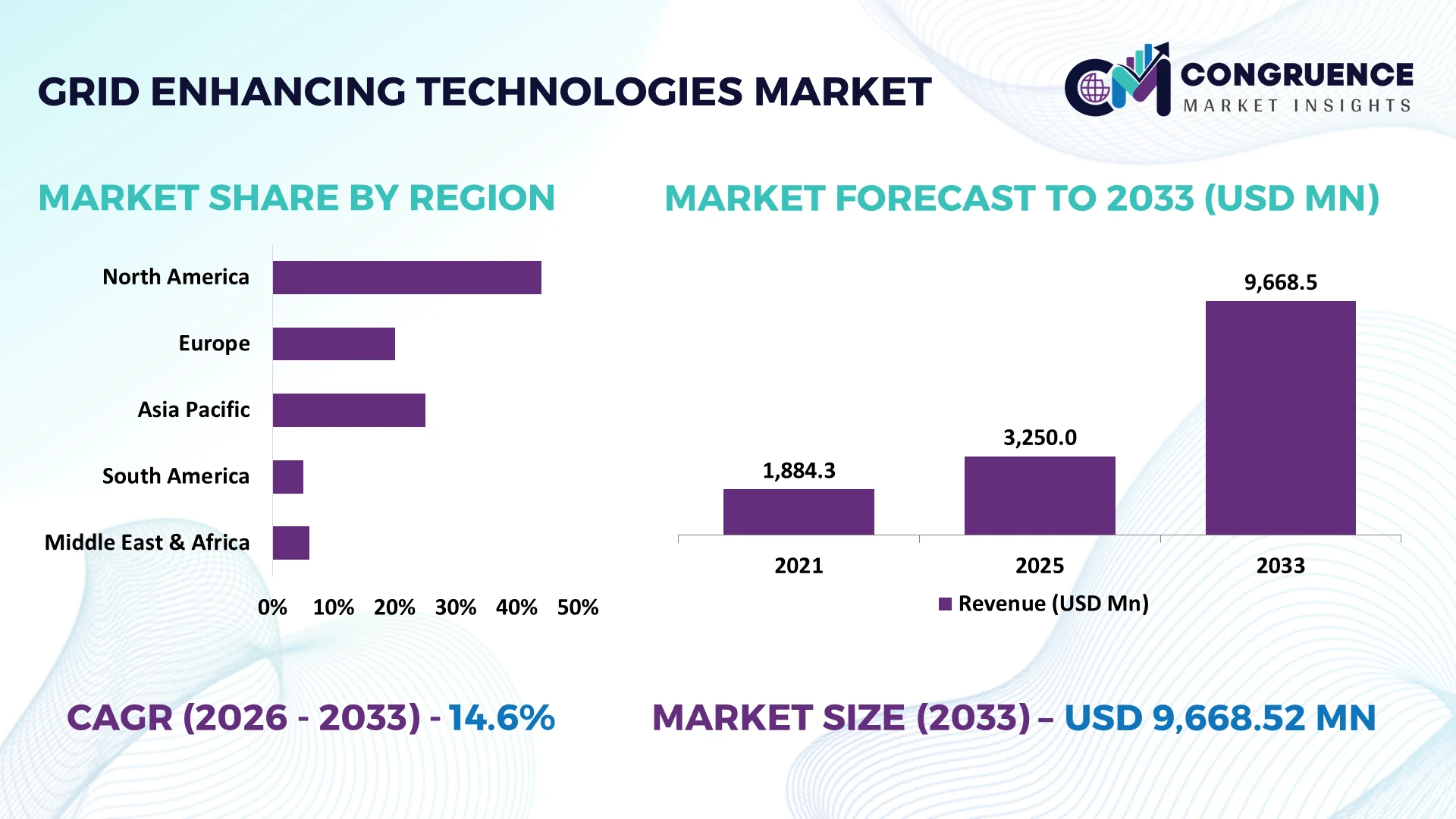
The United States dominates deployment momentum, accounting for an estimated 35% of global Grid Enhancing Technologies activity, supported by utilities, data centers, renewable developers, and industrial electrification. U.S. data centers consumed 4.4% of national electricity in 2023 and are projected to reach as much as 12% by 2028. Oncor demonstrated 6–14% transmission-capacity gains using dynamic line rating, while the UK deployed DLR across 275+ kilometers of National Grid circuits. FERC Order 1920 further embeds GETs into long-term U.S. transmission planning.
Strategic implication: utilities should prioritize high-congestion corridors where dynamic ratings, power-flow control, and advanced conductors unlock capacity faster than conventional transmission expansion.
Market Size & Growth: USD 3250 million in 2025 advances to USD 9668.52 million by 2033 at 14.6% CAGR, driven by transmission-capacity optimization and accelerated electrification.
Top Growth Drivers: Data centers approach 12% of U.S. electricity consumption by 2028, DLR unlocks up to 50% additional line capacity, and renewable interconnection pressure intensifies grid utilization.
Short-Term Forecast: By 2028, optimized dynamic ratings can deliver 10–30% practical capacity improvements on suitable constrained transmission corridors without constructing entirely new lines.
Emerging Technologies: Dynamic line rating, advanced power-flow control, topology optimization, AI-based grid analytics, and advanced conductors are moving from demonstration projects toward utility-scale transmission planning.
Regional Leaders: North America approaches USD 3.6 billion, Europe USD 2.8 billion, and Asia-Pacific USD 2.5 billion by 2033, supported respectively by DLR, renewable integration, and transmission modernization.
Consumer/End-User Trends: U.S. data-center electricity consumption rises from 4.4% in 2023 toward 12% by 2028, forcing utilities to extract additional capacity from existing transmission infrastructure.
Pilot/Case Example: Oncor demonstrated 6–14% transmission-capacity improvement through DLR, while Duquesne Light achieved a 25% capacity increase, validating measurable benefits from real-time conductor monitoring.
Competitive Landscape: GE Vernova, Siemens Energy, Hitachi Energy, LineVision, and Smart Wires compete across advanced power-flow control, grid monitoring, analytics, and transmission optimization technologies.
Regulatory & ESG Impact: FERC Order 1920 requires U.S. transmission planners to evaluate 4 alternative technologies—DLR, advanced power-flow control, advanced conductors, and transmission switching—during long-term planning.
Investment & Funding: The U.S. announced approximately USD 1.9 billion in 2026 for accelerated reconductoring and advanced transmission upgrades, strengthening commercialization of capacity-enhancing grid technologies.
Innovation & Future Outlook: DLR can expose up to 50% additional transmission capability under favorable conditions, shifting utility investment toward sensor-driven, dynamic grid operation before capital-intensive greenfield construction.
The Grid Enhancing Technologies Market is shifting transmission investment toward extracting more capacity from installed infrastructure before constructing new corridors. Dynamic line ratings, advanced conductors, power-flow controllers, topology optimization, and AI-enabled grid analytics are gaining priority across renewable interconnections, data-center hubs, and congested utility networks. DLR deployments have demonstrated 6–25% capacity improvements in operating U.S. networks, while FERC’s transmission-planning framework now requires consideration of advanced alternatives. This combination of load acceleration, regulatory change, and digital grid control establishes the foundation for the market’s strategic evolution.
Grid Enhancing Technologies are becoming strategic infrastructure as utilities face transmission congestion, renewable interconnection backlogs, and rapidly rising data-center loads. U.S. data centers consumed 4.4% of national electricity in 2023 and are tracking toward 6.7–12% by 2028, increasing pressure to unlock existing transmission capacity. FERC Order 1920 reinforces this shift by requiring evaluation of dynamic line ratings, advanced conductors, power-flow control, and transmission switching in long-term planning.
Dynamic line rating can unlock 10–30% practical capacity on suitable corridors, versus static ratings based on conservative weather assumptions. This allows utilities to defer selected conventional upgrades while accelerating renewable and large-load connections. The United States is advancing regulatory integration, while Europe has established multi-country deployments and Asia-Pacific remains focused on large-scale grid expansion. Over 2026–2028, sensor-based monitoring and topology optimization will increasingly enter transmission planning.
Oncor demonstrated 6–14% capacity gains through dynamic ratings, validating deployment under operating conditions. Utilities are expanding pilots, technology vendors are integrating sensors with analytics platforms, and developers are forming transmission partnerships. Competitive advantage will favor companies that convert existing grid infrastructure into flexible, measurable capacity faster than conventional expansion permits.
Rapid electrification is forcing utilities to extract more capacity from existing transmission corridors. U.S. data centers consumed 4.4% of electricity in 2023 and could reach 6.7–12% by 2028, while renewable interconnection queues contain more than twice the country’s installed generating capacity. Dynamic line rating can provide 10–30% additional usable capacity on suitable lines by replacing conservative static assumptions with real-time conductor and weather data. FERC Order 1920 has strengthened the structural shift by requiring planners to consider advanced transmission technologies. Utilities are responding with DLR pilots, advanced conductor deployments, topology optimization, and power-flow controllers. The strategic advantage is speed: capacity released from existing corridors can accommodate new generation and loads before lengthy greenfield transmission projects are completed.
Grid Enhancing Technologies must operate across transmission systems built with different protection schemes, telemetry standards, communication networks, and asset ages. Approximately 70% of U.S. transmission lines are more than 25 years old, while power transformers have average lead times extending beyond two years, increasing integration and replacement constraints. DLR can unlock 10–30% capacity, but realizing that benefit requires dependable sensors, communications, forecasting, and control-room integration. Utilities therefore face additional engineering expenditure before deploying GETs consistently across heterogeneous networks. Equipment supply constraints following global transformer shortages further complicate modernization schedules. Operators are reducing exposure through phased deployments, vendor qualification, standardized interfaces, and long-term equipment agreements. The key limitation is not technology availability but integrating advanced controls reliably into legacy infrastructure without compromising protection coordination or system reliability.
Data-center clusters create a targeted opportunity for Grid Enhancing Technologies because concentrated loads require capacity faster than conventional transmission can typically be permitted and constructed. U.S. data-center electricity consumption could reach 6.7–12% of national demand by 2028, while DLR can unlock 10–30% practical capacity on suitable constrained corridors. Advanced reconductoring can approximately double line capacity in selected applications without acquiring entirely new rights-of-way. Virginia, Texas, and other high-load states therefore offer attractive deployment environments for sensors, advanced conductors, topology optimization, and power-flow controllers. Vendors are developing integrated hardware-software platforms and partnering with utilities and large-load developers. The non-obvious opportunity lies in connection acceleration: GETs can become a commercial tool for shortening energization timelines for AI infrastructure, industrial electrification, storage, and renewable generation.
Scaling GETs transforms transmission assets into increasingly software-dependent infrastructure, creating cybersecurity, data-quality, workforce, and interoperability challenges beyond conventional grid engineering. Dynamic ratings can increase usable capacity by 10–30%, but operating closer to real-time thermal limits makes sensor accuracy and communications availability operationally critical. U.S. electricity demand is expected to rise approximately 16% between 2023 and 2028, increasing the consequences of erroneous forecasts or unavailable control systems during peak conditions. Utilities must integrate field sensors, weather feeds, EMS platforms, topology optimization, and protection systems while maintaining stringent reliability standards. Companies are investing in redundant communications, cybersecurity controls, predictive diagnostics, workforce training, and interoperable software architectures. Long-term competitiveness depends on proving that dynamic capacity can remain dependable during extreme weather, equipment failures, cyber incidents, and rapidly changing power flows.
Dynamic Ratings Enter Utility Operations: Utilities are shifting DLR from pilots into transmission operations as field deployments demonstrate approximately 6–25% capacity improvements, with favorable conditions producing substantially higher dynamic headroom. FERC transmission-planning requirements are reinforcing evaluation of advanced technologies. Vendors are integrating weather stations, conductor sensors, forecasting algorithms, and control-room software, allowing operators to replace fixed seasonal ratings with continuously calculated limits and improve utilization without rebuilding corridors.
Advanced Conductors Accelerate Reconductoring: High-performance conductors are moving into capacity-upgrade programs because selected advanced designs can provide up to 100% more transmission capacity while using existing rights-of-way. This approach addresses permitting constraints and transformer supply pressure while avoiding entirely new corridors. U.S. utilities are expanding conductor qualification and procurement programs, while manufacturers are increasing production capability. The operational shift makes reconductoring a capacity strategy rather than routine asset replacement.
Power Flow Becomes Controllable: Advanced power-flow controllers are transforming transmission routing from passive network behavior toward actively managed capacity. Modular systems can redirect hundreds of megawatts between parallel lines and improve utilization of underloaded circuits while relieving constrained paths. Utilities increasingly combine these devices with DLR and network analytics rather than deploying technologies independently. Suppliers are responding through modular platforms and utility partnerships, reducing installation complexity and enabling phased deployment around congestion hotspots.
Topology Optimization Gains Digital Role: Grid operators are increasingly using topology optimization to identify alternative switching configurations before committing to physical upgrades. Software-based approaches can evaluate thousands of network configurations and identify congestion-relieving actions using existing assets. Integration with energy-management systems, advanced sensors, and forecasting is strengthening operational applicability. The non-obvious shift is economic: transmission switching converts network configuration itself into a controllable capacity resource, pushing vendors toward interoperable analytics and automated decision-support platforms.
Dynamic Line Rating leads the type segment with an estimated 30–35% market share, supported by comparatively fast deployment, compatibility with existing transmission corridors, and measurable capacity improvement. DLR systems use conductor temperature, sag, wind, and ambient conditions to replace conservative static ratings with real-time limits, delivering approximately 10–30% practical capacity gains on suitable lines. Advanced Conductors represent a more capital-intensive alternative but can approximately double capacity during reconductoring, making them attractive where existing structures and rights-of-way can be retained.
Advanced Power Flow Controls represent the fastest-growing type as utilities seek active control over electricity routing rather than simply increasing thermal limits. Grid-Enhancing Power Flow technologies redirect power from overloaded paths toward available capacity, while Topology Optimization uses network switching and software analytics to relieve constraints without major physical construction. Vendors are consequently combining DLR sensors, power-flow controllers, and optimization software into integrated portfolios. Investment priorities are shifting from isolated devices toward coordinated transmission-capacity platforms capable of addressing thermal, routing, and network-configuration constraints simultaneously.
Transmission Capacity leads applications with an estimated 35–40% share because utilities increasingly need additional transfer capability without waiting for new transmission corridors. Dynamic ratings can provide approximately 10–30% practical capacity gains, while advanced reconductoring can deliver capacity increases approaching 100% in suitable installations. Congestion Management remains a mature application, using power-flow control and topology optimization to redistribute electricity away from overloaded elements and reduce renewable curtailment. Voltage Management complements these systems where changing generation and load patterns increase network-control requirements.
Renewable Integration is the fastest-growing application as wind, solar, and storage projects encounter constrained transmission and lengthy interconnection queues. More than twice existing U.S. generation capacity has been represented in interconnection queues, making transmission utilization increasingly critical to project economics. Grid Resilience is also strengthening as operators deploy real-time monitoring and controllable network technologies against extreme-weather disruptions. Suppliers are adapting by integrating sensors, analytics, dynamic ratings, and power-flow controls, allowing utilities to address capacity, congestion, resilience, and renewable interconnection through coordinated deployment strategies.
Transmission Operators lead end-user demand with an estimated 45–50% share because they control the high-voltage assets where congestion, thermal constraints, renewable interconnections, and reliability requirements directly determine GET deployment. Their operating scale supports combinations of DLR, advanced conductors, topology optimization, and power-flow controls rather than isolated technologies. Distribution Utilities represent a smaller but increasingly relevant segment where distributed generation and electrification create localized network constraints. Independent Power Producers primarily benefit indirectly through improved interconnection capacity and lower curtailment exposure.
Renewable Energy Developers are the fastest-growing end-user group as grid access increasingly determines whether generation projects reach commercial operation. U.S. interconnection queues contain generation and storage capacity exceeding twice installed generating capacity, while DLR can unlock approximately 10–30% practical headroom on suitable constrained lines. Industrial Power Users are also becoming strategically important around data-center and manufacturing clusters. Technology companies are targeting these buyers through utility partnerships, corridor-specific engineering, performance-based deployment models, and integrated monitoring platforms that connect additional capacity directly with project interconnection requirements.
North America accounted for the largest market share at 38.4% in 2025 however, Asia-Pacific is expected to register the fastest growth, expanding at a CAGR of 16.8% between 2026 and 2033.

Transmission Bottlenecks Accelerate Dynamic Grid Deployment
North America held approximately 38.4% of the market in 2025, supported by extensive transmission infrastructure, renewable interconnection congestion, data-center expansion, and early deployment of dynamic line rating and advanced power-flow controls. U.S. transmission operators increasingly evaluate GETs before committing to new corridors, particularly after FERC Order 1920 strengthened consideration of advanced conductors, DLR, power-flow control, and transmission switching. Operational deployments have demonstrated roughly 6–25% additional transfer capacity on constrained lines. Canada adds demand through interprovincial transmission modernization and expanding renewable generation. Utilities are integrating conductor sensors, weather analytics, topology optimization, and energy-management systems, while technology suppliers are partnering directly with grid operators. The critical shift is from demonstration projects toward portfolio-level deployment where multiple technologies address thermal and power-flow constraints together.
United States Market Outlook: The United States combines large-scale transmission infrastructure with exceptional load pressure from data centers, manufacturing, electrification, and renewable interconnections. Data centers accounted for 4.4% of U.S. electricity consumption in 2023 and could reach 6.7–12% by 2028. Utilities are therefore prioritizing advanced reconductoring, dynamic ratings, and controllable power-flow technologies around high-load corridors.
Cross-Border Networks Shift Toward Dynamic Capacity
Europe accounted for approximately 27.5% of market activity in 2025, supported by offshore wind integration, cross-border electricity trading, aging transmission corridors, and stringent network-efficiency requirements. Germany, the United Kingdom, the Netherlands, Spain, and Nordic countries are deploying digital monitoring and higher-capacity conductors as renewable generation changes traditional power-flow patterns. National Grid has applied dynamic line rating across more than 275 kilometers of transmission infrastructure, demonstrating operational movement beyond small-scale pilots. European transmission operators are also combining weather forecasting, digital substations, network analytics, and flexible power-flow management to improve utilization of existing assets. Offshore wind connections create particular demand because generation frequently enters networks far from major consumption centers. Suppliers are responding through utility partnerships and integrated hardware-software platforms, while grid operators increasingly treat transmission flexibility as an alternative to selected conventional reinforcement projects.
United Kingdom Market Outlook: The United Kingdom provides a strong deployment environment because offshore wind expansion must be integrated through an increasingly constrained transmission system. National Grid’s deployment of dynamic ratings across more than 275 kilometers demonstrates operational acceptance. Grid modernization is increasingly combining real-time asset monitoring, advanced conductors, network optimization, and coordinated transmission planning to accelerate renewable connections.
Grid Expansion Meets Digital Optimization at Scale
Asia-Pacific represented approximately 24.0% of the market in 2025, with China, India, Japan, South Korea, and Australia combining major transmission expansion with digital-grid modernization. China operates the world’s largest electricity network and continues extending ultra-high-voltage corridors while integrating large renewable-generation bases located far from coastal demand centers. India is simultaneously expanding interstate transmission to accommodate its target of 500 GW non-fossil electricity capacity by 2030. Australia provides a different deployment case, where long transmission distances and renewable-energy zones strengthen the economics of dynamic ratings and advanced conductors. Technology adoption increasingly combines sensors, AI-enabled network analytics, high-capacity conductors, and flexible power-flow control. Manufacturers are expanding domestic equipment capacity and utilities are digitizing asset management, creating opportunities for GET suppliers that can integrate optimization technologies with new-build transmission programs rather than treating them as retrofit-only solutions.
China Market Outlook: China’s advantage comes from exceptional transmission scale, domestic electrical-equipment manufacturing, and extensive ultra-high-voltage deployment. Renewable bases in western and northern provinces require electricity transfer over thousands of kilometers toward eastern load centers. Advanced conductors, digital monitoring, automated dispatch, and topology optimization therefore complement physical grid expansion by improving utilization across an increasingly complex national transmission network.
Renewable Corridors Drive Transmission Optimization
South America accounted for approximately 5.8% of the market in 2025, with Brazil and Chile providing the strongest deployment rationale through geographically concentrated wind, solar, and hydropower resources. Brazil derives more than 80% of electricity generation from renewable sources, creating long-distance transmission requirements between generation centers and major southeastern load hubs. Chile faces pronounced congestion between northern solar resources and central consumption centers, increasing the operational value of advanced conductors, monitoring, and power-flow optimization. Utilities are prioritizing transmission reinforcement alongside digital asset-management systems, while technology suppliers are pursuing partnerships with local grid operators. Deployment remains constrained by permitting timelines, capital availability, and extensive transmission distances. Consequently, GETs have particular value where existing rights-of-way can support reconductoring or dynamic operation before completely new corridors become available.
Brazil Market Outlook: Brazil combines continental-scale transmission infrastructure with substantial hydro, wind, and solar generation, making network utilization strategically important. Renewable electricity exceeds 80% of generation, while new wind and solar projects increasingly alter power flows across the interconnected system. Advanced conductors, digital monitoring, and topology optimization can strengthen transfer capability between resource-rich northern and northeastern states and southeastern demand centers.
Renewable Megaprojects Accelerate Grid Modernization
Middle East & Africa represented approximately 4.3% of market activity in 2025, led by transmission modernization in Saudi Arabia, the UAE, South Africa, and selected North African electricity systems. Saudi Arabia’s renewable procurement and industrial expansion are creating new transmission flows between large solar and wind projects and urban-industrial load centers. South Africa presents a different requirement: substantial renewable projects remain concentrated in areas where transmission capacity is limited, making network expansion and enhanced utilization operational priorities. Utilities are introducing digital substations, advanced monitoring, automated control, and higher-capacity transmission equipment as part of wider modernization programs. GET deployment remains selective because several African networks require fundamental transmission investment before sophisticated optimization technologies achieve scale. Suppliers are therefore targeting financially stronger utilities and renewable corridors where measurable congestion relief supports investment economics.
Saudi Arabia Market Outlook: Saudi Arabia offers the region’s strongest modernization platform through large renewable projects, industrial electrification, and expansion of its national transmission network. The country targets approximately 50% of electricity generation from renewable sources by 2030. Digital grid monitoring, advanced conductors, and power-flow optimization are becoming increasingly relevant for connecting geographically dispersed generation with Riyadh and major industrial clusters.
GE Vernova, Siemens Energy, Hitachi Energy, LineVision, Smart Wires, and TS Conductor compete across grid monitoring, advanced conductors, power-flow control, and digital optimization, with diversified grid OEMs challenging specialized GET innovators through integration scale. The top five participants collectively represent an estimated 40–45% of organized market activity. Competition centers on capacity uplift, deployment speed, interoperability, and lifecycle economics: DLR can unlock 10–30% practical capacity, while advanced reconductoring can deliver approximately 100% capacity improvement on suitable corridors. Specialists compete through focused sensor, conductor, or controller innovation; established OEMs bundle GET capabilities with substations, automation, and transmission equipment. Partnerships with utilities and transmission operators accelerate qualification and commercial deployment. Competition is shifting toward integrated portfolios combining hardware, analytics, forecasting, and network control. Lengthy utility qualification, cybersecurity requirements, grid-code compliance, and proven field reliability remain substantial entry barriers. Winning requires verified capacity gains, seamless control-system integration, bankable reliability, and rapid deployment at utility scale.
GE Vernova
Siemens Energy
Hitachi Energy
LineVision
Smart Wires
TS Conductor
CTC Global
Heimdall Power
Lindsey Systems
Ampacimon
WindSim Power
NewGrid
Prisma Photonics
Nexans
Current Grid Enhancing Technologies combine dynamic line rating sensors, advanced conductors, power-flow controllers, topology optimization, weather analytics, and SCADA integration. Dynamic ratings replace conservative static assumptions with real-time conductor and weather conditions, unlocking roughly 10–40% additional usable capacity on suitable lines. Advanced conductors can approximately double corridor capacity during reconductoring, allowing utilities to increase transfer capability without acquiring new rights-of-way or constructing entirely new transmission routes.
Emerging deployments integrate physical sensors with virtual sensing, AI forecasting, autonomous drone installation, and coordinated power-flow software. Compared with legacy static line ratings, DLR can improve available capacity by 25% in demonstrated utility deployments, while drone-installed sensors can be mounted on energized lines in under 10 seconds, avoiding outages. Adoption is moving beyond trials: individual European DLR programs exceed 100 sensors, while U.S. projects now span 100 miles of transmission infrastructure.
Through 2026–2028, disruptive value will come from combining DLR, topology optimization, advanced power-flow controls, and predictive asset analytics within control-room workflows. Transmission operators and technology vendors offering interoperable hardware-software platforms gain the strongest advantage because coordinated GET portfolios monetize unused network capacity. Utilities should act now to standardize data interfaces, cybersecurity controls, and operational procedures before deployment scales across critical corridors at scale.
September 2024 Smart Wires delivered SmartValve advanced power-flow controls with ISA TRANSELCA across five 220 kV circuits in Colombia, unlocking more than 300 MW of transmission capacity and enabling connection of 1.5 GW of approved wind and solar generation. Source: smartwires.com
March 2025 LineVision and Duquesne Light expanded dynamic line rating deployment under a USD 19.7 million grid-modernization program after earlier installations demonstrated up to 25% transmission-capacity improvement, increasing flexibility for renewable generation connections across the Pittsburgh electricity network. Source: duquesnelight.com
June 2025 National Grid deployed LineVision dynamic line rating technology across more than 275 kilometers of British transmission lines, targeting additional capacity sufficient for 75,000 homes annually while reducing network constraints and improving utilization of existing overhead infrastructure. Source: nationalgrid.com
January 2026 Heimdall Power installed 31 Neuron sensors across Entergy transmission lines in Louisiana, Texas, and Arkansas, including a U.S. record 14 sensors installed in one day using drones, enabling DLR deployment without outages or bucket trucks. Source: heimdallpower.com
The report evaluates Grid Enhancing Technologies across Dynamic Line Rating, Advanced Conductors, Grid-Enhancing Power Flow, Advanced Power Flow Controls, and Topology Optimization. Application coverage includes Transmission Capacity, Congestion Management, Renewable Integration, Grid Resilience, and Voltage Management, while end-user analysis covers Transmission Operators, Distribution Utilities, Renewable Energy Developers, Independent Power Producers, and Industrial Power Users. North America held approximately 38% of 2025 market activity, with Asia-Pacific showing accelerating deployment momentum.
Technology coverage examines real-time conductor monitoring, AI-enabled forecasting, advanced reconductoring, power-flow controllers, topology optimization, autonomous sensor deployment, and SCADA integration. The report evaluates North America, Europe, Asia-Pacific, South America, and Middle East & Africa, identifying high-congestion and renewable-intensive corridors. Its 2026–2033 framework supports investment planning, technology procurement, utility partnerships, geographic expansion, competitive positioning, and deployment prioritization across increasingly digital transmission networks.
| Report Attribute/Metric | Report Details |
|---|---|
Market Revenue in 2025 | USD 3250 Million |
Market Revenue in 2033 | USD 9668.52 Million |
CAGR (2026 - 2033) | 14.6% |
Base Year | 2025 |
Forecast Period | 2026 - 2033 |
Historic Period | 2021 - 2025 |
Segments Covered | By Type
By Application
By End-User
|
Key Report Deliverable | Revenue Forecast, Growth Trends, Market Dynamics, Segmental Overview, Regional and Country-wise Analysis, Competition Landscape |
Region Covered | North America, Europe, Asia-Pacific, South America, Middle East, Africa |
Key Players Analyzed | GE Vernova, Siemens Energy, Hitachi Energy, LineVision, Smart Wires, TS Conductor, CTC Global, Heimdall Power, Lindsey Systems, Ampacimon, WindSim Power, NewGrid, Prisma Photonics, Nexans |
Customization & Pricing | Available on Request (10% Customization is Free) |




