
Reports
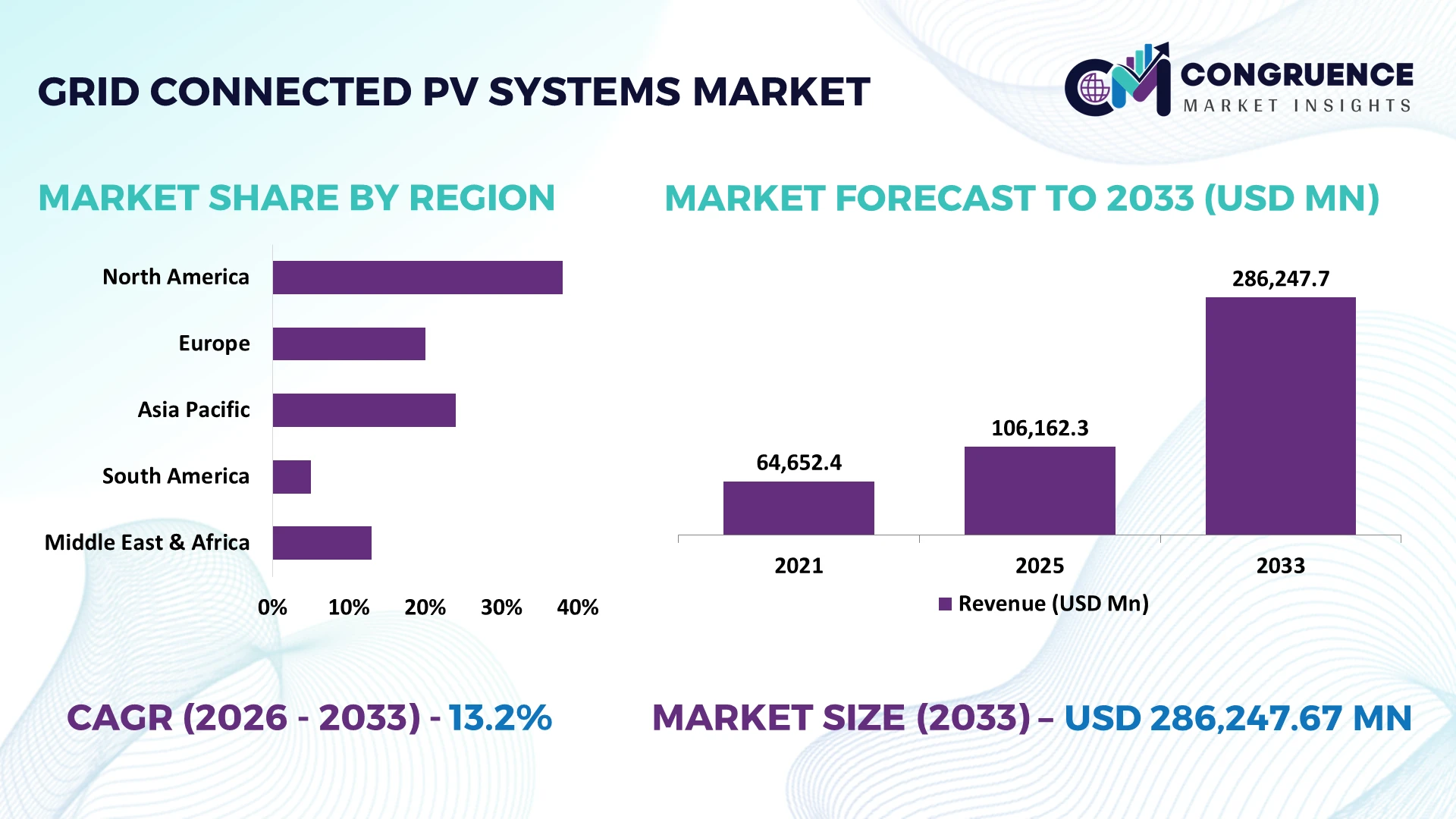
The Global Grid Connected PV Systems Market was valued at USD 106162.3 Million in 2025 and is anticipated to reach a value of USD 286247.67 Million by 2033 expanding at a CAGR of 13.2% between 2026 and 2033. Growth is driven by the transition toward high-efficiency N-type TOPCon and bifacial modules, utility-scale solar-plus-storage integration, and grid-modernization investments that enable higher renewable electricity penetration.
China dominates the global grid-connected PV landscape, accounting for approximately 60% of worldwide new solar installations in 2025, with nearly 370 GW of solar capacity additions. Its extensive manufacturing ecosystem across wafers, cells, modules, and inverters reinforces its competitive advantage in equipment supply and project deployment. India, by comparison, added approximately 50 GW of solar PV capacity in 2025, reflecting accelerating utility-scale procurement and industrial solar adoption. China's deployment volume was more than seven times India's, while India's expansion demonstrates the growing importance of South Asian markets. China's June 2025 transition from fixed tariffs to competitive renewable energy auctions further reshaped project commissioning strategies.
Strategic implication: Investors and technology suppliers should prioritize China's manufacturing and utility-scale ecosystem while expanding into India's rapidly scaling project pipeline, with grid connectivity, storage readiness, and domestic sourcing requirements shaping investment selection.
Market Size & Growth: The market advances from USD 106.16 billion in 2025 to USD 286.25 billion by 2033 at 13.2% CAGR, supported by TOPCon adoption and utility-scale solar-plus-storage deployment.
Top Growth Drivers: Asia-Pacific holds 59.4% market share; utility-scale systems account for 58.4%; solar modules represent 51.2% of component revenue.
Short-Term Forecast: By 2027, solar module prices retain a substantially lower cost base, following a 50% decline since 2023, strengthening procurement economics for developers.
Emerging Technologies: TOPCon, bifacial modules, AI-powered forecasting, automated monitoring, and hybrid inverters strengthen conversion efficiency, asset utilization, and grid stability.
Regional Leaders: Asia-Pacific leads with 59.4% market share, Europe records the fastest projected regional growth, and North America remains a major utility-scale deployment market.
Consumer/End-User Trends: Utility-scale applications command 56.5% of end-user revenue, while commercial and industrial users increasingly prioritize onsite generation and energy-cost control.
Pilot/Case Example: India's 2025 PM Surya Ghar programme recorded 11.05 lakh completed installations and 3.3 GW of installed rooftop capacity, demonstrating measurable residential grid-connected adoption.
Competitive Landscape: Huawei and Sungrow jointly controlled approximately 55% of global PV inverter shipments in 2024, competing with SMA, Enphase, and major integrated solar suppliers.
Regulatory & ESG Impact: India's USD 9 billion-equivalent PM Surya Ghar allocation supports 10 million households, targeting 30 GW of residential rooftop capacity by FY2026–27.
Investment & Funding: Global solar investment is projected at USD 450 billion in 2025, reinforcing utility-scale development, rooftop deployment, battery integration, and manufacturing expansion.
Innovation & Future Outlook: Solar-plus-storage, smart inverters, grid-forming capabilities, and AI-based predictive maintenance are shifting competition toward dispatchable generation and lifecycle performance.
The grid-connected PV systems market is gaining traction across utility-scale solar parks, commercial and industrial rooftops, residential installations, and hybrid solar-plus-storage projects. Demand is particularly strong for high-efficiency TOPCon modules, bifacial panels, smart inverters, and advanced grid-monitoring solutions. Bifacial modules accounted for approximately 90% of global shipments in 2024, reflecting their growing role in improving generation yields. Meanwhile, China's manufacturing concentration and evolving international trade policies are reshaping procurement strategies. The emerging market trend is the integration of battery storage and intelligent grid management, making system flexibility and operational reliability central to investment decisions.
Grid-connected PV systems are becoming strategically important as electricity-intensive industries, utilities, and governments compete to secure affordable, low-carbon power while reducing exposure to fossil-fuel price volatility. China's dominance in solar manufacturing and India's expansion of domestic solar production are reshaping procurement strategies. China's June 2025 renewable electricity pricing reform also accelerated the shift toward competitive power procurement, increasing the importance of project-level efficiency, grid access, and power-purchase agreements.
Technology selection is increasingly influencing project economics. Modern TOPCon modules achieve approximately 22–23% commercial conversion efficiency, compared with roughly 20–21% for conventional PERC modules, improving generation density and land utilization. China leads in manufacturing scale, while India emphasizes domestic manufacturing, utility-scale installations, and rooftop electrification. These differences create distinct opportunities for equipment manufacturers, EPC contractors, and technology integrators.
Over the next 2–3 years, battery-coupled installations, smart inverters, and automated performance monitoring will become increasingly important procurement criteria. India's solar park developments demonstrate how developers combine centralized generation with transmission infrastructure and long-term power agreements. Companies are responding through localized manufacturing, inverter innovation, storage partnerships, and integrated project development. Competitive advantage will increasingly depend on delivering higher generation yields, reliable grid integration, and predictable lifecycle costs rather than simply expanding installed capacity.
The transition toward renewable electricity procurement is accelerating grid-connected PV deployment across manufacturing, data centers, and industrial infrastructure. Solar PV supplied approximately 8% of global electricity in 2023, establishing a stronger position in utility power portfolios. Modern TOPCon modules deliver approximately 22–23% commercial efficiency, improving output per installed megawatt compared with conventional PERC technology. India's renewable procurement programmes and China's manufacturing expansion reinforce this structural shift. Developers are prioritizing high-efficiency modules, larger project pipelines, and solar-plus-storage configurations. Equipment manufacturers are responding through domestic production expansion, technology partnerships, and integrated inverter solutions to strengthen project economics and supply reliability.
Excess manufacturing capacity and concentrated component sourcing are creating pricing and procurement pressures. Global solar module manufacturing capacity reached approximately 1,100–1,350 GW in 2024, exceeding twice the annual deployment requirement. China controls approximately 95% of global wafer manufacturing capacity, exposing international buyers to concentrated sourcing and trade-policy disruptions. Persistent oversupply compresses manufacturer margins, increases inventory valuation risks, and weakens capacity-utilization rates. India's manufacturers face additional cost disadvantages when sourcing upstream wafers and polysilicon. Companies are mitigating exposure through backward integration, diversified procurement contracts, domestic manufacturing incentives, and selective technology investments. Supply-chain resilience, rather than module price alone, is becoming a critical procurement differentiator.
Battery-coupled PV systems, smart inverters, and AI-enabled energy management offer significant opportunities beyond conventional electricity generation. Global variable renewable generation from solar and wind is projected to increase from 17% to 27% of electricity generation by 2030, intensifying demand for flexible grid infrastructure. China's operational battery storage capacity reached 136 GW by the end of 2025, demonstrating the commercial scaling of complementary technologies. India's industrial parks, commercial rooftops, and renewable energy corridors offer attractive deployment opportunities. Manufacturers are investing in hybrid inverters, predictive maintenance, and modular storage integration. The strongest opportunity lies in converting intermittent solar generation into controllable electricity through storage, intelligent dispatch, and flexible consumption models.
Transmission readiness and system flexibility are becoming critical execution barriers as solar installations outpace supporting infrastructure. Globally, more than 2,500 GW of renewable generation, storage, and large-load projects remain in grid connection queues. India curtailed approximately 300 GWh of renewable electricity because of transmission constraints during January–March 2026, exposing the operational consequences of infrastructure delays. Meanwhile, increasing smart-inverter deployment introduces cybersecurity, interoperability, and remote-control requirements. These constraints affect commissioning schedules, electricity evacuation, asset utilization, and investment returns. Developers must coordinate transmission approvals, storage procurement, grid-code compliance, and cybersecurity testing earlier in project development. Long-term competitiveness will depend on synchronizing generation capacity with transmission expansion, digital security, and dependable grid operations.
N-Type Module Technology Transition: N-type technology represented approximately 82% of crystalline-silicon wafers used in cell manufacturing in 2025, accelerating the replacement of legacy P-type designs. Manufacturers are restructuring production lines around TOPCon and back-contact architectures to improve conversion performance, product differentiation, and manufacturing competitiveness. The shift also increases the importance of cell-to-module process optimization.
Tracker-Based Installation Expansion: Global solar tracker shipments exceeded 134 GWdc in 2025, increasing 19% year over year. Single-axis configurations remain central to large-project engineering, while suppliers are expanding automated positioning, robotic cleaning, and terrain-adaptive designs. Companies are strengthening regional manufacturing and EPC partnerships to shorten installation schedules and improve generation consistency across utility-scale assets.
Advanced Module Material Adoption: Bifacial modules represented more than 75% of global module production in 2024, while EPE encapsulant adoption increased from 28% to 37%. Manufacturers are redesigning module laminates to balance moisture resistance, durability, and material costs. This transition is shifting procurement decisions toward lifecycle reliability rather than headline module pricing alone.
Distributed Installation Model Evolution: Global distributed PV installations reached approximately 282 GW in 2025, compared with 228 GW in 2024. Commercial installers and residential providers are standardizing modular system designs, digital commissioning, and remote performance verification. Companies are expanding installer networks and financing partnerships to reduce customer acquisition costs and accelerate project execution.
Ground-Mounted Systems Maintain Deployment Leadership
Ground-mounted PV systems dominate the installation landscape, accounting for approximately 54.2% of the market in 2026. Their leadership reflects economies of scale, standardized engineering, higher installation capacities, and compatibility with utility-scale transmission infrastructure. Developers increasingly combine these installations with advanced tracking structures and bifacial modules to improve land productivity. Companies are prioritizing large-site engineering capabilities, modular mounting platforms, and long-term maintenance agreements to protect project performance.
Rooftop PV systems represent the fastest-expanding deployment opportunity as households and businesses seek greater control over electricity procurement. India's rooftop installations reached 7.1 GW in 2025, increasing 123% year over year. Floating PV remains an emerging segment, particularly for reservoirs and water bodies where land availability is constrained. Its potential for hydropower integration creates specialized opportunities for engineering companies. Suppliers are consequently balancing large-project ground-mounted portfolios with customized rooftop products and floating-system partnerships.
Utility-Scale Generation Leads Deployment Demand
Utility-scale power generation represents the leading application, accounting for approximately 56.5% of the global grid-connected PV systems market in 2026. Its dominance reflects centralized procurement, large project capacities, long-term electricity supply contracts, and established grid interconnection frameworks. Independent power producers and electricity utilities favor these installations because standardized project development supports predictable capacity expansion and operational management. Equipment suppliers are responding with high-capacity inverters, advanced mounting structures, and project-specific engineering solutions.
Residential applications are emerging as a faster-expanding use case, supported by rooftop electrification, household electricity-cost management, and government-backed installation programmes. Commercial applications benefit from corporate electricity procurement and daytime consumption alignment, while industrial facilities prioritize predictable power costs and onsite generation. India's rooftop solar installations increased 123% in 2025, demonstrating the accelerating residential and commercial adoption cycle. Companies are adapting through standardized installation packages, digital monitoring, financing arrangements, and differentiated solutions for household, commercial, and industrial consumption profiles.
Power Generation Companies Anchor Procurement
Power generation companies represent the dominant end-user group, accounting for approximately 56.5% of the market in 2026. Their purchasing strength comes from large-capacity installations, centralized procurement, grid infrastructure access, and long-term electricity supply obligations. Independent power producers and utility developers typically prioritize equipment reliability, plant availability, standardized engineering, and predictable maintenance costs. Manufacturers are strengthening relationships with these buyers through bulk procurement agreements, long-term service contracts, and integrated project solutions.
Households represent an increasingly important and rapidly expanding end-user category as rooftop solar adoption becomes more accessible through subsidies, consumer financing, and simplified installation models. Commercial buildings prioritize electricity-bill optimization and energy procurement flexibility, whereas industrial facilities focus on operational continuity and power-intensive consumption requirements. India's residential rooftop segment contributed approximately 76% of rooftop installations in 2025, highlighting the growing influence of household purchasing decisions. Companies are responding with smaller system configurations, installer networks, flexible financing, and tailored after-sales services. Future competitive positioning will depend on serving institutional buyers through scale while capturing distributed customers through accessible procurement and installation models.
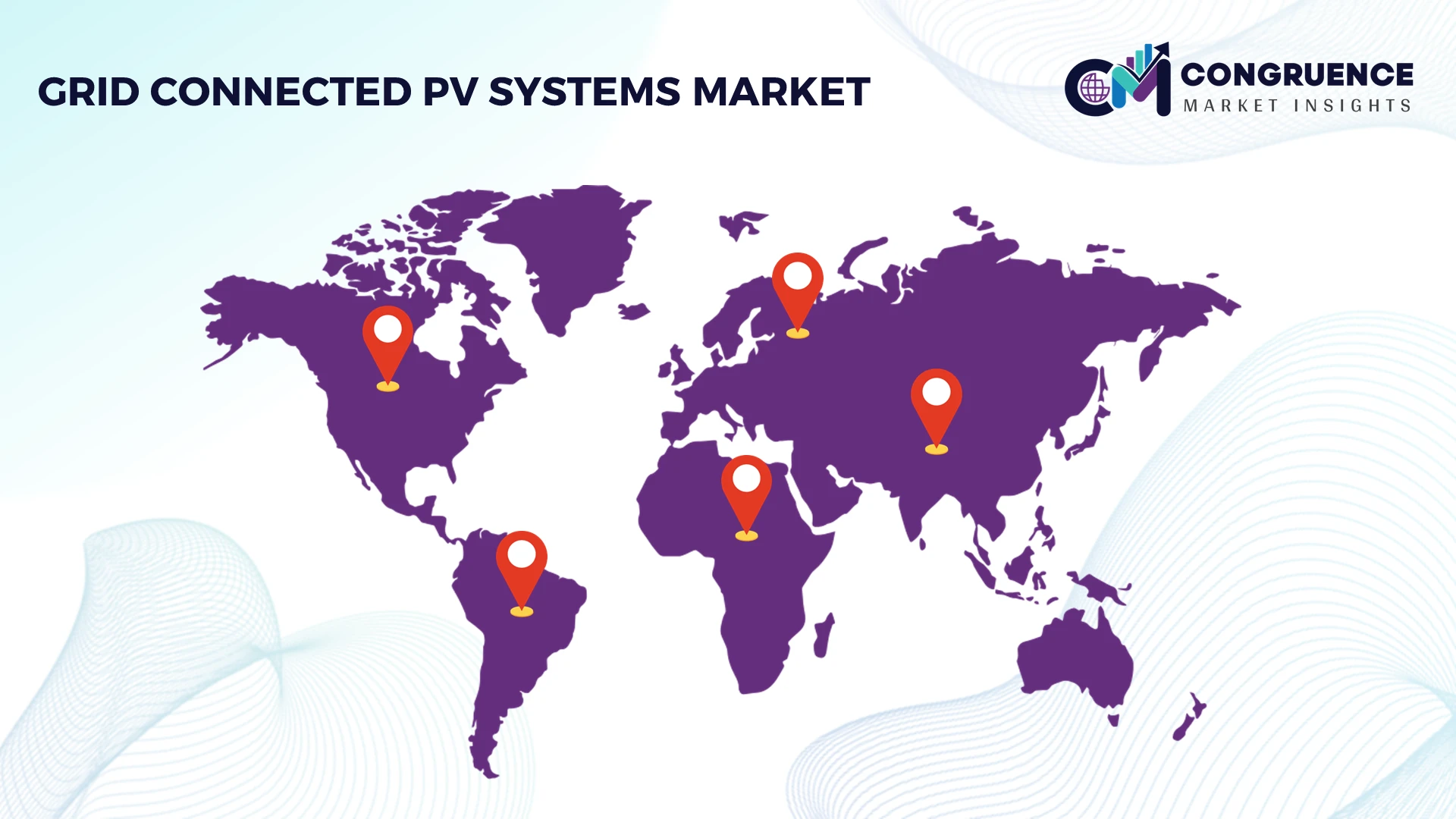
Asia-Pacific accounted for the largest market share at approximately 68.6% in 2025 however, Middle East & Africa is expected to register the fastest growth, expanding at an estimated CAGR of 10.2% between 2026 and 2033.
Utility Modernization and Domestic Manufacturing Reshape Deployment Priorities
North America represents approximately 9.9% of global installed solar PV capacity, with the United States accounting for the overwhelming majority of regional installations. Market activity is increasingly shaped by utility procurement, domestic manufacturing incentives, large-scale power purchase agreements, and transmission infrastructure requirements. The United States installed approximately 43 GW of solar capacity in 2025, although grid connection delays and policy uncertainty affected project commissioning. Mexico is strengthening its position through industrial electricity procurement and renewable power projects, while Canadian deployment reflects provincial energy strategies. Manufacturers are expanding domestic module production, strengthening EPC partnerships, and adapting procurement structures to local-content requirements. For investors, interconnection readiness and manufacturing eligibility increasingly determine project competitiveness.
United States Market Outlook: The United States remains the principal North American market because of its extensive utility infrastructure, established project-financing ecosystem, and advanced power-electronics industry. Its 210.86 GW installed solar capacity in 2025 provides a substantial base for grid-connected equipment demand. Developers are prioritizing transmission access, domestic equipment sourcing, and large-scale project optimization to improve commissioning certainty.
Distributed Generation and Grid Flexibility Drive Market Restructuring
Europe accounts for approximately 17.2% of global installed solar PV capacity, supported by established renewable energy policies, distributed generation infrastructure, and industrial decarbonization programmes. Germany, Spain, Italy, and France remain important deployment centers, with growing attention to grid flexibility, electricity storage, and repowering older installations. The European Union added approximately 65.7 GW of solar capacity in 2025, demonstrating sustained deployment despite permitting and network-integration constraints. Negative wholesale electricity prices and midday generation concentration are encouraging utilities to reassess conventional solar procurement models. Equipment manufacturers are strengthening smart-inverter portfolios, digital monitoring capabilities, and storage-compatible system architectures. Competitive positioning increasingly depends on balancing generation efficiency with electricity-market integration and operational flexibility.
Germany Market Outlook: Germany maintains a strategic advantage through its mature engineering industry, advanced distribution networks, and established photovoltaic installation ecosystem. Its installed solar capacity reached approximately 107 GW in 2025. Industrial rooftop projects, residential installations, and distributed energy management solutions support demand for advanced inverters, monitoring platforms, and grid-compliant equipment.
Manufacturing Scale and Deployment Density Reinforce Regional Leadership
Asia-Pacific commands approximately 68.6% of global installed solar PV capacity, supported by China's manufacturing dominance, India's expanding project pipeline, and Japan's established photovoltaic infrastructure. The region benefits from integrated production capabilities spanning polysilicon, wafers, solar cells, modules, and power-conversion equipment. China alone installed approximately 415 GW of new solar capacity in 2025, reinforcing its influence over global equipment availability and pricing. India is strengthening domestic manufacturing through production-linked incentives and renewable procurement programmes, while Japan emphasizes high-efficiency modules and space-efficient installations. Manufacturers are expanding production automation, diversifying export destinations, and developing localized supply partnerships. The region's strategic advantage extends beyond installation volume to its ability to influence global technology costs, component availability, and equipment standards.
China Market Outlook: China remains the central manufacturing and deployment hub for grid-connected PV systems. Its installed solar capacity reached approximately 1,202 GW in 2025, supported by extensive industrial clusters and established equipment supply networks. Manufacturers are prioritizing advanced cell architectures, automated production, and export-market diversification to defend international competitiveness and improve manufacturing utilization.
Distributed Solar Adoption Strengthens Energy Diversification
South America accounts for approximately 3.5% of global installed solar PV capacity, with Brazil representing the largest national market. Deployment is supported by distributed electricity generation, utility-scale procurement, industrial self-generation, and favorable solar irradiation conditions. Brazil's installed solar capacity reached approximately 64.69 GW in 2025, establishing a substantial domestic equipment and project-development base. Chile also benefits from strong solar resources and established renewable energy investment, particularly around mining and industrial electricity consumption. However, transmission congestion, curtailment, and uneven grid infrastructure affect project economics in selected markets. Developers are increasingly prioritizing storage-compatible installations, transmission-linked project locations, and commercial power agreements. Equipment suppliers are strengthening local distribution networks and EPC partnerships to reduce procurement delays and improve project execution.
Brazil Market Outlook: Brazil leads South American solar deployment through its established distributed-generation framework, utility procurement ecosystem, and substantial industrial electricity requirements. Its large agricultural, manufacturing, and commercial customer base creates opportunities for grid-connected rooftop and ground-mounted installations. Companies are focusing on localized project development, financing partnerships, and equipment distribution to strengthen market access.
Large-Scale Energy Diversification Accelerates Solar Infrastructure Investment
The Middle East & Africa represents approximately 1.4% of global installed solar PV capacity, but its project pipeline is expanding through utility-led procurement, electricity diversification, and industrial infrastructure investment. Saudi Arabia and the United Arab Emirates are advancing large solar developments to reduce domestic dependence on conventional power generation. South Africa remains an important African market because of electricity reliability requirements and private-sector procurement. Regional solar additions accelerated during 2025, with Saudi Arabia installing nearly 7 GW and sub-Saharan Africa recording substantial renewable capacity expansion. Developers are prioritizing high-temperature-resistant modules, dust-management systems, and grid-compatible power conversion equipment. International suppliers are forming local partnerships and adapting project designs to climatic conditions, transmission capacity, and country-specific procurement frameworks.
Saudi Arabia Market Outlook: Saudi Arabia is emerging as a strategically important market through its national renewable energy procurement programme and large utility-scale project pipeline. Solar capacity reached approximately 11.93 GW in 2025. Its investment environment supports international equipment suppliers, engineering contractors, and technology providers seeking long-term participation in large infrastructure projects.
The grid-connected PV systems market features intense competition between integrated manufacturers, power-electronics specialists, and regional EPC providers. LONGi, JinkoSolar, and Trina Solar compete through module efficiency, manufacturing scale, and procurement pricing, while Huawei and Sungrow lead inverter technology and system integration. SMA Solar Technology and Enphase Energy differentiate through specialized power-conversion platforms and application-specific solutions. The top five inverter suppliers collectively command approximately 60% of their segment, while the broader PV systems market remains fragmented. Chinese manufacturers control approximately 80% of global inverter manufacturing capacity, reinforcing their cost and supply advantages. Competition increasingly centers on technology performance, equipment availability, localization, and service capabilities. Leading suppliers are expanding overseas production, strengthening EPC partnerships, integrating storage-compatible inverters, and automating manufacturing. Domestic-content requirements and certification standards create substantial entry barriers. Price competition remains intense, but equipment reliability and supply-chain security increasingly influence procurement decisions. Winning requires manufacturing scale, differentiated technology, regional execution capabilities, and dependable lifecycle support.
LONGi Green Energy Technology
JinkoSolar Holding
Trina Solar
JA Solar Technology
Canadian Solar
First Solar
Hanwha Qcells
Huawei Technologies
Sungrow Power Supply
SMA Solar Technology
Enphase Energy
SolarEdge Technologies
The technology landscape is shifting from conventional P-type PERC modules toward N-type TOPCon, back-contact (BC), heterojunction (HJT), and perovskite-silicon tandem architectures. N-type technologies represented approximately 70% of global PV production in 2024, while bifacial modules exceeded 75% of production. This transition improves generation density and strengthens equipment differentiation. LONGi's BC demonstration recorded 3.16% higher electricity generation than comparable TOPCon modules under specific field conditions, highlighting the commercial importance of real-world performance rather than laboratory efficiency alone.
Advanced power electronics are becoming equally important. Smart inverters, silicon-carbide components, grid-forming controls, and AI-enabled monitoring improve conversion efficiency, fault detection, and system responsiveness. SolarEdge's next-generation inverter architecture demonstrated up to 20% higher low-power efficiency than leading European competitors. Compared with conventional commissioning workflows, its integrated platform reduced installation and commissioning time to under 30 minutes, strengthening installer productivity and lowering operational complexity.
Between 2026 and 2028, tandem cells, modular battery integration, automated diagnostics, and digital plant optimization will reshape technology competition. The 33% certified tandem-cell efficiency achieved by LONGi signals substantial future potential, although commercial scalability remains a critical milestone. Manufacturers with strong R&D capabilities, advanced manufacturing processes, and integrated inverter-storage portfolios are positioned to capture premium procurement opportunities.
June 2025: LONGi reported a 33% certified perovskite-silicon tandem-cell efficiency and back-contact module efficiency above 26%. The breakthrough strengthens its premium-technology position and expands R&D differentiation beyond mainstream silicon platforms, positioning tandem research for future commercialization and bankability. Source: longi.com
March 2025: JinkoSolar reported 92.9 GW in 2024 module shipments, up 18.3%, and mass-production TOPCon cell efficiency of 26.5%. The scale milestone reinforces its procurement leverage and supports continued investment in n-type manufacturing capacity and global customer coverage. Source: jinkosolar.com
February 2026: First Solar's annual filing detailed U.S. nameplate capacity rising from about 6 GW in 2020 to 13 GW in 2025, with over 17 GW projected by 2027. Domestic production strengthens supply security and local-content positioning procurement. Source: sec.gov
March 2026: SolarEdge launched Nexis in Germany, combining an inverter up to 20 kW with modular storage scalable to 78.4 kWh. Its single-SKU architecture cuts commissioning to under 30 minutes, improving installer throughput and simplifying inventory management globally. Source: solaredge.com
The Grid Connected PV Systems Market Report evaluates market structure, deployment patterns, technology adoption, and competitive positioning across rooftop PV systems, ground-mounted PV systems, and floating PV systems. Application coverage includes residential, commercial, industrial, and utility-scale power generation, while end-user analysis examines households, commercial buildings, industrial facilities, and power generation companies. The assessment covers North America, Europe, Asia-Pacific, South America, and the Middle East & Africa, highlighting differences in manufacturing capabilities, grid infrastructure, and solar deployment.
The report examines TOPCon, bifacial, back-contact, heterojunction, tandem-cell, inverter, and storage-integration technologies alongside emerging digital monitoring and automation solutions. Competitive assessment covers 12 major industry participants, their product strategies, manufacturing expansion, partnerships, and technological differentiation. These insights support investment planning, market-entry decisions, geographic expansion, procurement optimization, and competitive benchmarking, while identifying strategic opportunities and operational constraints shaping industry direction between 2026 and 2033.
| Report Attribute/Metric | Report Details |
|---|---|
Market Revenue in 2025 | USD 106162.3 Million |
Market Revenue in 2033 | USD 286247.67 Million |
CAGR (2026 - 2033) | 13.2% |
Base Year | 2025 |
Forecast Period | 2026 - 2033 |
Historic Period | 2021 - 2025 |
Segments Covered | By Type
By Application
By End-User
|
Key Report Deliverable | Revenue Forecast, Growth Trends, Market Dynamics, Segmental Overview, Regional and Country-wise Analysis, Competition Landscape |
Region Covered | North America, Europe, Asia-Pacific, South America, Middle East, Africa |
Key Players Analyzed | LONGi Green Energy Technology, JinkoSolar Holding, Trina Solar, JA Solar Technology, Canadian Solar, First Solar, Hanwha Qcells, Huawei Technologies, Sungrow Power Supply, SMA Solar Technology, Enphase Energy, SolarEdge Technologies |
Customization & Pricing | Available on Request (10% Customization is Free) |




