
Reports
The Global Green Synthetic Ammonia Market was valued at USD 1,308.0 Million in 2025 and is anticipated to reach a value of USD 70,476.8 Million by 2033 expanding at a CAGR of 64.6% between 2026 and 2033. Growth is driven by accelerating renewable hydrogen integration, maritime decarbonization targets, and large-scale industrial investments in carbon-free ammonia production.
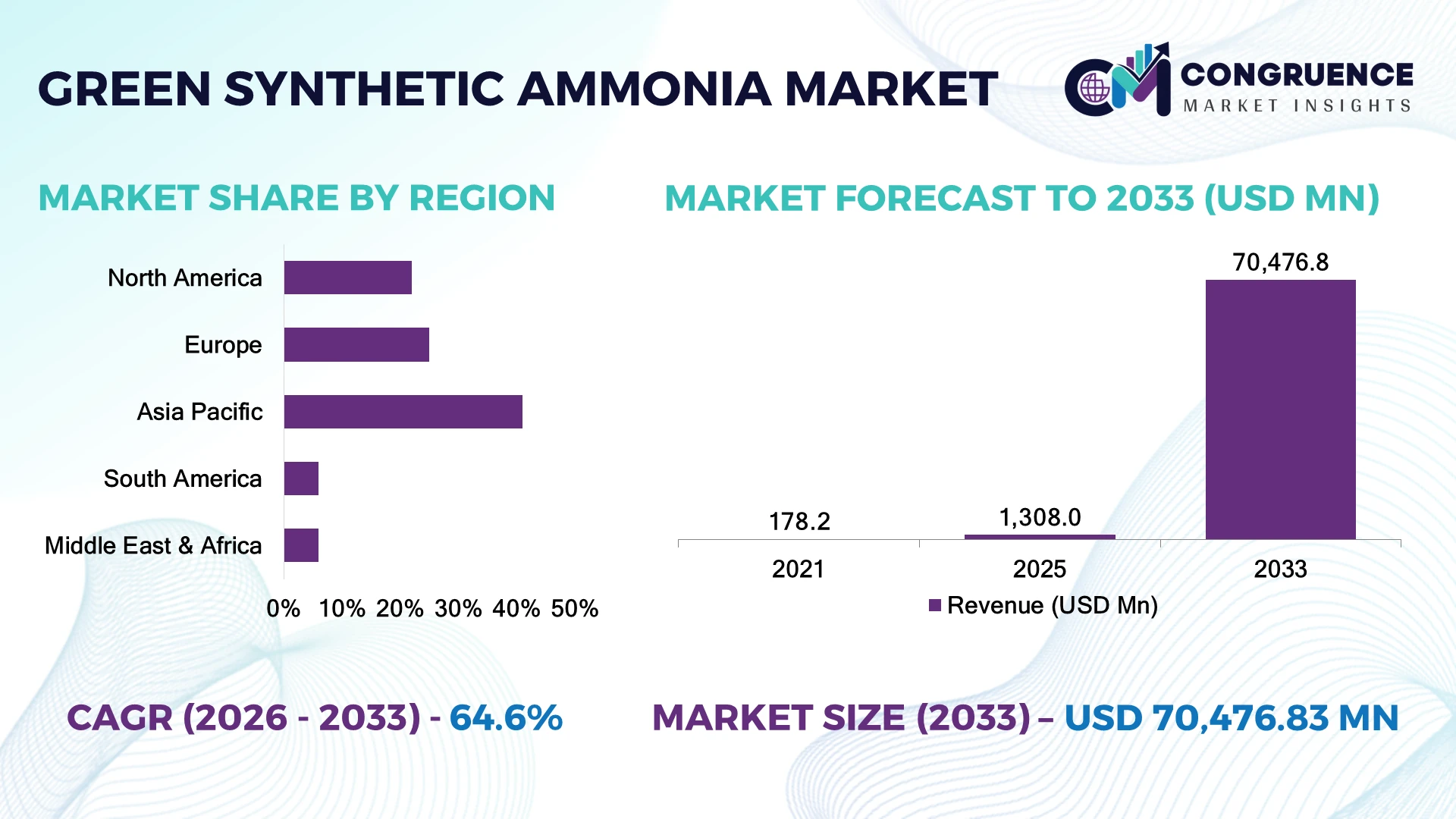
Australia leads the global landscape with approximately 24% of announced green ammonia production capacity, supported by multi-gigawatt renewable energy investments and export-focused hydrogen hubs. Japan follows through long-term import agreements and co-firing initiatives across the power sector, while Australia operates more utility-scale projects than Japan. More than 65% of planned facilities are integrated with solar and wind generation, strengthening production efficiency amid evolving Indo-Pacific energy security strategies.
This competitive landscape favors early infrastructure developers, integrated hydrogen producers, and export-oriented industrial partnerships.
Market Size & Growth: USD 1,308.0 Million in 2025, projected to reach USD 70,476.8 Million by 2033 at 64.6% CAGR, supported by expanding renewable hydrogen infrastructure.
Top Growth Drivers: Renewable electrolyzer deployment (+45%), maritime decarbonization initiatives (+38%), industrial hydrogen substitution (+31%).
Short-Term Forecast: By 2028, electrolyzer efficiency improves by nearly 18%, while renewable production costs decline around 22%.
Emerging Technologies: AI-powered process optimization, advanced PEM and SOEC electrolysis, and digital plant automation improve operational performance.
Regional Leaders: Asia Pacific approaches USD 28 Billion, Europe exceeds USD 20 Billion, and North America surpasses USD 13 Billion with export-oriented capacity expansion.
Consumer/End-User Trends: Over 42% of planned demand originates from fertilizer producers, followed by shipping fuel adoption and power generation.
Pilot/Case Example: In 2024, renewable ammonia demonstration projects achieved nearly 20% lower operating emissions through integrated hydrogen production.
Competitive Landscape: Top manufacturers collectively account for approximately 36% of planned commercial capacity, led by Yara International, CF Industries, ACME Group, Fortescue, and OCI.
Regulatory & ESG Impact: Carbon reduction policies support emission cuts exceeding 90% compared with conventional ammonia production pathways.
Investment & Funding: More than USD 120 Billion has been announced globally through strategic partnerships, export hubs, and integrated renewable projects.
Innovation & Future Outlook: Next-generation electrolysis, digital energy management, and cross-border hydrogen corridors are reshaping long-term industrial competitiveness.
Green Synthetic Ammonia Market demand is expanding across fertilizers, maritime fuel, power generation, and hydrogen transportation applications as industrial decarbonization accelerates. Advanced electrolysis systems and AI-enabled plant optimization continue improving operational efficiency, while integrated renewable energy complexes enhance production stability. More than 60% of announced projects are linked with renewable energy assets, supported by evolving carbon regulations and resilient international clean-energy supply chains, setting the stage for broader strategic market developments.
Green synthetic ammonia has become a strategic industrial commodity as governments and manufacturers strengthen energy security, decarbonize heavy industries, and diversify global fuel supply chains. Infrastructure modernization, renewable hydrogen integration, and expanding export corridors are reshaping competitive positioning. Countries including Australia, Saudi Arabia, and Japan are accelerating industrial partnerships to secure future clean fuel availability and strengthen long-term manufacturing resilience.
Modern proton exchange membrane electrolysis delivers approximately 15–20% higher operational flexibility than conventional alkaline systems under variable renewable power conditions, improving utilization rates and reducing production downtime. Europe emphasizes industrial decarbonization and regulatory compliance, while Australia prioritizes export-oriented mega-projects supported by abundant renewable resources. During the next two to three years, integrated renewable-ammonia facilities are expected to increase commercial operating capacity by more than 40% as project execution accelerates.
Industrial developers are expanding strategic partnerships with renewable energy providers, electrolyzer manufacturers, and port infrastructure operators to streamline production and export logistics. Large-scale integrated facilities demonstrate how renewable electricity, hydrogen generation, and ammonia synthesis can operate within a unified ecosystem. Organizations establishing vertically integrated value chains today are securing stronger competitive positioning, operational resilience, and long-term strategic relevance.
The strongest market catalyst is the rapid deployment of renewable hydrogen for ammonia synthesis across fertilizer production, shipping, and industrial energy applications. Electrolyzer installations have expanded by more than 40% annually in several leading markets, while renewable electricity contributes over 70% of planned project energy inputs. The European Union's carbon reduction framework and Japan's clean fuel roadmap continue accelerating commercial adoption. In response, companies are investing in vertically integrated production facilities, long-term renewable power agreements, and strategic export terminals. This integration reduces dependence on fossil-based feedstocks, improves energy security, and strengthens supply reliability. Early developers with integrated renewable assets are establishing durable operational advantages through scale, lower lifecycle emissions, and optimized production economics.
Commercial deployment remains constrained by substantial capital requirements, limited electrolyzer manufacturing capacity, and insufficient hydrogen transport infrastructure. Electrolyzers still represent nearly 30% of total project investment, while renewable electricity contributes around 55% of production costs. Port infrastructure capable of handling green ammonia exports remains limited in several emerging producer nations, delaying project commercialization. Companies are addressing these constraints through localization strategies, long-term equipment procurement contracts, and joint ventures with infrastructure developers. Industrial clusters integrating renewable generation, hydrogen production, and ammonia synthesis are also improving project economics. Firms that successfully secure stable renewable energy access and supply-chain resilience gain stronger execution capability and lower operational uncertainty.
New export-oriented hydrogen corridors are creating attractive opportunities beyond traditional fertilizer demand. More than 60% of announced green ammonia projects are designed for international trade, while integrated renewable hubs improve energy utilization by approximately 18%. Australia, Oman, and Saudi Arabia continue expanding export infrastructure alongside dedicated port investments and industrial partnerships. Companies are accelerating research into solid oxide electrolysis, digital process optimization, and flexible ammonia synthesis to improve operational performance. Ecosystem-based business models connecting renewable generation, hydrogen production, storage, and export logistics provide long-term competitive advantages. Organizations investing early in integrated value chains are positioned to capture premium supply contracts and strengthen international market access.
The principal long-term challenge involves coordinating large-scale renewable generation, hydrogen production, ammonia synthesis, storage, and export infrastructure within synchronized project timelines. More than 50% of announced projects remain in development stages, while specialized engineering talent shortages continue affecting execution schedules. Grid integration complexity and evolving certification standards further increase operational planning requirements, particularly for multinational export projects. Companies must strengthen engineering capabilities, digital asset monitoring, and strategic partnerships to maintain deployment consistency. Investment in workforce development, standardized certification frameworks, and resilient infrastructure will determine long-term competitiveness. Organizations capable of integrating complex supply networks efficiently will secure stronger operational performance and sustainable industry leadership.
Integrated Renewable Production Hubs: Large-scale projects are increasingly combining solar, wind, electrolysis, and ammonia synthesis within a single industrial ecosystem. More than 65% of announced facilities now integrate dedicated renewable assets, while project energy losses decline by nearly 15% through optimized power management. Australia and Oman are expanding export-oriented hydrogen hubs to reduce transmission dependency. Companies are restructuring project designs through integrated engineering partnerships and shared infrastructure, improving operational reliability while reducing commissioning timelines amid tightening clean-fuel certification requirements.
Digital Plant Optimization Expands: AI-enabled process control, predictive maintenance, and digital twin platforms are becoming standard across commercial-scale facilities. Early deployments have reduced unplanned downtime by approximately 22% while improving electrolyzer utilization by nearly 18%. Japanese technology providers are accelerating automation partnerships to stabilize renewable power fluctuations. Industrial operators are standardizing digital workflows, centralized monitoring, and automated diagnostics, enabling faster production balancing, improved equipment lifespan, and lower maintenance intensity despite increasing operational complexity.
Long-Term Offtake Agreements Increase: Industrial buyers are securing multi-year supply contracts before commercial production begins, strengthening project bankability and accelerating infrastructure deployment. More than 55% of large announced facilities now include strategic offtake commitments, while integrated procurement models reduce financing uncertainty by roughly 20%. European shipping companies and fertilizer manufacturers are prioritizing supply security following energy market disruptions. Developers are responding through consortium-based investments, cross-border partnerships, and synchronized production planning that supports scalable export logistics and stable commercial operations.
Certification and Traceability Advance: Digital carbon accounting and product certification systems are rapidly becoming operational requirements across international trade. More than 70% of new export projects are incorporating traceability platforms, while automated emissions verification reduces reporting time by nearly 30%. Growing regulatory alignment across Japan and the European Union is accelerating adoption of standardized sustainability documentation. Producers are deploying blockchain-enabled tracking, automated compliance software, and lifecycle emissions verification to strengthen buyer confidence, simplify cross-border transactions, and differentiate premium low-carbon ammonia supplies.
The market is commonly segmented into Alkaline Electrolysis-Based Green Ammonia, Proton Exchange Membrane (PEM) Green Ammonia, Solid Oxide Electrolysis (SOEC) Green Ammonia, and Other Emerging Production Technologies. Alkaline electrolysis-based green ammonia remains the leading segment with an estimated 56% market share due to lower capital costs, mature engineering, and proven compatibility with utility-scale renewable projects. Its commercial readiness and established supply chain continue to support large export-oriented developments. PEM-based green ammonia is the fastest-growing segment as operators seek greater flexibility under variable solar and wind generation. PEM systems improve dynamic load response by nearly 20%, making them attractive for integrated renewable facilities. SOEC technology is steadily gaining strategic attention because of its high electrical efficiency in industrial heat applications, while other emerging production technologies remain focused on demonstration projects and niche deployments. Companies are expanding electrolyzer manufacturing capacity, strengthening technology partnerships, and diversifying product portfolios to match varying project scales. Investment priorities increasingly favor flexible production platforms capable of balancing efficiency, operational resilience, and renewable power integration across different industrial environments.
The market is segmented into Fertilizers, Energy Storage, Shipping Fuel, Power Generation, Hydrogen Carrier, and Industrial Feedstock. Fertilizer production dominates with approximately 48% of demand because existing ammonia infrastructure allows relatively straightforward substitution of conventional production routes. Agricultural producers are increasingly adopting low-carbon feedstocks to meet sustainability commitments while maintaining production continuity. Shipping fuel is the fastest-growing application as international maritime decarbonization initiatives accelerate investment in ammonia-ready engines and bunkering infrastructure. Commercial shipping demonstrations have increased by more than 35%, while dual-fuel vessel development continues expanding globally. Power generation and hydrogen carrier applications are strengthening through seasonal energy storage and international hydrogen transport strategies. Industrial feedstock demand is also increasing as chemical manufacturers integrate cleaner production pathways into existing operations. Companies are responding through dedicated ammonia export terminals, fuel certification programs, and strategic partnerships with shipping operators and fertilizer manufacturers. Operational priorities increasingly emphasize infrastructure compatibility, fuel security, and integrated logistics capable of supporting multiple end-use industries.
Major end-user groups include Fertilizer Manufacturers, Maritime & Shipping Companies, Power Utilities, Chemical Manufacturers, Energy Companies, and Industrial Consumers. Fertilizer manufacturers account for nearly 45% of total demand because they already operate extensive ammonia handling infrastructure and require reliable feedstock for continuous production. Their large-scale procurement capabilities support long-term supply agreements and integrated production planning. Maritime and shipping companies represent the fastest-growing end-user segment as vessel operators accelerate adoption of alternative marine fuels and prepare for stricter emissions compliance. More than 30% of announced marine fuel projects now include ammonia within long-term decarbonization strategies. Power utilities and energy companies are increasing purchases for seasonal storage and co-firing initiatives, while chemical manufacturers continue integrating renewable feedstocks into existing production chains. Industrial consumers are gradually adopting green ammonia where direct electrification remains impractical. Suppliers are targeting these buyers through customized supply contracts, infrastructure partnerships, dedicated storage solutions, and flexible pricing models that improve long-term procurement certainty while strengthening competitive positioning across industrial value chains.
Asia-Pacific accounted for the largest market share at 41% in 2025 however, Middle East & Africa is expected to register the fastest growth, expanding at a CAGR of 67.8% between 2026 and 2033.
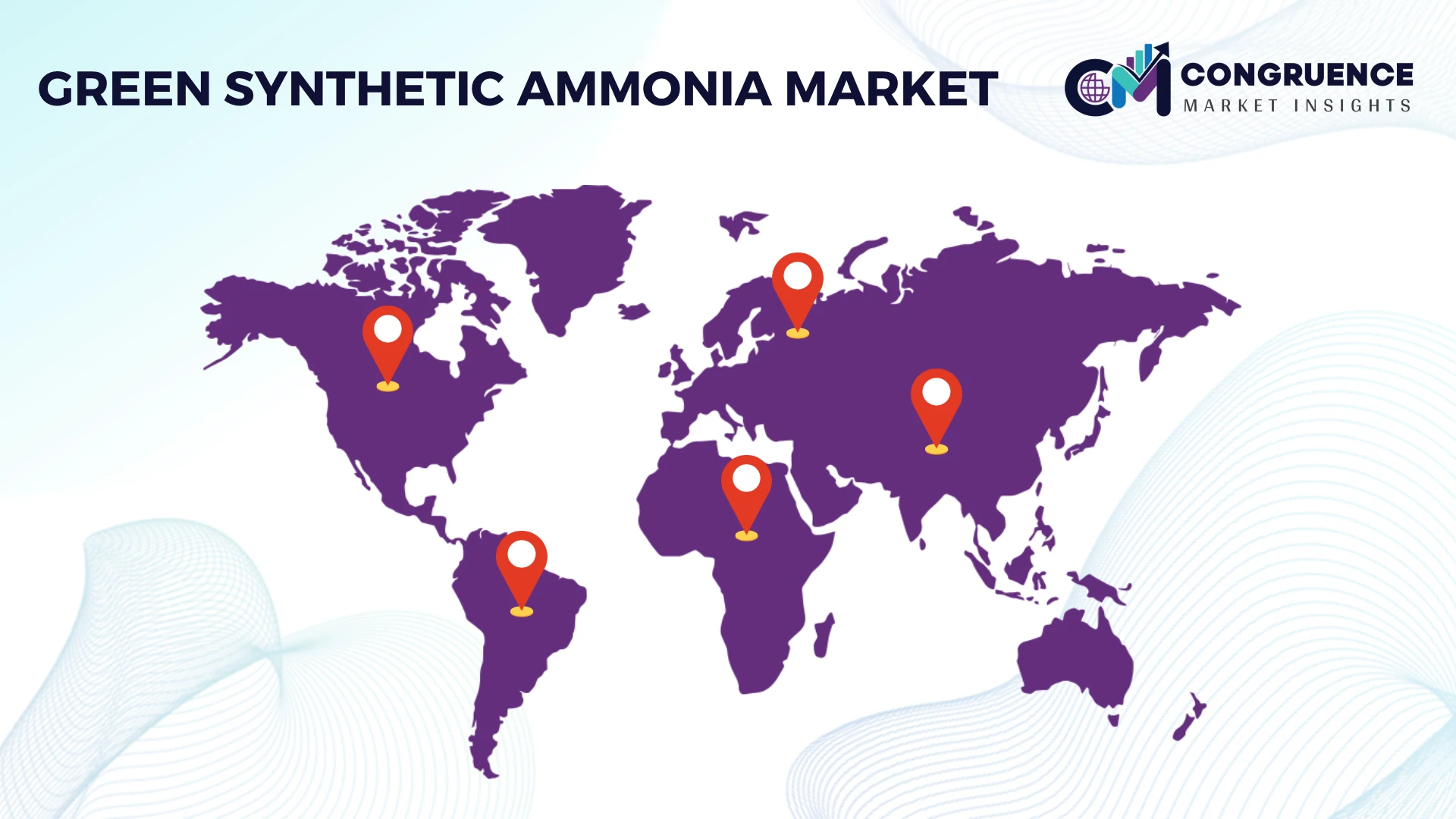
North America represents approximately 22% of the global market, supported by large-scale hydrogen deployment programs, established ammonia production infrastructure, and growing clean-fuel investment. The United States and Canada are accelerating renewable hydrogen integration into industrial applications, fertilizer production, and energy transition initiatives. Strategic alignment between renewable power generation and ammonia synthesis is improving project viability across major industrial corridors. Several commercial-scale developments are integrating gigawatt-scale renewable energy assets with hydrogen production facilities, strengthening domestic supply capabilities. Long-term industrial partnerships and port infrastructure upgrades are supporting future export competitiveness while enhancing supply-chain resilience. Operational focus increasingly centers on cost optimization, electrolyzer deployment, and scalable production systems capable of supporting industrial decarbonization objectives.
United States Market Outlook: The United States leads regional activity through extensive renewable energy resources, advanced hydrogen initiatives, and strong industrial demand. Federal clean-energy incentives continue supporting large-scale project development across Texas, Louisiana, and the Midwest. More than 35 announced green hydrogen and ammonia projects are progressing through development stages, supported by growing collaboration between energy companies, fertilizer manufacturers, and technology providers. The country's established ammonia infrastructure and export capabilities provide a strong foundation for commercial-scale deployment and long-term industry leadership.
Europe accounts for approximately 25% of the global market and remains a leading center for regulatory-driven clean ammonia adoption. Decarbonization mandates, carbon reduction policies, and industrial sustainability targets continue accelerating commercial deployment. Countries across Northern Europe are investing in integrated renewable hydrogen and ammonia facilities to reduce dependence on imported fossil-based feedstocks. Port modernization projects and cross-border hydrogen corridors are strengthening supply-chain connectivity while supporting industrial competitiveness. Strategic partnerships between utilities, industrial producers, and shipping operators are expanding operational deployment. The region continues prioritizing low-carbon industrial processes, renewable energy integration, and clean maritime fuel solutions as key components of long-term energy transition strategies.
Germany Market Outlook: Germany maintains a pivotal position through industrial manufacturing strength, advanced hydrogen planning, and strong policy support. The country is expanding hydrogen import infrastructure and developing dedicated ammonia handling capabilities at key ports. Several industrial clusters are integrating renewable hydrogen into chemical and fertilizer operations, while utility companies continue evaluating ammonia-based energy storage solutions. Germany's coordinated industrial strategy and infrastructure investments strengthen its role as a major demand center within the European clean ammonia ecosystem.
Asia-Pacific holds the largest global share at approximately 41%, driven by extensive renewable energy development, industrial demand concentration, and major export-oriented projects. The region benefits from strong participation across Australia, Japan, China, and South Korea, where governments and enterprises are actively supporting clean fuel deployment. More than half of globally announced export-focused green ammonia capacity is linked to projects within the region. Integrated renewable energy complexes, dedicated export terminals, and long-term supply agreements are accelerating commercial readiness. Industrial users are increasingly adopting green ammonia within fertilizers, power generation, and maritime applications. Strong manufacturing ecosystems and growing clean-energy investments continue reinforcing regional leadership across the value chain.
Australia Market Outlook: Australia is the region's most strategically significant market due to its abundant renewable resources, large-scale export ambitions, and integrated hydrogen development strategy. The country accounts for roughly 24% of announced global green ammonia production capacity and hosts several multi-gigawatt renewable hydrogen projects. Export-focused infrastructure development, including dedicated port facilities and international supply agreements, continues attracting global investment. Australia's ability to combine low-cost renewable generation with large-scale industrial deployment strengthens its long-term competitive position.
South America accounts for approximately 6% of the global market and is emerging as a promising production hub due to exceptional renewable energy potential. Countries are leveraging abundant wind and solar resources to develop export-oriented green hydrogen and ammonia projects. Infrastructure development remains at an earlier stage compared with mature markets, yet project pipelines continue expanding through international partnerships and foreign investment participation. Industrial producers are exploring ammonia production as a pathway to diversify exports while supporting clean-energy strategies. Port development, transmission upgrades, and integrated renewable energy projects are gradually improving deployment conditions. Despite infrastructure constraints, the region's resource advantages provide strong long-term operational potential.
Brazil Market Outlook: Brazil leads regional development through its large renewable energy base, industrial scale, and growing hydrogen investment activity. The country is advancing multiple green hydrogen and ammonia initiatives near major port locations to support future exports. Strong wind and solar generation capacity creates favorable production economics for renewable hydrogen integration. Industrial groups and international investors are increasingly partnering on large-scale projects designed to strengthen Brazil's position within emerging global clean-fuel supply chains and export markets.
Middle East & Africa represents approximately 6% of the current market but is rapidly transforming into a major future production center through large-scale clean-energy investments. Governments are leveraging abundant solar resources, strategic export locations, and industrial diversification strategies to accelerate deployment. Several flagship projects combine renewable generation, hydrogen production, and ammonia synthesis within integrated industrial complexes. Export infrastructure expansion and international supply agreements are strengthening commercial viability. Large-scale project announcements increasingly focus on supplying Europe and Asia with low-carbon fuels. Operational priorities include infrastructure modernization, technology deployment, and development of globally competitive clean-energy export industries capable of supporting long-term economic diversification.
Saudi Arabia Market Outlook: Saudi Arabia is the region's leading market due to its substantial investment capacity, large renewable energy ambitions, and strategic industrial planning. The country hosts some of the world's most significant integrated hydrogen and green ammonia developments, supported by utility-scale renewable projects and export infrastructure expansion. Major industrial partnerships are accelerating technology deployment and commercial execution. Saudi Arabia's focus on energy diversification, international supply agreements, and large-scale infrastructure development positions it as a future global supplier of green synthetic ammonia and related clean-energy products.
The market is led by Yara International, CF Industries, ACME Group, Fortescue, and OCI, while regional hydrogen developers and renewable energy integrators compete aggressively for export-oriented projects. The top five participants collectively control approximately 38% of announced commercial project capacity. Global ammonia producers compete on integrated supply chains and distribution networks, whereas technology-focused entrants emphasize electrolyzer efficiency and renewable integration. Around 60% of new projects rely on strategic partnerships to secure renewable electricity and long-term offtake agreements, while vertically integrated facilities reduce logistics costs by nearly 20%. Companies are strengthening competitiveness through project expansion, joint ventures, technology licensing, and dedicated export terminals. Competition is shifting from production scale toward certified low-carbon supply, operational reliability, and infrastructure ownership as governments tighten sustainability requirements. High capital intensity, permitting complexity, and renewable power availability remain significant entry barriers. Success depends on securing integrated renewable assets, scalable production capacity, reliable certification, and long-term customer contracts before competitors establish supply leadership.
CF Industries Holdings, Inc.
ACME Group
Fortescue Ltd.
OCI Global
Uniper SE
HIF Global
CWP Global
AM Green
Iberdrola S.A.
Topsoe A/S
Air Products and Chemicals, Inc.
Mitsui & Co., Ltd.
BASF SE
Green synthetic ammonia production is rapidly transitioning from conventional alkaline electrolysis toward advanced proton exchange membrane (PEM) and solid oxide electrolysis (SOEC) technologies. PEM systems deliver nearly 20% faster response under fluctuating renewable power, while SOEC can improve electrical efficiency by approximately 25% when integrated with industrial waste heat. Around 45% of announced commercial projects now incorporate digital energy management platforms, enabling tighter coordination between renewable generation, hydrogen production, and ammonia synthesis.
Artificial intelligence, digital twins, predictive maintenance, and automated process control are becoming standard across large industrial facilities. AI-enabled optimization has reduced unplanned downtime by nearly 22% and improved electrolyzer utilization by approximately 18%. Compared with conventional manually optimized operations, digitally integrated production environments achieve around 15% higher operational efficiency while reducing maintenance interventions. Integrated technology providers and vertically coordinated developers gain the greatest competitive advantage through lower operating costs and improved production consistency.
Between 2026 and 2028, modular electrolyzer architectures, advanced catalysts, and real-time carbon certification platforms are expected to accelerate commercial deployment. Companies investing in flexible production systems, intelligent automation, and integrated renewable infrastructure will strengthen supply reliability, accelerate project commissioning, and secure stronger positions in premium low-carbon ammonia supply chains as industrial procurement standards continue evolving.
March 2024 – Yara International and ACME Group signed a binding long-term agreement for the supply of 100,000 tonnes of renewable ammonia annually from ACME's Oman project, supporting large-scale decarbonization across industrial sectors. Source: www.yara.com
June 2025 – Yara Clean Ammonia participated in the world's first ship-to-ship ammonia bunkering pilot at Port Dampier, Australia, demonstrating safe offshore ammonia transfer and strengthening commercial readiness for maritime fuel adoption. Source: www.yara.com
June 2026 – Yara International announced it would not proceed with acquiring ammonia assets in the Louisiana Clean Energy Complex and instead reallocated capital toward higher-return U.S. ammonia investments, refining its strategic expansion priorities. Source: www.yara.com
July 2026 – Yara International agreed to acquire the Gulf Coast Ammonia facility in Texas with a planned production capacity of 1.3 million tonnes per year, strengthening North American manufacturing capability and future low-carbon ammonia integration.
This report delivers comprehensive analysis of the global Green Synthetic Ammonia Market across major production technologies, applications, end-user industries, and regional markets between 2026 and 2033. It evaluates technology adoption patterns, industrial deployment, infrastructure expansion, and competitive positioning across North America, Europe, Asia-Pacific, South America, and the Middle East & Africa. The assessment covers evolving production pathways, renewable hydrogen integration, export infrastructure, maritime fuel adoption, fertilizer applications, power generation, and industrial feedstock demand.
The study analyzes competitive participation across leading global manufacturers, technology providers, renewable energy developers, and integrated project operators. It highlights deployment trends, operational performance, technology evolution, and investment priorities while examining emerging production hubs and export corridors. Strategic insights support capacity planning, market entry, partnership development, supply-chain optimization, competitive benchmarking, and long-term business expansion by identifying high-potential segments, operational shifts, and technology transitions shaping future industry direction.
| Report Attribute / Metric | Details |
|---|---|
| Market Revenue (2025) | USD 1,308.0 Million |
| Market Revenue (2033) | USD 70,476.8 Million |
| CAGR (2026–2033) | 64.6% |
| Base Year | 2025 |
| Forecast Period | 2026–2033 |
| Historic Period | 2021–2025 |
| Segments Covered |
By Type
By Application
By End-User
|
| Key Deliverables | Revenue Forecast; Market Trends; Growth Drivers & Restraints; Technology Insights; Segmentation Analysis; Regional Insights; Competitive Landscape; Regulatory & ESG Overview; Recent Developments |
| Regions Covered | North America; Europe; Asia-Pacific; South America; Middle East & Africa |
| Companies Profiled | Yara International ASA; CF Industries Holdings, Inc.; ACME Group; Fortescue Ltd.; OCI Global; Uniper SE; HIF Global; CWP Global; AM Green; Iberdrola S.A.; Topsoe A/S; Air Products and Chemicals, Inc.; Mitsui & Co., Ltd.; BASF SE |
| Customization & Pricing | Available on Request (10% Customization Free) |




