
Reports
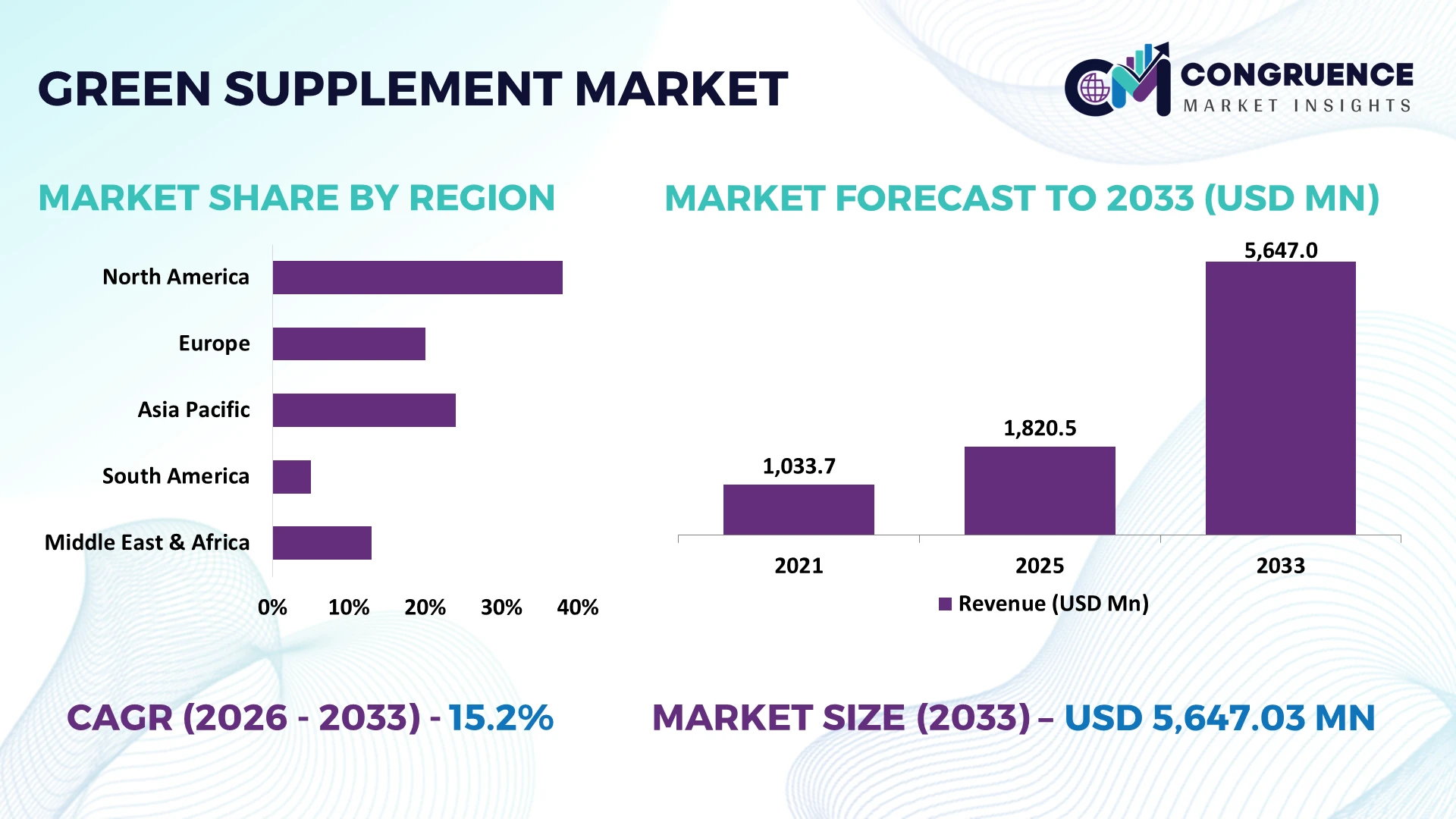
The Global Green Supplement Market was valued at USD 1820.54 Million in 2025 and is anticipated to reach a value of USD 5647.03 Million by 2033 expanding at a CAGR of 15.2% between 2026 and 2033. Growth is driven by algae-based formulations, green proteins, clean-label products, and rapid expansion of convenient powder and functional wellness formats.
The United States leads the Green Supplement Market, supported by established nutraceutical manufacturing, strong clean-label adoption, and advanced digital distribution. China remains a major production and consumption hub, while India is expanding its nutraceutical manufacturing base. China’s 7.6% market growth outpaces India’s 4.4%, highlighting stronger near-term momentum and reinforcing the U.S., China, and India as priority markets for capacity and product investment.
Strategic decisions should prioritize U.S. digital channels while accelerating algae, powder, and Asia-Pacific product portfolios.
Market Size & Growth: USD 1,820.54 million in 2025 to USD 5,647.03 million by 2033 at 15.2%, supported by algae and convenient powder innovation.
Top Growth Drivers: Plant-based preference 65%; organic preference 63%; vegan-certified demand 47%.
Short-Term Forecast: By 2028, automated formulation and digital forecasting are positioned to reduce inventory costs by 5% and improve planning efficiency by 8%.
Emerging Technologies: AI formulation, automated blending, precision algae cultivation, and advanced photobioreactors are reshaping high-growth production.
Regional Leaders: North America implies USD 2.23 billion, Europe USD 1.58 billion, and Asia-Pacific USD 1.69 billion by 2033 using current regional shares; APAC is expanding fastest.
Consumer/End-User Trends: Algae holds about 46% of product share, while powder represents roughly 35.4%, reinforcing convenient daily-use formats.
Pilot/Case Example: A 2025 Spirulina pilot increased productivity by 9.34% while variable-frequency mixing reduced energy consumption by 20.8%, strengthening scalable algae economics.
Competitive Landscape: North America leads at 39.5%; key competitors include GNC, Herbalife, NOW Foods, Puritan’s Pride, and Herbal Hills.
Regulatory & ESG Impact: U.S. dietary-supplement manufacturing remains governed by 21 CFR Part 111, increasing pressure for traceability, quality controls, and compliant labeling.
Investment & Funding: Wellness-sector consolidation remains aggressive, with Unilever targeting approximately £1.5 billion annually for bolt-on acquisitions, including its 2026 Grüns expansion.
Innovation & Future Outlook: Next-generation green proteins, precision-grown algae, personalized blends, and traceable sourcing will shift competition toward formulation efficacy, manufacturing efficiency, and premium positioning.
The global Green Supplement Market is increasingly concentrated around nutrient-dense algae, powders, functional beverages, and clean-label formulations serving fitness, preventive nutrition, digestive health, and immunity-focused consumers. Advanced photobioreactor technologies are improving Spirulina productivity by up to 40.93% while reducing mixing energy by 27.73%, strengthening the commercial case for controlled cultivation. Supply-chain scrutiny and U.S. quality requirements are also accelerating traceable sourcing and standardized manufacturing, setting the stage for strategic product and capacity decisions.
The Green Supplement Market is becoming strategically important as manufacturers compete on ingredient traceability, formulation efficacy, and lower-impact production rather than basic product variety. Algae cultivation, plant-derived micronutrients, functional powders, and clean-label blends are moving closer to mainstream nutraceutical portfolios. U.S. dietary-supplement manufacturers also operate under 21 CFR Part 111, making process control, testing, labeling, and batch traceability critical competitive capabilities.
Technology is sharpening production economics. A 2025 Spirulina photobioreactor trial using variable-frequency mixing achieved 9.34% higher areal productivity while cutting mixing energy consumption 20.8% versus conventional control operation. This contrasts with conventional open cultivation, where environmental variability increases contamination and consistency pressure. China and India provide scale advantages in cultivation and ingredient processing, while the United States emphasizes premium formulations, digital commerce, and standardized quality systems. The competitive gap is therefore shifting from raw-material access toward controlled production and verified quality.
Over the next 2–3 years, companies are expected to expand automated dosing, sensor-based cultivation, digital batch monitoring, and regional ingredient sourcing, targeting 5–10% improvements in processing efficiency. Practical deployment of controlled Spirulina photobioreactors demonstrates how production engineering can directly strengthen margins. Leading companies are responding through contract manufacturing, ingredient partnerships, localized processing, and R&D alliances. Competitive positioning will increasingly depend on combining scalable cultivation, validated formulations, regulatory discipline, and measurable resource efficiency.
Algae-based ingredients are becoming a structural growth driver as Spirulina and related microalgae combine protein, pigments, minerals, and antioxidant compounds in compact formulations. Controlled photobioreactor systems can deliver 9.34% higher productivity and 20.8% lower mixing energy than conventional control operation, strengthening production economics. In the United States, clean-label and functional formulations are increasingly positioned across wellness, sports nutrition, and daily micronutrient categories. Meanwhile, India is strengthening domestic nutraceutical manufacturing and ingredient-processing capabilities. Companies are responding through controlled cultivation, formulation partnerships, and vertically integrated sourcing. The non-obvious advantage is operational consistency: tighter cultivation control reduces batch variability while improving traceability, allowing premium brands to defend pricing through measurable quality rather than sustainability claims alone.
Production economics remain constrained by cultivation inputs, drying requirements, energy consumption, and dependence on specialized processing infrastructure. Advanced photobioreactors reduce selected operating costs, but capital-intensive systems can still carry substantially higher upfront requirements than basic open cultivation. Energy optimization can deliver a 20.8% reduction in mixing consumption, yet downstream drying and extraction remain cost-sensitive stages. In India and China, lower-cost processing networks provide scale advantages, while U.S. manufacturers face stronger requirements for documented quality and process controls under dietary-supplement manufacturing rules. Companies are reducing exposure through multi-country sourcing, longer supplier contracts, localized processing, and more efficient cultivation systems. The strategic constraint is not ingredient availability alone; it is achieving consistent specification at a commercially defensible landed cost.
Precision cultivation creates an opportunity to convert green supplements from commodity-style powders into higher-value standardized ingredients. Variable-frequency photobioreactor technology has demonstrated 9.34% higher productivity, 20.8% lower mixing energy use, and 13.2% greater energy-utilization efficiency, providing a measurable pathway for process optimization. Over the next 2–3 years, sensor-controlled cultivation, AI-assisted formulation, automated dosing, and digital batch records can target 5–10% improvements in production efficiency. India offers an attractive expansion base because of established nutraceutical manufacturing and lower processing costs, while U.S. companies can monetize premium formulations through digitally enabled direct-to-consumer channels. Companies are positioning through R&D partnerships and contract manufacturing. The strongest opportunity lies in selling standardized, traceable ingredients rather than undifferentiated green powders.
Long-term competitiveness depends on maintaining ingredient consistency as companies expand cultivation, processing, and contract-manufacturing networks. Controlled Spirulina systems demonstrate productivity gains of 9.34%, but scaling introduces tighter requirements for contamination control, sensor calibration, batch synchronization, and downstream drying. U.S. manufacturers must maintain documented production and quality procedures under 21 CFR Part 111, while multinational suppliers must coordinate specifications across different production environments. Digital monitoring can target 5–10% reductions in process deviations, but fragmented data systems and workforce capability gaps remain execution barriers. Companies therefore need investment in automated quality controls, interoperable manufacturing data, operator training, and supplier qualification. The strategic priority is building repeatable production architecture so expansion does not dilute formulation consistency, regulatory readiness, or brand credibility.
Algae Formulations Gain Scale: Spirulina and chlorella now represent about 38% of consumption volume, as manufacturers expand concentrated powders and blended formulations. Controlled cultivation and standardized processing are improving batch consistency, while companies are increasing algae-focused capacity and supplier partnerships.
Digital Distribution Reshapes Purchasing: E-commerce contributes nearly 55% of distribution, reflecting a shift toward subscription-based purchasing, direct-to-consumer fulfillment, and personalized product discovery. U.S. brands are strengthening online inventory planning and automated fulfillment to reduce stock gaps and improve order responsiveness.
Clean-Label Innovation Accelerates: Around 72% of supplement users prefer natural or organic formulations, pushing manufacturers toward non-GMO ingredients, transparent sourcing, and simplified ingredient panels. Companies are restructuring product portfolios around traceability and certification, particularly as regulatory scrutiny of health claims intensifies.
Functional Nutrition Broadens Usage: U.S. consumers increasingly prioritize measurable nutritional attributes, with 43% seeking higher-protein foods and 31% seeking higher-fiber options. Green supplement producers are responding by integrating algae and grass ingredients into functional foods and sports-oriented formulations rather than relying solely on standalone powders.
Spirulina is the leading ingredient within the specified type set, accounting for approximately 22% of total green-supplement ingredient utilization. Its dominance reflects scalable cultivation, high protein density, and compatibility with powders, capsules, and blended formulations. Chlorella follows at about 18%, supported by demand for nutrient-dense formulations and premium wellness positioning. Companies are increasing standardized algae processing and expanding multi-ingredient blends to improve formulation consistency.
Wheatgrass and barley grass remain strategically important for grass-based formulations, together contributing roughly 27% of consumption. Wheatgrass retains stronger mainstream recognition, while barley grass is gaining traction in digestive and daily-wellness products. The key investment shift is toward combining mature algae ingredients with grass-based components, enabling brands to differentiate formulations without relying on single-ingredient positioning.
Dietary Supplements lead the specified applications at approximately 42% share, supported by established consumer routines, broad retail availability, and compatibility with powders and capsules. Functional Foods follow at about 18%, reflecting increasing incorporation of green ingredients into bars, meal replacements, and nutrition products. Companies are expanding formulation partnerships to transfer green ingredients from standalone supplements into everyday food formats.
Sports Nutrition represents a high-value expansion area, with fitness-oriented consumers increasingly seeking nutrient-dense plant ingredients. Detox & Wellness remains relevant for premium positioning, particularly through concentrated powders and functional blends. The non-obvious shift is application convergence: manufacturers are designing one ingredient platform for multiple use cases, reducing formulation complexity while widening distribution opportunities. Companies are therefore prioritizing modular formulations, contract manufacturing, and cross-category product launches.
Nutraceutical Companies represent the dominant end-user group, accounting for approximately 42% of purchasing demand, supported by established formulation infrastructure, regulatory capabilities, and large-scale distribution. Food & Beverage Companies follow as green ingredients move into functional foods and beverages. Companies are increasingly using ingredient partnerships and contract manufacturing to shorten formulation cycles and broaden product portfolios.
Sports Nutrition Brands represent the fastest-expanding buyer group, benefiting from stronger demand for plant-based protein and convenient performance nutrition. Wellness Retailers remain important for premium discovery and specialty positioning, particularly in the United States. Approximately 27% of powder consumption is linked to fitness-oriented users, reinforcing the commercial relevance of sports-focused formulations. Manufacturers are responding with customized ingredient systems, private-label partnerships, and targeted pricing strategies, shifting competition toward application-specific formulations rather than generic green blends.
North America accounted for the largest market share at 39.5% in 2025 however, Asia-Pacific is expected to register the fastest growth, expanding at a CAGR of 16.8% between 2026 and 2033.
Digital wellness channels reshape premium supplement operations
North America remains the leading market, supported by established nutraceutical manufacturing, sophisticated retail infrastructure, and strong adoption of functional nutrition formats. The United States represents the region’s primary consumption base, while digital purchasing is reshaping product discovery, replenishment, and subscription models. Manufacturers are expanding direct-to-consumer capabilities and private-label portfolios while strengthening ingredient traceability and batch documentation. Contract manufacturing partnerships are helping brands shorten formulation cycles and reduce dedicated production requirements. The region’s competitive advantage increasingly comes from combining premium formulation, digital distribution, standardized quality systems, and rapid commercialization rather than competing primarily on ingredient cost.
United States Market Outlook: The United States remains the region’s most strategically significant country because of its advanced nutraceutical ecosystem and extensive specialty retail infrastructure. More than half of supplement purchasing is increasingly influenced by digitally enabled channels, supporting subscription models and faster product testing. Companies are prioritizing personalized formulations, automated fulfillment, and traceable ingredient sourcing to improve customer retention and operational efficiency.
Regulatory discipline accelerates clean-label portfolio restructuring
Europe is developing around stringent ingredient standards, sustainability expectations, and transparent product positioning. Germany, the United Kingdom, France, and Italy provide established distribution networks for organic and plant-based supplements, while manufacturers increasingly prioritize traceable raw materials and simplified formulations. Regulatory scrutiny surrounding health claims is strengthening substantiation, labeling, and quality documentation requirements. Companies are expanding partnerships with specialized algae and botanical suppliers to secure consistent specifications. Organic positioning also influences packaging and procurement decisions, particularly among premium brands. European manufacturers are therefore restructuring portfolios around compliant formulations, verified ingredients, and transparent sourcing. The region’s strategic advantage is strong consumer trust in regulated products, although compliance costs are encouraging larger companies to standardize procurement and formulations across multiple markets.
Germany Market Outlook: Germany remains a strategically important European market because of its established natural-health retail infrastructure, supplement manufacturing capabilities, and quality-focused consumers. Manufacturers are increasing certified ingredient sourcing and laboratory testing to strengthen product credibility. Pharmacy, specialty retail, and e-commerce channels provide multiple routes for scaling premium green formulations, encouraging companies to invest in localized product development and compliant labeling.
Manufacturing scale converges with formulation innovation
Asia-Pacific is expanding through the combination of large consumer markets and strengthening nutraceutical manufacturing capabilities. China remains a major production and consumption hub, while India is developing domestic formulation, processing, and export capacity. Controlled algae cultivation and ingredient standardization are becoming more important as manufacturers shift from commodity powders toward higher-value blends. China’s approximately 7.6% market growth exceeds India’s 4.4%, highlighting different stages of market maturity and distribution development. Companies are expanding local processing partnerships, automated packaging, and region-specific formulations. Supply-chain localization is becoming strategically important as manufacturers seek shorter ingredient routes and stronger control over quality specifications.
China Market Outlook: China remains the most strategically significant country because of its established algae cultivation ecosystem, large-scale ingredient processing, and extensive domestic manufacturing base. High-volume production supports competitive sourcing, while domestic brands are moving toward premium formulations. Companies are increasingly integrating automated processing and quality monitoring to improve consistency and compete through standardized ingredient performance rather than cost alone.
Premium wellness demand expands beyond traditional supplements
South America is developing through stronger demand for plant-based nutrition, natural ingredients, sports supplements, and wellness-oriented products. Brazil represents the principal commercial hub, supported by its large consumer base, established food-processing industry, and expanding specialty nutrition channels. Local manufacturers increasingly use regional agricultural inputs, reducing dependence on selected imported ingredients. E-commerce is widening access to premium green formulations beyond major metropolitan markets. Currency volatility and imported-equipment costs continue to influence formulation economics and inventory planning. Companies are responding through localized sourcing, domestic contract manufacturing, and smaller production batches that reduce working-capital exposure. The strongest strategic opportunity lies with manufacturers that combine local ingredient availability with standardized quality and premium positioning.
Brazil Market Outlook: Brazil provides the strongest commercial platform in South America because of its food-processing infrastructure, extensive agricultural supply base, and large consumer market. Green supplement brands are integrating plant-derived ingredients into functional nutrition portfolios. Domestic sourcing can reduce exposure to international freight fluctuations, while local contract manufacturing enables emerging brands to scale without building dedicated facilities.
Premium wellness infrastructure drives selective market expansion
The Middle East & Africa market is developing through premium wellness retail, sports nutrition, pharmacy channels, and expanding e-commerce infrastructure. The United Arab Emirates and Saudi Arabia are key commercial hubs because of sophisticated retail networks and investment in health-oriented consumer industries. Import-dependent markets remain exposed to freight costs and longer replenishment cycles, encouraging distributors to strengthen regional warehousing. Premium green powders, capsules, and functional blends are gaining visibility through specialist retailers and fitness channels. Companies are responding through distributor partnerships, localized inventory hubs, and selective private-label production. The region’s strategic advantage is its concentration of affluent urban consumers, enabling premium positioning despite comparatively limited local manufacturing depth.
United Arab Emirates Market Outlook: The United Arab Emirates is the region’s strongest commercial gateway because of advanced logistics infrastructure, high-income consumer segments, and established specialty retail. Importers increasingly use centralized warehousing and digitally managed inventory to improve product availability across Gulf markets. Companies are positioning UAE operations as distribution and partnership hubs for premium green supplements entering neighboring markets.
The Green Supplement Market pits established nutraceutical brands such as GNC, Herbalife, NOW Foods, Herbal Hills, and Nature’s Way against specialized algae and botanical suppliers competing on formulation depth and ingredient consistency. The top five players collectively control an estimated 18–22% of the market, leaving substantial room for regional brands and private-label manufacturers. Competition centers on price, formulation quality, supply reliability, and customization, with premium brands typically commanding 15–25% higher pricing than basic green powders. Companies are expanding through contract manufacturing, ingredient partnerships, direct-to-consumer channels, and vertically integrated sourcing. The competitive shift is moving from product breadth toward traceability, standardized active content, and faster formulation cycles. Entry barriers remain strongest in regulatory compliance, validated manufacturing, reliable ingredient sourcing, and distribution access. Winning players will combine scalable supply chains with differentiated formulations, quality assurance, and rapid commercialization.
GNC Holdings LLC
Herbalife Ltd.
NOW Foods
Nature’s Way
Garden of Life
Amazing Grass
Orgain
Nested Naturals
Pure Synergy
KIKI Health
Organic Burst
Sun Chlorella Corporation
Yaeyama Chlorella
Nutrex Hawaii
Controlled algae cultivation is becoming a core production technology, with photobioreactors improving Spirulina productivity by 9.34% while variable-frequency mixing cuts energy consumption 20.8% versus conventional control systems. Adoption remains concentrated among specialized algae producers, but integration with sensors and automated monitoring is expanding. These systems improve batch consistency, resource utilization, and scalable ingredient supply.
Emerging technologies include AI-assisted formulation, automated dosing, digital quality monitoring, and precision extraction. Integrated process controls can deliver 1–2% improvements in production efficiency, while automated workflows reduce manual intervention by about 2%. Closed-loop cultivation is gaining deployment as manufacturers prioritize contamination control and traceability. Technology-led producers benefit through faster formulation cycles, standardized active content, and stronger quality differentiation.
From 2026–2028, disruptive progress will center on intelligent photobioreactors, fermentation-derived nutrients, and data-driven formulation optimization. Advanced cultivation already demonstrates measurable advantages over legacy operations, making modernization commercially relevant now. Large nutraceutical companies benefit from scalable automation, while specialized algae producers gain stronger cost and quality positioning. Early investment in interoperable cultivation, processing, and quality systems will establish operational advantages before these technologies become standard across global green supplement manufacturing.
December 2024 Nature’s Bounty launched a plant-based Omega-3 supplement using 1,000 mg of algae oil per serving. The launch expanded algae-based nutrition into major U.S. retail channels, strengthening plant-derived alternatives to fish oil. Source: nestlehealthscience.us
June 2025 Designs for Health launched EssentiaGreens and Reds, a reformulated greens powder available in three flavors. The multi-functional formulation targets digestive, antioxidant, and metabolic health, strengthening premium clean-label positioning.
September 2025 Rohto F Okinawa launched a 100% algae-derived DHA/EPA supplement through online channels. The product uses algae-extracted omega-3s, reinforcing sustainable plant-based nutrition and expanding specialized algae applications in Japan. Source: rohto.co.jp
April 2026 Unilever announced its acquisition of Grüns, strengthening its wellbeing portfolio. Grüns had reached 10 million gummies shipped daily, giving Unilever a scaled greens platform and broader access to the U.S. supplement market. Source: reuters.com
The Green Supplement Market Report covers Spirulina, Chlorella, Wheatgrass, and Barley Grass across Dietary Supplements, Functional Foods, Sports Nutrition, and Detox & Wellness applications. End-user analysis includes Nutraceutical Companies, Food & Beverage Companies, Sports Nutrition Brands, and Wellness Retailers, enabling comparison of purchasing patterns, formulation priorities, and commercialization strategies.
The report evaluates North America, Europe, Asia-Pacific, South America, and the Middle East & Africa, with country-level analysis of manufacturing, distribution, regulatory conditions, and adoption. Technology coverage includes controlled algae cultivation, photobioreactors, automated processing, precision extraction, and digital quality monitoring. Segment-level indicators, competitive positioning, supply-chain dynamics, and technology deployment patterns support investment planning, market-entry decisions, capacity expansion, partnership development, and competitive strategy through 2026–2033.
| Report Attribute/Metric | Report Details |
|---|---|
Market Revenue in 2025 | USD 1820.54 Million |
Market Revenue in 2033 | USD 5647.03 Million |
CAGR (2026 - 2033) | 15.2% |
Base Year | 2025 |
Forecast Period | 2026 - 2033 |
Historic Period | 2021 - 2025 |
Segments Covered | By Type
By Application
By End-User
|
Key Report Deliverable | Revenue Forecast, Growth Trends, Market Dynamics, Segmental Overview, Regional and Country-wise Analysis, Competition Landscape |
Region Covered | North America, Europe, Asia-Pacific, South America, Middle East, Africa |
Key Players Analyzed | GNC Holdings LLC, Herbalife Ltd., NOW Foods, Nature’s Way, Garden of Life, Amazing Grass, Orgain, Nested Naturals, Pure Synergy, KIKI Health, Organic Burst, Sun Chlorella Corporation, Yaeyama Chlorella, Nutrex Hawaii |
Customization & Pricing | Available on Request (10% Customization is Free) |




