
Reports
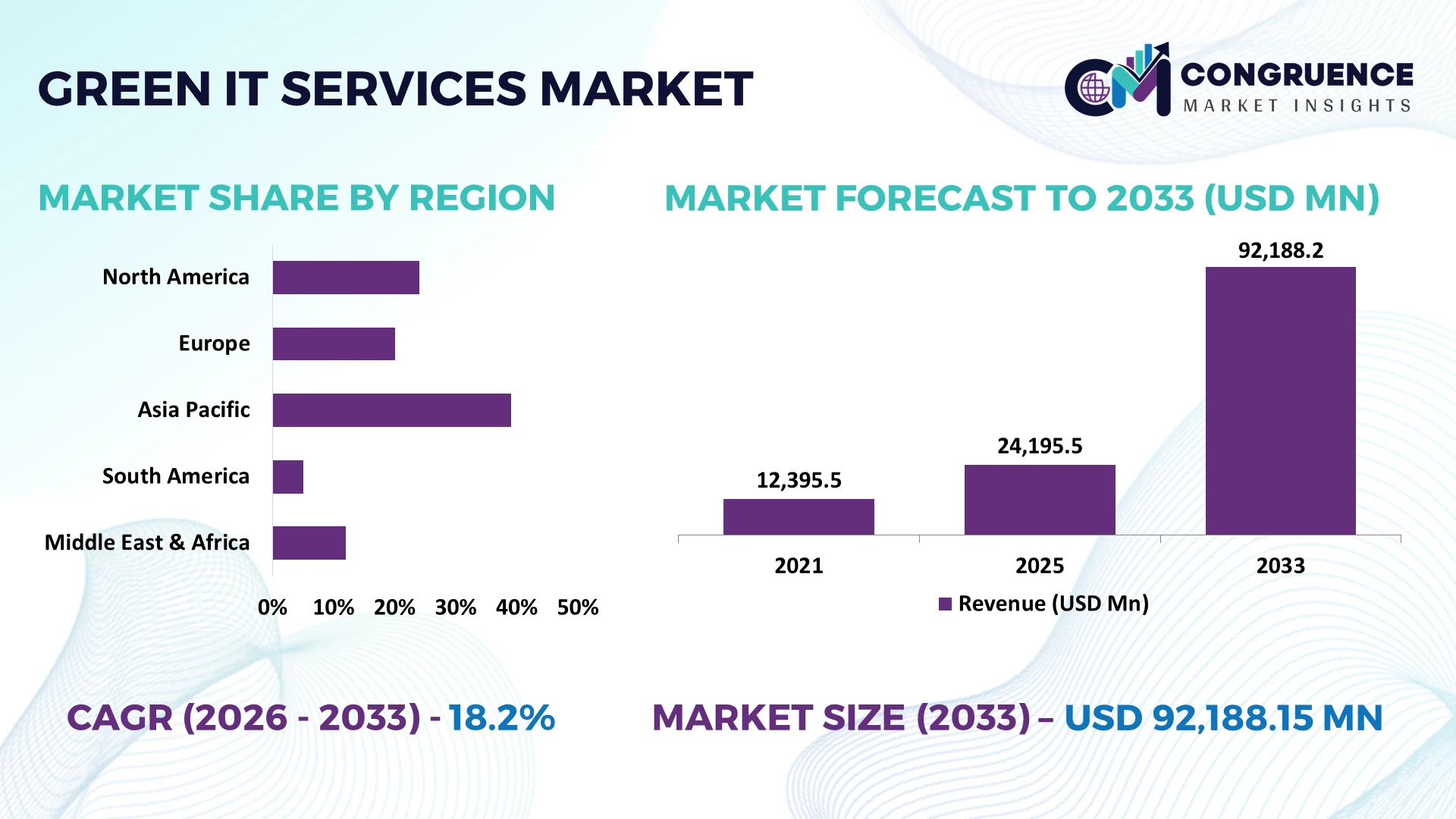
The Global Green IT Services Market was valued at USD 24195.54 Million in 2025 and is anticipated to reach a value of USD 92188.15 Million by 2033 expanding at a CAGR of 18.2% between 2026 and 2033. Growth is being driven by hyperscale data-center expansion, FinOps-led cloud optimization, carbon-accounting mandates, renewable-power procurement, AI workload efficiency, and enterprise requirements to measure Scope 1–3 digital emissions.
The United States anchors global Green IT Services demand, controlling 55% of worldwide hyperscale operational capacity in 2025 versus substantially smaller concentrations in China and Europe. Hyperscale facilities now represent 48% of total data-center capacity, while Google cut data-center energy emissions 12% despite electricity demand rising 27%. EU sustainability disclosure and U.S.–China technology tensions are simultaneously tightening infrastructure, sourcing, and emissions-management priorities.
Strategically, enterprises should prioritize measurable energy optimization, carbon-aware cloud architecture, lifecycle IT management, and auditable sustainability data rather than treating green IT as a standalone ESG reporting function.
Market Size & Growth: USD 24.20 billion in 2025 advances toward USD 92.19 billion by 2033 at 18.2%, driven by AI data-center efficiency and carbon-accountable cloud modernization.
Top Growth Drivers: Hyperscale facilities hold 48% of capacity, cloud waste reaches 29%, and AWS matches 100% of electricity consumption with renewable energy.
Short-Term Forecast: By 2028, leading optimization programs will increasingly benchmark against hyperscale efficiency levels where overhead energy requirements are already 84% below industry averages.
Emerging Technologies: AI-driven energy orchestration, carbon-aware workload scheduling, liquid cooling, and automated FinOps are converging as Google’s latest TPU delivers nearly 30× higher power efficiency versus its first generation.
Regional Leaders: By 2030, North America reaches about USD 16.96 billion, Europe USD 11.36 billion, and Asia-Pacific USD 12.41 billion, with cloud sustainability adoption accelerating fastest in Asia-Pacific.
Consumer/End-User Trends: Large enterprises represented 69.62% of Green IT Services adoption in 2025 as complex multi-cloud estates demand measurable energy, emissions, and asset optimization.
Pilot/Case Example: Google reduced data-center energy emissions 12% in 2024 while electricity demand increased 27%, demonstrating operational decoupling through infrastructure efficiency and clean-energy procurement.
Competitive Landscape: North America holds approximately 38% share, with IBM, Accenture, Microsoft, AWS, Infosys, and Cisco competing through consulting, cloud optimization, carbon analytics, and managed sustainability services.
Regulatory & ESG Impact: EU reporting requirements and data-center efficiency rules are shifting sustainability measurement toward auditable digital operations, while hyperscaler renewable matching has reached 100% at AWS.
Investment & Funding: Google contracted more than 8 GW of clean energy in 2024, strengthening demand for advisory, energy procurement, infrastructure optimization, and carbon-management services.
Innovation & Future Outlook: Cloud Centers of Excellence now operate at 71% of surveyed organizations, while 63% maintain FinOps teams, moving Green IT from reporting toward continuous infrastructure governance.
Green IT Services Market demand is concentrating around data-center optimization, sustainable cloud migration, IT asset lifecycle management, carbon accounting, FinOps, and AI infrastructure efficiency. Data-center optimization represented about 31.94% of service-area demand in 2025. Rising AI electricity loads, European disclosure requirements, and hyperscaler renewable-power procurement are turning measurable digital efficiency into an operating requirement, setting up the market’s strategic discussion.
Green IT services are becoming strategically critical as AI infrastructure, cloud expansion, energy constraints, and mandatory sustainability reporting turn digital efficiency into an operating requirement. Data-center electricity consumption is projected to rise roughly 15% annually through 2030, while accelerated servers increase consumption about 30% annually. The EU’s Energy Efficiency Directive now requires qualifying data centers to report energy and water performance, shifting enterprise sustainability from voluntary disclosure toward auditable infrastructure management.
Technology economics reinforce that shift. Google’s data centers operated at a 1.09 PUE in 2025, using 83% less overhead energy than the industry average, while its newest TPU delivers nearly 30-times the power efficiency of its first cloud TPU. North America leads hyperscale deployment, whereas Europe applies stronger reporting requirements and Southeast Asia is rapidly adding capacity, creating different service priorities across optimization, compliance, and infrastructure design.
Operationally, Google reduced data-center energy emissions 12% while electricity consumption increased 27%, supported by 2.5 GW of newly operational clean-energy projects. Enterprises are consequently expanding FinOps, carbon accounting, renewable procurement, and efficient architecture programs. Through 2028, competitive advantage will increasingly depend on converting sustainability data into measurable infrastructure, energy, and workload decisions.
Rising AI and cloud workloads are converting energy efficiency from an ESG objective into a core infrastructure requirement. Data-center electricity use is increasing about 15% annually toward 2030, accelerated-server consumption is rising around 30% annually, and 84% of cloud users already identify spend management as a primary challenge. In the United States, hyperscale expansion is intensifying pressure on grids and cooling infrastructure, forcing enterprises to connect FinOps, power management, and sustainability programs. Service providers are responding through carbon-aware workload placement, AI infrastructure optimization, efficient cooling design, renewable procurement, and managed FinOps. The non-obvious shift is financial: reducing compute waste now lowers both electricity exposure and emissions simultaneously, allowing sustainability projects to compete directly with conventional IT cost-reduction programs for enterprise investment.
Incomplete asset and consumption visibility restricts the ability to quantify energy savings across hybrid IT estates. Only 43% of surveyed organizations reported complete technology-stack visibility in 2025, while 35% said SaaS waste increased and cloud budgets ran approximately 17% above plan. These gaps become more costly as workloads move across data centers, SaaS platforms, hyperscalers, and edge environments, where emissions factors and utilization profiles differ. U.S. enterprises are responding by integrating IT asset management with cloud teams, reported by 44%, and FinOps functions, reported by 38%. Providers are expanding discovery, telemetry, software asset management, and consumption analytics. The key structural restraint is data quality: organizations cannot reliably optimize carbon intensity when inventories, utilization data, and contractual cloud information remain disconnected across operating environments.
AI infrastructure is creating a differentiated Green IT opportunity around workload scheduling, efficient accelerators, cooling optimization, and clean-energy matching. Google’s latest TPU delivers nearly 30-times greater power efficiency than its first cloud TPU, its data centers use 83% less overhead energy than the industry average, and renewables are expected to supply nearly 50% of additional global data-center electricity demand through 2030. Service providers can increasingly optimize when and where AI workloads run instead of focusing only on hardware replacement. Companies are building carbon-aware orchestration, GPU utilization analytics, liquid-cooling advisory, and clean-power procurement capabilities. A non-obvious opportunity lies in workload timing: flexible training and batch processing can shift toward lower-carbon electricity periods, turning scheduling software into an infrastructure-efficiency service with measurable energy and emissions benefits.
Maintaining efficiency as AI infrastructure scales presents a long-term execution challenge. Cloud waste increased to 29% in 2026, 85% of organizations still identified cloud spend management as a major challenge, and security remained a concern for 77% of cloud users. Australia illustrates the physical pressure: one major data-center operator recorded worsening power and water efficiency as commissioning activity and expanding capacity increased resource intensity. Green IT providers therefore must optimize compute, cooling, cybersecurity, and sustainability without constraining service availability. Companies are investing in Cloud Centers of Excellence, now present at 71% of organizations, alongside automated FinOps, telemetry, and infrastructure controls. The strategic issue is operational consistency: sustainability gains achieved in optimized facilities can deteriorate when AI clusters, new sites, and distributed workloads expand faster than governance and engineering capabilities.
FinOps Expands Beyond Cloud Cost: FinOps is moving into broader technology-value management as enterprises connect financial accountability with sustainability. FinOps teams operate in 63% of organizations, Cloud Centers of Excellence in 71%, while cloud waste reaches 29%. Companies are integrating cost allocation, utilization telemetry, carbon metrics, and automated rightsizing, turning sustainability optimization into an engineering workflow rather than periodic ESG reporting.
Liquid Cooling Enters AI Facilities: High-density AI racks are accelerating direct-to-chip and immersion cooling adoption as conventional air systems encounter thermal limits. Liquid cooling can reduce facility energy consumption by 10–20%, while AI racks increasingly exceed 100 kW. Data-center operators are redesigning mechanical infrastructure, partnering with cooling specialists, and retrofitting facilities, shifting Green IT consulting toward thermal engineering and infrastructure lifecycle planning.
Circular IT Procurement Gains Structure: Hardware lifecycle management is moving from disposal-led programs toward reuse, refurbishment, and auditable material recovery. Global e-waste reached 62 million tonnes in 2022, yet only 22.3% was formally collected and recycled; generation is heading toward 82 million tonnes by 2030. Enterprises are expanding device-as-a-service, certified refurbishment, take-back contracts, and asset tracking to reduce procurement exposure and regulatory risk.
Sustainability Data Becomes Auditable: Digital sustainability reporting is becoming operationally granular as regulation forces enterprises to measure infrastructure consumption. EU rules require qualifying data centers above 500 kW to report energy-performance information, while facilities above 1 MW face additional waste-heat considerations. Operators are deploying automated metering, carbon-accounting platforms, and environmental telemetry, creating recurring demand for data assurance, compliance integration, and sustainability-management services.
Managed Services represent the leading type, with an estimated 30% share, as enterprises increasingly outsource continuous cloud optimization, infrastructure monitoring, asset management, and sustainability reporting rather than maintain specialist internal teams. Consulting Services account for approximately 24%, remaining important for baseline assessments, sustainable architecture, compliance roadmaps, and data-center transformation. Energy Management provides focused value where electricity-intensive infrastructure requires metering, cooling optimization, and workload-level efficiency controls. Providers are expanding managed FinOps, telemetry, carbon accounting, and lifecycle services to convert one-time advisory engagements into continuous optimization contracts.
Cloud Services are the fastest-growing type as enterprises migrate applications toward infrastructure offering granular utilization measurement, autoscaling, and automated workload placement. Sustainability Services are also strengthening as carbon disclosure, Scope 3 accounting, circular IT, and supplier assessments become operational requirements. With 63% of organizations operating FinOps teams and 71% maintaining Cloud Centers of Excellence, buyers increasingly expect service providers to integrate cost, utilization, emissions, and governance rather than deliver isolated environmental reporting.
Data Center Optimization represents the leading application, with an estimated 32% share, reflecting the direct financial and environmental impact of servers, cooling systems, storage, networking, and power infrastructure. Energy Efficiency follows as enterprises optimize PUE, cooling, utilization, and electricity sourcing across increasingly dense computing environments. IT Infrastructure Management remains essential for asset discovery and workload consolidation, while E-Waste Management is becoming more structured through refurbishment, take-back programs, and certified recycling. Providers are integrating infrastructure telemetry, AI-assisted cooling, asset management, and sustainability dashboards to expose previously fragmented efficiency opportunities.
Cloud Optimization is the fastest-growing application as organizations confront rising AI consumption and persistent unused capacity. Cloud waste reached approximately 29% in 2026, while 85% of surveyed organizations identified cloud spend management as a major challenge. This makes rightsizing, commitment optimization, autoscaling, and workload scheduling commercially measurable Green IT activities. Companies are embedding optimization directly into DevOps and FinOps workflows, shifting demand from periodic assessment toward continuous automated control across multi-cloud estates.
IT & Telecom represents the leading end-user segment, with an estimated 34% share, driven by data-center density, hyperscale infrastructure, telecom networks, cloud platforms, and continuous hardware refresh cycles. Banking follows as regulated institutions prioritize efficient data centers, cloud governance, hardware lifecycle management, and auditable sustainability metrics. Manufacturing combines energy-efficient IT with industrial edge computing and asset optimization, while Government demand centers on sustainable procurement, consolidated infrastructure, and public-sector carbon commitments. Service providers are developing sector-specific FinOps, infrastructure assessment, reporting, and managed optimization offerings aligned with different compliance and operational requirements.
Healthcare is the fastest-growing end-user as digital records, imaging, connected medical systems, analytics, and AI increase computing intensity while hospitals face pressure to control operating costs. IT infrastructure accounts for a measurable component of healthcare electricity demand, making server utilization and cloud placement increasingly relevant. Providers are targeting hospitals through managed cloud optimization, device lifecycle programs, efficient infrastructure modernization, and sustainability reporting partnerships, while banking and government buyers emphasize security-linked environmental governance.
North America accounted for the largest market share at 38% in 2025 however, Asia-Pacific is expected to register the fastest growth, expanding at a CAGR of 20.5% between 2026 and 2033.
AI Infrastructure Intensifies Efficiency Management
North America holds approximately 38% of Green IT Services activity, anchored by hyperscale data centers, enterprise cloud estates, AI infrastructure, FinOps adoption, and renewable-power procurement. The United States controls roughly 55% of worldwide hyperscale operational capacity, making power utilization, cooling, workload optimization, and carbon accounting increasingly material IT functions. AI infrastructure is raising electricity intensity while cloud waste remains near 29%, strengthening demand for automated rightsizing and utilization analytics. Hyperscalers are responding with efficient accelerators, liquid cooling, carbon-aware computing, and long-duration clean-energy contracts. Enterprises increasingly integrate FinOps with sustainability management because both disciplines depend on granular consumption telemetry. This convergence creates recurring service opportunities across infrastructure assessment, managed optimization, sustainable architecture, asset lifecycle management, and clean-power procurement rather than one-time environmental consulting.
United States Market Outlook: The United States combines unmatched hyperscale concentration with mature cloud adoption and rapidly expanding AI clusters. Google achieved a 1.09 fleetwide data-center PUE in 2025, while AWS matches 100% of consumed electricity with renewable energy. Technology companies are increasingly procuring nuclear, geothermal, solar, wind, and storage capacity, expanding demand for Green IT specialists capable of linking workload architecture with physical energy constraints.
Regulation Converts Sustainability Into Operations
Europe represents approximately 27% of Green IT Services demand, differentiated by mandatory sustainability reporting, energy-efficiency regulation, circular-economy requirements, and increasingly stringent data-center disclosure. Under the Energy Efficiency Directive, qualifying facilities above 500 kW must report operational sustainability indicators, moving PUE, water consumption, renewable energy, and waste-heat information into auditable management processes. European enterprises are consequently integrating environmental telemetry with infrastructure management rather than maintaining sustainability data in separate reporting systems. Germany, France, Ireland, the Netherlands, and Nordic markets provide substantial data-center and enterprise optimization activity, although grid constraints increasingly influence new capacity placement. Providers are responding through energy audits, carbon accounting, sustainable cloud architecture, circular hardware programs, and waste-heat advisory. Regulation therefore creates an unusually durable recurring-services model built around measurement, assurance, optimization, and compliance.
Germany Market Outlook: Germany combines a large enterprise IT base, industrial digitalization, strict efficiency requirements, and growing demand for sustainable data infrastructure. Data centers exceeding 1 MW face progressively stronger energy-management and waste-heat requirements under national legislation. Enterprises are integrating ISO-aligned energy management, renewable electricity procurement, server consolidation, and heat-reuse planning, creating specialized opportunities for consulting and managed sustainability providers.
Data Center Expansion Meets Energy Constraints
Asia-Pacific accounts for approximately 25% of Green IT Services activity, with China, India, Japan, Singapore, Australia, and South Korea combining rapid cloud expansion with increasingly constrained power and land resources. AI infrastructure and digital-services growth are increasing server density, making cooling efficiency, renewable sourcing, hardware utilization, and carbon measurement operational priorities. Singapore illustrates the transition: after restricting data-center expansion because of resource pressure, authorities introduced sustainability-linked capacity allocation and require new projects to demonstrate stronger energy performance. India is simultaneously adding hyperscale capacity across Mumbai, Chennai and Hyderabad, expanding opportunities for sustainable facility design and cloud optimization. Providers are developing liquid-cooling expertise, renewable procurement services, FinOps practices, and sustainability analytics. The regional advantage lies in applying efficient infrastructure designs to new capacity before inefficient legacy configurations become embedded.
India Market Outlook: India combines accelerating data-center construction with deep IT-services expertise and growing renewable-energy capacity. Domestic data-center capacity exceeded 1 GW before 2025 and continues expanding across major technology hubs. Large operators increasingly contract renewable electricity and pursue lower-PUE facilities, while Indian service providers can export FinOps, sustainable cloud migration, carbon accounting, and infrastructure optimization expertise to global enterprise customers.
Renewable Power Strengthens Cloud Economics
South America represents approximately 4% of Green IT Services activity, with Brazil providing the strongest enterprise, cloud, telecommunications, financial-services, and data-center demand. Brazil’s electricity system derives more than 80% of generation from renewable sources in favorable years, giving data-center operators a comparatively low-carbon power foundation while increasing the value of verifiable renewable procurement and energy optimization. São Paulo remains the principal infrastructure cluster, but expansion into additional locations requires stronger connectivity and reliable power availability. Cloud adoption is also increasing demand for FinOps, infrastructure consolidation, asset lifecycle management, and emissions measurement among large enterprises. Execution remains constrained by financing costs, imported hardware exposure, and uneven digital infrastructure. Service providers are responding through local partnerships, managed cloud optimization, renewable-energy contracting, and circular IT programs designed around extended hardware utilization.
Brazil Market Outlook: Brazil combines the continent’s deepest cloud ecosystem with major banking, telecom, e-commerce, and industrial workloads. São Paulo’s concentrated data-center footprint creates measurable opportunities for cooling optimization and infrastructure consolidation, while the country’s renewable-heavy grid strengthens location-based emissions performance. Providers that combine cloud cost optimization with energy and carbon measurement can address financial and sustainability objectives through a single managed-service model.
Greenfield Digital Infrastructure Enables Efficiency
Middle East & Africa accounts for approximately 6% of Green IT Services activity, with the UAE, Saudi Arabia, and South Africa anchoring enterprise and data-center demand. Gulf governments are building AI, cloud, smart-city, and digital-government infrastructure at scale, allowing energy-efficient cooling, renewable integration, and automated environmental monitoring to be incorporated during facility design rather than retrofitted later. The UAE’s nuclear and solar generation expansion strengthens clean-power options for electricity-intensive digital infrastructure, while Saudi Arabia is linking data-center development with renewable-energy ambitions under Vision 2030. African demand remains concentrated because grid reliability and capital availability vary considerably across countries. Providers are responding through sustainable data-center design, hybrid cloud optimization, equipment lifecycle services, renewable procurement, and partnerships with local telecommunications and infrastructure groups.
United Arab Emirates Market Outlook: The UAE combines hyperscaler expansion, AI investment, advanced digital government, and rapidly diversifying electricity supply. The Barakah nuclear plant supplies approximately 25% of national electricity requirements, complementing large-scale solar capacity. This energy mix gives operators stronger options for low-carbon computing while creating demand for specialists in energy-aware cloud architecture, cooling optimization, sustainability measurement, and infrastructure certification.
Accenture, IBM, Capgemini, Microsoft, and Infosys compete across sustainable cloud transformation, infrastructure optimization, carbon analytics, and managed Green IT, while hyperscalers challenge consultancies through embedded efficiency tooling. The top five represent an estimated 31% combined share, indicating fragmented service delivery despite strong enterprise brands. Competition increasingly centers on measurable outcomes: cloud waste remains near 29%, FinOps teams operate at 63% of organizations, and Cloud Centers of Excellence reach 71%. Accenture and Capgemini integrate sustainability consulting with transformation programs; IBM emphasizes hybrid infrastructure and asset optimization; Microsoft embeds emissions and efficiency capabilities into cloud platforms; Infosys combines offshore delivery with sustainability engineering. Partnerships with hyperscalers, renewable-energy providers, and carbon-data platforms are accelerating. AI infrastructure is shifting competition toward workload-level energy optimization rather than reporting. Complex telemetry integration, specialist expertise, and auditable emissions data remain entry barriers. Winning requires verifiable savings, automated optimization, cross-cloud expertise, regulatory fluency, and scalable managed services.
Accenture plc
IBM Corporation
Capgemini SE
Microsoft Corporation
Infosys Limited
Tata Consultancy Services Limited
Cisco Systems, Inc.
Hewlett Packard Enterprise
Dell Technologies Inc.
Schneider Electric SE
NTT DATA Group Corporation
Fujitsu Limited
Wipro Limited
Atos SE
Current Green IT technology centers on AI-driven infrastructure optimization, FinOps automation, carbon accounting, virtualization, telemetry, and intelligent power management. Cloud rightsizing can reduce waste near 29%, while advanced data-center designs operate near 1.09 PUE, cutting overhead energy roughly 83% versus conventional industry baselines. Compared with legacy manually managed infrastructure, automated workload placement improves utilization, reduces idle compute, and converts sustainability management into continuous operational control.
Emerging systems combine GreenOps, liquid cooling, renewable-energy matching, digital twins, and carbon-aware workload scheduling. Liquid cooling can reduce facility energy use by 10–20% in high-density AI environments, while modern accelerators deliver substantially more compute per watt than earlier generations. Adoption is broadening as 63% of organizations operate FinOps teams and 71% maintain Cloud Centers of Excellence. Hyperscalers, managed-service providers, and enterprises with dense AI estates gain the strongest cost and capacity advantages.
From 2026–2028, disruptive Green IT will integrate AI agents, real-time carbon intensity signals, circular asset analytics, and automated energy orchestration across cloud and on-premise systems. FinOps already manages AI spending in 98% of participating practices. Providers investing now in interoperable telemetry, GreenOps platforms, efficient cooling, and auditable emissions data will secure higher-value managed-service contracts as buyers demand verifiable savings and regulatory reporting integration.
April 2024 Accenture-backed Green Software Foundation completed Carbon Hack 24 with over 500 developers, generating 47 submissions and 30 community plugins for software-impact measurement. The program accelerated enterprise carbon observability, standardized measurement tooling, and green software engineering adoption. Source: greensoftware.foundation
May 2024 IBM expanded Envizi with AI-infused sustainability planning and forecasting, integrating ESG data with Planning Analytics. The release automated scenario modeling and target planning, strengthening enterprise demand for technology-enabled sustainability consulting, reporting, operational forecasting, and decarbonization services. Source: ibm.com
February 2026 Microsoft reaffirmed 100% renewable-electricity matching after reaching its 2025 target, supported by 40 GW of contracted renewable capacity across 26 countries. The commitment strengthened clean-power procurement, data-center sustainability, and energy advisory demand around accelerating cloud expansion. Source: reuters.com
May 2026 Infosys partnered with Sopht to integrate FinOps and GreenOps across cloud and on-premise environments; early deployments delivered up to 20% CO2 reduction. The offering converts sustainability monitoring into continuous technology optimization, improving efficiency and client outcomes. Source: infosys.com
The Green IT Services Market report covers Consulting Services, Managed Services, Cloud Services, Sustainability Services, and Energy Management across Data Center Optimization, IT Infrastructure Management, Cloud Optimization, E-Waste Management, and Energy Efficiency. End-user analysis spans IT & Telecom, Banking, Healthcare, Manufacturing, and Government, with North America, Europe, Asia-Pacific, South America, and Middle East & Africa evaluated for deployment maturity, infrastructure intensity, regulatory pressure, and service adoption.
The report also assesses AI-driven optimization, FinOps, GreenOps, carbon accounting, liquid cooling, virtualization, circular IT, renewable-energy integration, and workload-level emissions management. Managed Services account for about 30% of type demand, while Data Center Optimization represents roughly 32% of application activity. Competitive benchmarking, country-level adoption patterns, and emerging AI-efficiency requirements support investment planning, service expansion, partnership strategy, portfolio positioning, and technology priorities through 2026–2033.
| Report Attribute/Metric | Report Details |
|---|---|
Market Revenue in 2025 | USD 24195.54 Million |
Market Revenue in 2033 | USD 92188.15 Million |
CAGR (2026 - 2033) | 18.2% |
Base Year | 2025 |
Forecast Period | 2026 - 2033 |
Historic Period | 2021 - 2025 |
Segments Covered | By Type
By Application
By End-User
|
Key Report Deliverable | Revenue Forecast, Growth Trends, Market Dynamics, Segmental Overview, Regional and Country-wise Analysis, Competition Landscape |
Region Covered | North America, Europe, Asia-Pacific, South America, Middle East, Africa |
Key Players Analyzed | Accenture plc, IBM Corporation, Capgemini SE, Microsoft Corporation, Infosys Limited, Tata Consultancy Services Limited, Cisco Systems, Inc., Hewlett Packard Enterprise, Dell Technologies Inc., Schneider Electric SE, NTT DATA Group Corporation, Fujitsu Limited, Wipro Limited, Atos SE |
Customization & Pricing | Available on Request (10% Customization is Free) |




