
Reports
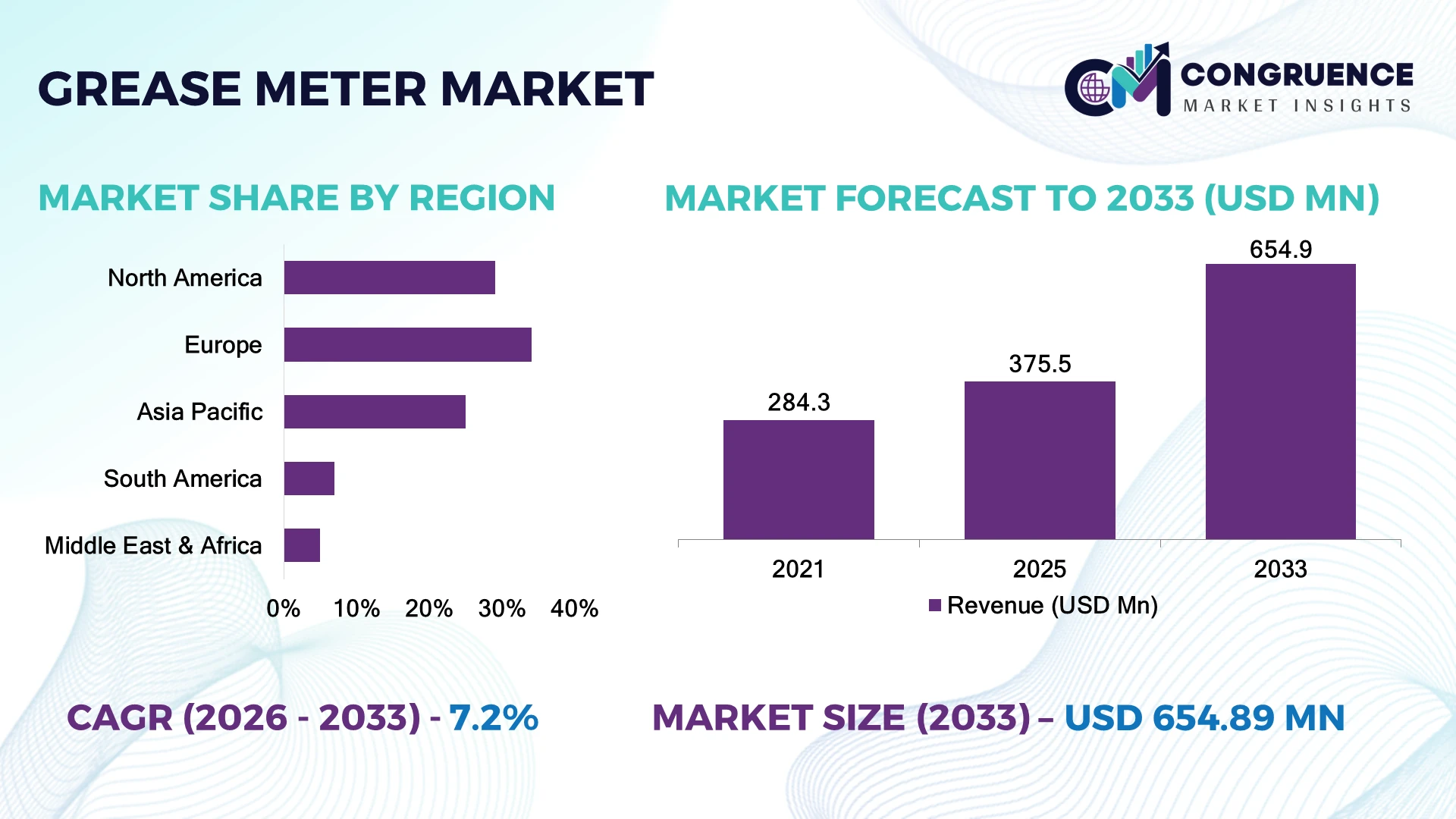
The Global Grease Meter Market was valued at USD 375.5 Million in 2025 and is anticipated to reach a value of USD 654.9 Million by 2033 expanding at a CAGR of 7.2% between 2026 and 2033. Growth is being driven by the rapid deployment of automated lubrication monitoring systems across manufacturing, mining, and heavy-equipment maintenance operations to reduce downtime and optimize asset performance.
Germany dominates the market with an estimated 24% share, supported by its advanced automotive, industrial machinery, and precision engineering sectors. More than 68% of large manufacturing facilities in Germany utilize predictive maintenance technologies, compared with approximately 49% in Italy. Industrial digitalization investments exceeding €20 billion and widespread Industry 4.0 adoption continue to accelerate grease monitoring integration across production environments. The ongoing European industrial modernization agenda further reinforces deployment momentum.
Companies prioritizing intelligent monitoring capabilities and industrial automation partnerships are positioned to capture the highest-value opportunities.
Market Size & Growth: USD 375.5 million in 2025, reaching USD 654.9 million by 2033 at 7.2% CAGR, driven by predictive maintenance adoption and industrial automation expansion.
Top Growth Drivers: Predictive maintenance adoption (+42%), smart factory deployment (+37%), equipment uptime optimization initiatives (+31%).
Short-Term Forecast: By 2028, lubrication monitoring efficiency is expected to improve by 18% while maintenance-related downtime declines by 14%.
Emerging Technologies: AI-based diagnostics, wireless IoT sensors, and cloud-connected asset monitoring platforms are reshaping operations.
Regional Leaders: Europe (~USD 220 million), North America (~USD 145 million), Asia-Pacific (~USD 118 million); each supported by industrial digitization initiatives.
Consumer/End-User Trends: Over 55% of large industrial facilities are integrating condition-monitoring systems into maintenance workflows.
Pilot/Case Example: In 2024, a heavy-equipment maintenance program achieved a 21% reduction in lubrication failures through sensor-based monitoring.
Competitive Landscape: Leading suppliers collectively control nearly 35% of the market, including SKF, Schaeffler, Timken, Parker Hannifin, and Graco.
Regulatory & ESG Impact: Industrial efficiency initiatives have reduced lubricant waste by approximately 15% in monitored facilities.
Investment & Funding: More than USD 450 million has been directed toward industrial monitoring, automation, and maintenance technologies globally.
Innovation & Future Outlook: Edge analytics, digital twins, and real-time lubrication intelligence are becoming central competitive differentiators.
Grease meter solutions are increasingly deployed across manufacturing plants, mining operations, transportation fleets, and energy infrastructure to improve lubrication accuracy and equipment reliability. Recent innovation focuses on wireless sensors, remote monitoring platforms, and AI-enabled diagnostics capable of reducing unplanned maintenance events by over 20%. Growing emphasis on operational efficiency, combined with tighter asset-management requirements and evolving industrial supply-chain resilience strategies, continues to expand adoption across high-utilization industrial environments, setting the stage for deeper strategic transformation.
Grease meter technologies are becoming strategically important as industrial operators prioritize asset reliability, maintenance efficiency, and production continuity. Equipment-intensive industries increasingly rely on lubrication intelligence to support digital maintenance programs and reduce operational disruptions. The ongoing shift toward connected factories and infrastructure modernization is accelerating deployment across manufacturing, mining, transportation, and energy facilities.
Modern sensor-enabled grease meters deliver up to 25% greater monitoring accuracy than conventional manual inspection methods while reducing maintenance labor requirements by nearly 18%. Germany and the United States lead in advanced deployment through established industrial automation ecosystems, while China is expanding implementation rapidly through large-scale manufacturing upgrades. Facilities integrating lubrication monitoring into predictive maintenance programs report measurable reductions in equipment failure frequency and maintenance scheduling inefficiencies.
Over the next two to three years, adoption is expected to accelerate as companies integrate grease monitoring with broader asset-performance platforms. Equipment manufacturers are expanding partnerships with industrial software providers and sensor developers to strengthen service portfolios. A practical example includes automated lubrication systems in mining fleets that continuously monitor grease consumption and equipment condition. Organizations that establish intelligent maintenance ecosystems today will secure stronger operational resilience, lower lifecycle costs, and a sustainable competitive advantage.
Predictive maintenance adoption is transforming lubrication management across industrial sectors. More than 55% of large manufacturing facilities now utilize condition-monitoring technologies, while equipment downtime reduction of 15–25% has been documented following deployment of automated monitoring solutions. Germany, Japan, and the United States continue investing heavily in industrial digitalization, creating strong demand for real-time grease measurement systems. The shift toward connected operations enables maintenance teams to identify lubrication deficiencies before component failure occurs. As a result, manufacturers are expanding smart monitoring portfolios, investing in wireless sensing technologies, and forming partnerships with industrial software providers. A key strategic insight is that lubrication data is increasingly becoming a critical operational input within enterprise asset management platforms, elevating grease meters from maintenance tools to productivity optimization assets.
Industrial facilities often face significant implementation challenges due to equipment compatibility requirements and modernization expenses. Initial deployment costs can increase maintenance technology budgets by 12–20%, while integration with legacy machinery may require additional engineering investments. Approximately 40% of older industrial assets operate with lubrication systems lacking digital connectivity, limiting immediate deployment opportunities. Supply-chain disruptions affecting sensor components and industrial electronics have also extended procurement timelines in several manufacturing markets. To mitigate risks, companies are diversifying supplier networks, localizing component sourcing, and negotiating long-term procurement agreements. A notable operational insight is that integration complexity frequently outweighs hardware cost considerations, making interoperability capabilities a major purchasing criterion for industrial buyers.
Industrial IoT adoption continues creating high-value opportunities for advanced grease monitoring solutions. More than 60% of smart factory initiatives now include equipment health monitoring components, while cloud-based maintenance platforms have improved maintenance planning efficiency by approximately 22%. China and India are investing aggressively in industrial modernization, creating untapped demand across manufacturing clusters and infrastructure projects. Emerging technologies such as AI-driven lubrication analytics, digital twins, and edge computing enable deeper operational visibility and optimized maintenance scheduling. Companies are increasing research investments, developing connected product ecosystems, and expanding strategic technology partnerships. A distinctive opportunity lies in transforming grease measurement data into predictive operational intelligence that supports broader equipment-performance optimization strategies.
As grease monitoring systems become increasingly connected, organizations face challenges related to data integration, workforce capabilities, and long-term system scalability. Nearly 35% of industrial operators report difficulties integrating maintenance data across multiple platforms, while skilled maintenance analytics professionals remain in limited supply. The growing volume of sensor-generated information requires stronger cybersecurity controls and advanced data management architectures. In highly automated facilities, inconsistent data standards can reduce deployment efficiency and limit interoperability benefits. Companies must address these challenges through workforce training, digital infrastructure investments, and cross-platform integration strategies. A critical strategic insight is that long-term competitiveness will depend not only on monitoring hardware performance but also on the ability to convert maintenance data into actionable operational intelligence at scale.
Wireless Monitoring Becomes Standard Industrial operators are accelerating migration from manual grease inspection to wireless monitoring platforms, with sensor-based deployments increasing by nearly 32% over the past two years. More than 58% of large manufacturing facilities now integrate lubrication data into centralized maintenance systems. This shift reduces inspection time by approximately 20% while improving maintenance scheduling accuracy. Suppliers are expanding wireless product portfolios and forming automation partnerships to support enterprise-scale deployments.
AI-Driven Maintenance Optimization Artificial intelligence is increasingly being applied to lubrication analytics, with predictive maintenance programs reporting up to 24% fewer lubrication-related equipment failures. Around 47% of industrial asset managers now utilize data-driven maintenance workflows compared with less than 35% three years ago. Companies are embedding machine-learning capabilities into monitoring platforms to improve fault detection speed and support autonomous maintenance decision-making across complex production environments.
Industrial Sustainability Compliance Focus Tightening equipment efficiency standards and lubricant waste reduction initiatives are influencing purchasing decisions. Facilities implementing advanced grease monitoring have reported lubricant consumption reductions of 12–18% and maintenance waste reductions exceeding 15%. German and Japanese manufacturers are increasingly linking lubrication performance to broader sustainability objectives. Equipment suppliers are responding through smart metering technologies that improve resource utilization and support operational compliance requirements.
Integrated Asset Management Expansion Enterprises are consolidating maintenance technologies into unified asset-performance ecosystems. More than 52% of industrial organizations now connect lubrication monitoring with enterprise asset management software, while maintenance response times have improved by approximately 19%. Labor shortages in skilled maintenance functions are accelerating automation investments. Vendors are expanding software interoperability, cloud connectivity, and digital service partnerships to strengthen long-term customer retention and operational visibility.
The market is segmented into Digital Grease Meters, Mechanical Grease Meters, Inline Grease Meters, Portable Grease Meters, and Smart IoT-Enabled Grease Meters. Digital Grease Meters lead the market with an estimated share of approximately 39%, supported by superior measurement accuracy, easier integration with maintenance systems, and improved operational visibility. Industrial facilities increasingly favor digital solutions because they reduce manual recording errors by nearly 25% and improve lubrication consistency across critical equipment. Mechanical Grease Meters remain relevant in cost-sensitive environments where durability and simplicity are prioritized, particularly in heavy-duty field operations. Smart IoT-Enabled Grease Meters represent the fastest-growing segment as industrial operators expand predictive maintenance programs and connected asset strategies. Adoption of connected monitoring technologies has increased by more than 30% among large manufacturing enterprises. Portable Grease Meters continue gaining traction in mobile service operations, while Inline Grease Meters support continuous monitoring requirements in automated production environments. Leading suppliers are investing in sensor innovation, software integration capabilities, and industrial connectivity partnerships to strengthen competitive positioning and capture evolving enterprise demand.
The market is segmented into Manufacturing Plants, Mining Equipment, Construction Machinery, Transportation Fleets, and Energy & Utilities Infrastructure. Manufacturing Plants account for approximately 36% of total demand due to high equipment utilization rates, continuous production requirements, and increasing predictive maintenance deployment. Large industrial facilities report maintenance efficiency improvements exceeding 18% following implementation of advanced lubrication monitoring programs. Mining Equipment remains a significant application segment where harsh operating environments make lubrication accuracy critical for equipment reliability and lifecycle management. Transportation Fleets represent the fastest-growing application area as fleet operators focus on reducing maintenance downtime and improving asset availability. Connected monitoring deployments within commercial fleet operations have expanded by nearly 28% over recent years. Construction Machinery continues benefiting from equipment modernization initiatives, while Energy & Utilities Infrastructure increasingly utilizes grease monitoring technologies to support reliability-focused maintenance practices. Companies are expanding deployment capabilities, integrating lubrication data with maintenance software, and automating inspection workflows to improve operational performance across diverse industrial applications.
The market is segmented into Manufacturing Companies, Mining Operators, Construction Firms, Transportation & Logistics Providers, and Energy & Utility Organizations. Manufacturing Companies hold the largest share at approximately 41%, driven by extensive equipment fleets, continuous production requirements, and growing investment in digital maintenance infrastructure. More than 55% of large manufacturers have integrated lubrication monitoring into broader reliability programs. Mining Operators remain a major buyer category because equipment failure costs are substantially higher in remote and production-intensive environments. Transportation & Logistics Providers represent the fastest-growing end-user segment as fleet operators pursue operational efficiency and maintenance optimization. Adoption of connected maintenance technologies within fleet operations has increased by nearly 27%, supporting stronger demand for monitoring solutions. Construction Firms continue investing in equipment productivity improvements, while Energy & Utility Organizations increasingly deploy grease monitoring technologies to improve infrastructure reliability. Suppliers are responding through industry-specific product customization, strategic service partnerships, and integrated software ecosystems that address diverse operational requirements and purchasing priorities.
Europe accounted for the largest market share at 34% in 2025 however, Asia-Pacific is expected to register the fastest growth, expanding at a CAGR of 8.4% between 2026 and 2033.
North America represented approximately 29% of the global market in 2025, supported by widespread deployment of predictive maintenance systems across manufacturing, energy, transportation, and mining operations. The United States and Canada continue investing in asset reliability programs that integrate lubrication monitoring with enterprise maintenance platforms. More than 60% of large industrial facilities in the region utilize condition-monitoring technologies, creating strong demand for precision grease measurement solutions. The market also benefits from high industrial automation penetration and increasing adoption of Industrial Internet of Things (IIoT) infrastructure. Recent deployment initiatives have enabled maintenance teams to reduce lubrication-related downtime by nearly 20% while improving equipment utilization rates. Companies are expanding software integration capabilities and strengthening industrial partnerships to support broader maintenance digitalization strategies.
United States Market Outlook: The United States remains the largest market in North America due to its extensive manufacturing base, advanced automation ecosystem, and mature industrial maintenance practices. More than 65% of large-scale manufacturing plants have adopted predictive maintenance frameworks incorporating lubrication monitoring technologies. Growth is supported by strong investments in industrial automation, energy infrastructure modernization, and fleet management optimization. Equipment operators increasingly prioritize real-time maintenance intelligence to improve productivity, extend asset life cycles, and reduce operational disruptions across critical industrial sectors.
Europe accounted for the largest regional share, supported by strong industrial automation deployment, advanced manufacturing infrastructure, and stringent equipment-efficiency standards. Industrial operators increasingly integrate grease monitoring systems within broader digital maintenance ecosystems to improve equipment reliability and operational visibility. Germany, France, and Italy remain key deployment hubs due to their large manufacturing and machinery sectors. More than 58% of industrial enterprises across major European manufacturing economies have accelerated investments in connected maintenance technologies. Regulatory emphasis on resource efficiency and equipment optimization continues supporting adoption across production-intensive industries. Companies are investing in intelligent lubrication monitoring solutions, sensor technologies, and software-enabled maintenance platforms to enhance productivity and maintenance planning effectiveness.
Germany Market Outlook: Germany represents the region’s most strategically significant market, supported by its leadership in industrial machinery, automotive manufacturing, and Industry 4.0 implementation. Approximately 68% of large industrial facilities utilize advanced maintenance technologies integrated with production systems. Strong engineering capabilities and substantial investments in factory modernization continue accelerating adoption of digital grease monitoring solutions. German enterprises increasingly deploy connected maintenance architectures that combine lubrication monitoring, machine diagnostics, and operational analytics to improve efficiency and strengthen global manufacturing competitiveness.
Asia-Pacific accounted for approximately 25% of the global market and is experiencing rapid adoption across manufacturing, mining, transportation, and infrastructure sectors. Expanding industrial production capacity, rising automation investment, and modernization of maintenance practices are driving deployment across major economies. China, Japan, South Korea, and India are increasingly integrating lubrication monitoring technologies into large-scale industrial operations. Industrial automation investments across key manufacturing sectors have increased by more than 30% over recent years, creating favorable conditions for connected maintenance solutions. Companies are expanding regional production capabilities and strengthening distributor networks to support growing demand from asset-intensive industries seeking higher operational reliability.
China Market Outlook: China remains the dominant market within Asia-Pacific due to its vast manufacturing ecosystem, extensive industrial infrastructure, and ongoing factory modernization programs. The country accounts for a significant share of global industrial equipment deployment, creating substantial demand for advanced maintenance technologies. More than 50% of large manufacturing enterprises have accelerated digital transformation initiatives focused on equipment monitoring and operational efficiency. Domestic manufacturers and international suppliers are expanding partnerships, localized production, and smart factory solutions to capitalize on increasing industrial digitalization requirements.
South America accounted for approximately 7% of the global market, with demand concentrated in mining, construction, transportation, and industrial processing sectors. Equipment-intensive industries increasingly recognize the value of lubrication monitoring in reducing maintenance costs and improving operational continuity. Mining operations in particular are adopting advanced grease monitoring solutions to improve equipment availability in challenging environments. Infrastructure modernization projects and industrial efficiency initiatives are supporting deployment across key markets. However, varying levels of digital infrastructure and capital investment continue influencing adoption rates. Companies are addressing these limitations through localized service networks, strategic partnerships, and cost-effective monitoring solutions tailored to regional operating conditions.
Brazil Market Outlook: Brazil represents the largest market in South America due to its extensive mining operations, industrial manufacturing activities, and transportation infrastructure. Heavy-equipment operators are increasingly deploying predictive maintenance systems to improve asset utilization and reduce downtime. The country’s mining sector continues investing in equipment monitoring technologies, with several large operators expanding digital maintenance programs across extraction and processing facilities. Industrial modernization efforts and growing awareness of reliability-focused maintenance strategies are further strengthening long-term demand for grease monitoring solutions.
The Middle East & Africa accounted for approximately 5% of the global market, driven by industrial diversification initiatives, energy-sector modernization, and expanding infrastructure investments. Oil and gas operations, mining facilities, transportation networks, and industrial processing plants increasingly utilize lubrication monitoring systems to improve equipment performance and maintenance efficiency. Governments and enterprises are prioritizing asset reliability as part of broader industrial transformation programs. Several large-scale industrial projects have incorporated digital maintenance technologies, improving operational visibility and reducing equipment failure risks. Companies are expanding regional partnerships and technical support capabilities to strengthen deployment across complex industrial environments.
Saudi Arabia Market Outlook: Saudi Arabia is the most strategically important market within the region due to extensive energy infrastructure, industrial diversification initiatives, and large-scale modernization programs. Industrial operators are increasingly implementing advanced asset-management technologies to support operational efficiency objectives. Major industrial facilities continue expanding digital maintenance capabilities, with connected monitoring technologies becoming more common across energy, petrochemical, and manufacturing assets. Strong infrastructure investment momentum and long-term industrial transformation strategies continue creating favorable conditions for advanced grease monitoring solution deployment.
The Grease Meter Market is characterized by competition between global industrial technology leaders such as SKF, Schaeffler, Graco, Timken, and Parker Hannifin and regional lubrication-equipment specialists focused on cost-efficient deployment. The top five players collectively account for approximately 42% of market activity, creating a moderately consolidated structure where technology differentiation increasingly outweighs price competition. Global leaders compete through digital monitoring platforms, while regional suppliers challenge with localized service networks and lower ownership costs. Competition is driven by measurement accuracy, software integration, reliability, and maintenance efficiency. Smart monitoring systems can improve lubrication visibility by over 25%, while predictive maintenance integration reduces unplanned downtime by nearly 20%. Companies are expanding industrial partnerships, strengthening distributor networks, and integrating lubrication monitoring into broader asset-management ecosystems. Vertical integration between sensor technologies, software analytics, and maintenance services is becoming a key competitive advantage. The competitive shift is moving toward intelligent monitoring and connected maintenance platforms. High integration requirements and industrial qualification standards remain significant barriers. Winning requires scalable digital capabilities, strong industrial partnerships, and proven operational performance.
Schaeffler AG
Graco Inc.
The Timken Company
Parker Hannifin Corporation
Bijur Delimon International
Cenlub Systems
DropsA S.p.A.
Lubecore International
Oil-Rite Corporation
Pricol Limited
I.L.C. Srl
Alemite LLC
BEKA Lubrication
Traditional mechanical grease meters are rapidly being replaced by digital and connected monitoring technologies that provide greater measurement accuracy, automated data capture, and real-time visibility. Modern digital systems deliver approximately 20–30% higher measurement precision than legacy manual devices while reducing inspection workloads by nearly 18%. Adoption of digital monitoring platforms has exceeded 55% among large industrial maintenance programs, particularly within manufacturing, mining, and transportation sectors where equipment uptime directly affects operational performance.
The most significant emerging technologies include Industrial IoT connectivity, AI-assisted lubrication analytics, wireless sensing networks, and cloud-based maintenance platforms. AI-enabled monitoring systems have demonstrated maintenance planning improvements of approximately 22%, while wireless deployments can reduce installation complexity by nearly 15%. Integration with enterprise asset management software is becoming standard practice, allowing lubrication data to support predictive maintenance strategies. Global industrial leaders and digitally mature manufacturers benefit most from these technologies because they can scale maintenance intelligence across large equipment fleets.
Between 2026 and 2028, competitive advantage will increasingly depend on intelligent monitoring ecosystems rather than standalone hardware. Edge analytics, digital twins, and automated lubrication optimization are expected to accelerate deployment across asset-intensive industries. Companies investing early in connected maintenance architectures will strengthen equipment reliability, improve maintenance efficiency, and establish stronger operational resilience as industrial digitalization continues advancing.
May 2024 – Graco Inc. launched Pulse® Asset, an extension of its fluid management platform using programmable ID tags to track asset-level lubricant dispensing and maintenance activity. The system improves fluid traceability across industrial facilities and strengthens digital maintenance workflows. Source: www.investors.graco.com
September 2025 – Schaeffler expanded its smart lubrication portfolio with the FAG OPTIME C4 lubricator, offering a larger lubricant reservoir and app-controlled monitoring capabilities. The solution supports wider deployment across mining and industrial applications while improving lubrication reliability and maintenance visibility. Source: www.schaeffler.us
January 2026 – Schaeffler introduced FAG OPTIME E-CM, combining electrical condition monitoring with its existing smart lubrication ecosystem. The platform adds AI-supported diagnostics for electrically driven assets, enabling broader predictive maintenance coverage and improved equipment health assessment. Source: www.schaeffler.com
March 2026 – The Timken Company acquired Bijur Delimon International to strengthen its automated lubrication systems portfolio. The transaction expands lubrication capabilities, broadens industrial market access, and enhances service coverage across key maintenance-intensive sectors.
This report provides comprehensive analysis of the Grease Meter Market across key technology categories, industrial applications, end-user groups, and major geographic regions. Coverage includes Digital Grease Meters, Mechanical Grease Meters, Inline Grease Meters, Portable Grease Meters, and Smart IoT-Enabled Grease Meters, alongside deployment across manufacturing plants, mining equipment, construction machinery, transportation fleets, and energy infrastructure. The study evaluates adoption patterns, technology integration trends, and operational performance factors influencing purchasing decisions and deployment priorities.
The report further examines competitive positioning, industrial automation trends, predictive maintenance adoption, and evolving lubrication management strategies across North America, Europe, Asia-Pacific, South America, and the Middle East & Africa. More than 55% of large industrial facilities are incorporating condition-monitoring technologies into maintenance programs, highlighting the growing importance of connected monitoring solutions. Strategic insights support investment evaluation, market-entry planning, expansion decisions, partnership development, and long-term competitive positioning between 2026 and 2033 while identifying emerging opportunities across smart maintenance and industrial digitalization ecosystems.
| Report Attribute / Metric | Details |
|---|---|
| Market Revenue (2025) | USD 375.5 Million |
| Market Revenue (2033) | USD 654.9 Million |
| CAGR (2026–2033) | 7.2% |
| Base Year | 2025 |
| Forecast Period | 2026–2033 |
| Historic Period | 2021–2025 |
| Segments Covered |
By Type
By Application
By End-User
|
| Key Deliverables | Revenue Forecast; Market Trends; Growth Drivers & Restraints; Technology Insights; Segmentation Analysis; Regional Insights; Competitive Landscape; Regulatory & ESG Overview; Recent Developments |
| Regions Covered | North America; Europe; Asia-Pacific; South America; Middle East & Africa |
| Companies Profiled | SKF; Schaeffler AG; Graco Inc.; The Timken Company; Parker Hannifin Corporation; Bijur Delimon International; Cenlub Systems; DropsA S.p.A.; Lubecore International; Oil-Rite Corporation; Pricol Limited; I.L.C. Srl; Alemite LLC; BEKA Lubrication |
| Customization & Pricing | Available on Request (10% Customization Free) |




