
Reports
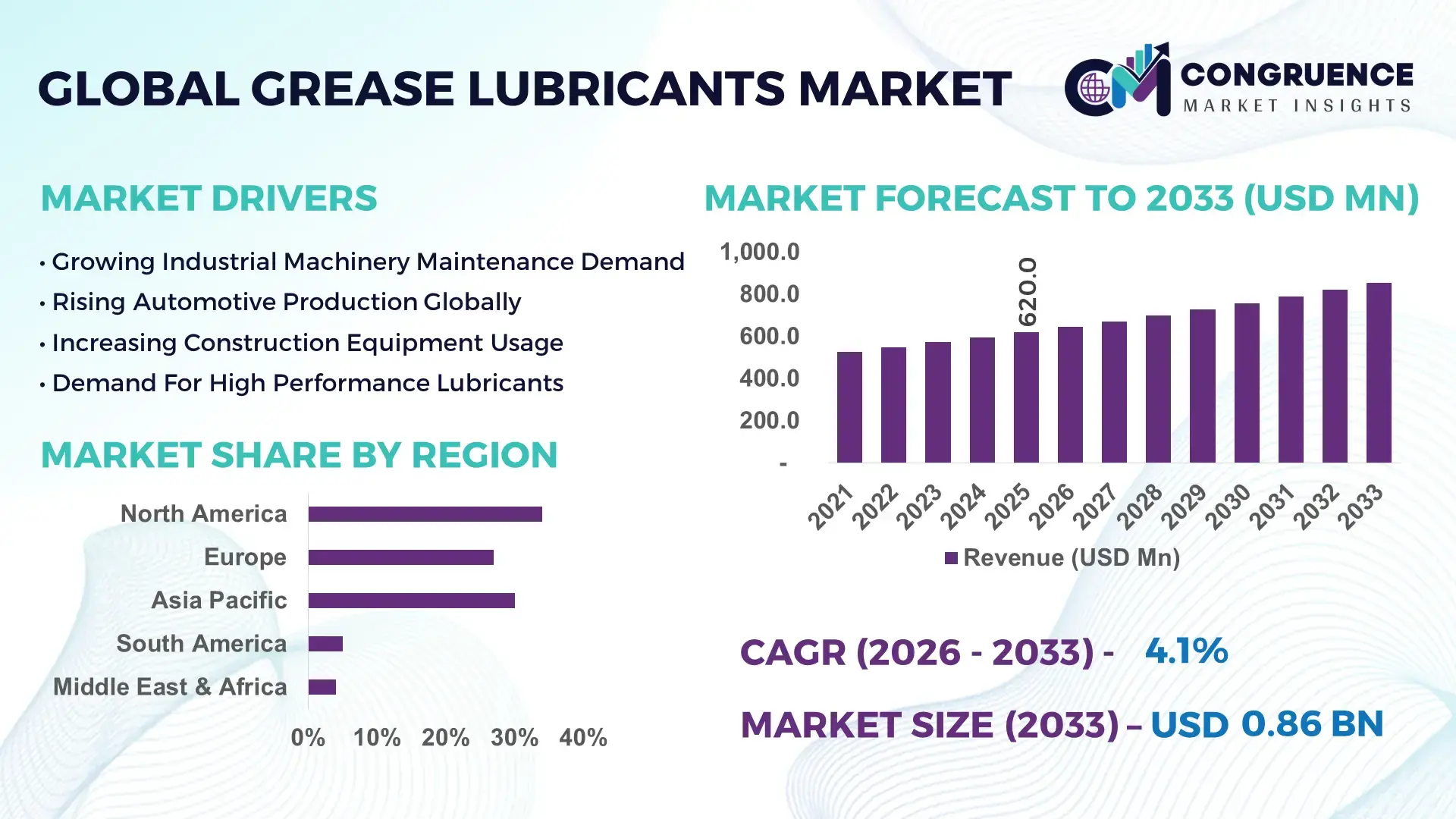
The Global Grease Lubricants Market was valued at USD 620.0 Million in 2025 and is anticipated to reach a value of USD 855.1 Million by 2033 expanding at a CAGR of 4.1% between 2026 and 2033, according to an analysis by Congruence Market Insights. The growth is primarily driven by increasing demand for high-performance lubrication solutions across automotive, industrial machinery, and heavy equipment sectors requiring extended operational efficiency and reduced maintenance cycles.
The United States continues to demonstrate strong industrial integration within the grease lubricants market, supported by an annual production capacity exceeding 1.2 million metric tons of lubricants, with grease formulations accounting for approximately 15–18% of total lubricant output. Over USD 3.5 billion has been invested in advanced lubrication technologies and synthetic grease development between 2020 and 2025, particularly targeting aerospace, automotive, and manufacturing sectors. Industrial applications contribute nearly 48% of total grease consumption, while automotive usage accounts for around 32%. Adoption of lithium complex and polyurea-based greases has increased by over 27% in high-load applications, driven by automation in manufacturing plants. Additionally, over 60% of large-scale industrial facilities in the country have implemented automated lubrication systems, enhancing equipment lifespan by up to 35% and reducing unplanned downtime significantly.
Market Size & Growth: Valued at USD 620.0 Million in 2025, projected to reach USD 855.1 Million by 2033, growing at 4.1% CAGR due to rising industrial automation and vehicle production.
Top Growth Drivers: Industrial automation adoption (42%), EV component lubrication demand (28%), equipment lifecycle extension benefits (35%).
Short-Term Forecast: By 2028, predictive lubrication technologies are expected to improve maintenance efficiency by 22% and reduce operational downtime by 18%.
Emerging Technologies: Nano-additive greases, bio-based lubricants, and AI-enabled predictive lubrication systems are gaining rapid traction.
Regional Leaders: North America (~USD 310 Million by 2033) driven by industrial automation; Asia-Pacific (~USD 290 Million) led by manufacturing expansion; Europe (~USD 180 Million) supported by sustainability mandates.
Consumer/End-User Trends: Automotive OEMs and heavy industries represent over 65% of demand, with increasing shift toward synthetic and long-life greases.
Pilot or Case Example: In 2024, a manufacturing facility reduced equipment downtime by 25% using AI-based lubrication monitoring systems.
Competitive Landscape: Market leader holds ~18% share, followed by 3–5 key players focusing on specialty grease innovation and global expansion.
Regulatory & ESG Impact: Over 40% of manufacturers are transitioning toward biodegradable greases aligned with environmental regulations.
Investment & Funding Patterns: More than USD 2.8 billion invested globally in advanced lubrication R&D and sustainable formulations since 2022.
Innovation & Future Outlook: Integration of IoT-based lubrication systems and high-performance synthetic greases is expected to redefine operational efficiency standards.
Industrial machinery accounts for approximately 45% of total grease demand, followed by automotive applications at nearly 30%. Recent innovations include lithium-free and bio-based grease formulations, improving sustainability by up to 20%. Regulatory pressure on emissions and waste management is accelerating adoption across Europe and North America, while Asia-Pacific continues to dominate consumption with over 50% demand driven by manufacturing expansion and infrastructure growth.
The Grease Lubricants Market holds critical strategic importance across industrial, automotive, and energy sectors due to its role in enhancing equipment reliability, reducing operational downtime, and optimizing lifecycle costs. With over 65% of heavy industrial machinery globally relying on grease-based lubrication systems, the market has become an essential component of predictive maintenance strategies. Organizations are increasingly prioritizing high-performance synthetic and specialty greases to address rising operational complexities and stringent environmental regulations.
Advanced lubrication technologies such as nano-enhanced greases deliver up to 30% improved wear resistance compared to conventional mineral-based greases, significantly enhancing machinery efficiency. Asia-Pacific dominates in volume due to large-scale manufacturing operations, while Europe leads in adoption with over 55% of enterprises integrating eco-friendly and biodegradable grease solutions. By 2028, AI-enabled predictive maintenance systems are expected to reduce equipment failure rates by nearly 25%, transforming lubrication management practices across industries.
Sustainability commitments are also shaping market pathways, with firms targeting up to 40% reduction in carbon emissions through adoption of bio-based lubricants and recyclable packaging solutions by 2030. In 2024, a major industrial manufacturer in Germany achieved a 22% reduction in maintenance costs through implementation of automated lubrication systems integrated with IoT sensors.
Looking ahead, the Grease Lubricants Market is positioned as a cornerstone of industrial resilience, supporting digital transformation, regulatory compliance, and long-term sustainability objectives while enabling operational excellence across global industries.
The Grease Lubricants Market is influenced by a combination of industrial expansion, automotive production growth, and advancements in lubrication technologies. Increasing mechanization across manufacturing sectors has led to higher demand for reliable lubrication systems capable of withstanding extreme pressures, temperatures, and environmental conditions. Over 70% of industrial equipment globally depends on grease lubrication due to its ability to remain in place and provide long-term protection. Additionally, the transition toward electric vehicles is reshaping product demand, as EV components require specialized greases with enhanced thermal stability and electrical insulation properties. Environmental regulations are also driving innovation, with more than 45% of manufacturers focusing on developing biodegradable and low-toxicity grease solutions. Furthermore, digital transformation in maintenance practices, including IoT-enabled monitoring systems, is influencing purchasing decisions, as industries increasingly seek solutions that reduce downtime and improve operational efficiency.
Industrial automation has significantly increased the need for high-performance lubrication systems capable of supporting continuous operations. Automated manufacturing plants operate at utilization rates exceeding 85%, requiring consistent lubrication to prevent wear and tear. Approximately 60% of global factories have implemented automation technologies, resulting in a 30% increase in demand for specialty greases designed for high-speed and high-load applications. Robotics and CNC machinery rely heavily on precision lubrication, where even minor inefficiencies can reduce productivity by up to 20%. Additionally, automated lubrication systems reduce manual intervention by nearly 40%, enhancing efficiency and reducing maintenance costs. The integration of smart sensors in industrial equipment has further driven demand for advanced grease formulations that support predictive maintenance strategies and extend machinery lifespan.
The Grease Lubricants Market faces significant challenges due to volatility in raw material prices, particularly base oils, lithium, and additives. Lithium, a key component in widely used grease formulations, has experienced price fluctuations exceeding 60% in recent years, directly impacting production costs. Over 70% of grease products rely on petroleum-based inputs, making them sensitive to crude oil price variations. These cost pressures are often transferred to end-users, leading to reduced adoption in price-sensitive markets. Additionally, supply chain disruptions and geopolitical factors have created inconsistencies in raw material availability, affecting production planning. Smaller manufacturers, which account for nearly 35% of market participants, are particularly vulnerable to these fluctuations, limiting their ability to invest in innovation and expansion.
Bio-based lubricants present a significant growth opportunity in the Grease Lubricants Market, driven by increasing environmental regulations and sustainability initiatives. Approximately 40% of industrial companies are actively exploring eco-friendly lubrication alternatives to reduce environmental impact. Bio-based greases offer up to 25% lower toxicity and improved biodegradability compared to conventional products, making them suitable for environmentally sensitive applications such as agriculture, marine, and forestry. Governments across Europe and North America are promoting the adoption of green lubricants through incentives and regulatory frameworks, accelerating market penetration. Additionally, advancements in vegetable oil-based formulations have improved performance characteristics, enabling their use in high-temperature and heavy-load applications. This shift is expected to create new revenue streams and expand application areas across industries.
Despite technological advancements, grease lubricants face performance challenges under extreme operating conditions such as high temperatures, heavy loads, and harsh environments. Conventional greases can lose consistency or degrade at temperatures exceeding 200°C, limiting their effectiveness in industries such as aerospace and heavy manufacturing. Approximately 25% of industrial failures are attributed to inadequate lubrication under extreme conditions, highlighting the need for advanced formulations. Developing high-performance greases requires significant investment in research and testing, increasing production costs. Additionally, compatibility issues between different grease types can lead to equipment damage, further complicating maintenance practices. These challenges necessitate continuous innovation and stringent quality control measures to ensure reliability and performance across diverse applications.
Growing adoption of synthetic greases improving efficiency by over 30%: Synthetic grease usage has increased by approximately 35% across industrial sectors due to superior thermal stability and extended service intervals. These greases can operate efficiently at temperatures exceeding 250°C, reducing maintenance frequency by nearly 40% and improving equipment lifespan by up to 30% in high-load environments.
Expansion of bio-based lubricants reaching 40% industrial adoption trials: Bio-based grease formulations are gaining traction, with over 40% of manufacturing companies testing eco-friendly alternatives. These products reduce environmental impact by up to 25% and are increasingly used in agriculture and marine applications where regulatory compliance is critical.
Integration of IoT-enabled lubrication systems enhancing monitoring by 50%: Smart lubrication systems equipped with sensors are being deployed in over 55% of large industrial facilities, enabling real-time monitoring and predictive maintenance. These systems have reduced unplanned downtime by nearly 20% and improved lubrication efficiency by up to 50%.
Rising demand from electric vehicles increasing specialized grease usage by 28%: EV production has led to a 28% increase in demand for specialized greases with high electrical resistance and thermal stability. These greases are essential for components such as bearings and motors, supporting longer operational cycles and improved performance.
The Grease Lubricants Market is segmented based on type, application, and end-user industries, each contributing distinctively to overall demand patterns. Lithium-based greases dominate due to their versatility and cost-effectiveness, while synthetic and bio-based greases are gaining traction in specialized applications. Industrial applications account for a significant portion of demand, driven by manufacturing and heavy machinery operations. Automotive applications follow closely, supported by rising vehicle production and maintenance requirements. End-user industries such as construction, mining, and energy also contribute substantially, with increasing adoption of advanced lubrication systems. Regional variations in consumption patterns reflect differences in industrialization levels, regulatory frameworks, and technological adoption, shaping segmentation dynamics across global markets.
Lithium-based greases dominate the Grease Lubricants Market, accounting for approximately 52% of total demand due to their superior water resistance, mechanical stability, and cost efficiency. These greases are widely used across automotive and industrial sectors, making them the preferred choice for general-purpose lubrication. Calcium-based and sodium-based greases collectively contribute around 23%, serving niche applications where specific properties such as corrosion resistance are required. Synthetic greases represent the fastest-growing segment, expanding at an estimated CAGR of 5.8%, driven by increasing demand for high-performance lubrication in extreme conditions. These greases offer enhanced thermal stability and longer service life, making them suitable for aerospace, automotive, and heavy industrial applications. Polyurea-based greases are also gaining traction, particularly in electric motor applications due to their excellent oxidation stability. The remaining specialty greases, including aluminum complex and bentonite-based products, account for approximately 25% of the market, catering to specific industrial needs where standard formulations are insufficient.
• In 2025, a leading automotive manufacturer deployed polyurea-based grease in electric vehicle motors, improving bearing lifespan by over 30% and reducing maintenance cycles significantly.
Industrial machinery applications lead the Grease Lubricants Market with approximately 45% share, driven by the need for continuous lubrication in heavy equipment and manufacturing processes. Automotive applications account for around 30%, supported by vehicle maintenance requirements and increasing production volumes. Construction and mining applications contribute nearly 15%, reflecting growing infrastructure development activities globally. Electric vehicle applications are the fastest-growing segment, expanding at an estimated CAGR of 6.2%, fueled by the need for specialized lubrication solutions that can withstand high temperatures and electrical loads. Aerospace and marine applications also show steady growth, requiring high-performance greases for critical components. In 2025, more than 48% of industrial facilities globally reported adopting advanced lubrication systems to enhance operational efficiency. Additionally, over 35% of automotive service providers are transitioning toward synthetic greases for improved performance and reduced maintenance frequency.
• In 2024, a global manufacturing firm implemented automated lubrication systems across 20 facilities, reducing downtime by 25% and improving equipment efficiency significantly.
Manufacturing remains the leading end-user segment, accounting for approximately 40% of total grease lubricant consumption due to extensive use of machinery and equipment. Automotive OEMs and aftermarket services contribute around 28%, driven by vehicle production and maintenance activities. The construction and mining sectors collectively hold nearly 18%, reflecting demand from heavy equipment operations. The energy sector is the fastest-growing end-user segment, expanding at an estimated CAGR of 5.5%, supported by increasing investments in renewable energy and power generation infrastructure. Wind energy applications, in particular, require specialized greases capable of operating under extreme conditions. In 2025, over 52% of manufacturing companies reported integrating predictive maintenance systems, enhancing lubrication efficiency and reducing operational costs. Additionally, approximately 37% of energy sector operators have adopted advanced grease formulations to improve equipment reliability.
• In 2025, a wind energy company implemented high-performance grease solutions across turbine systems, increasing operational efficiency by 20% and reducing maintenance intervals significantly.
North America accounted for the largest market share at 34% in 2025 however, Asia-Pacific is expected to register the fastest growth, expanding at a CAGR of 5.2% between 2026 and 2033.
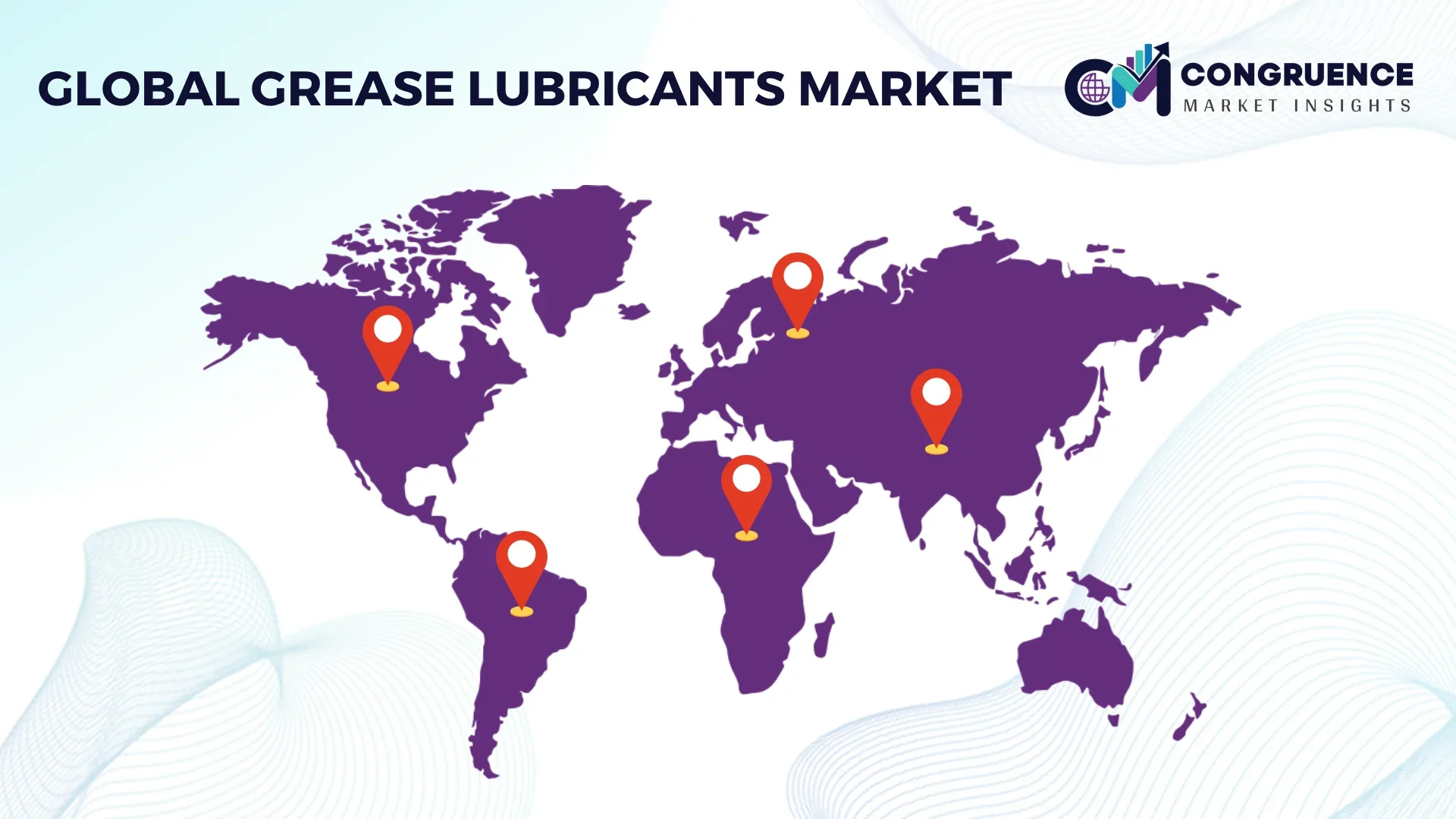
North America benefits from advanced industrial infrastructure, with over 65% of manufacturing facilities utilizing automated lubrication systems. Europe follows with approximately 27% share, driven by stringent environmental regulations and adoption of bio-based lubricants across 45% of industries. Asia-Pacific accounts for nearly 30% of consumption, supported by large-scale manufacturing hubs in China, India, and Japan, contributing over 55% of global industrial output. South America holds around 5% share, while the Middle East & Africa contribute approximately 4%, with demand driven by oil & gas and construction sectors.
North America holds approximately 34% of the global Grease Lubricants Market, driven by strong industrial automation and high adoption of advanced manufacturing technologies. Key industries such as automotive, aerospace, and heavy machinery contribute significantly to demand. Regulatory frameworks emphasize environmental compliance, leading to increased adoption of biodegradable greases in over 40% of industrial applications. Technological advancements, including IoT-enabled lubrication systems, are widely implemented, with over 60% of large enterprises utilizing predictive maintenance tools. A major regional player has focused on expanding synthetic grease production capacity by 20%, supporting demand for high-performance applications. Consumer behavior reflects higher enterprise adoption, particularly in healthcare and finance-linked industrial systems requiring precision machinery.
Europe accounts for around 27% of the Grease Lubricants Market, with Germany, the UK, and France leading regional demand. Strict environmental regulations have driven over 50% of industries to adopt eco-friendly and biodegradable grease formulations. The European Union’s sustainability initiatives encourage reduced emissions and waste, accelerating innovation in bio-based lubricants. Advanced manufacturing sectors are integrating high-performance synthetic greases, improving operational efficiency by up to 25%. A regional manufacturer has introduced lithium-free grease solutions, reducing environmental impact while maintaining performance standards. Consumer behavior shows a strong preference for sustainable products, with regulatory pressure influencing purchasing decisions across industries.
Asia-Pacific represents the fastest-growing region and accounts for nearly 30% of global consumption, led by China, India, and Japan. Manufacturing and infrastructure development drive demand, with over 55% of global industrial output originating from this region. Increasing investments in automation and smart manufacturing are boosting adoption of advanced lubrication systems. A major regional player has expanded production capacity by 25% to meet rising demand from automotive and construction sectors. Consumer behavior is influenced by cost efficiency and scalability, with industries prioritizing high-volume, cost-effective lubrication solutions. Growth is further supported by expanding electric vehicle production and industrial modernization initiatives.
South America holds approximately 5% of the Grease Lubricants Market, with Brazil and Argentina as key contributors. Infrastructure development and energy sector expansion are primary drivers of demand, particularly in mining and oil & gas industries. Government policies supporting industrial growth have increased adoption of advanced lubrication solutions. A regional player has invested in improving distribution networks, enhancing market penetration across remote industrial areas. Consumer behavior is closely tied to economic conditions, with industries prioritizing cost-effective solutions while gradually adopting high-performance greases for efficiency improvements.
The Middle East & Africa account for approximately 4% of the global Grease Lubricants Market, driven by oil & gas, construction, and infrastructure sectors. Countries such as the UAE and South Africa lead regional demand, supported by industrial modernization initiatives. Adoption of advanced lubrication technologies is increasing, with over 30% of large enterprises implementing automated systems. Trade partnerships and regulatory frameworks are encouraging the use of high-performance greases. A regional company has expanded its product portfolio to include synthetic greases tailored for extreme environments. Consumer behavior reflects demand for durable and high-temperature-resistant solutions.
United States – 28% Market share: strong industrial base and high adoption of advanced lubrication technologies
China – 22% Market share: extensive manufacturing capacity and large-scale infrastructure development
The Grease Lubricants Market is moderately fragmented, with over 50 active global and regional players competing across various product categories. The top five companies collectively account for approximately 42% of the market, indicating a balanced mix of consolidation and competitive diversity. Market leaders focus on expanding their portfolios through advanced synthetic and bio-based grease formulations, addressing evolving industrial and environmental requirements.
Strategic initiatives such as mergers, acquisitions, and partnerships are common, with over 20 major collaborations recorded between 2022 and 2025 aimed at enhancing production capabilities and geographic reach. Product innovation remains a key differentiator, with companies investing heavily in R&D to develop high-performance lubricants capable of operating under extreme conditions. Digital transformation is also influencing competition, as manufacturers integrate IoT-enabled solutions to provide value-added services such as predictive maintenance and performance monitoring.
Additionally, regional players are strengthening their market presence by offering cost-effective solutions tailored to local industries, intensifying competition. The increasing focus on sustainability has led to the introduction of eco-friendly grease products, with over 35% of new product launches emphasizing environmental compliance.
ExxonMobil Corporation
Chevron Corporation
BP plc
TotalEnergies SE
Fuchs Petrolub SE
Valvoline Inc.
Petro-Canada Lubricants Inc.
Indian Oil Corporation Ltd.
Sinopec Limited
Idemitsu Kosan Co., Ltd.
Phillips 66 Company
Klüber Lubrication (Freudenberg Group)
Castrol Limited
Technological advancements in the Grease Lubricants Market are centered around improving performance, sustainability, and predictive maintenance capabilities. Synthetic grease formulations have gained prominence due to their ability to operate at extreme temperatures exceeding 250°C and provide up to 40% longer service life compared to conventional greases. Nano-additive technology is emerging as a key innovation, enhancing load-bearing capacity by nearly 20% and reducing friction losses significantly.
IoT-enabled lubrication systems are transforming maintenance practices, with over 55% of large industrial facilities adopting smart sensors to monitor lubrication conditions in real time. These systems enable predictive maintenance, reducing equipment downtime by approximately 25% and improving operational efficiency. Artificial intelligence is further enhancing these systems by analyzing performance data and optimizing lubrication schedules.
Bio-based grease formulations are also gaining traction, with advancements in vegetable oil-based technologies improving biodegradability by up to 30% while maintaining performance standards. Automation in grease dispensing systems has increased precision by nearly 35%, minimizing waste and improving consistency.
Additionally, research into lithium-free and alternative thickener technologies is addressing supply chain challenges and environmental concerns. Digital platforms are being integrated with lubrication systems, enabling remote monitoring and control, which is particularly beneficial for large-scale industrial operations and energy infrastructure projects.
• In March 2025, TotalEnergies Lubrifiants announced a breakthrough by integrating an immersion-cooled battery system into a hybrid vehicle, enabling improved thermal management efficiency and enhancing component lifespan under high-load lubrication conditions. This innovation supports next-generation lubricant and grease applications for EV systems. Source: www.totalenergies.com
• In August 2025, TotalEnergies Lubrifiants introduced advanced lubrication solutions for medical metalworking applications, focusing on high-precision environments. The new formulations improve machining efficiency and reduce tool wear, addressing stringent industrial lubrication requirements in specialized sectors.
• In 2025, Shell plc continued expanding its industrial lubricants portfolio with new product developments and customer-focused solutions aimed at improving equipment efficiency and sustainability, reinforcing its leadership in advanced grease and lubrication technologies across manufacturing and heavy industries.
• In June 2025, Fuchs Petrolub SE launched a specialized grease for electric power steering and automotive gear systems, delivering enhanced thermal stability, reduced friction, and improved durability for next-generation vehicle components, particularly in electric and hybrid vehicles.
The Grease Lubricants Market Report provides a comprehensive analysis of the global industry, covering key product types, applications, end-user industries, and regional markets. The report evaluates major product categories including lithium-based, calcium-based, synthetic, and specialty greases, highlighting their performance characteristics and industrial relevance. Applications analyzed include industrial machinery, automotive, construction, mining, aerospace, and energy sectors, each contributing distinct demand patterns.
Geographically, the report covers North America, Europe, Asia-Pacific, South America, and the Middle East & Africa, offering detailed insights into regional consumption trends, industrial growth, and technological adoption. Asia-Pacific accounts for over 50% of global consumption, driven by manufacturing expansion, while North America and Europe focus on high-performance and sustainable lubrication solutions.
The report also examines technological advancements such as IoT-enabled lubrication systems, nano-additive technologies, and bio-based formulations, which are reshaping market dynamics. End-user industries including manufacturing, automotive, construction, and energy are analyzed for their adoption rates and operational requirements.
Additionally, the scope includes competitive landscape analysis, profiling key market players and their strategic initiatives. Emerging trends such as electric vehicle lubrication, renewable energy applications, and sustainability-driven innovations are also covered, providing a forward-looking perspective for decision-makers and industry stakeholders.
| Report Attribute / Metric | Details |
|---|---|
| Market Revenue (2025) | USD 620.0 Million |
| Market Revenue (2033) | USD 855.1 Million |
| CAGR (2026–2033) | 4.1% |
| Base Year | 2025 |
| Forecast Period | 2026–2033 |
| Historic Period | 2021–2025 |
| Segments Covered |
By Type
By Application
By End-User Insights
|
| Key Report Deliverables | Revenue Forecast; Market Trends; Growth Drivers & Restraints; Technology Insights; Segmentation Analysis; Regional Insights; Competitive Landscape; Regulatory & ESG Overview; Recent Developments |
| Regions Covered | North America; Europe; Asia-Pacific; South America; Middle East & Africa |
| Key Players Analyzed | Shell plc; ExxonMobil Corporation; Chevron Corporation; BP plc; TotalEnergies SE; Fuchs Petrolub SE; Valvoline Inc.; Petro-Canada Lubricants Inc.; Indian Oil Corporation Ltd.; Sinopec Limited; Idemitsu Kosan Co., Ltd.; Phillips 66 Company; Klüber Lubrication; Castrol Limited |
| Customization & Pricing | Available on Request (10% Customization Free) |




