
Reports
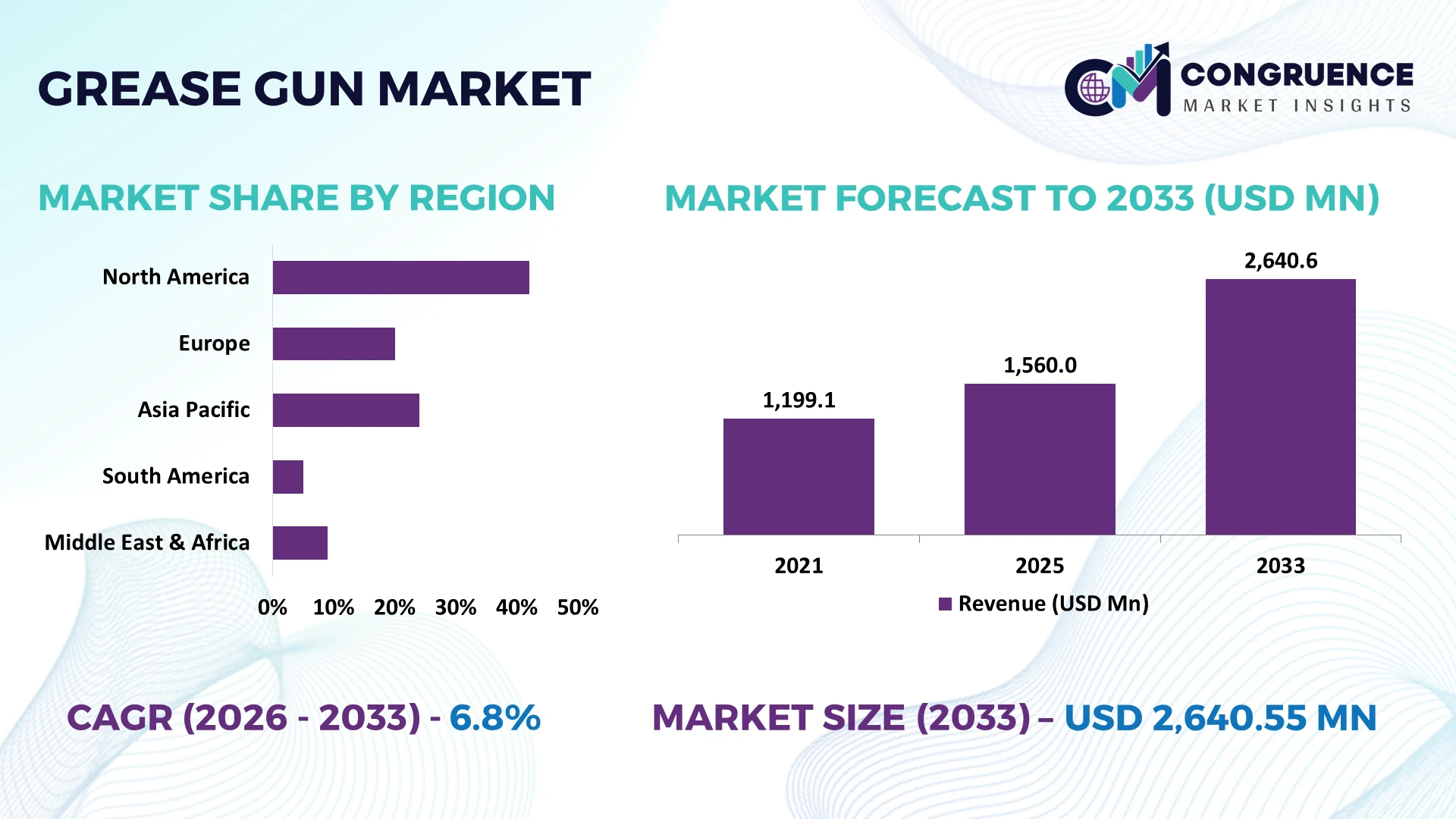
The Global Grease Gun Market was valued at USD 1560 Million in 2025 and is anticipated to reach a value of USD 2640.55 Million by 2033 expanding at a CAGR of 6.8% between 2026 and 2033. Growth is driven by industrial maintenance requirements, agricultural mechanization, expanding construction equipment fleets, and the adoption of cordless electric lubrication tools.
China represents a major manufacturing and consumption center for industrial lubrication equipment, supported by its extensive machinery production ecosystem. Its industrial manufacturing capacity, agricultural mechanization programs, and construction equipment industry generate substantial demand for manual, pneumatic, and electric grease guns. China's manufacturing sector accounted for approximately 27% of global manufacturing value added in 2023, considerably exceeding the United States. Industrial modernization initiatives and domestic equipment manufacturing strengthen China's position in the global grease gun supply chain, particularly for industrial maintenance applications.
Manufacturers prioritizing cordless lubrication technology, industrial distribution networks, and localized production are positioned to address changing equipment maintenance requirements.
Market Size & Growth: The global market reached USD 1,560 million in 2025 and is projected to attain USD 2,640.55 million by 2033, reflecting a 6.8% CAGR supported by industrial maintenance automation.
Top Growth Drivers: Three principal demand drivers are industrial equipment maintenance, agricultural mechanization, and construction machinery servicing. Their individual percentage contributions require verified market segmentation data.
Short Term Forecast: By 2028, cordless electric grease guns are expected to gain relevance as industrial operators prioritize faster lubrication cycles and reduced manual maintenance requirements.
Emerging Technologies: Three important developments are automated grease dispensing, electronically controlled lubrication systems, and lithium ion battery integration.
Regional Leaders: Asia Pacific, North America, and Europe represent important regional markets, supported respectively by manufacturing expansion, industrial maintenance investment, and advanced equipment servicing. Verified regional revenue forecasts remain unavailable.
Consumer and End User Trends: Industrial maintenance teams increasingly prioritize cordless equipment, pressure control, and precise grease dispensing to improve lubrication consistency.
Pilot and Case Example: Documented industrial maintenance applications demonstrate the operational relevance of powered lubrication equipment, although a verified project with quantified performance improvements has not been established.
Competitive Landscape: SKF, Lincoln Industrial, Groz Engineering Tools, Milwaukee Tool, and Alemite compete through industrial distribution, lubrication technology, product durability, and equipment specialization.
Regulatory & ESG Impact: Industrial maintenance practices increasingly emphasize controlled grease dispensing, reduced lubricant waste, and equipment reliability. Quantified regulatory impacts require application specific evidence.
Investment & Funding: Manufacturing expansion, product development, and distribution partnerships remain important investment priorities, particularly for cordless and industrial lubrication equipment.
Innovation & Future Outlook: Advanced battery technology, automated dispensing, and digitally integrated maintenance systems are reshaping product development toward greater precision and operational efficiency.
The global grease gun market serves industrial manufacturing, automotive maintenance, construction equipment servicing, agriculture, and mining operations. Cordless electric grease guns are gaining attention because they reduce repetitive manual pumping and improve accessibility during machinery maintenance. Electronic pressure monitoring and precision dispensing technology support consistent lubrication while limiting excessive grease application. China's manufacturing sector, representing approximately 27% of global manufacturing value added in 2023, illustrates the industrial scale supporting lubrication equipment demand. Increasing equipment complexity and preventive maintenance requirements are shifting purchasing priorities toward durable, efficient lubrication solutions, establishing important considerations for strategic market positioning.
The global grease gun market is becoming strategically important as manufacturers prioritize equipment reliability, preventive maintenance, and lubrication efficiency. Industrial automation and infrastructure modernization are shifting procurement toward cordless electric grease guns, precision dispensing equipment, and centralized lubrication solutions. China's expanding industrial equipment ecosystem and India's infrastructure development programs are creating opportunities for manufacturers to strengthen domestic distribution and technical service capabilities. Product differentiation increasingly depends on battery performance, dispensing accuracy, durability, and compatibility with specialized industrial lubricants.
Technology adoption is changing maintenance economics. Compared with conventional manual grease guns, powered equipment reduces repetitive pumping and supports more consistent lubrication during intensive servicing operations. Selected cordless models deliver pressures exceeding 10,000 PSI, supporting applications involving heavily loaded bearings and difficult lubrication points. Germany emphasizes precision engineering and automated maintenance integration, while India presents opportunities in agricultural machinery, construction equipment, and industrial servicing. These differences influence product specifications, distribution strategies, and maintenance requirements.
Between 2026 and 2028, manufacturers are expected to prioritize intelligent dispensing, interchangeable battery platforms, and improved pressure monitoring. Construction fleet maintenance provides a practical application, with cordless equipment supporting lubrication across multiple heavy machinery components. Companies investing in specialized products, technical partnerships, and maintenance distribution networks can strengthen customer retention. Competitive positioning increasingly depends on delivering measurable maintenance productivity, consistent lubrication performance, and dependable equipment availability.
Industrial mechanization and preventive maintenance requirements are strengthening demand for professional grease guns. China's manufacturing sector contributes more than 25% of global manufacturing value added, establishing a substantial industrial equipment servicing base. Modern cordless grease guns offer operating pressures of 8,000 to 10,000 PSI, supporting lubrication applications involving heavily loaded bearings and construction machinery. India's infrastructure modernization and agricultural mechanization programs are expanding the installed base of equipment requiring periodic lubrication. Manufacturers are responding by introducing battery powered grease guns, expanding industrial distribution networks, and developing specialized accessories. The strategic advantage lies in reducing maintenance labor requirements while improving lubrication accessibility across industrial machinery, agricultural equipment, and commercial vehicle fleets.
Manufacturing costs and component sourcing dependencies constrain the commercial competitiveness of advanced grease guns. Lithium ion batteries, electric motors, precision pumps, and electronic pressure controls increase product complexity compared with conventional manual equipment. India's standard Goods and Services Tax rate of 18% applies to many industrial equipment categories, although the applicable classification determines the actual treatment of individual products. Imported electronic components also expose manufacturers to exchange rate fluctuations and procurement uncertainty. Battery powered models introduce additional replacement and maintenance expenses, particularly for smaller workshops with limited equipment utilization. Manufacturers are addressing these constraints through localized component sourcing, standardized battery platforms, supplier diversification, and modular product engineering. Maintaining affordable ownership costs without compromising pressure performance remains a critical procurement consideration.
Intelligent dispensing technology creates opportunities to expand beyond conventional grease gun applications. Electronic pressure monitoring, programmable grease delivery, and integrated maintenance tracking enable more controlled lubrication across industrial machinery. Professional cordless equipment capable of exceeding 10,000 PSI supports demanding applications involving construction machinery and heavy industrial bearings. India's expanding industrial infrastructure and agricultural equipment ecosystem provide opportunities for specialized lubrication products and localized technical support. Manufacturers can differentiate their portfolios through interchangeable battery systems, precision dispensing mechanisms, and equipment specific lubrication accessories. Partnerships with industrial maintenance providers and machinery distributors offer additional opportunities to establish recurring demand. Integrating dispensing records with digital maintenance platforms creates a strategic opportunity to improve lubrication accountability and strengthen equipment servicing relationships.
Integrating advanced grease guns into established industrial maintenance operations presents significant execution challenges. Different machinery manufacturers specify distinct lubrication pressures, grease formulations, servicing intervals, and connector configurations. Professional equipment operating at pressures approaching 10,000 PSI requires appropriate application controls and operator training to prevent seal damage and excessive lubrication. Germany's advanced manufacturing facilities increasingly emphasize digitally coordinated maintenance, creating additional expectations for equipment compatibility and servicing documentation. Battery management, pressure calibration, and dispensing accuracy introduce technical responsibilities beyond conventional manual lubrication. Manufacturers must invest in application engineering, technician training, standardized accessories, and dependable technical support. Establishing consistent lubrication procedures across diverse machinery fleets is essential for maintaining equipment reliability and achieving sustainable operational improvements.
Precision Lubrication Gains Industrial Importance: Industrial maintenance teams increasingly prioritize controlled grease dispensing to prevent excessive lubrication and premature bearing damage. Advanced electronic grease meters offer measurement accuracy of ±3% under specified operating conditions and support pressures reaching 700 bar. Manufacturers are incorporating digital displays, pressure monitoring, and calibrated dispensing accessories to improve lubrication consistency and maintenance accountability.
Agricultural Equipment Servicing Priorities Shift: Equipment replacement constraints are changing maintenance purchasing decisions. During 2025, American agricultural equipment manufacturers experienced a 7.6% contraction in direct employment, reflecting difficult industry conditions. Farmers increasingly prioritized repairs, retrofits, and incremental upgrades. Lubrication equipment suppliers are responding by emphasizing replacement accessories, affordable maintenance tools, and established agricultural distribution channels.
Portable Equipment Performance Becomes Differentiator: Professional maintenance operations increasingly require portable lubrication equipment capable of servicing multiple machinery types. Advanced battery operated grease guns offer 20 volt battery platforms, dual dispensing speeds, and output reaching 170 grams per minute. Manufacturers are combining ergonomic designs, extended hoses, and electronic dispensing controls to improve servicing accessibility and reduce equipment handling requirements.
Equipment Maintenance Distribution Networks Expand: Industrial suppliers are adjusting distribution strategies around equipment servicing rather than machinery replacement alone. The United States equipment manufacturing industry supported 2.2 million jobs during 2025, demonstrating its extensive industrial ecosystem. Manufacturers are strengthening aftermarket distribution, maintenance contractor relationships, and technical support capabilities to capture recurring lubrication equipment demand.
Manual grease guns represent an established product category because of their affordability, mechanical simplicity, portability, and suitability for intermittent lubrication requirements. Their applications include automotive workshops, agricultural equipment servicing, and industrial machinery maintenance. The exact global market share attributable to manual grease guns has not been established through independently verified segmentation data. Lever Operated models remain relevant for applications requiring controlled manual pressure, while Pneumatic and Air Operated variants serve workshops and industrial facilities with existing compressed air infrastructure.
Battery Powered and Cordless Electric grease guns represent important technology driven product categories. Cordless Electric equipment is positioned for increased adoption in applications involving extensive lubrication points, difficult equipment access, and repetitive maintenance procedures. Advanced professional models incorporate 20 volt battery systems, dispensing rates reaching 170 grams per minute, and electronic grease measurement capabilities. Manufacturers are prioritizing battery compatibility, ergonomic improvements, and precision dispensing technology. Investment priorities increasingly favor product platforms that combine portable operation with consistent lubrication performance.
Automotive Maintenance represents an established application for grease guns, supported by vehicle servicing networks, commercial workshops, and recurring component lubrication requirements. The United States automotive aftermarket services an extensive installed vehicle base, creating sustained demand for lubrication equipment and replacement accessories. However, a verified global percentage establishing Automotive Maintenance as the largest grease gun application is unavailable. Industrial Machinery represents another substantial application, particularly in manufacturing facilities where bearings, mechanical assemblies, and production equipment require scheduled lubrication. Manufacturers serving these applications emphasize product durability, dispensing accuracy, and compatibility with commonly used industrial greases.
Construction Equipment presents opportunities for greater adoption of portable powered lubrication tools. Heavy machinery requires frequent servicing across multiple lubrication points, making equipment accessibility and dispensing consistency important purchasing considerations. Mining Equipment demands durable lubrication products capable of operating in challenging environments, while Agricultural Equipment generates demand through seasonal servicing and preventive maintenance. Fleet Maintenance increasingly emphasizes standardized lubrication procedures across commercial vehicles. Suppliers are expanding specialized accessories, maintenance distribution partnerships, and professional equipment portfolios to address these different operational requirements.
Automotive Workshops constitute an established purchasing category because of recurring vehicle servicing requirements and extensive aftermarket distribution networks. However, verified global market share data identifying the largest grease gun purchasing group are unavailable. Manufacturing Plants represent another important customer category, particularly where scheduled lubrication supports machinery reliability and production continuity. These facilities prioritize durable equipment, controlled dispensing, and compatibility with industrial maintenance procedures. Maintenance Contractors serve multiple industrial customers and emphasize portable equipment that accommodates different lubrication requirements without extensive equipment inventories.
Construction Companies represent an important market for advanced portable grease guns because heavy machinery maintenance frequently occurs outside conventional workshop environments. Mining Companies prioritize high pressure lubrication equipment, dependable couplers, and durability under demanding operating conditions. Agricultural Enterprises require affordable equipment suitable for seasonal maintenance, while Fleet Operators increasingly emphasize standardized servicing procedures and consistent equipment availability. Manufacturers are developing application specific product portfolios, expanding aftermarket distribution, and strengthening relationships with professional maintenance providers. Competitive differentiation increasingly depends on matching equipment specifications with customer utilization patterns and technical servicing requirements.
Asia Pacific accounted for the largest market share at 38.2% in 2025 however, Asia Pacific is expected to register the fastest growth, expanding at a CAGR of 6.65% between 2026 and 2033.
Advanced Industrial Maintenance and Professional Lubrication Equipment Adoption
North America represents an established market for grease guns, supported by extensive automotive servicing infrastructure, industrial manufacturing, agricultural mechanization, and construction equipment maintenance. The United States drives regional demand through professional maintenance operations, machinery manufacturing, and established industrial distribution networks. Increasing adoption of cordless electric grease guns reflects industrial operators' emphasis on maintenance productivity and equipment accessibility. Canada contributes through mining operations, agricultural machinery servicing, and industrial equipment maintenance. Professional cordless models offering operating pressures exceeding 10,000 PSI address demanding lubrication applications involving heavy machinery and industrial bearings. Manufacturers are strengthening aftermarket distribution, expanding compatible battery platforms, and developing precision dispensing accessories. Industrial maintenance contractors increasingly prioritize standardized lubrication equipment across multiple machinery categories. Established distribution infrastructure and specialized servicing capabilities support the region's demand for professional lubrication equipment.
United States Market Outlook: The United States maintains extensive automotive maintenance infrastructure and established industrial equipment distribution networks. Professional equipment manufacturers emphasize battery technology, dispensing accuracy, and product durability. The country's agricultural and construction machinery sectors generate recurring lubrication requirements. Manufacturers are expanding relationships with industrial distributors and maintenance contractors to strengthen product accessibility, replacement accessory availability, and technical support.
Precision Lubrication and Industrial Maintenance Modernization
Europe's grease gun market is supported by established machinery manufacturing, automotive production, industrial automation, and professional maintenance infrastructure. Germany, Italy, France, and the United Kingdom represent important consumption centers, with industrial operators emphasizing equipment durability and controlled lubricant dispensing. Pneumatic grease guns remain relevant in facilities with established compressed air infrastructure, while cordless electric alternatives address mobile maintenance applications. European manufacturers are introducing electronic dispensing controls, ergonomic equipment designs, and specialized lubrication accessories. The European Union's Machinery Regulation becomes applicable in January 2027, reinforcing equipment safety requirements where relevant. Manufacturers are strengthening product documentation, engineering capabilities, and technical support networks. Industrial maintenance providers increasingly emphasize standardized lubrication procedures to improve servicing consistency. Advanced manufacturing infrastructure and established industrial distribution channels support demand for precision lubrication equipment.
Germany Market Outlook: Germany represents an important European market because of its established automotive manufacturing, industrial machinery production, and precision engineering capabilities. German manufacturers emphasize electronically controlled lubrication equipment, accurate grease dispensing, and industrial maintenance integration. Professional users increasingly prioritize equipment compatibility and consistent lubrication performance. Established industrial distribution networks support specialized equipment availability and technical servicing.
Manufacturing Scale and Industrial Equipment Expansion
Asia Pacific accounted for 38.2% of the global grease gun market in 2025, according to a published market estimate. China represents an important manufacturing and consumption center, supported by extensive machinery production, established component supply chains, and industrial equipment distribution. India's infrastructure development and agricultural mechanization create additional demand for portable lubrication equipment. Japan and South Korea contribute through advanced manufacturing operations and precision machinery servicing. Regional manufacturers supply manual, pneumatic, and cordless electric grease guns across industrial and professional maintenance applications. Established manufacturing infrastructure supports component sourcing, product development, and export distribution. Companies are strengthening battery technology integration, expanding industrial distribution partnerships, and improving dispensing performance. Growing equipment servicing requirements encourage manufacturers to differentiate products according to operating pressure, durability, portability, and application compatibility.
China Market Outlook: China maintains extensive industrial machinery production capabilities and established domestic component manufacturing infrastructure. Its manufacturing sector accounts for more than one quarter of global manufacturing value added, supporting substantial industrial equipment servicing requirements. Domestic manufacturers produce manual, pneumatic, and electric lubrication equipment for industrial distribution and international markets. Product development increasingly emphasizes manufacturing efficiency, battery integration, dispensing accuracy, and compatibility with specialized industrial applications.
Agricultural Mechanization and Heavy Equipment Servicing
South America's grease gun market is supported by agricultural machinery maintenance, mining operations, automotive servicing, and construction equipment deployment. Brazil represents an important regional consumption center because of its extensive agricultural equipment ecosystem and established industrial manufacturing infrastructure. Argentina contributes through agricultural mechanization and industrial equipment servicing, while Chile generates specialized lubrication requirements through mining operations. Agricultural machinery distributors play an important role in supplying grease guns and replacement accessories to geographically dispersed customers. Mining operators prioritize durable equipment, reliable couplers, and consistent lubrication performance under demanding operating conditions. Imported components, exchange rate fluctuations, and uneven technical service accessibility influence equipment procurement decisions. Manufacturers are expanding local distribution partnerships, strengthening replacement accessory availability, and developing application specific equipment portfolios to address these operational requirements.
Brazil Market Outlook: Brazil's extensive agricultural machinery fleet, automotive manufacturing infrastructure, and industrial equipment servicing requirements support demand for professional grease guns. Large agricultural operations require portable lubrication equipment suitable for tractors, harvesting machinery, and associated equipment. Industrial distributors are strengthening relationships with agricultural machinery dealerships and maintenance contractors. Product affordability, equipment durability, and replacement accessory availability remain important purchasing considerations.
Infrastructure Modernization and Heavy Machinery Maintenance
The Middle East and Africa grease gun market is influenced by construction infrastructure development, mining operations, energy production, and industrial equipment maintenance. Saudi Arabia and the United Arab Emirates represent important equipment servicing markets, supported by infrastructure investment and industrial diversification initiatives. South Africa contributes through mining machinery maintenance and established industrial manufacturing operations. Extreme operating temperatures, abrasive environments, and geographically dispersed machinery fleets increase demand for durable lubrication equipment and dependable servicing accessories. Construction and mining operators prioritize portable grease guns capable of supporting intensive machinery maintenance. Manufacturers are strengthening regional distribution partnerships, expanding technical support arrangements, and developing products suitable for demanding industrial applications. Equipment reliability, maintenance accessibility, and replacement component availability remain important factors influencing procurement decisions across industrial and infrastructure projects.
Saudi Arabia Market Outlook: Saudi Arabia's Vision 2030 industrial diversification and infrastructure development initiatives support demand for construction machinery and professional maintenance equipment. Major transportation, industrial, and urban development projects generate lubrication requirements across heavy equipment fleets. Industrial suppliers are expanding relationships with machinery distributors and maintenance contractors. Durable lubrication products, specialized servicing accessories, and dependable technical support are important considerations for equipment procurement.
The global grease gun market features competition between established lubrication specialists SKF and Groz Engineering Tools, professional equipment manufacturers Milwaukee Tool and Makita, and industrial suppliers such as Pressol. Verified combined market share figures for the five leading manufacturers remain unavailable. Competition centers on dispensing accuracy, equipment durability, battery compatibility, pricing, and distribution accessibility. Professional cordless grease guns deliver operating pressures exceeding 10,000 PSI, differentiating advanced equipment from conventional manual alternatives. SKF emphasizes industrial lubrication expertise, while Milwaukee Tool and Makita leverage established cordless battery ecosystems. Groz and Pressol compete through extensive lubrication equipment portfolios and professional distribution networks. Manufacturers are expanding product compatibility, developing precision dispensing accessories, and strengthening industrial distribution partnerships. Increasing adoption of battery powered equipment is shifting competition toward integrated maintenance solutions. Established distribution relationships, engineering expertise, and product reliability create significant entry barriers. Competitive positioning depends on application specialization, dependable servicing infrastructure, and measurable maintenance productivity improvements.
SKF
Milwaukee Tool
Makita
Groz Engineering Tools
Pressol
Bosch
DeWalt
Ingersoll Rand
Lumax Industries
Samoa Industrial
Beta Utensili
Gedore
Draper Tools
Sealey
Cordless electric lubrication technology is transforming professional grease gun applications through improved portability, controlled dispensing, and reduced manual effort. Advanced equipment incorporates lithium ion batteries, variable speed motors, electronic pressure monitoring, and ergonomic dispensing mechanisms. Professional models operate at pressures exceeding 10,000 PSI, supporting demanding industrial applications. Compared with manual grease guns, powered alternatives eliminate repetitive pumping and improve servicing consistency. Established cordless battery ecosystems provide competitive advantages for manufacturers offering compatible equipment across multiple professional tool categories.
Emerging technologies include intelligent grease measurement, electronic dispensing controls, and digital maintenance integration. Advanced grease meters achieve measurement accuracy within ±3% under specified operating conditions, supporting controlled lubricant application and improved maintenance documentation. Connected lubrication equipment enables maintenance teams to record dispensing activity and standardize servicing procedures. Industrial operators increasingly prioritize compatibility with preventive maintenance workflows. Manufacturers are responding through product engineering, specialized accessories, and partnerships with professional equipment distributors.
Between 2026 and 2028, technological development will emphasize improved battery efficiency, automated dispensing, and integration with digital maintenance platforms. Industrial machinery operators benefit from accurate lubricant delivery, while construction and mining companies prioritize equipment durability and portable operation. Manufacturers combining intelligent dispensing technology with established distribution networks gain stronger competitive positioning.
May 2026: Makita introduced its 40V XGT cordless grease gun, featuring a brushless motor delivering 10,000 PSI and dispensing 12 ounces per minute. Four adjustable speed settings and digital controls strengthen its professional lubrication portfolio and improve dispensing precision.
December 2025: Groz Engineering Tools showcased advanced lubrication equipment at EXCON 2025 in Bengaluru, including its rechargeable grease gun featuring a 12V integrated battery. The exhibition strengthened product visibility among construction contractors and industrial equipment maintenance customers across India.
September 2025: Makita recalled approximately 62,927 cordless grease guns and hoses following reports of hose failures. The company offered free replacement hoses, addressing identified safety risks and reinforcing the commercial importance of component reliability and product safety compliance.
June 2025: Groz introduced its G77 dual mode grease gun, combining 2 operating mechanisms through pistol grip and lever handle configurations. The design addresses confined lubrication points and demanding pressure applications, expanding equipment versatility for automotive, agricultural, and industrial maintenance.
The Grease Gun Market Report provides comprehensive analysis of industry structure, competitive positioning, technological developments, and emerging investment opportunities between 2026 and 2033. Segmentation covers six product types: Manual, Pneumatic, Battery Powered, Cordless Electric, Lever Operated, and Air Operated. Application analysis examines Automotive Maintenance, Industrial Machinery, Agricultural Equipment, Construction Equipment, Mining Equipment, and Fleet Maintenance. End user coverage includes automotive workshops, manufacturing plants, construction companies, mining companies, agricultural enterprises, fleet operators, and maintenance contractors.
Regional analysis examines North America, Europe, Asia Pacific, South America, and the Middle East and Africa. Technology coverage evaluates lithium ion batteries, electronic pressure monitoring, precision dispensing, and intelligent lubrication systems. Competitive assessment examines product innovation, manufacturing capabilities, distribution strategies, and supplier differentiation. The report supports investment planning, geographical expansion, product development, and strategic market positioning.
| Report Attribute/Metric | Report Details |
|---|---|
Market Revenue in 2025 | USD 1560 Million |
Market Revenue in 2033 | USD 2640.55 Million |
CAGR (2026 - 2033) | 6.8% |
Base Year | 2025 |
Forecast Period | 2026 - 2033 |
Historic Period | 2021 - 2025 |
Segments Covered | By Type
By Application
By End-User
|
Key Report Deliverable | Revenue Forecast, Growth Trends, Market Dynamics, Segmental Overview, Regional and Country-wise Analysis, Competition Landscape |
Region Covered | North America, Europe, Asia-Pacific, South America, Middle East, Africa |
Key Players Analyzed | SKF, Milwaukee Tool, Makita, Groz Engineering Tools, Pressol, Bosch, DeWalt, Ingersoll Rand, Lumax Industries, Samoa Industrial, Beta Utensili, Gedore, Draper Tools, Sealey |
Customization & Pricing | Available on Request (10% Customization is Free) |




