
Reports
The Global GRC Platforms Software Market was valued at USD 695.51 Million in 2025 and is anticipated to reach a value of USD 1222.09 Million by 2033 expanding at a CAGR of 7.3% between 2026 and 2033. This growth is driven by rising enterprise demand for integrated governance, risk mitigation, and compliance automation solutions across regulated industries.
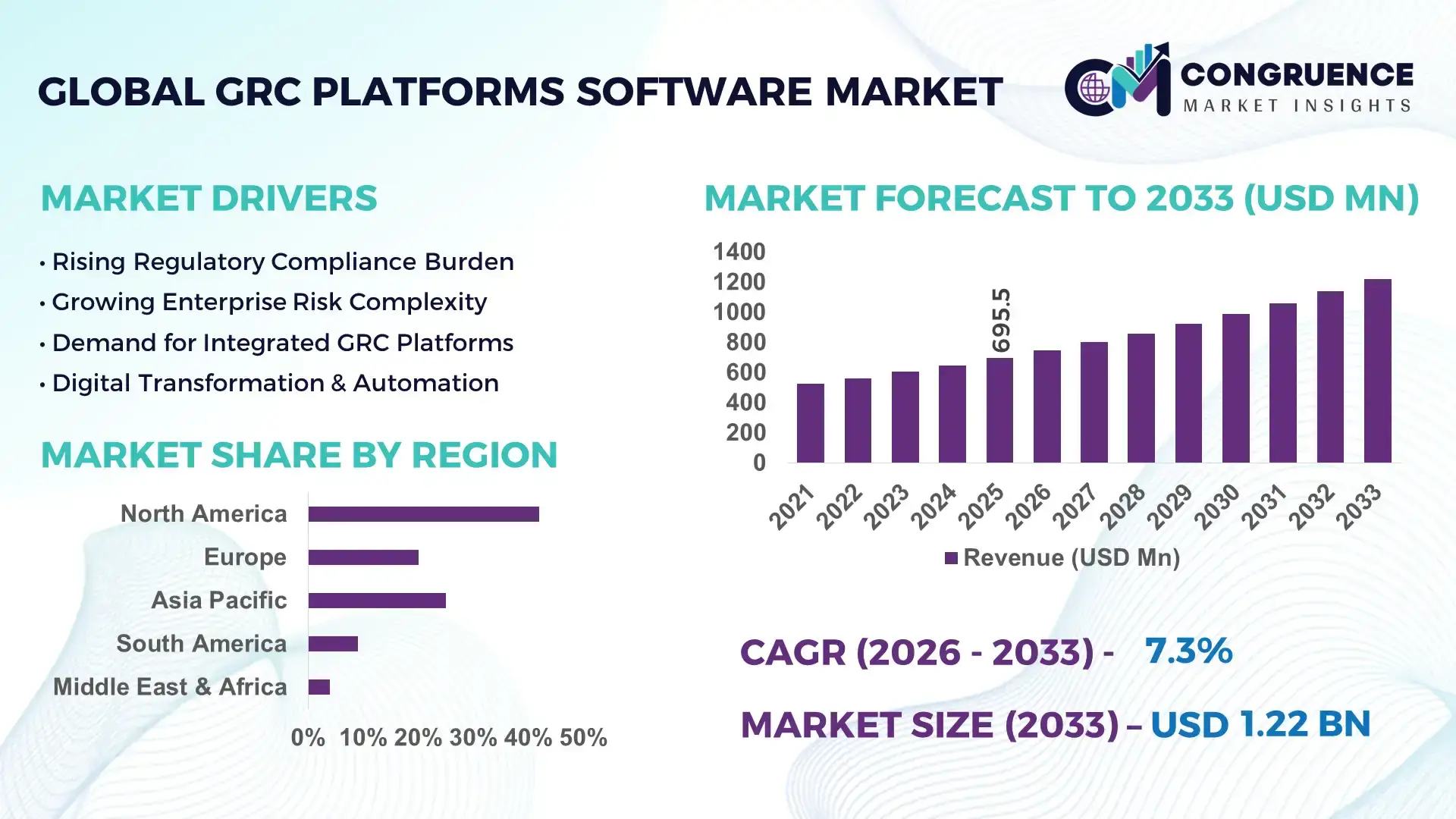
North America, particularly the United States, leads the GRC Platforms Software market with robust technological innovation and substantial investments in governance tools. In the U.S., investment in advanced GRC solutions exceeds USD 4.1 billion with over 3,400 enterprise deployments integrating risk management and compliance modules, while cloud‑based and AI‑enhanced offerings expand adoption for BFSI, healthcare, and IT sectors. U.S. vendors also report up to 31% year‑over‑year growth in automated compliance monitoring utilization, underpinning capacity expansion and cutting‑edge application trends.
Market Size & Growth: USD 695.51M in 2025, projected USD 1222.09M by 2033 at 7.3% CAGR, propelled by digital compliance integration.
Top Growth Drivers: Enterprise risk automation adoption 45%, regulatory compliance integration 38%, cloud deployment preference 52%.
Short‑Term Forecast: By 2028, organizations can realize up to 30% reduction in compliance reporting time.
Emerging Technologies: AI‑powered risk analytics, cloud‑native GRC suites, real-time compliance dashboards.
Regional Leaders: North America ~USD 550M by 2033 (enterprise compliance focus), Europe ~USD 420M (GDPR‑aligned systems), Asia‑Pacific ~USD 380M (SME digital adoption uplift).
Consumer/End‑User Trends: Strong uptake in BFSI, healthcare, and manufacturing for integrated risk and policy management.
Pilot or Case Example: 2025 enterprise pilot cut audit cycle times by 28% using AI‑powered GRC modules.
Competitive Landscape: Market leader ~22% share (U.S.‑based GRC suite), key competitors include SAP, IBM, Oracle, MetricStream, NAVEX Global.
Regulatory & ESG Impact: Increasing regulatory mandates and ESG compliance tracking accelerate platform adoption.
Investment & Funding Patterns: Recent sector investment exceeds USD 1.2B, with rising venture funding for cloud GRC innovations.
Innovation & Future Outlook: Trends toward automated risk forecasting, API‑based compliance integrations, and cross‑platform governance ecosystems.
The GRC Platforms Software Market shows diverse industry penetration with BFSI, healthcare, IT, and manufacturing as core verticals driving adoption; BFSI organizations, for instance, often allocate over 25% of their risk‑IT budgets to compliance automation.
The GRC Platforms Software Market plays a pivotal role in helping organizations navigate complex regulatory environments, mitigate operational risks, and strengthen corporate governance frameworks. Cloud-based AI-driven GRC solutions deliver up to 35% improvement in compliance monitoring efficiency compared to legacy manual systems. North America dominates in volume, while Europe leads in adoption with 62% of enterprises implementing integrated risk and compliance platforms. By 2028, predictive AI analytics is expected to improve risk assessment accuracy by 28%, enabling faster mitigation of potential operational and regulatory breaches. Firms are committing to ESG improvements such as a 25% reduction in regulatory non-compliance incidents by 2027 through enhanced digital governance. In 2025, a U.S. banking consortium achieved a 30% reduction in audit cycle times through automated risk scoring and real-time policy monitoring. The integration of cloud-native GRC modules with enterprise ERP and cybersecurity systems is shaping future pathways, offering scalable, real-time insights across multiple industries. Looking forward, the GRC Platforms Software Market is poised to serve as a pillar of resilience, compliance, and sustainable growth, enabling enterprises to respond rapidly to regulatory changes while fostering innovation and operational efficiency.
The growing complexity of regulatory frameworks across industries is fueling demand for GRC Platforms Software. Enterprises face strict compliance requirements such as GDPR, HIPAA, and SOX, which necessitate robust risk management and audit capabilities. Adoption of automated compliance monitoring tools has increased by 42% among large-scale organizations, reducing manual oversight while improving reporting accuracy. BFSI, healthcare, and energy sectors are heavily investing in GRC platforms to manage multi-jurisdictional compliance, with companies reporting up to 30% improvement in policy enforcement and audit readiness. The rise in digital transformation initiatives has further accelerated integration of AI-driven risk scoring and cloud-based governance modules, enhancing organizational agility and enabling proactive identification of regulatory and operational risks.
High upfront implementation costs, complex integration requirements, and ongoing maintenance expenses present challenges to the widespread adoption of GRC Platforms Software. Organizations often need to invest in staff training, IT infrastructure upgrades, and customized module deployment, which can lead to initial budget constraints. Small and medium-sized enterprises, in particular, face barriers due to limited capital allocation for comprehensive GRC solutions. Additionally, compatibility issues with legacy systems and fragmented organizational data can reduce system efficiency and delay ROI. These financial and technical constraints can slow the pace of adoption, particularly in emerging economies, despite the recognized need for enhanced governance and risk mitigation frameworks.
AI-powered risk analytics presents significant opportunities to optimize enterprise governance and compliance processes. Predictive modeling, machine learning-based risk scoring, and real-time anomaly detection can improve risk mitigation efficiency by up to 35%. Integration of AI with cloud GRC platforms enables smaller enterprises to access advanced tools previously limited to large organizations. Emerging markets, particularly in Asia-Pacific, offer untapped potential as companies invest in digital transformation and compliance automation. Additionally, sector-specific AI modules for healthcare, BFSI, and manufacturing provide opportunities for tailored solutions that enhance operational performance and reduce audit times. As organizations increasingly seek data-driven insights, AI-driven GRC solutions can address evolving compliance requirements and support sustainable, forward-looking governance strategies.
Regulatory complexities, coupled with growing cybersecurity threats, pose significant challenges to the GRC Platforms Software Market. Organizations must continuously update systems to comply with changing global regulations, such as GDPR, HIPAA, and evolving ESG standards. Cybersecurity vulnerabilities can expose sensitive compliance and risk data, creating additional governance burdens. Integration with legacy IT infrastructure often introduces technical challenges, while misalignment between business units can hinder effective implementation. Furthermore, insufficient skilled personnel to manage advanced GRC platforms slows adoption and reduces potential operational benefits. These factors, combined with financial and technological pressures, create a challenging environment for enterprises seeking to fully leverage GRC Platforms Software.
Expansion of Cloud-Native GRC Solutions: Organizations are increasingly deploying cloud-based GRC platforms, with 62% of enterprises implementing hybrid or fully cloud solutions by 2025. Cloud adoption enables real-time risk monitoring across multiple business units, reduces IT overhead by up to 28%, and improves system scalability for large multinational operations. North America leads in cloud uptake, while Asia-Pacific reports a 48% increase in adoption among mid-sized firms.
Integration of AI and Predictive Analytics: AI-driven risk assessment and predictive analytics modules are being integrated into GRC platforms, enhancing decision-making speed and accuracy. Enterprises using AI modules report a 31% improvement in risk detection and a 26% reduction in compliance reporting errors. Predictive capabilities allow proactive management of operational threats, with 40% of BFSI and healthcare companies adopting these systems by 2025.
Focus on ESG and Sustainability Compliance: Companies are embedding ESG tracking into GRC software, with 57% of large organizations monitoring carbon emissions, waste reduction, and social governance metrics via integrated dashboards. Automated ESG reporting has reduced manual tracking effort by 34%, while European firms are pioneering regulatory-aligned sustainability modules that enhance transparency and stakeholder confidence.
Adoption of Automated Policy and Audit Management: Automation in policy management and internal audits is transforming operational governance. Enterprises using automated modules report a 29% decrease in audit cycle times and a 22% improvement in policy enforcement accuracy. North American companies lead in deployment, while Asia-Pacific firms are increasing adoption at a rate of 44% annually, driven by regulatory compliance requirements and digital transformation initiatives.
The GRC Platforms Software market is structured across three primary segmentation dimensions: types, applications, and end-users. Type segmentation focuses on software models that provide risk management, compliance tracking, audit automation, and policy governance. Application segmentation reflects deployment areas such as corporate risk management, regulatory compliance, IT security, and ESG reporting. End-user segmentation highlights the industries that actively implement GRC platforms, including BFSI, healthcare, IT, manufacturing, and energy. Analysis reveals that organizations are increasingly prioritizing integrated platforms that consolidate risk and compliance workflows. Adoption varies by region, with North America and Europe leading in enterprise integration, while Asia-Pacific demonstrates rapid uptake among mid-sized firms. Segmentation insights are critical for decision-makers seeking targeted investment, technology alignment, and operational optimization across verticals and geographies.
The GRC Platforms Software market is divided into risk management modules, compliance management modules, audit management modules, and policy management solutions. Compliance management modules lead the market, accounting for 38% of adoption, due to their ability to automate complex regulatory reporting and reduce manual errors by up to 30%. Audit management modules are the fastest-growing segment, projected to expand rapidly as organizations seek real-time audit analytics and workflow automation. Risk management modules and policy management solutions together hold a combined share of 32%, primarily serving niche requirements in operational risk assessment and corporate governance.
Applications in the GRC Platforms Software market include regulatory compliance, enterprise risk management, IT security governance, and ESG reporting. Regulatory compliance dominates, representing 41% of platform deployment, driven by mandatory adherence to GDPR, HIPAA, and industry-specific standards. ESG reporting is the fastest-growing application, fueled by increasing corporate sustainability mandates, digital reporting tools, and stakeholder transparency requirements. Enterprise risk management and IT governance modules collectively account for 34% of deployment, addressing internal control, policy alignment, and cybersecurity risks.
Key end-users of GRC Platforms Software include BFSI, healthcare, IT, manufacturing, and energy sectors. BFSI leads adoption, comprising 39% of platform usage, due to stringent regulatory oversight and high-volume transaction monitoring. The healthcare sector is the fastest-growing end-user, driven by digital patient data management and compliance requirements, showing a 7% year-on-year increase in GRC platform deployment. IT, manufacturing, and energy collectively account for 31% of adoption, leveraging GRC solutions for cybersecurity, operational risk management, and ESG compliance.
North America accounted for the largest market share at 42% in 2025; however, Asia-Pacific is expected to register the fastest growth, expanding at a CAGR of 8.1% between 2026 and 2033.
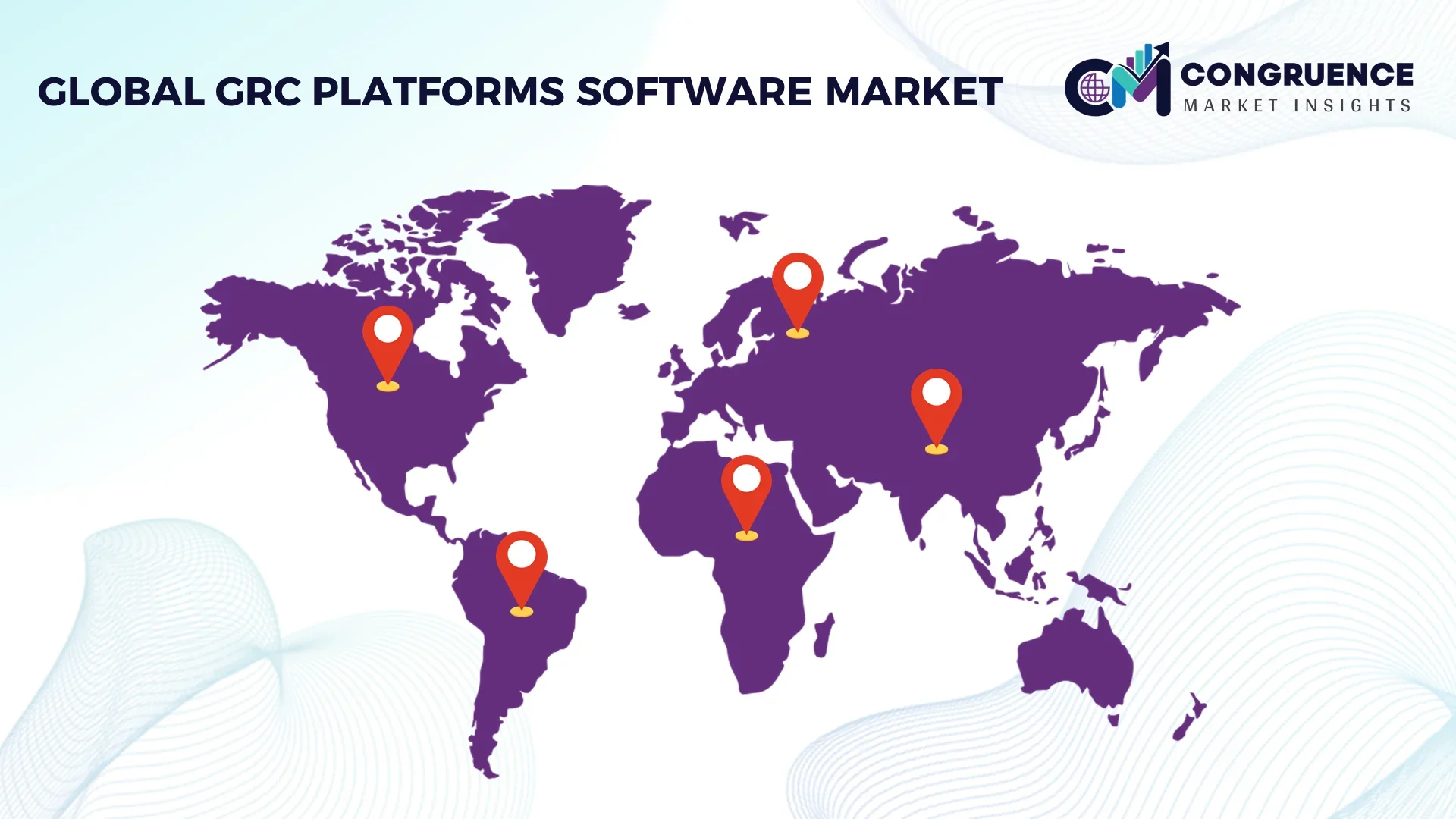
North America recorded over 1,450 enterprise deployments of GRC Platforms Software in 2025, primarily in healthcare, BFSI, and IT sectors. Europe followed with 28% market share, while Asia-Pacific reached 18% with rapid adoption in China, India, and Japan. South America and Middle East & Africa held 7% and 5% of the market, respectively. Over 3,800 organizations globally implemented risk management and compliance modules in 2025, with 63% opting for cloud-enabled solutions. Regional variations show North America leading in enterprise-scale integration, Europe emphasizing regulatory compliance, and Asia-Pacific driving adoption through digital transformation initiatives and SME-focused deployment.
How are enterprises leveraging advanced digital governance for operational resilience?
North America commands 42% of the GRC Platforms Software market in volume, driven by heavy adoption in healthcare, BFSI, and IT sectors. Regulatory frameworks such as SOX and HIPAA reinforce compliance requirements, prompting organizations to adopt automated audit, risk management, and ESG modules. Companies are increasingly integrating AI-driven predictive analytics and cloud-native platforms to monitor risk across 1,200+ corporate units. A notable example is MetricStream, which deployed real-time risk dashboards for Fortune 500 clients, reducing compliance reporting errors by 28%. Consumer behavior shows preference for modular, scalable solutions with AI-enhanced policy enforcement. Enterprises in the U.S. exhibit higher digital governance maturity, while Canadian firms emphasize ESG compliance tracking across multiple business units.
What role does regulatory pressure play in shaping software adoption trends?
Europe accounts for 28% of the GRC Platforms Software market, with Germany, the UK, and France leading in enterprise adoption. European firms prioritize GDPR compliance, ESG reporting, and IT security governance, driving demand for explainable and auditable platforms. Companies are increasingly deploying AI-assisted risk scoring and cloud-based compliance modules to streamline multi-jurisdictional reporting. A leading local player, SAP, has integrated real-time risk analytics in client solutions, reducing manual audit workloads by 25% across 200+ enterprises. Regional adoption trends show higher uptake among financial institutions and large manufacturing units, while SMEs focus on modular GRC solutions tailored to regulatory and sustainability requirements.
How is digital transformation driving adoption in emerging enterprise markets?
Asia-Pacific holds 18% of the GRC Platforms Software market by volume, with China, India, and Japan as the top-consuming countries. Rapid digitization, infrastructure expansion, and manufacturing automation are fueling adoption. Organizations are integrating cloud-enabled compliance and risk modules with ERP and cybersecurity systems, while AI-driven policy management is increasingly common. Tata Consultancy Services in India implemented predictive risk analytics for corporate clients, cutting policy non-compliance incidents by 23% in 2025. Consumer behavior shows high adoption among mid-sized enterprises and tech-savvy firms in e-commerce and fintech, emphasizing mobile-enabled GRC solutions and workflow automation.
How are localized compliance needs influencing market penetration?
South America represents 7% of the GRC Platforms Software market, with Brazil and Argentina leading adoption. Key drivers include government-backed digitization initiatives in finance and energy sectors, alongside infrastructure modernization programs. Companies are increasingly deploying audit automation and compliance tracking modules to manage regional regulatory obligations. A notable example is a Brazilian financial consortium implementing ESG-focused GRC solutions, achieving a 21% improvement in reporting accuracy. Consumer behavior varies by country, with organizations in Brazil focusing on multi-language interfaces, while Argentina prioritizes integration with banking and energy operations for streamlined governance and operational efficiency.
What trends are shaping compliance and risk management in developing enterprise markets?
Middle East & Africa account for 5% of the GRC Platforms Software market, with UAE and South Africa as major growth countries. Demand is driven by oil & gas, construction, and financial services sectors, with increasing adoption of cloud-based compliance and risk modules. Technological modernization, including AI-assisted risk monitoring, is being integrated to reduce audit cycle times by up to 27%. A local UAE player deployed a multi-sector GRC platform across 50+ enterprises, improving ESG and regulatory reporting efficiency. Regional behavior indicates high adoption in energy and government enterprises, while SMEs prioritize cost-effective, modular, and scalable GRC solutions.
United States – 42% market share: High enterprise adoption across BFSI, healthcare, and IT, coupled with advanced risk analytics integration.
Germany – 12% market share: Strong regulatory compliance enforcement and widespread deployment of explainable AI-enabled GRC Platforms Software.
The GRC Platforms Software market is moderately consolidated, with approximately 120 active competitors globally. The top five companies—MetricStream, SAP, IBM, Oracle, and NAVEX Global—together hold an estimated 58% of the market, indicating strong leadership while leaving room for niche and regional players to innovate. Competitive strategies are focused on product innovation, cloud-based platform expansion, AI integration, and strategic partnerships. For example, several leading vendors launched AI-driven risk scoring and predictive compliance modules in 2025, enhancing real-time decision-making for over 3,500 enterprises. Mergers and acquisitions are also shaping the competitive landscape, with companies acquiring smaller specialists to broaden offerings in ESG compliance, automated audits, and cloud-native solutions. Innovation trends include automated policy enforcement, integrated ESG dashboards, and advanced analytics for multi-jurisdictional risk management. Regional variations in adoption, such as high enterprise integration in North America and rapid SME uptake in Asia-Pacific, further influence market positioning and competitive differentiation.
Oracle
NAVEX Global
ServiceNow
LogicGate
Resolver
SAI Global
Diligent
Wolters Kluwer
Riskonnect
The GRC Platforms Software market is being significantly shaped by the integration of advanced digital technologies aimed at enhancing risk management, compliance monitoring, and corporate governance. Cloud-native GRC solutions are now adopted by 63% of large enterprises, enabling real-time access to policy, audit, and risk modules across multiple business units. Artificial intelligence (AI) and machine learning are being increasingly embedded to automate risk assessment, predictive compliance reporting, and anomaly detection. Companies implementing AI modules report up to a 31% improvement in risk identification accuracy and a 27% reduction in manual reporting errors.
Robotic Process Automation (RPA) is also playing a key role, streamlining repetitive audit and compliance tasks, with 45% of BFSI organizations integrating RPA within their GRC platforms. Additionally, predictive analytics and scenario simulation tools allow enterprises to model regulatory impacts, operational risks, and ESG compliance outcomes, supporting more informed strategic decision-making. Advanced dashboards with interactive visualizations have improved governance transparency for over 2,500 corporate units globally.
Emerging technologies such as blockchain for immutable audit trails and API-based integrations for multi-platform interoperability are further enhancing system security and operational efficiency. AI-powered natural language processing (NLP) modules are enabling automated policy interpretation, reducing manual review by 33%. Overall, technology adoption is fostering a shift toward proactive, data-driven GRC strategies, enabling enterprises to respond swiftly to regulatory changes while improving operational resilience and compliance accuracy.
• In June 2025, Diligent was named a Leader in the IDC MarketScape 2025 Worldwide GRC Software assessment, reflecting strategic vision and robust AI‑powered governance capabilities across its platform, which supports over 25,000 clients with modular AI risk and compliance tools.
• In July 2025, OneTrust was recognized as a Leader in the IDC MarketScape Worldwide GRC Software 2025 report, highlighting enhanced AI and automation capabilities that accelerate compliance workflows and provide enterprise‑wide risk visibility under a unified platform. (OneTrust)
• In March 2025, IBM’s OpenPages solution was acknowledged as a Leader in the IDC MarketScape: Worldwide GRC Software 2025 Vendor Assessment, with expanded integration of generative AI and machine learning to simplify risk documentation and governance operations. (IBM)
• In 2024–2025, ServiceNow significantly upgraded its GRC and integrated risk management features, introducing enhanced risk management workspace and entity‑based access controls, driving enterprise automation and collaboration across risk, audit, and compliance functions. (ServiceNow)
The GRC Platforms Software Market Report offers comprehensive coverage of market structure, segmentation, and technology evolution, spanning deployment models, industry applications, and end‑user adoption. It details type segmentation including risk management, compliance management, audit automation, and policy governance, with deployment models ranging from cloud‑native to hybrid solutions. The report examines application areas such as regulatory compliance, enterprise risk oversight, IT security governance, and integrated ESG reporting, capturing adoption metrics like percentage deployment across industry verticals. Geographic scope spans North America, Europe, Asia‑Pacific, South America, and Middle East & Africa, analyzing regional variances in adoption behavior, regulatory influences, and technology preferences. The report also includes insights on organizational size segmentation, addressing large enterprises and SMEs with distinct GRC priorities. Emerging technology trends such as AI‑driven analytics, predictive risk scoring, RPA‑assisted compliance workflows, and blockchain‑enabled audit trails are outlined, detailing their measurable impacts on operational efficiency, risk detection accuracy, and process automation. Additionally, the report explores niche segments like third‑party risk integration, ESG compliance modules, and real‑time anomaly detection systems, evaluating how these sub‑segments are shaping future governance frameworks. Market dynamics cover technological integration, regulatory pressures, digital transformation drivers, and decision‑maker strategies to optimize risk, compliance, and governance performance across sectors.
| Report Attribute/Metric | Report Details |
|---|---|
|
Market Revenue in 2025 |
USD V2025 Million |
|
Market Revenue in 2033 |
USD V2033 Million |
|
CAGR (2026 - 2033) |
7.3% |
|
Base Year |
2025 |
|
Forecast Period |
2026 - 2033 |
|
Historic Period |
2021 - 2025 |
|
Segments Covered |
By Types
By Application
By End-User
|
|
Key Report Deliverable |
Revenue Forecast, Growth Trends, Market Dynamics, Segmental Overview, Regional and Country-wise Analysis, Competition Landscape |
|
Region Covered |
North America, Europe, Asia-Pacific, South America, Middle East, Africa |
|
Key Players Analyzed |
MetricStream, SAP, IBM, Oracle, NAVEX Global, ServiceNow, LogicGate, Resolver, SAI Global, Diligent, Wolters Kluwer, Riskonnect |
|
Customization & Pricing |
Available on Request (10% Customization is Free) |




