
Reports
The Global Grape Seed Oil Market was valued at USD 550.2 Million in 2025 and is anticipated to reach a value of USD 863.8 Million by 2033 expanding at a CAGR of 5.8% between 2026 and 2033. Growth is being driven by winery-by-product valorization, premium edible oils, clean-label cosmetics, and nutraceutical formulations.
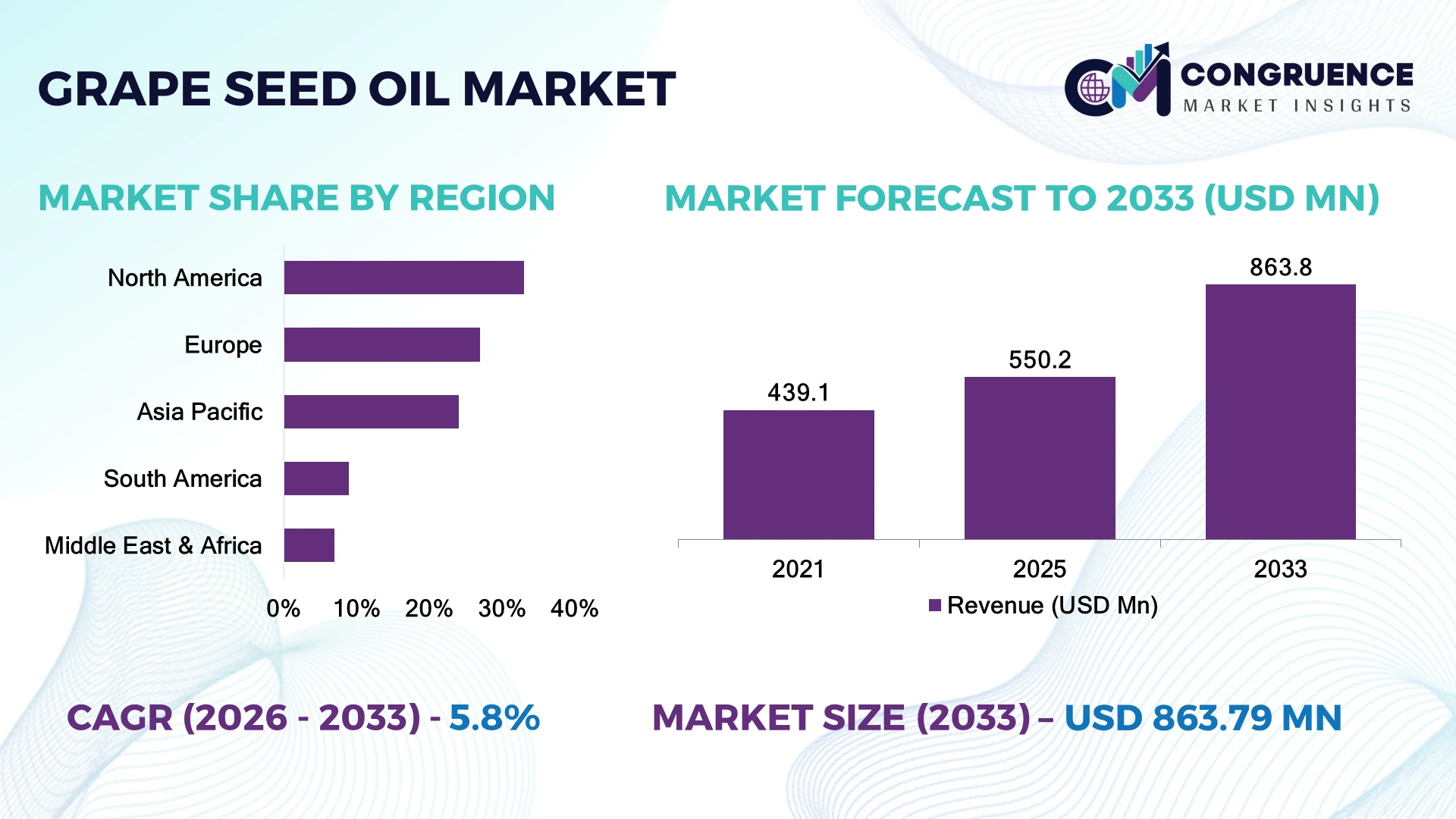
The U.S. anchors consumption, with North America holding 36.8% of the global market in 2025; California produces about 85% of U.S. wine, creating a concentrated seed feedstock base. Europe benefits from Spain, Italy, and France’s integrated wine-processing infrastructure, while Asia is scaling beauty and wellness manufacturing. U.S. trade-policy uncertainty is pushing suppliers toward diversified sourcing and regional inventory.
Strategic implication: prioritize vertically integrated feedstock recovery, certified natural grades, and multi-region supply coverage.
Market Size & Growth: USD 550.2M in 2025 to USD 863.8M by 2033 at 5.8% CAGR, supported by winery by-product valorization and clean-label oils.
Top Growth Drivers: Natural cosmetics 35%, premium culinary use 30%, and nutraceutical formulations 25% are key demand catalysts.
Short-Term Forecast: By 2028, automated extraction and process controls can target 5–10% higher recovery and 5% lower processing losses.
Emerging Technologies: Supercritical CO₂, pulsed-electric-field pretreatment, and enzyme-assisted extraction improve yield, selectivity, and bioactive retention.
Regional Leaders: North America could represent about USD 551M by 2033, Europe USD 479M, and Asia-Pacific USD 389M, with Asian beauty manufacturing accelerating adoption.
Consumer/End-User Trends: Food industry holds 37.5% share, while personal-care formulators increasingly favor cold-pressed, traceable botanical oils.
Pilot/Case Example: 2025 testing achieved 19.46% oil yield with para-cymene versus 11.01% through cold pressing, demonstrating recovery upside.
Competitive Landscape: Tampieri leads specialist supply at roughly 10,000 tons annually; Alvinesa, Borges, Gustav Heess, and Olitalia compete through scale and sourcing.
Regulatory & ESG Impact: Upcycling winery residues converts waste streams into ingredients, while certified natural processing strengthens sustainability positioning.
Investment & Funding: Alvinesa’s 2024 acquisition added 3 production centers, reinforcing southern-hemisphere sourcing and year-round feedstock availability.
Innovation & Future Outlook: 2026–2028 competition shifts toward traceable upcycled oils, cleaner extraction, and integrated biorefinery models linking oil with co-products.
The Grape Seed Oil Market is expanding across premium culinary oils, clean-label skincare, haircare, nutraceuticals, and functional ingredients. Natural products represent roughly 58% in one current market assessment, while upcycled extraction is gaining relevance as wineries monetize pomace. European processors are integrating seed recovery with broader biorefinery operations, strengthening supply resilience and creating higher-value co-products.
The Grape Seed Oil Market is becoming strategically important because one feedstock can serve food, cosmetics, nutraceuticals, and specialty ingredient chains while converting winery residues into saleable inputs. This multi-market positioning is encouraging processors to secure seed supply rather than rely solely on spot procurement.
Extraction technology is reshaping economics. A 2025 comparison produced 19.46% oil yield with para-cymene versus 11.01% from cold pressing, while supercritical CO₂ with ethanol reached 18.61%. These results strengthen the case for cleaner high-recovery systems where premium specifications justify investment. Europe retains the strongest feedstock integration through Spain, Italy, and France, while the U.S. leads consumption and Asia-Pacific is scaling cosmetics and wellness manufacturing.
Over the next two to three years, suppliers should target 5–10% recovery improvements through pretreatment, process automation, and tighter seed sorting. Alvinesa’s acquisition of businesses in Chile and Argentina added three production centers, demonstrating how geographic diversification can offset seasonal feedstock concentration. Competitive advantage will increasingly come from integrated sourcing, certified processing, and multi-product biorefinery economics rather than oil volume alone.
Winery residue valorization is strengthening grape seed oil supply economics as processors convert pomace into higher-value ingredients. Mechanically pressed oil represents approximately 52.3% of processing demand, while food applications account for about 37.5%, creating a substantial base for integrated extraction. Spain, Italy, and France benefit from concentrated winemaking infrastructure, while California provides another major seed-processing hub. Alvinesa’s expansion across Chile and Argentina demonstrates the shift toward geographically diversified feedstock procurement. Companies are investing in integrated extraction and refining to improve seed utilization and stabilize raw-material availability. The strategic advantage increasingly lies in securing winery relationships and monetizing multiple co-products rather than competing solely on finished-oil pricing.
Grape seed oil production remains constrained by seasonal grape availability, fragmented winery collection, and variable seed quality. Mechanical extraction typically produces lower oil recovery than advanced solvent-free systems, with conventional cold pressing achieving approximately 11.0% yield in comparative testing versus 18.6–19.5% from advanced green extraction routes. Smaller processors therefore face weaker asset utilization and higher unit costs outside harvest periods. Transportation between dispersed wineries further increases handling requirements and contamination-control complexity. Companies are responding through multi-country sourcing, contracted winery relationships, seed drying, and inventory buffering. The operational insight is that feedstock aggregation is becoming as important as extraction efficiency: processors with geographically balanced supply networks can maintain plant utilization more consistently.
Cleaner extraction technologies are creating opportunities to improve recovery while protecting sensitive bioactive compounds. Comparative research achieved 19.46% oil yield using para-cymene and 18.61% using supercritical CO₂ with ethanol, compared with 11.01% from cold pressing. This performance gap supports investment in solvent-recovery systems, supercritical processing, and enzyme-assisted pretreatment for premium food and cosmetic grades. China and India provide expanding processing and personal-care manufacturing bases, while European producers benefit from established winery feedstock. Companies are positioning through R&D partnerships and modular extraction equipment. A non-obvious opportunity is selling standardized antioxidant-rich fractions alongside oil, increasing value extracted from each tonne of grape residue and improving overall biorefinery economics.
Scaling grape seed oil operations into integrated biorefineries creates execution complexity because oil quality must remain consistent while processors simultaneously recover antioxidants, phenolics, and other grape-derived ingredients. Advanced extraction can raise recovery toward 18–20%, but tighter temperature, moisture, and solvent-control requirements increase process-monitoring needs. European wineries also face increasingly structured sustainability reporting, requiring traceability from residue collection through processing. Companies must integrate automated moisture sensing, batch tracking, laboratory quality control, and digital production records to maintain specification consistency. The long-term competitive pressure is not simply extraction capacity; it is the ability to coordinate variable winery feedstock with standardized output. Producers investing in integrated process analytics and co-product recovery can protect margins while reducing residue disposal.
Upcycling Becomes Core Processing Strategy: Grape seed processors are increasingly integrating oil extraction with broader winery-residue utilization. Alvinesa’s three added production centers in Chile and Argentina strengthened year-round feedstock access, while integrated facilities increasingly target oil alongside antioxidants and other ingredients. The shift improves asset utilization and reduces dependence on single-country harvest cycles.
Green Extraction Gains Commercial Relevance: Advanced solvent systems are moving beyond laboratory evaluation as processors seek higher recovery with lower environmental burdens. Comparative testing achieved 19.46% yield using para-cymene and 18.61% with supercritical CO₂ and ethanol versus 11.01% from cold pressing. Equipment suppliers are therefore emphasizing modular, solvent-recovery-enabled extraction platforms.
Certification Shapes Procurement Decisions: Environmental-management certification is becoming more relevant for food and cosmetic buyers. Tampieri obtained ISO 14001 certification covering extraction and refining operations in 2025, with certification extending through 2028. This operational credential strengthens supplier qualification as customers increasingly evaluate documented environmental controls alongside oil quality and traceability.
Southern-Hemisphere Sourcing Expands: Supply networks are becoming geographically diversified to reduce harvest-season concentration. Alvinesa’s 2024 acquisition added three production centers across Chile and Argentina, extending processing beyond European harvest cycles. This creates a non-obvious advantage: suppliers can stabilize customer deliveries by balancing northern- and southern-hemisphere grape-processing schedules rather than relying on larger inventories alone.
Mechanically pressed grape seed oil represents approximately 52.3% of the market, supported by established equipment, relatively straightforward processing, and strong acceptance in food and cosmetic formulations. Cold pressing is particularly attractive for premium positioning because it minimizes chemical-processing concerns and supports clean-label claims. Chemically extracted oil remains important where higher recovery and industrial-scale economics take priority, while other advanced extraction routes are gaining relevance for specialty products. The mature mechanically pressed segment therefore retains broad commercial reach, but its recovery limitation creates space for technology-led alternatives.
Advanced extraction is gaining attention because comparative testing has delivered oil yields approaching 18.6–19.5%, versus approximately 11.0% from cold pressing. Companies are investing in supercritical CO₂, green-solvent systems, and enzyme-assisted pretreatment to narrow the cost-per-unit gap while preserving bioactive compounds. The strategic investment shift is toward higher-recovery processing integrated with winery residue utilization, particularly in Spain, Italy, and the United States.
A 2025 extraction study reported 19.46% oil yield using para-cymene and 18.61% using supercritical CO₂ with ethanol, compared with 11.01% through cold pressing, highlighting the recovery advantage of advanced processing.
The food industry is the leading application for grape seed oil, accounting for approximately 37.5% of demand. Culinary oils, salad dressings, functional foods, and specialty food formulations benefit from its neutral flavor and fatty-acid profile. Personal care and cosmetics follow as a high-value application, supported by formulations emphasizing botanical, antioxidant-rich, and lightweight emollient ingredients. Supplements and healthcare applications remain smaller but strategically relevant because standardized composition and traceability support premium positioning. Companies serving food customers prioritize consistent sensory and quality specifications, whereas cosmetic formulators place greater emphasis on purity, processing method, and bioactive retention.
Personal care and cosmetics represent one of the strongest technology-sensitive demand areas, with natural-product positioning influencing formulation decisions. Premium formulations increasingly favor minimally processed oils, while advanced extraction supports higher recovery of targeted compounds. Industrial and niche applications remain comparatively specialized. Producers are responding by separating food-grade and cosmetic-grade processing streams, strengthening certification, and developing customized specifications. The business implication is greater margin differentiation: suppliers able to document origin, processing, and quality can capture higher-value cosmetic contracts rather than competing primarily through commodity pricing.
The U.S. Department of Agriculture reported that U.S. organic food sales reached approximately USD 71.6 billion in 2024, reinforcing the commercial importance of traceable and clean-label ingredient positioning across food formulations.
Food manufacturers represent the dominant end-user group, reflecting grape seed oil’s established incorporation into culinary oils, dressings, functional foods, and specialty formulations. Their purchasing behavior emphasizes supply continuity, sensory consistency, food-grade compliance, and competitive landed cost. Cosmetic and personal-care manufacturers form the fastest-expanding strategic buyer group as brands increase botanical and naturally derived ingredient content. Nutraceutical manufacturers occupy an intermediate position, requiring tighter compositional specifications and documentation than conventional food processors. Retail and specialty formulators remain important for premium packaged products but operate at smaller procurement volumes.
The contrast is increasingly visible in procurement priorities: food manufacturers typically emphasize standardized bulk supply, while cosmetics and nutraceutical companies are more willing to pay for cold-pressed, organic, traceable, or antioxidant-rich grades. Companies are responding with differentiated product portfolios, private-label partnerships, contract processing, and dedicated certification programs. U.S. and European buyers increasingly favor documented provenance, while Asian personal-care manufacturers prioritize scalable ingredient supply. The strategic shift is toward segmentation by specification rather than volume, allowing processors to protect margins through customized grades and application-specific technical support.
The U.S. Food and Drug Administration’s 2025 enforcement emphasis on food traceability under the Food Safety Modernization Act strengthens the commercial value of documented ingredient provenance and batch-level supply-chain records for large food manufacturers.
North America accounted for the largest market share at 33.02% in 2025 however, Asia-Pacific is expected to register the fastest growth, expanding at a CAGR of 7.11% between 2026 and 2033.

North America held 33.02% of global grape seed oil demand in 2025, supported by established specialty-food retail, foodservice, supplements, and premium personal-care manufacturing. The United States remains the primary consumption and processing hub, particularly around California’s wine-producing areas. Mechanically pressed products retain strong commercial relevance because they align with clean-label positioning and established food-processing workflows. Canada is increasing organic adoption through natural-food channels, while Mexico is developing industrial food-processing demand. Companies are responding with cold-pressed portfolios, organic certifications, private-label manufacturing, and diversified winery sourcing. The region’s strategic advantage is its ability to monetize grape seed oil across multiple premium channels rather than depending solely on culinary consumption.
U.S. Market Outlook: The United States combines substantial wine-processing infrastructure with sophisticated food, nutraceutical, and cosmetic manufacturing. California’s wine industry provides an important domestic seed feedstock base, while premium retail and foodservice channels support higher-value oil positioning. Companies are strengthening traceability, cold-pressed offerings, and formulation partnerships to address clean-label purchasing requirements.
Europe benefits from its concentration of winemaking and established food-processing infrastructure. Italy, France, and Spain produced approximately 49.8, 45.6, and 35.7 million hectoliters of wine, respectively, in 2022, creating substantial grape-pomace availability for valorization. Mechanically pressed oil accounted for about 57.3% of European extraction demand in 2025. Producers are increasingly integrating seed recovery with broader biorefinery operations, while sustainability requirements strengthen interest in upcycled ingredients. Companies are investing in extraction, refining, and ingredient standardization to improve utilization of winery residues.
Italy Market Outlook: Italy is strategically important because of its large wine-processing base, sophisticated food manufacturing, and strong cosmetic ingredient ecosystem. Its extensive winery network creates favorable conditions for localized grape-seed recovery and processing. Producers can improve economics by integrating oil extraction with phenolic and antioxidant recovery, converting seasonal winery residues into multiple commercial ingredient streams.
Asia-Pacific is the fastest-expanding market, supported by China and India’s expanding food-processing and personal-care manufacturing bases. China and India together account for more than 55% of regional grape seed oil volume, with food and beverage processing representing the primary application. Japanese buyers emphasize premium, natural, and functional oils, while Chinese cosmetic manufacturers increasingly incorporate botanical ingredients into skincare formulations. Companies are responding through import diversification, regional distribution partnerships, and application-specific cosmetic grades. The region’s strategic opportunity lies in converting growing botanical-ingredient demand into higher-value processed oil rather than competing solely through bulk culinary volumes.
China Market Outlook: China provides the strongest industrial platform through large-scale food processing, cosmetics manufacturing, and specialty ingredient distribution. Its expanding personal-care sector supports demand for botanical carrier oils, while domestic formulators increasingly require consistent purity and traceability. Suppliers are positioning through local distributors, customized specifications, and partnerships with cosmetic and food manufacturers.
South America has an important structural advantage through Chile and Argentina’s established wine industries, which generate recoverable grape seeds alongside wine production. The region remains smaller than North America and Europe but is gaining strategic relevance as processors seek diversified feedstock sources. Alvinesa’s acquisition of businesses in Chile and Argentina added three production centers, strengthening regional processing infrastructure. Brazil provides additional demand through food, cosmetics, and nutraceutical channels. Companies are developing local processing and export capabilities to reduce dependence on imported specialty oils. The primary constraint remains uneven processing infrastructure, making integrated winery-to-extraction models particularly valuable.
Chile Market Outlook: Chile is strategically significant because of its export-oriented wine industry and established agricultural-processing infrastructure. Local grape-processing activity provides a dependable foundation for seed recovery, while proximity to Pacific trade routes supports international ingredient distribution. Companies can improve competitiveness by integrating extraction with winery operations and supplying standardized oil to food and cosmetic manufacturers.
Middle East & Africa remains a developing market where grape seed oil demand is concentrated in premium food, cosmetics, wellness, and specialty personal-care formulations. Gulf countries, particularly the UAE and Saudi Arabia, provide strong distribution infrastructure and premium consumer channels, while South Africa contributes through its established wine and agricultural-processing base. Natural and botanical ingredients are increasingly incorporated into premium skincare and wellness products. Companies are responding through specialized imports, distributor partnerships, and private-label formulations rather than large-scale local extraction. The strategic opportunity is to use sophisticated Gulf distribution networks to introduce higher-value certified oils while developing African feedstock and processing capabilities.
South Africa Market Outlook: South Africa offers the strongest production-linked opportunity through its established wine industry and agricultural-processing capabilities. Its domestic wineries provide a potential source of grape seeds for localized recovery, while Cape Town’s established wine ecosystem supports ingredient-processing partnerships. Companies can strengthen competitiveness by connecting winery residue collection with extraction, refining, and export-oriented specialty oil production.
Global leaders Borges, Tampieri, Alvinesa, and Gustav Heess compete with regional processors and specialty natural-ingredient suppliers. Borges and Tampieri compete on scale and food-grade consistency; Alvinesa differentiates through integrated grape by-product valorization, while specialty suppliers target cosmetic-grade customization. The top five players are estimated to control approximately 70% of refined grape seed oil, indicating concentrated competition. Price remains decisive for bulk food grades, while premium segments emphasize traceability, extraction quality, and formulation support. Advanced extraction can raise oil recovery from 11.01% through cold pressing to 18.61–19.46%, creating a 69–77% yield advantage in comparative testing. Leading companies are expanding through acquisitions, multi-country sourcing, certifications, and integrated processing. The competitive shift is toward feedstock control and circular biorefinery models rather than standalone oil refining. Entry barriers include winery relationships, processing infrastructure, quality certification, and reliable seed aggregation. Winning requires secure feedstock, high recovery, differentiated grades, and dependable international distribution capabilities consistently worldwide.
Borges Agricultural & Industrial Edible Oils S.A.U.
Tampieri S.p.A.
Alvinesa Natural Ingredients
Gustav Heess Oleochemische Erzeugnisse GmbH
Mediaco Vrac
Provence Huiles
Salute Santé
Agralco S. Coop.
F.J. Sánchez
CCGB
Songhai Shenghua
Olitalia S.r.l.
Oleificio Salvadori S.r.l.
Pietro Coricelli S.p.A.
Current production is centered on cold pressing, mechanical separation, drying, and refining, with mechanically pressed oil representing about 52.3% of market demand. Automated seed sorting, moisture monitoring, and refining controls can reduce process variability by 5–10%. Tampieri’s integrated Italian plants demonstrate how feedstock separation and oil production operate within one coordinated chain, improving consistency and traceability.
Emerging extraction technologies are closing the recovery gap. A 2025 comparison delivered 19.46% yield using para-cymene and 18.61% using supercritical CO₂ plus ethanol, versus 11.01% from cold pressing, representing roughly 69–77% higher yield. Pulsed-electric-field pretreatment can further improve supercritical extraction performance, while ultrasound pretreatment has demonstrated yield improvements exceeding 12% in high-pressure extraction. These systems favor processors targeting premium food, cosmetic, and nutraceutical specifications.
During 2026–2028, disruptive development will center on digitally controlled green extraction, integrated residue valorization, and traceability platforms. Automated extraction monitoring can target 5–10% efficiency improvements, while integrated biorefineries monetize oil, phenolics, and other coproducts from the same feedstock. Alvinesa benefits from this model through European and southern-hemisphere processing assets. Companies acting now gain stronger feedstock economics, faster specification control, and differentiated sustainability credentials. This favors vertically integrated suppliers with winery contracts, quality laboratories, solvent recovery, and application-specific product development capabilities.
July 2024: Alvinesa acquired Chile’s Vínicas and Argentina’s Dervinsa, adding three production centers. The transaction strengthened grape-seed-oil feedstock access, expanded circular ingredient processing, and improved year-round supply positioning across southern-hemisphere wine regions for global customers and buyers globally. Source: ingredients-insight.com
July 2025: Tampieri obtained ISO 14001 environmental certification covering extraction and refining operations. Certification remains valid through July 2028, strengthening environmental management for food and cosmetic customers and supporting procurement programs requiring measurable sustainability controls across supply chains. Source: vegetableoil.tampieri.com
April 2025: Researchers compared green grape-seed-oil extraction methods, achieving 19.46% yield with para-cymene and 18.61% with supercritical CO₂ plus ethanol, versus 11.01% from cold pressing. Findings strengthen investment cases for higher-recovery, lower-impact processing technologies and cleaner ingredient production. Source: revistas.csic.es
August 2026: California Natural Color began expanding its Fresno manufacturing site, targeting a 300% increase in existing production capacity for grape-seed extract and natural colors. The expansion strengthens U.S. processing infrastructure and supports commercialization of grape-derived specialty ingredients. Source: nutritionaloutlook.com
The Grape Seed Oil Market Report covers mechanically pressed, solvent-extracted, and advanced green-extraction oils across food and beverage, personal care and cosmetics, nutraceuticals, healthcare, and specialty applications. Regional analysis spans North America, Europe, Asia-Pacific, South America, and Middle East & Africa, with country-level assessment covering major wine-producing and consumption markets.
The study evaluates cold pressing, supercritical CO₂, enzyme-assisted extraction, pulsed-electric-field pretreatment, ultrasound processing, refining, traceability, and winery-residue valorization. Mechanically pressed oil represents approximately 52.3% of demand, while food applications account for about 37.5%, establishing the core commercial base. The report supports investment planning, feedstock sourcing, capacity expansion, technology selection, competitive positioning, partnership strategy, and identification of higher-value cosmetic, nutraceutical, and upcycled ingredient opportunities through 2026–2033.
| Report Attribute/Metric | Report Details |
|---|---|
|
Market Revenue in 2025 |
USD 550.2 Million |
|
Market Revenue in 2033 |
USD 863.8 Million |
|
CAGR (2026 - 2033) |
5.8% |
|
Base Year |
2025 |
|
Forecast Period |
2026 - 2033 |
|
Historic Period |
2021 - 2025 |
|
Segments Covered |
By Type
By Application
By End-User
|
|
Key Report Deliverable |
Revenue Forecast, Growth Trends, Market Dynamics, Segmental Overview, Regional and Country-wise Analysis, Competition Landscape |
|
Region Covered |
North America, Europe, Asia-Pacific, South America, Middle East, Africa |
|
Key Players Analyzed |
Borges Agricultural & Industrial Edible Oils S.A.U., Tampieri S.p.A., Alvinesa Natural Ingredients, Gustav Heess Oleochemische Erzeugnisse GmbH, Mediaco Vrac, Provence Huiles, Salute Santé, Agralco S. Coop., F.J. Sánchez, CCGB, Songhai Shenghua, Olitalia S.r.l., Oleificio Salvadori S.r.l., Pietro Coricelli S.p.A. |
|
Customization & Pricing |
Available on Request (10% Customization is Free) |




