
Reports
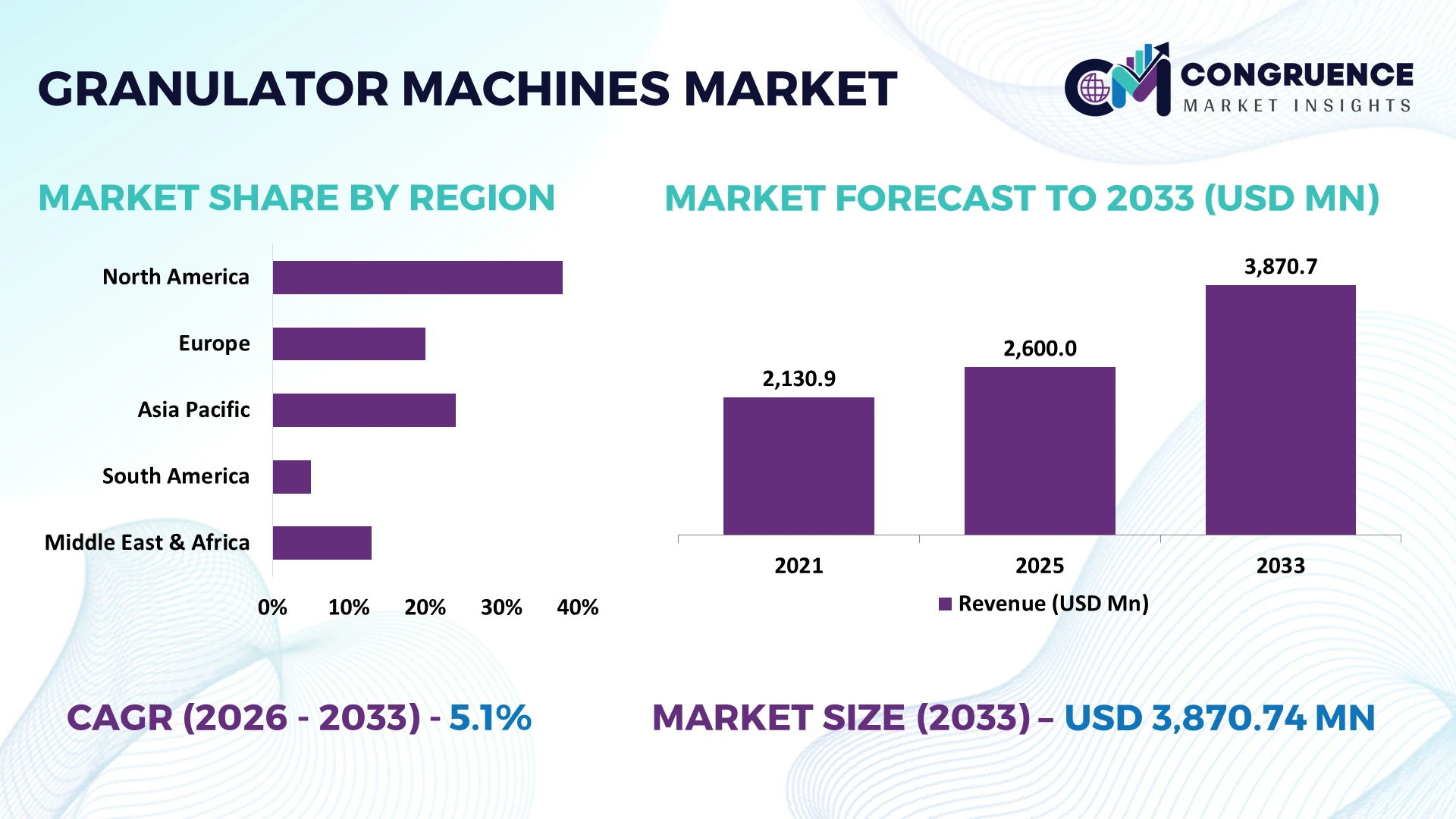
The Global Granulator Machines Market was valued at USD 2600 Million in 2025 and is anticipated to reach a value of USD 3870.74 Million by 2033 expanding at a CAGR of 5.1% between 2026 and 2033. Growth is driven by mandatory plastic waste processing, expansion of closed-loop polymer recycling, and adoption of automated size-reduction systems in plastics manufacturing and pharmaceutical production.
China remains a dominant manufacturing hub for industrial granulator machines, supported by its extensive plastics processing infrastructure, machinery production clusters, and recycling equipment supply chains. The country accounts for approximately 33% of global manufacturing value added, according to World Bank indicators, although this is not a granulator-specific market share. China's machinery ecosystem supports high-capacity rotor granulators, automated feeding systems, and integrated washing and pelletizing lines. Compared with India, China benefits from a more established equipment export network, while India's expanding plastics recycling infrastructure strengthens regional machinery procurement.
Manufacturers prioritizing energy-efficient drives, replaceable cutting assemblies, and automated material handling are positioned to capture industrial modernization and recycling equipment replacement opportunities.
Market Size & Growth: USD 2,600 million in 2025, reaching USD 3,870.74 million by 2033 at 5.1% CAGR, supported by automated polymer recycling.
Top Growth Drivers: EU plastic packaging recycling targets increase from 50% in 2025 to 55% by 2030; recycled-content requirements reach 35% for specified packaging categories.
Short-Term Forecast: By 2028, energy-efficient drive adoption strengthens; advanced size-reduction drives demonstrate up to 25% efficiency improvements in documented applications.
Emerging Technologies: AI-assisted monitoring, automatic feed regulation, and low-energy cutting systems advance industrial granulation; CMG reports up to 50% energy savings for its EV series.
Regional Leaders: Asia-Pacific leads manufacturing activity, while Europe and North America prioritize advanced recycling; regional granulator revenue forecasts remain unestablished.
Consumer/End-User Trends: Plastics processors prioritize continuous operation and material recovery; CMG's EV 92-220 system targets approximately 4–6.5 tonnes of processing capacity hourly.
Pilot/Case Example: In 2024, YS Reclamation deployed Vecoplan's VAZ 1700 L6, reducing fine-material generation by approximately 40% while processing 4 tonnes hourly.
Competitive Landscape: Rapid Granulator, CMG, Hellweg, Vecoplan, and Zerma compete through throughput, rotor design, and service capabilities; verified individual market shares are unavailable.
Regulatory & ESG Impact: EU Regulation 2025/40 establishes a 70% overall packaging recycling target for 2030, reinforcing investments in material preparation equipment.
Investment & Funding: Equipment investment favors integrated shredding, washing, and granulation lines; consolidated global funding totals are not publicly established.
Innovation & Future Outlook: Next-generation granulators incorporate predictive monitoring and intelligent feed control; high-capacity systems demonstrated at K 2025 accelerate automated recycling modernization.
The Granulator Machines Market serves plastics recycling, injection molding, extrusion, pharmaceutical manufacturing, and industrial waste processing. Equipment innovation increasingly emphasizes precision cutting, variable-speed drives, automated feeding, and integrated material recovery. CMG's advanced granulation technology demonstrates energy savings of up to 50% in specified configurations, highlighting the operational value of efficient size reduction. Europe's packaging regulations and expanding Asian recycling infrastructure are influencing equipment specifications, particularly contamination control, throughput consistency, and material traceability. These developments place lifecycle operating costs, automation compatibility, and recycled-material quality at the center of strategic equipment procurement decisions.
The Granulator Machines Market is becoming strategically important as plastics manufacturers, recycling operators, and pharmaceutical processors restructure production around material recovery, operational efficiency, and automated processing. The European Union's packaging framework targets 55% recycling of plastic packaging waste by 2030, strengthening procurement requirements for industrial granulators capable of delivering consistent particle sizes. Manufacturers are increasingly integrating granulation with extrusion, washing, and material separation to reduce handling losses and improve recycled feedstock quality. This transition positions granulation equipment as a critical component of circular manufacturing infrastructure.
Technology differentiation increasingly centers on energy consumption, throughput stability, and cutting precision. CMG's advanced granulation systems demonstrate energy savings of up to 50% under specified operating conditions compared with conventional configurations. China maintains advantages in machinery production scale and component sourcing, while Germany emphasizes precision engineering, automation, and recycling system integration. India presents opportunities through expanding domestic plastics processing and recycling capacity.
During 2026–2028, equipment procurement will increasingly favor variable-frequency drives, predictive maintenance, and automated feeding systems. High-capacity granulators processing several tonnes hourly illustrate the operational value of integrated recycling installations. Manufacturers are strengthening engineering partnerships and aftermarket services to improve equipment availability. Competitive advantage will increasingly depend on processing consistency, energy efficiency, and lifecycle equipment performance.
The transition toward closed-loop plastics manufacturing is accelerating demand for industrial granulator machines with consistent particle sizing and high-throughput capabilities. Germany's packaging recovery infrastructure operates under European recycling requirements targeting 55% plastic packaging recycling and 70% overall packaging recycling by 2030. These mandates encourage processors to upgrade size-reduction equipment and integrate granulation into mechanical recycling lines. Advanced CMG granulators offer up to 50% lower energy consumption than conventional systems, improving processing economics. Equipment manufacturers are responding with intelligent rotor controls, modular cutting chambers, and automated material evacuation. The strategic advantage lies in producing uniform recycled feedstock suitable for extrusion without excessive secondary processing or material degradation.
High-capacity granulator installations face structural constraints involving machinery acquisition costs, replacement components, and inconsistent recycled material quality. Conventional granulators consume more than 50 Wh/kg in documented operating comparisons, while optimized configurations operate at approximately 20–25 Wh/kg. This efficiency difference places electricity-intensive legacy equipment at a disadvantage. In India, heterogeneous post-consumer plastic streams introduce additional sorting, contamination removal, and blade maintenance requirements. Mixed polymers, metallic impurities, and abrasive fillers increase cutting-tool wear and disrupt throughput consistency. Manufacturers are addressing these limitations through replaceable wear-resistant liners, localized spare-parts production, and application-specific rotor configurations. Procurement competitiveness increasingly depends on verified energy consumption per kilogram and maintenance expenditure rather than equipment purchase price alone.
Automated granulation systems create opportunities for machinery suppliers combining advanced controls, predictive diagnostics, and localized production. CMG's EV-series technology demonstrates up to 50% energy savings, while selected configurations provide 40% additional processing capacity through integrated feed-pusher systems. The company's 2026 manufacturing expansion in Pune, India, illustrates the shift toward regional production and technical support. Connected granulators equipped with OPC-UA communication enable continuous monitoring of power consumption, blade wear, and processing efficiency. During 2026–2028, manufacturers integrating these capabilities with extrusion and recycling lines can differentiate through equipment availability and consistent regrind quality. Local assembly, engineering partnerships, and digital aftermarket services strengthen competitiveness in price-sensitive industrial markets.
Maintaining consistent particle quality across industrial-scale recycling lines presents significant engineering and operational challenges. CMG's EV-series systems support capacities of approximately 3,000–5,000 kg/hour, requiring coordinated material feeding, cutting, evacuation, and downstream separation. Advanced cutting-chamber designs provide approximately 70% usable rotor volume, while specified equipment vibration remains below 1.5 mm/s under documented operating conditions. These performance characteristics require disciplined maintenance, accurate sensor calibration, and effective process integration. In China, large recycling installations must coordinate heterogeneous material streams with automated production controls. Manufacturers are investing in remote diagnostics, operator training, and standardized communication interfaces. Long-term competitive differentiation depends on maintaining throughput, particle uniformity, and equipment reliability under variable industrial loading.
Precision Particle Size Control Advances: Pharmaceutical manufacturers are refining granulation workflows to improve particle size distribution, powder flowability, and tablet compression consistency. High-shear granulators integrate adjustable impeller speeds, automated binder dosing, and endpoint monitoring to reduce batch variability. Systems operating at 100–300 rpm accommodate different formulation requirements, while controlled moisture levels improve downstream drying performance. Equipment suppliers are integrating recipe management and inline sensors to strengthen process reproducibility and reduce material losses during product changeovers.
Continuous Granulation Replaces Batch Handling: Pharmaceutical equipment manufacturers are introducing continuous wet granulation platforms that combine powder feeding, liquid addition, mixing, and discharge within integrated production lines. Twin-screw systems offer residence times measured in seconds rather than conventional batch cycles lasting several minutes. Germany's pharmaceutical machinery suppliers are expanding modular process equipment and digital validation capabilities. Continuous production reduces intermediate material handling, supports faster formulation adjustments, and improves manufacturing flexibility for facilities producing multiple tablet formulations.
Hygienic Granulator Design Gains Priority: Food processors are specifying stainless-steel contact surfaces, tool-free disassembly, and controlled discharge systems to reduce sanitation downtime. Equipment manufacturers increasingly offer 316L stainless-steel components and surface finishes approaching Ra 0.8 µm for demanding hygienic applications. Automated cleaning sequences and enclosed material transfer limit contamination exposure during product transitions. Suppliers are responding with modular assemblies and accessible cutting chambers, improving cleaning consistency while supporting stringent food safety and allergen management requirements.
Modular Processing Systems Improve Flexibility: Chemical manufacturers are shifting toward configurable granulation platforms that accommodate varying feedstock properties, particle specifications, and production volumes. Oscillating granulators with interchangeable screens and adjustable operating speeds support processing changes without complete equipment replacement. Modular equipment interfaces enable integration with 2–3 downstream operations, including screening, drying, and packaging. Machinery suppliers are expanding configurable product portfolios, reducing installation complexity and supporting multiproduct manufacturing facilities.
High-Shear Granulators represent a major value-intensive segment of the Granulator Machines Market, particularly in pharmaceutical and specialty chemical production. Their dominance in precision applications reflects rapid powder agglomeration, controlled binder distribution, and consistent granule density. Integrated impeller and chopper mechanisms support processing speeds of approximately 100–300 rpm, depending on formulation and equipment design. Compared with Oscillating Granulators, high-shear systems deliver more intensive mixing and support automated endpoint determination. Pharmaceutical equipment manufacturers are investing in programmable controls, closed processing chambers, and integrated drying systems to strengthen production consistency and regulatory compliance.
Dry Granulators are gaining strategic importance in moisture-sensitive pharmaceutical formulations because roller compaction eliminates liquid binders and wet-granulation drying stages. Wet Granulators remain essential where controlled liquid addition improves powder cohesion and granule strength. Oscillating Granulators serve established applications requiring screen-based particle sizing and gentle material handling. Equipment suppliers are expanding modular product configurations and application-specific engineering services to accommodate varying batch sizes, cleaning requirements, and material characteristics. Verified global market shares by granulator type are not publicly established.
Pharmaceuticals represent a high-value application for granulator machines because solid dosage manufacturing requires controlled particle distribution, predictable powder flow, and validated processing conditions. High-shear and dry granulation technologies support tablet manufacturing, capsule filling, and moisture-sensitive formulations. Equipment suppliers are incorporating automated binder addition, programmable mixing parameters, and inline process monitoring to improve batch reproducibility. Compared with Food Processing, pharmaceutical installations involve more demanding documentation, cleaning validation, and process control requirements. Continuous manufacturing adoption is strengthening demand for integrated granulation platforms capable of coordinating feeding, agglomeration, and downstream compression.
Plastics Recycling is emerging as a particularly important application for industrial size-reduction equipment, supported by circular-material requirements and investment in post-consumer waste processing. European plastic packaging recycling targets increase from 50% in 2025 to 55% by 2030, encouraging upgrades to material recovery infrastructure. Food Processing applications prioritize hygienic equipment design and uniform ingredient particle sizes, while Chemical Processing requires corrosion-resistant assemblies and controlled handling of specialty materials. Manufacturers are developing dedicated equipment platforms to address these distinct processing conditions.
Pharmaceutical Manufacturers constitute a strategically important buyer group because granulation equipment directly influences tablet quality, production reproducibility, and regulatory compliance. These companies prioritize high-shear granulators, roller compactors, and automated process monitoring to manage formulation-specific requirements. Equipment procurement increasingly emphasizes containment, cleanability, and electronic batch documentation. Continuous manufacturing technologies have progressed from their first pharmaceutical regulatory approval in 2015 to broader commercial implementation, encouraging manufacturers to integrate granulation with upstream dispensing and downstream tablet compression. Equipment suppliers are responding through validation support, modular production platforms, and specialized technical services.
Plastic Recycling Plants represent an expanding industrial customer category, requiring robust granulators capable of handling heterogeneous feedstocks and maintaining continuous material throughput. Europe's recycling sector reported approximately 13.5 million tonnes of installed processing capacity in 2024, demonstrating the scale of its equipment infrastructure. Food Manufacturers emphasize hygienic material contact surfaces and rapid product changeovers, whereas Chemical Manufacturers prioritize material compatibility, dust containment, and processing flexibility. Suppliers are differentiating through application-specific cutting systems, maintenance contracts, and equipment integration partnerships.
Asia-Pacific accounted for the largest market share in 2025, supported by China's industrial machinery manufacturing capacity, extensive plastics processing infrastructure, and pharmaceutical equipment production. Asia-Pacific is also positioned for the fastest expansion between 2026 and 2033, driven by industrial automation and recycling infrastructure investments.

Advanced Manufacturing and Precision Processing Modernization
North America represents an established market for industrial granulator machines, supported by pharmaceutical manufacturing, plastics processing, specialty chemicals, and automated material recovery facilities. The United States dominates regional equipment deployment through its concentration of injection molding, extrusion, and pharmaceutical production infrastructure. Industrial processors increasingly specify centralized granulation systems, automated material conveying, and precision cutting equipment to improve regrind consistency. The United States generated approximately 35.7 million tonnes of plastic waste in the EPA's 2018 materials assessment, demonstrating the scale of the material recovery challenge. Canada's industrial recycling operations strengthen demand for equipment capable of handling post-industrial polymer scrap. Machinery suppliers are expanding application engineering, preventative maintenance services, and automated material handling solutions. Competitive differentiation increasingly depends on equipment uptime, consistent particle sizing, and compatibility with existing manufacturing systems.
United States Market Outlook: The United States benefits from established pharmaceutical production clusters in New Jersey, Massachusetts, and North Carolina, alongside plastics manufacturing concentrations in Ohio and Michigan. The EPA's National Recycling Strategy targets a 50% national recycling rate by 2030 across municipal solid waste materials. Pharmaceutical equipment buyers emphasize validated processing, while plastics manufacturers prioritize closed-loop scrap recovery and integration with existing production equipment.
Circular Manufacturing Regulations Accelerate Equipment Modernization
Europe maintains a technologically advanced granulator machines market, supported by precision engineering, pharmaceutical production, and established industrial recycling infrastructure. Germany, Italy, and Switzerland contribute specialized machinery capabilities, including high-shear granulation, automated cutting systems, and integrated material processing equipment. The European Union's Packaging and Packaging Waste Regulation establishes a 65% overall packaging recycling target for 2025 and 70% by 2030, encouraging investment in material recovery technologies. Plastics recyclers increasingly require equipment capable of processing contaminated polymer streams while maintaining controlled particle distribution. Pharmaceutical manufacturers prioritize enclosed granulation systems, digital batch documentation, and validated cleaning procedures. Equipment suppliers are introducing modular platforms and application-specific engineering services to address increasingly demanding production specifications. Regional competitiveness centers on regulatory compliance, equipment reliability, and advanced manufacturing integration rather than low-cost machinery supply.
Germany Market Outlook: Germany remains a strategic manufacturing center for granulation technology through its pharmaceutical engineering capabilities, chemical processing infrastructure, and machinery export network. The country's Verpackungsgesetz establishes a 63% mechanical recycling requirement for plastic packaging. German equipment manufacturers emphasize high-shear processing, automated controls, and precision engineering, supporting customers requiring reproducible particle characteristics and reliable integration with downstream production systems.
Manufacturing Scale and Industrial Automation Leadership
Asia-Pacific holds the strongest manufacturing position in the Granulator Machines Market, supported by China's machinery production ecosystem, India's expanding plastics processing industry, and Japan's precision equipment engineering capabilities. China benefits from extensive industrial component supply chains, domestic equipment manufacturing clusters, and established export infrastructure. India provides an increasingly important production base for pharmaceutical granulation equipment and industrial plastics processing machinery. Japan and South Korea concentrate on advanced automation, precision controls, and specialized manufacturing applications. China's manufacturing sector accounts for approximately 28% of global manufacturing value added, highlighting the industrial scale supporting equipment production. Machinery suppliers are strengthening localized assembly, aftermarket servicing, and automated equipment integration. Regional competitive advantages include component availability, production scalability, and proximity to industrial processing customers, supporting both domestic deployment and machinery exports.
China Market Outlook: China leads regional industrial machinery production through established manufacturing clusters in Guangdong, Zhejiang, and Jiangsu. The country's pharmaceutical, plastics, and chemical processing industries support diversified granulator demand. China's 2024 equipment renewal action plan targets a more than 25% increase in industrial equipment investment by 2027 compared with 2023. Domestic manufacturers are developing automated feeding, intelligent monitoring, and integrated material processing systems to strengthen industrial productivity.
Industrial Recycling Capacity and Processing Equipment Localization
South America's granulator machines market is concentrated in Brazil, Argentina, and Colombia, where plastics manufacturing, food processing, and pharmaceutical production support equipment demand. Brazil represents the principal industrial center through its established polymer conversion industry and manufacturing infrastructure. Regional processors increasingly require granulators capable of recovering injection molding scrap, processing packaging waste, and supporting production efficiency. Brazil's plastics transformation industry includes more than 12,000 companies, creating a substantial installed base of potential machinery customers. Imported precision equipment remains important for pharmaceutical and specialized chemical applications, while domestic manufacturers compete in conventional industrial size-reduction systems. Currency volatility, equipment financing costs, and uneven waste collection infrastructure constrain procurement decisions. Suppliers are responding through localized technical support, component sourcing, and maintenance partnerships to improve equipment availability and reduce operating interruptions.
Brazil Market Outlook: Brazil's industrial manufacturing concentrations in São Paulo, Paraná, and Santa Catarina support demand for plastics processing and granulation machinery. The country's National Solid Waste Policy provides a regulatory framework for waste recovery and reverse logistics. Brazil recycled approximately 1.1 million tonnes of post-consumer plastics in 2023, supporting investment in mechanical processing equipment. Local machinery servicing and spare-parts availability remain important procurement considerations.
Petrochemical Diversification and Recycling Infrastructure Investment
The Middle East & Africa granulator machines market is developing through petrochemical manufacturing, pharmaceutical production, packaging conversion, and industrial recycling investments. Saudi Arabia and the United Arab Emirates are expanding downstream industrial capabilities, creating demand for specialized polymer processing and material recovery equipment. South Africa contributes established plastics conversion and pharmaceutical manufacturing operations, while Egypt supports growing industrial processing activity. Saudi Arabia's Vision 2030 industrial diversification program strengthens the strategic importance of local machinery capabilities and downstream manufacturing. The UAE's circular economy initiatives encourage industrial material recovery and improved waste processing infrastructure. Equipment deployment remains uneven because of differences in technical servicing networks, industrial automation capabilities, and recycling feedstock availability. Machinery suppliers are establishing regional distribution partnerships, providing application-specific systems, and developing maintenance capabilities to support reliable industrial operations.
Saudi Arabia Market Outlook: Saudi Arabia benefits from extensive petrochemical infrastructure in Jubail and Yanbu, providing a foundation for downstream polymer processing and industrial granulation applications. The country's National Industrial Development and Logistics Program supports manufacturing diversification and industrial technology adoption. Saudi Arabia targets diverting 90% of waste from landfills by 2040, strengthening the relevance of advanced material recovery equipment, localized engineering services, and integrated recycling technologies.
The Granulator Machines Market features competition between established engineering specialists, pharmaceutical equipment manufacturers, and cost-focused industrial machinery suppliers. Rapid Granulator, ZERMA, and CMG compete in plastics size reduction, while GEA and L.B. Bohle emphasize pharmaceutical granulation technology. The combined global market share of the five largest suppliers remains unverified, reflecting fragmented equipment categories and private ownership. Competition centers on cutting efficiency, automation compatibility, equipment durability, and application customization. CMG's advanced granulators demonstrate energy savings reaching 50% under specified operating conditions, strengthening differentiation against conventional machinery. Pharmaceutical suppliers compete through validated process controls and hygienic equipment designs. Chinese manufacturers emphasize competitive pricing and localized component sourcing, while European specialists invest in precision engineering and integrated processing systems. Current competitive pressure increasingly favors digital monitoring, specialized aftermarket services, and regional assembly partnerships. Technical validation, application engineering expertise, and dependable replacement components remain significant entry barriers. Winning requires demonstrable lifecycle savings and reliable industrial performance.
Rapid Granulator AB
ZERMA Machinery & Recycling Technology
CMG Granulators
Vecoplan AG
Hellweg Maschinenbau GmbH & Co. KG
Conair Group
Moretto S.p.A.
GEA Group AG
L.B. Bohle Maschinen und Verfahren GmbH
Glatt GmbH
Freund-Vector Corporation
Alexanderwerk GmbH
Hosokawa Micron Corporation
Fitzpatrick Company
Current granulator technologies emphasize variable-frequency drives, optimized rotor geometry, and automated process controls. Conventional fixed-speed machines experience efficiency losses under fluctuating feedstock loads, while intelligent systems adjust cutting speeds and material feeding. CMG reports energy savings reaching 50% for specified advanced configurations compared with conventional alternatives. Pharmaceutical high-shear granulators integrate programmable impellers, binder dosing, and endpoint detection, improving particle consistency and reducing manual intervention.
Emerging technologies connect granulators with sorting, extrusion, and packaging equipment through industrial communication interfaces. Vibration sensors, power monitoring, and predictive diagnostics support condition-based maintenance. High-capacity plastics granulators process several tonnes hourly, making equipment availability operationally critical. Continuous twin-screw granulation integrates feeding, wetting, and mixing into coordinated pharmaceutical workflows. Manufacturers are introducing modular equipment configurations that simplify cleaning, product changeovers, and automated production integration.
Between 2026 and 2028, procurement priorities will increasingly emphasize energy consumption per kilogram, particle uniformity, and verified equipment uptime. Digital batch records strengthen pharmaceutical traceability, while automated feed regulation improves plastics processing stability. European specialists benefit from precision engineering and application expertise, whereas Asian suppliers emphasize localized manufacturing and component availability. Competitive differentiation increasingly depends on interoperable controls, accessible maintenance systems, and demonstrable lifecycle operating advantages across industrial applications.
November 2025: CMG Granulators introduced Regrind Evac Systems, offering material handling capacities up to 7,000 kg/hour across 10 configurations. Vacuum conveying and dedusting improve material cleanliness, supporting automated plastics recycling operations. Source: cmg-granulators.com
September 2025: Rapid Granulator introduced its 800 Series industrial granulator, featuring a 132 kW standard motor and rear-access knife maintenance. The redesigned system improves servicing safety and supports high-volume wet granulation for demanding plastics recycling applications. Source: k-online.com
February 2025: FORNNAX Technology initiated construction of a 23-acre manufacturing facility in Gujarat, targeting annual production of approximately 250 recycling machinery units by 2030. The expansion strengthens domestic manufacturing capabilities and international equipment supply ambitions. Source: tyreandrubberrecycling.com
March 2024: Vecoplan reported YS Reclamation's installation of its VAZ1700 L6 shredder in Warrington, supporting plastic film recycling operations processing 27 tonnes daily. The equipment addressed productivity and quality constraints in upstream material preparation before pellet production. Source: vecoplan.com
The Granulator Machines Market Report evaluates industry developments across four equipment types: Wet Granulators, Dry Granulators, Oscillating Granulators, and High-Shear Granulators. Application coverage includes Pharmaceuticals, Plastics Recycling, Food Processing, and Chemical Processing, alongside their corresponding manufacturing and recycling end-users. Regional analysis examines North America, Europe, Asia-Pacific, South America, and the Middle East & Africa, identifying differences in manufacturing infrastructure, equipment deployment, regulatory requirements, and industrial processing capabilities.
The report assesses 2026–2033 market opportunities through automation adoption, precision cutting technologies, continuous pharmaceutical granulation, and integrated material recovery systems. Competitive benchmarking covers 14 profiled manufacturers, emphasizing equipment performance, customization, supply-chain positioning, and technical capabilities. Operational indicators include processing throughput, energy consumption, maintenance requirements, and production integration. These findings support capital allocation, market entry decisions, supplier evaluation, manufacturing expansion, and long-term competitive positioning.
| Report Attribute/Metric | Report Details |
|---|---|
Market Revenue in 2025 | USD 2600 Million |
Market Revenue in 2033 | USD 3870.74 Million |
CAGR (2026 - 2033) | 5.1% |
Base Year | 2025 |
Forecast Period | 2026 - 2033 |
Historic Period | 2021 - 2025 |
Segments Covered | By Type
By Application
By End-User
|
Key Report Deliverable | Revenue Forecast, Growth Trends, Market Dynamics, Segmental Overview, Regional and Country-wise Analysis, Competition Landscape |
Region Covered | North America, Europe, Asia-Pacific, South America, Middle East, Africa |
Key Players Analyzed | Rapid Granulator AB, ZERMA Machinery & Recycling Technology, CMG Granulators, Vecoplan AG, Hellweg Maschinenbau GmbH & Co. KG, Conair Group, Moretto S.p.A., GEA Group AG, L.B. Bohle Maschinen und Verfahren GmbH, Glatt GmbH, Freund-Vector Corporation, Alexanderwerk GmbH, Hosokawa Micron Corporation, Fitzpatrick Company |
Customization & Pricing | Available on Request (10% Customization is Free) |