
Reports
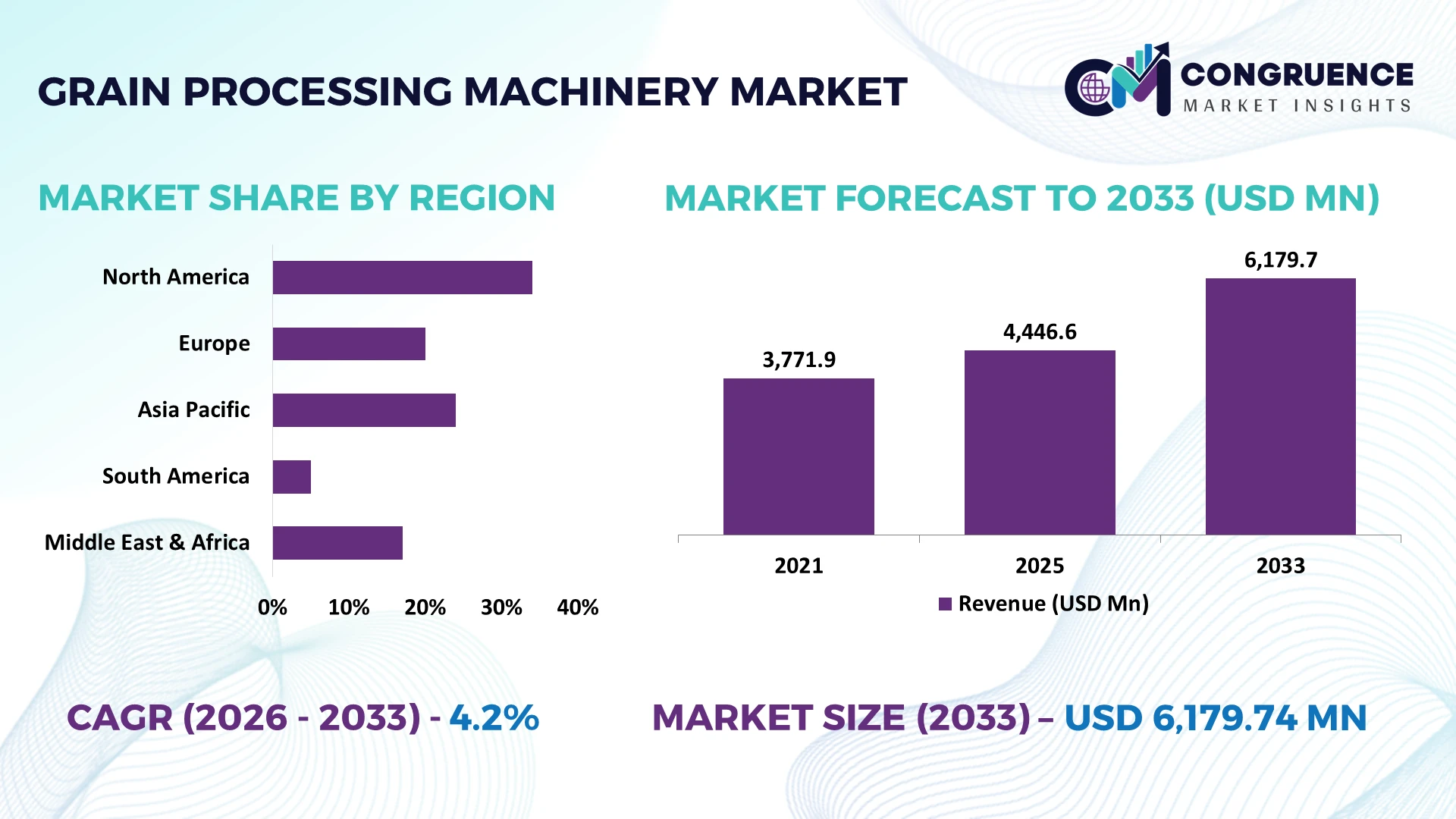
The Global Grain Processing Machinery Market was valued at USD 4446.6 Million in 2025 and is anticipated to reach a value of USD 6179.74 Million by 2033 expanding at a CAGR of 4.2% between 2026 and 2033. Growth is driven by replacement of energy-intensive mills, automated cleaning and optical sorting, larger cereal-processing volumes, and government-backed modernization of flour, rice, maize, feed, and storage infrastructure.
China anchors global grain-processing machinery deployment, producing 714.88 million tonnes of grain in 2025—about 23.5% of worldwide cereal output—with corn alone reaching 301.24 million tonnes. Its 2025 equipment-renewal policy explicitly added grain dryers, color sorters, and flour mills, while food-security tensions encouraged modernization across milling, feed, starch, rice, and grain-storage operations. China’s grain output is roughly twice India’s 357.73 million tonnes, although India recorded nearly 8% annual foodgrain growth and is rapidly expanding domestic processing infrastructure.
Strategically, machinery suppliers should prioritize China for replacement-scale automation while using India as the strongest localization, capacity-expansion, and mid-market equipment opportunity.
Market Size & Growth: USD 4,446.6 million in 2025 reaches USD 6,179.74 million by 2033 at 4.2%, driven by mill modernization and automated grain handling.
Top Growth Drivers: Automatic equipment holds 51.1%, preprocessing machinery 53.4%, while global cereal output increased 6.1%, strengthening equipment utilization and replacement intensity.
Short-Term Forecast: By 2028, advanced pneumatic conveying retrofits can reduce milling energy consumption by up to 30%, improving operating economics for high-throughput flour mills.
Emerging Technologies: AI optical sorting, IoT condition monitoring, and autonomous milling are advancing; automatic machinery already represents 51.1% of global equipment demand.
Regional Leaders: Indicative 2033 positioning places Asia-Pacific near USD 2.9 billion, Europe around USD 1.25 billion, and North America near USD 1.0 billion as automation deepens.
Consumer/End-User Trends: Global cereal utilization increased 2.7%, raising throughput requirements across flour, rice, maize, feed, starch, and ingredient-processing facilities.
Pilot/Case Example: Bühler Mill E3 installations achieved about 8% energy savings, 20% lower building volume, and over 10,000 installation-hours saved.
Competitive Landscape: Bühler remains the technology benchmark alongside Satake, PETKUS, Westrup, and AGI; automatic equipment’s 51.1% share shifts competition toward integrated digital processing.
Regulatory & ESG Impact: China expanded eligible machinery categories from 6 to 12 in 2025, explicitly supporting replacement of grain dryers, sorters, and flour mills.
Investment & Funding: Bühler committed approximately USD 24 million-equivalent to Indian manufacturing expansion, strengthening localized milling equipment production and shorter supply chains.
Innovation & Future Outlook: Energy-adaptive conveying cuts consumption up to 30%; AI sorting and connected mills shift competitive advantage toward autonomous, data-driven processing.
Grain processing machinery demand is concentrating around flour milling, rice processing, maize preparation, feed production, cleaning, grading, and optical sorting. Automatic systems already account for roughly 51% of equipment adoption, while AI-enabled sorters, adaptive pneumatic conveying, and connected milling platforms improve quality and energy control. China’s equipment-renewal policy and localized manufacturing in India reinforce the supply-chain transition, setting up the strategic discussion ahead.
Grain processing machinery is becoming strategically important as food-security policies, milling modernization, and supply-chain localization reshape investment priorities. China processed against a 2025 grain base of 714.88 million tonnes, while India reached 357.73 million tonnes, creating sustained pressure for higher-capacity cleaning, milling, sorting, drying, and conveying systems. Equipment renewal is shifting from isolated mechanical upgrades toward digitally monitored, energy-optimized production lines.
Modern modular mills provide a clear efficiency advantage over conventional installations: advanced designs reduce installation time by up to 30%, building volume by about 30%, and energy consumption by up to 10%. China emphasizes scale and state-supported machinery renewal, while India combines expanding foodgrain output with localized manufacturing and application engineering. Automatic machinery already represents about 51.1% of equipment demand, indicating that automation is moving into mainstream procurement.
A practical example is modular flour milling that combines online quality sensing, integrated grinding, condition monitoring, and automated yield management. Through 2026–2028, processors will increasingly prioritize energy-efficient pneumatics, optical sorting, predictive maintenance, and localized service capability. Suppliers are expanding manufacturing, training centers, and retrofit partnerships accordingly. Competitive advantage will increasingly depend on lifecycle efficiency, process intelligence, and dependable local support.
Automation is the primary structural driver as grain processors replace manually intensive cleaning, grading, milling, and handling equipment with integrated systems. Automatic machinery accounted for about 51.1% of equipment demand in 2025, while preprocessing equipment represented 53.4%. China’s grain output increased 1.2% to 714.88 million tonnes, intensifying throughput requirements across wheat, corn, and rice processing. Beijing’s equipment-renewal program expanded eligible agricultural machinery categories, including grain dryers, color sorters, and flour mills. The operational impact is higher line consistency, improved quality control, and lower dependence on manual inspection. A non-obvious benefit is better asset synchronization across cleaning and milling stages. Suppliers are responding with digital controls, modular platforms, optical sorting, and localized retrofit programs.
High energy intensity and brownfield integration constrain machinery replacement, particularly in older flour and rice mills. Pneumatic conveying remains one of the largest electricity loads in milling, while advanced retrofit packages demonstrate that legacy configurations can consume 20–30% more fan energy than optimized systems. Traditional aspiration equipment also uses substantially more fresh air, with modern recycling designs cutting fresh-air requirements by up to 90%. In India, fragmented processor scale and heterogeneous installed equipment complicate standardized modernization. The direct impact is longer payback, uneven operating costs, and delayed automation among smaller mills. The overlooked constraint is that replacing one machine rarely fixes upstream inefficiency. OEMs are therefore emphasizing staged retrofits, variable-frequency drives, localized spare parts, energy audits, and service contracts rather than complete plant replacement.
The strongest opportunity lies in digitally connected, energy-optimized grain plants combining optical sorting, IoT monitoring, automated yield control, and predictive maintenance. Automatic systems already account for 51.1% of equipment demand, while advanced air-recycling separators cut energy consumption by up to 30%. New aspiration channels reduce energy use by 15% and fresh-air demand by as much as 90%, creating a compelling modernization case where electricity costs are rising. India is particularly attractive: 2024–25 foodgrain output increased by roughly 7.7%, creating higher utilization across flour, rice, maize, and feed processing. A non-obvious opportunity is aftermarket analytics, where OEMs monetize performance optimization beyond machinery sales. Companies are expanding R&D, localized manufacturing, digital services, and application centers to capture this shift.
Long-term scalability depends on integrating sensors, PLCs, optical sorters, MES platforms, and predictive-maintenance systems across plants built over multiple equipment generations. With automatic machinery already representing 51.1% of demand, processors face growing requirements for controls specialists, data engineers, and maintenance technicians rather than only mechanical millers. Advanced modular mills can shorten installation by 30% and reduce building volume by 30%, but realizing these gains requires accurate commissioning and disciplined process integration. India’s agricultural economy still employs about 46.1% of the workforce, highlighting the scale of the skills transition as processing becomes more automated. The strategic risk is fragmented digital architecture rather than machine failure alone. Suppliers must invest in training centers, interoperable controls, remote diagnostics, cybersecurity, and local systems-integration partnerships.
Quality Control Moves Upstream: Grain processors are moving optical sorting, contaminant detection, and grading closer to intake as 2025 cereal production reached 3,043 million tonnes, up 6.1%, while utilization increased 2.7%. Mill operators are deploying sensor-based cleaning systems to protect downstream equipment, stabilize extraction rates, and reduce quality-related reprocessing.
Energy Optimization Reaches Conveying: Pneumatic conveying is shifting from fixed-speed operation toward pressure-responsive control. Adaptive systems can reduce conveying energy consumption by up to 30%, while advanced mill architectures deliver up to 10% energy savings. Suppliers are integrating variable-speed drives and real-time airflow control as electricity-per-tonne becomes a critical operating KPI.
Compact Mills Reshape Expansion: Modular grain-processing lines are replacing space-intensive conventional installations. Advanced modular milling can shorten installation by 30% and reduce required building investment by up to 30%; newer rice lines achieve 60% lower mill volume. OEMs are increasingly supplying preassembled modules that accelerate commissioning and simplify capacity additions.
Processing Mix Follows Grain Flows: Equipment configurations are adjusting to changing cereal utilization. Coarse-grain use is expected to increase 0.5% in 2026/27, rice utilization 0.9%, while wheat utilization remains comparatively flat. Processors are rebalancing grinding, dehulling, polishing, and handling capacity, particularly where maize feed consumption and rice food use are strengthening.
Milling Machines lead the type segment with an estimated 32% share, reflecting their indispensable position in flour, rice, corn, oat, and barley conversion. High utilization, continuous operation, and direct influence on extraction yield sustain replacement demand. Cleaning Machines account for approximately 24%, supported by tighter impurity control and increased use of optical sorting before grinding. Their role is becoming more strategic as processors seek to prevent foreign material from reducing downstream equipment efficiency.
Grinding Machines represent the fastest-expanding type, with an estimated 20% share, supported by increasing maize and feed utilization and greater demand for controlled particle sizing. Dehulling Machines account for roughly 14%, serving rice, oats, and barley processing, while Polishing Machines represent around 10% and remain concentrated in finished rice and premium grain applications. Manufacturers are directing product development toward intelligent roll adjustment, automated grinding control, modular cleaning, and energy-efficient drives, shifting investment from isolated mechanical machines toward interconnected process trains.
Wheat Processing holds the leading application position at an estimated 34%, supported by extensive flour-milling infrastructure and wheat’s importance across bakery, noodles, pasta, and staple foods. Rice Processing follows at approximately 29%, with China, India, Indonesia, Bangladesh, and Southeast Asian exporters supporting intensive cleaning, dehulling, whitening, and polishing requirements. Global rice utilization is projected to reach 558.2 million tonnes in 2026/27, reinforcing equipment utilization.
Corn Processing, representing approximately 23%, is the fastest-expanding application as maize increasingly feeds animal nutrition, starch, grits, ethanol, and ingredient manufacturing. Oat Processing contributes about 8%, while Barley Processing accounts for approximately 6%, with specialized demand from food, feed, and malt-related operations. Equipment companies are developing multi-grain cleaning systems, adjustable grinding platforms, moisture-management controls, and rapid recipe switching. The strategic advantage is increasingly the ability to process different grain grades without installing dedicated lines.
Grain Mills lead end-user demand with an estimated 31% share because integrated facilities operate cleaning, grading, grinding, conveying, and milling equipment across multiple grain categories. Flour Mills follow at approximately 26%, supported by continuous wheat-processing cycles and high machinery utilization. Rice Mills represent around 20%, with investment concentrated in dehulling, whitening, polishing, sorting, and automated handling across major Asian production hubs.
Feed Mills are the fastest-expanding buyer group, representing approximately 15%, as greater maize and barley utilization increases requirements for high-capacity grinding and precise particle-size control. Food Processors account for roughly 8%, concentrating on specialty flours, flakes, cereal ingredients, and differentiated grain products. Suppliers are segmenting portfolios accordingly: turnkey digital plants target large grain and flour mills, while modular machines and retrofit packages address smaller processors. Service contracts and performance optimization are also becoming more important as mill electricity consumption typically ranges between 50 and 75 kWh per tonne of wheat.
Asia-Pacific accounted for the largest market share at approximately 42% in 2025 however, Asia-Pacific is expected to register the fastest growth, expanding at a CAGR of approximately 5.1% between 2026 and 2033.

Automation Upgrades Mature Milling Infrastructure
North America accounts for approximately 21% of global grain processing machinery demand, anchored by industrial-scale corn, wheat, soybean, and feed processing in the United States. Large processors increasingly replace standalone mechanical equipment with digitally connected cleaning, grinding, conveying, and optical-sorting systems. High labor costs strengthen investment in automatic controls, while energy-intensive pneumatic conveying creates a clear modernization target. The United States remains particularly important for high-capacity corn wet and dry milling, flour production, ethanol-linked grain processing, and compound feed. Canada adds substantial wheat and oat processing capacity, with export-oriented mills emphasizing product consistency and traceability. Investment is shifting toward brownfield modernization rather than extensive greenfield construction, benefiting suppliers offering retrofit-compatible sensors, variable-frequency drives, predictive maintenance, and automated quality-control systems that extend existing plant life.
United States Market Outlook: The United States combines large-scale cereal production with sophisticated processing infrastructure and strong demand for automation. Corn production exceeds 400 million tonnes in strong crop years, sustaining intensive grinding, conveying, separation, and feed-processing requirements. Processors increasingly prioritize digital process control, energy-per-tonne optimization, optical inspection, and preventive maintenance to improve utilization without rebuilding entire milling complexes.
Efficiency Standards Reshape Mill Modernization
Europe represents approximately 23% of global machinery demand, supported by mature flour milling, animal feed, cereal-food, malting, and specialty-grain industries. Germany, Italy, France, Switzerland, and Türkiye form important equipment manufacturing and processing centers. Capital expenditure increasingly targets energy efficiency because grinding, aspiration, and pneumatic conveying account for significant electricity consumption inside industrial mills. European processors are deploying variable-speed drives, automated roll adjustment, heat recovery, digital quality monitoring, and compact modular configurations. Food-safety requirements also strengthen demand for optical sorting and traceability-compatible equipment. Unlike Asia’s capacity-led expansion, European investment primarily replaces aging assets while improving yield and environmental performance. Machinery manufacturers are responding with digitally optimized retrofits and service-based efficiency programs, creating recurring aftermarket opportunities alongside conventional equipment sales and reducing the economic disruption associated with complete line replacement.
Germany Market Outlook: Germany combines advanced mechanical engineering with highly automated food and feed production, making it an important technology market rather than simply a volume market. German processors emphasize energy-efficient motors, automated controls, hygienic engineering, and process traceability. Equipment suppliers increasingly compete through lifecycle optimization and integration expertise, particularly when modernizing established mills without extended production shutdowns.
Processing Scale Drives Equipment Leadership
Asia-Pacific commands approximately 42% of global demand, reflecting exceptionally high rice, wheat, corn, and feed-processing volumes across China, India, Japan, Indonesia, Vietnam, and Thailand. China produced 714.88 million tonnes of grain in 2025, including 301.24 million tonnes of maize, 209.04 million tonnes of rice, and 140.07 million tonnes of wheat. India recorded 357.73 million tonnes of foodgrains in 2024–25, reinforcing machinery requirements across decentralized and industrial mills. Equipment renewal is moving beyond capacity expansion toward optical sorting, automated moisture management, energy-efficient grinding, and intelligent process control. China’s machinery-renewal policies strengthen replacement demand, while India’s processing expansion encourages localized equipment production. Suppliers are therefore expanding regional manufacturing, application centers, spare-parts networks, and lower-cost modular platforms rather than relying exclusively on imported turnkey machinery.
China Market Outlook: China is the region’s most strategically significant market because its 2025 grain output increased 1.2%, while average grain yield improved 1.1% to 5,987 kilograms per hectare. Government-supported equipment renewal includes grain dryers, color sorters, and flour mills, strengthening demand for higher-efficiency processing assets and giving locally manufactured automated systems a strong procurement advantage.
Record Harvests Expand Processing Requirements
South America accounts for approximately 9% of global machinery demand, with Brazil and Argentina dominating grain production and downstream processing. Brazil’s 2025/26 grain harvest is estimated at 360.8 million tonnes, 2.4% above the previous season, while planted area reaches approximately 83.5 million hectares. Expanding corn and soybean volumes increase requirements for cleaning, drying, grinding, feed milling, and bulk-handling equipment. Argentina provides additional demand through maize, wheat, soybean, and feed processing, although currency conditions and imported machinery costs complicate capital planning. Brazilian processors increasingly require higher-capacity machinery near production corridors to reduce logistics inefficiencies and improve value addition before shipment. OEMs are responding through local assembly, distributor partnerships, spare-parts inventories, and modular systems suited to incremental expansion rather than capital-intensive complete plant replacement.
Brazil Market Outlook: Brazil provides the region’s largest addressable processing base, with maize output projected near 143 million tonnes in 2025/26. Grain production is increasing faster than planted area, strengthening the utilization case for industrial cleaning, drying, grinding, and feed-processing assets. Local service capability remains decisive because seasonal harvest peaks place exceptional pressure on equipment uptime.
Food Security Accelerates Milling Investment
Middle East & Africa represents approximately 5% of global machinery demand, but food-security programs and dependence on imported cereals make processing infrastructure strategically important. Saudi Arabia, Egypt, Türkiye-linked trade corridors, South Africa, and the UAE support significant flour, feed, and grain-handling operations. Gulf countries increasingly invest in storage, milling, and food-manufacturing capacity to strengthen supply resilience, while African markets require scalable machinery suited to fragmented processing networks and variable electricity infrastructure. Wheat-import exposure following Black Sea supply disruptions reinforced the importance of domestic storage and milling capability. Suppliers are responding with energy-efficient compact mills, modular cleaning systems, remote diagnostics, and distributor-led technical support. The market rewards machinery capable of operating reliably under demanding climatic conditions while minimizing skilled-maintenance requirements and dependence on imported replacement components.
Saudi Arabia Market Outlook: Saudi Arabia combines strategic grain reserves with large industrial flour-milling and feed operations, making food-security infrastructure a central procurement driver. Privatization and modernization of milling assets have strengthened commercial operating discipline, while expanding domestic food manufacturing supports automated grain handling, cleaning, grinding, and quality-control systems designed for high utilization and desert operating conditions.
Bühler, Satake, AGI, Alapala, and PETKUS compete globally against specialized Chinese, Indian, Turkish, and European machinery suppliers, with the top five estimated to control approximately 30–35% of equipment demand. Bühler and Satake compete through integrated milling, optical sorting, automation, and lifecycle services, while regional OEMs challenge them through localized manufacturing and equipment prices typically 15–25% lower. Digital process control, energy optimization, and yield improvement increasingly outweigh basic throughput: advanced pneumatic systems reduce conveying energy by up to 30%, while modular mills can shorten installation by roughly 30%. Suppliers are expanding manufacturing centers, application laboratories, distributor partnerships, and remote-service platforms to secure aftermarket relationships. Competition is shifting from standalone cleaning and grinding machines toward connected processing ecosystems integrating sensors, automation, analytics, and maintenance. Installed-base integration, process expertise, food-safety compliance, and service availability create strong entry barriers. Winning requires competitive lifecycle costs, measurable process efficiency, reliable local support, and adaptable multi-grain technology.
Bühler Group
Satake Corporation
AGI
Alapala
PETKUS Technologie
Westrup
Henry Simon
Milltec Machinery
PINGLE Group
Zhengzhou Chinatown Grain Machinery
Golfetto Sangati
Schule Mühlenbau
Bratney Companies
Lushan Win Tone Engineering Technology
Current grain processing technology is shifting toward sensor-rich automation, intelligent pneumatic conveying, direct-drive finishing, and optical sorting. More than 100 Bühler SmartMill lines are already connected globally, showing digital adoption. Pressure-responsive pneumatic retrofits cut fan energy use by up to 30%, while direct-drive bran finishers also reduce energy consumption by about 30% versus previous belt-driven models, lowering operating costs and maintenance exposure.
Emerging systems combine AI-assisted vision, automatic defect profiling, condition monitoring, MES integration, and modular mill architecture. Satake’s latest optical sorting platform reduces acceptable-product loss with defective material by approximately 10%, directly improving yield. Compared with legacy fixed-speed conveying, adaptive controls deliver around 20% average energy savings in customer tests, while modular mill designs can shorten installation by 30%, improving project speed and capital utilization.
Through 2026–2028, disruptive advantage will come from autonomous process optimization, predictive maintenance, digital twins, and interoperable cleaning-to-milling control. Large processors benefit first because data density supports yield and energy optimization across multiple lines, while regional millers gain through retrofit packages. Suppliers combining machinery, controls, analytics, and local service will outperform equipment-only competitors. Acting now matters because digital integration lowers lifecycle cost, protects grain quality, and raises throughput consistency before automation standards become procurement requirements.
June 2024 Bühler launched the Arrakis roller mill, succeeding Airtronic with patented grinding-gap adjustment designed for stable grinding performance and improved operational efficiency. The launch strengthened Bühler’s premium milling portfolio and modernization proposition for major global flour processors. Source: Bühler
December 2025 Alapala secured new Marata Group contracts in Brazil adding 1,600 tonnes-per-day of flour milling capacity, lifting installed capacity to 2,200 tonnes-per-day. The expansion deepened Alapala’s turnkey presence in Latin America and strengthened Marata’s regional processing scale. Source: Miller
June 2026 Satake globally launched the SLASH β PLUS optical sorter, whose high-efficiency ejectors reduce acceptable product discarded with defects by approximately 10%. The upgrade improves grain yield, sorting precision, and operating economics for processors handling variable-quality inputs. Source: Satake
February 2026 AGI unveiled a bucket elevator spanning 10,000–120,000 bushels-per-hour capacity at GEAPS Exchange. Customer-led redesign added easier inspection access, abrasion protection, and removable sections, strengthening uptime, maintenance safety, and high-capacity grain handling performance across large commercial facilities. Source: WorldGrain
The Grain Processing Machinery Market report covers Cleaning Machines, Milling Machines, Grinding Machines, Dehulling Machines, and Polishing Machines across Rice Processing, Wheat Processing, Corn Processing, Oat Processing, and Barley Processing. End-user assessment includes Grain Mills, Food Processors, Flour Mills, Rice Mills, and Feed Mills, supported by analysis across North America, Europe, Asia-Pacific, South America, and Middle East & Africa.
Technology coverage evaluates optical sorting, intelligent grinding, automated cleaning, pneumatic conveying, AI-assisted quality control, IoT condition monitoring, and integrated mill automation. Milling Machines account for approximately 32% of type demand, while Grain Mills represent about 31% of end-user deployment, highlighting concentrated modernization opportunities. The report also examines modular mills, energy-efficient retrofits, multi-grain processing, and digital service models, helping stakeholders prioritize investment, geographic expansion, partnerships, competitive positioning, and technology strategy through 2033.
| Report Attribute/Metric | Report Details |
|---|---|
Market Revenue in 2025 | USD 4446.6 Million |
Market Revenue in 2033 | USD 6179.74 Million |
CAGR (2026 - 2033) | 4.2% |
Base Year | 2025 |
Forecast Period | 2026 - 2033 |
Historic Period | 2021 - 2025 |
Segments Covered | By Type
By Application
By End-User
|
Key Report Deliverable | Revenue Forecast, Growth Trends, Market Dynamics, Segmental Overview, Regional and Country-wise Analysis, Competition Landscape |
Region Covered | North America, Europe, Asia-Pacific, South America, Middle East, Africa |
Key Players Analyzed | Bühler Group, Satake Corporation, AGI, Alapala, PETKUS Technologie, Westrup, Henry Simon, Milltec Machinery, PINGLE Group, Zhengzhou Chinatown Grain Machinery, Golfetto Sangati, Schule Mühlenbau, Bratney Companies, Lushan Win Tone Engineering Technology |
Customization & Pricing | Available on Request (10% Customization is Free) |




