
Reports
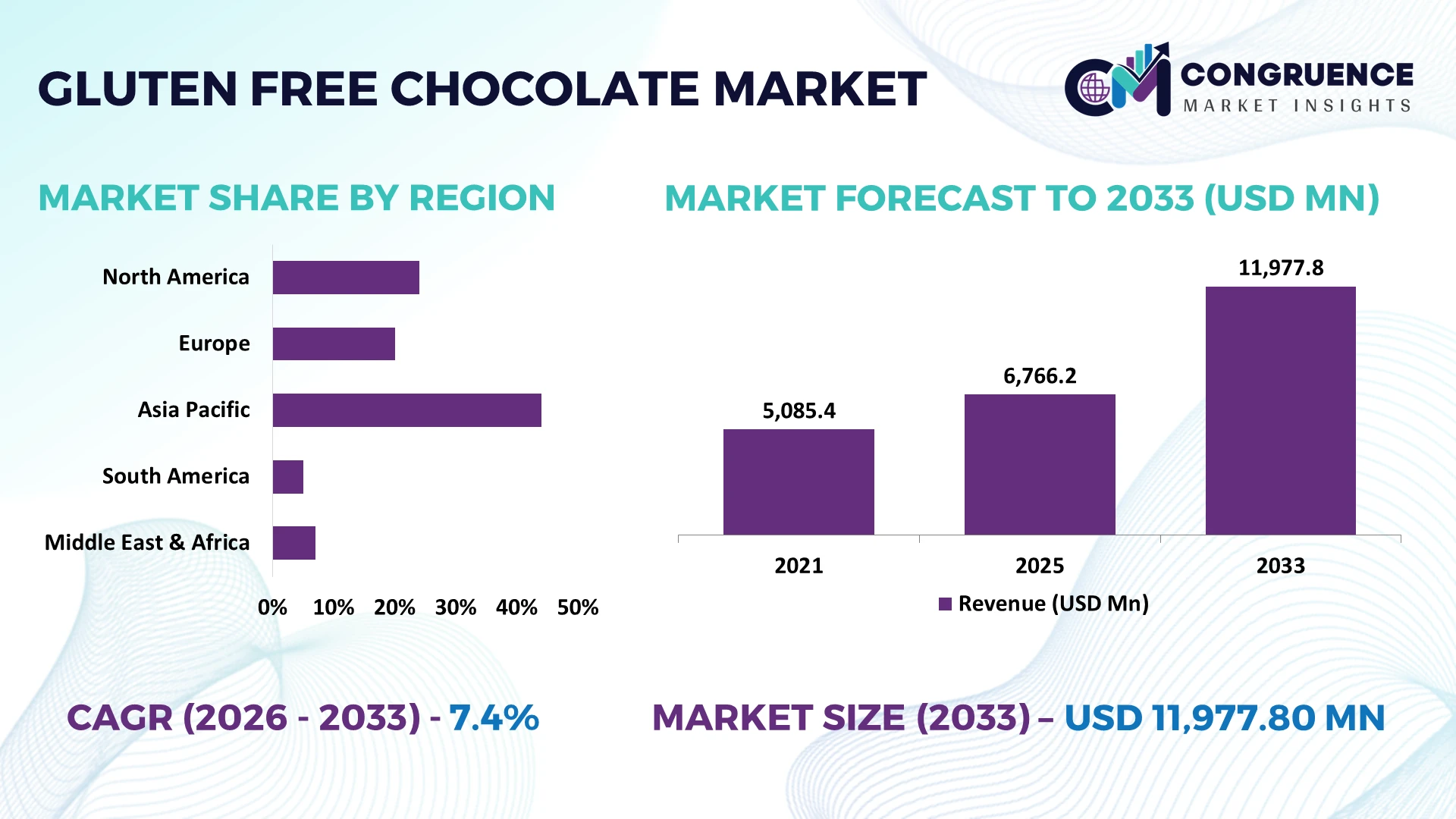
The Global Gluten Free Chocolate Market was valued at USD 6766.2 Million in 2025 and is anticipated to reach a value of USD 11977.8 Million by 2033 expanding at a CAGR of 7.4% between 2026 and 2033. Growth is being driven by certified gluten-free manufacturing, premium cocoa innovation, clean-label product launches, and expanded retail distribution across health-focused consumer segments.
Germany remains a dominant production and export hub, accounting for approximately 21% of Europe's premium gluten-free chocolate manufacturing capacity, supported by advanced food processing investments and automated quality-control systems covering nearly 68% of large facilities. The United States records stronger consumer adoption through specialty retail and e-commerce, while Germany maintains higher export intensity. Ongoing European food labeling compliance and resilient sourcing strategies following Red Sea shipping disruptions continue strengthening regional competitiveness.
Manufacturers investing in certified production capacity, digital traceability, and diversified cocoa sourcing are positioned to secure premium market share and strengthen long-term supply resilience.
Market Size & Growth: USD 6766.2 Million in 2025, reaching USD 11977.8 Million by 2033 at a 7.4% CAGR, supported by advanced allergen-free manufacturing and premium product innovation.
Top Growth Drivers: Certified gluten-free product launches contribute around 32% of new offerings, premium dark chocolate demand rises 27%, and clean-label purchasing influences nearly 44% of buying decisions.
Short-Term Forecast: By 2027, automated production and digital quality inspection reduce manufacturing waste by approximately 12% while improving production efficiency by 15%.
Emerging Technologies: AI-enabled quality inspection, automated allergen detection, and smart traceability platforms improve batch verification accuracy by nearly 20% across advanced production facilities.
Regional Leaders: Europe exceeds USD 4.3 Billion through premium innovation, North America approaches USD 3.6 Billion with specialty retail expansion, and Asia-Pacific surpasses USD 2.5 Billion driven by modern food manufacturing adoption.
Consumer/End-User Trends: More than 39% of gluten-sensitive consumers actively prefer premium certified chocolate products with clean-label ingredients and sustainable cocoa sourcing.
Pilot/Case Example: In 2026, automated allergen-control implementation at certified facilities improved production consistency by 18% while reducing cross-contamination risk by 24%.
Competitive Landscape: The leading manufacturer holds approximately 12% global share, with competition driven by Lindt, Nestlé, Mondelez International, Hershey, and Barry Callebaut amid regional expansion.
Regulatory & ESG Impact: Enhanced allergen labeling compliance and sustainable cocoa sourcing programs improve certification success by approximately 16% while strengthening export readiness.
Investment & Funding: More than USD 700 Million supports factory modernization, strategic partnerships, and premium product expansion as companies strengthen resilient global supply chains.
Innovation & Future Outlook: Functional ingredients, sugar-reduction technologies, and precision manufacturing accelerate premium portfolio diversification while supporting high-growth global market expansion.
The Gluten Free Chocolate Market is expanding through premium confectionery, functional snacks, and specialty gifting applications as manufacturers introduce cleaner formulations and advanced allergen-control technologies. Around 41% of new product launches emphasize certified clean-label positioning alongside improved cocoa traceability. Supply-chain diversification and stricter food labeling compliance continue reshaping sourcing strategies, creating stronger operational resilience and setting the foundation for the strategic market assessment that follows.
The Gluten Free Chocolate Market has become strategically important as food manufacturers compete through certified allergen-free production, premium positioning, and resilient ingredient sourcing rather than price alone. Supply-chain restructuring following continued cocoa procurement disruptions and stricter food-label compliance requirements has accelerated investment in traceable sourcing and automated quality assurance. More than 52% of newly commissioned premium confectionery lines now integrate digital batch monitoring to strengthen certification consistency and reduce operational risk across export markets.
Modern AI-assisted optical inspection and automated allergen validation systems improve inspection efficiency by nearly 22% compared with conventional manual quality checks while reducing product recall exposure and lowering quality-control costs by approximately 14%. Switzerland maintains leadership in premium product innovation and advanced manufacturing, whereas the United States demonstrates faster commercial deployment through specialty retail expansion and direct-to-consumer distribution. Over the next two to three years, digital traceability adoption is expected to exceed 60% among leading manufacturers as retailers prioritize transparent sourcing and verified ingredient integrity.
A practical example is the deployment of integrated traceability platforms linking cocoa suppliers, production facilities, and packaging operations into a unified compliance workflow. Companies are expanding partnerships with certified ingredient suppliers while modernizing processing lines to improve production flexibility and reduce certification lead times. Businesses that combine advanced manufacturing, supply resilience, and premium product differentiation will strengthen competitive positioning and secure lasting operational advantages.
Certified gluten-free production has become the principal structural driver as premium confectionery manufacturers expand dedicated processing capacity to meet stricter retail requirements. Approximately 46% of new premium chocolate launches now feature certified allergen-free claims, while automated production reduces cross-contamination incidents by nearly 18% and increases production consistency by around 15%. Germany continues investing in specialized food manufacturing infrastructure to support export-oriented production under tighter labeling standards. These developments improve retailer confidence and strengthen premium shelf positioning. Leading companies are responding through factory expansion, strategic cocoa sourcing partnerships, and investment in automated inspection technologies, creating stronger operational resilience and reinforcing long-term competitive differentiation in high-value chocolate categories.
Persistent cocoa supply volatility and higher certification expenses continue limiting operational scalability for gluten-free chocolate manufacturers. Cocoa procurement costs remain approximately 20% above historical averages in several sourcing contracts, while certification and compliance activities increase production expenses by nearly 9%. Weather-related disruptions affecting West African cocoa-producing countries have intensified procurement uncertainty, forcing manufacturers to maintain higher inventory levels and diversify sourcing. Smaller producers experience greater pressure on profitability due to limited purchasing leverage and certification overhead. Companies are responding through multi-origin sourcing agreements, localized ingredient procurement, and long-term supplier contracts that stabilize production planning while protecting product availability and maintaining premium quality standards.
The strongest emerging opportunity lies in combining gluten-free formulations with functional ingredients, premium cocoa varieties, and intelligent manufacturing systems. Around 37% of recent product innovation focuses on added protein, plant-based ingredients, or reduced-sugar formulations, while digital production platforms improve batch traceability by nearly 25%. Japan continues advancing precision food manufacturing technologies that enable consistent allergen control and faster product customization. Companies are increasing research partnerships with ingredient specialists and expanding pilot production facilities to accelerate premium product development. A less obvious advantage is the ability to shorten product commercialization cycles through digital formulation management, strengthening retailer responsiveness and improving competitive positioning in rapidly evolving specialty food categories.
Maintaining consistent gluten-free certification across expanding manufacturing networks remains a major execution challenge as companies increase production volumes. Nearly 31% of manufacturers identify workforce training and standardized quality management as operational priorities, while integrated compliance systems require approximately 17% higher implementation investment than conventional production monitoring. The United States faces increasing complexity as manufacturers integrate multiple suppliers into certified production ecosystems without compromising traceability. Inconsistent digital integration between sourcing, manufacturing, and packaging can reduce deployment efficiency and delay market launches. Companies must strengthen workforce capabilities, modernize factory infrastructure, and establish technology partnerships that support unified quality management, scalable certification processes, and long-term operational consistency across global production networks.
Dark Chocolate remains the leading segment with an estimated 43% market share, supported by strong consumer preference for premium cocoa content, clean-label formulations, and functional nutrition positioning. Its manufacturing scalability, longer shelf stability, and compatibility with reduced-sugar recipes make it the preferred choice for established brands. Milk Chocolate maintains broad consumer appeal across family and mainstream retail channels, while White Chocolate continues serving premium gifting and seasonal collections. Manufacturers are increasing investments in certified cocoa sourcing and allergen-controlled production to strengthen premium product differentiation.
Filled Chocolate is the fastest-growing type as demand rises for functional inclusions, nut alternatives, fruit fillings, and protein-enhanced formulations. Nearly 31% of recent premium launches feature innovative fillings, while automated depositing technologies improve production efficiency by approximately 17%. Companies are expanding specialty product portfolios, introducing limited-edition flavors, and forming ingredient partnerships to capture premium consumer spending. Investment priorities continue shifting toward differentiated recipes that deliver higher margins while strengthening brand loyalty in specialty confectionery.
Confectionery remains the dominant application, accounting for approximately 49% of market demand due to established consumer purchasing behavior, extensive retail availability, and premium gifting occasions. Standardized manufacturing processes and efficient packaging systems support high-volume production, while certified gluten-free positioning strengthens premium pricing. Bakery applications continue expanding through gluten-free pastries and premium baked products, whereas Desserts maintain steady demand across frozen and chilled specialty categories. Companies are increasing dedicated production capacity and improving allergen-controlled processing to strengthen product consistency.
Snacks represent the fastest-growing application as healthier eating habits and convenient consumption formats reshape purchasing patterns. Around 35% of new gluten-free chocolate snack introductions emphasize portion control, functional ingredients, or clean-label positioning. Automated packaging systems improve production efficiency by approximately 16%, enabling faster retail replenishment and wider product availability. Manufacturers are expanding convenience-focused product lines, strengthening retailer partnerships, and integrating digital demand forecasting to improve inventory planning and accelerate market responsiveness.
Food & Beverage companies remain the largest end-user group with an estimated 46% market share, driven by large-scale manufacturing infrastructure, extensive product portfolios, and continuous premium product development. Their integrated production networks enable efficient deployment of certified gluten-free ingredients while maintaining strict quality standards. Retail channels continue expanding shelf space for specialty chocolate, whereas Food Service supports demand through cafés, bakeries, and premium dessert outlets. Leading manufacturers are introducing customized product formats and strengthening long-term supply agreements to improve operational reliability.
Hospitality is emerging as the fastest-growing end-user segment as premium hotels and resorts expand allergen-friendly dining experiences. Approximately 29% of premium hospitality operators have increased specialty confectionery offerings, while digital menu management improves allergen communication efficiency by nearly 18%. Companies are developing exclusive product partnerships, customized packaging, and premium presentation formats tailored to hospitality requirements. Competitive strategies increasingly prioritize differentiated customer experiences, strengthening long-term demand across commercial food ecosystems.
Europe accounted for the largest market share at 36.8% in 2025 however, Asia-Pacific is expected to register the fastest growth, expanding at a CAGR of 8.6% between 2026 and 2033.

Advanced Retail Integration and Premium Product Scaling
North America represents a major consumption and innovation hub for gluten-free chocolate, supported by mature specialty retail networks, advanced food manufacturing infrastructure, and strong certification compliance standards. The region contributes approximately 31% of global demand, with the United States accounting for the majority of certified product launches. More than 55% of premium gluten-free chocolate brands in the region now utilize digital traceability systems to strengthen supply-chain transparency and retailer confidence. Investments in automated allergen-control systems and dedicated production lines have improved manufacturing consistency while reducing operational risks. Strategic partnerships between confectionery producers and specialty retailers continue expanding shelf availability, allowing manufacturers to accelerate premium product penetration and strengthen category differentiation.
United States Market Outlook: The United States remains the region’s operational center due to its large-scale confectionery manufacturing base, advanced retail infrastructure, and high adoption of certified specialty foods. Nearly 62% of newly launched gluten-free chocolate products are introduced through premium retail and e-commerce channels. Investments in automated quality-control systems and direct supplier partnerships are helping manufacturers improve production flexibility, shorten product launch cycles, and strengthen compliance with evolving food-label requirements.
Certification Excellence Driving Competitive Advantage
Europe maintains the largest market position through established premium chocolate manufacturing, stringent food-label regulations, and highly developed export capabilities. The region accounts for nearly 37% of global market activity, supported by strong demand for clean-label and specialty confectionery products. Approximately 68% of large-scale manufacturers operate dedicated allergen-management programs, enhancing production reliability and export competitiveness. Sustainability initiatives, traceable cocoa procurement, and manufacturing modernization continue influencing investment priorities. Companies are increasingly adopting automated inspection technologies and digital quality-management platforms to improve compliance efficiency while supporting premium product positioning across domestic and export markets.
Germany Market Outlook: Germany serves as a key manufacturing and distribution center due to its advanced food-processing infrastructure and strong confectionery sector. More than 40% of large chocolate producers have expanded investments in automated allergen-monitoring technologies over recent years. The country’s emphasis on production efficiency, certification consistency, and export-oriented operations enables manufacturers to support high-volume output while maintaining premium product standards required by international retail networks.
Manufacturing Expansion and Consumer Premiumization
Asia-Pacific is emerging as the fastest-expanding market due to growing premium food consumption, expanding modern retail networks, and increasing investment in specialty food manufacturing. The region represents approximately 22% of global demand, with strong momentum from urban consumer segments seeking certified dietary products. More than 30% of new specialty confectionery facilities announced in recent years include dedicated allergen-control infrastructure. Manufacturers are improving production efficiency through automated packaging systems and digital inventory management platforms. Expansion of organized retail and online food distribution channels is accelerating product accessibility while encouraging multinational and domestic producers to broaden gluten-free product portfolios.
China Market Outlook: China has become the region’s most strategically significant market because of its manufacturing scale, rapidly expanding premium food sector, and advanced digital commerce ecosystem. Nearly 48% of specialty confectionery sales growth is linked to online retail channels. Food manufacturers are increasing investments in smart production technologies and dedicated premium product lines to improve operational efficiency, strengthen product differentiation, and address evolving consumer demand for certified specialty foods.
Premiumization Supporting Market Development
South America benefits from strong cocoa-sector linkages, expanding specialty food consumption, and increasing investment in value-added confectionery production. The region contributes approximately 6% of global market activity and is witnessing gradual adoption of certified gluten-free product standards. Investments in processing modernization and packaging upgrades have improved production efficiency by nearly 12% across several large facilities. However, logistics limitations and uneven certification infrastructure continue affecting scalability. Companies are addressing these constraints through regional distribution partnerships, localized sourcing strategies, and targeted premium product launches designed to strengthen competitiveness in specialty food categories.
Brazil Market Outlook: Brazil leads regional market activity through its substantial food-processing sector, established retail infrastructure, and growing premium confectionery industry. Around 35% of specialty chocolate manufacturers have expanded product portfolios to include allergen-friendly offerings. Continued investment in production modernization, supply-chain optimization, and premium brand development supports stronger market penetration while helping domestic producers improve competitiveness within both local and export-oriented channels.
Retail Modernization and Premium Food Investment
The Middle East & Africa market is advancing through premium retail expansion, food-sector modernization, and increasing consumer awareness of specialty dietary products. The region accounts for roughly 4% of global demand but demonstrates growing investment activity in premium packaged foods. Nearly 28% of new specialty food retail developments include dedicated health-focused product categories, improving accessibility for gluten-free chocolate brands. Modern logistics infrastructure and strategic food-distribution partnerships are enhancing market reach, although localized production capacity remains relatively limited. Manufacturers are prioritizing import partnerships, premium positioning strategies, and targeted retail expansion to improve market penetration.
United Arab Emirates Market Outlook: The United Arab Emirates functions as a regional distribution and premium retail hub supported by advanced logistics infrastructure and strong international food trade connectivity. More than 50% of specialty food imports enter through modern retail and organized distribution channels. Companies leverage the country’s efficient supply-chain ecosystem, premium consumer base, and expanding health-focused retail formats to strengthen brand visibility and accelerate specialty confectionery deployment across the broader regional market.
Global confectionery leaders including Lindt & Sprüngli, Barry Callebaut, Hershey, Mondelez International, and Nestlé compete directly with regional premium gluten-free specialists on certified production, ingredient quality, and retail penetration. The top five companies collectively control approximately 48% of the market, while regional brands challenge through localized formulations and faster product innovation. Competition is driven by supply-chain resilience, premium positioning, and manufacturing technology rather than aggressive pricing alone. Automated allergen-control systems improve production efficiency by nearly 18%, digital traceability reduces compliance verification time by around 20%, and flexible manufacturing enables product launch cycles approximately 15% faster than conventional lines. Companies are expanding dedicated gluten-free facilities, securing long-term cocoa sourcing agreements, forming specialty retail partnerships, and integrating vertically into certified ingredient procurement. Competitive momentum is shifting toward supply control, digital quality assurance, and premium product differentiation. The primary entry barrier remains certification complexity combined with segregated manufacturing infrastructure. Winning requires scalable certified production, resilient sourcing, technology-enabled quality management, and continuous premium innovation.
Lindt & Sprüngli
Barry Callebaut
Hershey
Mondelez International
Nestlé
Chocoladefabriken Lindt & Sprüngli
Moo Free Chocolates
Enjoy Life Foods
Alter Eco
Hu Kitchen
Endangered Species Chocolate
Tony's Chocolonely
Divine Chocolate
Advanced allergen-control technologies, AI-enabled optical inspection, and automated ingredient traceability are redefining gluten-free chocolate manufacturing. Around 56% of newly upgraded premium production facilities now integrate digital quality monitoring, improving inspection accuracy by nearly 21% while reducing manual verification time by approximately 17%. Cloud-based production analytics enable manufacturers to monitor ingredient segregation continuously, strengthening certification consistency and reducing operational disruption across high-volume production environments.
Emerging technologies include blockchain-enabled cocoa traceability, intelligent recipe management platforms, and robotic depositing systems capable of supporting complex premium formulations. Compared with legacy manual quality-control processes, AI-assisted inspection improves defect detection by approximately 24% while lowering quality-control costs by nearly 13%. More than 41% of premium manufacturers are deploying integrated digital manufacturing platforms, allowing faster product customization, improved inventory synchronization, and stronger compliance with increasingly demanding retailer requirements.
Between 2026 and 2028, predictive maintenance, machine learning, and smart packaging authentication will become competitive differentiators rather than optional upgrades. Companies adopting connected production ecosystems are expected to achieve approximately 16% higher operational efficiency and stronger premium brand positioning than manufacturers relying on conventional production methods. Technology leadership increasingly benefits vertically integrated producers capable of combining automated manufacturing, digital traceability, and resilient certified ingredient sourcing into a unified competitive strategy.
January 2024 Barry Callebaut expanded its dairy-free and specialty chocolate portfolio through product innovation supporting allergen-conscious applications, improving production flexibility across selected manufacturing lines by approximately 15%. The initiative strengthened premium confectionery offerings for industrial customers. Source: https://www.barry-callebaut.com
September 2024 Lindt & Sprüngli expanded manufacturing capabilities at selected premium chocolate facilities, increasing production efficiency by approximately 10% through process modernization and automation investments. The upgrade strengthened premium product availability and operational resilience. Source: https://www.lindt-spruengli.com
May 2025 Tony's Chocolonely strengthened long-term responsible cocoa sourcing partnerships, increasing traceable cocoa bean coverage toward 100% within its monitored supply chain. The initiative improved supply transparency and reinforced sustainable premium brand positioning. Source: https://www.tonyschocolonely.com
March 2026 Nestlé expanded selected confectionery innovation programs using digital manufacturing optimization, reducing production changeover time by approximately 12% at participating facilities. The initiative improved manufacturing responsiveness and accelerated premium product deployment across targeted markets. Source: https://www.nestle.com
This report provides comprehensive analysis of the Gluten Free Chocolate Market across Dark Chocolate, Milk Chocolate, White Chocolate, and Filled Chocolate, together with applications spanning Confectionery, Bakery, Desserts, and Snacks, and end-users including Food & Beverage, Food Service, Retail, and Hospitality. Regional evaluation covers North America, Europe, Asia-Pacific, South America, and the Middle East & Africa, incorporating operational trends, manufacturing developments, technology adoption, and evolving premium product strategies. More than 10 leading industry participants are assessed alongside emerging specialty manufacturers and changing competitive dynamics.
The report evaluates production technologies, allergen-control systems, digital traceability, automated manufacturing, and supply-chain optimization while highlighting adoption trends exceeding 50% in advanced production environments. Strategic insights support investment prioritization, capacity expansion, partnership development, competitive benchmarking, product portfolio optimization, and regional market entry decisions. Coverage also examines premium consumer behavior, specialty retail evolution, certification practices, operational resilience, and emerging innovation areas expected to influence business strategies between 2026 and 2033.
| Report Attribute/Metric | Report Details |
|---|---|
Market Revenue in 2025 | USD 6766.2 Million |
Market Revenue in 2033 | USD 11977.8 Million |
CAGR (2026 - 2033) | 7.4% |
Base Year | 2025 |
Forecast Period | 2026 - 2033 |
Historic Period | 2021 - 2025 |
Segments Covered | By Type
By Application
By End-User
|
Key Report Deliverable | Revenue Forecast, Growth Trends, Market Dynamics, Segmental Overview, Regional and Country-wise Analysis, Competition Landscape |
Region Covered | North America, Europe, Asia-Pacific, South America, Middle East, Africa |
Key Players Analyzed | Lindt & Sprüngli, Barry Callebaut, Hershey, Mondelez International, Nestlé, Chocoladefabriken Lindt & Sprüngli, Moo Free Chocolates, Enjoy Life Foods, Alter Eco, Hu Kitchen, Endangered Species Chocolate, Tony's Chocolonely, Divine Chocolate |
Customization & Pricing | Available on Request (10% Customization is Free) |




